



Abstract
The aim of the study was to categorise coaches’ decision making during professional Australian Football matches by assessing messages they send to players. A secondary aim was to identify how messages change throughout a match, based on environmental constraints such as the score margin and the match quarter. Messages from three coaching groups at one professional Australian Football club were recorded during matches (n = 35) across two seasons of the Australian Football League. Qualitative content analysis was used to categorise coaches’ messages to players to generate five categories that describe aspects of team performance that coaches’ decisions addressed during matches: Movement and Positioning, Contest and Stoppage, Ball Movement, Feedback on Performance, and Personnel Change. The findings revealed varying use of the categories by the three coaching groups. Coaching group 2 sent a higher proportion of Contest and Stoppage messages than the other two groups, while coaching group 3 had sent a higher proportion of Personnel Change messages than the other coaching groups. This highlights the different areas of performance that coaches’ address through their messaging. Possible connections were found between the score margin, match quarter, and the types of decisions coaches made during matches, such as more Feedback on Performance messages being sent in the first quarter of the match and while the team was in a winning position. This study has implications for researchers and practitioners working with coaches who wish to categorise coaching communication during matches and reflect on decisions being made throughout a match.
Introduction
The Theory of Bounded Rationality asserts that individuals’ decisions are influenced by cognitive and environmental constraints. 1 Identifying these cognitive and environmental constraints can reveal how coaches’ decisions are made during games to potentially influence game outcomes.2,3 As such, in-game decision-making is an important role of a coach as they frequently engage with players, providing messages on how to improve performance.4–6 Indeed, recent research identified the aspects of team performance a coach is addressing in their decisions. For instance, Debanne et al. 7 identified a significant effect of a game's reward structure (a combination of the score margin and a team's player numerical advantage) on a team's defensive strategy in handball. Results revealed that the later in the game, coaches’ decision making around a team's defensive structure was influenced by the score margin, with coaches implementing more defensive structures to conserve a lead. Similarly, McFarlane 8 investigated the effect of implementing intentional foul tactics towards the end of NBA matches on win probability. McFarlane 8 showed that as the game drew closer to completion, intentional fouling became the optimal decision for teams trailing by only a few points. This indicates that decisions made by coaches may differ depending on the constraints of the game (i.e., time remaining and match score). These findings support the notion that preferred tactics can change throughout a match, therefore emphasising the importance of assessing a coach's decision-making ability during a game.
A common decision coaches make during matches is how to use substitute players to influence their team's chances of winning. Hirotsu and Wright 9 quantified the effect of substitutions used for changing formation on the probability of winning in J1 League football games. Their findings highlight that optimal formations exist for teams, but vary depending on the formation of the opposition, the score of the match, and time remaining in the game. More recently, Lorenzo-Martínez et al. 10 used positional data to explore the impact of substitutions on elite football team's tactical performance during matches. The results indicated that offensive and defensive changes have differing effects on a team's spatial control and positioning in certain areas on the field. As such, existing research showed how substitutions afford the coach an opportunity to alter their team's playing style and chances of winning the match; however, only recently has research begun to investigate coach decision making in Australian Football, one of Australia's most popular team sports.11–12
Australian Football is a contact sport in which two teams compete over four quarters, attempting to score more points than their opponent. Each team has eighteen on-field players, and five players on the interchange bench (four regular interchange players and one substitute player). At a professional level, teams often comprise of one head coach, and four to six assistant coaches. During games, these coaches are seated in the coaches’ box and use telephones to deliver feedback and instructions to staff and players on the bench. 11 These messages can then be relayed to the on-field players via another coach (colloquially called a runner).4,11 Direct communication with players on the field is limited (even for coaches positioned on the bench) as the playing field is so large, therefore communication usually comes from messages delivered by “runners”. These decisions are often made to implement changes in the playing style and formation of the team, with the goal of improving the chances of winning the game.
In Australian football, Vanderwert 12 recorded coaches’ decisions if a player's position or role was changed, if the team's structure was changed, or control of the game was sought through changes in the team's ball movement. Using retrospective interviews, they sought to understand whether coaches and players could recall decisions made during a match, and whether they were perceived to influence the match. The findings revealed that players and the coach could recall coaches’ messages and perceived them to positively influence the outcome of the game, providing insights into the coach's ability to recall their decisions and how they are perceived to influence the match. In a more recent investigation within Australian Football, Aarons et al. 13 identified three main types of decisions coaches made during Australian Football matches: changes to player matchups (e.g., who plays on who), game-style (e.g., how teams use the ball), and structure. Drawing upon the Theory of Bounded Rationality, 1 Aarons et al. 14 identified cognitive and environmental constraints that may influence the quality of a coaches’ decision-making ability during matches. In semi-structured interviews, coaches described several constraints including time pressure and their own emotions (that are often influenced by the scoreboard) that potentially swayed their decision-making ability. Identifying the environmental constraints that influence coaches’ decisions may further researcher's understandings on how and when coaches send messages during matches to influence team and player performance. However, as the Aarons et al. 14 study drew upon coaches’ perceptions of constraints, it would be valuable for researchers to assess whether any patterns can be identified between coaches’ decisions and environmental constraints via direct analysis of live coach communications during matches.
Identifying the types of decisions coaches make, how frequently they occur, and what constraints might influence these decisions could be crucial for improving current understanding of the interactions between coaches and players during competitive matches. However, with limited access to the coaches’ box, the content of coaches’ messages and the aspects of performance they relate to remains relatively unknown. As such, the purpose of the current study was to categorise decisions 1 made by coaches during professional Australian Football matches by assessing messages they send to players using qualitative content analysis. A secondary aim was to investigate how messages change throughout a match, based on environmental constraints such as the score margin and the match quarter (i.e., using the Theory of Bounded Rationality as a sensitising concept rather than a full explanatory model driving the research from start to finish). During the completion of the study, an opportunity emerged with three head coaches overseeing the team at different stages across the two seasons. With such a unique sample, a final research aim was established to explore similarities and differences in messages between the three different coaching groups.
Methods
Given the primary aim of this study was to understand the meaning behind coaches’ messages, an interpretivist philosophical stance underpinned the research. 15 As such, we drew upon a relativist ontology, which assumes no single external reality exists as independently of the individual, because the coaches’ realities were shaped by their lived experiences and multiple mental constructions about how to communicate with players during matches. 15 In addition, the lead researcher was embedded within the club, which enabled a thorough understanding of the language and terminology used by coaches to initially derive meaning from their messages in a subjective way before co-developing appropriate coding and category labels with staff. This subjective epistemological stance aligned with an interpretivist approach which posits that knowledge is created through social interactions between the researcher and the participants. 16 Possible insider bias was embraced as part of the process, with regular meetings occurring between the lead researcher and club staff, as well as peer debriefings with the other researchers.
Given the qualitative nature of this project, a positionality statement is important to help readers understand their influence on the research project. Two of the three researchers were known to the team prior to commencing the research and are therefore familiar with the processes and ways of working in AFL contexts. The second and third researchers hold PhD's in coaching and sport science, with more than 10 years of connection to professional sport as researchers and practitioners. The lead researcher has undertaken coursework and professional development training in qualitative methods and data analytic techniques to assist with the development, implementation, and translation of the research. They also hold high level coaching qualifications in another contact sport and are currently coaching at a representative level. Each of these experiences helped shape their understanding of the research process, data, and interpretation of results.
Participants
After gaining ethical clearance from the university's human ethics committee (H15691), a purposive sampling process 17 was used to recruit one professional Australian Football club to participate in the study. The primary researcher was given continuous access to a professional Australian Football club throughout the completion of the research (i.e., audio and statistical data from matches, training sessions or team meetings), which enabled the researcher to familiarise themselves with the language and terminology used within the club, while also building rapport and trust with club staff before completing the data collection and analysis procedures. Because the research team was interested in informants who have the best knowledge concerning the research topic, 18 all fourteen members of the club's coaching and management staff across two recent Australian Football seasons consented to be involved in the study. The participants have a range of experience (5–20 + years) playing, coaching, and working in elite Australian Football at both the reference club and other professional Australian Football clubs. Throughout the completion of this study, three head coaches oversaw the team at the reference club, each having a group of assistant coaches on staff. Coaching groups 1 and 3 had 5 assistant coaches, while coaching group 2 had 6 assistant coaches. To protect the anonymity of the club, coaches, and playing group, no further specific information can be provided.
Data collection
An audio recording of coaches’ messages and discussions during Australian Football matches was obtained from the laptop of a coach or analyst that was positioned centrally in the coaches’ box during the match. Data was collected across 35 regular season matches throughout two recent Australian Football League seasons. Of the 35 matches, two were incomplete as the recording device was turned on after the match commenced or experienced a fault during the match. The partial recordings of these two matches were kept for the data analysis, as it was determined that information from these two matches would assist in the primary aim of categorising coaches’ messages. It is of note that for several matches the head coach was positioned on the bench during the match and therefore individual messages sent by this coach would not be recorded. Audio recordings were synced with video footage of the match using Hudl Sportscode, a sports analysis software. Data was coded and analysed after the completion of the second Australian Football League season, using Hudl Sportscode, Microsoft Excel, and RStudio.
Data analysis
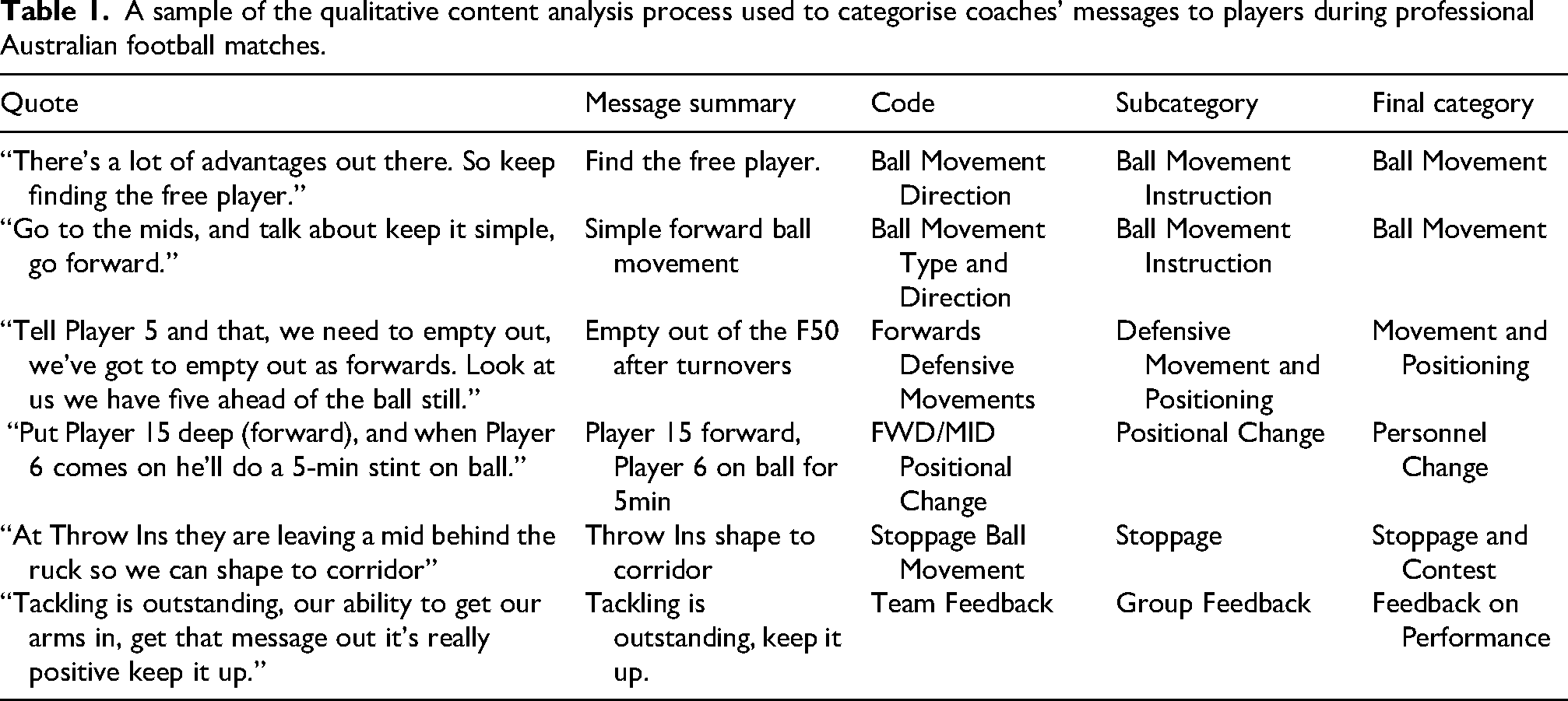
Qualitative content analysis is often used to transform data into meaningful categories. 19 Content analysis provides a robust method in which researchers can extract patterns from data, while producing rigorous results.20–22 The researchers followed a cyclical process of coding, labelling, categorising, and reflecting to analyse the data, beginning with the primary researcher immersing themselves within the dataset.20,22 This involved listening to and watching the video files several times, while taking notes on points of interest or identifying potential discussions to be had with the other researchers or club staff. All messages sent from the coaches’ box to players were summarised into condensed units, capturing the meaning of the message while reducing its length to a single idea (i.e., manifest content). 22 For example, “There's lots of advantages out there, so keep finding the free player”, was summarised as ‘Find the free player’ (see Table 1). After summarising coaches’ messages, initial codes were developed inductively. During this process, patterns in codes were generated from the data, which related to the tactical aspects of coaches’ messages (i.e., As data analysis progressed, these codes were used when messages holding similar meaning appeared in the data. 22
The next phase of analysis involved grouping together codes with similar meanings into subcategories. 22 These subcategories represent an aspect of player or team performance that the coach is attempting to influence with their message. For example, ‘Interchange Update’ messages are those sent from the coach to staff members on the bench with changes to be made to the team's pre-existing interchange plan. Once subcategories were formed, final categories were determined by combining subcategories that shared similar, broader meanings (i.e., what Graneheim et al. 22 refer to as high abstraction levels – low interpretation levels). For instance, messages relating to both players’ movements in offence (Attacking Movement and Positioning) and defence (Defensive Movement and Positioning) were both brought into the final category of Movement and Positioning. Rather than imposing the Theory of Bounded Rationality as a predetermined coding frame, it guided the researchers’ attention toward data which appeared to be shaped by constraints like score margin and the match quarter. For example, as codes and subcategories were examined across the dataset, the researchers noted frequent Movement and Positioning messages which coaches used to early in the game to manage the cognitive load of player decision-making. The presence of these messages did not form an explicit theoretically driven category; however, sensitising the data helped our interpretation of when and why such messages were common.
As the primary aim was to categorise coaches’ messages that related to tactical aspects of performance, the final categories represent a broad but recognisable aspect of team and player performance in Australian Football. Indeed, the terminology used in the development of the final categories was determined through conversations with the research group and club staff, to ensure the categories were meaningful for both practitioners, and researchers. Given the embedded nature of the researcher and the required familiarity with the reference club's terminology, inter-coder reliability was determined to not be feasible in this study. However, several discussions were held between club analysts and researchers throughout the analytical process to maximise the credibility of the data analysis, 18 as they could apply their knowledge of the game to clarify points of uncertainty and terminology used by coaches and players unique to the club. At the completion of the data analysis approximately 70 h of video files had been watched several times, with approximately 2800 messages coded and categorised. Players from the club, opposition players mentioned, and coaches were all de-identified with a random numerical identifier to protect their identities.
Results
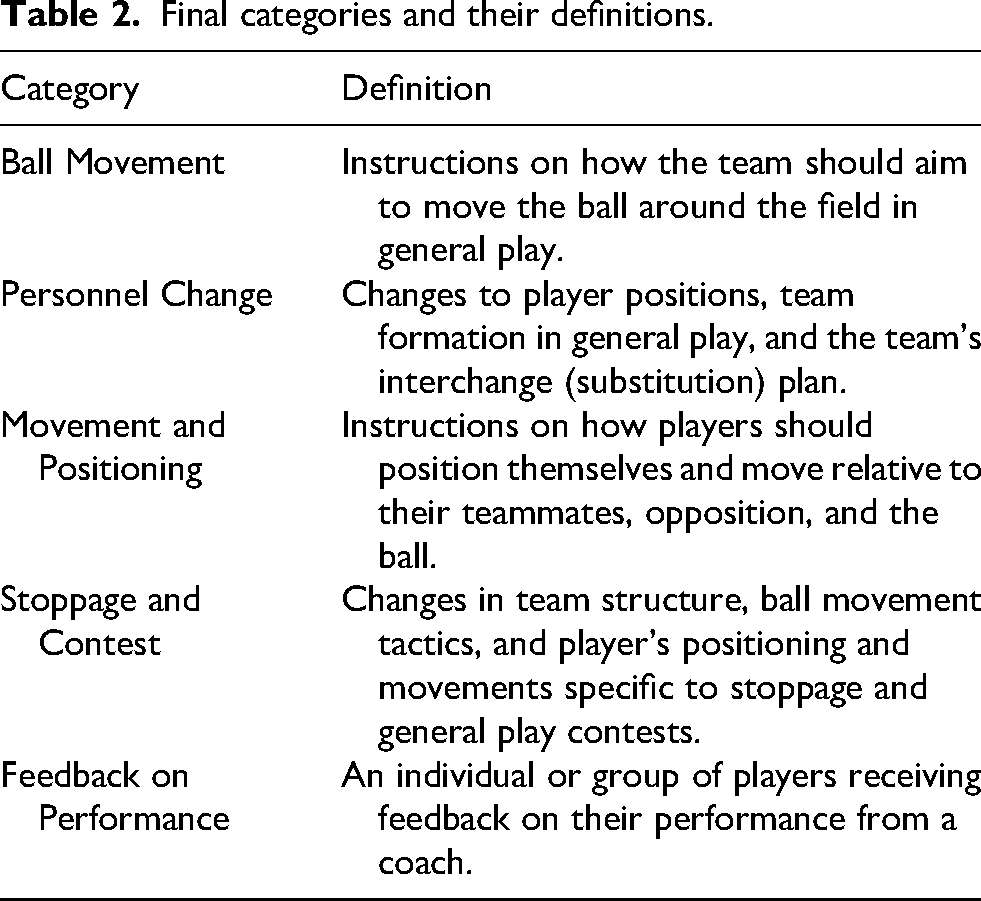
Through qualitative content analysis, five categories were generated to describe the types of messages coaches deliver to players during professional Australian Football matches (see Table 2). The results define each category, provide supporting quotes, and assess the use of each category by the coaching groups.
A sample of the qualitative content analysis process used to categorise coaches’ messages to players during professional Australian football matches.
Final categories and their definitions.
Movement and positioning
Movement and Positioning changes were messages where coaches provided players with instructions on how they should move around the field when their team is in offence, defence, or during a kick-in. Movement and Positioning included three subcategories which covered ‘Attacking Movement and Positioning’, ‘Defensive Movement and Positioning’, and ‘Kick-In Positioning’. Coaches’ often used Movement and Positioning messages to reduce the impact of an opposition player by instructing an individual to restrict the amount of space the opposition player has on the field, “Play on Opponent 10's back, don’t let him play up the ground, drag him all the way back to the goal square if you have to” (Coach 2). Coaches also attempted to alter the movement patterns of one player to have a positive influence on a teammate's performance: “Let's see if we can isolate Player 10 inside 50, tell Player 42 to stay up” (Coach 2). As such, coaches also often provided specific instructions to players about how and where to move on the field to influence how players interact with one another. In terms of the message use, Movement and Positioning was the most common category coaches used and consisted of around 25% of coaches’ messages across the two seasons. Figure 1 shows that coaching group 1 used these types of messages 33% of the time, whereas both coaching groups 2 and 3 sent these messages 25% of the time. Movement and Positioning messages decreased as the match progressed, with approximately 30% of these messages being sent in the first quarter, dropping down to 18.98% during the final quarter.
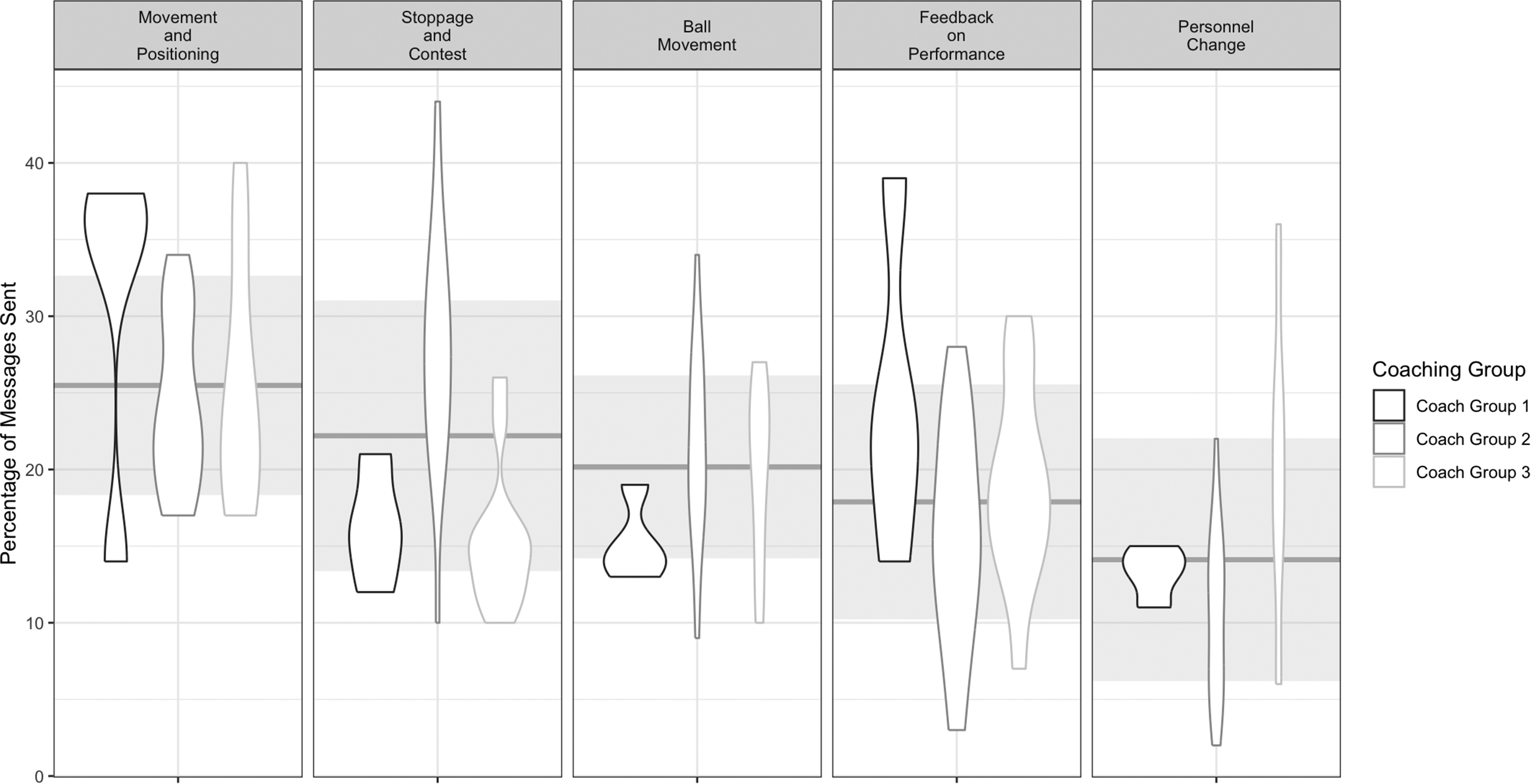
Proportion of category use by coaching groups.
Contest and stoppage
Contest and Stoppage messages aim to change the team's structure, ball movement tactics, and player's positioning and movements specific to stoppages and general play contests and is made up of the subcategories of ‘Stoppages’ and ‘Contests’. ‘Stoppages’ are events in Australian Football in which an umpire throws the ball into play (e.g., if the ball has gone over the sideline) and both teams must compete against each other to gain possession of the ball for their team. The primary aim of a stoppage for each team is to gain possession of the ball and then perform a clearance in which the ball is propelled away from the stoppage and to another teammate. Teams use a variety of tactics at stoppages, which alter the player's positions and movements, with the aim of improving their chances of gaining possession of the ball. For instance, the following message from Coach 6 to Player 3 signals the team is being instructed to change the positioning of their wingers at stoppages: “Hey mate, so we are going cross wings at all stoppages, so go across.” A general play ‘Contest’ in Australian Football are moments where members of each team are competing to gain possession of the ball, usually after a long kick has been performed by one of the teams. Both teams compete for possession of the ball by either knocking the ball in the direction of a teammate or gaining possession of the ball themselves. As coach 5 indicated, the following play refers to a particular general play contest known as a Long Down the Line (LDL): “So LDLs it's the same as last week with big spoils, so second layer needs to be switched on.”. Both messages cover different aspects of team performance but ultimately relate to moments in the game when the ball is in dispute.
Contest and Stoppage comprised 22% of total messages and was the second most common category. A disparity can be seen (in Figure 1) between the coaching groups, with coaching group 2 using Contest and Stoppage messages 27% of the time, while coaching groups 1 and 3 both used Contest and Stoppage messages as 15% of their messages. Such a large disparity between coaching groups may indicate that coaches have different focuses during matches, resulting in different types of messages being sent. Figure 2 shows a continuous decrease in Contest and Stoppage message use dropping from 34% of these messages being used in the first quarter to 17% in the final quarter.
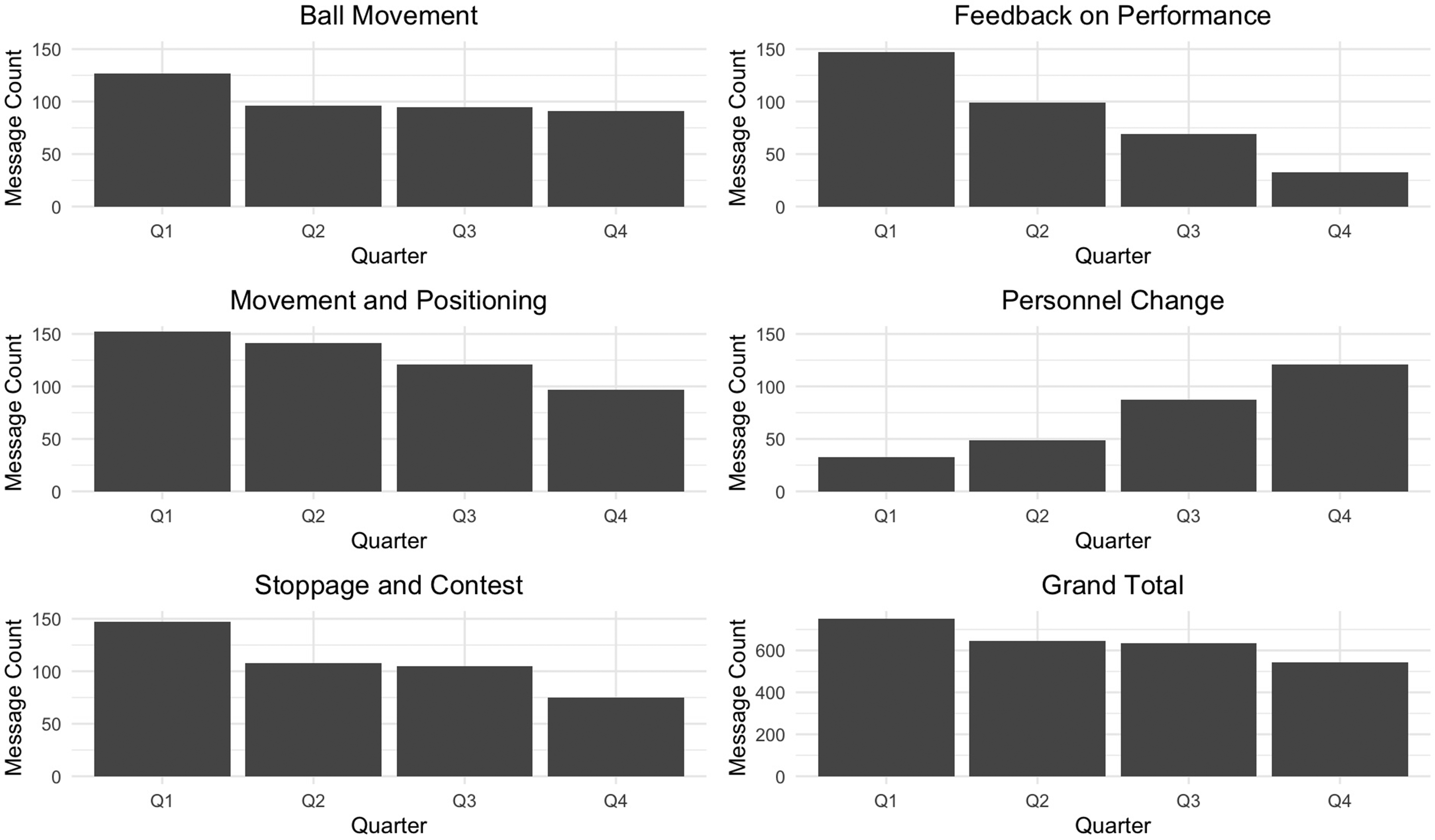
Message count for categories by quarter.
Ball movement
Ball Movement messages were categorised as instructions related to how the team moved the ball around the field and included three subcategories: ‘General Play Ball Movement’, ‘Kick-In Ball Movement’, and ‘Scoring Instruction’. Ball Movement messages was used for several purposes, because the preferred way to move the ball around the field often changed, depending on the score, the weather, or match quarter. For example, this message from Coach 7 was sent with five minutes remaining in the second quarter with the intent of changing the speed of ball movement while ensuring the team maintained a lead at halftime: “We want uncontested marks, we want to slow this right up, get to everyone.” In contrast, coaches adapted the team's method and direction of ball movement to gain more territory and progress the ball down the field, as Coach 8 instructed “Just a little too handball heavy at the moment, in particular backwards, alright we’ve got to take some territory, but we want to be composed with it”. Ball Movement was the third most common type of tactical communication, accounting for 20% of messages sent across the two seasons. Ball Movement messages were similar between coaching groups 2 and 3 at approximately 20%, with coaching group 1 using Ball Movement messages only 15% of the time. This may reflect that some coaches have a preferred method of ball movement and are less likely to instruct the team to change during the match.
Feedback on performance
The Feedback on Performance category describes how an individual or group of players received feedback on their performance and was underpinned by subcategories: ‘Individual Feedback’, and ‘Group Feedback’. For example, the following message was targeted towards an individual about their general performance during the match “Player 25 well done, exactly what we are after mate, great work” (Coach 11). While this group message from Coach 7 was sent to several players in the midfield: “Get to Player 31, Player 16, and Player 44, and tell them that's the pressure we want, come forward pressure”. The results indicate that Feedback on Performance accounted for 18% of messages, the fourth most common category. The results show that 42% of Feedback on Performance messages were sent in the first quarter of a match, whereas only 9% of these messages were sent in the final quarter (see Figure 2). There was also an apparent connection between the score margin and the amount of Feedback on Performance messages coaches send, with more messages being sent when the team is in a winning position (see Figure 3).
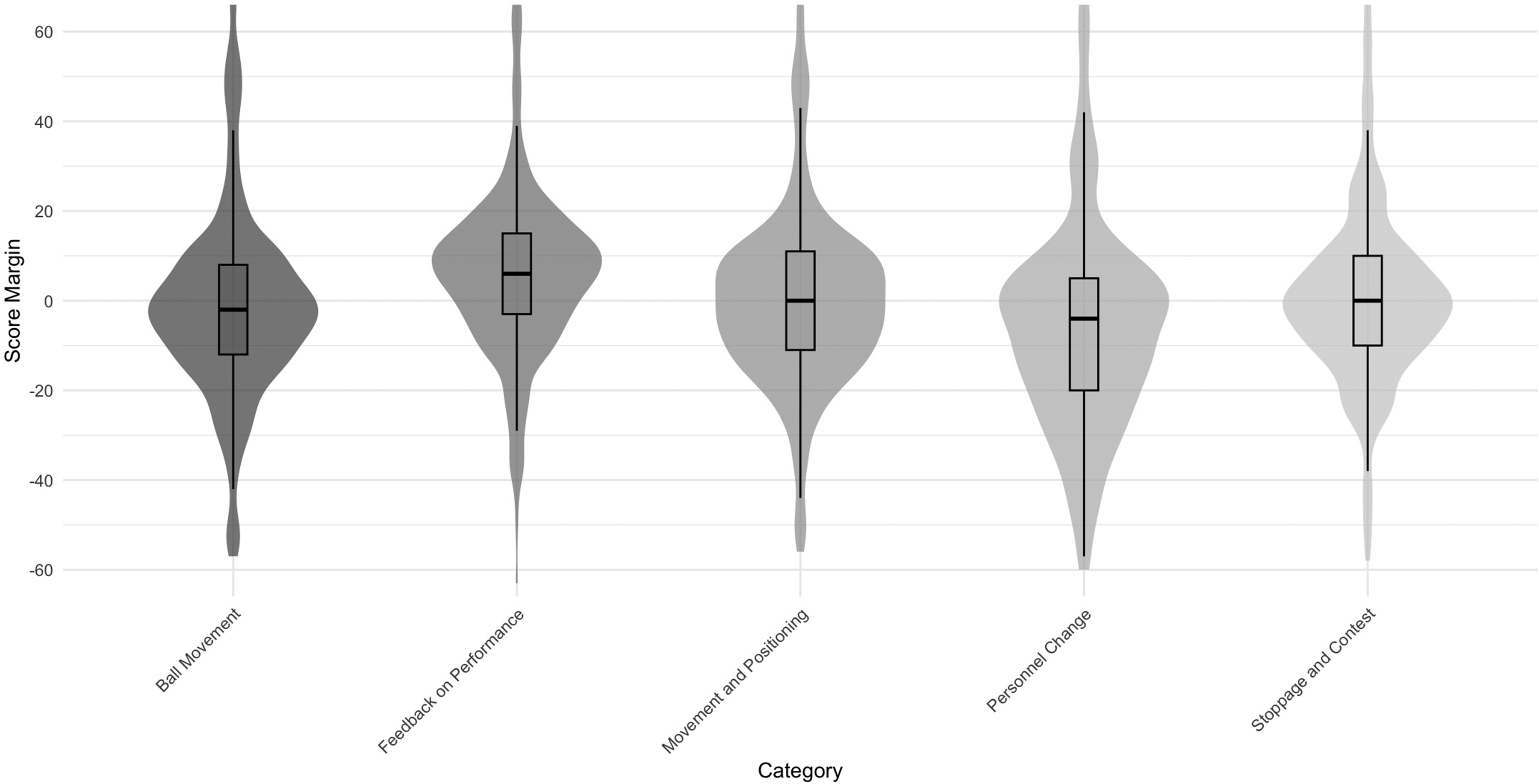
Message use of categories by margin.
Personnel change
The Personnel Change category related to individual player positions or team formations and included five subcategories: ‘Positional Change’, ‘Interchange Update’, ‘Injury Change’, ‘Team Structure Change’, and ‘Matchup Change’. Personnel Change messages were used for a variety of purposes. For example, ‘Positional Changes’ occurred when coaches swapped individual players’ positions, while ‘Interchange Updates’ and ‘Injury Changes’ involved changing the team's interchange plan (i.e., moving players on or off the field), either for tactical reasons or due to injury. ‘Team Structure Changes’ occurred when a coach made alterations to the team's formation because while an Australian Football team generally has six backs, six midfielders, and six forwards on the field, these positions are not fixed (with the exception of centre bounce formations), and coaches often adjust these numbers based on various game constraints (e.g., score, match quarter, weather). For example, Coach 7's message to the bench indicates that the coach is moving a player (who was previously in the midfield), into the backline, with the team now playing with seven backs and only five forwards.: “We are going to have a seventh back in Player 23, get to him and Player 48”. These changes often reflected the defensive or offensive intent from the coach, as they attempted to create a numerical advantage in a certain area of the field, prevent the opposition from scoring, or increase the chances of their team winning the ball in their defensive half by providing the team with an extra back. Connected to the team's structure, players are generally assigned to “play on” (mark) an opponent throughout the match, which is referred to as a player matchup in Australian Football. During the match, the coach may make a ‘Matchup Change’, which involves giving two or more players a new opponent to play on: “Tell Player 34 to play on Opponent 5, Player 2 to play on Opponent 27, and Player 39 to play on a small” (Coach 3). In this message, the coach instructs three players in the same positional group to change the opposition player they are marking. These messages are often made to reduce the impact of an opposition player or create an advantage for one of their own team's players.
Personnel Changes included 14% of coaches’ messages during matches and was the least common category. When considering each of the coaching groups’ use of Personnel Changes, coaching group 3 utilised these messages 20% of the time, which might indicate differences in coaching styles and tactics between the three coaching groups. The number of Personnel Change messages was also influenced by the match quarter, with 41% of these messages being sent in the final quarter of the match (see Figure 2). Further, Figure 3 indicates that the score margin influenced the use of Personnel Change messages, as more messages were sent when the team was in a losing position.
Discussion
The primary aim of the current study was to categorise coaches’ decisions during professional Australian Football matches. Using qualitative content analysis, five categories were generated that reflect unique aspects of player or team performance: Movement and Positioning, Contest and Stoppage, Ball Movement, Feedback on Performance, and Personnel Changes. Some of the categories and subcategories of decisions have been identified in previous research investigating coach communication during various sporting matches.12,13 For instance, Vanderwert 12 and Aarons et al. 13 showed that Australian Football coaches sought to make changes to the ball movement, positional changes (player matchups), and team structure to gain control of a match while ‘Interchange Update’ and ‘Team Structural Change’ have been identified as decisions which influence team performance in other sports such as football9,10 and handball. 7 The current study also demonstrates the number of decisions coaches make during matches, highlighting the complexities of the sport and the challenges coaches face in trying to improve team performance. For example, Movement and Positioning was the most common type of message sent by coaches, accounting for 25.58% of messages, showcasing the importance of movements off the ball in Australian Football. Given the size of the teams and playing field, this is a complex yet important problem for coaches to address. Therefore, it makes sense that coaches continuously send messages on how they want players to move both without the ball in offence and defence. In sum, these findings demonstrate the complexity of the types of messages that coaches deliver to players during professional Australian Football matches.
A secondary aim was to investigate how messages change throughout a match, based on contextual information such as the score margin and the match quarter. The findings from the current study support existing research which draws upon the Theory of Bounded Rationality in sport by illustrating the influence that constraints such as match quarter and score margin can have on coaches’ decision-making during matches.3,14 In the present study, a reduction in message use can be seen across four of the five categories as the match progresses, perhaps indicating that coaches’ total message use declines across the match (see Figure 2). The only exception was Personnel Changes, which increased from the first quarter through to the final quarter of matches and when the team was losing (see Figure 3). What this demonstrates is that the purpose and perceived outcome of coaches’ messages changes at different match stages. For instance, Personnel Changes can involve moving players into different positions or changing the team's structure, both viewed as critical decisions by coaches. 12 It is possible that as matches progressed, the coaches attempted to create a major change in the team's performance if the initial gameplan was not working or because they were losing. For example, coaches may send an extra player forward of the ball to help the team generate more scoring opportunities. In contrast, if the team is in a winning position in the final quarter, the coach may rotate a midfielder or forward into a position behind the ball to help bolster the team's defence to hold onto the lead. In contrast, more Feedback on Performance messages were sent when the team was in winning positions and earlier in the match which may show how coaches seek to reinforce the team's overall strategy by providing Feedback on Performance during these times. These findings relate to the work of Mason et al. 11 who revealed that more positive feedback was given to players during winning quarters in Australian Football matches. Although the current study did not examine the nature of the feedback from coaches, both studies highlight a possible connection between score margin and coaches’ feedback to players. Further, both the current study and Mason et al. 11 used similar methodology in recording the coaches’ box to assess coaches’ messages to players. While Mason et al. 11 assessed the nature of the feedback, the current study examined and categorised the tactical aspect of the coaches’ message, generating an additional four categories beyond Feedback on Performance. While the current study's findings echo previous research within other sporting contexts that identified that the optimal team structure varies based on the score of the match and time remaining in the game, 9 to the authors’ knowledge, the current findings provide the first example in Australian Football of how the types and use of messages change based on the score margin and the match quarter.
The final aim – which emerged during the study itself - was to identify any similarities or differences in message use between the three coaching groups. The findings of the current study revealed that the coaching groups had varied message use across the five categories. For coaching group 2, Contest and Stoppage was their most frequently used category (27%), sending nearly twice as many messages than the other coaching groups. Coaching groups 3 and 1 utilised Movement and Positioning messages more than the other categories (see Figure 1), putting a greater emphasis on off the ball movements during the match. The unique opportunity to analyse three coaching groups at the same club across two seasons shows how players can be exposed to different communication methods within and between seasons when coaches change within clubs. Aarons et al. 14 work described differences in six head coaches’ perspectives on barriers that influence their decisions during Australian Football matches. Aarons et al. 14 conducted semi-structured interviews, allowing coaches to express their differing perspectives on constraints like their emotions and time pressure can influence their decisions. The current study differed in methodology, recording the coaches’ box, which allowed the researchers to directly examine coaches’ decisions during matches and how environmental constraints could possibly influence them. The current study provides further insights into the various perspectives that coaches have relating to their decision-making during matches, highlighted in the different aspects of performance they emphasis through their messaging.
In any study, there are a range of strengths and limitations. During the analytic phase of the current study, the final categories were developed after conversations between the research group and club staff, which assisted in making the final categories meaningful for both practitioners and club staff. However, a limitation of the current study is that as only one club was utilised throughout the research, which means that it is possible that the final categories may demonstrate minimal transferability beyond the current cohort of Australian Football coaches. 23 What this means is that while some categories may be appropriate, further research is required to ensure further generalisability because other clubs may uncover other types of messages that coaches send during matches, based on their unique communication styles. While the current study showed that coaches’ messaging can change depending on the score margin and the match quarter, it did not explore the impact of other environmental constraints such as the weather, climate, ladder position of opposition, or time that the match is held. Future research could investigate how coaches’ messages change based on these environment constraints as this could deepen understanding about the different tactics that coaches’ employ during the match to assist the team in adapting to all the constraints identified through the Theory of Bounded Rationality. Future research could also seek to link coaches’ messages to team and player performance outcomes during the match by asking questions like “does making a change to stoppages lead to improvements in key stoppage metrics, such as winning more clearances?” Finally, investigating how coaches’ messages change across different professional male and female sport settings would add depth to the current body of knowledge.
Conclusion
Using qualitative content analysis to assess coaches’ messages, this study aimed to categorise coaches’ decisions during professional Australian Football matches. Analyses revealed how messages change throughout a match, based on contextual information such as the score margin, and the match quarter. The methodology used in this study offers a mechanism in which coaches and practitioners can categorise and review messages sent to players during matches. This may assist coaches in adjusting their communication throughout the match (i.e., sending more Feedback on Performance messages during the final quarter), or to identify what areas of performance coaches are not addressing during matches. As such, the methods used in this study offer researchers and practitioners a potential framework for categorising coaches’ messages from a tactical perspective of team and player performance.
Footnotes
Acknowledgements
The authors would like to thank the coaches and players from the AFL club which granted permission to undertake the study.

Ethical considerations
This study gained ethical clearance from the university's human ethics committee (H15691).
Consent to participate
Written consent to participate in the study was provided by the club to the research group.
Consent for publication
Written approval to publish the research was given to the researchers by the club.
Funding
The authors received no financial support for the research, authorship, and/or publication of this article.
This research did not receive any specific grant from funding agencies in the public, commercial, or not-for-profit sectors.
Declaration of conflicting interests
The authors declared no potential conflicts of interest with respect to the research, authorship, and/or publication of this article.