




Abstract
The purpose of this study was to explore professional female cyclists’ understanding and experience of team trust in road cycling, with a focus on the factors that contribute to the development and maintenance of trust, and furthermore the consequences of team trust for the team. Based on a qualitative research design, semi-structured interviews were conducted with ten female riders with experience from various continental teams. The data were analyzed using reflexive thematic analysis with an abductive approach, grounded in a critical realist epistemology. The study aims to address a gap in the literature, as team trust in professional sports remains underexplored, despite its documented importance for collaboration and performance in teams. The results showed team trust to be a relational and multidimensional phenomenon, shaped by assessments of individual characteristics, as well as relational and structural team factors. Furthermore, the results indicate that key antecedents of team trust encompass both individual attributes and team level factors, which together generate a range of positive outcomes for interpersonal relationships, team processes, and overall performance.
Introduction
Bicycle road racing is an endurance sport in which the competitors must cope with tremendous physical and psychological demands in both training and competition.1,2 Success in cycling depends on the rider's ability and opportunity to preserve and apportion energy as it is needed during a race, for example having enough energy to be in a breakaway (where one or more riders try to separate themselves from the main pack of riders, the ‘peleton’) or to surge in the intense sprint finish at the end of the race. In a professional cycling team, assigned roles are commonly the climber (often a lighter weight rider who specializes in hilly or mountainous racing), the sprinter (a powerful rider who can perform high-velocity burst finishes), the time trialist (a strong endurance rider who excels at maintaining a high speed over a long period of time to win stage sprints or time trials) and the protected rider (the rider who is favored by the team to win either the day's stage or the overall) (for a brief explanation about roles/rider types see Lycett. 3 The protected rider may vary from stage to stage and be a climber on a mountain stage, or a sprinter on the flats or one of the general classifications (GC) contenders (riders going for the best overall time in the event rather than an individual stage win). Behind the individual winner of every stage or overall title, there is a whole team that has worked together to ensure success. 4 Therefore, a cycling team needs supporting riders, termed as ‘domestique’ or ‘gregarious’ riders that are necessary to ensure success through helping the protected rider to win. 5 The supporting riders’ main functions are to help the protected rider by sheltering them from the wind, physically buffering them from other riders, bringing water and food from the team car, and if necessary, handing over their own bike to the protected rider, if necessary, e.g., in the case of a flat tire. Not surprisingly professional road cycling has therefore been identified as ‘an individual sport practiced in teams’, 6 where success is dependent on a well-functioning team within which members have different roles and responsibilities.
Previous research in professional women's cycling 7 has identified how there is a complex interplay between the internal, social, environmental and cultural factors that contribute to the success (or lack of) within a cycling team (e.g., poorer career and working conditions, short term contracts). Although Vaughan et al. 7 were specifically looking at stressors and coping within professional women's cycling they identified how there was a clear interplay between team hierarchy, relationships and battling for contracts (e.g., different roles, high and low status athletes, reduced personal achievement). Further, they identified how there was a need for teamwork and harmony to achieve the required performance objectives. This suggests that a level of trust would be needed between team members.
A number of factors have been identified to contribute to effective functioning on team performance in sports such as group cohesion, shared identity, role clarity, shared mental models, and willingness to allocate individual effort for the team performance.8,9 Another emerging factor that has garnered increased attention within organizational psychology research is team trust. Trust is often referred in the research literature as a psychological state characterized by positive expectations regarding others’ intentions and behavior. 10 Much of the trust research largely focuses on dyadic relationships within the workplace, meaning relationships between two parties at the individual level.10–12 When exploring trust at the team level, the phenomenon must be understood beyond what occurs in one-on-one relationships. 13 In teams, members face more complex and multifaceted social dynamics, which impose specific requirements on how trust is developed, maintained, and challenged within a group.14,15 This means that team members have to navigate a wide array of social dynamics such as information sharing, conflict management, role distribution, and social exclusion.16,17 Breuer et al. 13 defined team trust as: “the shared willingness of the team members to be vulnerable to the actions of the other team members based on the shared expectation that the other team members will perform particular actions that are important to the team, irrespective of the ability to monitor or control the other team members” (p. 5). Here, team trust is understood as a shared perception among team members, with mutual expectations that members will act in the team's best interest and make themselves vulnerable to each other. Breuer et al. 13 created a taxonomy of team trust with key overarching factors including ability, benevolence, predictability, integrity and transparency. In the research literature, team trust has been found to be a crucial factor for team effectiveness and performance. 18 Team trust has also been shown to enhance communication, coordination, and problem-solving under stress. 19
These studies investigating team trust have consistently focused on the workplace, virtual teams, or general organizational structures.11,13,20 However, there is some research within sport psychology and particularly in road cycling that has demonstrated that trust among riders in a team constitutes a central prerequisite for effective cooperation in the team by promoting coordination, willingness to sacrifice, and tactical adaptation in competitive situations.21,22 Nevertheless, there is a lack of research examining the characteristics of team trust in cycling and more specifically women's professional road cycling. The study specifically investigated woman professional cyclists’ understanding and experience of team trust in road cycling, focusing on antecedents and consequences of team trust.
Method
Philosophical orientation
The theoretical foundation of this study is built on a critical realist perspective, which understands reality as real and independent of our perception, though knowledge of this reality is always theory-driven and influenced by interpretation. 23 Critical realism combines ontological realism with epistemological relativism, thereby enabling an exploration of both participants’ subjective experiences and the underlying mechanisms that shape these experiences. 24 Such a perspective facilitates the development of explanatory models that not only describe the phenomenon but also seek to explain how and why team trust develops in professional cycling teams. The study employs a qualitative approach through semi-structured interviews, with abductive analysis, influenced by the work on Breuer et al. 13 and Mayer et al. 10 which was deemed most appropriate for addressing the research questions.
Participants
The sample consists of ten woman professional road cyclists aged between 20 and 40 years (average age of 25.7 years) from various UCI Continental teams. A UCI Continental Team in cycling is a team registered and approved by the International Cycling Union (UCI) to compete at the continental level in road cycling. 25 Continental Teams primarily compete in national and regional races, they can also participate in certain major international events. The riders have experience ranging from two years to over ten years in the international racing program, with a combined average experience of approximately six years. Eight of the participants were still active professional riders at the time of the interviews, while two had recently retired. Nine of the riders has represented the Norwegian national team in international championships and races, and all have been on the podium in international races. To maintain participants’ anonymity, further details about their identity or results are not disclosed. The riders are anonymous and were given pseudonyms identified by letter and ID numbers (I1 to I10).
Data collection
Recruitment was carried out through strategic selection, where potential participants were contacted digitally via social media, email, and SMS, combined with the snowball method to reach additional participants. Participants received an information letter and consent form prior to the interviews, with all providing consent for participation, use of audio recordings, and transcription of the interviews. The interviews were conducted by the first author and was done digitally via video calls in environments that safeguarded participants’ anonymity and privacy and lasted between 37 to 44 min (M = 40.4; SD = 2.63). Conversations began with a brief introduction to the study's purpose and ethical guidelines, emphasizing creating a safe and open dialogue to promote reflection and depth in participants’ responses. The interview guide was inspired by the team trust literature conducted by Breuer et al. 13 and Mayer et al. 10 and it was organized in the following two sections. 1) Reflection on trust in teams sport (e.g., “How do you perceive trust among cyclists?”). 2) Personal experiences of trust in their current team. (e.g., “Can you reflect or elaborate your experiences on trust in your team?”). In both sections the participant was asked related to a) antecedents and b) consequences in races, training, or team gatherings.
The study was approved by SIKT - the Norwegian Knowledge Sector's service provider (reference no. 739838) for processing personal data and was conducted in accordance with the research ethical guidelines at the Norwegian University of Science and Technology.
Data analysis
The audio recorded interviews were transcribed into written material comprising 99 pages with 1.5 line spacing and a total of 53,539 words. The analysis was conducted with an abductive approach, through continuous interchange between empirical findings and theoretical perspectives.10,13,18 This approach facilitates emphasizing an open and exploratory process to identify unexpected insights and illuminate underlying mechanisms. Our analysis was grounded in the data while we simultaneously used theoretical concepts and literature on team trust to deepen our analytic interpretations. More specifically, we used Breuer's et al. 13 taxonomy of team trust where they identified ability, benevolence, predictability, integrity, and transparency to influence our view of the data. This analysis process recognizes the researcher's role as an interpretative agent in the construction of knowledge, where subjectivity and interpretation are integral parts of the analysis process. 26 The data material was analyzed using reflexive thematic analysis 27 which unfolds six phases: 1) familiarization, 2) coding, 3) generating initial themes, 4) theme revisions, 5) defining and naming themes, 6) reporting. Initially, the first author transcribed the interview, and together with last author read, and re-read the interview data to get a general sense of the data material. In the following stages (2–4), codes and themes were crafted through synthesis of deductive and inductive approaches. Initial coding was informed by the research aims, while remaining open to new patterns and meanings generated inductively from the data. We generated the following three themes: (a) Description of team trust in cycling, (b) Antecedents to team trust in cycling (c) Consequences of team trust in cycling. Within each theme, the first author identified initial codes and themes through a combined inductive and deductive approach to best encapsulate the meanings articulated by the participants, subsequently presenting them to the last author who functioned as a critical friend. 28
Recognizing the inherently reflective nature of coding, which mirrors the researcher's subjectivity, Braun and Clark 29 highlighted that researchers’ values, beliefs, and professional experiences significantly influence their interpretation of data and the formation of themes. Consequently, reflexive thematic analysis inherently acknowledges the researchers’ subjectivity in their engagement with both the data and the analytic process. In this endeavor, we organizing codes into themes (see Figure 1). In the following phases, the researchers met several times to develop a shared interpretation of the data, recognizing that these findings reflect their perspectives rather than representing the only definitive solution. 29 In this process, segments of the data were coded with descriptive and interpretive labels that captured participants’ meanings and experiences related to the research focus (e.g., “Trust also involves the willingness to do the task and make sacrifices. We had a teammate who was very, very good at helping others, and she always kept her promises to others”(I-6), was initially described as the subtheme helping behavior, and ended up based on the discussion and agreement in the research team as an example of the subtheme benevolence). The subthemes subsequently organized into main themes (i.e., Personal Characteristics), following phases 3–5 of theme development, refinement, and naming. 30 Finaly, the reporting phase was completed by all the authors. 27 During this process the team identified outcomes or ‘consequences’ of team trust, such as social and emotional relationship development, improvement in team dynamics and individual and team performance. This allowed for the development of a thematic model of the antecedents and consequences of team trust within professional women cyclists (see Figure 1). To ensure the anonymity of the participants, team names, places, and names of individuals were removed or replaced with pseudonyms. As the interviews were conducted in Norwegian, all the quotes presented have been translated by the authors, who translated the Norwegian quotes into English, and was translated back to Norwegian to explore potential differences in the content and meaning of the quotes. 31 One of the authors was also an English native speaker and the research group including this English native speaker discussed the content and meaning of each quote.
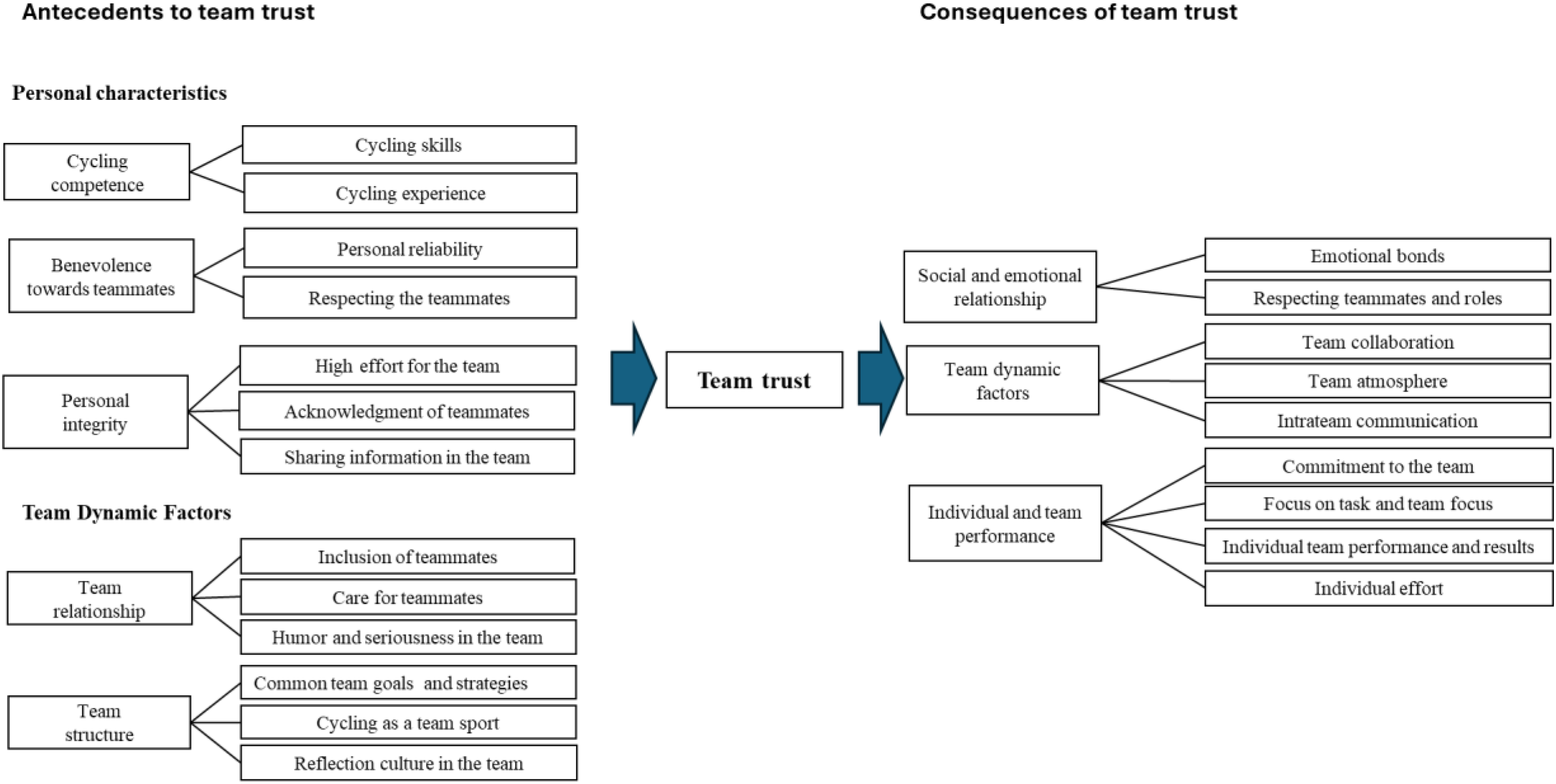
A thematic map of team trust in female professional cycling teams.
Results
Based on the analysis, we generated a thematic model to illustrate how woman professional cyclist experienced team trust, which factors they perceived contribute to team trust, and finally consequences they perceived team trust can have for the team (Figure 1). As can be seen in Figure 1 the antecedent to team trust is divided into the following two themes: Personal characteristics, and Team factors. Personal characteristics consist of three subthemes: Competence with the themes of skills and experience, Benevolence with the themes of reliability and respect, and Integrity with the themes of work ethic, acknowledgment, and openness. The dimension Team Factors consist of the following two subthemes: Team relationships with the themes of care, inclusion, and well-being, and Team structure with the themes of common goals and strategy, task dependency, and communication. The consequences of team trust are divided into the following three dimensions: Relationships with the themes of emotional bonds and respect, Team dynamics with the themes of collaboration, team atmosphere and communication, and Performance with the themes of task focus, motivation, and results.
Team trust
The participants describe team trust in cycling teams as a mutual expectation that teammates have good intentions and perform their tasks both in training and competition in line with the team's values, strategies and goals. Jane and Peggy described this in the following way: “Trusting that the team has your back, that they have good intentions”. “I think of trust as being able to rely on others to do what they are supposed to, and that I do my part in return. It's a mutual trust relationship”.
Antecedent to team trust
Cycling Skills relate to how skilled the rider is technically and tactically, including the ability to position themselves correctly in the peloton, make good decisions during a race, and carry out the tasks required in various situations. Joanne and Jane describe this in the following: “You know you can trust that person, because they can make tactical assessments during the race”. “Trust is also built when you know that person is good at exactly what you need them to do, so you can rely on them to do the job”.
Cycling Experience refers to the sum of the athlete's previous participation in cycling, including years in the sport, participation at different levels, and exposure to various situations that have provided insight and learning over time: “That a teammate has more experience than I do and has done this more than me and can actually position herself ahead in the peloton, and I can see that she truly has the skills for it. And then I trust 100% that she will do what she is supposed to do” (Amy). “Sometimes when I ask a person if a situation has occurred, I ask that person because I know they have long experience after so many races. They are older, they know a little more, so then I trust more that when I ask them what we should do in this situation, they will come up with an opinion, and it's wise, and then I trust it's a correct decision” (Joanne).
Personal Reliability involves being a person the team members can count on. A rider who meets the team's expectations, steps up for the team, and acts consistently in race situations. This includes being stable and predictable toward the team: “You build trust by showing that she takes and does what she is told, she can be relied upon to always be there to perform what she needs to do, and that she does not suddenly choose to race for herself” (Peggy). “Trust also involves the willingness to do the task and make sacrifices. We had a teammate who was very, very good at helping others, and she always kept her promises to others. And she was very, very well-liked” (Emily).
High efforts for the team refer to the rider's mindset of making an effort for the team's benefit, even in situations where they don't race for their own result. The rider steps up by choice, makes clear efforts for their team members, and demonstrates a willingness to do their best for their teammates. Laura describes it in the following: “That one puts their efforts into helping that rider, and it doesn't need to be such a specific task, but that people are intent on doing it. And that they wish to do it as well as they can”.
Acknowledgment of teammates involves the rider's ability to see and appreciate teammates’ contributions and efforts. This entails the rider making it clear that the effort matters, regardless of role or result. Acknowledgment is expressed through gratitude, praise, and inclusion: “The person we rode for is a very good leader. I believe it was crucial for the feeling of trust. She clearly articulated what she wanted. She praised us a lot for what we did. She really noticed what we did. She always involved us in everything, and that she couldn't have done it without us. When she was on the podium and received the prize, she gave it to us immediately. I think the way she, as captain, managed things contributed to the rest of us feeling involved in the success” (Ann). “It's much about that honesty, being open and being able to also take in other issues apart from cycling itself, because I often feel that one has an easier time working for each other if one knows more about the person than just the cycling itself. […] If one shares a lot about himself and is good at being honest, not going behind the others’ backs on the team. During meetings, saying one's opinion, and describing how one feels before competition or training, being honest about where one stands” (Joanne). I think much of it involves the willingness to share what one is good at. […] If you have teammates who wish well for you and share: “ok, but I know this,” they share their experiences and things like that, then that helps in building trust” (June).
Care for teammates involves an experience of safety, where riders take care of each other and know they receive support from teammates when needed. Riders meet each other with warmth and understanding. Charlotte stated the following: “Being met with open arms and feeling that one receives comfort or a little understanding from another person. And that you can be at competition and know that the others back you up”. While June said: “You feel that the relationships or the space or the surroundings are safe. That it's genuine and that there's a mutual understanding […] further is that people or the person wishes well for you. Truly shows that they are there for each other”.
Inclusion of teammates involves team members feeling a sense of belonging. They experience being seen and made to be a part of the team's community, where time is spent together both within and outside the cycling arena. June and Ann stated the following: “Feeling like one is in the right place. Feeling: “Okay, here is where I belong,” and having a connection to the team because they take care of you”. “I feel it involves a lot of unity. The greater the unity, the more things you've done together, trained together, and done a bit together”.
Seriousness and humor in the team refers to the experience of belonging and positive atmosphere within the cycling team, where there is room for both seriousness and humor: “There have been environments where we've had a great time and had a fantastic atmosphere and could joke and talk about everything. Where everyone does what they are supposed to do, and there's a great flow. Often where there is trust, there has been a good group, and then one thrives in that environment” (Laura).
Common team goals and strategy involve team members being aligned, both in the planning and execution of training sessions and races. All riders know their roles, commit to the team's plan, and are determined to work towards the team's goals: “It's about making a plan, and that everyone is positive about that plan. And not only that but also executing it and being positive about making an effort so the team as a whole can have a good experience and a good result. In order to perform at competitions, then, one must trust that everyone is willing to put in an effort for the others in the team, or what they've been assigned. I feel it plays a significant role, really. Both in training and in competition, really” (Charlotte).
Cycling as a team sport involves a shared understanding that success in a cycling race is not achieved alone. In a cycling team, roles are closely interconnected, and riders must be able to trust that the others on the team do their part, allowing the riders to focus entirely on their own task: “One cannot do everything alone in a cycling race. One is dependent on having good teammates who help to achieve the performances one wishes to have. And then one must have trust so that oneself doesn't find themselves doing everything. Knowing that perhaps someone else covers that attack or closes that gap. Otherwise, one tires oneself out, and it negatively impacts the performances” (Peggy). “One is very, very dependent on the entire team. I feel that if one is to just focus on performing, then one needs that trust that, okay, they’ll manage it if something happens. So that you don't need to stress about that in addition to during the competition” (Jane). “You can have a general tactic when entering a competition that's discussed and debated in advance, where everyone gets to say or express what they think about the tactic. And changes are made if something comes up, if someone has some good points or strong wishes. But it's communicated both before and after a race” (May). “Yes, we always, or like 90% of the time, have evaluations after each race […] and I feel it's a pretty important part, that we always have a meeting before a race, and it's also pretty important to have it afterward, just to address things, so one doesn't have to go around thinking about them” (Peggy).
Consequences of team trust
This dimension encompasses the positive outcomes that arise when there is a high degree of trust among riders within a team. It addresses how trust affects both relational processes within the team, the dynamics in interaction and structure, as well as the motivation and performances of the riders. The dimension consists of the following three subthemes: social and emotional relationships, team dynamic factors, and individual and team performance.
Emotional bonds involve the riders building strong and deep relationships, contributing to the experience of mutual care, loyalty, and support: “When I feel we have strong trust in each other, it's not just strong trust on the bicycle seat, but also. I see you as a person. And I want to take care of you as a person because you are so good to me. You see the whole person, not just the athlete in the person” (June). “One was supposed to do a lead-out for me, meaning she would be ahead of me towards the finish taking all the wind, and then I get a very good position toward the sprint. I can trust that she does it, because I have done it several times for her, and we have mutual respect and trust towards each other that, yes, we wish each other to do well” (Jane).
Team collaboration involves doing one's part of the job and all riders standing together during a race. In this way, it becomes easier to work collaboratively towards common goals. Amy stated the following: “I feel that the times I trust them, and we have trust in each other, we manage to work together, leading to a better result than when one doesn't trust each other and doesn't help each other” (Amy).
Team atmosphere involves creating social safety conducive to well-being, humor, and openness. Such environments create positive interaction among riders, where one takes care of each other and dares to be oneself. May states the following: “When there is trust in the team, I feel there is just an extremely good mood on the team, and we really enjoy each other's company”.
Intrateam communication refers to a low threshold for speaking up, expressing personal needs, and asking both tactical and relational questions. When riders can be open without being judged, it leads to more clear, honest, and effective communication both during preparation and in race situations: “Team trust provides the foundation for everyone to do what they've been told and for one to know one can also speak up during evaluation without it leading to poor mood. That openness and honesty form the cornerstone for it to function” (Joanne).
Focus on task and performance involves working concentratedly and purposefully without being distracted by uncertainty, personal concerns, or conflicts. When riders feel assured that everyone does their part and works together, they can focus their attention on the team's goals. Emily stated: “Trust provides safety, and it can contribute positively to better performances. You relax a bit more. You feel a kind of safety if you have good trust. Then one can focus on the tasks”.
Commitment to the team refers to riders’ inner drive and commitment to contribute to the team. It indicates a desire to make a good individual effort and a willingness to support the team's strategy and goals: “If you see another is working for you and trusts in what you can achieve, it brings forth an inner drive. Inner drive to perform, because you see the others sacrifice themselves or do what they are supposed to” (Joanne). “You see that everyone else is doing what they should, giving an extra boost, a little more energy maybe, thinking: “Okay, I’ll achieve my task as well. So, it helps, you build each other up and do it in that way, both in terms of setting them in a good position, but also mentally, it just gives that boost” (Peggy).
Laura stated: “I feel that the times where things have flowed well regarding results, have been in a group where there is trust”. While Ann described the following: “I felt that we were really well-positioned. We had someone we were racing for, and then the rest of us were to do tasks to help her. We succeeded in that […] The outcome that time was that we won. It was a five-day race, and we won overall, so the result was really great”. “I feel that I am also willing to do, if there's an agreement on something, then I am willing to put more effort if I race for someone, I trust a lot, more than someone who has chosen to do other things than what was planned beforehand” (Charlotte). “I would say that if you have a team behind or around you, it makes you want to perform, or it's not just the individual person, but actually, it's that many have helped you for you to be there, and then I feel that you put in a bit more, even on the individual performance, because it's not just me who's done the effort to be in the situation, but many have put in hard effort for you to be there, and then it makes you sharpen a bit and put in the extra” (Amy).
Discussion
The purpose of this study was to investigate woman professional road cyclist perception and experience with the phenomenon team trust. Using a reflexive thematic analysis, 27 we developed a model (Figure 1) inspired by the work of and Breuer et al. 13 and Mayer et al. 10
Cycling competence, benevolence towards teammates, and personal integrity were identified as personal characteristics that promote team trust. The riders assess the credibility of teammates over time, based on experiences and an overall impression of how these qualities are demonstrated in specific situations, both on and off the cycling context. This illustrates that trust is developed through both rational and emotional processes, and supports previous research.10,13,32 When a rider consistently demonstrates skills, accountability, and loyalty in various situations, it strengthens others’ belief that the individual will act in the team's best interest. Similar findings were evident in Fulmer and Gelfand, 14 which claim that past experiences and social context influence how competence, benevolence, and integrity are interpreted in practice.
Cycling competence consists of skills and experience and refers to the riders’ technical and tactical abilities, as well as the experience one has from various race situations. The riders describe a teammate as competent when she has extensive experience and has shown good performance over time. This is not a surprising finding, as research literature shows that trust develops through repeated interactions where reliability and competence are demonstrated over time, where experience sets expectations for future behavior. 12
Benevolence towards teammates manifests in the riders’ perception of reliability and respect within the team. In line with theory, benevolence concerns whether a person is perceived to have good intentions and acts in accordance with others’ interests. 10 When teammates behave reliably and respectfully in race situations, this helps to strengthen team trust. The riders perceive such actions as supportive of the team's strategy and goals, while also being interpreted as expressions of care, a desire for common success, and recognition of others’ contributions and roles. This supports the findings of Breuer et al., 13 which emphasize that emotional care and loyalty are behaviors that demonstrate benevolence and contribute to promoting the development of team trust.
The riders assess team members’ personal integrity through qualities such as high effort for the team, acknowledgment for teammates, and sharing information in the team. When a teammate is consistent and predictable in her actions, she is perceived as credible and loyal to the team's shared values. This aligns with the trust model presented by Mayer et al., 10 where integrity is understood as a consistency between actions, words, and values. Putting in maximum effort for the team's benefit, without the effort being based on selfish concerns, signals a strong internal commitment to the team's values, which promotes team trust in the cycling team.13,17,33 The results also align with previous research, which has shown that acknowledging others’ efforts contributes to strengthening team spirit and collective identity, which, in turn, increases trust in the team.12,18 The role of, for example, a domestique rider involves sacrificing one's own results for the team's benefit, where one rarely receives visible rewards in the form of placement or recognition. 34 The participants describe that it becomes especially important that their contributions become visible through praise and gratitude, and that this is crucial for developing and maintaining team trust. When riders present openness as a central prerequisite for trust, it implies that they consider a teammate more credible when she shows openness by sharing personal thoughts and ideas, uncertainties, and experiences, both on and off the cycling arena. These findings parallel previous research, which shows that openness through information sharing, and emotional availability allows for mutual understanding and strengthens the relational bond among members. 13
The results point to six team dynamic factors as central prerequisites for team trust in a cycling team. These factors are understood as both relational and structural, reflecting the complexity of how trust is developed. The findings indicate that team trust not only developed through interpersonal relationships and cognitive evaluations, but also the organizational frameworks present in the team.13,18 Three following different team relational trust factors was: care for teammates, inclusion of teammates, and humor and seriousness were highlighted as significant for developing team trust.
Care for teammates refers to the experience of emotional support, in the form of being seen, heard, and appreciated. In a cycling team, riders spend much of the year together, both during races and training camps. 21 and the need for safety, emotional support, and relational continuity becomes prominent. Experience of care may increase the bonding between the riders, and such makes teammates more inclined to engage, share information, and take risks, described as psychological safety. 35 Psychological safety has been claimed as a key component for developing effective and well-functioning teams35,36 and has similarity with team trust but they are not entirely the same. When team trust refers to expectations about others’ future actions, psychological safety relates to the experience of being able to express oneself freely in the team. 37 More specifically it may well be that a rider feels safe asking questions during a race evaluation but still be unsure if teammates will support her during a race, which is one essential difference between psychological safety and team trust.
Inclusion of teammates refers to riders’ experiences of belonging, being part of a community, and being included both socially and athletically. When riders feel they are “in the right place,” it may strengthen their attachment to the team and contribute to increased team trust. These findings are consistent with previous studies that have presented the connection between inclusion and trust.32,38 A possible mechanism for this relationship can be, according to social identity theory, that experiencing a shared social identity will create a sense of belonging (we-felling) to the group, and it will influence team members’ perceptions and behaviors (e.g., increased team trust perceptions and behaviors).
According to the results of the study, team relationship factors are closely related to well-being. An indication of high well-being in the cycling team is when riders feel they can be themselves and “can joke and talk about anything.” Furthermore, well-being is promoted by the feeling of safety, inclusion, and appreciation, making riders more inclined to trust each other, share information, and support team goals. This illustrates that well-being, safety, and trust strengthen each other in a mutual process, as previous research has also shown.35,39,40
The structural team factors contain common team goals and strategies, cycling as a team sport, and reflection culture in the team. A shared understanding of goals and strategy makes it easier to predict what others will do, and such reduce uncertainty within the team. 13 In a cycling team, roles are often clearly defined in anticipation of competitions, and a common strategy helps create clear expectations of what each rider is supposed to do. This supports previous research, which also refers to common goals and strategy as a central prerequisite for team trust, supporting previous research.16,18
In cycling, the course of the competition is already agreed upon through predetermined strategies, where the riders have different tasks, all crucial for the team to achieve its goals, 6 appears to be a decisive factor for the development of team trust. In road cycling, riders rarely have the opportunity to directly monitor each other's actions during the race. Riders must trust that teammates complete their tasks in line with the plan, without immediate confirmation. 34 This differs from more traditional team sports, where athletes can observe and correct each other in real-time, representing a trust-based vulnerability. Mayer et al. 10 support this, where the willingness to be vulnerable is not based on control but on expectations. The results build on previous studies, which identify that a high degree of dependence among team members reinforces the need for trust, as individual performance is closely tied to the group's success.13,16,18
Clear and continuous communication before and after races is important for the team's strategy to be interpreted equally by everyone. This clarifies individual roles and how they relate to the team's collective goals. This is particularly relevant in continental teams without access to radio transmission during competitions, thereby limiting the possibility of continuous tactical communication during the race.6,21 Open and strategic communication during tactical meetings and evaluations promotes predictability within the team, which, in turn, contributes to developing team trust. This is supported by Breuer and colleagues 13 and Costa and colleagues, 18 who point out that information sharing contributes to a trust-based psychological climate.
The positive consequences that were generated in the results align closely with previous research.13,16,18,21,22 Firstly, team trust contributes strengthen the bonding between the teammates with bond that characterized by emotional closeness and mutual respect. Furthermore, it created a “culture” where teammates wish each other well, show mutual loyalty, and support each other on and off the cycling arena. Several researchers have identified similar patterns, where trust is associated with strong emotional bonds, social support, and a stronger emotional community.13,32,39 Secondly, the participants emphasized team trust contributes to coordinated cooperation, a positive team environment, and open communication. They further stated it increase team members responsibility and their willingness to defend and represent the team. Similar finding is also prevalent in former research showing that trust leads to better flow in both cooperation, coordination, and communication.18,40 It also aligns with the findings of Salmon and colleagues 22 and Netland and colleagues, 21 which identify trust as a central support mechanism for effective teamwork.
Thirdly, and perhaps most important team trust also appears to have an important function for the cycling team's performance, by strengthening the riders’ task focus, motivation, results, and effort. The trust that teammates will do their part reduces the need for worry and control, making it easier to concentrate on one's own tasks. Such safety and predictability create an environment that enables targeted and coordinated collaboration toward shared goals. The results align with previous research, showing that trust promotes both self-regulation and effective interaction.13,16,32 The team's performance also improves, as team trust enhances riders’ motivation and effort. A mutual trust relationship within the team contributes to strengthening personal commitment and a desire to contribute, both in training and competition. 21 These findings are well aligned with Carmeli and Spreitzer, 38 who point out that team trust helps promote a sense of connection and accountability, which strengthens members’ motivation and commitment.
Limitations of the study
The main limitation in the present study is the qualitative data collection with only one interview with the participants. Taking a longitudinal approach to team trust can allow for a more in depth understanding of how trust is developed, maintained or even lost throughout a season. Although it is hoped readers can take their own interpretations from the findings 27 (naturalistic generalizability), we acknowledge that the sample is quite homogenous (gender, sport, nationality, performance level) and future research may wish to consider wider factors.
Practical implications and future consideration
This study provides nuanced empirical insights into how team trust is understood and experienced in professional woman cycling teams and can be used by coaches and leaders to strengthen trust-promoting practices. Although the study is context-dependent, it points to factors likely relevant in other performance-oriented team environments. The findings may, therefore, have transferability to other sports and performance environments, and we encourage future research to consider our findings within their work. The results show that trust is perceived as a dynamic, multidimensional, and relational phenomenon, influencing how trust is assessed and developed in practice. Measures to enhance team trust must, therefore, may be tailored to the team's needs. For example, in a continental team without radio transmission, it becomes particularly important for coaches and leaders to establish structure and safety before competitions, through strategic planning, role clarification, and tactical meetings. The results confirm previous research, which shows that team trust enhances cooperation, coordination, and performance, therefore, targeted efforts should be made to establish and maintain practices that build trust in everyday cycling and competition situations.
Further research should explore how team trust shapes itself in other areas of cycling, such as men's teams, WorldTour teams, or across different cultural contexts. There is also a need for longitudinal studies that can explore how the phenomenon develops over time (e.g., over a season or changes in team configurations), and in response to strains such as injuries, defeats, or conflicts. Simultaneously, there is a need for further research investigating how team trust is shaped and developed in interaction with other key stakeholders (e.g., coaches, sports directors, and support staff).
Conclusion
The purpose of the study was to investigate team trust in road cycling through the understandings and experiences of woman cyclists from various continental teams. Women's cycling research is scarce and this study sought to shed light on the interactions that are important for trust and coherence to occur within a cycling team. The findings show that team trust in cycling teams is perceived as a complex phenomenon and supports several other studies in this field. The main results showed team trust to be a relational and multidimensional phenomenon, shaped by assessments of individual characteristics, as well as relational and structural team factors, indicating that teams characterized by high levels of trust exhibit mutual commitment, emotional support, and predictability. Since this study explores team trust within a unique competitive context not previously instigated, we consider the concrete descriptions to offer novel, distinctive, and practically relevant insights into the concept of team trust. Nevertheless, the findings alignment with previous research, indicates the robustness of the concept of team trust while simultaneously enhancing the ecological validity of the present results.
Footnotes

Funding
The authors received no financial support for the research, authorship, and/or publication of this article.
Declaration of conflicting interests
The authors declared no potential conflicts of interest with respect to the research, authorship, and/or publication of this article.