



Abstract
This study investigates the relationships between coaches’ need-supportive and need-thwarting behaviors, satisfaction of basic psychological needs, motivation, intentions to continue, and athletes sport persistence. A total of 518 athletes (212 male, 306 female), 18 to 32 years (M = 23.18, SD = 4.19), participated in the study, with participants from football (n = 179), basketball (n = 166), and swimming (n = 173). A structural equation model and a mediation model were performed to understand the associations between motivational factors based on self-determination theory and a 2-year sport persistence assessment. Intentions to continue sport practice accounted for 12% of the variance related to sport persistence in the structural equation model. The mediation model did not reveal any direct effects for need-supportive or need-thwarting behaviors towards sport persistence. However, significant indirect paths were identified in the bright side of the model. Total indirect effect of the need-supportive behaviors in the model was β = .14 (CI95% = .26, .37) while for need-thwarting behaviors was β = −.05 (CI95% = −.11, −.01) towards sport persistence, indicating a positive mediation process. Coaches by being perceived as need-supportive may increase athletes’ intention to continue participating in sport, and consequently sport persistence.
Introduction
Sport provides a unique platform for studying the dynamics of interpersonal behaviors and their impact on athletes’ motivation and persistence. 1 Researchers have increasingly focused on the concepts of need-supportive behaviors, need-thwarting behaviors, and basic psychological need satisfaction or frustration as key determinants of athletes’ experiences and outcomes. 2 Investigating these factors empirically holds great practical value in enhancing our understanding of motivation and ultimately improving sport persistence among athletes. Central to this exploration is the examination of basic psychological needs and their fulfillment or frustration. According to self-determination theory (SDT), 3 individuals possess three innate psychological needs (BPN): autonomy (i.e., the need to feel in control of one's own actions and decisions; to act in accordance with one's values, interests, and sense of choice); competence (i.e., the need to feel effective, capable, and able to master tasks or challenges; experiencing growth and success in one's activities) and relatedness (i.e., the need to feel connected to others, to belong, and to experience caring, supportive relationships. Satisfying these needs cultivates autonomous motivation, which stems from internal factors like personal interest, enjoyment, and a sense of choice.4–6 Conversely, need frustration can give rise to controlled motivation, where external factors such as rewards or punishments dictate an athlete's dropout behavior.2,7
SDT explains the impact of environmental factors, such as social influences, on psychological mediators. Hence, the perceived interpersonal behaviors exhibited by others, in this context referring to the behaviors of sport coaches, play a critical role in the satisfaction or frustration of BPN. Coaches can facilitate autonomy by involving athletes in decision-making processes and offering choices. They can foster competence by providing constructive feedback, challenging tasks, and opportunities for skill development. Furthermore, they can nurture relatedness by creating a supportive and inclusive environment that values athletes’ contributions, fosters connections, and provides emotional support. 8 Empirical research has consistently demonstrated that supportive behaviors, characterized by positive feedback and emotional connection from the coaches, are positively correlated with the satisfaction of BPN. Coaches who exert excessive control over athletes, disregard their perspectives, or foster an environment of hostility and exclusion contribute to the frustration of BPN. 9 Thus, behaviors that undermine these needs, such as negative feedback or social exclusion from coaches, have been linked to basic psychological need frustration.10,11
Sport provides a unique platform for studying the dynamics of interpersonal behaviors and their impact on athletes’ motivation and persistence. 1 Researchers have increasingly focused on the concepts of need-supportive behaviors, need-thwarting behaviors, and basic psychological need satisfaction or frustration as key determinants of athletes’ experiences and outcomes. 2 Investigating these factors empirically holds great practical value in enhancing our understanding of motivation and ultimately improving sport persistence among athletes. Central to this exploration is the examination of BPŃs and their fulfillment or frustration. According to SDT, 3 individuals possess three innate psychological needs: autonomy, competence, and relatedness. Satisfying these needs cultivates autonomous motivation, which stems from internal factors like personal interest, enjoyment, and a sense of choice.4–6 Conversely, need frustration can give rise to controlled motivation, where external factors such as rewards or punishments dictate an athlete's dropout behavior.2,7
SDT explains the impact of environmental factors, such as social influences, on psychological mediators. Hence, the perceived interpersonal behaviors exhibited by others, in this context referring to the behaviors of sport coaches, play a critical role in the satisfaction or frustration of basic psychological needs. Coaches can facilitate autonomy by involving athletes in decision-making processes and offering choices. They can foster competence by providing constructive feedback, challenging tasks, and opportunities for skill development. Furthermore, they can nurture relatedness by creating a supportive and inclusive environment that values athletes’ contributions, fosters connections, and provides emotional support. 8 Empirical research has consistently demonstrated that supportive behaviors, characterized by positive feedback and emotional connection from the coaches, are positively correlated with the satisfaction of basic psychological needs. Coaches who exert excessive control over athletes disregard their perspectives or foster an environment of hostility and exclusion contribute to the frustration of BPN. 9 Thus, behaviors that undermine these needs, such as negative feedback or social exclusion from coaches, have been linked to basic psychological need frustration.10,11
Building on these assumptions, it is important to clarify how the satisfaction or frustration of basic psychological needs relates to different forms of motivation and, ultimately, persistence in sport. According to SDT, 3 when autonomy, competence, and relatedness are fulfilled, athletes are more likely to internalize the value of sport participation, giving rise to autonomous motivation that sustains engagement over time. In contrast, when these needs are thwarted, controlled motivation and amotivation emerge, often associated with reduced effort and higher dropout rates. 12
This relationship, however, is far from linear. Persistence in sport is also shaped by contextual and personal moderators. On the one hand, need-supportive environments foster resilience, positive affect, and long-term commitment. 13 On the other hand, adverse conditions—such as lack of resources, injuries, or social exclusion—can weaken the motivational benefits of needs satisfaction. Individual factors, including coping skills, personal goals, or psychological resilience, may also influence whether autonomous motivation translates into persistence or whether controlled forms of regulation increase dropout likelihood.
By integrating both the “bright” (need-supportive behaviors, need satisfaction, autonomous motivation) and “dark” (need-thwarting behaviors, need frustration, controlled motivation) motivational pathways, a more comprehensive understanding of persistence becomes possible. Prior research has often addressed these dimensions separately or focused exclusively on psychological constructs without measuring persistence as a behavioral outcome.10,14–17 Therefore, addressing both sides within the same framework is essential to fully grasp how interpersonal behaviors shape athletes’ motivation and their long-term decisions to remain engaged in sport.
The final component of the self-determined motivation model proposed by Ryan and Deci 3 elucidates the associations between different types of motivational regulations and their cognitive and behavioral consequences. Within the sporting context, empirical evidence indicates that autonomous motivation is positively associated with athletes’ intentions to continue sport practice, whereas controlled motivation shows a negative relationship with this outcome.14,15 In this context, intention refers to an athlete's conscious commitment or plan to engage in continued participation, while persistence reflects the sustained effort, consistency, and long-term adherence to sport practice, even in the face of challenges, setbacks, or external pressures. In the exercise context, individuals exhibiting higher levels of autonomous motivation tend to display stronger intentions to engage in future activity, a factor critical for maintaining persistence over time.18,19 In sport, persistence is a central concern because athletes frequently encounter physical, psychological, and social demands that can lead to dropout or disengagement. Therefore, understanding the motivational mechanisms that underlie both intention and persistence is essential, as it allows for the identification of factors that support long-term engagement and mitigate premature dropout. Based on these considerations, it is plausible to hypothesize that athletes with higher levels of intention, fostered by autonomous motivation and need satisfaction, are more likely to sustain their engagement in sports over the long term.
The present study aims to complement the literature concerning the measurement of athletes’ persistence in sport overtime considering both the bright and dark side of motivation based on self-determined motivation. While previous research has contributed valuable insights into the roles of these motivational factors,10,14,15 not all studies have simultaneously considered both the “bright” (need-supportive behaviors, basic psychological needs satisfaction, autonomous motivation) and “dark” (need-thwarting behaviors, basic psychological needs frustration, controlled motivation) aspects. Additionally, some studies have only gathered data on psychological variables without considering the behavior itself.10,18,19 In other words, measuring behavior, such as persistence, should be considered to achieve a more holistic understanding of the motivational variables that influence athletes’ long-term behavior. Addressing both dimensions would require collecting data from a substantial sample size, which is not always an easy task. To address this research gap, the current study aims to measure persistence, capturing their sustained commitment in sport, which represents a lesser desirable form of motivation. The investigation of underlying mechanisms pertaining to motivation and persistence will incorporate the complete causal sequence proposed by self-determination theory research. 3 Through the exploration of these interconnected factors, the study seeks to elucidate the specific pathways through which interpersonal behaviors influence athletes’ motivation and, ultimately, their intentions and persistence in sport. 16 In this study, our aim is to empirically explore the relationships between need-supportive and need-thwarting behaviors, basic psychological need satisfaction, motivation, and sport persistence among athletes. This research intends to provide practical insights for coaches, sport organizations, and policymakers on how to foster an environment that supports athletes’ psychological needs and motivates them to persist in their sport practice.
Methods
Participants
Prior to conducting the study, sample size calculations were performed using the Soper calculator for structural equation modeling. 17 The aim was to determine the minimum sample size required to effectively test the hypothesized factor structure of the measurement model. Considerations such as the desired statistical power level (p = 0.9), significance level (p = 0.05), number of latent variables (6), and observed variables (19) were considered. The calculations indicated that a minimum sample size of 502 participants was necessary. A total of 518 Portuguese athletes (212 male and 306 female), ranging in age from 18 to 32 years (M = 23.18, SD = 4.19), participated in the present study. The sample included participants from football (n = 179), basketball (n = 166), and swimming (n = 173). The athletes’ sport experience varied from 1 to 14 years (M = 7.76, SD = 3.17), with the number of training sessions per week ranging from 1 to 4 (M = 3.13, SD = 0.80).
Procedures
Prior to commencing data collection, ethical approval was obtained from the Ethical Committee of IP Leiria (CE/IPLEIRIA/26/2021), following the ethical guidelines stated in the Helsinki Declaration of the World Medical Association. 20 The recruitment process involved contacting several clubs (n = 8) from diverse regions of Portugal. The selection of these clubs was based on practical considerations, including factors such as geographic location and the variety of sports practiced, with the aim of enhancing the generalizability of the study findings within the specific context. Permissions were obtained from sports clubs, and informed consent was obtained from all participants, ensuring ethical compliance and confidentiality. Questionnaires were administered in designated spaces without coaches present to maintain participant confidentiality and independence. Participants provided feedback on their current coach to accurately reflect on their experiences. Data collection confidentiality was assured of all participants. Questionnaires were administered before training sessions.
Measures
The present study employed the Interpersonal Behaviors Questionnaire Portuguese version. 21 This questionnaire consisted of 24 items organized into six factors, with four items allocated to each factor. The factors encompass autonomy support (e.g., “My coach provides support for my decisions”), competence support (e.g., “My coach motivates me to improve my abilities”), relatedness support (e.g., “My coach enjoys spending time with me”), autonomy thwarting (e.g., “My coach imposes their own viewpoints on me”), competence thwarting (e.g., “My coach doubts my ability to overcome obstacles”), and relatedness thwarting (e.g., “My coach does not display empathy towards me”). Composite factors were created for both need-supportive and need-thwarting behaviors.8,11 Participants responded to each item using a 7-point rating scale, ranging from 1 (“strongly disagree”) to 7 (“strongly agree”), indicating the degree to which they concurred with each statement. Prior studies have offered empirical support for the validity and utility of this scale in assessing perceived interpersonal behaviors from coaches.8,11 The present instrument exhibited strong internal consistency, as evidenced by composite reliability values for each dimension: autonomy support (.84), competence support (.88), relatedness support (.82), autonomy thwarting (.90), competence thwarting (.87), and relatedness thwarting (.89).
The present study utilized the Basic Psychological Needs Satisfaction and Frustration Scale Portuguese version. 22 This questionnaire consisted of 24 items organized into six factors, with four items allocated to each factor. The factors encompass autonomy satisfaction (e.g., “I feel a sense of choice and freedom in the sport I undertake during training session”), competence satisfaction (e.g., “I feel confident that I can do train well”), relatedness satisfaction (e.g., “ I feel connected with others in the club”), autonomy frustration (e.g., “I feel forced to do training sessions I would not choose to do”), competence frustration (“I feel disappointed with my performance”), and relatedness frustration (e.g., “I feel that the relationships I have at the gym are just superficial”). Composite factors were computed to represent overall basic psychological needs satisfaction and frustration. Participants responded to all items using a 5-point scale ranging from 1 (“totally disagree”) to 5 (“totally agree”). It is worth noting that similar procedures have been successfully employed in previous studies, supporting the appropriateness of this scale within the sport domain. 11 The instrument also demonstrated strong internal consistency for the psychological needs dimensions, with composite reliability values as follows: autonomy satisfaction (.90), competence satisfaction (.88), relatedness satisfaction (.81), autonomy frustration (.88), competence frustration (.87), and relatedness frustration (.86).
The Behavioral Regulation in Sport Questionnaire Portuguese version was utilized to assess athletes’ behavioral regulations in the sport context. 23 This questionnaire consisted of 24 items organized into six factors, with four items allocated to each factor. Participants were asked to indicate their level of agreement with a series of statements that reflect intrinsic motivation: (e.g., “I engage in sport because it is personally important to me”), integrated regulation (e.g., “I engage in sport because it aligns with my personal values and fits with who I want to be as a person”), identified regulation (e.g., “I engage in sport because I value the benefits it brings to my physical and mental well-being.”), introjected regulation (“I engage in sport because I would feel guilty or ashamed if I didn't”), external regulation (e.g., “I engage in sport because others expect me to”), and amotivation (“I don't see any reason why I should engage in sport.”) Composite scores for autonomous motivation and controlled motivation were calculated to represent the different forms of motivation assessed by the questionnaire. Responses were recorded on a rating scale ranging from 1 (“not at all true”) to 7 (“very true”). The BRSQ has been extensively used in previous research studies, demonstrating its reliability and validity in assessing the multifaceted nature of motivation in sport contexts. 24 Composite reliability coefficients indicated good internal consistency across the motivational regulation subscales: amotivation (.84), external regulation (.82), introjected regulation (.87), identified regulation (.82), integrated regulation (.88), and intrinsic motivation (.90).
To assess intention, we utilized a validated scale Portuguese version, which aimed to measure athletes’ intention to engage in future sport. 25 The scale consisted of three items that evaluated behavioral persistence (e.g., “I will continue to play sports in the next 2 years as I currently do”). Participants responded to these items using a seven-point scale, ranging from 1 (“absolutely not”) to 7 (“absolutely yes”). The composite reliability coefficient indicated excellent internal consistency for intention (.96).
Persistence was evaluated using a coding system similar to by Pelletier et al., 14 where participants who dropped out their participation at different time intervals were assigned specific codes. The coding for each athlete was assigned based on their records in various clubs over a two-year period. Considering the anonymity of the data collected from each athlete, each athlete was informed at the beginning of the questionnaire that the authors would contact the clubs where they trained and competed every 6 months to find out if the athlete was still engaged in sports practice. To do so, sociodemographic data would be used and cross-referenced with club records. Participants who dropped out from sport practice within a period of less than 6 months were assigned a code of 1, those who dropped out between 6 and 12 months were coded as 2, those who dropped out between 12 and 18 months were assigned a code of 3, and those who dropped out between 18 and 24 months were coded as 4. Participants who persisted throughout the entire 2-year period were coded 5. The two-year temporal window for categorizing persistence was selected based on both theoretical and practical considerations. From a theoretical perspective, a period of two years allows for the assessment of sustained engagement, capturing meaningful variations in athletes’ commitment while accounting for potential seasonal fluctuations and transitions in training or competition levels. Practically, this timeframe aligns with prior research in sport psychology and exercise science that has used similar periods to operationalize persistence and intention in athletic populations.12,13 The composite reliability coefficient indicated excellent internal consistency for persistence (.94).
Statistical analysis
A structural equation modeling analysis was performed using the maximum likelihood approach in AMOS version 27 (IBM Corp., 2020), adhering to guidelines provided by Hair et al. 25 However, before proceeding with SEM analysis, considering the nested data structure and the potential group effects of the various contacted clubs and practiced modes, as well as the athletes in relation to the club and/or practiced modes, a multilevel analysis was employed to examine the possible variation and its influence on persistence. Consequently, three multilevel models were evaluated, each considering persistence as the variable of interest alongside type of sport, sex, and clubs. Findings revealed that the slopes and intercepts of the regression lines remained consistent across types of sports, sex, and clubs, indicating that these factors do not exert influence on the relationships among the variables in the model under scrutiny. Specifically, for sports (Wald Z test = 2.31, p = .356), sex (Wald Z test = 2.98, p = .299), and clubs (Wald Z test = .467, p = .694), no significant effects were observed. Thus, the prerequisites for conducting SEM analysis without issues were met.
The objective of the structural model was to evaluate the fit of the model by employing various fit indices, namely the Comparative Fit Index (CFI), Tucker-Lewis Index (TLI), Standardized Root Mean Square Residual (SRMR), and Root Mean Square Error of Approximation (RMSEA) with its corresponding 90% confidence interval. Acceptable cutoff values for these indices were defined as CFI and TLI ≥ .90, and SRMR and RMSEA ≤ .08, as suggested by Hair et al. 26 and Marsh. 27 Direct and indirect regression coefficients were examined to test the hypotheses in the study. These coefficients were analyzed to determine the direct relationships between the independent and dependent variables, as well as the mediating effects of the proposed intermediate variables. 26
Following the completion of the structural model analysis, mediation analysis was conducted using the IBM SPSS (IBM Corp., 2020). Specifically, the mediation analyses were performed using the PROCESS macro developed by Hayes. 28 Prior to analysis, predictors, mediators, and outcome variables were standardized following the recommendations of Preacher and Hayes. 29 This model incorporated two independent variables, namely need-supportive and need-thwarting behaviors, as well as five mediators: M1 (needs satisfaction), M2 (needs frustration), M3 (autonomous motivation), M4 (controlled motivation), and M5 (intention). The sequential nature of the mediators was organized in such a way that M1 and M3 formed a sequential path, and M2 and M4 other independent path. M5 was positioned after all preceding mediators and before the dependent variable (sports persistence). Bootstrap resampling with 5000 samples was employed, and a 95% confidence interval was used to determine significance. 29 The use of bootstrap resampling procedures, with 5000 samples, is recommended for mediation analysis, especially when ordinary least squares calculations are employed. 28
Results
The structural equation model demonstrated satisfactory fit with the following indices: χ2(198) = 1159.13, p < .001, CFI = 0.92, TLI = 0.90, SRMR = 0.07, and RMSEA = 0.07 (CI 90% = 0.07, 0.08). Significant positive correlations were found among the constructs (refer to Figure 1). The results also revealed several indirect effects between the constructs, with autonomous motivation exhibiting the highest indirect effect on sport persistence (refer to Table 1). In terms of explained variance, intentions to continue sport practice accounted for 12% of the variance in sport persistence.
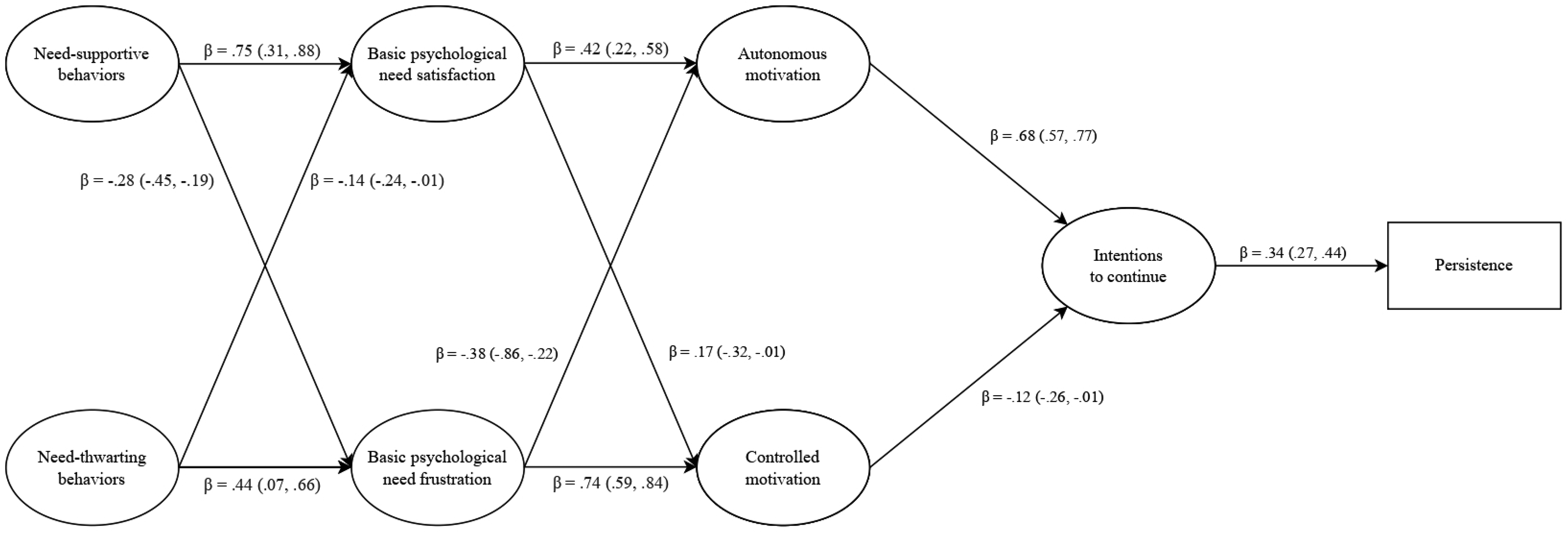
Structural equation model. Notes: β = standardized coefficients, between brackets = Confidence Interval at 95%.
Indirect effects.
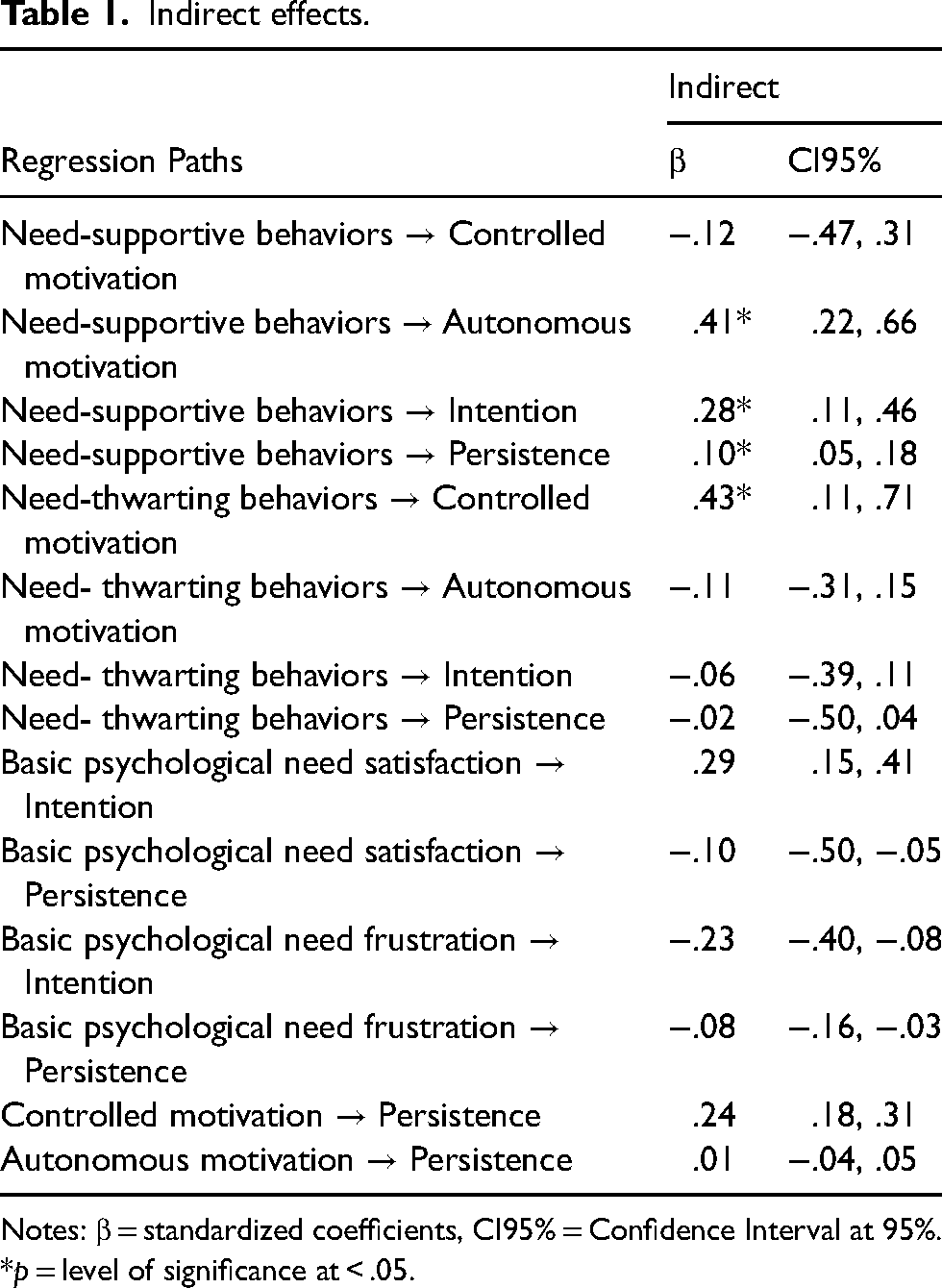
Notes: β = standardized coefficients, CI95% = Confidence Interval at 95%. *p = level of significance at < .05.
The mediation model did not reveal any direct effects for need-supportive or need-thwarting behaviors. However, significant results were observed for several indirect paths. Need-supportive behavior demonstrated positive associations with needs satisfaction (β = .31, CI95% = .26, .36), autonomous motivation (β = .12, CI95% = .06, .18), and intention (β = .38, CI95% = .26, .49). Notably, significant indirect paths were identified, including need-supportive behavior > autonomous motivation > sports persistence (β = .02, CI95% = .01, .05), needs satisfaction > intention > sports persistence (β = .05, CI95% = .02, .08), need-supportive behavior > needs satisfaction > autonomous motivation > sports persistence (β = .02, CI95% = .01, .04), needs satisfaction > autonomous motivation > intention > sports persistence (β = .01, CI95% = .01, .03), and need-supportive behavior > needs satisfaction > autonomy > intention > sports persistence (β = .01, CI95% = .00, .02). Furthermore, need-supportive behaviors displayed a negative association with needs frustration (β = −.15, CI95% = −.21, −.09). In terms of need-thwarting behaviors, a positive association was observed with needs frustration (β = .29, CI95% = .23, .35), controlled motivation (β = .15, CI95% = .09, .21), and intention (β = .12, CI95% = .00, .23). The total indirect effect of the need-supportive behaviors towards sport persistence in the model was β = .14 (CI95% = .26, .37), while for need-thwarting behaviors was β = −.05 (CI95% = −.11, −.01), indicating a positive mediation process (Figure 2).
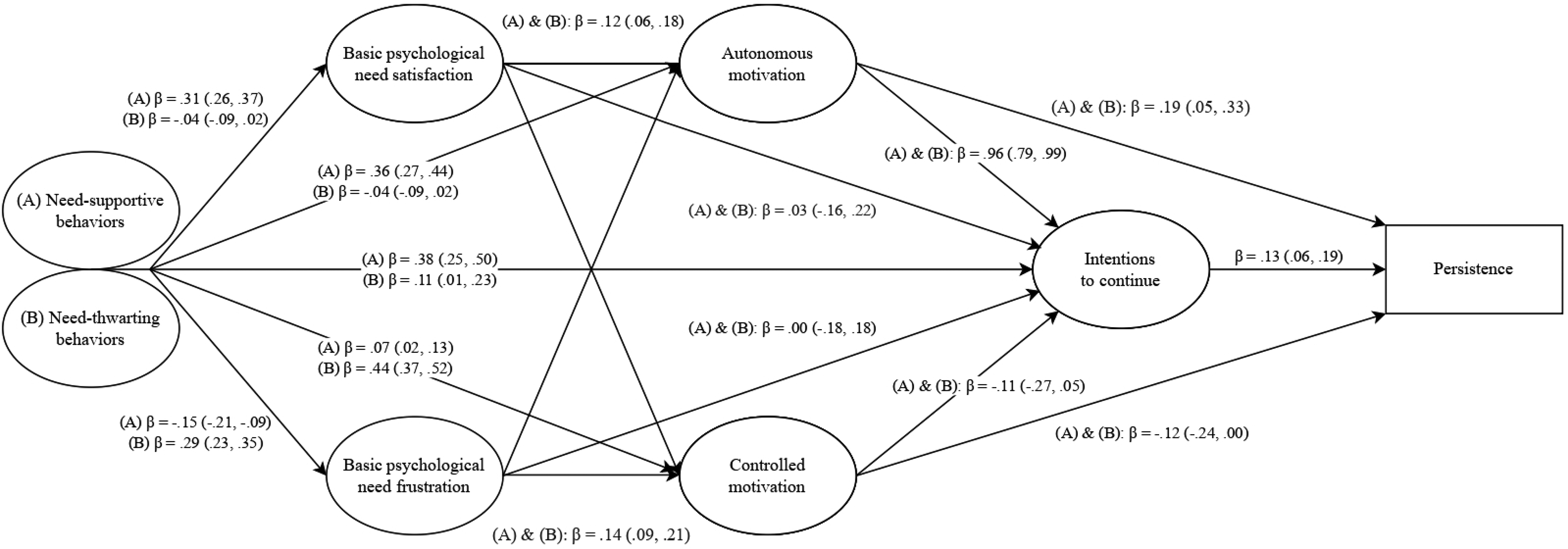
Mediation model. Notes: β = standardized coefficients, between brackets = Confidence Interval at 95%.
Discussion
The present study aimed to investigate the relationships between need-supportive and need-thwarting behaviors, basic psychological need satisfaction, and motivation in the context of sport persistence among athletes. The findings revealed significant correlations between need-supportive behaviors, basic psychological need satisfaction, autonomous motivation, intentions, and sport persistence. Additionally, significant correlations were observed between need-thwarting behaviors, basic psychological need frustration, and controlled motivation. These dark-side motivational determinants 3 exhibited negative associations with intentions and sport persistence. The positive associations found between need-supportive behaviors, basic psychological need satisfaction, autonomous motivation, intentions, and sport persistence align with previous theoretical frameworks and empirical evidence.3,15,18 According to self-determination theory, need-supportive behaviors, such as providing athletes with choice, autonomy, and opportunities for competence, can facilitate the satisfaction of basic psychological needs, leading to increased autonomous motivation and intentions to continue engaging in sport. These findings corroborate previous studies that have highlighted the importance of need satisfaction in fostering autonomous motivation and persistence.2,15,18 Conversely, the negative associations observed between need-thwarting behaviors, basic psychological need frustration, and controlled motivation provide further support for the detrimental effects of these factors on athletes’ intentions and sport persistence. Need-thwarting behaviors, such as exerting excessive control, neglecting athletes’ perspectives, or creating an environment that undermines their competence, can lead to frustration of basic psychological needs, diminishing autonomous motivation and increasing controlled forms of motivation. This finding aligns with the tenets of self-determination theory, which posits that the frustration of basic psychological needs can undermine individuals’ autonomous motivation and persistence. 3
Our study explored how athletes’ satisfaction or frustration of their basic psychological needs influenced their motivation and likelihood of continuing to participate in sport. We found that when athletes felt their needs for autonomy, competence, and relatedness were fulfilled, they were more likely to experience autonomous motivation. This means that they were motivated by personal interest and a sense of choice. On the other hand, when athletes’ needs were not fulfilled, they were more likely to experience controlled motivation, where external pressures or demands influenced their participation. These findings have practical implications for coaches, trainers, and sports organizations. To promote athletes’ motivation and persistence in sport, it is crucial to create environments that support their basic psychological needs.4,19 Coaches can provide athletes with opportunities for autonomy, such as allowing them to make choices and decisions related to their training or competition. They can also foster a sense of competence by providing appropriate challenges and feedback that help athletes develop and improve their skills. Additionally, creating a supportive and inclusive team environment that emphasizes positive relationships, and connectedness can address athletes’ need for relatedness. By promoting autonomous motivation and reducing controlled motivation, coaches can increase athletes’ intentions to continue participating in sport.6,16 This can be achieved by focusing on fostering intrinsic motivation and personal satisfaction rather than relying on external rewards or pressures. Furthermore, our study showed that autonomous motivation had a positive impact on athletes’ actual persistence in sport. Athletes who were autonomously motivated were more likely to stick with it over time. In contrast, athletes who felt coerced or pressured were less likely to persist in their sport participation as demonstrated by the negative association between controlled motivation and intentions, and sport persistence. Based on these findings, coaches can design training programs and practices that prioritize athletes’ autonomous motivation. They can create a positive and supportive atmosphere that encourages athletes to take ownership of their sport participation and develop a sense of personal connection to their sport.2,9
The current study expands on previous research by highlighting the specific relationships between need-supportive and need-thwarting behaviors, basic psychological need satisfaction and need frustration, various forms of motivation, intentions, and sport persistence. The findings emphasize the importance of fostering need-supportive environments that promote basic psychological need satisfaction among athletes, as these factors were positively associated with autonomous motivation, intentions, and sport persistence. Furthermore, the negative associations between need-thwarting behaviors, basic psychological need frustration, and controlled motivation highlight the potential risks associated with such behaviors in undermining athletes’ intentions and sport persistence.10,15 The present study also contributes to the existing literature by providing support for the mediating role of basic psychological need satisfaction, autonomous motivation, and intentions to continue in the relationship between need-supportive behaviors and sport persistence. These findings suggest that need-supportive behaviors indirectly influence athletes’ persistence through the satisfaction of their basic psychological needs and the cultivation of autonomous motivation, as well as intentions to continue.10,14,15
Limitations and agenda for future research
Firstly, the use of cross-sectional data with a longitudinal measurement of sport persistence restricts our ability to establish causal relationships between the variables. Future research should employ longitudinal designs to investigate the temporal dynamics and predictive nature of the associations observed. Secondly, the absence of measures assessing the motives for dropout in this study hinders our understanding of the factors influencing sport persistence. Future investigations should incorporate assessments of dropout motives to gain a more comprehensive understanding of athletes’ decision-making processes. It should be acknowledged that the variability in athletes’ age (18–32 years) and sport experience (1–14 years) may have influenced the results, and future studies should examine whether these factors moderate the relationships proposed in the theoretical mode. The assessment of persistence based on club withdrawal may not fully reflect true sport dropout, as athletes could continue practicing in other contexts; future studies should consider additional measures to capture long-term engagement more comprehensively. Lastly, the study's exclusive focus on a particular sport modes and convenience sample may restrict the generalizability of the findings to other sports and populations. Future research endeavors should explore these associations across various sport modes and diverse samples to enhance the external validity of the findings.
Practical implications
By cultivating an environment that supports athletes’ basic psychological needs, particularly autonomy, competence, and relatedness, coaches can effectively promote autonomous motivation. This type of motivation is associated with positive outcomes, such as stronger intentions to continue participating in sports and a higher likelihood of long-term persistence. Prioritizing the satisfaction of these needs is essential for creating conditions that foster sustained engagement and success in athletic endeavors. Results from the present study indicate that need-supportive behaviors, the satisfaction of basic psychological needs, autonomous motivation, intentions, and sport persistence are positively correlated. This underscores the importance of designing environments that meet athletes’ psychological needs, thereby enhancing their motivation and persistence. Conversely, need-thwarting behaviors, frustration of basic psychological needs, and controlled motivation are negatively associated with intentions and sport persistence, demonstrating the detrimental effects these factors can have on athletes’ motivation and long-term involvement in sports.
Coaches can facilitate athletes’ motivation and persistence by actively supporting their autonomy, which can be achieved through providing choices, allowing for self-direction, and involving athletes in decision-making processes. To further enhance motivation and persistence, coaches should focus on fostering competence by offering appropriate challenges, constructive feedback, and opportunities for skill development. Additionally, creating a team environment that promotes positive relationships, cooperation, and a sense of belonging is crucial for addressing athletes’ need for relatedness. Meeting this need can significantly increase their motivation and intention to continue participating in sports.
Footnotes
Approval
Approval from the Ethical Committee of IP Leiria (CE/IPLEIRIA/26/2021) was obtained.
Data availability statement
The data that support the findings of this study are available on request from the corresponding author.
Declaration of conflicting interests
The author(s) declared no potential conflicts of interest with respect to the research, authorship, and/or publication of this article.
Funding
The author(s) disclosed receipt of the following financial support for the research, authorship, and/or publication of this article: This work was funded by National Funds by FCT - Foundation for Science and Technology under the following project UID/04045: Research Center in Sports Sciences, Health Sciences, and Human Development.
