



Abstract
The aim of this study was to examine factors that impact wrestlers’ decision-making related to their willingness to train and compete with pain and/or injuries. Five Greco-Roman male wrestlers from Norway, with a mean age of 27.0 (SD = 2.55), were interviewed about their decision-making process when dealing with pain and/or injury. The foundation for the study was based on a decision-based framework for presenteeism and absenteeism in athletes outlined by Mayer and Thiel.(Mayer J, Giel KE, Malcolm D, et al. Compete or rest? Willingness to compete hurt among adolescent elite athletes. Psychol Sport Exerc 2018; 35: 143–150.) The thematic analysis identified three themes: 1) personal self-expectations, 2) the wrestling culture, and 3) post career health. Overall, all the wrestlers expressed a high degree of willingness to risk their bodies physically to achieve top results in competitions. A strong desire to compete, athletic identity, a normalized pain culture, and fear of long-term consequences are the main factors impacting the wrestler's choice to train or compete with pain and/or injury.
Introduction
The modern elite sport represents a situation where athletes both consciously and unconsciously expose themselves to physical risk. 1 Today, training with pain or injuries is a common practice in elite sports, 2 and it is a common practice to “play hurt”,3,4 and “playing through pain” or “competing injured”. 5 The decision to train and compete despite having a health problem (i.e., pain and injuries) can, according to Mayer and Thiel,6,7 be conceptualized as sickness presenteeism in sports organizations. Hence, professional athletes attend work (e.g., training and competition) while being ill.
When examining this topic, it is crucial to acknowledge the nuanced ways in which athletes manage pain and injuries. 8 Particularly in elite sports, athletes are often observed to possess a higher pain threshold compared to non-athletes. 9 This fact becomes especially pertinent in the context of wrestling. As a physically demanding contact sport, wrestling carries an inherent risk of injury,10,11 further emphasizing the need for a comprehensive understanding of pain management within this specific sport. In the worst case, an injury might be career-threatening, 4 and even more importantly, it can have negative consequences for the athlete's long-term health (i.e., chronic overuse injuries) and extend well beyond the realm of sports. For instance, in a cross-sectional study of injuries and later-life health status among 3357 retired Olympians, Palmer and colleagues 12 found that a third of the former athletes attributed current, ongoing pain and functional limitation to injuries they sustained during their Olympic careers.
Still, it may be difficult to imagine elite sports, especially wrestling, without any form of risk. Sociological analysis shows that organized sport socializes young athletes to almost blindly accept the risk of pain and injury inherent in sports participation.13–16 Consequently, pain is an integral part of sports, and when athletes often believe it is their own decision to train or compete injured, it ultimately is a result of the socialization into what Nixon identifies as risk culture. 17 Risk culture is described as a set of beliefs that athletes are socialized into, which makes them accept risk, pain, and injuries. 18 This notion is supported by Mayer and Thiel's recent work on a holistic decision-based framework on presenteeism and absenteeism among athletes, which highlights that competing with injuries is primarily mediated by socialization processes in the context of competitive sport and gradually shaped through social expectations within the elite sport context (i.e., from coach and teammates). 19 Furthermore, the willingness to compete injured is expected to be influenced by the athlete's expectations of themselves and their commitment to pursuing a career in elite sport.3,19 Subsequently, while a strong sense of athletic identity can provide the necessary drive and motivation needed to experience success in sport, it is important to recognize that those who identify strongly with their athletic identity are also more susceptible to pushing their bodies beyond what is safe and healthy20,21 (i.e., toughing out an injury in wrestling). Hence, these athletes are more prone to overuse injuries. 22
Significantly, collaboration and communication between the coach and the medical team influence the decision-making process in the elite context and can lead to fewer injuries among the athletes.23,24 Further, research indicates that athletes are willing to rest when instructed to do so by either their coach or the medical team (i.e., doctors, or physiotherapists). 7 However, in contrast, research has also indicated that both coaches and medical advisors often encourage athletes to continue training and competing despite pain and/or injuries. 4 In fact, for some coaches, playing with pain communicates the ‘right attitude’ in elite sports. 25
Even though elite sports have been shown to include physical risk, 1 and training with pain or injuries is a common practice in elite sport, 2 the decision to train and compete with injuries must be defined and empirically analyzed as a sport-specific form of sickness presenteeism among athletes.6,7 Given the high injury rate observed in men's Greco-Roman wrestling, 26 this sport seems an interesting case for examining athletes’ willingness to train and compete with pain or injury to see if such a sickness presenteeism culture is present.
One nation that has shown to have a strong physical focus, according to themselves, is the Norwegian national wrestling team and the Norwegian Wrestling Federations, which describe their philosophy in their development plan as follows: “In Norway, we emphasize being the active wrestler who makes the opponent passive. (…) We train to be better physically trained than other nations. Several nations have greater breadth and broader sparring, which means that they have other focus areas. Norway is not in this situation and has thus chosen this mindset.” 27 Even though wrestling is a minor sport in Norway (approximately 9000 members), the male Norwegian national team has still performed well in the Olympics, European and world championships (7 medals since 2014). So, based on the fact that wrestling is a physically demanding sport with an inherent risk of injury, combined with the abovementioned philosophy of the Norwegian Greco-Roman national team, the aim of the current study is to inductively examine Norwegian Greco-Roman wrestlers’ willingness to train and compete with pain and injury. Our research investigates the factors that impact Norwegian Greco-Roman wrestlers’ decision-making regarding their desire to train and compete with pain and injury.
Methods
The current study examines Norwegian Greco-Roman wrestlers’ attitude and reflections upon training and competing despite pain and/or injury. A qualitative research design through in-depth interviews was designed to examine the wrestlers own understanding, subjective experiences, and decision-making concerning pushing through the pain and/or injuries. The interviews were semi-structured, which is an advantage for gathering rich data about the participants lifeworld. 28 Ethical approval was in accordance with and approved by the Norwegian Social Sciences Data Services [reference number: 358960] prior to the data collection.
Participants
The study sample consists of five Greco-Roman male wrestlers from Norway, aged between 24 and 30. Four participants were currently active wrestlers, while one was a recently retired wrestler who had been part of the same senior national team training group. To maintain confidentiality, we have chosen to keep identifying details vague. The wrestlers possess extensive experience in international-level competition, with four current wrestlers having 4–8 years of experience on the national team, and the retired wrestler having multiple years of experience on the national team. Collectively, the wrestlers have accumulated over 30 years of experience on the Norwegian senior wrestling team. We have deliberately provided minimal written information about the participants to uphold ethical considerations regarding anonymity.
Procedure
The recruitment of participants was conducted through an acquaintance of the main author, who has a relationship with athletes in the Norwegian wrestling milieu. This person reached out to the team and sent the contact information to those who wanted to participate in the study. Five of the ten athletes in the national training squad agreed to participate in the study. All the interviews were conducted using FaceTime, because the participants have their base in another city and had a lot of traveling outside of Norway during the period of the study. The length of the interviews varied from 43 to 79 min (M = 62:22; SD = 15:17). Each interview commenced with a brief explanation of the study's purpose and outlining the rights of the participants. The interview guide had three main topics, in addition to opening and finalizing questions, in terms of: athletic identity (i.e., Which qualities do you think your coach is looking for in a wrestler?), pain management (i.e., What is pain for you?), and elite sport culture (i.e., Do you feel you can talk openly about pain with your coaches?) (the interview guide can be obtained by request to the corresponding author). The interview guide was developed based on inspiration from theoretical approaches such as Mayer and Thiel,6,7 and earlier research. 8 Still, we used an inductive approach, meaning that we sought the athletes’ attitude and reflections upon training and competing despite pain and/or injury. All interviews were audio-recorded and transcribed verbatim. Participants were provided with the opportunity to receive the transcribed quotes used in the study for review and confirmation of content, which none of them used. The interviews concluded by informing the participants about the further progress and work of the study.
Analytical process
We used an inductive, interpretive approach with the intention to develop themes of risk culture in Greco-Roman wrestling from our data. 29 The present study is positioned within a social interactionist ontology 30 also adopting a constructionist approach, which suggests that multiple realities exist, and that social reality is a subjective experience. 31 Such an approach allows participants to construct their reality within their contexts, enabling us as researchers to gain insight into how they negotiate their priorities in decision-making regarding training and competing with pain or injury—both in the short term, concerning their careers, and in the long term, regarding their health post-career. The data were transcribed and analyzed using thematic analysis by Braun and Clarke. 32 The thematic analysis proceeded in six reflexive stages: 1) Familiarize with the data material, 2) Coding, 3) Searching for themes, 4) Reviewing themes, 5) Defining, and 6) Naming themes. Phase one involved familiarizing with the data material and taking notes along the way. Through a systematic process in phase two, 390 codes were identified and named with the purpose of identifying the meaning behind quotes from the interviews. The codes were predominately semantic but not exclusively. In the third phase, patterns in the codes were sought, and various subcategories (e.g., “degrees of pain”) were identified. Later these subcategories were placed into higher-order themes (e.g., “personal self-expectations”). In phase four, systematic work was done to review the various themes and validate that they corresponded with the subcategories and codes. In phase five, each theme was given a name to provide conceptual clarity for the reader, with a summary linked to the research question. In the sixth and final phase, writing up and finalizing the research project was done.
Research rigour
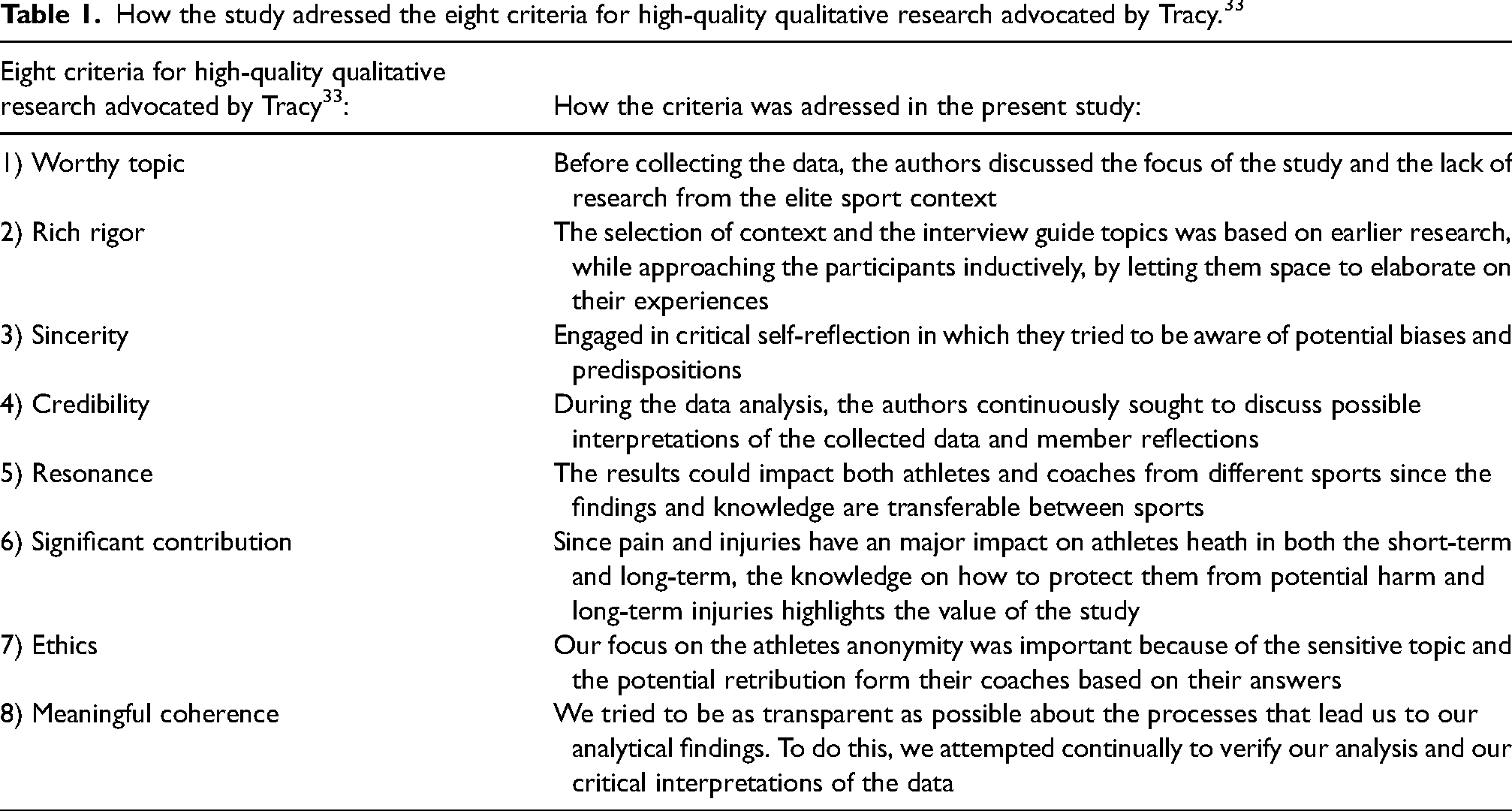
We used the eight criteria for high-quality qualitative research advocated by Tracy 33 : worthy topic, rich rigor, sincerity, credibility, resonance, significant contribution, ethics, and meaningful coherence were adhered to (see Table 1). In the planning of the study, we discussed the focus of the study and the lack of research from the elite sport context (worthy topic), while still building on the theoretical approaches of earlier studies (rich rigor). During the data collection processes, the first and last authors discussed our results and our interpretations to ensure peer agreement and validity and also addressed ethical issues such as confidentiality (credibility, sincerity, meaningful coherence and ethics).34,35 Because of the potential impact of the study, we also discussed how these findings could impact the coach-athlete relationship among wrestlers (resonance) and the same dyad within other sports (significant contribution).
How the study adressed the eight criteria for high-quality qualitative research advocated by Tracy. 33
Results
Guided by the thematic analysis, three main themes were identified as central in the wrestlerś decision-making: 1) their personal self-expectations, 2) the wrestling culture and the actors in the national team, and 3) post career health.
Personal self-expectations
Within the theme personal self-expectations, the wrestlers described a) their perceptions and attitudes towards pain and injury in sports, and b) how their athletic identity influence their decisions regarding presenteeism (and absenteeism) in training and/or competition.
Perceptions and attitudes towards pain and injury
A common attitude towards pain among wrestlers was that pain is something they must accept as a norm, a belief instilled in them from an early age by both parents and coaches. When the wrestlers were asked to describe pain in their own words, John answered the following: An illusion? No, it is not. It is a companion throughout a wrestling career. It is just the way it is. Wrestling, even if you are completely fit, you have nothing bothering you, wrestling hurts. Even if you have no injuries, you are still in pain. So, the body is constantly battered, really. (John)
All the wrestlers described pain being an essential part of a wrestler's career, and when they experience pain, they want to grit their teeth and build character. Still, they made a distinct difference between harmless pain, which was described as the acute pain that they could expect as a wrestler, while the dangerous pain is the pain that can lead to serious injuries or other long-term consequences. Daniel exemplifies: Firstly, I would say there are degrees of pain. (…) If I stopped every time I felt a little pain, I would never be able to wrestle. Wrestling hurts. And you must be able to sort through your pain and distinguish between what is dangerous pain and what is harmless pain. Dangerous pain, of course, should be considered. (Daniel)
Many of the wrestlers had experienced chronic pain and stated that this was the pain they feared the most. Especially if the pain led to a potential drop in training quality, which was a clear indicator that your body needed rest and healing.
Athletic identity
The wrestlers describe a strong connection to their athletic identity, which seemed to provide motivation and drive, highlighted as necessary for their success. At the same time, some of the wrestlers describe situations where they are willing to push their bodies beyond what they consider as safe. When the wrestlers are asked if they have, or are willing to compete regardless of physical costs, Patrick had this to say: Yes, 100%. I have done that. If it came down to it, 100%. Of course, it completely depends on health, the injury, and what we are talking about, you know. But if it were the Olympics and I had torn half of the ligaments in my elbow, I would still step onto that mat and be “king crazy”. (Patrick)
A common agreement among the wrestlers is that there is a higher willingness to compete with pain and injuries, than to train with pain and injuries. However, there is still a high willingness to train with pain or injuries if the competition is imminent. Daniel describes how he ignored medical advice from his doctor when having a serious injury: The doctor told me, “You should not wrestle anymore this year. You are basically done for the year. (…) In six months, you can start getting back on the wrestling mat.” But six months later was the World Championships. So, for me, that was completely out of the question. I started wrestling again after three months. And I competed in the World Championships in September. So, I ignored what the doctors said, to compete in the World Championships. (Daniel)
When asked about their strong commitment to wrestling their willingness to train and compete with pain, the wrestlers emphasize that their goal is to win international medals. According to one of the wrestlers, they tend to think more with their heart than with their brain, indicating that their love for the sport meant that they sometimes pushed their bodies harder in training and competition, than viable according to sound intensity regulation. Subsequently, they may not be able to make what could be considered a right decision for their long-term health all the time.
Interestingly, some of the wrestlers stated that their strong commitment to wrestling can be challenging outside of the wrestling environment. They state that the “tough wrestler” on the wrestling mat, compared to the person outside the wrestling mat, must be seen as two different identities: Pushing oneself physically so hard does build character, but it is not a character trait that is pleasant to have when interacting with people who are not from that environment. Because you tend to trivialize others pain as well, and that is not good. (…) I have long identified solely as a wrestler. But in recent years, I have discovered that I have added value outside of that, as a human being and as a person too. So, my identity has expanded to include other things as well. (John)
In this quote John reflects around the negative aspects of having built solely a “wrestler identity”. John`s narrative emphasizes that elite wrestlers should be taught not to be single-minded, thus, foster relationships outside the sporting context and be open for other facets of life.
The wrestling culture and actors in the national team
The wrestlers describe a tough and raw wrestling culture, and the actors (coaches and medical staff) situated around them impacts their decisions regarding presenteeism and absenteeism. This theme consists of the following subthemes: 1) culture that normalizes pain, and 2) you find yourself squeezed between the coach and the medical staff.
Culture that normalizes pain
The wrestlers describe a traditionally tough culture where pain is an integral part of their sport since they have more days with pain, than without, and that pain almost must be seen as a necessary companion to develop as an elite wrestler. On a general basis, during training sessions, they mention painful shoulders, knees, necks, and fingers. Daniel described how he always trains with pain and considers it something which a regular and usual this in the following: I have pain in both my shoulders. My knee can be a bit painful at times. Usually, my neck hurts. So, I train with pain all the time. (Daniel)
Most of the athletes agree that it is necessary for them to train with pain most of the time, in order to succeed. When asked about why they believe that they choose to cope with that much pain on a regular basis, three of them answered that they have become pressured by the tough wrestling environment to do so. I think our approach to this has ruined a lot of the joy of sports… It has just been challenging, it has been hard. (…) I love the lifestyle, but it has been very, ungrateful at times. (…) I strongly believe that with joy and love, one can achieve very good performances rather than with exploitation, if one is willing to put in the work. I think there are many psychological factors at play, which would make an approach focusing on reward and love versus threats and fear in a performance culture yield equally good result. Now it is too late. (John)
Based on the quote, John reflects upon the downsides of the tough lifestyle and environment he has been a part of over the last years, even indicating that another approach with joy and love would have given another output in terms of better results.
“You find yourself squeezed between the coach and the medical staff”
There was a common understanding among the wrestlers that their coaches emphasize the notion that athletes themselves should be able to know their body well enough to evaluate when they are fit enough to train and/or compete, when struggling with pain or injuries. Subsequently, the wrestler has the final word in the decision-making process. While autonomy in decision-making is generally emphasized, wrestlers also experience pressure to train and compete. This highlights the complexity of the culture and training environment within this group, and its impact on presenteeism and absenteeism.
7
In the case of wrestlers, the data show autonomous and controlling motivations are present in the culture. Patrick's following quote is part of controlling cues in the environment but could also be part of presenteeism. Whether the motivational or introjection regulation is externally regulated depends on the internalization. Patrick explain how the coach reacts if he asks about skipping practice, thus why he avoids speaking up may be due to all three reasons (presenteeism, external regulation, and introjection regulation) and warrants future research: It has been received both positively and negatively. It has depended on whether someone is present to assess if the pain is genuine [i.e., a physiotherapist or doctor]. I am the type who does not speak up when I am in pain and continue to push myself as far as I can. (Patrick)
In an extension of this, John had this to say when he was asked about if he had felt pressured to train or compete despite pain or injuries: It might not be direct pressure, but it is like an endless guilt trip, you know. You are like, okay, I should sit this one out, but I am scared to, I feel guilty because the coach would be disappointed or say something. And then it is like, okay, I will just swallow it. And then you do it over and over, and you do it so often that it becomes normal, and it becomes the norm, you know. So, yeah. It is more like a mix of self-imposed pressure to do it. Because you are afraid of the consequences. Or have been. Have been, that is probably the right way to put it. (John)
Even though the athletes felt pressure from the coach, explicitly or implicitly, it was described as more acceptable to be absent if a physiotherapist or doctor was around to evaluate and verify the pain/injury. This was however not always the case. For example, when some of the wrestlers got injured, they were told by their physiotherapist to take it easy for 6–8 weeks, but the coach argued that there was no time to take it easy for 6–8 weeks. The wrestlers were then told to train with the pain and to put up with it. Noteworthy, the pressure from the coaches was higher in periods leading up to an important competition or tournament. In some cases, several wrestlers often knew that they should not train, but they either felt pressured to push through the pain or ended up in a squeeze between the coach and the physiotherapist. You become a bit torn. Here is someone [the physiotherapist] who has expertise on what the injury entails and then the coach refuses to accept that it should take so long. (…) After all, you know yourself best (…) and ultimately, you must make the decision yourself, because nobody knows your body as well as you do. (Michael)
Post career health
All the wrestlers agreed that their elite sport career is a short chapter of their life. Even so, their fear of long-term consequences seemed not to be a factor that influences their daily decision-making process in wrestling.
Fear of long-term consequences
There is a mutual understanding that the potential consequences of training and competing with pain and/or injury can impact both their sporting success and their health in a long-term perspective. Some of the wrestlers fear a life after their career where they become restricted in doing activities they love. They described the dilemma of short- versus long-term consequences, emphasizing that it is difficult to think these thoughts while they still are active, because their only focus is to become as good as they possible can. John reflected: I have a body that is not exactly made for elite sports in any way. So, I must take care of it. If not, I might have some good years in elite sports. But my future as an adult is going to suck because I will not be able to go for walks and exercise. (John)
Even though the athletes seem to have a fear of chronic and long-term injuries, they emphasize that most of the time it is difficult to stop training or competing because of a) the adrenaline they get when wrestling, and b) they feel trapped inside the elite sports “bubble” which makes it difficult to see themselves being affected by serious injuries. Daniel explains: I would say that one specific injury has made me somewhat more cautious in the long run regarding my health. But I would still say that I push many boundaries that many others would not do. (…) but one cannot foresee oneself dying. I think it is a bit the same with saying that one will become paralyzed. (…) I think a bit about my long-term health, but I would also say that I am taking risks right now. (Daniel)
Based on this quote, it seems like Daniel downplays the serious risks that would be acknowledged outside of this bubble as much more serious and devastating in the short-term but also impacting the athlete's long-term health.
Discussion
This study aimed to examine what impacted on wrestlers’ decision-making on their willingness to train and compete with pain and/or injuries (presenteeism). The wrestlers in the present study described pain as an integrated and natural part of their sport,2–4 and even acknowledging its role in their success in elite wrestling, even describing it as impacting their success in elite wrestling. However, an important factor was to distinguish between types of pain and, furthermore, the degrees of pain, assess presenteeism and absenteeism, and determine whether the pain can lead to injuries or have other negative long-term consequences.4,7 The wrestlers agreed that to be absent from training because of pain (absenteeism), the pain must decrease their ability to perform at the level that they feel they should train based on the degree of pain. Earlier research from health science indicates that individual and subjective meanings regarding pushing through pain and injuries play a role regarding the decision-making process. 19 Future research should delve into the potential connections between presenteeism and controlling motivational regulations as delineated in self-determination theory. While our results suggest possible associations between these concepts, further investigation across diverse sports contexts could enhance and deepen this understanding.
As wrestlers, the athletes describe themselves as tough and crazy. They highlight the importance of being able to push through pain, which can be seen as a strong athletic identity. 20 Their high degree of conformity to the sports ethic entices them to train with pain, 36 and even overly hard, 37 and furthermore their choices to ignore injuries by avoiding medical treatment instructed by the medical staff, which in worst cases could be detrimental to their career.16,20 Young 38 have suggested that male athletic identity is part of hegemonic masculinity, as seems to be the case in the current wrestler culture described by the wrestlers. The athletes’ descriptions of pain give a clear picture of onerous physical requirements in addition to social influences from coaches and teammates which almost force them to presenteeism. Earlier studies have found that athletes with a large training effort identify more strongly with the role as an athlete, 39 and especially when social circles coalesce around sports, where they tend to identify more strongly with their role as an athlete than with other roles. 40
When pain or injuries occur, as a part of elite sport10,11,26 the wrestlers stated that their coacheś emphasize their role in the final decision regarding presenteeism versus absenteeism. This finding contrasts results from team sports where coaches are described as having a bigger say in the decision. 23 Even though the wrestlers described it as their own decision to train or compete injured, Nixon has argued that this ultimately results from the socialization into what he described as a risk culture. 17 Some wrestlers describe situations where the coach pressures them to presenteeism, 13 while some also described it as an indirect pressure, where they sometimes felt afraid to be absent because of guilt and not wanting to disappoint the coach. This feeling of pressure to train and/or compete with injuries can exemplify how presenteeism manifests in a wrestler culture. In this regard, it is important to recognize that pressure of presenteeism can occur when there is a lack of or low degree of communication. 24 This pressure can, however, also be seen as distrust between the wrestlers and the coaches, which could be detrimental, since the relationship between coaches and their athletes is considered the most basic dyad in sport situations. 41 These results might also be related to the Norwegian context, where there seems to be a driving force to push through pain and injuries by training to be physically better than their opponents, 27 which again could be related to the federation's approach which most likely is internalized by the national team coaches. Research indicates, as in the present study, that athletes in sports are willing to rest when instructed to do so by either coaches, doctors, or physiotherapists, 7 highlighting their important influence regarding decision-making on pain and injuries.
Despite a strong athletic identity related to wrestling, for some of them the joy of wrestling has partly faded because of the physical requirements and the dilemmas of handling presenteeism and absenteeism based on pain and/or injury. Their athletic identity makes ideas of retirement emotionally challenging, 42 despite the risk involved and the potential of serious long-term injuries. Still, when the athletes were asked about their perception of long-term consequences that could impact their lives after their elite sports career, they described how it influenced their decision-making process. While agreeing that their elite sport career lasts for a short period of time, none of them want to sustain injuries that can impair them after their career in elite sports. Interestingly, research shows that one-third of retired Olympians have current pain (32.4%) or functional limitations (35.9%). 12 In this study, we found that the retired wrestler sometimes had to use painkillers to function at his daily job, as a result of his wrestling career. This parallels findings in other studies, where the use of painkillers has been reported to have negative impacts on athletes even after the end of their sporting career.43–45 Subsequently, it is important that active wrestlers and their key stakeholders (i.e., coaches, medical staff) acknowledge that a hazardous risk culture in wrestling can create long-term health issues and extend well beyond the realm of sports.
Applied implications
The findings of this study have several significant implications. Firstly, wrestlers, coaches, and support staff could benefit from enhanced knowledge regarding pain and pain management, specifically in distinguishing between “good” pain and “bad” pain. To achieve this, it is essential to establish open and honest communication about these issues, thereby mitigating fears of judgment or undue pressure to exceed physical limits. Emphasizing the importance of adhering to medical advice and treatment plans is crucial, as it highlights the potential long-term consequences of neglecting injuries and underscores the benefits of proper recovery. While the culture of rigorous training is prevalent, it should be complemented by an emphasis on training smart. Promoting a more holistic approach to training that includes sufficient rest and recovery periods may also help prevent long-term injury setbacks. Furthermore, assisting athletes in balancing their athletic identity could be beneficial. For wrestlers with long-term injuries, developing a secondary identity might facilitate their recovery. Returning to sport prematurely could lead to excessive exertion and subsequent setbacks. If an athlete's identity is not solely tied to wrestling, it may be easier to encourage them to take the necessary time to fully recover before resuming competition.
Implementing programs that address the psychological aspects of injury recovery could reinforce this approach, with coaches playing a crucial role. Coaches trained to recognize signs of harmful presenteeism and poorly integrated motivation in their athletes will be better positioned to prioritize athlete welfare. They should be equipped to support athletes in making safe decisions regarding training and competing with pain. Hence, it is crucial for athletes, coaches and other support staff such as medical staff, to have a common language related to pain and presenteeism. To achieve this, coaches themselves require support. Raising awareness about the hazardous risk culture in wrestling necessitates policies and practices that alleviate the pressures athletes feel to train and compete while injured. Aligning training and competition practices with values such as unity, mastery, and honesty, as advocated by the Norwegian Sports Federation, could foster a performance culture that prioritizes athletes’ overall well-being. Ensuring compliance among all stakeholders—athletes, coaches, medical staff, and federation officials—to create a unified approach to managing pain and injuries is essential. This collective effort will ensure that the athletes’ long-term health remains a shared priority.
Strengths and limitations
The study shows that elite wrestlers exhibit presenteeism which emerges from guilt over whether to train or rest when injured or experiencing pain. However, the exclusive focus on athletes in the current study does not capture all of the complexity in Mayer and Thiel's decision-making model. 6 If all stakeholders (i.e., coaches, medical staff) had been included and interviewed in the current study, this could have generated a richer understanding of the risk culture in Norwegian Greco-Roman wrestling. Furthermore, one could argue that the study should have recruited a greater sample size. However, it is essential to acknowledge that these are elite athletes from a relatively small sport in Norway, and we therefore argue that the dataset is sufficient concerning the study aim, with high “information power”. 46 Our study could be further strengthened if the participants took the opportunity to review the transcribed interviews. While the aim of this study was to prospectively examine athletes actively involved in health-related-decision-making in wrestling, we had the opportunity to also include a recently retired athlete. This included a valuable post-career perspective to the study. In retrospect, we conclude that more retired wrestlers could have been included in the study and would have made a stronger case. We would also point out that follow-up of the athletes could have given us a better description of their decision regarding presenteeism or absenteeism, and especially how key stakeholders (i.e., the coach) impact their decision. In addition, future studies should include an organizational psychology approach (i.e., Wagstaff, 2016 47 ) that recognize the athleteś surroundings.
Conclusion
The aim of this study was to study factors that impact wrestlers’ decision-making related to their willingness to train and compete with pain and/or injuries. Overall, all the wrestlers described a high degree of willingness to risk their body physically to achieve top results in competitions, indicating a strong elite wrestling identity - in which pain is negotiated through a very specific cultural lens. Some of the wrestlers did, however, make a clear differentiation between them as athletes and them as a person outside of wrestling, were they in the later would not be described with tough and raw character traits as they were as wrestlers. The wrestlers furthermore describe a risk culture that normalizes pain which sometimes meant feeling pressured to train and compete with pain and/or injuries. Despite the strong athlete identity, they also highlighted the need for life quality after elite sports, also impacting the decision-making process related to pain and injuries, where the wrestlers wanted to live an active lifestyle without pain after their athletic career.
Footnotes
Ethical considerations
Ethical approval was in accordance with and approved by the Norwegian Social Sciences Data Services [reference number: 358960] prior to the data collection.
Declaration of conflicting interests
The authors declared no potential conflicts of interest with respect to the research, authorship, and/or publication of this article.
Funding
The authors received no financial support for the research, authorship, and/or publication of this article.
