



Abstract
Perceptual training can be used to develop anticipation skills, however, is not commonly integrated into tennis practice sessions. The aim of this study was to assess the effect of perceptual-cognitive training based on video recordings of tennis serves, modified by temporal occlusion, on the development of anticipatory skills of high-performance tennis players and tennis beginners. A total of 32 participants were divided into intervention and control groups based on skill level. We used pre and post-test design with intervention and control groups. The intervention group underwent a 3-week video-based perception training program. Results revealed a perception-cognitive training led to greater anticipation performance in the intervention group of high-performance players compared to beginners. Furthermore, improvements were observed in specific occlusion conditions across skill levels with key moments of racket-ball contact. These findings indicate that video-based perceptual training can effectively enhance visual anticipation development of tennis players, and ought to be included as a method in the comprehensive training of tennis players.
Introduction
Perceptual-cognitive training consists of using sport-specific visual information to make decisions that can lead to improved sports performance through visual anticipation1 by making a prediction based on advance cues, e.g., contextual information and opponents’ action. It can serve as a standard training method that enables repeated experiences of specific situations both directly on sports grounds and outside them, 1 and when athletes cannot train physically due to injury or illness. In a tennis match, the involvement of a range of cognitive functions is crucial, mainly manifested in specific perception, anticipation, and strategic behaviour. 2 The ball speed in sports games creates critical time constraints on players’ sensory perception and motor actions, as their biological processes have inherent limits on response times. Players’ decisions must be made in millisecond time windows with high accuracy and under temporally and spatially changeable conditions. 3
Perceptual-cognitive training focuses on higher-order perceptual-cognitive functions involving the cerebral cortex, brainstem, and cerebellum. It allows interpretation of visual information in sports and integrates it with players’ knowledge and experience in the sport. 4 Next to anticipation and decision-making, this training also develops other perceptual-cognitive skills like pattern recognition and perception of contextual and situational information, which is used to inform anticipation and decision-making. 5 During a match, players need to focus on relevant information and ignore unimportant details. 6 Expert players, compared to less experienced players, can capture, and use contextual and kinematic information to make predictions.7–9 Contextual information can be visual (e.g., player position) or non-visual, e.g., score, wind. 10 Kinematic information during a tennis serve includes the movement of the opponent's body segments, the racket or the ball toss. This information occurs before the server hits the ball, and then kinematic information from the initial part of the ball's flight is also essential. 11
Perceptual-cognitive training often uses images or videos to simulate sport-specific situations. Viewing conditions can be manipulated, such as slowing down the video or highlighting parts of the image. After viewing, players must predict or decide what will happen next based on the visual information they have seen. The temporal occlusion paradigm can be applied as a training method. 12 The video recording is typically filmed from the perspective of the participating player and edited to include temporal occlusion. Temporal occlusion consists of interrupting the video at certain kinematic points (e.g., during server's movement, ball flight) to prevent access to visual information around various key moments or anticipation. The length of the video clip varies according to the selected moments of interruption, which are occlusion conditions. 1 The purpose of temporal occlusion is to control duration of visual information presented to determine the timing of visual information pick-up required for anticipation. 13 The effect of perceptual training based on temporal occlusion on anticipation skills has also been demonstrated in sports games, e.g., baseball, 14 football, 15 or badminton. 16 The players who participated in the visuomotor and visual perception intervention were able to pick up advance information and demonstrated improved anticipation by identifying cues earlier during the post and transfer tests. 12 These studies suggest that the players can benefit from this video training and learned skills can be transferred to game performance.
There is a large body of literature that confirms experts are better at extracting information from advance cues to predict when compared to beginners or novices. Much of this work focusses upon response accuracy as the dependent variable, and this measure is often used to discriminate differences between expert and novice groups. An early study by Abernethy & Russell 17 showed that expert badminton players were better than novices in extracting advance cues when a film test was used to test anticipatory cue usage. Interestingly in this study it was also confirmed that experts utilised sources of information from the arm, in addition to the racquet, which indicated that the major source of expertise-related differences is determined by how the use of the received information is applied. Further work by Abernethy & Zawi 7 extended these findings by concluding that world class players were able to consistently pick up useful information from advance cues in isolation whereas the novice or recreational player relied more upon the linkage of segments to extract information.
Early work by Williams et al. 18 also examined anticipation in tennis strokes by using realistic film simulations with movement-based response measures in conjunction with eye movement recording. Their findings suggested that skilled players were faster than their less skilled counterparts in anticipating the direction of opponent's tennis strokes.
In case of tennis serve-return action, expert players focus upon and perceive the ball toss, which can be an information source of anticipation, and similarly, coaches should develop players’ subconscious awareness of contextual and kinematic information sources. 10 As shown by many authors,18–20 higher-level players exhibit greater anticipatory skills by extracting relevant information from the opponent's early kinematic patterns. However, there is still a lack of anticipation and perceptual training research in temporally constrained sports that include a representation of highly skilled, younger athletes. The work of Weissensteiner 21 has shown that athletes aged under 15 years of age could exhibit the ability to extract advance cues to predict however there is scant information in the literature showing the ability of highly skilled younger athletes to use advance information to predict. In addition, underdeveloped skill to extract and use advance information from an opponent's movement pattern could also be a performance limiting factor for younger players and it may be desirable to pay attention to this aspect of game performance in training.
Typically, the training approach in this area is based on video-recorded perceptual training with temporal occlusion. Its effectiveness in the speed and accuracy of predicting the following events has been proven by several authors across several sports games with studies showing the transfer of perceptual and anticipation skills from the laboratory environment to sports performance in situ tests on sports fields have been conducted in softball, 22 field hockey, 23 cricket 24 and tennis. 25 In summary of the literature pertaining to the use of temporal occlusion to improve the anticipation and response accuracy in sports, the recent meta-analysis performed by Müller et al. 26 also supports the validity of temporal occlusion training as a method for improving anticipation emphasing key points of large effect size improvements in visual anticipation were found from video-based temporal occlusion training that transferred to laboratory and field tests.
The serve-return situation in tennis often determines the point outcome or the ensuing rally. This critical situation is decisive; therefore, we aim to show possible development and behaviour of players in this area.8,25 By assessing the effect of perceptual-cognitive training based on video recordings of tennis serves modified by temporal occlusion on development of anticipatory skills in high-performance tennis players containing a representation of younger players and beginners, we hypothesize that high performance tennis players containing a representation of younger players will be significantly better than beginners in development and execution of anticipatory skills after perceptual-cognitive training for returning a tennis serve.
Material and methods
Participants
This study consisted of 32 participants based on convenience sampling who voluntarily agreed to participate in this experiment. The selected participants were then divided according into two playing levels, tennis beginners (B) and high-performance tennis players (PP). These two groups were further randomly divided into intervention (BI, PPI) and control (BC, PPC) groups. In creating the PP intervention and control groups, quasi-randomization was applied to divide the players evenly into the intervention and control groups based on their age categories: U12, U14, U18, and adults. The PP group included 19 players (ten male and nine female). The mean age of these participants was 16.5 ± 6.4 years, and they had been playing tennis for 10.4 years ± 6.2. These participants had represented in international performance tennis or were national players playing in international tournaments. Their mean ranking in the national ranking of the Czech Republic in their age category was 33.0 ± 40.6. The B group with minimal tennis experience (actively playing tennis no more than two years and two hours per week) included 13 adult participants (five men and six women) with a mean age of 28.9 ± 3.8 years. The Ethics Committee at the Faculty of Physical Education and Sport, at Charles University approved this study in accordance with the Declaration of Helsinki. All participants or their adult representatives were informed of the risks and benefits of the study and provided written informed consent prior to participating.
Methods and procedures
Experimental design was randomised pretest-post-test. All research groups were subject to pretest and post-test, and the intervention group also completed three-weeks perceptual-cognitive training. Pretest, perceptual training, and post-test were delivered by watching edited video recordings of tennis serves from the perspective of the receiving player. Temporal occlusion was applied by prematurely ending the video recording by blacking out the screen in selected periods (Figure 1), creating a set of video sequences of various durations, which contained varying availability of visual information pertaining to the server's action kinematics.
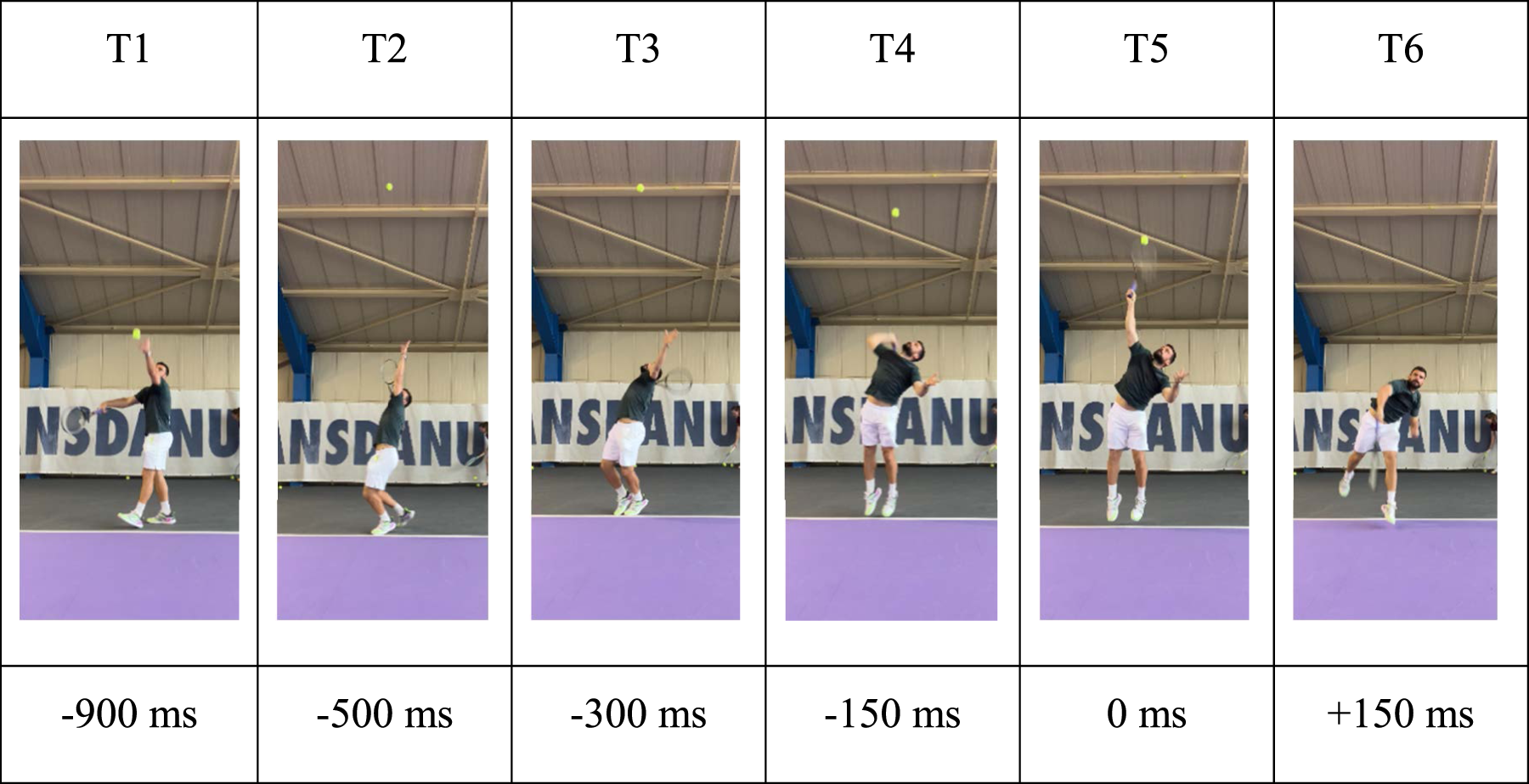
Occlusion points in the video sequences. Condition T5 (0 ms) represents the racket-ball contact.
First, we created a series of video sequences – one testing (pretest and post-test) and one training (intervention) set. Two 17-year-old right-handed servers playing tennis for over 12 years and regularly participating in international tennis tournaments (mean ITF Juniors ranking 228.5 ± 67.5) were recorded on an iPhone 14 Pro Max (30 fps) and a Canon EOS 4000D (30 fps). A tripod with the video-device was placed in the usual position of the receiving player and set to the mean body height of the participants (these videos only served as feedback for the intervention group). The second video-camera was placed at the server's end, 1 m from service line towards the net on the axis between the server and the first video-device. This second video-camera was aimed at the server's action to provide clear view of his motion and ball outcome.
From 58 videotaped serves from the deuce court, 12 representative serves (6 from each server) were selected by expert evaluation of experienced tennis coach (over 10 years) who also was a former tennis player regularly playing national competitions. These serves included all three types of first serves (flat, slice, kick) bouncing inside the correct service box close to the T line (junction of the service line and centre service line) and wide (near the sideline). Videos were edited so that every recording started from the beginning to capture the preparation for the serve and the initial position of the server and was prematurely terminated at the chosen moment with a five-second blackout (black screen). Each serve type was occluded at six specific moments (see Figure 1). Altogether, 72 video sequences including six occlusion conditions were created. Subsequently, we created video files with the same randomized order of these video sequences for the pretest and post-test, and a differing randomised order for the training intervention.
Pretest
After being instructed on tasks and conditions of testing, participants took part in the pretest. The participants were not familiar with servers in the video recordings. The pretest included four practice trials with occlusion and four without occlusion to familiarize participants with the test conditions and tasks. Pretest required watching and acting to the set of 72 sequences, with occlusion in a random order without providing sound. The task was to predict in the shortest possible time the final serve outcome by simulating either a forehand return shot (if the ball was aimed wide) or a backhand return shot (if the ball was aimed to T). The set of video sequences was played on a screen with a diagonal of 139 cm. The participants took their normal receiving position with a tennis racket on a mark 4 m far from the screen so that they could observe the image on the screen at an angle of 6°, which corresponds to the spatial situation in situ. There was a 6-min break after 36 trials (halfway through). The participants’ responses were recorded on the prepared sheets. The entire test took approximately 20 min.
Intervention
Participants assigned to intervention group underwent 12 perceptual-cognitive training sessions (4 times a week for three weeks) and their regular tennis and fitness training between the pretest and the post-test.12,27,28 Perceptual training consisted of watching pretest videos on a tablet or TV screen with added serve outcome feedback (after the occluded trial, the entire server action followed without occlusion, including the ball trajectory with the ball impact in the service box). The video recording (one session) lasting 14 min contained 144 video sequences (72 with occlusion + the entire video as feedback for each occlusion condition). Before starting the intervention, the participants were instructed to 1) watch the video recordings on display with a diagonal size of at least 25 cm; 2) perform a motor reaction to each occluded video sequence by simulating a forehand or backhand return shot based on the serve outcome (wide or T). After completing all 12 training sessions, participants in the intervention group viewed a total of 864 occluded video sequences, 144 for each occlusion condition.
Post-test
Two days after the end of the intervention, all participants completed the post-test. The post-test was identical to the pretest.
Data analysis
The dependent variable was response accuracy of participants’ motor responses in estimating the correct location of the tennis serve for each occlusion condition. The correct motor response was a simulation of a forehand or backhand return shot corresponding to the server's location. The relative correctness of responses was calculated as the proportion of correct responses out of all responses for a specific occlusion condition for each participant. The value ranges from 0–1 (e.g., 0.60 = 60% accuracy).
The homogeneity of variances for PPI and PPC groups’ pre-test scores was assessed by Levene's test for equality of variances (p = .816); and BI and BC (p = .780). A 3-way repeated measures factorial ANOVA including post-hoc tests (Bonferroni) was used to analyze the main and interaction effect of time (pre vs. post-test), group (PPI, PPC, BI, BC) and occlusion (T1–T6) Additionally, a Cohen's d was calculated to assess the effect size (interpreted as small 0.20–0.49; moderate 0.50–0.79; large ≥ 0.80). 29 Data was compared to a 50% guessing level, as only two response options were available.
Results
The PP and B groups showed comparable results during the pretest (Figure 2). Although PP were more accurate in conditions T3–T6, they were particularly successful in T6, achieving a success rate 9% higher than B. This suggests that PP began to pick up on some advance cues compared to B, as indicated by their improved success rate. A 3-way repeated measures factorial ANOVA was performed and indicated significant main effect of time (pre vs. post test) F(1,5) = 16.2, p < .05; η² = .028 suggesting that intervention improved overall performance; group (PPI vs. PPC vs. BI vs. BC) F(3,15) = 5.4, p < .05; η² = .037; occlusion (T1–T6) F(5,25) = 11.6, p < .001; η² = .213. Further analyses revealed significant interaction effect between time and group F(3,15) = 9.4, p < .001; η² = .034 indicating groups responded differently over time to training, with PPI showing the greatest improvement.
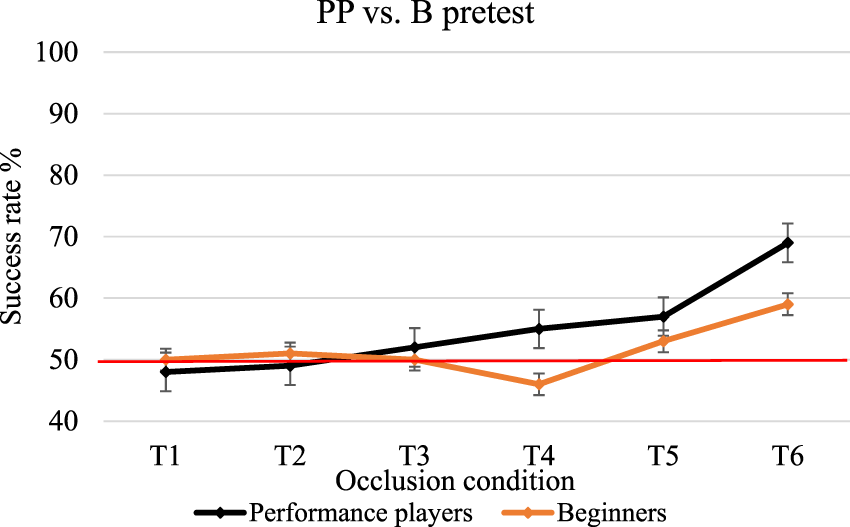
Results of performance players and beginners during pretest. Legend: 50% guess line is highlighted; error bars represent standard error.
Post-hoc pairwise comparisons (Bonferroni) provided further insights into these effects. Due to the large number of data combinations in our analyses, we report only the post-hoc tests with p-values ≤ .100. Within-group comparisons showed significant effect of time between pre and post-test (p = .010); group PPI vs. BC (p = .003); PPI vs. BI (p = .068). As this specific comparison of PPI vs. BI is most important for assessing the perceptual training effect on skill level between intervention groups of beginners and high-performance players, we include Tukey's correction in addition to the primary Bonferroni post hoc test solely to compare the robustness of the results and determine whether they lead to the same or different conclusions. Results were significant with Tukey's correction (p = 0.040) between PPI and BI, but did not reach significance with Bonferroni correction. This suggests a trend toward significance, but findings should be interpreted with caution. Other within-group comparisons revealed significant effect of occlusion T1 vs. T6 (p = .038), T2 vs. T6 (p = .016), T4 vs. T6 (p = .013); interaction between time and group – pretest of BI vs. post-test PPI (p = .018) and post-test PPI vs. post-test BC (p = .024).
The PPI and BI groups achieved better results in most occlusion conditions in the post-test compared to the pre-test (Figure 3). The mean difference between pretest and post-test was up to 6% in T1–T4. The PPI group increased the percentage of correct responses in the post-test in T5 by 15% (to 71%); and in T6 by 17% (to 85%). The BI group improved the responses in the post-test only in T5 by 5% and in T6 by 8% compared to the pretest. In the control groups (PPC and BC), the percentage difference in the results of the pretest and post-test ranged from ± 0–4%.
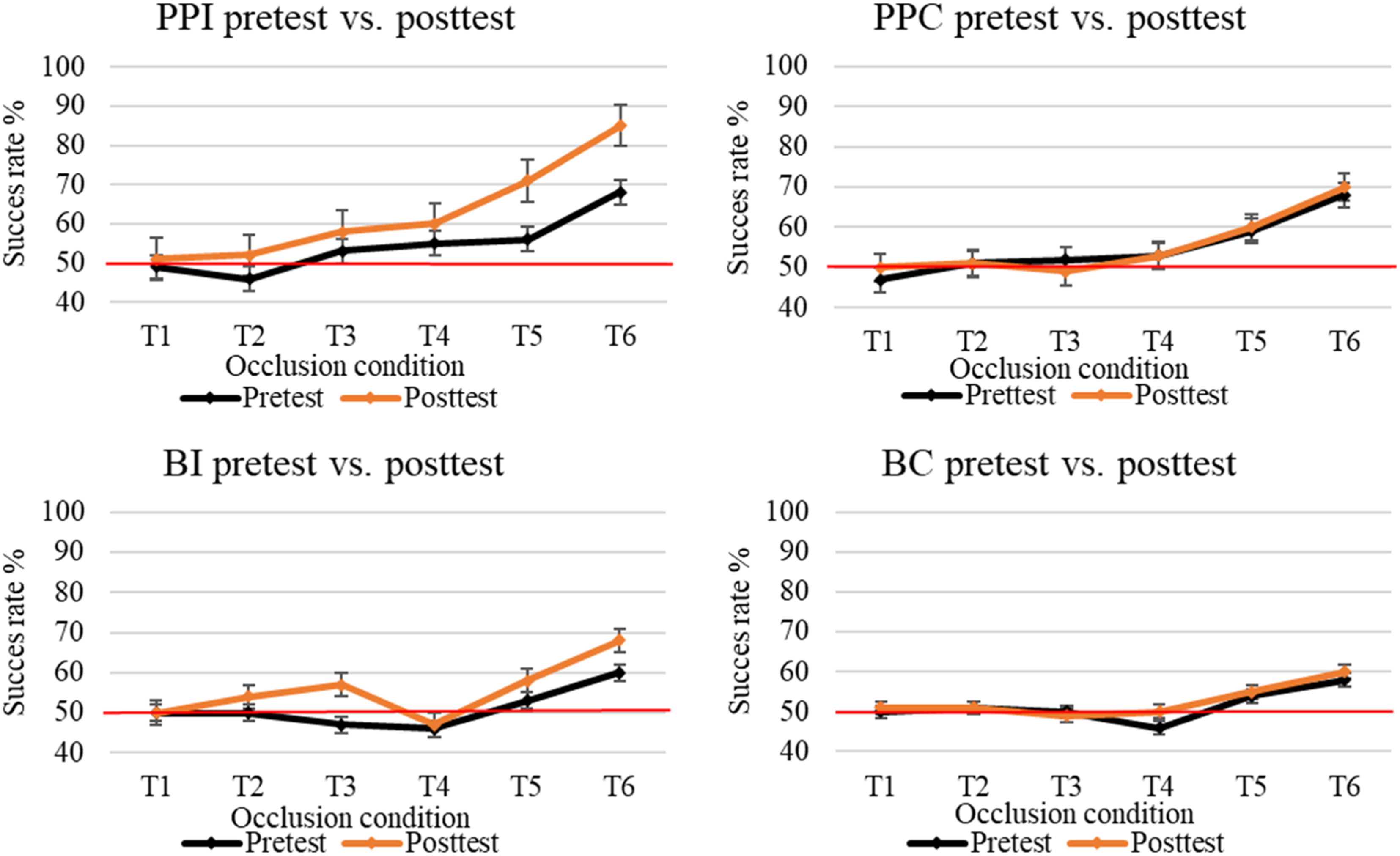
Results of intervention and control groups of performance players and beginners. Legend: 50% guess line is highlighted; error bars represent standard error.
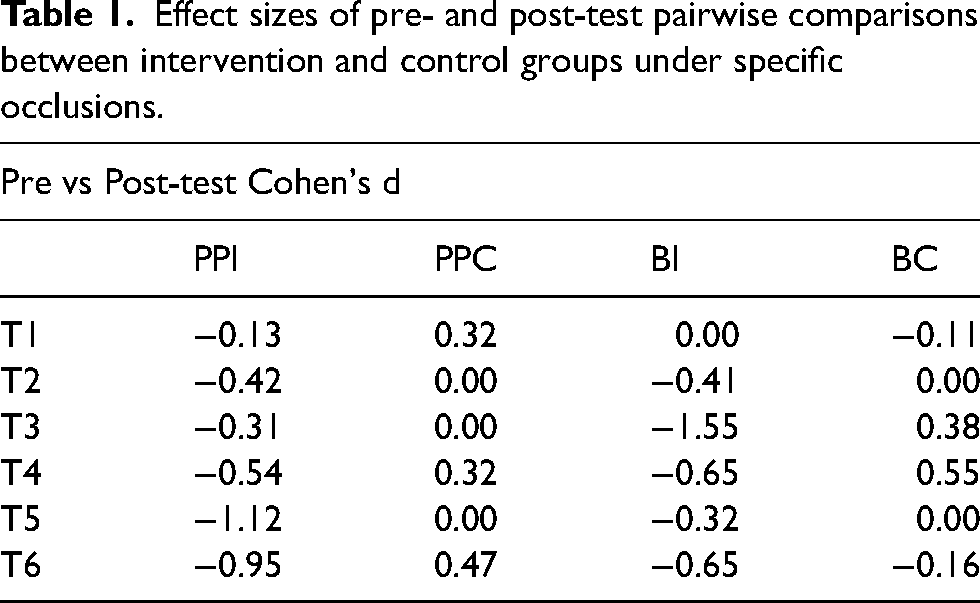
To further assess the magnitude of changes across conditions, Cohen's d values were calculated for pre- and post-test comparisons within each group and occlusion condition (Table 1). As this study primarily focuses on the effect of perceptual training, we specifically examined effect sizes for the intervention (PPI, BI) and control (PPC, BC) groups between the pre- and post-tests during occlusion periods. Notably, larger effect sizes indicate a greater effect in the intervention groups, PPI and BI (see Table 1). We observed none, small, and moderate effects; however, a large effect was observed in T5 and T6 of the PPI group, suggesting a notable improvement in the participants’ anticipation success rates.
Effect sizes of pre- and post-test pairwise comparisons between intervention and control groups under specific occlusions.
Discussion
Our aim was to assess the effect of perceptual-cognitive training based on video recordings on the development of anticipatory skills of PP and B. Our findings only partially support, but not fully confirm, our hypotheses of high-performance tennis players will be significantly better than beginners in development and execution of anticipatory skills. While some significant effects were found, post-hoc tests did not reveal a statistically significant difference between the PPI and BI groups (except for an additional Tukey's post-hoc test). However, supporting evidence includes the overall superior performance of high-performance players and their greater improvements in percentage success after the intervention, with double the improvement in T6 and triple the improvement in T5 compared to BI. Despite these trends, the differences were not statistically significant, with support coming primarily from relative values and effect sizes rather than post-hoc significance tests.
Pre-tests
In the pre-test, participants achieved most accurate results at T5 (racket-ball contact) and T6 (150 ms after racket-ball contact). These results compare favourably to occlusion conditions reported in previous studies.27,30 Surprisingly, the T6 occlusion condition achieved a low percentage of correct responses (B 59%; PP 68%), contrasting with the 70–90% reported by Farrow and Abernethy. 30 This difference can be explained by the later onset of the occlusion condition during the ball's flight and the involvement of experienced tennis players.
Low performance during T1–T4 occlusion conditions in the pretest indicated a difficulty in detecting differences in the first half of toss kinematics to anticipate serve location for different serve types.31,32 or do not provide enough visual information about the unknown serve kinematics to be used for successful anticipation. It should be noted that it can take several games before the receiver starts to read the server's toss. 10 Another explanation for the low T1–T4 performance may be the presence of confounding kinematic information (e.g., variations in the server's stance and position), insufficient information to determine the serve outcome, or lack of skill in detecting relevant cues during these time intervals. 27 Improved results at T5 suggest that watching full toss leads to better anticipation as the toss itself can provide advance information of different serve types. 31 The increase in correct responses occurred at T5 and T6, suggesting the period between T4 and T5 offered arm and racket acceleration together with racket-ball contact. During this period, participants extracted enough relevant information for anticipation 18 who found that sufficient temporally relevant anticipatory sources include moments just before and at the instant of racket-ball contact. Based on these pretest results, it can only be claimed that the amount of relevant visual information leading to a significant increase in anticipation performance can be found immediately after the contact of the racket with the ball and within 150 ms after it. This suggests that ball toss and/or the kinematic phase of the racket acceleration to racket-ball contact contains important information for anticipation, which cannot be found in earlier stages. Compared to beginners, expert players can pick up advance information from the racket-shoulder area and during movement patterns, 8 as well as from the ball toss, 10 which can vary across different serve types and serving locations.32,33
The effect of the perceptual-cognitive training
Based on previous findings of perceptual-cognitive training effects on the development of anticipatory skills in various sports, we assumed there would be an improvement in the post-test responses in PPI and BI groups. However, no significant difference (p = 0.07) was found between these groups. Even though these results are close to significance and trending (additional Tukey's post-hoc test agreed with significance), we observed a large effect size in the PPI group pre- and post-tests along with a much higher percentage improvement compared to the BI group. While this suggests a potential trend indicating a greater effect in PPI, we interpret the practical significance based on the effect size, acknowledging that statistical significance was not reached. This implies that perceptual-cognitive training may have had a meaningful impact on performance, despite the lack of conclusive statistical support. We can explain these results by noting that expert players extract relevant cues through distinct visual search strategies,16,19 fixating their gaze on specific locations for certain durations. This approach can vary between players, particularly among beginners. 15 At the same time, expert players achieve better results when tested with a motor response compared to less experienced players. 34 Comparing the values achieved in pre and post-tests showed improvements including the large effect sizes in correct responses for PPI group.
The results of the PPI group under specific occlusion conditions demonstrate that there was a large relative and effect size improvement at occlusion conditions T5 and T6. Early anticipatory behaviour when receiving the serve, i.e., movement initiation before racket contact with the ball, is not regularly applied in professional players. 35 According to Triolet et al., 36 if anticipatory behavior occurs, the player's movement initiation is made 140–160 ms earlier. The shortest reaction times need to be achieved when receiving a serve. 37 The time “gain” of 140–160 ms with more frequent and more accurate anticipation around the ball's impact could represent a significant advantage resulting in a better performance when receiving a serve, with the possibility of affecting the outcome of the entire match. Farrow and Abernethy 30 also demonstrated the effect of perceptual-cognitive training on the gain and use of advance information under racket-ball contact occlusion conditions. However, they did not reach improvements under subsequent occlusion condition, which included the ball flight. This difference in results may stem from the smaller margin of improvement observed in the last occlusion condition between the pre- and post-tests. This limited improvement was likely because participants had already achieved a very high percentage of correct responses in the pre-test. The BI results showed a slight improvement compared to BC, but the improvement was insignificant. This could be explained by lower effectiveness of implicit learning during the training applied here compared to the PPI and the differences in visual search strategies of beginners. Without explicit training, it is reasonable to assume that beginner players, due to their lack of experience, struggled to focus on relevant cues and recognize finer details as experts do. While explicit learning can sometimes enhance anticipatory performance, implicit learning appears more effective, as it may help avoid cognitive overload during skill acquisition, allowing learners to process information more efficiently and fostering lasting changes in skill over time. 30
Beginners vs. high-performance players
The results showed that, although the PP group had a higher pre-test success rate than the B group, this difference was not statistically significant. We observed comparable results in the T1–T3 occlusion conditions, ranging close to 50% of correct responses. When analyzing the line graph curve, we can observe a performance improvement under T4–T6 occlusion conditions. PP group's better performance under T4–T6 could suggest an acquisition rate of anticipatory information in these time intervals. Other studies support this result27,38–40 that expert tennis players perform better in anticipation tests than tennis novices and can capture relevant information from earlier actions in the opponent's movement pattern. As we included junior players in the PP groups, our results suggest that perceptual training may improve the performance in younger categories advancing the findings of Weissteiner et al. 21 We note that young players may not need to anticipate/perceive the advance information while playing tennis, because they may have more time to respond during the service delivery and may rely only on the ball flight trajectory and reactive behaviour.
Limitations and implications
Video-based perceptual-cognitive training can develop anticipatory skills, which rank among the performance-limiting factors of game performance. This development could represent an argument for its use in practice. Advantages include time efficiency, given that improvement can be observed after twelve training units lasting less than 15 min. The player needs only a display to run the video with perceptual training. There is no need for any premises, coach or sparring partner. The player can practice entirely alone and improve their anticipation skills through very effective implicit learning.34,41 This video-based perceptual training allows transferring training outside tennis courts or sports venues, e.g., to the home environment or when travelling and enables players to save time.
Further investigations should focus on using mobile phones to establish if they can provide sufficient kinematic data to reach a satisfactory level of perceptual-cognitive training effect. One of the study limitations might be comparison of adult beginners with the mix of youth and adult high-performance players. We used the same servers both in the intervention videos and the post-tests videos, which could potentially lead to familiarity effect. Additionally, a transfer test should be included to determine whether participants can transfer obtained skills to various servers, which is a limitation of this study. Despite that, we believe this study brings enough evidence about perceptual training effect on different skill levels. We also suggest that perceptual-cognitive training improved performance in junior categories, so examining this effect in detail in junior athletes and from the long-term perspective would be interesting. The possibility of combining both methods, i.e., perceptual training and watching slow-motion,42–44 could be in the interest to increase effectiveness of this type of perceptual training.
Conclusion
Our study has shown that differing amounts of visual information required for anticipation is obtained in various occlusion conditions. However, regardless of skill level, the moments surrounding the racket-ball contact are the key sources of information for anticipating incoming serves. Results show that more experienced players performed better in anticipation tests, as evidenced by the higher performance of the PP group. After completing perceptual training, the PPI group demonstrated a greater percentage improvement in post-test success rates compared to their pre-test performance, while the BI group showed a smaller improvement. Additionally, larger effect sizes in the PPI group suggest a trend toward greater improvement. Although these findings indicate a potential effect of perceptual training, the lack of statistical significance prevents a definitive conclusion.
Video-based perceptual training can be an effective approach to enhance tennis players’ perceptual and anticipatory skill development, supporting inclusion of this training method in comprehensive tennis training programs. It is also a cost effective and portable technique that can easily be implemented to accelerate visual anticipation skill across a variety of sports. 26 Given the growing interest in anticipation and perception among professionals and general sports public, and the trend of including various types of visual perceptual training methods in daily coaching practice, it is possible that this form of targeted anticipation development in tennis could fulfil its potential as a viable training intervention.
Footnotes
Acknowledgements
The work was supported by the Charles University Cooperatio Sport Science – Biomedical and Rehabilitation Medicine.
Declaration of conflicting interests
The authors declared no potential conflicts of interest with respect to the research, authorship, and/or publication of this article.
Funding
The authors disclosed receipt of the following financial support for the research, authorship, and/or publication of this article: This work was supported by the Charles University Cooperatio Sport Science – Biomedical and Rehabilitation Medicine.
