



Abstract
Maximal strength of the lower body is important for many athletic tasks and demands. Lower body extensor strength, defined as maximal expressions of force in the vertical plane, can be measured in several different ways, using a wide range of tests and metrics. Although there have been investigations into the interrelationships between lower body strength and force measures, there is no known analysis or synthesis of these data that focuses on classifying variables into groups based on statistical similarity and/or distinction. This information is important to consider in an environment where many measurement options exist for diagnosing lower body characteristics. Understanding the overlap and distinction of these analysis methods and metrics will inform parsimonious, yet comprehensive, assessment of the lower body. It was therefore the purpose of this review to explore and summarize the commonality (i.e., r, R2, component loading) between metrics from weightbearing, multi-joint lower body strength tests that are presented in the current literature, with the aim to group metrics into distinct domains of strength expression. The results of this review suggest that five unique domains of lower body extensor strength are present in athletes and trained populations: 1) reactive dynamic, 2) unloaded dynamic, 3) loaded dynamic, 4) early isometric, and 5) maximal isometric. Despite these findings, there are considerable limitations and gaps in the literature, and it is suggested that additional empirical investigations be conducted to better understand this concept of lower body strength domains.
Introduction
Muscular strength has traditionally been defined as the ability to exert force against an object or environment.1–3 While the importance of maximal strength in sport is well documented, 4 the rate, direction, and magnitude of force that underpins the expression of muscular strength can vary considerably across different athletic tasks. 5 Vertical force expressions alone can be highly diverse in athletes, ranging from a time-constrained foot strike in a sprint, to a prolonged action of a ruck where one moves both their own and their opponent's body mass. Lower body extensor muscle groups are responsible for many of these vertical force expressions and are consequently assessed in the strength and conditioning environment. Common approaches to assess lower body extensor strength include weight-bearing, multi-joint assessments executed with maximal effort. Since each of these tests and metrics show strong associations to various aspects of sport performance,4,6 it is common to combine multiple tests into batteries, believing each test provides a subtly different insight into an athlete's capability. However, the ability to communicate meaningful, unique information with minimal overlap is challenged with the large amount of data available from these tests. Specifically, with the introduction of newer technology and methods to assess physical qualities, there has been a substantial increase in variables representing lower body strength, which has not been matched with a clear understanding of the value each variable represents. This creates a challenge for practitioners wishing to conduct comprehensive strength testing in an effective and efficient manner. To address this problem, it is advantageous to classify measures of lower body extensor strength into distinct qualities to help guide effective and efficient assessment strategies.
Previous research has been conducted with the goal of classifying strength metrics into groups of similar information using a variety of classification criteria. 7 Metrics of lower body strength have been classified based on mechanical quality such as maximal strength, ‘power’, jump height, or rate of force development (RFD). Although helpful to distinguish aspects of each movement, the quantity derived from two different tasks may be representative of different qualities. For example, peak force measured in a CMJ and 1-RM back squat may measure different abilities to express force. Alternatively, a movement pattern classification system such as grouping tests and metrics into ballistic, non-ballistic, and isometric actions has been applied. 6 While this is an intuitive method, it does not always account for variation in load or temporal constraints applied to the system under each of these categories (e.g., CMJ and CMJ with 60 kg) that can greatly influence the force expression and neuromuscular demand of a movement. 8 In other cases, ballistic actions have been grouped by test such as CMJ or squat jump, 7 yet this method also lacks consideration of task constraints that may directly influence how force is expressed. Within a particular task or external constraint, there may be metrics measuring unique information, such as that observed in timing and outcome metrics of a CMJ.9,10 This distinction within a task category may be captured when the classification system groups muscular strength/force-time variables into speed- (“starting” and “explosive”) or maximal-strength categories for both static (i.e., isometric) and dynamic conditions. 11 In this model, strength is not classified into isometric and dynamic actions, and is instead considered elements of both. 11 Although a helpful approach, this method does not account for the abovementioned muscle actions and external load differences that may influence the underlying force expression across tasks.
There have also been empirical studies involving principal component analyses (PCA) used to classify general physical characteristics12,13 and lower body strength and ‘power’14,15 within resistance-trained and athletic populations. Though this work may help guide strength assessment practices, these studies involved only a subset of strength tests commonly used in the modern strength and conditioning environment, which limits its applicability to many of today's practices. Recently, the relevant strength diagnosis trends reported in both empirical 14 and theoretical 16 work were reported in a practitioner-focused review. 7 The results of this review suggest that lower body strength metrics fall into five different categories: reactive strength, light maximal dynamic strength, heavy maximal dynamic strength, maximal isometric strength, and explosive strength. 7 While the authors summarized trends in strength assessment data, this review did not include a systematic analysis of the relevant data, which may limit the thoroughness of the consolidation process for lower body strength metrics. Although each of these classification systems provide valuable considerations for strength assessment practices, there is no single method that offers a data-driven classification system that considers the range of test constraints and force-time metrics available in today's practice.
Considering the available information, it is prudent to undergo a comprehensive review on the classification of traditional and contemporary measures of lower body extensor strength. A data-driven classification process involving statistical techniques to quantify the similarities and differences between variables is likely to enhance or outperform subjective methods employed by researchers or practitioners, especially when involving extensive datasets across studies. This involves employing basic statistical outputs such as correlation (r), regression (R2), and data reduction techniques (e.g., component loading) to discern statistical similarity among specific metrics. Thus, the purpose of this review was to explore and discuss the commonality between weightbearing, multi-joint lower body extensor strength metrics in athletes and trained populations using a comprehensive classification system to summarize the existing literature.
Materials and methods
The assessment of muscular strength has traditionally been stratified into isometric, isointertial and isotonic muscle actions. 17 For athletes, the most relevant types are isometric and isoinertial (dynamic),4,6,14 and therefore, this review focused exclusively on these conditions.
Literature search
Original and review journal articles were extracted from electronic searches of Google Scholar, Medline, SportDiscus, Cochrane, and CINAHL with language limited to English. Not date limit was applied. An additional search of each article's reference list was undergone. The search strategy included the search terms ‘muscular strength’, RM, ‘repetition*maximum’, ‘drop jump’, ‘rebound jump’, ‘squat jump’, countermovement, CMJ, ‘concentric strength’, ‘eccentric strength’, ‘reactive strength’, athlete*, sport*, player*, lower-body, squat, deadlift, ‘dead*lift’, ‘power*clean, ‘full*clean*, ‘clean*pull’, power, ‘isometric mid*thigh pull’, and ‘isometric*squat’. The search was completed in September 2024. Articles were selected if they included an assessment of multi-articular, vertical dynamic or isometric assessments of the lower body, and involved athlete or resistant-trained participants. Tests within the selected studies were not included in this review if they assessed upper-body, single-joint, isokinetic, or horizontal properties, as these muscular characteristics are outside the scope of this review. Of these articles, only those that contained a statistical comparison of shared variance between two or more measures of lower body strength and/or force were included in the classification process.
Classification system
The classification system employed in this review involved three steps. Step 1: lower body assessments gathered from existing literature were categorised based on a) muscle action, b) external load constraint, and c) external time constraint (Figure 1). Step 2: Each performance variable (force, time, force-time, or load) was assessed for commonality with other variables within the same assessment category (Figure 1). Step 3: Variables were then assessed for commonality across different assessment categories (Figure 1). Collectively, this approach offered a comprehensive and data-driven method to evaluate the commonality and uniqueness of information available from lower body extensor strength assessments.
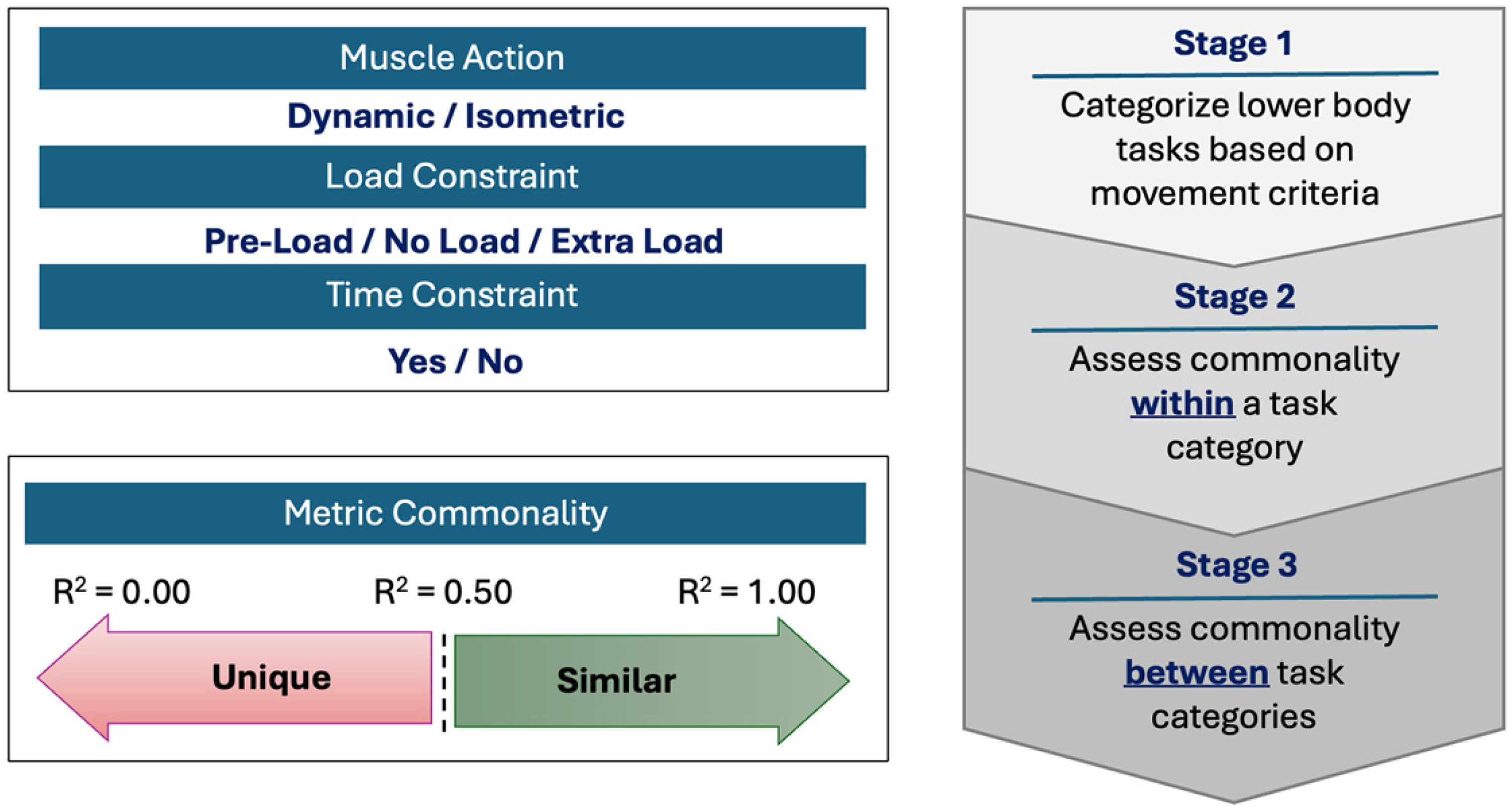
Criteria used to classify strength assessment tasks and assess commonality between strength metrics.
In the first step, lower body assessment methods were categorized based on similar task constraints. Movement type including (dynamic ballistic, dynamic non-ballistic, use of the stretch shortening cycle (SSC), isometric), external load constraints (barbell, pre-load due to gravity) and temporal constraints (instructions to “move fast”, “move gradually”, or contraction time criteria). For example, the drop jump and rebound jump were placed in the same category since the portion of the task that is evaluated share similar load temporal (pre-loading from gravity acting on the centre of mass) and temporal (“fast off the ground” instructions) constraints.
The second stage of this study involved assessing commonality of variables in the same constraint category, and the third stage involved assessing commonality of variables between categories (Figure 1). To quantify commonality, a threshold-based approach was employed. Variables with shared variance > 49% (r > 0.70; R2 > 0.49)18,19 were termed “similar” and those that shared ≤ 49% (r < 0.70; R2 < 0.49) were termed “unique” for the purpose of this review (Figure 1). When data reduction techniques such as factor analysis or PCA were used, variables that loaded heavily onto the same component or latent factor were considered to be more correlated with each other than with variables loading onto different factors.
Results
The first stage of this classification process returned six groups of tests and metrics based on the external constraints of the tasks (Figure 2). These categories were used for the subsequent comparisons in step two and three.
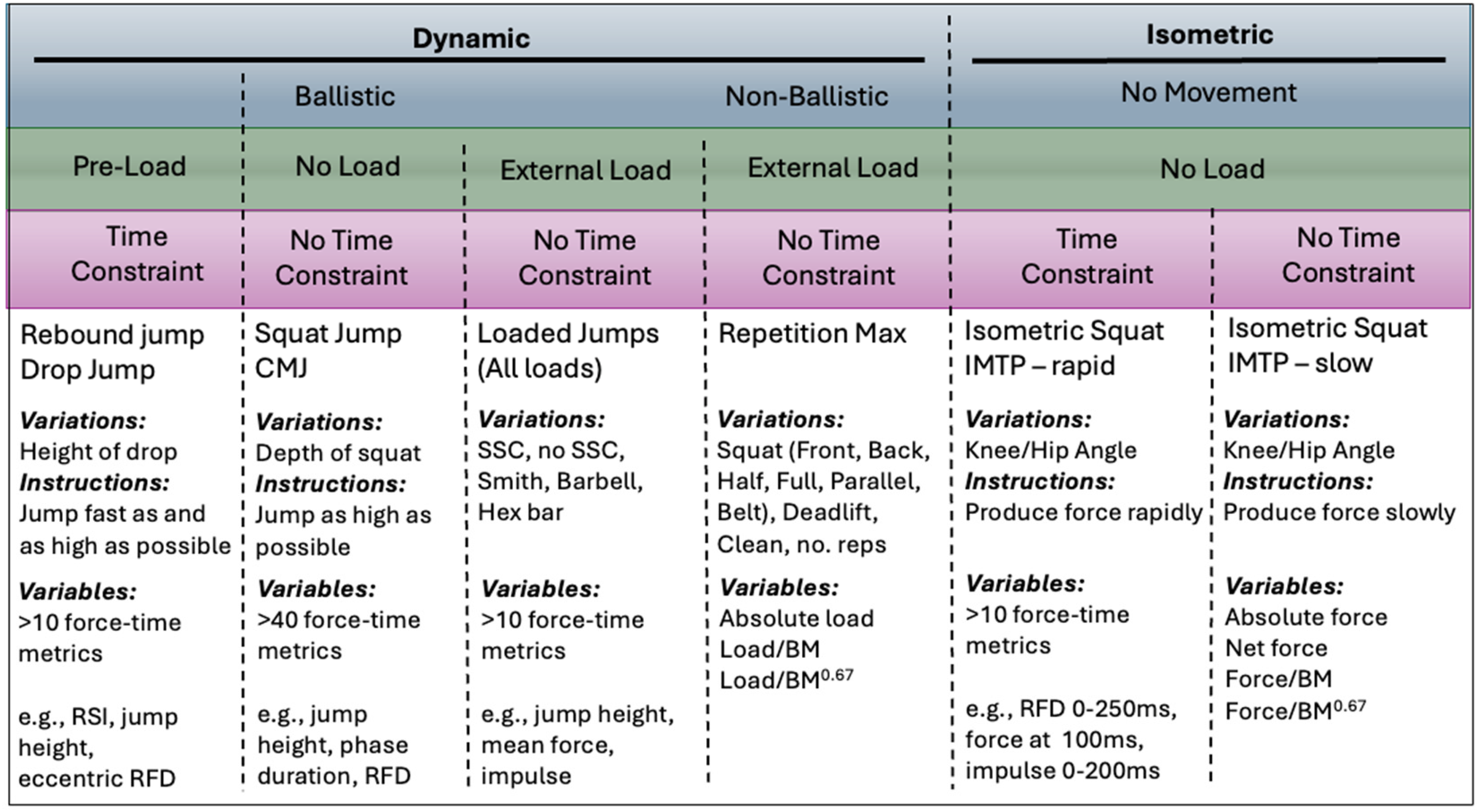
The categorization of strength tests based on muscular contraction type and external constraints of the tasks. CMJ = countermovement jump, IMTP = isomeric mid-thigh pull, RSI = reactive strength index, RFD = rate of force development.
The second step of this classification revealed that most variables from the same task category shared over 50% of variance or were inconclusive (Table 1). The exceptions were timing and outcome variables within the unloaded ballistic task category, which shared approximately 1–10% variance. This indicates that these variables may provide unique information about unloaded dynamic force expression.
Summary of relationships between metrics from the same task constraint category.
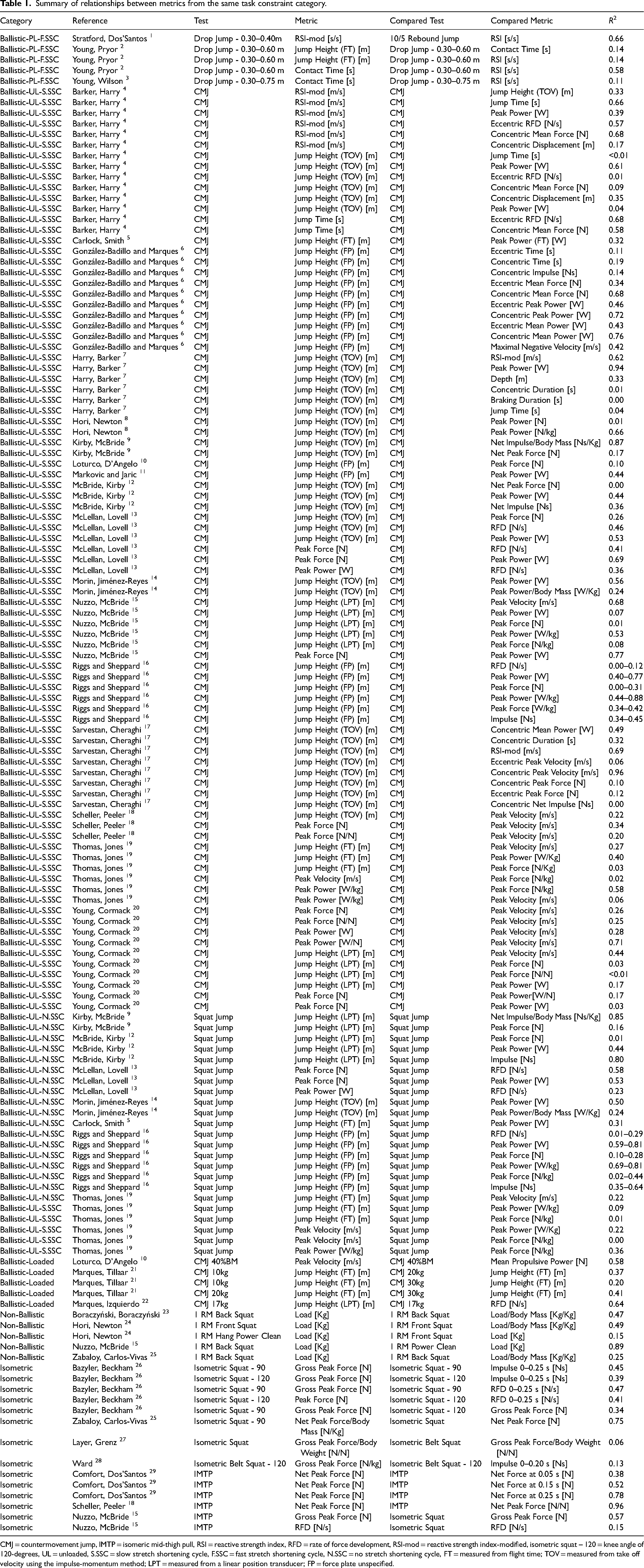
CMJ = countermovement jump, IMTP = isomeric mid-thigh pull, RSI = reactive strength index, RFD = rate of force development, RSI-mod = reactive strength index-modified, isometric squat – 120 = knee angle of 120-degrees, UL = unloaded, S.SSC = slow stretch shortening cycle, F.SSC = fast stretch shortening cycle, N.SSC = no stretch shortening cycle, FT = measured from flight time; TOV = measured from take off velocity using the impulse-momentum method; LPT = measured from a linear position transducer; FP = force plate unspecified.
Lastly, strength variables were analyzed across the different assessment categories. While some overlap was observed, the majority of metrics were unique, highlighting differences in force expression between the task conditions (Table 2). Specifically, there were differences between dynamic and isometric task metrics, metrics that evaluated the fast SSC and those that measured the slow SSC, and those measuring non-ballistic and unloaded ballistic tests. There were inconclusive findings concerning the commonality between unloaded and loaded ballistic tasks. Overall, these findings suggest that at least five unique domains of strength and force-expression exist in the lower body of athletes and trained individuals.
Summary of relationships between metrics from different task constraint categories.
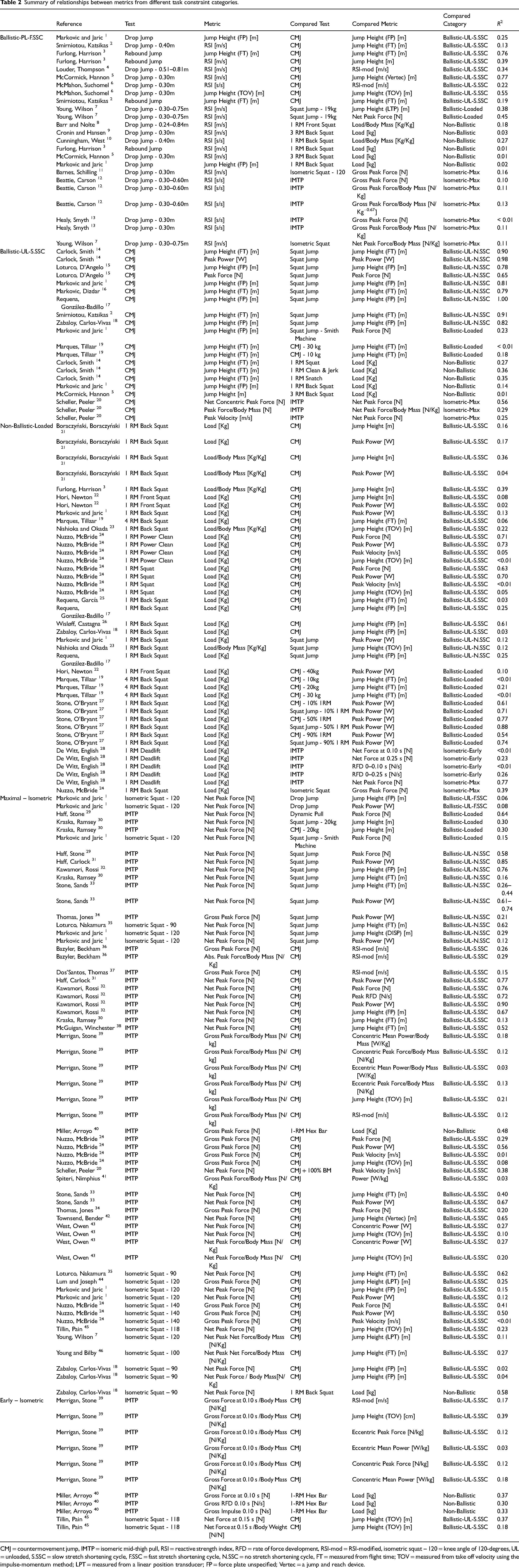
CMJ = countermovement jump, IMTP = isomeric mid-thigh pull, RSI = reactive strength index, RFD = rate of force development, RSI-mod = RSI-modified, isometric squat – 120 = knee angle of 120-degrees, UL = unloaded, S.SSC = slow stretch shortening cycle, F.SSC = fast stretch shortening cycle, N.SSC = no stretch shortening cycle, FT = measured from flight time; TOV = measured from take off velocity using the impulse-momentum method; LPT = measured from a linear position transducer; FP = force plate unspecified; Vertec = a jump and reach device.
Discussion
The three-step classification process employed in this review allowed vertical strength and force expression to be categorized into five unique domains. Although there are some common trends observed in the reviewed data, many of the reported associations and relationships in strength and force-time metrics varied across studies. This may be a result of several confounding factors such as population, collection procedures or equipment, all of which are discussed in the subsequent section. Overall, this review provides a data-driven, systematic approach to understanding the classification of lower body extensor strength variables available in today's practice that can be used to inform efficient and effective lower body strength diagnosis.
Ballistic–pre-loaded–fast SSC
When body segments are exposed to high stretch loads, as seen in a drop and rebound jumps (i.e., “pre-load”), combined with instructions to minimize contact time, and maximize jump height, the fast SSC can be effectively utilized and evaluated.20–25 The fast SSC is defined as the musculotendinous unit's ability to produce rapid eccentric and concentric actions within 0.25 s2,26–28 and is thought to be highly relevant to athletic tasks such as endurance running, cutting or pivoting, accelerating, and running at maximal speed. 29 The most common measurement derived from the drop and rebound jump is the reactive strength index (RSI), representing the ratio of jump height and contact time (or similar). 29 These tests can also provide data on jump height, flight time, contact time, 29 braking (termed ‘eccentric’ in some reports), rate of force development, 30 power, and takeoff and landing peak force, 31 which all tend to share a considerable amount of variance (R2 = 0.50–0.94) 32 (Table 1). As long as the tasks constraints are upheld (i.e., contact time < 0.25 s) 33 the commonality between each of these metrics remains high (R2 > 0.50) irrespective of drop height (e.g., 0.30 m to 0.45 m).34,35 The high correlation between metrics may be a result of how each metric is calculated. For example, the strong correlation between jump height and flight time could be inflated in studies where jump height is derived from flight time (i.e., take off velocity = [9.81*flight time]/2) instead of more accurate methods such as the impulse-momentum method.36,37 Similarly, the correlation between peak power and jump height may be artificially inflated since take-off velocity (used to calculate jump height) and propulsive velocity (used to calculate mechanical power) are highly collinear. 38 Thus, the calculations behind each metric should be considered when interpreting shared variance across metrics. Unlike metrics within a test type, the shared variance between an RSI calculated from a rebound and drop jump is only about 30%. 39 Despite each test being designed to measure the fast SSC, the limited shared variance may be due to the different jump strategies used for these tasks, 40 though it is difficult to draw conclusions from a single study.
When evaluated in athlete populations, metrics derived from drop and rebound jumps shared only about 50% of variance with metrics from other dynamic and isometric assessments (Table 2). The associations between drop jump RSI and 1–3-RM range from r = 0.07–0.33 in absolute35,41–43 and r = 0.52–0.6943,44 in relative values, suggesting that different qualities are being measured. Further, a single study reported associations between drop jump and loaded CMJ metrics ranging from r = 0.62–0.67 14 (Table 2). It is important to note that the strongest reported correlations between heavy dynamic tasks and reactive strength tasks were observed in a study that involved high (> 0.60 m) drop heights and recorded contact times > 0.25 s, 35 indicating that depth drops (i.e., no time constraints 45 ) rather than drop jumps (i.e., contact times < 0.25 s) were performed. While athletes of varying skill and strength levels can effectively train and test from drop heights, 46 it is crucial that the ground contact times be measured to ensure the appropriate physical quality is being used in the task. Despite its importance, ground contact times of drop or rebound jumps are often overlooked. For instance, a recent practitioner-focused review illustrated drop jump force-time traces that varied from ∼0.20 s to ∼0.50 s despite mention of a < 0.25 s contact time criteria. 47 This highlights the ease with which contact times can be missed or disregarded when analysing data. Collectively, force expressions measured from tasks involving a pre-load and ground contact times of < 0.25 s are unique from that of loaded ballistic and non-ballistic task categories (Table 2). Based on these findings, it is recommended that practitioners select a task where athletes can achieve contact times of < 0.25 s when instructed to jump as high and as fast as possible to measure the reactive strength quality. If an athlete cannot meet these criteria, it is advisable to first develop their reactive strength capacity before assessing this quality.
Ballistic–unloaded–SSC
Ballistic movements involving the slow SSC with no additional load (i.e., unloaded) are frequently used in the strength and conditioning environment to assess and monitor neuromuscular capacity. 48 The slow SSC is characterized by a rapid eccentric muscle action followed by a rapid concentric muscle action, with a duration exceeding 0.25 s. The most common task used to assess this quality is a CMJ.25,28,49 The CMJ is a simple, non-exhaustive test that is relevant to many sporting tasks.50–56 Although a CMJ with an arm swing has been used, 48 this variant can be considered a sport performance task rather than a direct measure of lower body force expression 57 and has not been considered in this review. The CMJ can be measured using a wide range of equipment and collection methods that vary considerably in cost, accuracy, and data output.
When performed on force-platforms, an array of performance measures can be generated from the CMJ (i.e., 20–40 in recent reports).9,10,58 This presents a challenge for researchers and practitioners to identify the most appropriate variables for their athletes9,59 and consolidating findings across independent studies. Although some CMJ metrics consistently demonstrate strong interrelationships, such as that observed between jump height (measured from takeoff velocity) and peak velocity (R2 = 0.44–0.96),60–62 others are more variable. For instance, there are substantial differences in the relationships between CMJ jump height and peak/mean force (R2 < 0.01–0.60),63–65 peak power (R2 = 0.07–0.94),15,50,55,60,66–69 impulse (R2 < 0.01–0.87),60,64,67,70–72 RFD (R2 = 0.01–0.65),73–76 and RSI-modified (R2 = 0.62–0.69). 60 These discrepancies may be a product of methodological differences such as verbal instructions,,24,77 measurement equipment (e.g., position transducer verses force plate), fatigue levels,48,78 or countermovement depth.70,79 Most importantly, these differences may have resulted from the method of analysis and/or metric calculation.37,80 For instance, many of the force dependent calculations (i.e., impulse, force, power) can be represented as gross (body weight included) or net (body weight subtracted) measures. Additionally, the method of calculating peak power (i.e., from absolute or relative force or jump height 38 ) and RFD (e.g., including part of the unweighting phase in the braking calculation, 76 or not specifying the phase 73 ) can drastically affect what the metric represents and, in turn, the relationship to other variables. For example, when jump height and power were both calculated from flight time, there was a near perfect relationship between these metrics (R2 = 0.94 50 ). In contrast, when power and jump height were correctly derived from force-time data, the relationship is much lower (R2 = 0.44 72 ). Thus, to ensure accurate comparisons across studies, it is crucial to understand and account for the specific calculation method(s) used for each metric. It is also possible that commonality between metrics is influenced by the type of athlete and their training history. 78 For example, volleyball, basketball, and football athletes demonstrated rather low relationships between CMJ jump height and mean concentric force (R2 = 0.08 to 0.32), 81 whereas track and field and recreational athletes demonstrate much stronger relationships (R2 = 0.59–0.71).63,64 Thus, it is possible that different athlete groups present with different relationships between metrics, and in turn, different domains of strength. This can only be tested, however, by employing research with consistent testing procedures and metric calculation methods across populations.
Despite the variations within different outcome variables, there is relatively consistent evidence suggesting that timing metrics are independent from the outcome metrics of the CMJ. This is evidenced by the reported relationships between jump height and braking (termed ‘eccentric’ in some studies) duration (R2 < 0.01–0.17)64,69 and total jump time (R2 < 0.01–0.40).64,69,74,76 These trends are corroborated by data reduction models in athletic, 82 tactical, 10 and recreational 9 populations where outcome (e.g., jump height), and timing (e.g., braking duration) metrics load separate PCA components.9,10,82 The distinction between CMJ outcome and timing variables is further supported by work examining intact waveforms, 83 where athletes tend to cluster into groups driven by their ability to jump high or jump quickly. These results not only suggest that timing and outcome metrics are unique but also suggest that the performance level or athlete type of the participant can influence the relationships between metrics. 83 It is also important to note that intact waveform analyses such as statistical parametric mapping may provide additional insights into movement strategy and fatigue of the athlete that discrete measures cannot fully capture. 84 Thus, it is recommended that this analysis method be considered and compared to other measures of strength expression in future research.
In summary, while numerous metrics can be derived from a CMJ, variations in calculation methods can obscure the distinctions between them. It is therefore recommended to use the most biomechanically supported methods to calculate force-time metrics from the CMJ and to account for the calculation method when interpreting results. Given the consistent differentiation between timing and outcome metrics in unloaded ballistic tasks, metrics within this category were compared to others based on these variable types.
Ballistic–unloaded–no SSC
A vertical jump task performed with no external load and no SSC (i.e., concentric only movement) is termed a squat jump. Although fewer metrics can be derived from the squat jump, this concentric-only action is represented by >10 discrete performance variables when performed using modern technology.80,85 There are few studies that have evaluated the commonality between discrete force-time metrics of the squat jump (Table 1), showing a range in commonality between jump height and peak power (R2 = 0.09–0.81),15,73,75,86 impulse (R2 = 0.64–0.87),70,75 peak force (R2 = 0.01–0.29),65,70,75,86 peak velocity (R2 = 0.22), 86 and RFD (R2 = 0.29). 75 In light of these data, it is possible that a distinction exists between outcome (e.g., jump height) and timing (e.g., RFD) metrics of the squat jump, yet the variability in study methodology and movement strategy of the participants maybe be confounding this observation. Overall, it is recommended that additional work be conducted prior to drawing these conclusions.
The CMJ and squat jump are often considered distinct tests 87 as one utilizes the SSC while the other does not.49,87,88 It is also well accepted that greater jump heights are achieved in the CMJ compared to the squat jump89,90 and the magnitude difference between these two jumps can represent eccentric utilization 78 or pre-stretch augmentation. 91 Despite these discrepancies, CMJ and squat jump height share high levels of commonality, ranging from very strong to almost identical (R2 = 0.80–0.95).43,50,66 Further, concentric impulse, mean force, and power of the two jump types share over 50% variance (R2 = 0.50–0.81)15,67,92 and have similar factor loadings in PCA analyses. 15 One important consideration when interpreting these data is the compliance of the participants to a concentric only action (i.e., no countermovement or unloading) in the squat jump. It is common for participants to perform a small countermovement in squat jumps which is often undetectable without carefully analyzing the force-time trace, 93 which can make it difficult or unrealistic for practitioners to standardize this test in ‘real time’. Thus, these strong correlations must be interpreted with this limitation in mind. Furthermore, the discrepancies in power, impulse, and mean force may result from differences in jump depth, with some studies allowing self-selected depth in the CMJ, while most studies examining a squat jump involve a standardized squat depth (e.g., 90-degrees). Taken together, these findings suggest that outcome metrics of a CMJ and squat jump be considered a similar expression of force.
When unloaded ballistic tasks are compared to pre-loaded fast SSC tasks, the commonality is highly dependent on the metric used to represent each category. Specifically, the relationships between CMJ height and drop jump height are strong (R2 = 0.55–0.96),24,94 whereas the relationships to contact time metrics such as RSI and RSI-modified in the drop jump and CMJ, respectively, are low. 94 This does not seem to be the case when comparing unloaded ballistic tasks to other categories, as CMJ height is reported to share as little as 3% 95 and as much as 66% 15 of variance with the 1-RM squat test and as little as 1% and as much as 88% with loaded CMJ and squat jumps metrics (jump height, peak power and velocity) across a range of loads (10 kg-125% BM)68,96 (Table 2). Despite this variability, most reports demonstrate relationships bertween unloaded ballistic outcome metrics and loaded ballistic and non-ballistic outcome metrics to range from R2 = 0.29–0.6715,92,97–101 and R2 = 0.20–0.66,55,66,97,99,102,103 respectfully.
Fewer studies have evaluated the timing metrics of the unloaded ballistic tasks across task categories. Of the few available reports, RSI-modified94,104–106 and RFD 107 measured in a CMJ appear to be independent from early (RFD, force < 0.15 s) isometric, peak absolute and relative isometric, and RSI measured in a drop jump r = 0.22–0.46.43,63,94,104–107 There were no studies identified in this review that compared CMJ timing metrics to measures derived from loaded ballistic tasks. Overall, it appears that timing variables from an unloaded ballistic task are unique from many other dynamic and isometric tasks, yet there remains insufficient evidence to fully recognize this group of metrics as a unique domain of force expression. Thus, outcome and timing metrics from unloaded ballistic tasks will be considered a single domain in this review.
Ballistic–externally loaded
When ballistic movements are loaded with external mass or resistance, they introduce unique task constraints for the individual. 108 These movements are often performed as a vertical jump109,110 and can be represented by a multitude of force-time metrics when measured using force platforms, accelerometers, or position transducers. While each measurement method is valid, caution is advised when using linear position transducers, particularly with free weights, as some devices fail to account for motion outside a single plane (e.g., mediolateral or anterior-posterior). 111 Similarly, accelerometer-based devices often show poor reliability under high-speed, low-load conditions. 112 These measurement limitations can collectively impact the accuracy of metric calculations. Loaded ballistic tasks are often loaded using an Olympic barbell, Smith machine, or trap bar (i.e., hex bar) and can be performed with or without a countermovement.6,99,113–115 Though the modality of external loading can lead to different performance outcomes,115,116 the associations remain high (Table 1), suggesting that the loading modality does not affect the strength quality being assessed.110,114,117 It also appears that outcome metrics such as peak power and jump height share high levels of variance between SSC (i.e., CMJ) and non-SSC (i.e., squat jump) movements 96 (Table 1), with jump height becoming more similar as load is increased.26,27 It is possible that the benefits of the SSC diminish with heavier loads and longer phase durations, leading to the convergence of these two test types.26,27 Taken together, these findings suggest that loaded ballistic tasks, irrespective of loading modality or use of the SSC, represent measure a similar expression of force.
Loaded jumps have been examined under a range of loads from 10% BM to 90% of a 1-RM back squat. Although 30% 1-RM was proposed to represent the distinction between “light” and “heavy” loaded jumps,118,119 there is insufficient evidence to support this distinction. Although there is consistent evidence demonstrating a reduction in both jump height and peak power as load is added to a jump,120–122 the correlation between these values is inconsistent across reports. 72 For example, in resistance-trained subjects, performance in “light” loaded jumps (10% 1-RM) is highly related (R2 = 0.62) to the performance in “heavy” loaded jumps (90% 1-RM). 96 In contrast, among elite volleyball players, performance in 10 kg and 30 kg loaded jumps show a relationship of only R2 = 0.20. 123 It is possible that the commonality between loaded ballistic tasks are influenced by the strength level or training status of the participants rather than the absolute load.120,124 Additionally, it's worth considering that these relationships may be affected by whether the load is based on strength values, an individual's body mass, or simply measured as an absolute load. Due to the variance between study designs and results, it is difficult to consolidate the evidence to inform the distinction between “light”, “heavy” and potentially “moderate” loaded ballistic assessments for the purpose of assessing distinct strength qualities.
Among jumps performed with “moderate” and “light” loads (20% and 40% 1-RM back squat), the relationship between jump height and peak force is negligible (R2 = < 0.01–0.01). 72 In contrast, higher correlations exist between jump height and relative impulse (R2 = 0.36–0.80) 72 and jump height and peak power (R2 = 0.44–0.66). 72 These results are limited to only a few findings, restricting the ability to distinguish loaded ballistic tasks into multiple categories.
There are few studies investigating metrics from loaded ballistic tasks against those from other test categories. Of this limited body of literature, metrics from “heavy” loaded ballistic tasks (i.e., 100% BM) share more variance with isometric peak force (44–49% 92 than “light” loaded ballistic tasks (20% BM, 11 kg, or 20 kg) (15–25%15,125,126). Despite this, both loaded conditions remain unique form isometric metrics. Furthermore, the relationships between loaded CMJ/squat jump height and IMTP peak force, force at 0.05 to 0.25, and RFD range from R2 = 0.06 to 0.44.125,126 These results suggest that metrics from loaded ballistic tasks measure a unique quality from that of isometric tasks.
Based on the available data, the commonality between non-ballistic and loaded ballistic metrics are relatively consistent. Peak power, velocity, and jump height measured from CMJs loaded with 10–90% 1-RM share 54–88% variance with 1-RM back squat values, 96 with the strongest associations occurring between 1-RM and the loads in the middle range of this spectrum (40–80% 1-RM) (r = 0.80–0.94). 96 Furthermore, when placed into a factor analysis, squat jumps with > 30% 1-RM and 1-RM back squat heavily load the same factor (0.92, 0.93) suggesting these variables greatly contributed to the same component of variance. 15 In contrast to these cross-sectional data, training with 30% 1-RM has been shown to imporve unloaded CMJ performance, while training with loads of 80% 1-RM increases peak force and 1-RM values. 119 These training results suggest there may be a distinction between 30% and 80% 1-RM loaded conditions not captured in the cross-sectional analyses. Overall, there is no clear understanding of which loaded ballistic condition(s) should be assessed to represent a unique quality of lower body strength. Additionally, there is a significant gap in understanding how the range of available force-time metrics from these tasks relate to one another and to other lower body strength qualities. It is therefore unclear where loaded ballistic tasks should be categorized within this classification framework.
Non-ballistic–externally loaded
Non-ballistic actions refer to movements where the lifter and/or barbell remain grounded (i.e., do not enter free space) such as that in a traditional back squat. 108 When assessed in a maximal capacity, non-ballistic strength tests are considered the gold standard for “maximal dynamic strength”. 127 Maximal strength is considered one of the most important physical qualities underlying athletic ability and has been linked to key performance indicators across a wide range of individual and team-based sports 4. This quality has traditionally been measured using 1- to 3-RM tests,4,42,128–130 yes can also be assessed using 5- to 10-RMs.131–133 These higher rep ranges have a near-perfect relationships with 1-RM values (R2 = 0.96 to 0.98), 134 yet are not recommended in practice, as the error in estimating 1-RM increases with each additional repetition. 134 Sub-maximal loads moved with maximal intent can also be used to estimate a 1-RM due to the largely linear load-velocity relationship in multi-joint actions.135–137 Though attractive, this method may only be accurate when using heavy (> 90% 1-RM) loads. 137
The most popular means of assessing maximal lower body non-ballistic strength is by using the squat. Though variations of the squat exist, they are each highly associated to one another (r = 0.94–0.98)138,139 when measured in trained and athlete groups (Table 1). Concentric- and eccentric-only squats have also been used to assess specific dynamic properties140,141 which appear to be nearly identical (R2 = 0.89–0.91) to the traditional eccentric-concentric squat condition. 140 The deadlift has also been used, sharing 70–90% variance with the back squat66,142 (Table 1). The clean, including the full clean, power clean, and hang clean, is another means of assessing strength in the lower body. The different variants of this lift are highly correlated (r = 0.86–0.97), 143 and share a considerable amount of variance with the back squat (R2 = 0.81–0.89)66,102 and deadlift (R2 = 0.81) 142 (Table 1). Overall, the large proportion of shared variance between 1- to 3-RMs of a squat, deadlift and clean variations suggest that these tests measure a similar physical quality in athletes and trained populations. There is less consistency when evaluating the relationships between absolute loads and loads relative to body mass (Table 1), yet this may be a result of changes in body mass rather than strength levels. Relative 1-RM values tend to be closer to other measures of dynamic performance (e.g., CMJ height). 66 This suggests that absolute values may provide more distinct information about an athlete, yet further research is required to distinguish these metric types. Overall, non-ballistic strength variables appear to be distinct from unloaded dynamic task metrics.
Isometric
Maximal isometric strength is characterized by maximal force applied to an unyielding object irrespective of the rate or ability to sustain the effort.2,3,144,145 Isometric tests are attractive to practitioners as they are a safe, time efficient, and reliable means of assessing maximal force production,6,7,146 and have been linked to a range of athletic qualities.146,147 The most common methods of assessing multi-joint isometric strength is via the IMTP 144 and isometric squat 145 performed on a force platform. Peak force measured in these tasks share anywhere from ∼6% to 57% variance.66,148,149 This variability is potentially due to athlete bias towards one of the two movements due to previous and/or preferred training positions (i.e., squat or clean pull) or the influence of other body segments such as the back and arms. 149 This value can be represented as gross value (including body weight), net (minus body weight) value, or relative value scaled to body mass (i.e., force/body mass, force/body mass0.67). The relationship between absolute (gross or net) and relative peak force varies across the literature (Table 1), which may in part be due to the range in methods used to calculate the scaled/relative values. 146 Nevertheless, absolute and relative measures appear to load the same factor when placed in data reduction models. 14
Another set of metrics that can be derived from maximal isometric assessments are rate (i.e., time, epoch) dependent metrics. When an isometric test is performed with the intent to produce force rapidly, the force-time trace can be partitioned into epochs for assessing the rate at which force is produced. This is believed to be particularly important for sporting tasks that involve time-constrained actions such as sprinting or changing direction. 150 Common force-time metrics that are generated from multi-joint isometric assessments are instantaneous force, impulse, and RFD. When each of these metrics are calculated over the same or similar epoch (e.g., force at 0.10 s, RFD 0–0.10 s, Impulse 0–0.10 s), they risk high levels of collinearity as they are derived from either the average or total force over the same epoch. 146 Similarly, instantaneous force expressed as a percentage of peak force [%] and relative to body mass [N·kg−1] show strong correlations when measured over the same epoch. 151 There are no studies identified in this review process that have evaluated the relationship between either peak or average RFD with epoch-constrained force metrics (e.g., force and RFD at 0.20 s), possibly due to the assumption of high collinearity between metrics. When assessed across test types, there appears to be considerable unexplained variance between RFD measured in the IMTP and isometric back squat (R2 = 0.15). 66 This variance could stem from different early force production patterns inherent to each test's body position or an athlete's preferred position, yet more research is warranted to explore these differences.
The relationships between peak force metrics and time-constrained isometric metrics tend to increase as the epoch gets longer, with metrics recorded at or before 0.15 s showing lower relationships (0.05 s: R2 = 0.38–0.72; 0.90–0.10 s: R2 = 0.18–0.47; 0.15 s: R2 = 0.52),151–153 and metrics recorded after 0.15 s showing stronger relationships (0.20 s: R2 = 0.63; 0.25 s: R2 = 0.78–0.87).151–153 Collectively, these results suggest that force expressions at or before 0.15 s likely differ from those of peak force production in multi-joint isometric actions. This finding is supported by the seminal work of Andersen and colleagues 154 who observed different training responses in early (0.10 s) and late (0.20 s) phases of force development in single joint isometrics. An important consideration when interpreting these comparisons is how the force-time metrics were calculated. Values can be calculated form gross or net force, which will change the metric value and may influence the relationship between variables. For instance, the strong relationship between an athlete's gross force at 0.10 s and gross peak force may be more influenced by the force due to body weight rather than the force produced. When the same athlete is assessed using net values, the relationship may be much lower, as body weight is no longer a constant between metrics. Thus, it is imperative to understand the calculations when interpreting this metrics from test.
Overall, this evidence suggests that two force expression domains exist in isometric tests: metrics recorded at or before 0.15 s and those measured after 0.15 s and peak/non time-constrained metrics.
The commonality between peak isometric and non-ballistic strength, such as the 1-RM squat, ranges from R2 = 0.14–0.75 in absolute and R2 = 0.02–0.87 in relative strength values15,66,92,95,102,152,155–162 (Table 2). Additionally, when assessed over time, the association between changes in isometric and non-ballistic strength were moderate (r = 0.67–0.73). 163 The broad range in relationships reported in the literature may be due to differences in population, task constraints, or calculation methods. For instance, isometric tasks performed with smaller knee angles (∼90°)95,155 or with the bar closer to the floor 156 show greater relationships to dynamic performance than positions with 120–140◦ knee angles.66,155 This is perhaps due to the latter representing the “strongest” position for the athlete, 164 and the smaller angles representing a more technical position (e.g., “sticking point” of a squat). Another consideration is the metric calculation, specifically if the force measure includes body weight (i.e., gross force) or not (i.e., net force), as isometric net force tends to have slightly larger relationships to CMJ height and power than gross measures (e.g., < 0.01 66 verses 0.62 53 ) (Table 2). Lastly, the athlete's familiarity to the test is also important, as the relationships between isometric and dynamic performance in trained weightlifters is among the highest reported in the literature107,144,159,165 which may be a result of the task specificity of the mid-thigh pull and clean pull. Despite the inconsistency observed between non-ballistic and isometric strength, absolute and relative measures of maximal isometric strength can be considered unique from reactive strength metrics (R2 < 0.01–0.19)162,166–168 and unloaded ballistic outcome metrics (R2 = 0.01 to 0.52)15,53,66,86,102,150,153,169–171 and unloaded ballistic timing metrics (R2 = 0.15–0.26)107,152,159 (Table 2). Additionally, when assessed in response to training, the associations between changes in unloaded dynamic and isometric measures are negligible (r = 0.12–0.15)). 172 Overall, the results from this review suggest that maximal isometric strength is likely a unique quality of strength when evaluated in the “second pull” position (knee angle of 120–140°, an upright chest).144,146 Furthermore, it is recommended that force-time metrics be calculated from net force (i.e., removing body weight) instead of gross force.
Isometric force-time metrics measured at or before 0.15 s can be considered mostly unique from measures of reactive strength (r = 0.43), 173 unloaded ballistic outcome metrics such as peak power (r = 0.30–0.81)103,125,171,174 and jump height (r = 0.01–0.70),86,171,175 and CMJ RSI-modified (r = 0.43–0.45).35,41–43 Some studies involving weightlifters have reported higher associations, such as IMTP RFD and CMJ peak power, yet this RFD was not constrained to a particular epoch and power was calculated from jump height, 159 possibly confounding the relationship between these metrics. Early isometric force (i.e., < 0.15 s) has also been compared to loaded ballistic strength, demonstrating that these measures are likely unique (r = 0.33–0.52). 125 The research is unclear when assessing early isometric measures to loaded non-ballistic strength, as reported correlation coefficients range from r < 0.01–0.82.66,156,160,161 Not only is this a very large discrepancy in findings, but each of these studies involved largely different procedures on different populations making it difficult to consolidate these data. Collectively, there is sufficient evidence to suggest that two domains of force expression exist in isometric tasks when performed with a rapid intent, ‘early isometric’ and ‘maximal isometric’, and these are unique from other dynamic expressions of strength.
Limitations
Current research and practice7,59 have identified the need for parsimonious, efficient, and informative testing practices in the sport science environment. While the methods of this review were designed to consolidate information across a wide range of studies, there is an inherent limitation to evaluating results from variable methodologies. Specifically, the threshold nature of classifying variables may be an overgeneralized means of interpreting the data. In extension, while metrics may be highly correlated, underlying physiological mechanisms behind them can differ (e.g., early and late RFD are highly correlated, yet relate differently to Type IIx fibres 154 ). This is important to consider if the goal is to measure a specific mechanism rather than a broader strength expression. Furthermore, variations in how metrics are calculated or measured across studies can significantly impact strength values and their interrelationships. Adopting best practice calculation methods in future research is recommended. It is also important to recognize that most studies in this review used cross-sectional data. Examining how strength characteristics change in relation to each other over time would strengthen the findings presented in this review. Lastly, due to the broad inclusion criteria (i.e., no age limits, recreational and athletic populations, wide range of strength test and measurement options), this review did not employ a meta-analytic approach. While this limits the consolidation of the findings, it provides a foundation for exploring the concept of strength domains in different athlete populations. Overall, this review should be interpreted in the context of its limitations.
Future directions
This review highlighted a gap in our understanding of how lower body strength can be classified into different domains. Therefore, it is recommended to conduct a single comprehensive study to classify lower body extensor strength across the conditions outlined in this review, with a particular focus on lower body force-time metrics. Additionally, it is advised that strength classification studies include participants from specific sport or training backgrounds and compare these groups to identify any differences across populations. Such research will enhance our understanding of strength classification and can be leveraged to improve the efficiency and effectiveness of lower body strength diagnosis. Lastly, the similarities and differences of lower body strength and force-expression variables were covered, yet the relevance of each variable to the strength diagnosis process was not considered. Future research should therefore focus on evaluating the validity and reliability of lower body strength metrics in relation to the range of practical applications.
Conclusions
This review presents a data-driven approach to summarizing the commonality in metrics derived from lower body strength assessments common to the strength and conditioning environment. The findings of this review suggest that five domains can be independently measured using lower body extensor assessments: 1) reactive; 2) unloaded dynamic; 3) loaded dynamic; 4) maximal isometric; and 5) early isometric. By leveraging these results, practitioners and sports scientists can choose specific tests and metrics that align with each domain category, ensuring a comprehensive, yet parsimonious representation of strength. In summary, the approach taken in this review has provided direction for the selection and interpretation lower body assessment strategies by classifying strength metrics into five unique domains.
Footnotes
Acknowledgements
This review is a part of a PhD project partially funded by VALD Performance.
Declaration of conflicting interests
The authors declared no potential conflicts of interest with respect to the research, authorship, and/or publication of this article.
Funding
The authors received no financial support for the research, authorship, and/or publication of this article.
