



Abstract
The present study compared the physiological, physical, and technical performances during “FUNino” (3 vs. 3) to that of the standard competition mode (7 vs. 7) under the influence of two coaching feedback situations (verbal encouragement vs. no verbal encouragement). “FUNino” features a 3-a-side game on a small pitch size (20 × 27-meter) with specific scoring rules (scoring within a 6 m goal zone) utilizing four small goals played without goalkeeper. There are also no offsides or throw-ins, however a kick- or dribble in. Sixteen U11 male youth footballers performed eight 10-min games, four in the “FUNino” and four in the standard competition game (7 vs. 7) in accordance to the German national government soccer association (DFB). All games were videotaped and physiological, physical, and technical parameters quantified for each game. A two-factors linear model with repeated measurement (ANOVA) were used to analyze the parameters. There were significant (p < 0.05) higher physiological (+7.10%), physical (+17.3%), and technical (+219%) parameters in the “FUNino” format. There were also significant higher physical (average (+8.88%) and relative (+5.47%) running distance) as well as technical (relative number of ball touches, + 9.69%) parameters in the feedback mode. “FUNino” provided a significant higher number of physiological, physical, and technical demands than the 7 vs. 7 used by the national soccer government association. Additionally, verbal encouragement positively influenced running distance. Competition format had greater influence on physiological, physical, and technical outcome compared to verbal encouragement.
Introduction
National Soccer Federations regulate football game, more specifically formats and rules, for children and youth at different age groups to develop technical, tactical, and physiological capacities. In this sense, small-sided games (SSG) are an efficient and common training method 1 and it seemed that the most frequent format manipulations were number of players and playing field dimensions. 2 Lots of research is available with regards to manipulating one or the other, or even both. However having additional rule modification such as manipulation of targets (existing target, change in scoring target size, number of targets) reduced the scientific body of evidence 2 tremendously with regards to a youth population. The effects of more than two constraints in SSG were visible on the physiological,3,4 technical4–8 and tactical7–12 aspects. Physiological outcome measures such percentage of maximum heart rate seemed to represent a higher game intensity utilizing small-goals as well as fewer players. 3 However, this was not statistically confirmed. Technical parameters investigated throughout the literature showed the following results. The smaller game format (i.e., lower number of players, smaller pitch dimensions, and different goals) increased the technical outcome such as frequency of individual actions, namely number of ball touches, 7 number of ball touches in offensive and defensive half, 7 scoring attempts, 7 number of balls entering penalty area, 7 number of short passes, 4 number of pass completed,6,7 number of dribbles,4,6,7 number of shots on goal,6,8 number of goals 4 and a decrease in long passes and headers. 4 It was also concluded that the use of the modified rules generated a greater number of attack and defense actions in areas close to the goal, and favored team play. 5 From the aforementioned given research studies, the investigation of Lex et al. 6 is of particular interest to this scientific investigation as a specific form of SSG called “FUNino” was utilized in comparison with the regular competition format (7 vs. 7 and 6 vs. 6) of the German national Football association (DFB). “FUNino”, was original developed by Horst Wein 13 in 2000 and it features a 3-a-side game format on a relative small pitch size (27 × 20 m) with specific scoring rules (scoring within a 6 m goal zone) utilizing four small goals on the base line with 2 m distance to the outside lines played without goalkeeper. Technical differences between the two competition formats were given and the small format showed increased number of short passes, number of dribbles, number of goals and a decrease in long passes and headers. 4 However, the authors failed to provide physiological as well as physical outcome of the new game format and to the authors knowledge there has not been any other scientific investigation with regards to “FUNino”.
Coaching and verbal encouragement (VE) is another key aspect in training and competition and is frequently used to influence players behaviors in the given context. The scientific body of evidence is limited with regards to a youth population, however, initially suggesting to increase intensity of the small-sided games. 14 More precisely, verbal encouragement increased variables such as maximum15,16 and mean heart rate, 16 rating of perceived exertion,15,16 and enjoyment15,16 compared to SSGs without VE. 16 Furthermore, the VE condition also impacted the technical variables showing an increased percentage of successful passes, number of interceptions and fewer lost balls. 16 However, contrary results were also evident throughout the literature showing no differences for the physiological response and time-motion characteristics, but increases in RPE and a decrease in game performance under pushed feedback. 17 Consequently, the authors concluded that VE raises RPE, it negatively affected the players’ game performance, without necessarily provoking higher physiological responses. 17
Given the aforementioned information and the scenario that the German Soccer Association (DFB) will implement these “FUNino” games nationwide into grassroots soccer starting in the 2024/2025, the aim of this study was to explore “FUNino” with regards to physiological, physical, and technical outcomes in comparison to the regular competition format (7 vs. 7) in grassroots football with and without VE. Consequently, this investigation contributes to the physiological, physical and technical understanding of the “FUNino” games, indicate differences to the regular competition format and provide normative values for coaches to better program training and competition.
Material and methods
A randomized controlled set-up was applied and games were played on two separate days during the in-season on a training day with equal time gap from the last match and with regards to the next league match. The first day was used to play the two “FUNino” conditions (VE vs. no VE) in a randomized order, while the second day, three days later, was utilized to apply the two regular competition formats. Two youth teams, as a convenient sample, were utilized in this study. However, the player in the teams had sufficient experience in both game formats to be able to exclude a familiarization session. For the two days of testing, the coaches were instructed to create equally strong teams to ensure competitive games.
Participants
Sixteen male youth footballers (9.80 ± 0.40 years, 144 ± 0.55 centimeters, 34.7 ± 2.80 kg) from two different clubs volunteered to participate in this study. All participants were physically active and trained regularly (2–3 times per week for 60–75 min per training session) in their local club which played at the highest possible competition level. Players exhibited one competitive game per week. All participants and their legal guardians were informed of risks and benefits of participation in the research and both, legal guardians and participants, provided written informed consent and assent to participate in this study. Procedures were approved by the institutional Ethics Committee of the FAU University and consequently adhered to the Declaration of Helsinki. For this study, the sample size estimation was conducted using G*Power software (version 3.1). 18 With a minimum effect size of 0.8, 19 power of 0.8, and a p-value of 0.05, between 8–12 participants per training group were determined, depending on the variable. However, the sample size was raised to 16 participants per group to account for potential participant dropouts during data collection.
Equipment
Polar Team 2 (Polar, Kempele, Finnland) 10 Hz heart rate monitors were used to capture the physiological variable, average heart rate. A camera (GoPro Hero 2, Woodman Labs Inc., San Mateo, CA, USA, Rollei 6 s, Rollei, Hamburg, Germany) was placed elevated in the center of at a front end (width) of the soccer pitch to record each game. The video material was further processed with a personal computer to indicate the technical variables (e.g., number of passes). Physical performance data (e.g., average running distance) was captured using portable 10 Hz Catapult (OptimEye S5, Catapult Sports, Melbourne, New South Wales, Australia) Global-positioning systems (GPS) and fitbit-Zip (Fitbit, San Francisco, California, USA) devices. The units were deemed reliable and valid,,20,21 however, in-depth information is provided elsewhere. Round-shaped Pop-up mini goals with 1,83 m width and a maximum height of 1,07 m or aluminum small-sided goals with 1,80 m width and 1,20 m height were used in the “FUNino” games. Regular aluminum soccer goals with a 5-by-2 m dimension were used in the 7 vs. 7 games.
Procedures
Participants were assessed on two separate occasions on a natural outdoor pitch three days apart. Data were collected on the same time of day and activity patterns in the 48 h prior to each data collection session were standardized around mode of training and daily structure. The temperature and relative humidity was 11 and 14 degrees Celsius and 76 and 65% for the two testing days respectively. On the first day of testing, anthropometric measurements were taken before the warm-up session. The height (cm), weight (kg) was measured, the age of the participants calculated. Participants then received a 10-min warm-up protocol on the football pitch consisting of running, passing and 4 vs. 2 small-sided games with two goals. The exact same procedures, without the inclusion of the anthropometric assessments, were replicated on testing occasions two. “FUNino” was played on a 20 × 27-meter pitch (relative pitch size 90 m2/player) utilizing either four round shaped pop-up mini goals or aluminum small-sided goals. Two goals were placed 12 meters apart from each other on the baseline of each pitch side. The pitch was divided into three zones. Two zones marked the scoring area with a 6-meter-depth over the entire width of the field in front of two goals on each side leaving a 18 m distance in between, the center zone. Scoring was allowed only from within the 6-meter scoring zone.
7 vs. 7 games were played with goalkeeper on the identical outdoor pitch with the official Bavarian playing dimensions of 50 × 32-meter length and width respectively (relative pitch size 114 m2/player). Utilized goals were 5 × 2 meter in dimension. All games were played in a continuous format of 10 min with a complete recovery of 7 min between games. An official lightweight (290 gramm) size four football was used and several identical balls were placed around the pitch to restart the game as fast as possible when a ball went out-of-bounce. Each team had one additional player being available as a substitution. There were no limits with regards to number of substitutions with players being sent-on and off multiple times during a game. Specific rule changes in the “FUNino” games in comparison with official 7 vs. 7 games were applied. For example, there were no throw-ins, penalties or offsite situations. An out-of bounce ball was kicked-in or dribbled in by the team supposed to receive a throw-in or corner. Players were already familiar with both competition format as they played 7 vs. 7 in their respective leagues and “FUNino” was a regular part of their football training.
Verbal encouragement
During the games the participants received verbal encouragement (VE) according to a previously described scenario. 22 That is, the coach, holding a UEFA-B-License, positioned himself close proximity and within the line of sight of the designated participant employing positive expressions such as “bravo”, “way to go”, “well done” and “Go”, “push-it” to stimulate continued effort. Encouragement was continuous throughout the game and spontaneous based on the behavior of the players according to their positions, efforts, and movements. Additionally, the coach maintained an overall encouraging demeanor, employing authoritative and empowering language to instill confidence and reassurance in the encouraged player, even during negative outcome actions occurred. 22
Data analysis
One physiological variable (average heart rate) was analyzed. Average running distance and number of steps were quantified as physical variables. Technical variables (number of ball touches, number of successful passes, number of lost balls, number of shots on goal and number of goals, number of successful and unsuccessful space covering dribbling, number of successful and unsuccessful ball shielding dribbling, number of successful and unsuccessful 1vs1 dribbling) performance data were later quantified through notational analysis from a researcher. The reliability of these variables was determined by quantifying all variables two times. If a variable was different from the 2nd to the 1st trial, a 3rd trial was conducted and finally the value which was recognized twice was used for statistical analysis. Variables were defined as follows: Number of ball touches: Count when individual players had an action with the ball. Number of successful passes: Count when a pass was connected to a teammate. Number of lost balls: Count when individual players lost ball possession through turn-over or out-of-bounce ball. Number of shots on goal: Count when individual players shot on goal. Number of goals: Count when players scored a goal. Number of successful space covering dribbling: Count when individual players dribbled the ball into the opposition goal direction without pressure from opposition players and without losing ball possession. Number of unsuccessful space covering dribbling: Count when individual players dribbled the ball into the opposition goal direction without pressure from opposition players with losing ball possession. Number of successful ball shielding dribbling: Count when individual players dribbled the ball in close proximity to or in contact with an opposition player without losing ball possession. Number of unsuccessful ball shielding dribbling: Count when individual players dribbled the ball in close proximity to or in contact with an opposition player losing ball possession. Number of successful 1vs1 dribbling: Count when individual players dribbled the ball passed an opposition player towards the opposition goal. Number of unsuccessful 1vs1: Count when individual players attempted dribbling passed an opposition player towards the opposition goal, however, lost ball possession. All data were reported as total (over the entire playing time) as well as relative value (standardized over a 1-min playing period).
Statistical analysis
Data were checked for outliers and assumptions regarding normality, linearity and homoscedasticity were checked using Kolmogorow-Smirnov-Test with the IBM SPSS statistical software package (version 25.0; IBM Corporation, New York, USA). A repeated measure of analysis of variance (ANOVA) was then utilized to establish difference in the mean of different formats and conditions. If ANOVA assumption were violated trough Mauchly's test of sphericity, Greenhouse-Geisser corrections were applied. Effect sizes were calculated and displayed through eta-squared values. Descriptive variables were quantified and data was reported using 95% confidence limits (CL) and means.
Results
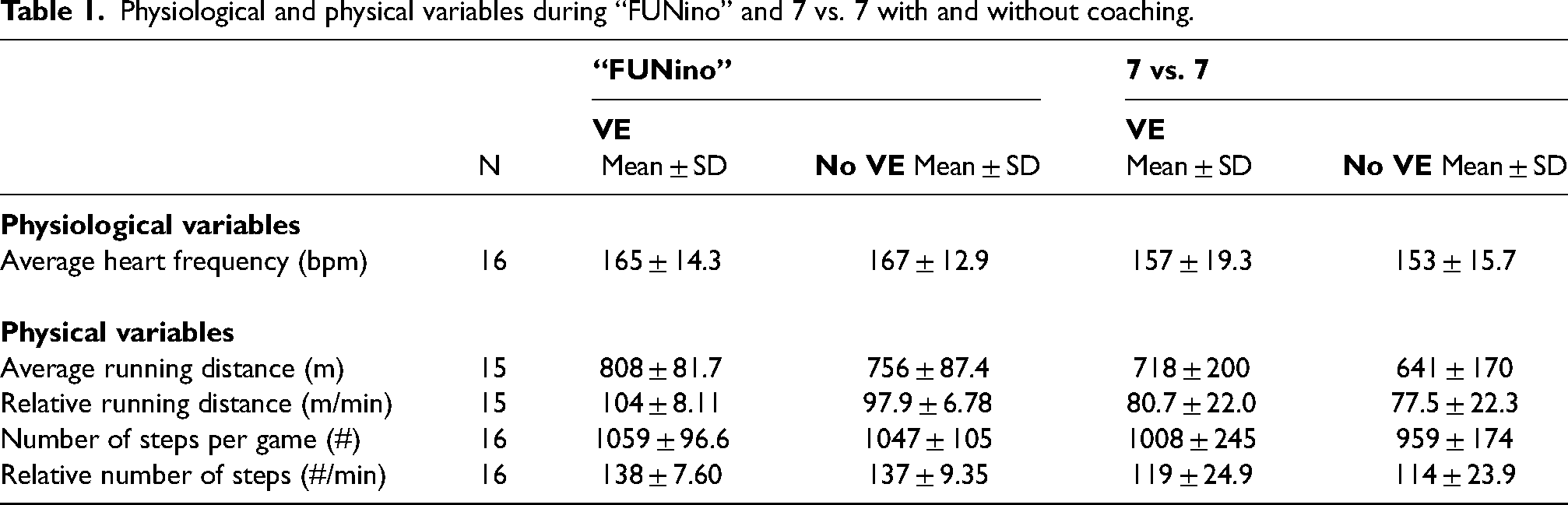
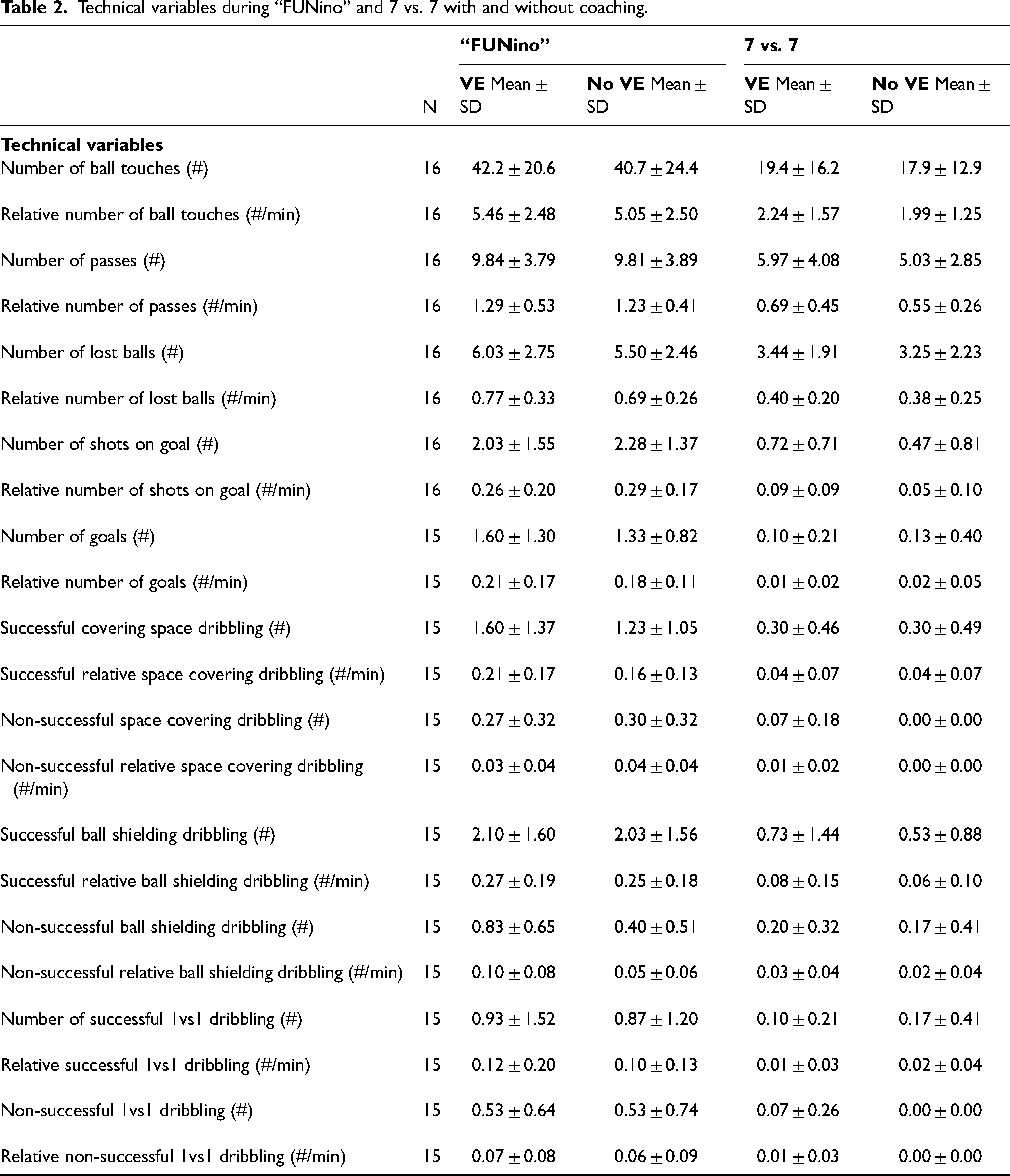
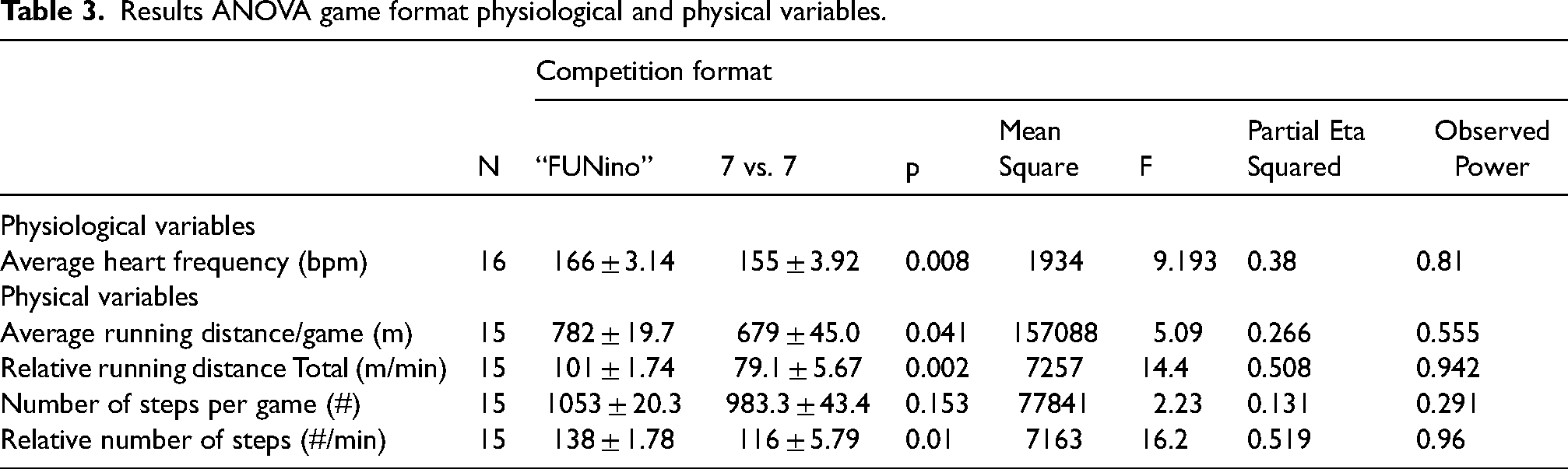
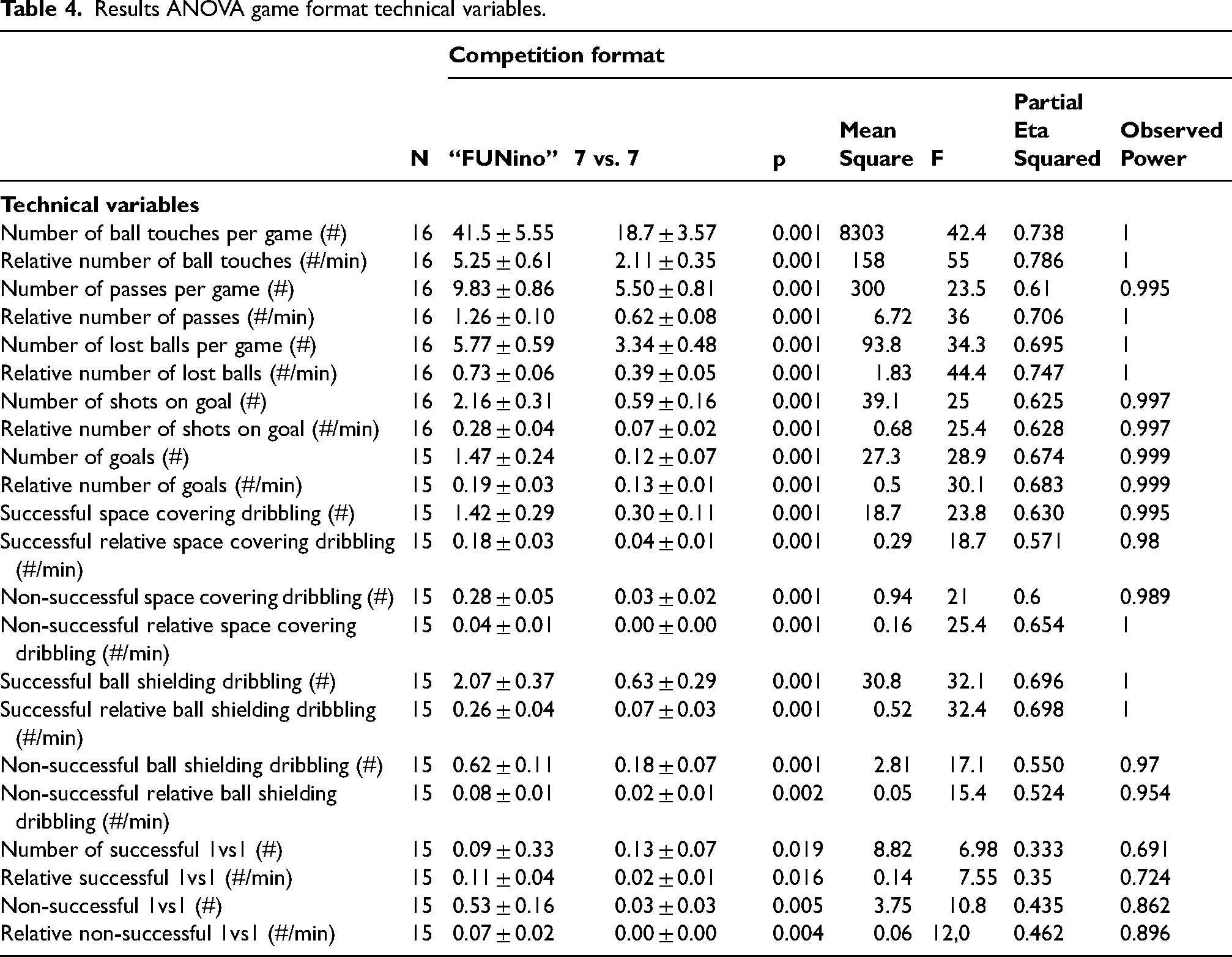
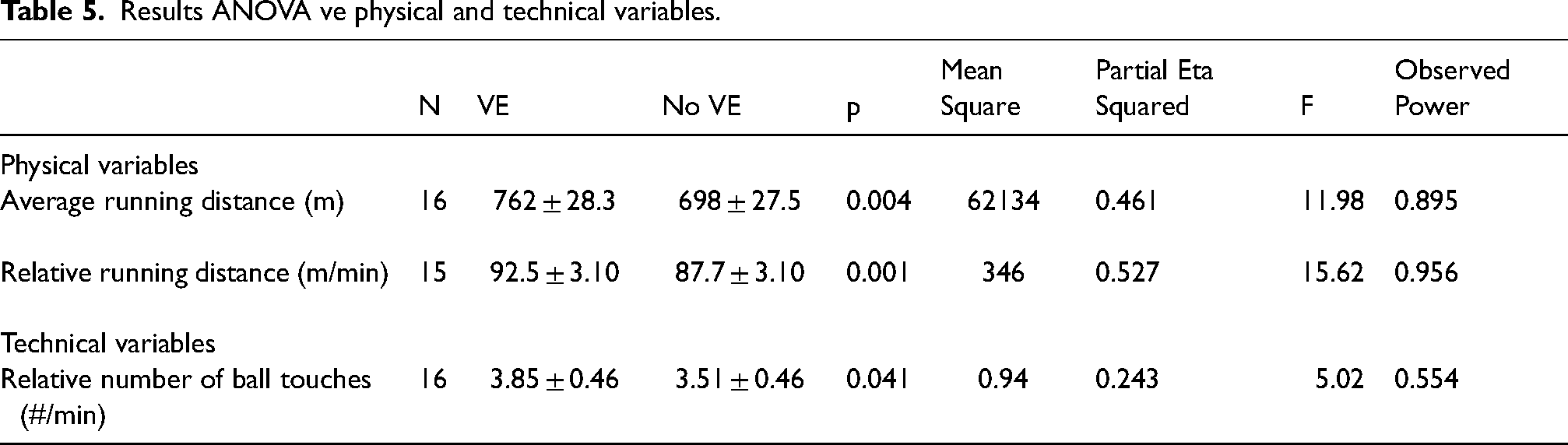
The raw values for all physiological, physical, and technical variables for the two different competition formats (“FUNino” vs. 7 vs.7) and the feedback mode (VE vs. no VE) can be observed in Table 1 and Table 2. The result of the ANOVA indicated significant (p < 0.05) effects for the competition format (“FUNino” vs. 7 vs.7). The “FUNino” format resulted in higher values for all variables, except for number of steps (Table 3 and Table 4). Furthermore, significant differences with regards to several variables obtained from the two feedback formats (VE vs. no VE) can be observed in Table 5. The ANOVA indicates significant higher means for the total and relative average running distance as well as relative number of ball touches in the VE games.
Physiological and physical variables during “FUNino” and 7 vs. 7 with and without coaching.
Technical variables during “FUNino” and 7 vs. 7 with and without coaching.
Results ANOVA game format physiological and physical variables.
Results ANOVA game format technical variables.
Results ANOVA ve physical and technical variables.
Discussion
The primary purpose was to compare the new “FUNino” concept with the present competition format (7 vs. 7). “FUNino” showed significant higher physiological, physical, and technical outputs, except for total number of steps compared to the official competition format (7 vs. 7). Feedback seemed to have lesser effect on all variables, as only two physical and one technical variable was statistically significant different in the VE vs. no VE format. Nonetheless, VE games indicated higher total and relative running distance, and relative number of ball touches compared to non VE games.
The results in this study align with the limited existing scientific knowledge. Whilst a different variable was used as an indication of physiological load during SSG in the literature, the direction and magnitude seemed identical. More precisely, percentage of maximum heart rate, was already observed higher in games utilizing fewer players in combination with small-goals 3 or different pitch-sizes and scoring rules. 4
With regards to the physical variables, it can be reported that all total and relative physical variables measured in this investigation were also significantly higher in “FUNino” compared to the regular competition format 7 vs. 7, except for total steps. Consequently, the smaller format (90 m2 vs. 114 m2) including small-goals and a scoring zone provide greater physical stimuli for players in grassroots football, which might foster their physical development to greater extend compared to 7 vs. 7. The circumstance that a smaller relative pitch size inherits greater physical demand seemed to surprise as generally, the larger relative space induced greater physical stimulus throughout the scientific literature with small-sided games. 23 However, we speculate that the combination of the scoring zone with two small-goals, one on each lateral side of the teams’ touchline led to the greater physical engagement. More precisely, the scoring zones required all players to cover more space whilst attacking, possibly on two goals, as shots from distance disallow scoring which consequently might alter physiological variables. Indeed, the results of changing the scoring rule so all players have to be higher on the pitch was seen to change percentage of maximum heart rate. 24
Similar to the physiological and physical parameters, all technical parameters in this investigation indicated more active participation of players in “FUNino” compared to the 7 vs. 7 format. That is also in accordance to the scientific knowledge in the existing literature, despite the fact that partly other technical outcome variables, such as number of ball touches in offensive and defensive half, 7 scoring attempts, 7 number of balls entering penalty area, 7 number of short passes, 4 were compared to the ones in this investigation. Nevertheless, the total and relative frequency of individual actions such as number of pass completed,6,7 number of dribbles,4,6,7 number of shots on goal,6,8 and number of goals 4 were also significantly higher in “FUNino” compared to the 7 vs. 7 format. All aforementioned variables are indicative of individual participation in the game which ultimately, might affect continuous participation in the long-term players development process. Indeed, it was asserted that personal engagement was one of three components to influence personal development and continued participation in sport 25 and motivation was observed as a significantly different factor between level of play in youth footballers. 26 Whilst not investigated throughout the existing literature, this investigation provided scientific knowledge with regards to individual technical variables, more precisely different types of dribbling such as, space covering, ball shielding and 1 vs. 1 dribbling. All of these variables were significantly higher in the “FUNino” compared to the 7 vs. 7 competition format. Consequently, it seems that “FUNino” provides greater individual learning frequency for developing soccer players over a variety of technical skills. With the greater amount of total and relative ball touches in the “FUNino” format it is not surprising, that the negative associated variables such as, number of lost balls and non-successful dribbling are also higher in the “FUNino” format compared to the 7 vs. 7.
This is the first scientific study investigating the influence of coaches’ feedback in both, the “FUNino” and the 7 vs. 7 competition format. In the VE format only two physical variables and one technical variable were statistically different between the two formats. That is, average running distance, relative running distance and relative number of balls touches revealed VE effects and therefore being higher compared to the no VE games. With regards to the existing literature in the physiological context it can be stated that this investigation support the limited existing literature. In detail, VE had no increasing effect on physiological parameters such as heart rate as seen in the investigation by Selmi et al. 16 and Sahli et al.. 15 However, average running distance and relative running distance as physical variables were observed significantly increased in the VE games in this investigation. Unfortunately, there is an absence with regards to the influence of coaching on physical variables in SSGs in youth throughout the scientific literature. Consequently, there seemed to be an additional necessity for scientific clarification of VE and its effect on physical variables as well as the connection with physiological variables. With regards to the influence of VE on technical variables it can be stated that this investigation seemed to have somewhat opposing results compared to the study by Selmi et al.. 16 While the authors stated that VE improve technical performance namely successful passes, lost balls and interceptions, it positively affected the number of ball touches per minute in this investigation only. Consequently, it seems exaggerated to conclude that VE had positive influence on technical variables. Furthermore, while statistically not significantly different, it seems worthwhile mentioning that the no VE “FUNino” format presented higher values of dribbling compared to the VE 7 vs. 7. In combination with the fact that the condition (VE vs. no VE) provoked three significant changes (two physical, one technical) in parameters, while the format of games (“FUNino” vs. 7 vs. 7) changed all physiological, physical (except for #steps), and technical variables it seems legitimate to conclude that the competition format seemed to have greater impact on physiological, physical, and technical outcome in grassroots soccer players compared to VE.
There are some possible limitations of this study. For example, VE was implemented, however the authors would also like to question whether more guiding feedback with football specific instructions would have altered the investigated variables. In addition, the heterogeneity and amount of VE was not quantified. Furthermore, a different skill level of players might result in different physiological, physical and technical outcome. More specifically, the players in this study were from a club with decent quality of youth footballers closing the season in the middle of the final league table. Players from a club with talent pathway accredited from the German Football Federation could display different results.
Conclusion
“FUNino” provides greater individual physiological, physical, and technical stimuli compared to the current competition (7 vs .7) format for young soccer players. That is players ran more with greater intensity, touch the ball more often, dribble more, play more passes, shot and score more. Due to the greater and positive involvement through the “FUNino” concept during training, players experience pronounced participation in football activities and consequently, will achieve greater technical proficiency and motivation in their early development. This might ultimately lead into a more joyful and longer involvement and less drop-out in later stages. Furthermore, players are exposed to higher physiological and physical demands during “FUNino” also fostering greater development of equivalent capacities.
Footnotes
Author contributions
MA, JS, ML contributed to the conception of the manuscript and conducted the data recording. MR and ML performed the data and statistical analysis, and wrote sections of this manuscript. MR and ML have made a substantial, direct and intellectual contribution to the work and approved this manuscript for submission to the International Journal of Sports Science & Coaching.
Data availability
Data is not yet publicly available, due to university infrastructural problems. However, data can be accessed via direct mail to the corresponding author.
Declaration of conflicting interests
The authors declared no potential conflicts of interest with respect to the research, authorship, and/or publication of this article. The datasets generated and analyzed during the current study are not publicly available. The experiments comply with the current laws of the country where they were performed.
Funding
The authors received no financial support for the research, authorship, and/or publication of this article.
