




Abstract
Limited research has examined continued skill development in adult high-performance sport. In addition, while game-based approaches emphasise the concurrent development of technical excellence and tactical nous, there is a lack of clarity in relation to how coaches develop skill within a games-based approach. As such, this paper explored coaches’ understanding of skill and their approaches to the development of skill within high-performance cohorts through a game-based approach. Individual, semi-structured interviews were conducted with eight coaches with experience coaching at the highest level of Gaelic football; these coaches self-identified as adhering to a game-based approach, albeit not to a particular framework. Reflexive thematic analysis was applied to the resulting transcripts. The analysis identified two key challenges coaches faced in relation to skill development through a game-based approach: competing priorities for coaches in relation to team preparation within training sessions, compounded by competing priorities for players in terms of athletic development outside of training sessions. Despite these competing priorities, the coaches endorsed skill development as an important function of the high-performance coach and reported a sophisticated definition of skill. The coaches described a variety of activities which were used to support players’ development of skill, consistent with their espoused games-based approach to coaching. However, more sophisticated game design, better integration of unopposed activities and games, developing player self-regulatory skills and enhanced coherence between coaches appear to be ways in which skill development could be enhanced to address the challenges coaches identified and maximise the benefits of employing a game-based approach.
Introduction
The umbrella term Game-Based Approaches (GBA) refers to a diverse family of models for teaching and/or coaching in sport which share several common features1–3: (a) teaching technical skills and tactical awareness in an interactive manner; (b) the majority of practice time is spent engaging in modified game forms focused on the developmental needs of the learner rather than on technical practices which are more isolated from the game context; (c) adopting a non-linear sequence of practice activities (e.g., start with a game) rather than a linear drill-to-game sequence; (d) the extensive use of questioning and other means of promoting dialogue; and (e) adopting a thematic approach to the organisation of sessions, training cycles and the broader curriculum. 1 Systematic reviews reveal broad support for the efficacy of GBAs in developing a range of desirable outcomes in sports coaching.4,5 Nonetheless, coaches and teachers’ uptake of GBAs appears to be limited in that relatively few practitioners are implementing “full” versions of GBAs as described within the academic literature.1,6–8 Exploration of coaches’ practices and rationales is essential to understand why such an apparently effective approach to coaching is not being implemented more widely.
Within the context of GBAs, skill is technique performed in context 9 ; that is, skill is a performance that answers the problem that a player is confronted with in a particular moment and not the reproduction of an idealised technical model.2,10,11 The movements of elite performers are characterised by consistency and an economy of effort in solving the problem posed (i.e., achieving their desired outcome). To solve the problems that the game presents requires players to read the evolving play and adapt their movements in response. 12 When conceptualising skill in this way, deciding upon an action and adapting movements to meet the demands of the context are highly integrated. GBAs propose that this integration should be at the core of developing skill, and that the role of the coach lies in scaffolding learning opportunities through the activities presented and the feedback provided.
One of the common objections to implementing a “full” GBA 1 is practitioners’ perceived need to spend considerable time focused on technique in isolation from game forms in order to achieve this consistency and economy of movement which characterise skill,6,13,14 particularly (although not exclusively 15 ) with relatively novice participants. Across a range of populations and contexts, critical examination of the literature shows limited support for the concept that ‘technique first’ interventions are more effective than GBAs for developing technical skill.9,13,15,16 Systematic reviews have concluded that GBAs were as effective as more traditional training in developing skill execution, and better for the development of decision making.4,5 Furthermore, there are multiple examples of superior technical development from a GBA relative to an approach more directly focused on technical development. For example, over a six-week intervention with 10-year-olds, a GBA led to superior improvement in throwing and catching skills (measured in isolation) as well as decision making measured during game play relative to a control group which engaged in a linear drill to game approach; there were no differences between the groups in technical skill execution during game play. 16 A group of 22-year-old amateur Australian football players demonstrated greater improvements in kick proficiency and skill adaptability from participating in small sided games relative to a group which practiced kicking in isolation. 15 An important feature of these studies was that enhancing skill execution was a primary focus of the intervention. In contrast, if skill execution is relegated to a secondary focus, then improvements in decision making without a corresponding improvement in skill execution could be expected. The lack of improvement in skill execution in some contexts may also result from the challenge of implementing GBAs optimally17,18; GBAs incorporate a wide range of game forms, from full-sided to small-sided games, even and uneven numbers per side, altered pitch dimensions and a variety of individual and team conditions (e.g., bonus point for scoring from a certain type of scenario).9–11 The coach must provide the optimal modification to the game form for the developmental needs of the participants. Thus, rather than asking whether a GBA or technical focused approach is better for technical development, a more pertinent question appears to be how can coaches optimise a GBA to develop technical excellence from players as they adapt their movements to the demands of the situation?
Coaches may be reluctant to fully employ GBAs due to a conflict with their understanding of skill. Within the context of GBAs, the definition of skill as technique performed in context 10 has implications for session design The umbrella term is Game-Based, not Exclusively-Games; within GBAs there is a place for some practice in a very much simplified context, which may include isolated activities,18,19 albeit with the caveat that the technique be “placed back in the game as soon as possible” (p. 13). 18 Thus, there is a place for some practice in a very much simplified context to allow learners to understand the basic coordination pattern. Once that basic coordination pattern is understood, then the key to progression is learning to adapt. 20 If coaches are not clear on the distinction between technique and skill 21 or believe that skills constitute highly automated patterns and that the challenge in developing skill lies in automating these patterns rather than in adapting movements to the demands of the immediate context, their beliefs may constrain their selection and sequencing of practice activities. 22 Consequently, any exploration of coaches’ practices to develop skill must also consider coaches foundational understanding of skill which drives that process.
Skill development does not stop once an athlete reaches the highest level of the game, 23 yet research on the processes underpinning continued skill development for adult high-performance players is extremely limited. 24 Baker et al. 24 argue that at the professional level, there appears to be an increased emphasis on maximising current performance through tactical preparation for immediate opponents and managing training load to mitigate injury risk, with continued skill development largely a secondary consideration. A few studies have examined the microstructure of the practice of experts, identifying how top-level performers adopt a more deliberate approach to practice than their sub-expert peers.25–27 Despite this provisional evidence base, Baker et al. 24 conclude that increased exploration of the ‘what’, ‘how’, ‘when’ and ‘why’ of skill development processes in high-performance contexts would be valuable for coaches and applied sport scientists.
Gaelic football is a team sport fusing many of the elements of soccer, rugby and basketball; it is one of Ireland's native sports and is the country's most popular team sport. 28 The use of GBAs is a contemporary topic in Gaelic football coach development; GBA was the theme for a National Coaching Conference in 2017 (https://www.youtube.com/watch?v=DXpI6-N2wrQ) and has subsequently featured prominently in research on coaching in Gaelic football.29–32 Across invasion sports generally, and within Gaelic football in particular, GBAs are commonly recommended for practitioners, but are not always fully implemented in practice.6,32,33 A common concern amongst coaches appears to be the capacity to develop skill within GBAs.7,14 It is not clear whether coaches’ concerns arise from a misunderstanding of skill or coaches not implementing GBAs in an optimal manner to facilitate skill development. Therefore, this study investigated two questions: 1) How do high-performance Gaelic football coaches define skill? and 2) How do high-performance Gaelic football coaches develop skill within the context of a GBA?
Method
Research design
Skill development is a complex process, taking considerable time and involving multiple contexts (e.g., team training sessions, individual practice sessions, video review sessions). A qualitative approach is suitable for investigations of such processes, as it allows coaches to consider a range of contextual examples and timeframes, providing a description of both what they do and their underpinning rationale.32,34 Given the complexity of the process and the dearth of existing research, this exploratory study utilised a Qualitative Descriptive approach 35 to examine what, who, when, where and how experienced coaches developed skill within the framework of a GBA. The design and analysis of this study were consistent with an interpretivist philosophical position, 36 with the goal of understanding coaches’ lived experiences; that is, we sought to prompt participants to provide in-depth information relating to how they facilitated players’ skill development within their context. As an interpretivist approach considers all knowledge fundamentally subjective, our goal was to generate points for reflection for a broader audience of coaches and coach developers from our exploration of the experiences of the participants.
Participants
Eight male coaches participated in this project. These coaches self-identified as using a GBA in their practice and had a reputation within the coaching community as promoters of a GBA; coaches were purposefully sampled on this basis, as individuals who would be able to provide extensive commentary on the research question. All eight coaches had previously delivered workshops or open training sessions which confirmed their use of a GBA. Their interviews provided further confirmation of their belief that they were implementing a GBA; for example: “The majority of my sessions are centred around games, particularly conditioned games. We train for one hour and the majority of that is spent in either conditioned games or larger sided games’ (Coach 6); “for me, the majority of the collective training sessions should be spent in game form. Time is precious at inter county level so the majority of our sessions would be spent in games” (Coach 5). The quality of the coaches’ implementation of a GBA was not assessed; consequently, ahead of the interviews these participants were considered to be coaches attempting to use a GBA and not defined as master practitioners. Coaches’ explanations were most closely aligned with Game Sense but coaches did not describe strictly following one particular framework. Six coaches were currently coaching at the highest level within Gaelic Games (inter-county); the other two had been coaching at that level within the past two years. Gaelic football players who represent their counties (the highest level of the game) also compete for their clubs. County teams are drawn from multiple clubs, thus players will typically have different coaches at club and county level. Coaches had between 1–5 years’ experience coaching at the highest level (mean 3 years) and all bar one coach had over 10 years coaching experience; the exception was a retired top-level player with four years coaching experience. Sampling was also guided by the concept of information power 37 ; that is, the narrow aim, the specificity of experiences of the sample, the focused analysis strategy and, as interviews progressed, the apparent strength of the dialogue, guided our decision to halt recruitment after eight interviews.
Procedure
An interview guide consisting of three sections was developed through consultation within the research team, two of whom were actively coaching within Gaelic games and two of whom had previously published qualitative investigations into GBAs. The questions explored 1) Coaching background, 2) Coaches’ perceptions of skill in Gaelic football and 3) Coaches’ application of a GBA. A pilot was conducted with two sub-elite club coaches. These pilot interviews confirmed that the structure and content of the interview guide was appropriate and afforded the researcher the opportunity to develop his interview skills. In particular, after the pilot the interviewer asked additional follow up questions, more frequently requesting specific detail on examples raised by the interviewee and prefacing these probing questions with a summary of what the coach had said (e.g., “Those scenarios you mentioned previously where players are repeating the same scenario over and over again; do you find in those scenarios that players do the same thing? Are you looking out for the same thing?”). Following institutional ethical approval, the data collection consisted of semi-structured one-to-one interviews. Individual interviews were chosen to ensure that coaches could express themselves without concern for how other coaches might interpret their views. The semi-structured nature allowed the interviewer to sequence the interview in light of each participant's initial responses, as well as using probing questions to gain additional examples and detail as required. Six interviews took place on Microsoft Teams and two took place in person with each interview ranging between forty-five to sixty minutes.
Data analysis
To identify emerging themes and patterns throughout the interviews, reflexive thematic analysis was implemented.38,39 Thematic analysis is considered a flexible method of analysis suited to exploratory data sets. Following completion of the interviews, the audio visual/recordings were listened back to for familiarisation by the first and third author, and transcripts were then produced verbatim. Following checking for accuracy and the removal of identifying information (e.g., names of people and events), transcripts were then coded line by line by the first author using different coloured highlighters which allowed visual checking for themes and commonalities to be organised later.40,41 Both semantic and latent codes were sought throughout. 38 The third author also independently coded one transcript to facilitate a detailed discussion of the coding process and content being highlighted. Through an iterative process of coding and discussing, provisional themes were generated, guided by the original research question. 41 These provisional themes were then refined to ensure that any overlap could be merged into overarching themes. 40 Themes and sub themes (primary and secondary categories) were then organised into a thematic map and draft narrative, which was presented to and discussed by the full research team. The revised draft and narrative formed the basis for the final report. The process of writing refined and confirmed the organisation of data as having captured a perspective on the research question.
Rigour
The study was guided by a relativist approach for judging the rigour of qualitative research. 42 First, the lead author's background as a coach facilitated understanding of the terminology and contemporary landscape of Gaelic games coaching, as well as building rapport with the coaches. Second, a reflexive journal was kept and referred to throughout the research process, to help the lead author attune to their developing understanding of content and method. Third, the second and third authors acted as critical friends throughout the process, challenging the lead author's process and developing interpretation of the data. Fourth, ‘member reflections’ 43 were encouraged by sending participants summaries so that they might further elaborate on aspects of the conversations that resonated for them. The final practice involved inviting responses to our findings from key stakeholders, a strategy referred to as external reflections. 44 Specifically, identified themes were presented to several audiences who had not participated in the project (e.g., external colleagues at other third level institutions, and coaching peers). These audiences were encouraged to consider how the themes overlapped with their practice and observations.
Results
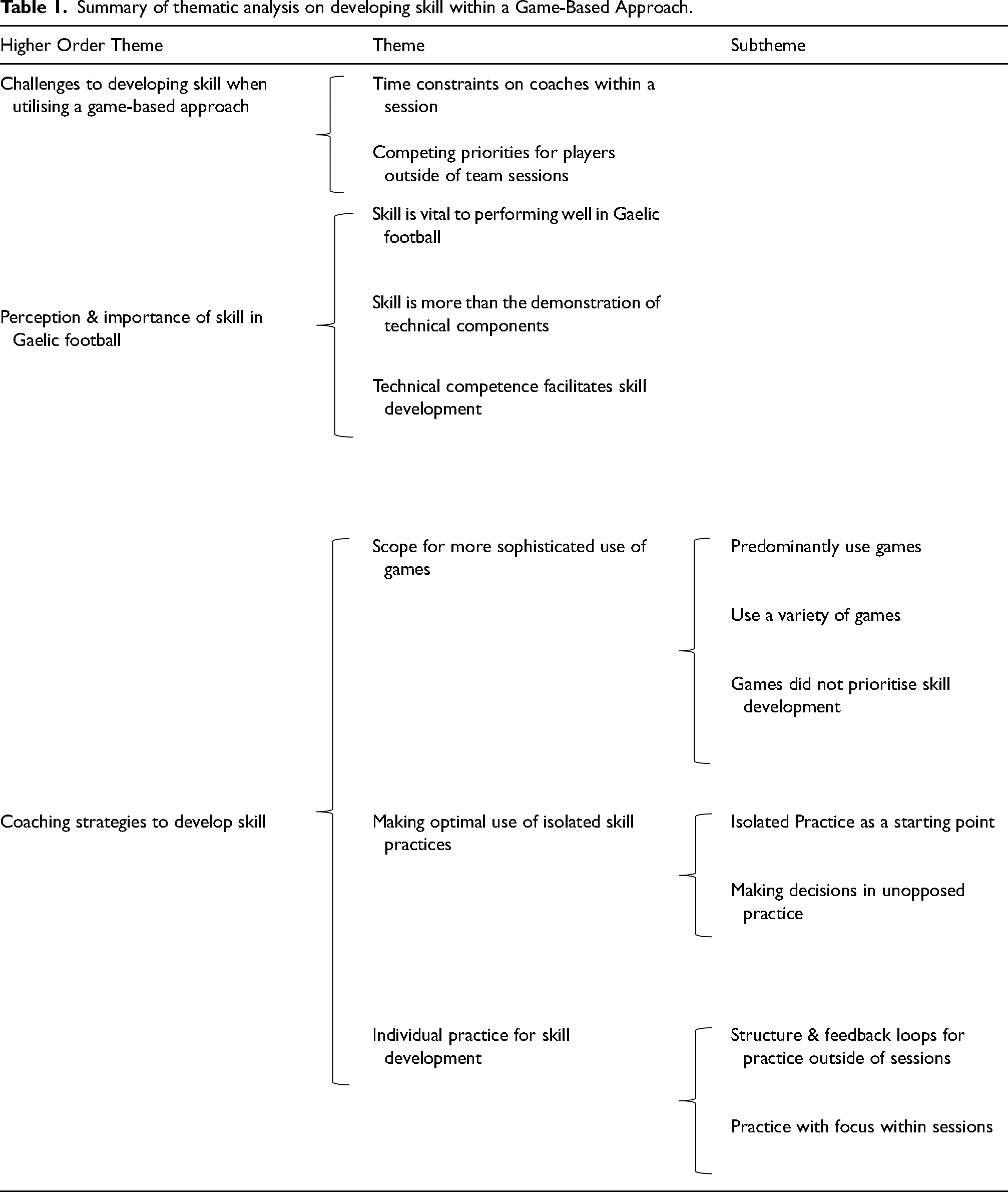
Table 1 presents the themes developed through the analysis. The first higher order theme documents the challenges to developing skill when utilising a GBA that coaches described: primarily Time constraints on coaches within a session and Competing priorities for players outside of team sessions. The second higher order theme addressed coaches’ perception of skill within Gaelic football; this theme indicated that the challenges that these coaches perceived when developing skill did not arise from basic misunderstandings of skill or a belief that skill was unimportant for high-performance Gaelic football. The final higher order theme related to coaching strategies to develop skill and consisted of three avenues by which the coaches’ challenges might be overcome: Scope for more sophisticated use of games; Making optimal use of isolated skill practices; Individual practice for skill development.
Summary of thematic analysis on developing skill within a Game-Based Approach.
Challenges to developing skill when utilising a game-based approach
The first higher order theme developed in the analysis described the key challenges that coaches experienced when developing skill within a GBA. The primary challenge identified by coaches was Time constraints on coaches within a session. Coaches described how players need to be prepared for many aspects of the game within the limited time available for team training sessions: ‘Your conditioning, tactics, kick outs, you're listening to the whole thing. You're looking to build all that in’ (Coach 1). This time constraint was exacerbated by Gaelic football being an amateur sport, even at the highest level, resulting in limited contact time with players. Furthermore, coaches only provided one example of a trade-off (with strength & conditioning) in which a coach prioritised skill development ahead of another element: ‘there were three players who were all seriously left-handed. 1 When they're in the conditioning block, we would ask the coach to excuse them, and we do a bit of work with them’ (Coach 4). Overall, coaches reported that dedicating time primarily to skill development is simply not a priority: ‘I don't think it should take up a lot of prescribed time because I think collective time is too important to spend working on skill’ (Coach 5).
The primary challenge of limited time to develop skill within sessions was compounded by a second challenge: Competing priorities for players outside of team sessions. Coaches believed that for optimal skill development, their game-based sessions needed to be supported by players engaging in individual practice outside of team training sessions. However, coaches’ ability to develop players’ skill within team sessions was compromised by players prioritising their physical development during this individual practice. For example, Coach 8 expressed frustration with “driving by the pitch and seeing the lights on in the gym and no lights on in the pitch”. Coach 1 similarly described how players “all have a foam roller and a band and a dumbbell, but how many of them actually have a football and practise their skills?”.
Perception & importance of skill in Gaelic football
The second higher order theme developed from the data described coaches’ perception of what skill was, and its importance in Gaelic football. The lack of priority given to skill development described in the first higher order theme was not due to a belief that skill was of secondary importance for Gaelic football; rather, coaches reported that skill is vital to performing well in games: 'Skill is the most important component of Gaelic games…Look at [successful club side]; those players had such a high skill level that their cornerbacks could solo and hand pass with both hands, both feet under pressure all the time’ (Coach 2) ‘Why are Dublin and Kerry the most successful teams? The amount of effort that must have been spent to get to that seamless, clean, tidy quality of passing’ (Coach 4)
A lack of time dedicated to skill development may also be due to an overly simplistic understanding of skill, but that was not apparent in this sample. Coaches’ demonstrated a sophisticated understanding of skill in so far as they defined skill as more than the demonstration of technical components. Rather than something which existed out of context, skill was defined by what a player needed to be able to do to complete their role for the team within specific situations on the playing field: “we bring the players in and ask them about corner backs or corner forwards. No Podcast crap. What does a cornerback do? … skills are doing the right thing at the right time’ (Coach 4). ‘it's the ability to have the raw attributes to make the right decisions in a range of situations… (Coach 5) ‘you have to train the width and depth, you have to train players how to scan a pitch, how to keep swivelling their heads, it's a huge part’ (Coach 2) ‘I would probably count them [off the ball] skills to be as important, if not more important [than actions in possession], because they happen more regularly during the game; thinking, understanding, how you connect with your teammates’ (Coach 5)
Despite this emphasis on situational factors when defining skill, coaches highlighted that technical competence facilitates skill development; that is, coaches perceived that the ability to execute the basic technical components of the game well enhanced players’ ability to perform skilfully under pressure: ‘I always felt in coaching and playing that unless you can do the simple things well, you’re going nowhere. These include the pick-up, the toe tap, the fist pass, the high catch, the block’ (Coach 6) ‘the basic skills done well consistently normally equates to a really good performance; every skill from the pickup to the catch to the solo to the block, the tackle, everything’ (Coach 2)
Taken together, the quotations within this higher order theme indicate that the challenges that these coaches perceived when developing skill did not arise from basic misunderstandings of skill or a belief that skill was unimportant for high-performance Gaelic football.
Coaching strategies to develop skill
The third higher order theme developed from the data related to the coaching strategies these coaches used to develop skill. Even though coaches’ practices were largely consistent with a GBA, there was scope for coaches to enhance how they developed skill in relation to three themes: scope for more sophisticated use of games; making optimal use of isolated skill practices; and individual practice for skill development.
There was scope for more sophisticated use of games to facilitate skill development. While isolated unopposed practice and individual development plans were mentioned by the coaches in relation to skill development, the majority of session activities were some form of a game: ‘Your main body of your session should be based around a games-based approach and then you improve those individual facets through the games that you play’ (Coach 5). Coaches identified a wide variety of game forms that they utilised within training sessions, including: small-sided games, conditioned games, game scenarios and full sided games: ‘We're very much a conditioned games approach where we start small, build to medium, build to half and full size. But we play full size every night regardless’ (Coach 2). For the most part, the games designed by coaches focused on physical and tactical elements as primary objectives with missed opportunities to layer in skill development objectives. Largely, there was no clear game design primarily targeting specific aspects of skill development. Only two coaches offered specific examples of developing skill through games. Coach 4 offered: ‘I really like a rectangle and there's four defenders in it and everybody else is involved. Just getting the ball up and down that rectangle’. Here, players are afforded more opportunity to execute the skill due to a low number of defenders. Coach 2 also illustrated a conditioned game specifically aimed at developing skill: ‘there will be a 5-min block where everybody has to kick with their left and it switches to the right and again’. These examples proved to be exceptions and it was also not clear from the coaches’ descriptions that these particular games were fully integrated into a progressive sequence of activities. Skill development was thus relegated to a secondary consideration within most games described by the coaches. That is, instead of designing games for players to develop particular aspects of their skills as part of a progressive series of activities, players were simply punished for poor execution: ‘If I'm planning a conditioned game, if the pass hits the ground, it's a turnover; if a pickup is missed, it's a turnover’ (Coach 6).
Although game forms were the main session activity type, coaches did support game play by using some isolated technical practices; the second theme in this section suggested that coaches were not making optimal use of isolated practice. In particular, these unopposed practices were used as a starting point for coaches’ sessions, suggesting a linear sequence to practise design rather than responding to an identified need within the session: ‘We always start unopposed and then we bring it into contact…because you can't expect somebody to perform the skill at a high level, under pressure, without being able to do it without any pressure’ (Coach 2). When asked about the rationale of using isolated drills in this way coaches suggested that they were not only for skill development but often primarily used to create intensity: ‘You need to give them a bit of a livener before you put them into a game’ (Coach 8). Only Coach 4 reported starting with a game and then developing the skills from that: ‘A lot of it will start with games and then going back and fixing an element’.
In many cases these unopposed activities described by coaches were more sophisticated than just a linear drill where there was no decision making with limited variability in actions required (i.e., always hand passing a set distance and direction). Although unopposed, these practices forced players to think or make decisions on how to pass and where to pass, as well as the timing and direction of running in support of the player in possession: ‘We use patterns where all players can be involved where we can have two goalkeepers working, kicking the ball out, catching offload to his quarter runner, kick pass inside and over the bar’ (Coach 2).
The third theme in this section related to individual practice for skill development. Coaches emphasised the importance of players engaging in individual practice outside the main body of the session: ‘that work [developing skills] is done with players either before a session or is done mainly in your own time’ (Coach 5). Although coaches stated that it was the responsibility of players to develop skills, they placed major importance on developing strong relationships with their players to build trust and improve player's confidence to underpin the skill development process: ‘taking out the wing back and spending 15 min with them working on their kick pass or working on their tackling…individually the players can gain a lot from that and they're building relationships (Coach 3). This trust was in part developed by creating practice structure and feedback loops to challenge players to enhance their development: ‘We have regular one-to-one's where we get the player to describe where they feel they're technically good and where they need to improve. We then assign homework to do outside of training’ (Coach 2) ‘Yea you’re asking them questions and they have some ownership [on what they need to work on] but it's very much still led by me’ (Coach 5)
Discussion
This study investigated two questions: 1) How do high-performance Gaelic football coaches define skill? and 2) How do high-performance Gaelic football coaches develop skill within the context of a GBA? Participants reported a sophisticated understanding of skill, which they believed was central to achieving high performance in Gaelic football. Participants described a variety of activities which were used to support players’ development of skill; consistent with their espoused games-based approach to coaching, these activities were primarily various game forms but a supporting role for some unopposed practice was also identified. The coaches also described two key challenges they faced in relation to skill development when utilising a GBA: time constraints on coaches within a session and competing development priorities for players outside of team sessions. In addition to these challenges, the analysis suggested a number of opportunities to further enhance player skill development within this high-performance context through more sophisticated game design, alternative sequencing of isolated skill practices and enhancing the quality of individual practice within and outside of sessions.
Coaches held a sophisticated understanding of skill, grounded in the specific role players performed on the pitch and the competencies needed to deliver that role successfully, considering both movement skills (e.g., ways to carry, pass and shoot the ball) and game skills (e.g., creating and reducing space45,46). This understanding is consistent with contemporary definitions of skill2,17,21 which emphasise the integration of reading the play and adapting movements in response. 12 A coach's actions are anchored to their fundamental understanding and beliefs in relation to what skill is and how it is developed.47,48 Consider a coach who equates skill with technique and who believes that failure to execute a skill in a competitive context is indicative of insufficient automation of the basic movement. Such a coach is likely to believe that this issue can be resolved by extensive repetitions of that movement in isolation from context. Furthermore, this coach is unlikely to be swayed by arguments to replace the majority of these isolated practice activities with more representative – but still simplified – game forms unless their underpinning understanding is first addressed. Thus, coach educators looking to encourage uptake of a GBA should initially evaluate the understanding of skill held by the coaches they are supporting.
Despite reporting a sophisticated understanding of skill, coaches’ descriptions of how to design practice activities for skill development could be enhanced. Consistent with previous research in team invasion sports49,50 including Gaelic Games, 6 the coaches’ sessions contained various game forms. However, these games chiefly targeted tactical development or more holistic performance improvement. When probed on how they targeted skill development specifically, coaches were either simply penalising skill failure within games or primarily relying on unopposed practices. While there is a place for regressing to unopposed practices within a GBA when required,19,51–53 coaches’ rationale for their reliance on unopposed practice was under-developed; that is, when probed the coaches did not reveal an appreciation for alternative game related activities based on task simplification.20,54 For example, strategies which might scaffold the learning experience by influencing the time and space available to players, such as making additional use of uneven numbers (i.e., 6v3, 6v4, 6v5) or constraining what individual players were able to do (e.g., full contact defence v light touch defence v shadowing only), were largely absent from their examples in relation to skill development. Such strategies produce games which, while maintaining the need to make some decisions and achieve an overall objective, prioritise skill development by affording players greater time and space to execute high repetitions of the desired actions, with greater attention allocated to matching of their technique to the demands of the situation than would be possible in games requiring more complex decision making.
At the heart of GBAs is the coupling of decision-making and skill execution; in the design of practice activities and the delivery of feedback, there exists a continuum of emphasis for both elements, where some tasks may place greater emphasis on decision-making while others focus more heavily on skill execution. Within the GBA literature, the emphasis on skill execution is less clearly articulated compared to decision-making.4,5 The present analysis suggests that practitioners require more guidance on how to adjust the emphasis within practice activity design more toward skill execution whilst still retaining decision-making elements. Such modified games for skill development compare favourably to isolated skill practices,12,14 but further research is warranted into whether they optimise transfer of learning relative to game play which places a primary emphasis on tactical development.
Despite using various conditions to develop tactical awareness, the coaches did not explain how they might be applied to facilitate skill development. Instead, the small sided and conditioned games described by coaches were primarily used to increase the frequency of opportunities to perform skills in a game-like environment, rather than scaffolding that environment to facilitate the development of specific aspects of skill. That is, the coaches’ concern when designing practice appeared to be more for representative task design (ensuring training faithfully mimicked the game) rather than representative learning design (deliberately exaggerating features of the practice activity to guide the learner towards exploring new movement possibilities while preserving the functional coupling between perception and action processes). 55 Coach educators looking to promote effective use of GBAs should help coaches to understand how different conditions can be applied to place a primary emphasis on skill development (as opposed to tactical considerations such as offensive or defensive structure) so that they can deliver an appropriately scaffolded set of learning activities to meet their players’ needs.
“Layering of complexity” 34 in the planning and sequencing of practice activities has been identified as a particular challenge when delivering a GBA. The coaches in this study described how to appropriately present highly complex activities through the extensive use of large and full sided games; they also described how to present learners with low complexity activities in the form of unopposed activities which often still promoted a degree of decision making and variability in movement execution with respect to where to pass, when to pass, and how to pass. However, there was considerable scope for coaches to employ additional modifications to create intermediate layers of complexity through small sided and conditioned games to facilitate players’ connecting lessons from the most basic to the most complex practice activities.19,20 To clarify, coaches described using small sided and conditioned games, but only rarely were coaches able to provide in-depth examples of how complexity might be effectively manipulated within such games to provide an optimal stimulus for skill development. Providing this optimal stimulus requires coaches to understand how to design a progressive sequence of simplified forms of the game which exaggerate key features for the learners without disrupting perception-action coupling.20,55 Within this progressive sequence, at times greater emphasis may be placed on reading the play and decision making or on adapting technique to the context, but retaining the integration of decision making and technique adaptation is central to successful transfer of learning.12,56 Such scaffolding of learning experiences is not easy 57 requiring considerable skill at “noticing to inform action”. 58 Thus, the challenge for coach educators interested in promoting GBAs may be to move beyond encouraging the use of game forms to promoting more sophisticated use of games. Researchers may support coach educators by providing case studies of the decision-making underpinning such layering of complexity, enabling coaches to better understand when and how much they might utilise each type of practice activity to achieve their specific goals within their specific context.
In addition to various game forms, the coaches in this study valued the use of unopposed practices where appropriate for a player's skill level, consistent with a GBA.18,19 Simple repetitive drills were rare; instead, coaches predominantly described activities which constrained what skill a player could use while still requiring decisions in relation to when and how to execute. As such, the views of these Gaelic games coaches were consistent with the perspectives of professional and academy soccer coaches, 59 and also consistent with the view that a variety of levels of representativeness have a place in practice session design.18–20 Although the rationale for using some unopposed practice was consistent with a GBA, the sequence in which coaches presented these activities was not because they did not have a contextualising game preceding the activity. Furthermore, even though the coaches reported that they did not make extensive use of unopposed activities, there was scope for greater justification for their use of unopposed practices over modified games with high-performance players given that systematic reviews of GBAs in general4,5 and specific studies focused on high-performance populations 15 have demonstrated that appropriately simplified games are at least as effective as unopposed practices for the development of technical skill. To be clear, we are not dismissing the value of some unopposed practice in enhancing player understanding, confidence or exploration of new coordination patterns; rather, we are highlighting that unopposed practices may be best utilised under a “minimum necessary dose” 6 philosophy.
This “minimum necessary dose” 6 philosophy towards unopposed activity is informed by Gentile's60,61 model of skill acquisition, where the goal of the initial phase of practice is for the learner to “get the idea of the movement” under simplified conditions. Gentile's model suggests two implications for coaches when designing these simplified conditions. First, this initial practice should still involve responding to the specific environmental conditions to which movement must conform to be successful; what Gentile termed regulatory conditions. As such, the isolated practice should involve a high volume of repetitions under conditions where a player has more time and space to execute but where they are still required to adapt their movements to some demands of the situation (e.g., varying distance of a pass). Second, the goal of this initial practice period is not to perfect an action, but for the learner to gain enough understanding of the regulatory conditions and necessary movement adaptations to progress to yet more dynamic contexts; hence the model guides coaches to use the minimum necessary dose of isolated practice. Coaches would benefit from greater research on the optimal selection and integration of unopposed activities within GBA sessions, especially in relation to when to regress to an isolated activity rather than a simplified game form, when to progress from that isolated activity back to game play, and how a player may have a say on these decisions (e.g., ‘pressing the pause button’ 62 ).
The preceding discussion has focused on insufficient time as a barrier to skill development within training session. The interviewed coaches reported that this time constraint was compounded by players’ prioritising physical development outside of team training sessions. The competition between physical and skill development for players time is a noted source of conflict for coaches.32,63 Physical development also features prominently in research and practice in Gaelic football. 64 However, there is a paradox here as coaches stated that winning teams and the best players were the most skilful, yet the lack of emphasis placed solely on developing skills could be detrimental to performance in a continuously evolving game. 65 Rather than competing with athletic development for time, a more productive strategy for coaches may be to seek further opportunities to exploit the time that players are already spending in practice. Two avenues are apparent from these data: (1) developing player's self-regulatory skills, and (2) developing connections between coaches at club and representative county level. Pursuing these avenues might create an environment in which a coach finds it easier to implement a GBA.
Two players may attend the same session, notionally complete the same activities, but derive different degrees of benefit from the time invested.25,66 This difference arises from what each learner thinks and does during the session; that is, the extent to which they engage in self-regulation.66–68 Self-regulatory strategies include setting immediate goals, monitoring performance against those goals, exploring reasons for performance outcomes, and seeking feedback.67,68 Some coaches within this sample were infusing the development of some self-regulatory skills within practice, such as by ensuring that players had a specific focus for their practice and understood the “difference between just training and practicing”. Nonetheless, there was scope for considerably more investment in the development and practice of self-regulatory skills.68,69 Research within Gaelic games has shown that more highly skilled players engage in more sophisticated practice than less skilled players. 25 Furthermore, an intervention which taught Gaelic footballers to self-regulate during practice accelerated their learning relative to a control group which engaged in their typical practice. 70 A more strategic approach to educating players to self-regulate their practice68–70 may be a fruitful strategy for coaches to enhance skill development within their current time and resource constraints.
Gaelic football players, who compete both at county and club levels, often work with different coaches; the absence of cooperation between club and county coaches in developing players’ skills was notable within the current data. Within talent development contexts, cohesion between coaches is well-established as an important contributor to athlete success71–73 including in an Irish context.74,75 County players are, by definition, better than their club peers. Thus, club training sessions may offer an opportunity for the layering of complexity within skill development discussed above, as within game play during club training sessions county players are likely to experience less pressure from opponents than at county training sessions. Inter-county coaches emphasised the importance of individual practice in developing skills and supported players in this process. A clear opportunity to further enhance the potential for player skill development appears to lie in greater engagement with club coaches (either directly or through the players). Gaelic football coaches may have scope to learn from practitioners and/or research in other sports such as rugby and soccer, where coherence and cooperation across academy and senior teams are central to effective transitions.76,77
Coaches provided a valuable insight into their perceptions of skill and the place it has within their practice design. The interviews allowed coaches to draw upon multiple examples across different timeframes and teams.32,78 However, to provide a deeper understanding of how skill is being developed, a more longitudinal study that follows coaches practice over the course of a season may provide greater insight into coaches’ practice. By observing coaches practice over multiple visits, one could confirm the consistency between coaches espoused and enacted approaches.79,80 Such a longitudinal approach would also facilitate investigation of how all characteristics of a GBA are applied to developing skill, including some which did not feature within the present interviews (e.g., coach questions, player dialogue). Furthermore, interviewing players about their experiences of skill development may offer further insights into the topics discussed above, in particular self-regulation within sessions and coherence between inter-county and club coaches.
Conclusion
In conclusion, this study explored the perceptions and practice activities used by coaches aligned to a GBA to develop skill in high-performance Gaelic footballers. A GBA is not only a way of delivering a coaching session but also a way of thinking which takes time for coaches to work through as they implement this type of situational learning. Our results indicate that the coaches in this study have grasped the concept of utilising games and a variety of game forms to develop players. Despite this positive finding, the data also suggests these coaches are still working through the nuances of GBA delivery. Coaches noted various competing priorities which they felt hampered their ability to promote skill development. Coaches viewed skill as important, and their definition of skill was aligned with contemporary literature. Despite the predominant use of games to develop skill, coaches reported few examples of designing a progressive series of game forms specifically targeting aspects of skill development. Instead, coaches often assumed that skills could be developed through the games being played when high performance standards were demanded. Strategies such as more sophisticated game design, better integration of unopposed activities and games, developing player self-regulatory skills and enhanced coherence between coaches appear to be ways in which skill development could be enhanced within coaches’ current constraints. While there is enthusiasm for coaching through games, coach education needs to support coaches to be more sophisticated in how they utilise and connect a variety of game forms to best meet the skill development needs of players.
Footnotes
Declaration of conflicting interests
The authors declared no potential conflicts of interest with respect to the research, authorship, and/or publication of this article.
Funding
The authors received no financial support for the research, authorship, and/or publication of this article.
