




Abstract
This case study explored the perceptions and utilisation of data-driven methods of coaches, scouts, and a sporting manager overseeing the U8-U14 unit of a German Bundesliga academy. It comprised seven semi-structured interviews and employed thematic analysis to unravel the complexities of talent identification, selection and development (TISD). The findings provide highly contextual insights into practices and perceptions of key stakeholders within the context of academy football. Technology and data-driven methods were restricted to anthropometric measurements and automated video evaluations. Nonetheless, informants recognised the potential of data-driven methods, such as AI, to enhance TISD practices and decision-making. Financial constraints did not pose a barrier, however, challenges, such as limited expertise and insufficient time for data interpretation, hindered the wider adoption of data-driven strategies and technologies. It is suggested that training staff in data interpretation and investing in skilled personnel could improve the effective use of new technologies and enhance player development. Legal regulations, such as the General Data Protection Regulations, were perceived as potential hurdles to adopt innovative methods. Moreover, demographic dynamics, particularly younger staff, are believed to positively influence technological adoption. The need for further research to explore how organisational dynamics and data protection laws impact the adoption and effectiveness of data-driven methods in football academies was suggested.
Introduction
Over the past three decades, technological advancements and innovations have greatly increased data availability, 1 adding new layers of complexity to the already intricate processes of identifying, selecting and developing talented athletes (referred to as TISD hereafter).2,3 Suddenly, researchers and practitioners were confronted with new ways for collecting and storing large data sets which significantly reshaped the landscape of how promising athletes and their performances are developed and evaluated. 4 Nonetheless, to stay competitive, football clubs must keep up with these industry trends and standards.5,6 In fact, it has been argued that the discourse has long shifted from discussions of whether the adoption of such tech is valuable or desired to focusing on how to achieve effective implementation instead.7,8 Despite these developments, football clubs still have limited practical experience with technologies and data-driven methods across different departments9,10 and subjective methods – such as observations and intuition11,12 – remain important for the practice of talent identification, selection and development (TISD) stakeholders.
Data-driven methods and technologies are generally understood to provide objective insights by reducing subjective uncertainties. 4 Such methods and technologies include, for instance, global positioning systems (GPS) and inertial measurement unit systems, 13 local position measurement, 14 automated camera tracking technologies, 15 wearable sensors, 16 and/or mobile applications. 17 Nonetheless, the quantification within and of society is not a new phenomenon. Historically, it has been understood as an attempt to provide epistemic validation, standardisation, transparency, objectivity and new ways of knowing. 18 Therefore, it is not surprising that the quantification of human attributes increasingly takes a role in understandings of what makes athletes excel. Frequently discussed variables include athletes’ anthropometric characteristics, 19 physical and physiological factors, 20 strength and conditioning indicators, 21 motor skill proficiency, 19 tactical and technical aspects, 3 psychological 22 and psychosocial competencies, 23 as well as diverse lifestyle factors (e.g., sleep). 16
The non-linear nature of development trajectories – common among younger athletes – make it difficult to standardise data and compare individuals solely based on numerical data. 24 As a result, is has been suggested to balance subjective and objective data in TISD decision-making processes11,12,25 to avoid overly narrow, mono-disciplinary approaches. 26 This is particularly important given that 12–13-year-olds encounter high evaluation and development stress levels, 27 emphasising the necessity to find athlete-friendly and holistic evaluation strategies. 28 However, reaching a consensus among stakeholders on what constitutes “the right way” within TISD can be challenging. Previous research 29 on football scouts highlighted that misalignments in perceptions and approaches to TISD, including differing views on which methods are valuable, may lead to disagreements among stakeholders. Such misalignments can lead to tension within organisations, impeding collaboration, or hindering progress toward common goals. Moreover, it has been argued that the decision to adopt new data-driven methods is often authority-driven, rather than collectively decided upon practitioners 30 which may reinforce organisational misalignments and hinder effective collaboration.
Nonetheless, data-driven strategies may pose certain advantages in areas such as scheduling optimisation, skills evaluation and classification, decision-making assessment, talent identification and team selection, and injury risk assessment. 31 Previous research 32 surveyed the perceptions of coaches, support staff, and players across different countries. This research further suggested that data-driven methods and technologies were generally perceived as useful, but that limited financial resources, coach buy-in and limited evidence base posed adoption barriers. Similarly, others 3 investigated the perspectives of professional football practitioners on technological innovations within a premier league academy in the UK. While the UK practitioners appreciated the increasing opportunities to collecting more data, they also highlighted that data did not and should never replace experiential and contextual knowledge. Specifically, they emphasised that the information produced from such methods must be both meaningful and easy to comprehend. This finding aligns with other research, arguing that major challenges may lie in the overall practicality and data literacy of different groups and professions within football.21,33 Consequently, many suggest that the role of the sports scientist has become increasingly important in translating raw data sources and existing data analysis outcomes into actionable insights to address the practical demands of different stakeholders. 6 Further challenges include concerns regarding the controlling and disciplinary effects that extensive monitoring and quantification may have on athletes.34,35 Unawareness of the influence that such monitoring might have on athletes also raises questions of privacy, especially in the age of General Data Protection Regulations (GDPR). 36
Given the growing accessibility of technology and data in the football industry and the complex, non-linear development trajectories of young athletes, this case study adds to the literature by exploring contemporary perspectives and practices related to data-driven methods within a German Bundesliga academy, particularly focusing on younger age groups (U8-U14).
Furthermore, the study responds to previous claims that suggested football clubs were reluctant to share information on to their integration of technology and data-driven methods. 37 While TISD processes and decision-making are often specific to each organisation and lack “one-size-fits-all” solutions,7,38 understanding context-specific cases is crucial for effectively addressing the complexities of TISD across various football academy settings. 39 Comprising seven semi-structured interviews with seven coaches, scouts, and a sporting manager from the U8-U14 unit of a German Bundesliga academy, this study employed thematic analysis to provide insights into the perceptions and use of technology and data-driven methods in informing TISD practices within a German high-performance environment.
Methodology
A qualitative case study approach was employed in this research. 40 This method enabled an in-depth exploration of the academy staff's understandings and perceptions, particularly their views on the situation, challenges, and practical strategies. Without any prior personal or professional connections to elite youth environments, gaining access presented a significant challenge. 41 As such, it is important to highlight that the selection of the club in which this study is situated was primarily driven by the feasibility of securing access. In late 2021, all youth academies of the eighteen Bundesliga clubs were contacted via email. In early 2022, I met two representatives from different clubs via video call to provide more information about the study. Ultimately, one club agreed to participate.
Context
The study is contextualised within the youth academy of a prominent European football club known for its modern and dynamic approach to player development. Located in Germany, this club has made a name for itself through its investment in both youth training and infrastructure, with a focus on developing young talent for both domestic and international competition. The academy serves as an example of a highly structured youth programme consisting of approximately 20 different teams, including boys’ and girls’ teams, and featuring a boarding school for athletes aged 15 and older. The club's youth academy is recognised by the German Football Association as part of a network of elite football schools, meeting all the requirements for providing optimal support to young players in balancing their sporting and academic commitments.
Informants
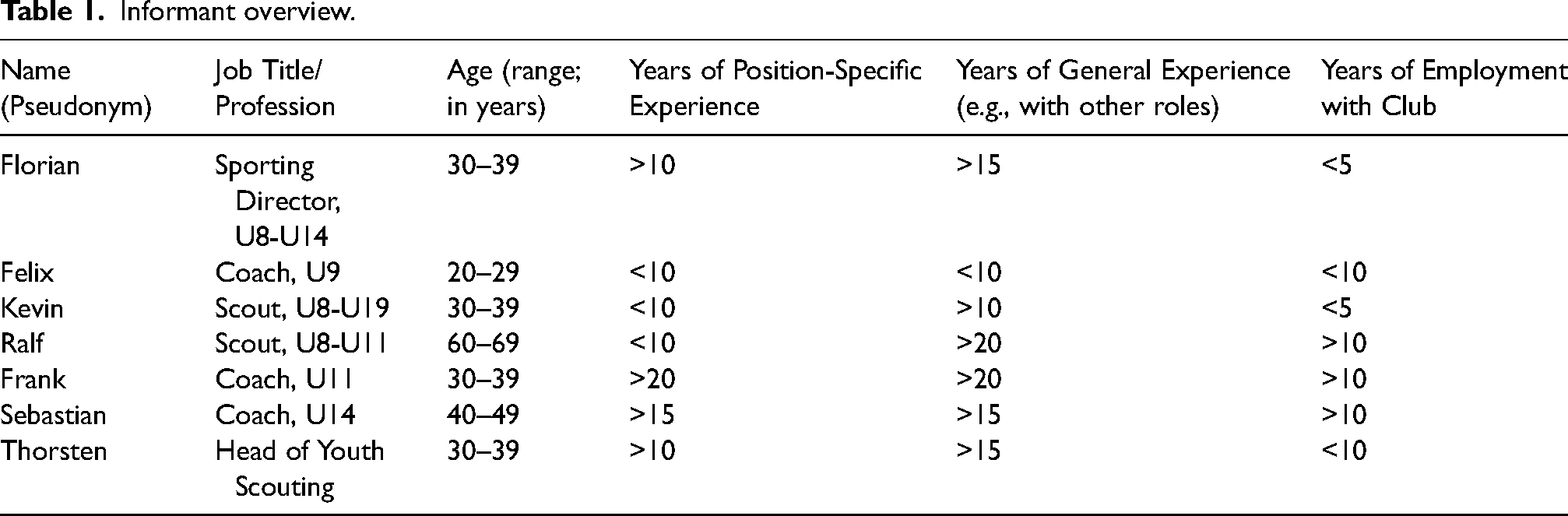
The informants (N = 7) consisted of male coaches (n = 3), scouts (n = 3) and their sporting director (n = 1) between the ages 24 and 68 (M = 38.57, SD = 13.97) overseeing male athletes in the category U8-U14. On average, informants had been employed at the club for 6.7 years (SD = 3.73) and previously held coaching positions at both the elite and amateur level (part-time and full-time). Table 1
Informant overview.
Data collection and analysis
Data collection commenced in October 2022 and comprised seven semi-structured, in-person interviews held in German. This qualitative approach is conducive to unearthing the underlying motivations, contextual factors, and challenges TISD stakeholders encounter in their decision-making processes. 42 The interview guide was structured into three sections: (1) the informants’ professional background (to gain a comprehensive understanding of their expertise and knowledge development); (2) organisational structures (to contextualise the informants’ experiences and perspectives); and (3) perceptions of different TISD methods with a particular emphasis on the use of quantitative metrics and technologies. In October 2021, the interview guide was piloted at an amateur football academy to ensure its clarity and effectiveness, 43 resulting in several adjustments to its content and structure. The informants’ engagement and interest in the study led some interviews to naturally expand beyond the questions asked in the interview guide, resulting in a diverse range of interview durations ranging from 45 up to 120 min. Roughly ten hours of interview material were recorded and transcribed. Interviews were transcribed concurrently with the taking of notes as part of an initial, informal analysis. Once all interviews were conducted and transcribed, a more structured approach to thematic analysis (TA) was implemented.
The decision to use TA was deemed appropriate as the method matched the research objectives. This approach enabled the identification, analysis, and reporting of TISD stakeholders’ understandings of data-driven methods and technological advancements, providing a shared understanding based on individual accounts.44,45 Being a popular method in qualitative sport and exercise research, 45 TA is an interpretive and constructionist approach that has its roots in the iterative stages of coding proposed by grounded theorists. 46 While TA is typically understood as a purely inductive approach, it could be argued that some theoretical guidance – typically in the form of previous research – is necessary to ensure that data collection and analysis are aligned with the study's research questions and aims. In that sense, Braun and Clarke 47 emphasised that conducting purely inductive research is arguably impossible. However, they also highlighted that one approach typically tends to dominate. The dominance of either a deductive or inductive method often reflects a broader focus on either researcher/theory-driven (deductive) meaning or respondent/data-driven (inductive) meaning, respectively. In this study, the emphasis leans more towards the latter—respondent/data-driven meaning.
TA involves the identification and organisation of recurring and distinctive codes and themes which are identified and actively constructed by the researcher who has fully familiarised themselves with the data corpus through immersive and repeated reading. 45 Consequently, codes, themes and findings do not simply “emerge” from the data, but are actively constructed by the researcher. Both semantic coding (focusing on the explicit meanings in the data) and latent coding (focusing on hidden meanings and underlying assumptions) were applied without prioritising one over the other, allowing for a comprehensive understanding of the data that aligns with the study's constructive and interpretive framework. As such, material could be double-coded in accordance with the semantic meaning communicated by the respondent, and the latent meaning interpreted by the researcher. 48 Peer debriefings were utilised, with colleagues serving as critical friends, to discuss codes and themes, thereby enhancing the reliability of the research. 40
Ethical considerations
The study underwent the scrutiny of the Swedish Ethical Review Authority (ID:2022-03401-01). All data has been collected and stored according to the GDPR. The identities of research informants and their associated club have been anonymised by using pseudonyms and keeping potentially relevant information, such as years of experience or employment or background information about the club, as general as possible.
Findings
The analysis of the interview material resulted in the construction of three themes. The first theme explores how and what kind of data is utilised and how stakeholders perceive quantitative data to inform TISD decision-making more generally. The second theme addresses the challenges perceived by TISD stakeholders regarding the increasing quantification of athletes through new technologies and new methods to collect data. Finally, the third theme encompasses future outlooks and expectations on such data and technologies providing such data for TISD processes.
Data utilisation and perspectives
The informants emphasised that extensive data collection primarily takes place in late adolescence and early adulthood and that it was generally not perceived as very meaningful before that. Collecting data and focusing on numbers is a difficult topic, especially when it comes to how that affects the motivation of the youngest kids. We want to follow the kids and give them room to develop. In that regard, data does not really make sense for such younger age groups in my opinion. Felix, Coach I think the team from U16 and up is way better at collecting data but I can't really tell you how they use all this data. Frank, Coach
Moreover, the informants highlighted that talent, and the identification thereof, was not necessarily bound to quantifiable metrics and performances emphasising a reluctance to quantify talent. We really only measure performance when the players are 19 or 20. We don't really measure anything before that. Talent does not necessarily have something to do with numbers or quantified performance. I can tell if an athlete is talented before we actually start to measure their performance. Kevin, Scout
Sporting manager Florian, too, highlighted that data collection did not take place beyond the collection of anthropometrics to calculate peak height velocity. We don't collect anything [data] when it comes to the little ones. We look at height, weight and also seated height because we want to look at their PHV [peak height velocity]. But that's about it. Florian, Sporting Manager
This data is intentionally collected to assess growth patterns, monitor training loads, adjust training sessions and support injury prevention. Further, the informants stated that data was utilised to identify and monitor players with delayed development patterns as well as to keep track on individuals’ progressions rather than using data to compare individual athletes to each other and base TISD decisions on such comparisons. From U13 we start to pay more attention to assessments of height, weight and also seat height, because based on that we can predict growth patterns. (…) That's something we use to calculate peak height velocity, so when the boys have the biggest growth. When they peak, they usually have the highest risk for injury so we use that to adjust our training sessions at least a little or at least have an eye on how the load should be… When they hit puberty around U12, U13… Once they enter U14, U15 it's usually over but we also have the delayed players, the ones that take longer to develop but through the data it is easier to keep an eye on them. Frank, Coach I have to keep in mind that these twenty kids are completely different individuals. I cannot compare this data. I cannot compare one squad to another because the humans are completely different. We look at their peak height velocity. (…) But we also have to consider other factors like what time of the year players are born. The ones who are born earlier in the year usually have an advantage. So if the squad does a speed test then the slightly younger ones are usually slower. When it comes to development potentials, biological development, strength development, speed development… then I can’t really compare all these individuals and I don’t feel comfortable using such broad tests and making evaluations based on them. All these factors skew the data. Sebastian, Coach We mainly look at their height, especially when it comes to goalkeepers. We sometimes have relatively small kids and when we look at their parents and see that they are not very tall either that is something we try to address early to create the right expectations. But even here it's not that we are very strict about it. We just try to be transparent in how we predict potential outcomes. Felix, Coach
Moreover, informants confirmed the gathering of anthropometric data in the realm of athlete-initiated recruitment – typically through sign-up forms leading to trial sessions. Yet, they underscored its questionable reliability, particularly when self-reported by athletes themselves or by their legal guardians. While such data on paper pre-informed identification of potential athletes, it was argued to not dictate athlete selection. For the very young children who want to come to a trial session, it is often the parents who are responsible for entering their kid's data. Example: There are plenty of ambitious fathers everywhere who simply say ‘My child is two-footed ‘… then the child comes and we realise: no way. Or they say ‘My child is very, very tall and very athletic’ and then comes, in an exaggerated sense, a little chubby boy. So that's very uninformative when it comes to this data. Size yes, you can say, weight can also be checked somehow. If the player is a candidate for us, this data will of course be checked to some extent. (…) But we won't do that if 150 children register for such a fun training here. Sebastian, Coach
While anthropometric data was generally seen as meaningful and informing TISD processes, the informants also revealed that the club tried to implement the utilisations of technology such GPS systems. However, they argued that the adoption failed as the data received did not proof to be meaningful to TISD processes in the younger age groups (U8-U14). We kind of realised “Okay, we don’t really need GPS technology here in the U14”. The U16 uses it, because it makes more sense there and we can use it to monitor and stir the training sessions there. I definitely think this has potential, but it has to make sense. Frank, Coach
Adding to this, automated evaluations of video-based material have been tested to assist TISD processes in the younger age groups with the aim to get a more holistic view of the players. Nonetheless, the informants expressed caution when using such data, highlighting that it was only perceived as potentially useful when triangulated with other sources of information: (…) it [data]helps us to get a more holistic view of the player. It helps us to be more objective. If that's good in the end? I want to be careful with video evaluations and evaluations computed by machines. We have to put everything in relation. Sebastian, Coach I would like people to focus less on data and documenting things and instead ask “What does the boy really want?” Kevin, Scout
Challenges
The findings highlight several challenges when it comes to the utilisation and adoption of new methods to inform TISD decision-making. Sebastian, for instance, argued that in his perception it was not data collection that constituted a problem, but rather how said data was evaluated and operationalised. I think we collect a lot of data. I believe that we could improve when it comes to how data is evaluated and put into practice when it comes to prognoses of player development of a player. Sebastian, Coach
We bought these new GPS trackers. It was really funny the first two years because we had all these fancy trackers – which were super expensive (…) – and suddenly we also had all this data, and we were like “What are we going do with it now?” We didn’t know how to read the data at all.
Frank, Coach
Adding to this, time constraints were highlighted to be one of the main issues inhibiting optimal use of data: I really would like someone to take care of all the data analysis and who can give us scientific support (…) considering that I don’t have a lot of time. Florian, Sporting Manager
Moreover, some informants expressed that the collection of data was too complex. This perceived complexity reinforces them to return to more qualitative-informed approaches and intuitive knowledge to support their TISD decision-making. I am a really bad scientist. I am extremely bad at collecting data and also when it comes to organising of processes and so forth. As soon as things get too complex… that's really not my strength and that is also why I am not really engaged with this stuff. I really don’t measure a lot, I rather feel. Thorsten, Scout
The findings further highlight that the complexity of data protection regulations, particularly in regard to German federalism, is perceived to pose logistical challenges and complicating data management. Things were a lot easier back then. Around here, it is still relatively easy but as soon as we are talking on a national scale it has become difficult because every state tends to have their own rules. Data protection complicates my work immensely. Ralf, Scout I would say that we are really not that good when it comes to data and following-up on it.. I also really don’t know how the situation is with the data protection laws these day… but generally, we are really not that great when it comes to data, evaluation of data and so on. Surprisingly. Florian, Sporting Manager
Future outlooks and opportunities
While informants expressed a sense of novelty and caution towards the collection of quantitative data and adoption of new technologies for TISD decision-making, they also frequently expressed a positive outlook for their future and potential of such methods. For instance, one of the coaches argued that video-based evaluations were new to them, but that they saw potential in its further utilisation to get a holistic understanding of players: We just started using, and it really is quite new, an automated video-based evaluation of 5 against 5. (…) We have used it once so far… or twice. But we want to keep using it in the future as well because it helps us to get a more holistic view of the player. Sebastian, Coach
There is a lot more potential! Especially in terms of AI… I don’t have enough knowledge about these things but it's insane what is possible when it comes to predictions and so.
Frank, Coach
Additionally, there was a keen interest in leveraging historical metrics to extract valuable insights into athlete development trajectories. The potential of such analyses was perceived to lie in various factors, including training frequency, physical attributes, medical history, and academic performance: It would be really interesting to see and compare data from previous generations of athletes who have been part of football academies. That would be a lot of data considering how much is being collected these days. It would be interesting to see if those who made it have done more, did they train more, how tall were they at specific times during their development, how many physio appointments did they have, or what kind of school grades did they have… you could really look at this data at so many levels and maybe inform more decisions based on such data. Thorsten, Scout
Finally, the demographic composition of the staff emerged as an opportunity for current and future adoptions. For instance, the relatively young age of the staff was seen as providing unique access to emerging technologies and innovative approaches. I think it [an openness towards new methods] has something to do with the average age we have in the team here. Our team is quite young, we have less experience and thus less reference point to always go back to. That can also be a disadvantage of course but, generally, I would say that it leads to us being more curious and more open to try new things. Kevin, Scout
Discussion
This single case study was conducted to generate in-depth and context-rich insights into how a team of seven coaches, scouts and a sporting manager overseeing the U8-U14 athletes at a German Bundesliga youth academy experience data-driven methods and technology to inform TISD decision-making and processes. The analysis of interview data resulted in three themes: data utilisation and perspectives, challenges and future outlooks and opportunities.
Data utilisation and perspectives
Data-driven methods and technology were perceived as having potential to inform current TISD practices. Nonetheless, they were not perceived to inherently define talent. For instance, while anthropometric data were perceived to provide valuable insights to predict and monitor growth and injury prevention, the informants expressed caution about its reliability and relevance, highlighting the importance of following a holistic approach to TISD that does not overly rely on metrics. This aligns with previous research suggesting that TISD environments and stakeholders must strike a balance between objective and subjective measures in informing TISD practices.11,12 However, some informants, such as Sebastian, explicitly stated that incorporating more quantitative data and technology into his practice was perceived to help him and his colleagues become more objective. This suggests that objectivity is something he and his team are actively striving for and perceive as adding value to TISD decision-making. Nonetheless, it is important to highlight that even seemingly objective methods can still be influenced by bias and subjective judgements. 49 For example, the adoption of certain methods perceived as objective may be rooted in subjective beliefs about their value and applicability, as well as personal preferences and philosophies, 9 which can reinforce biases such as confirmation, anchoring, or availability biases. Therefore, practitioners like Sebastian should exercise caution when labelling certain methods as more “objective” than others, even if those methods may produce concrete, transparent, and tangible metrics, as compared to, for instance, observations. While metrics may increase transparency among staff as well as trust and respect in the coach-athlete relationship, 50 an abundance of data may also presents potential risks. When data is used excessively, it may foster an environment of pressure and scrutiny, 28 increasing surveillance and control,34,35 which could negatively impact coach-athlete dynamics.
Informants ascribed less significance for extensive data collection for the age groups U8-U14, and more significance for older age groups. Moreover, they expressed uncertainty regarding the extent and methods of data collection in other parts of the club. This implies that there is an organisational disconnect regarding the flow and transparency of information within the academy. To reduce such uncertainties and to ensure transparency, I suggest that TISD environment establish clear protocols for the flow of information within the organisation. Additionally, encouraging collaboration between staff responsible for different age groups can foster a more integrated understanding of athlete development within the organisation.
Challenges
Informants expressed concern about the evaluation, meaningful application, and translation of collected data into actionable insights for TISD processes. This is consistent with prior research conducted in the UK 3 which highlighted the importance of ensuring that data collection is meaningful to stakeholders. Perceived barriers to effective data utilisation included lack of expertise among current staff members, time constraints, and the complexity of data protection regulations, which reinforced the informants to stick to traditional and qualitative approaches rather than engaging with more complex data systems. Similar challenges were highlighted in previous research, 51 problematising lack of expertise in data management and interpretation as well as time constraints. These recurring and overlapping problems across different contexts strengthen Žižek's “post-political” viewpoint, arguing that current debates should prioritise how to employ such methods, rather than debating their necessity or rationale. 8 Consequently, the findings further emphasise a growing necessity for hiring trained personnel and/or providing proper training to TISD staff working with new technologies and data-driven methods. 7
The findings further underscored the issue that the increasing availability of innovative technologies and data, as well as comparisons to rivals, may lead to the adoption of new methods without conducting thorough assessments, often resulting in superficial implementation.2,3,21 The manager's perception of the club's “surprising” lack of data collection and utilisation reinforces that TISD stakeholders may struggle with expectations within the industry that top-level club's must collect and utilise lots of data and technology to be legit.5,30 In other words, metrics and technology have become increasingly linked with what constitutes efficient and good TISD environments. While prior research indicates that financial constraints are a major factor in clubs’ reluctance to adopt new technologies and TISD methods,32,36 the findings suggest that a lack of financial resources did not impede, but rather expedited the adoption of new methods. New technologies like GPS systems, for instance, were introduced without providing staff with a comprehensive introduction or training on how to use such tools, resulting in an investment that did not actually came to fruition. With research emphasising the importance of experts feeling competent in their practices, 52 new methods that fail to resonate with stakeholders and cause feelings of incompetence can hinder future adoption of beneficial innovations aimed at enhancing TISD decision-making. Moreover, the integration of new technology, such as GPS systems, also suggest that a push to collect more data within the U8-U14 unit may be authority-driven and taken from a bottom-down approach within the overall organisation, rather than collaborative and in agreement with the practitioners and sporting manager of the U8-U14 unit. Given that previous research indicates decision-making is often driven by authority, 30 this prompts inquiries regarding the autonomy of key stakeholders, such as sporting managers, and their ability to resist implementing new methods and technologies that senior organisational leaders favour but which the managers themselves may not find valuable. Asking TISD stakeholders to utilise methods that do not align with their own beliefs or that they do not want to use, may affect intra-organisational communication or even cause disagreement among staff, potentially impeding collaboration, and hinder progress toward common goals within the organisation. 29 Consequently, TISD stakeholders should be included as much as possible when new technologies and methods are introduced.
Data protection laws were perceived to be a challenge to data collection efforts in youth academies, 36 particularly for scouts who look for new talent across regional or national borders. Governed at both federal and state levels, data protection laws in Germany include the Federal Data Protection Act (Bundesdatenschutzgesetz - BDSG) and the GDPR. However, all federal states (Bundesländer) can enact supplementary regulations, leading to varying requirements and standards across regions. This decentralised approach complicates compliance for football clubs, as they must navigate both federal and state-level regulations. This highlights that understanding the regulatory context is crucial for clubs operating across multiple regions to maximise the use of data collection effectively.
Future outlooks and opportunities
Although TISD stakeholders recognised and encountered current challenges with data-driven approaches and novel technologies, they remained optimistic on the potential of emerging methods like AI and automated video-based evaluations for younger academy athletes. While informants acknowledged that their understanding of these methods was limited, they expressed optimism about the potential future applications of these tools to enhance decision-making. They anticipated that utilising these technologies will provide a more comprehensive and holistic understanding of player development. This optimism suggests that stakeholders may push for greater investment in these technologies, leading to the acquisition and implementation of advanced tools that could enhance training and evaluation processes. As these tools become more integrated, the volume of data collected could grow significantly, leading to additional challenges in data management, analysis, and maintaining data quality. Consequently, and in line with previous research, 7 these findings reinforce the need for proactive training programmes to equip practitioners with the skills to effectively use and interpret these new technologies and data.
Potential was seen in leveraging historical data, such as training frequency, physical attributes, medical history, and academic performance to inform future decision-making processes. Previous research argued that continuous tracking and establishments of historical data bases can provide valuable insights into athletes’ long-term development, helping to identify benchmarks, track an athletes’ progress, and improve goal-setting and performance evaluation.37,53 However, managing and analysing comprehensive datasets could increase staff workload and, thus, require significant investments in data management systems and skilled personnel, adding complexity to data handling and TISD infrastructures. While large data bases were seen as having potential, informants also expressed concerns about privacy and ethical considerations regarding the storage of such longitudinal data. 54
Structural and organisational factors were perceived as key to the implementation of new methods. For instance, informants noted that the younger demographic of the staff fostered openness toward innovative methods. These perceptions align with previous research linking age to coaches’ receptiveness to adopting new technological innovations. 55 Instead of focusing on what different kind of age groups may bring to the table, I argue that clubs should invest in the continuous professional development of all staff members, regardless of age, to keep them updated on new technologies and methods. This inclusive approach fosters learning and equality, helping to bridge potential gaps among stakeholders with diverse backgrounds.
Limitations
Football academies operate within their own unique socio-cultural, organisational, and regulatory context. As a result, the contextual nature of this study limits its transferability, which is a common challenge in single and small-scale case study designs like this one. Adding to this, the relatively small sample of seven informants may be prone to biases, potentially resulting in findings that disproportionately reflect the idiosyncratic views or characteristics of only a few informants rather than providing a comprehensive overview. The study may also be limited in the amount of contextual background it provides. Individual, organisational, cultural, and societal factors shape our perceptions and actions. Determining how much contextual detail is necessary or which factors are most impactful can be challenging within the scope of a single study. Future research could investigate how these broader influences interact with TISD approaches, particularly data-driven ones. Nonetheless, the case study provides valuable, contextual insights into the TISD practices of seven stakeholders of a German football youth academy in an increasingly data-driven society, offering lessons for future research.
Conclusion
This study investigated how stakeholders within a German Bundesliga youth academy experience and perceive data-driven methods and technology in talent identification and sporting development U8-U14 athletes. Comprising seven semi-structured interviews with coaches, scouts, and a sporting manager, the study offers nuanced insights into 1) current perceptions and the utilisation of data-driven methods, 2) challenges surrounding data-driven methods, and 3) future outlooks and opportunities.
The findings illustrate that data-driven methods and technology are increasingly linked with the notion of efficient and effective TISD environments. In practice, however, the findings underscored a reluctance by participants to adopt new methods and technologies to inform TISD decision-making. While adoption does not fail due to a lack of financial resources, perceptions in regard to lack of expertise and time, as well as legal regulations, continued to hinder the implementation of new methods, reinforcing informants to rely on familiar and more traditional practices instead. Nonetheless, informants remained fairly optimistic in terms of future developments. Data-driven methods and technologies were perceived as means to improve objectivity, with potential for adopting and implementing more advanced solutions in the future, such as AI-based methods. Organisational and demographic factors, such as the age of key stakeholders, were seen as beneficial, fostering openness to new methods and driving adoption. Further research could further address the challenges and perspectives influencing the adoption and successful implementation of data-driven methods in football academies. For instance, research could further examine the effects of organisational dynamics and data protection laws on the adoption and implementation processes of new technological tools to inform TISD practices. Additionally, longitudinal studies could assess the adoption processes over time and across entire organisations, examining their impacts on various stakeholders and practices.
The findings have important implications for youth football academies, suggesting that they should prioritise training staff in data interpretation or consider investing in trained personnel to support coaches, scouts, and managers who may lack the time and expertise to effectively utilise new technologies. By equipping staff with the necessary skills to understand and apply data, academies can enhance decision-making and improve player development. Furthermore, fostering a collaborative approach that involves key stakeholders in the decision-making process when adopting new technologies can help ensure these methods align with the academy's objectives and practitioners’ values. This approach not only promotes successful adoption but also creates a culture of continuous improvement, ultimately optimising TISD practices and facilitating long-term sustainability.
Footnotes
Acknowledgments
Deep appreciation is extended to the seven informants who generously dedicated their time to partake in this study. I also thank Jenny Vikman for her critical thoughts and feedback during the revision of this paper.
Declaration of conflicting interests
The author declared no potential conflicts of interest with respect to the research, authorship, and/or publication of this article.
Funding
The author received no financial support for the research, authorship, and/or publication of this article.
