




Abstract
The ability to strike regularly in the sport of tenpin bowling is of paramount importance for bowlers should they wish to obtain high scores and compete at an elite level. Therefore, bowlers and their coaches are often looking to maximise the size of the contact area on pin number one (the head pin) that can be hit such that the chance of getting a strike is high. This effectively increases the margin of error that the bowler has, which could result in them having an advantage over the opposition. To help gain insight into the features of a shot that can potentially increase this area whilst maintaining a high strike percentage, ball tracking data from the 2017 Weber Cup is analysed. The position of the ball as it hits the pins is found to be important. If the ball travels through the pins without much deflection, and the position of the ball towards the last row of pins is close to the centre of the lane, then the target area around the head pin increases significantly. The entry angle and entry speed of the ball are found to be less important.
Introduction
Tenpin bowling is a very popular sport and remains the number one participation sport in the United States of America. 1 Participants have two attempts to knock down ten pins with a bowling ball. The pins are located between 18.29 m and 19.08 m (60 feet and 62.6 feet) away from the foul line where the ball is released from. They are arranged in a tetractys, with the outline forming an equilateral triangle with side length 0.914 m (36 inches). 2 The width of the lane is approximately 1.05 m (41.5 inches) and a gutter can be found at the extreme edges that results in an immediate score of 0 for that particular shot should the ball fall into it. 3 The lane is divided into 39 thin strips across its width which are known as boards. The boards are used by bowlers as a reference frame for targetting and are each approximately 2.73 cm wide (1.07 inches). Where necessary, measurements in terms of boards, centimetres and inches will all be given here for clarity. The lane surface is protected by a thin film of lane conditioner, commonly referred to as oil, which can significantly influence strategy.4,5
Equations for a sphere rolling on a surface are well-established and have been extensively studied in various sporting contexts.6–10 The scenario of a ball moving along a horizontal plane while rotating about an axis not perpendicular to its direction of travel, commonly seen in tenpin bowling, has also been investigated11,12 with the results being able to predict the ball’s parabolic path.13,14 Experimental studies on determining the characteristics of a rotating bowling ball have been conducted using an inertial measurement unit placed inside the ball. 15
The primary objective of the game is to record a strike, where all ten pins are toppled on the first shot. This yields the best potential for score as a strike is worth ten points plus a bonus equal to the number of pins that the bowler knocks down on their next two shots. 16 Therefore bowling strikes consecutively makes maximum use of the bonus that each strike gives.
The sequence in which the pins fall can be a very chaotic problem due to many factors such as the curved shape of the pins and slight deviations in their initial positions. As a result, there are many different ways that the pins can interact with each other such that the end result is a strike. However, through this randomness, there is one optimal sequence of interactions that will result in a strike without having to rely on any significant good fortune with respect to the manner in which the pins fall. This sequence of collisions between the ball and pins is shown in Figure 1 for a ball entering the pins from the right side of the lane. The arrows in Figure 1 should be reflected in a line that passes through the centre of the one and five pin for the equivalent strike for a ball entering the pins from the left side of the lane. Surprisingly, the bowling ball itself will only hit four of the ten pins during this interaction before falling into the pit. For a ball entering the pins from the right, those pins are the one, three, five and nine, whilst for a ball entering from the left the pins are the one, two, five and eight.
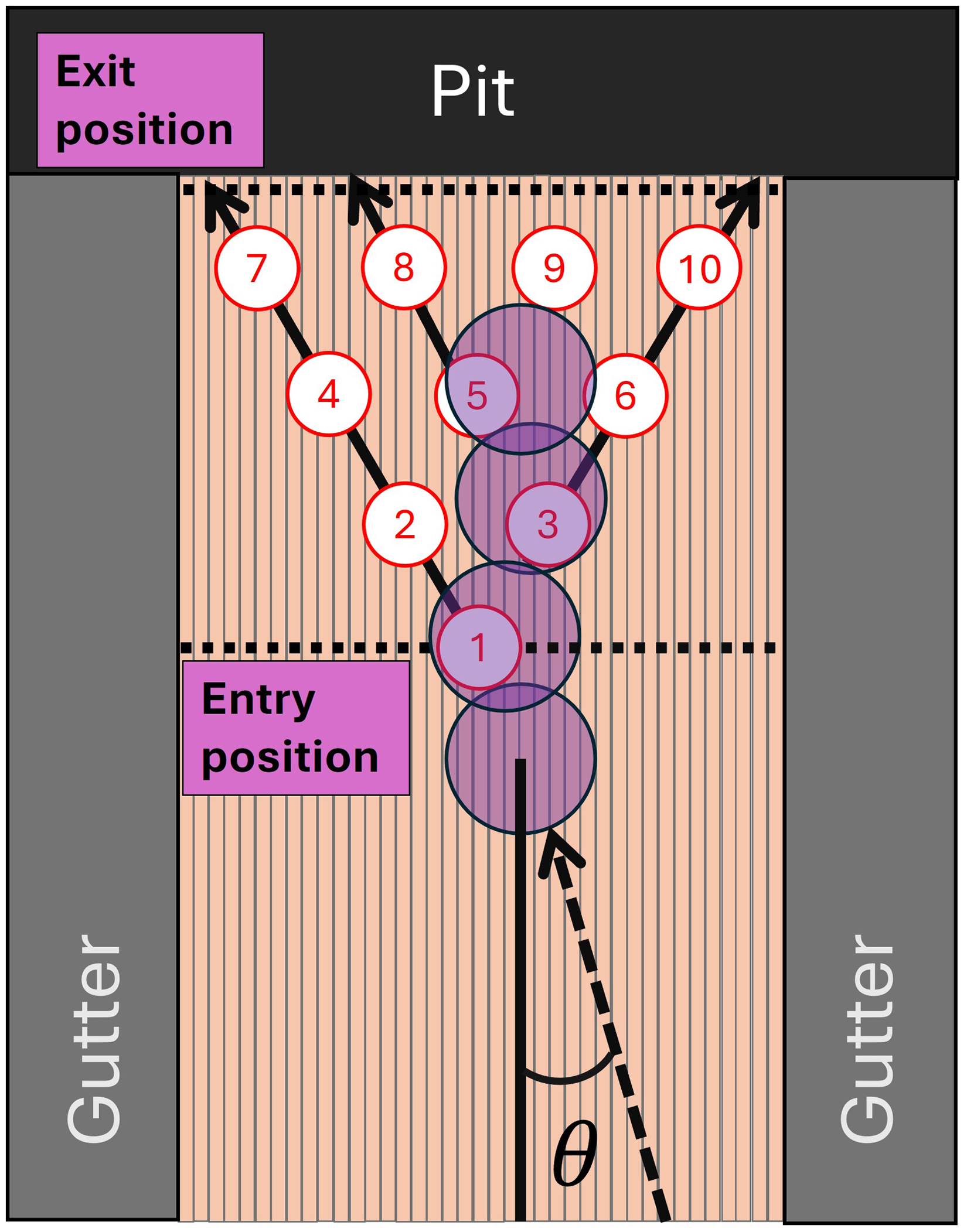
A schematic of the pin deck area of a bowling lane showing how the ball and pins interact during an optimal strike for a ball entering the pins from the right half of the lane. The pins are numbered from 1 to 10 as shown. The entry angle of the ball is shown by
In order to generate this particular ball–pin interaction, the ball must hit a small part of pin number one, which is known as the head pin. This does not give the bowler much room for error. For example, if the head pin is hit slightly fuller (further to the left from the ball shown in Figure 1), the four pin could remain standing as it does not get hit by the two pin which would pass in front of it. Alternatively, if the head pin is hit slightly too thin, then the ball will hit the three pin too far to the right, which will result in the three pin hitting the six pin too far to the left which would consequently cause the ten pin to remain standing. It is therefore of great interest to bowlers to find a way to be able to get a strike regularly when their ball hits the head pin slightly away from the optimal position, which essentially increases the size of their target at the head pin.
Controlled experimental investigations have found that the optimal place to hit the head pin to get a strike, for entry angles between 2° and 6° is approximately 5.7 cm (2.25 inches, 2.10 boards) offset from the centre.
17
It was also found that the angle at which the ball approaches the pins at, known as the entry angle, changes the strike percentage for a given impact location.
17
This parameter is shown by
Whilst studies regarding size of the target on the lane one has such that the head pin is hit in the desired area have been conducted, 14 to the best of the author’s knowledge, there has not yet been an analysis of ball tracking data from a bowling tournament collected outside of a laboratory setting where features of the path of the ball whilst it is on the lane are investigated with respect to the outcome of the shot. Therefore, this research aims to analyse the ball tracking data that was collected from the 2017 Weber Cup and examine how the path that the ball takes whilst it is on the lane influences the probability of getting a strike.
Method
The data for this study was collected from the eight professional bowlers who participated in the 2017 Weber Cup, where USA and Europe compete against each other. It is analogous to the Ryder Cup of golf, and the Mosconi Cup of pool. The results of each shot were analysed from the television coverage and corresponding ball tracking data that was measured at the event in real time by Kegel’s Specto measuring system. 18 This device uses lidar to determine the location of the ball, from which many important features of the shot can be calculated, such as the speed of the ball as it travels through different areas of the lane, and the entry angle. During the tournament, 31 matches were played which resulted in 62 games being completed. There were 829 recorded shots during those games encompassing both first and second shots. Of those, it was the 612 recorded first shots that were of interest here where the bowlers were attempting to bowl a strike. Analysis was performed in Microsoft Excel and MATLAB. 19 Permission was granted by Kegel to use the data for the purposes of this study.
Of the eight bowlers, six of them bowled with their thumb fully in the ball and had a one-handed swing, and two of them bowled with their thumb fully out of the ball and had a two handed swing. Whilst the tournament was bowled on one and the same lane, five different oil patterns were used throughout the event which gave rise to five different playing surfaces. The oil patterns had volumes between 24.05 mL and 28.70 mL, and lengths between 40 feet and 45 feet (12.19 m and 13.72 m). The features of the individual shots thrown by the bowlers in this study have speeds between 27.16 kph and 35.49 kph (7.54 m/s and 9/86 m/s), and initial angular velocities greater than 350 rpm. These characteristics are often shared by many amateur and recreational league bowlers, which means that the results of this study are directly applicable to them, as well as other elite level bowlers too. Some of the features that separate professionals from amateurs are that the former have superior ability to repeat shots, have a greater understanding of how to adjust and stay lined up as the lane condition changes, and they can execute good quality shots under pressure more regularly. The results given in the following sections do not take into account the bowler that bowled the shot, the ball that they bowled the shot with, or the oil pattern that the ball was bowled on, but this would make for an interesting future study.
Results
The entry position is the location of the ball when it is 60 feet (18.29 m) away from the foul line. It is expressed as the number of boards away from the centre of the head pin in the direction that the ball travels into it from. As the centre of the headpin is also located at this distance, the ball might have already made contact with the headpin when the entry position is given, but the difference between the entry position and contact position will be small given that the radius of the ball is
A frequency plot of the entry position of all first shots thrown is shown in Figure 2. Of these shots, 376 of them were strikes (61.4
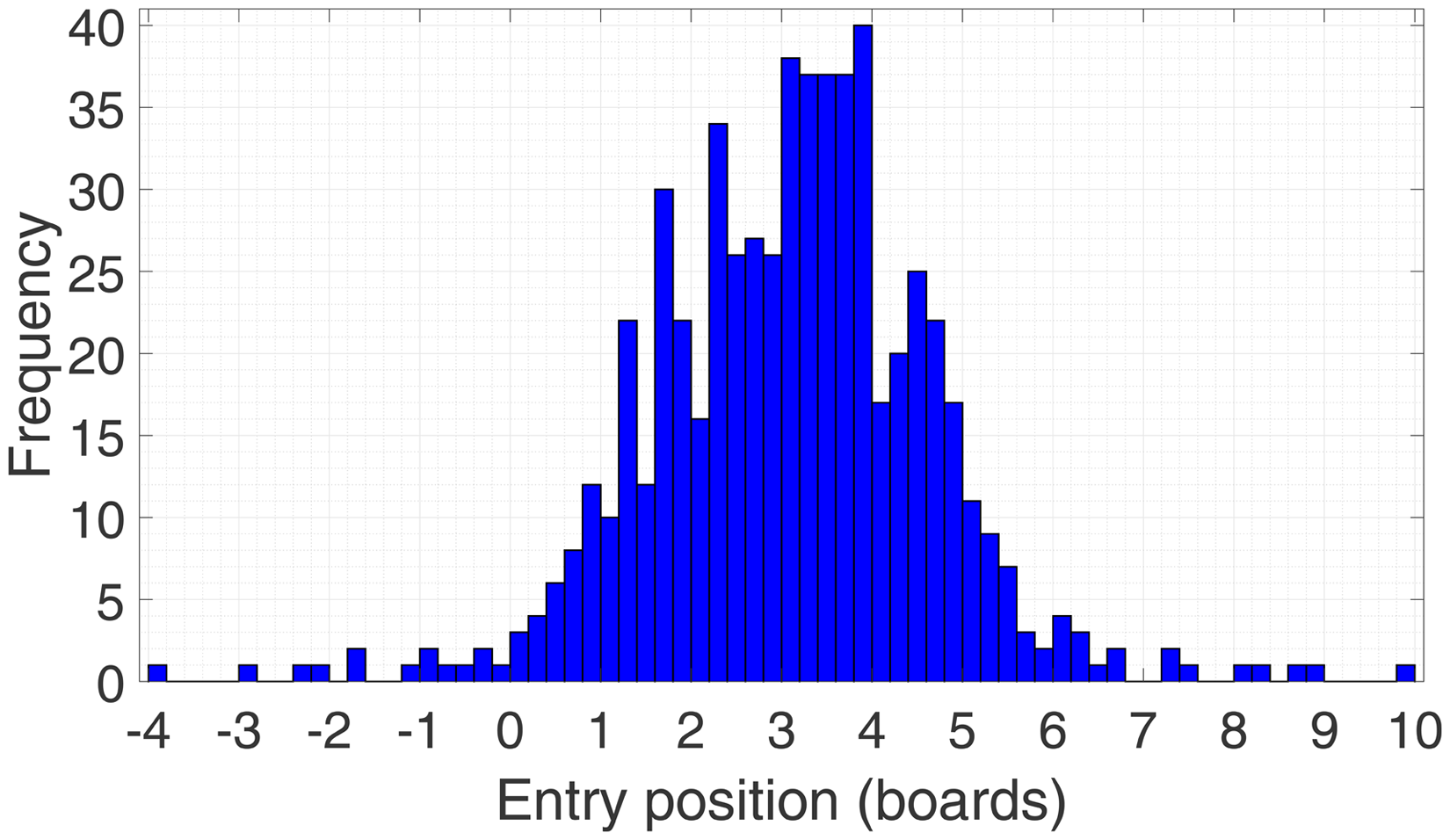
A frequency graph showing the entry position of the bowling ball measured in boards from the centre of the head pin. 1 board = 2.73 cm = 1.07 inches.
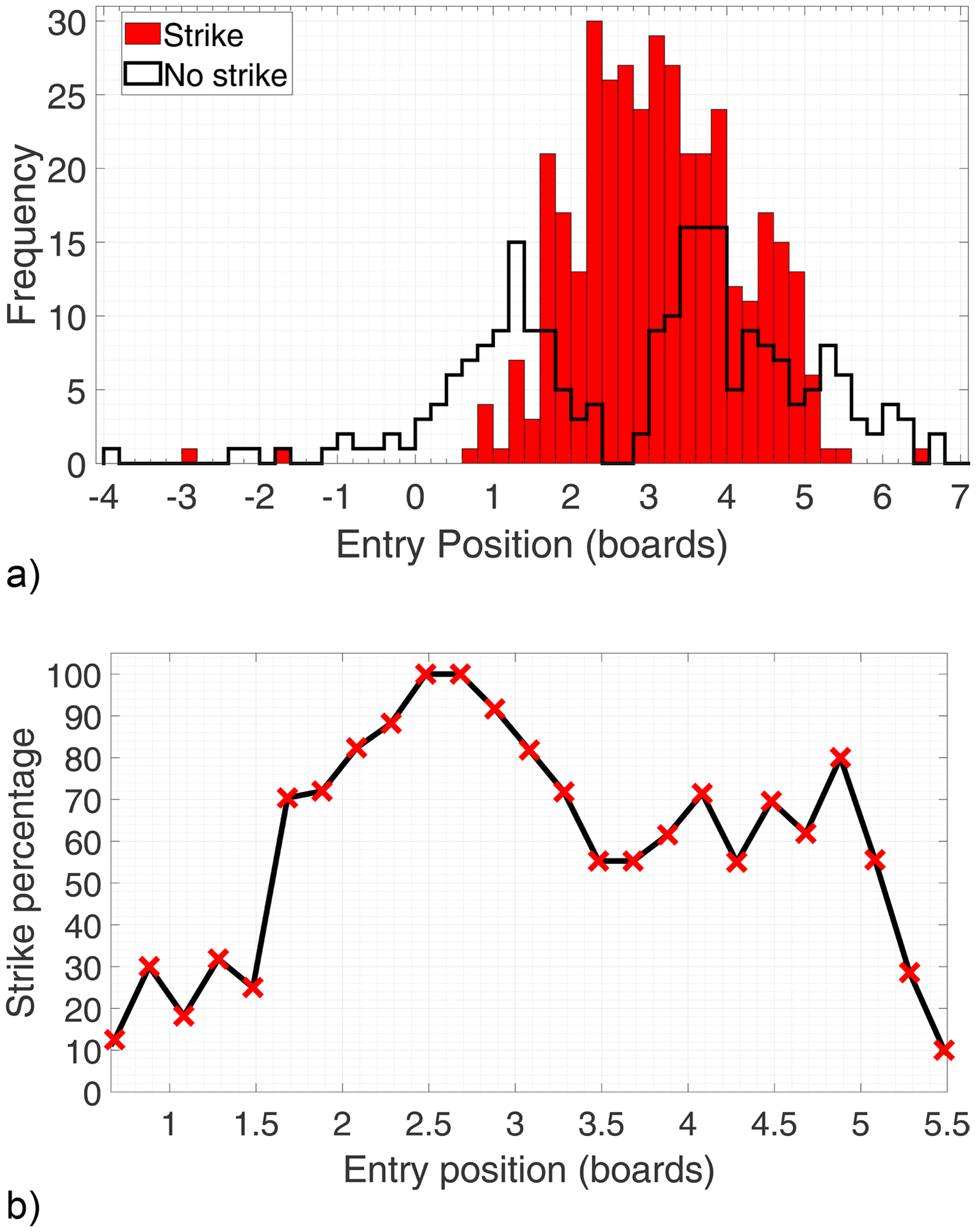
Distribution of strikes with respect to entry position. 1 board = 2.73 cm = 1.07 inches. (a) A frequency plot showing the the entry position of shots that resulted in a strike (red bars) and those that did not strike (black line); (b) Strike percentage for a given entry position. The crosses show the data points which are given at the midpoint of the interval at which the percentage was calculated.
On expanding the range of the entry position to between 2 and 3 boards (5.45 and 81.8 cm, 2.15 and 3.22 inches), there is a 93
Another interesting feature of a shot is the position of the ball after it has travelled through the full rack of pins. This position is referred to as the exit position and is measured when the centre of the ball is 62.5 feet (19.05 m) away from the foul line. Figure 4(a) shows where each first shot exited the pin deck and whether the shot resulted in a strike or not. There were 53 shots in total that exited the pin deck between 0.2 and 2 boards (0.55 and 5.45 cm, 0.21 and 2.15 inches) from the centre, and all of them resulted in a strike regardless of the contact position at the head pin. Moreover, balls that exited the pin deck somewhere within the 4 board (10.9 cm, 4.29 inch) range of
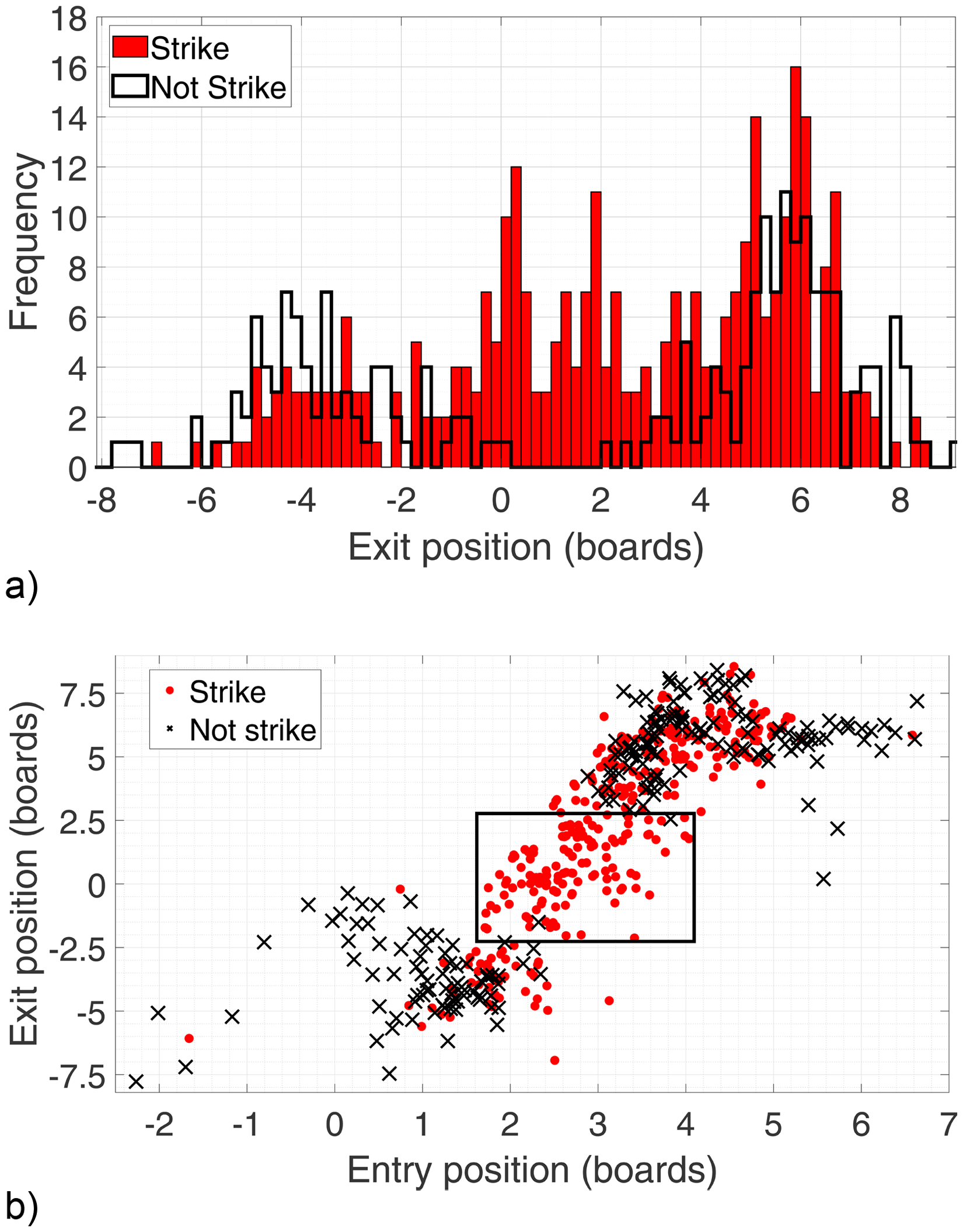
Distribution of strikes with respect to exit and entry position. 1 board = 2.73 cm = 1.07 inches. (a) A frequency plot showing the the exit position of shots that resulted in a strike (red bars) and those that did not strike (black line). 1 board = 2.73 cm = 1.07 inches; (b) A scatter plot of exit and entry position of each first shot. The black rectangle in the middle of the graph indicates the optimal region for bowling strikes.
The exit positions are plotted with their respective entry position in the scatter plot of Figure 4(b). This gives an indication of how the ball has travelled through the pins after first making contact with the head pin. There is a region close to the centre of the graph, indicated by a black rectangle, that has significantly more strikes than not. The region, which is defined by entry positions between 1.6 and 4.1 boards (4.36 and 11.18 cm, 1.72 and 4.40 inches), and exit positions between
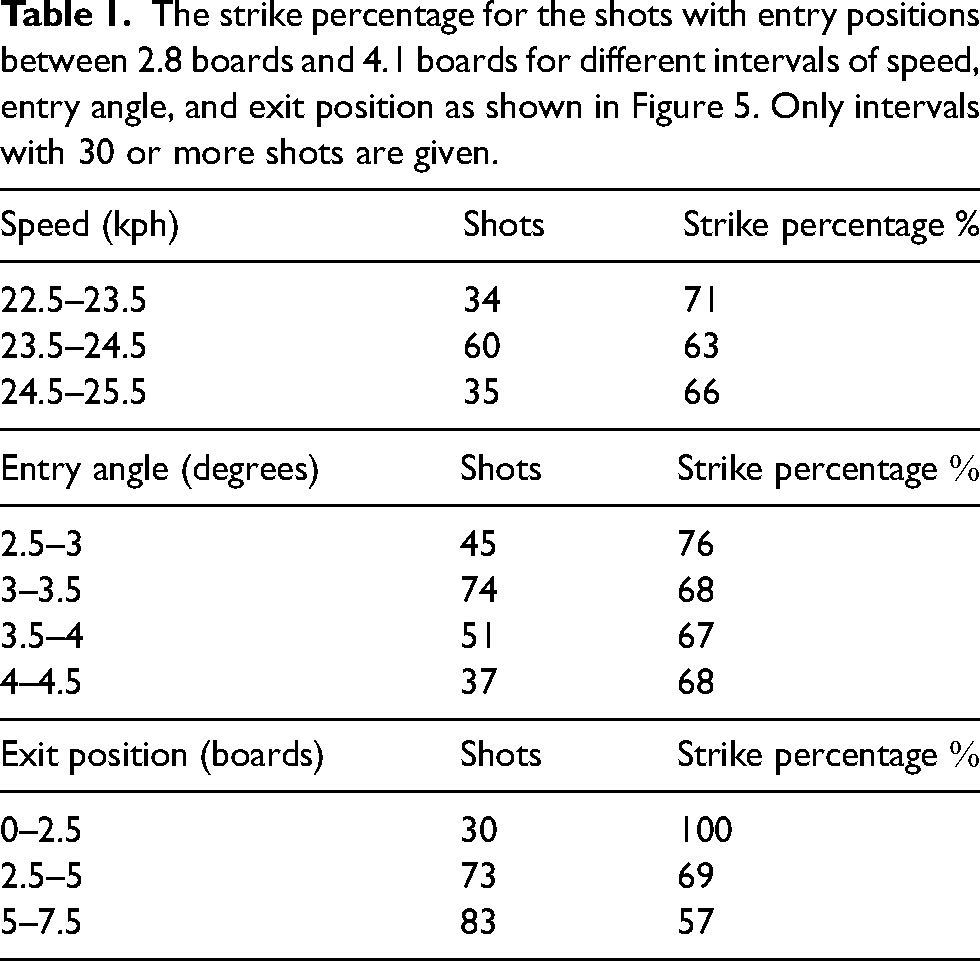
Bowlers commonly refer to an area of the head pin that they are trying to hit in order to get a strike as the pocket. There is no formal definition of the pocket, so here, based on this data, it will be defined as the area of the head pin covering 1.6 to 4.1 boards (4.36 and 11.18 cm, 1.72 and 4.40 inches) from its centre in the direction from which the ball approaches it. To investigate these pocket hits in more detail, further parameters of them are plotted in Figure 5. In particular, there is the speed at which the shot hit the head pin at (Figure 5(a)), the entry angle (Figure 5(b)), and the exit position of the shot (Figure 5(c)). The results are summarised in Table 1 with corresponding strike percentages.
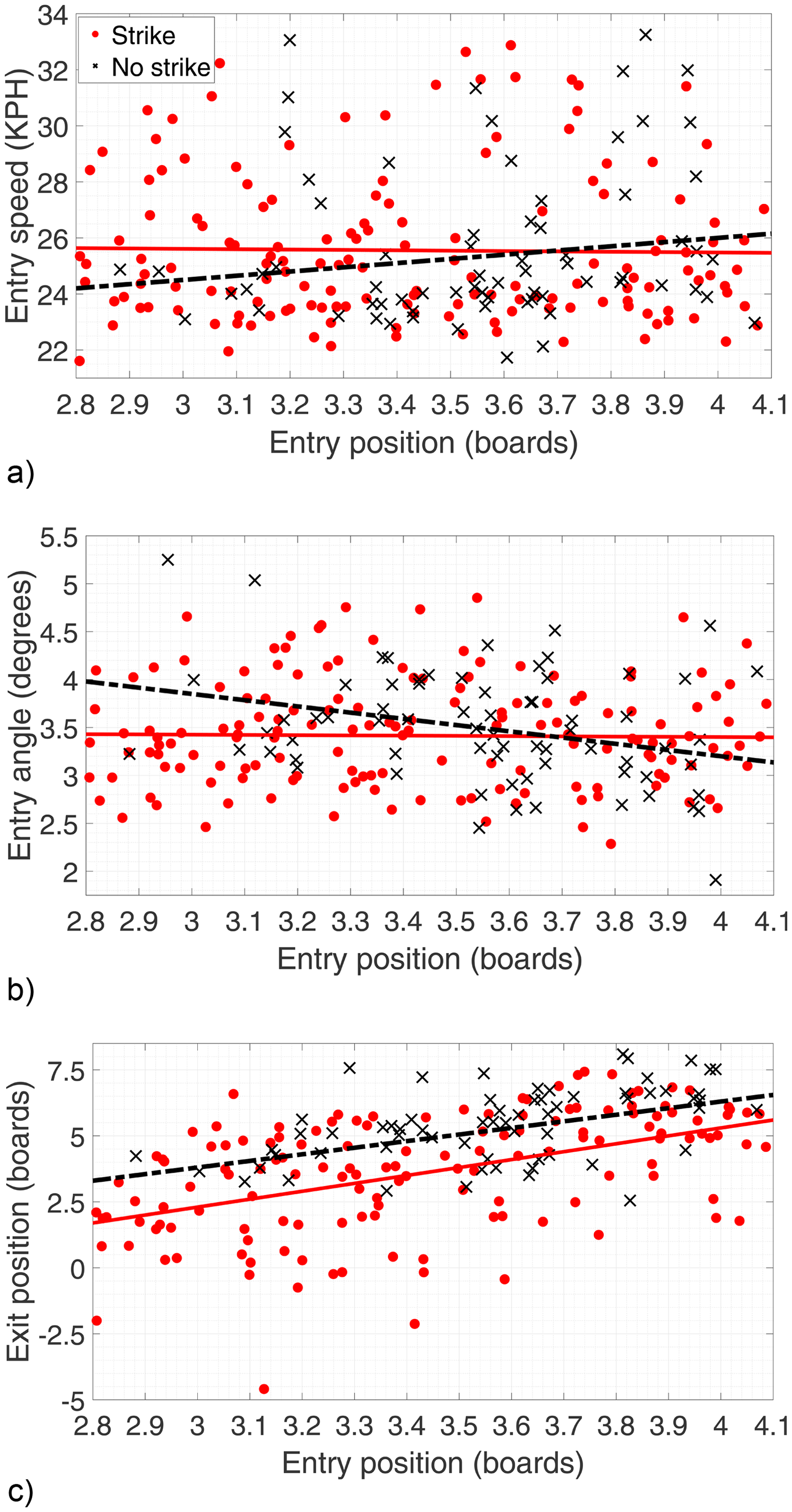
The entry speed (a), entry angle (b) and exit position (c) for shots that hit the head pin between 2.8 and 4.1 boards (7.64 and 11.18 cm, 3.00 and 4.40 inches) from the centre of the head pin that got a strike (red, dot) and shots that didn’t strike (black, cross). The linear regression lines for each data set are also plotted and their equations given below. 1 board = 2.73 cm = 1.07 inches. (a) Strikes (red solid):
The strike percentage for the shots with entry positions between 2.8 boards and 4.1 boards for different intervals of speed, entry angle, and exit position as shown in Figure 5. Only intervals with 30 or more shots are given.
Discussion
In order to be successful in leagues and tournaments, it is beneficial for bowlers to be able to bowl strikes frequently. From the data presented here, any shot that hits the head pin between 2.4 and 2.8 boards (6.55 and 7.64 cm, 2.58 and 3.00 inches) from it’s centre obtained a strike. This offers an area of 0.4 boards (1.09 cm, 0.43 inches), which is small and requires a high degree of accuracy and skill to hit regularly. It would be useful for the bowler to be able to get their ball to hit the head pin within a larger area whilst still maintaining a high chance of getting a strike. To devise such strategy, the parameters discussed in the previous section shall be analysed.
Exit position
It becomes apparent from analysing the differences between the shots that resulted in a strike and those that did not, that the exit position of the ball is pertinent to maximising the area of the head pin that can be hit to have a high chance of getting a strike. The regression line of the exit and entry position of shots that got a strike is always below that of the shots that did not strike, indicating that exit positions closer to the centre of the lane for a given entry position yield a greater chance of striking. A possible reason for this is due to the contact position of the ball with the second pin that it hits, which is the three pin if the ball hits the head pin from the right side of the lane, and the two pin if the ball hits the head pin from the left side.
As discussed in the introduction, the optimal place to hit the three (or two) pin is on the side closest to the head pin in such a way that it hits the six (or four) pin directly into the ten (or seven) pin. The ball is then more likely to deflect towards the middle of the lane and continue through the remaining pins, exiting the pin deck towards the centre of the lane. If contact is made too close to the centre of the three (or two) pin, the six (or four) pin will not be hit in such a way that it directly hits the ten (or seven) pin. The ball will then continue to deflect away from the centre of the lane, leaving the pin deck at a location that is further away from the centre of the lane, and exit position is increased.
Indeed, all of the 59 balls that exited the pin deck between 0.2 and 2 boards (0.55 and 5.45 cm, 0.21 and 2.15 inches) offset, resulted in a strike regardless of the location, entry angle, or speed at which they hit the head pin at. Ultimately, the area at the head pin can be increased by a factor of 6 to between 1.6 and 4.1 boards (4.36 and 11.18 cm, 1.72 and 4.40 inches) offset whilst giving a 98% chance of striking, but only if the ball also leaves the pin deck towards the centre of the lane between
Entry angle
It would seem reasonable to suggest that increasing the entry angle would help balls that hit the pocket to exit the pin deck between 0.2 and 2 boards from the centre as a greater entry angle will minimise the deflection of the ball for a given contact point. The result would then be that the second pin that the ball hits would be contacted in a position such that the pinfall is as described in Figure 1. Shallower entry angles will cause the ball to deflect too much after contact is made with the head pin, resulting in the ball hitting the second pin too close to its centre such that the pin on the ball side corner remains standing.
However, the scatter graph in Figure 5(b) which shows entry angle against entry position for balls hitting the head pin between 2.8 and 4.1 boards (7.64 and 11.18 cm, 3.00 and 4.40 inches) from the centre, which is part of the region defined earlier as the pocket, suggests that as the entry position increases, increasing the entry angle does not yield a meaningfully greater chance of getting a strike. Furthermore, the gradient of the regression line of the strikes is very close to 0, suggesting that entry angle is invariant to obtaining strikes as the contact made between the ball and head pin becomes thinner, which would be expected given previous work. 17
The mean and median entry angle of shots that were strikes was 3.46 and 3.42° respectively, whilst the mean and median of those that didn’t was 3.50 and 3.46° respectively. The similarity of the statistics of these two data sets suggests that increasing the entry angle alone does not improve ones chance of bowling a strike if they do not hit the head pin in the optimal place.
Ball speed
It might be considered as a useful skill to be able to throw the ball faster down the lane in order to have the potential to transfer more kinetic energy to the pins from the ball, but from the data presented here, there is no evidence to suggest that increasing the speed of the ball alone improves the chances of getting a strike. Recall that this data has been captured from professional bowlers, all whom have adequate ball speed to bowl strikes regularly. It may well be that increasing the ball speed throughout an interval below the speeds that this data set covers improves ones chance of getting a strike, but further studies are required to investigate this.
Ultimately, the data suggests that it is important for the ball to not only hit the correct part of the head pin, but also for it to travel through the pins in the correct manner in order to improve strike percentage. If the ball hits the head pin in the desired region but deflects too much, the ball side corner pin will often remain standing. This is exactly what happens for the balls that hit the head pin between 1.6 and 4.1 boards (4.36 and 11.18 cm, 1.72 and 4.40 inches) offset but leave the pin deck more than 2.75 boards (7.50 cm, 2.95 inches) to the right of the centre of board 20.
The decrease in number of strikes observed in the scatter graph in the vicinity of when the head pin is hit around 4 boards from the centre is also due to the ball side corner pin remaining standing. Of those shots that hit the head pin in this area, the data suggests that the shots exiting the pin deck closer to the centre of lane resulted in a strike more frequently than those that deflected too much and exited the pin deck closer to the gutter.
Conclusion
Ball tracking data from the 2017 Weber Cup of Tenpin Bowling has been analysed. The aim was to understand what features of a shot contributed to maximising the area one has to hit the headpin such that striking has a high probability, so that bowlers can improve their strategies. This is the first time that such study has been presented outside of a laboratory setting.
It was found that the optimal place for the head pin to be hit in order to get a strike was approximately between 2.4 and 2.8 boards (6.55 and 7.64 cm, 2.58 and 3.00 inches) offset from the centre. This area increased significantly when the exit position of the ball was between 0.2 and 2 boards (0.55 and 5.45 cm, 0.21 and 2.15 inches) from the centre, indicating a ball that doesn’t deflect away from the centre by a large amount as it travels through the pins.
Contrary to previous studies, there was no clear link between the entry angle of the ball and strike percentage. The speed of the ball also didn’t offer any meaningful advantage in getting strikes when the head pin was hit away from the optimal area. Therefore in order to improve strategy in striking, it is important for the ball to hit the head pin in the correct place, but also to travel through the pins correctly without deflecting too much.
Possible reasons for differences between this field study and lab studies could be caused by difference in the pins, the coefficient of restitution between the balls and pins, the speed of the balls as they hit the pins, as well as the relationship between the angular velocity and translational velocity of the balls as they hit the pins. It is not expected that the outcome of this study would be different if the data was obtained from bowlers of less skill but bowled shots with similar characteristics, although more shots would need to be measured before conclusions could be made due to the larger variability in shot quality that would be encountered. If the shots studied had different characteristics, slower ball speeds for example, then the findings might be different, but further work is required to investigate.
Bowlers and coaches alike should pay close attention to where their ball not only hits the pins, but how it travels through them. From the analysis of this study, adjustments should be made to enable the ball to hit the head pin between 1.6 and 4.1 (4.36 and 11.18 cm, 1.72 and 4.40 inches) boards away from the centre whilst exiting the pin deck between −2.25 and 2.75 boards (−6.14 and 7.50 cm, −2.42 and 2.95 inches) away from the centre. For example, if it is observed that the ball is hitting the pocket but deflecting too much as it travels through the pins, a number of adjustments could be made depending on the condition of the lane and bowler ability. Such adjustment could be to change the speed of the ball, the initial position of the ball, the launch angle of the shot, the ball itself to one with different characteristics, or a combination of these adjustments.
Further measurements are required to determine if variables such as the type of pin or type of bowling ball affect what is required to achieve the largest possible area available for the head pin to be hit within to have the largest chance of getting a strike. It would also be interesting to analyse data from a more recent tournament to see if the area is maximised further due to the latest bowling balls or current generation of professional bowler, but sufficient data was not available for this work.
Footnotes
Acknowledgements
The author would like to thank Kegel and Or Aviram for providing the data used in this study and for their support, and to the three referees for their critique which significantly enhanced this work.
Declaration of conflicting interests
The author declares no potential conflicts of interest with respect to the research, authorship, and/or publication of this article.
Funding
The author received no financial support for the research, authorship, and/or publication of this article.
