




Abstract
The high intensity of training to improve performance in open skill sports such as team invasion and combat sports can have potential negative effects. As a result non-specific forms of training collectively called Off-Feet Conditioning (OFC) have been used to mitigate the possible impact of training. This study conducted a survey of active practitioners in open skill sports into the use of OFC. There were 158 respondents from 16 countries, with an average experience of 11.5 ± 7.6 y experience working with open skill sports. Questions were divided into five categories: responder information implementation, perceived effectiveness, equipment selection and an applicable definition of OFC. A high percentage of respondents employ OFC methods in their typical training programs in conjunction with traditional run-based training. Typically respondents used OFC methods twice per week. While OFC is most commonly used for aerobic development, research suggests that OFC may also be used to improve other areas of physical performance. Short-interval training (15–60 s) are most frequently prescribed method of OFC and is typically used to target aerobic adaptations. Electronic ergometers, or “cardio equipment” were the most commonly used category of equipment, with cycle ergometers were the most commonly used form of OFC. Based on survey responses, we propose that OFC can be defined as “any non-running or non-impact training designed to reduce load and improve physical performance”. This definition will differentiate OFC from the broader term “cross-training” which may include skill and tactical transfer from one sport to another.
Introduction
Open skill sports have been defined as any sport that requires performing skills in an ever changing environment. 1 Examples of open skill sports include team invasion games, court and wall sports, bat and ball sports, and combat sports. These types of sports require intermittent maximal intensity efforts with highly variable periods of recovery and inactivity. 2 Maximal and high intensity efforts in open skill sports are characterised by a mixture of general physical actions such as jumping and sprinting, combined with sports specific actions unique to each sport.3–6 The high degree of accelerations and decelerations in open skill sports add a further element of intensity. 7
The frequency and intensity of these types of movements represent a challenge for coaches and trainers. Open skill sports require much of their training to be performed at high and maximal intensities, however, this type of training can come at significant cost with negative as well as positive impacts. 8 Excessive training of maximal intensity efforts can lead to negative effects such as muscle damage, 9 delayed muscle soreness, 10 and decreased performance for extended periods. 11 The impacts can be exacerbated in less trained athletes who are less experienced. Even low volumes of work potentially being problematic when the athlete has a low training age. 12
Training methods to develop maximal and high intensity performance in open skill sports are often based around different forms of interval training. Interval training involves repeated higher intensity efforts of varied duration, interspersed with light activity or complete rest. 13 This form of training has been shown to impact all energy systems required in open skills ports and forms the basis for most physical training. 14 High intensity interval training is particularly effective in well-trained athletes. 15
The physical toll of performing maximal and high intensity forms of training has led to many practitioners using non-specific forms of training, to try to mitigate training load. 16 This form of training is often referred to as off-feet conditioning (OFC). Despite common use of the term in recent times, it is not well defined. Whilst the potential for transfer of one training method to another has been well researched in endurance and racing sports,17,18 transfer to performance in open skill sports is less well known. Thus, to better understand OFC, we conducted a survey of practitioners in open skills sports to identify how OFC is being used. The survey was designed to better understand, the rationale for using OFC and how it is employed in open skill sports setting. In particular, the survey was designed to investigate the role of interval training to develop energy systems using OFC methods.
Methods
An 18-question survey was placed online using a cross-sectional web-based survey software site (Qualtrics, SAP, Walldorf Germany). Questions fell into five different categories: responder information, methods of implementation, perceived effectiveness, equipment selection, and an applicable definition of OFC. The survey was accessible online for a period of 100 days. Social media, email, and on-line sharing were used to gather respondents. Strength and conditioning coaches and interns, sports scientists, sports coaches, and rehabilitation coaches; strength and conditioning coaches specialising in return to play programs, were targeted for the survey. Responders were required to be working with open skill sport athletes, but sports professionals working across a variety of sports were also included in the survey. The survey was only available in English.
Respondents
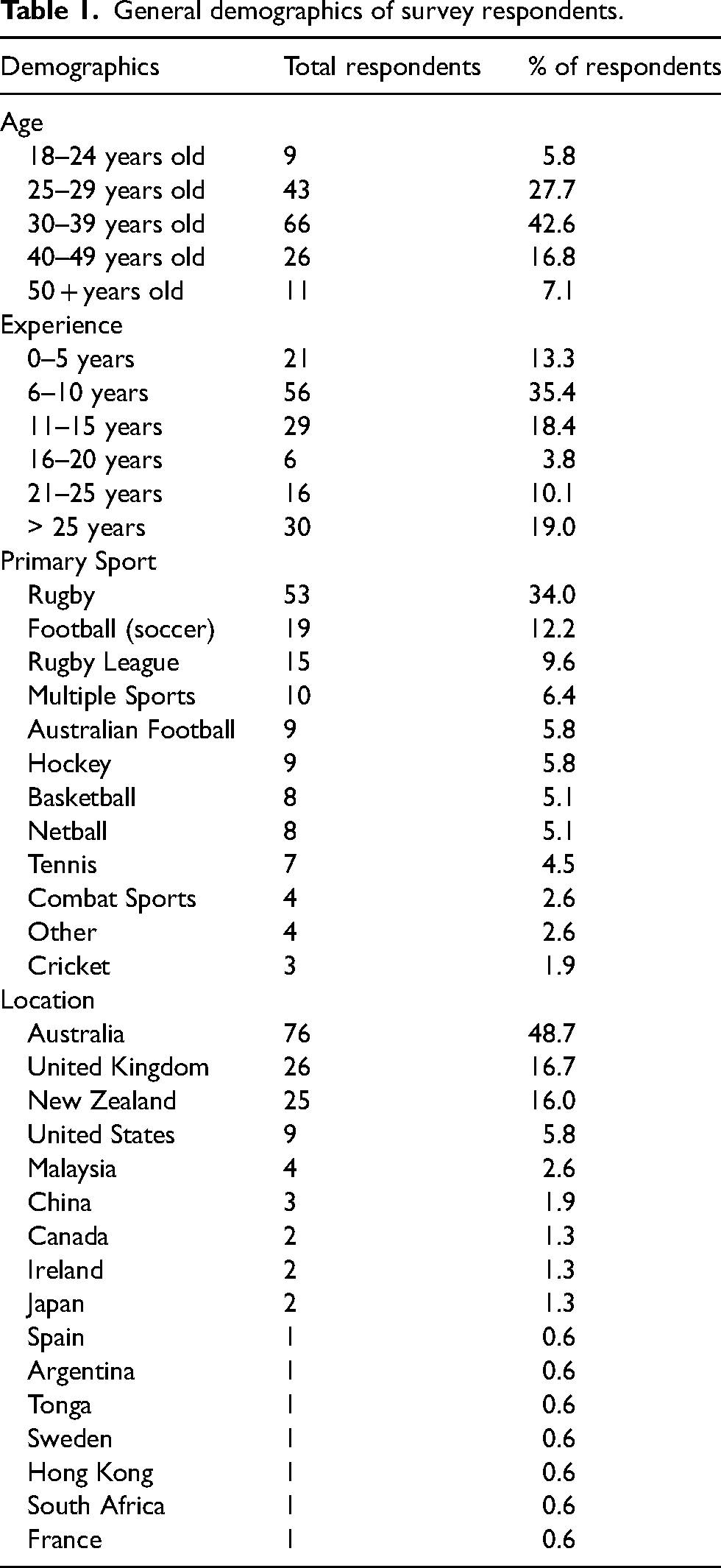
There were 158 completed surveys returned out of 268 surveyed. Of the respondents, 74.5% identified as a strength and conditioning coach or intern, 10.8% as a sports scientist or intern, 7.0% as a sports coach or assistant coach, 7.6% as a rehabilitation coach with 73.2% working with semi-professional or professional athletes. The average years of experience working with open skill sports was 11.5 (±7.6) y, ranging from less than 1 year of experience, up to over 30 years’ experience. Respondents came from 16 different countries, with the majority (91%) coming from countries where English is the primary language. Demographics of the survey respondents are listed in Table 1.
General demographics of survey respondents.
Statistics
The survey contained fixed-response questions, as well as two open text-based questions. Descriptive statistics to identify frequency counts and percentages of response were calculated. For the two open text-based responses, a qualitative thematic analysis was used whereby the frequency or responses was determined and then discussed by the research group to reach a consensus. Data was transferred from the survey software to Excel 2016 (Redmond WA, USA) for analysis.
Results
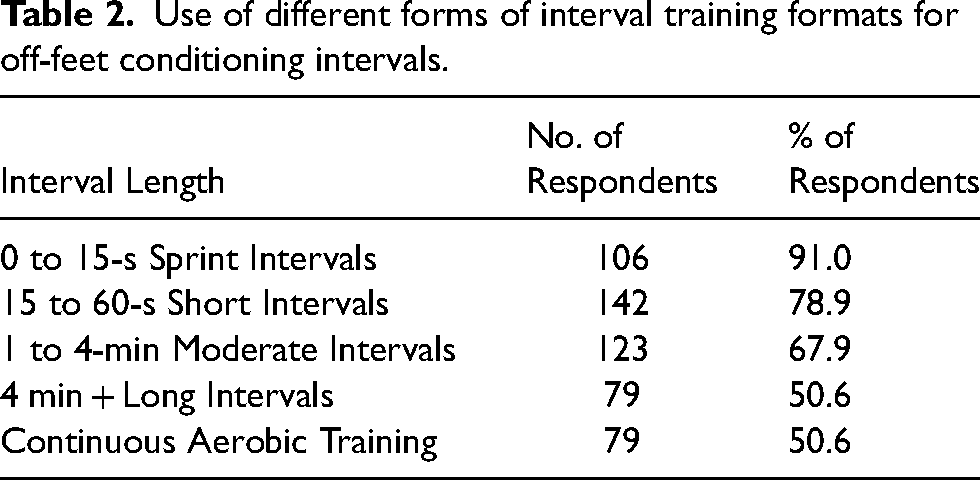
The majority of the 158 respondents (98.7%) stated that they use OFC as part of their physical performance program with only 2 (1.3%) answering negatively. When asked how frequently they use OFC, the most common response was 2 sessions per week (51.9%), with 23.4% using it once a week, 15.4% less than once per week and 9.7% of respondents answering 3 or more sessions per week. The average percentage of training considered for OFC was 18.5 ± 9.9% of training. Interval training methods implements using OFC are outlined in Table 2. Short duration intervals of 15–60 s (91.0%) was the most frequent response, followed by moderate duration of 1–4 min (78.8%) and 67.9% respondents using sprint intervals of less than 15 s. Power in the form of Watts or W·kg−1, was the most frequently employed method of determining intensity (71.2%) followed by heart rate (56.4%) and distance covered (53.4%).
Use of different forms of interval training formats for off-feet conditioning intervals.
Respondents were asked to rank OFC for developing different physical qualities. Overall effectiveness of OFC for developing the energy systems are shown in Figure 1. Aerobic endurance was ranked highest by 62.4% of respondents followed by Anaerobic Endurance with 24.8%. The majority of respondents viewed OFC as highly effect for aerobic energy system development by 57.1% of respondents followed by glycolytic (36%) the phosphagen system (25.3%). One question asked participants to rank the effectiveness of OFC as great, good, ok, or bad for reducing load, variety, safety, effectiveness, and ease of use. Of the respondents, 56.1% ranked reducing load as great and a further 35.7% ranked it as good. “Reduced load on the lower body” was main reason for using OFC (67.1%) followed by “increased fitness benefits (17.4%). Availability of equipment was the most frequent response, (95.6%) for disadvantages of OFC followed by squad numbers being too high (58.3%).
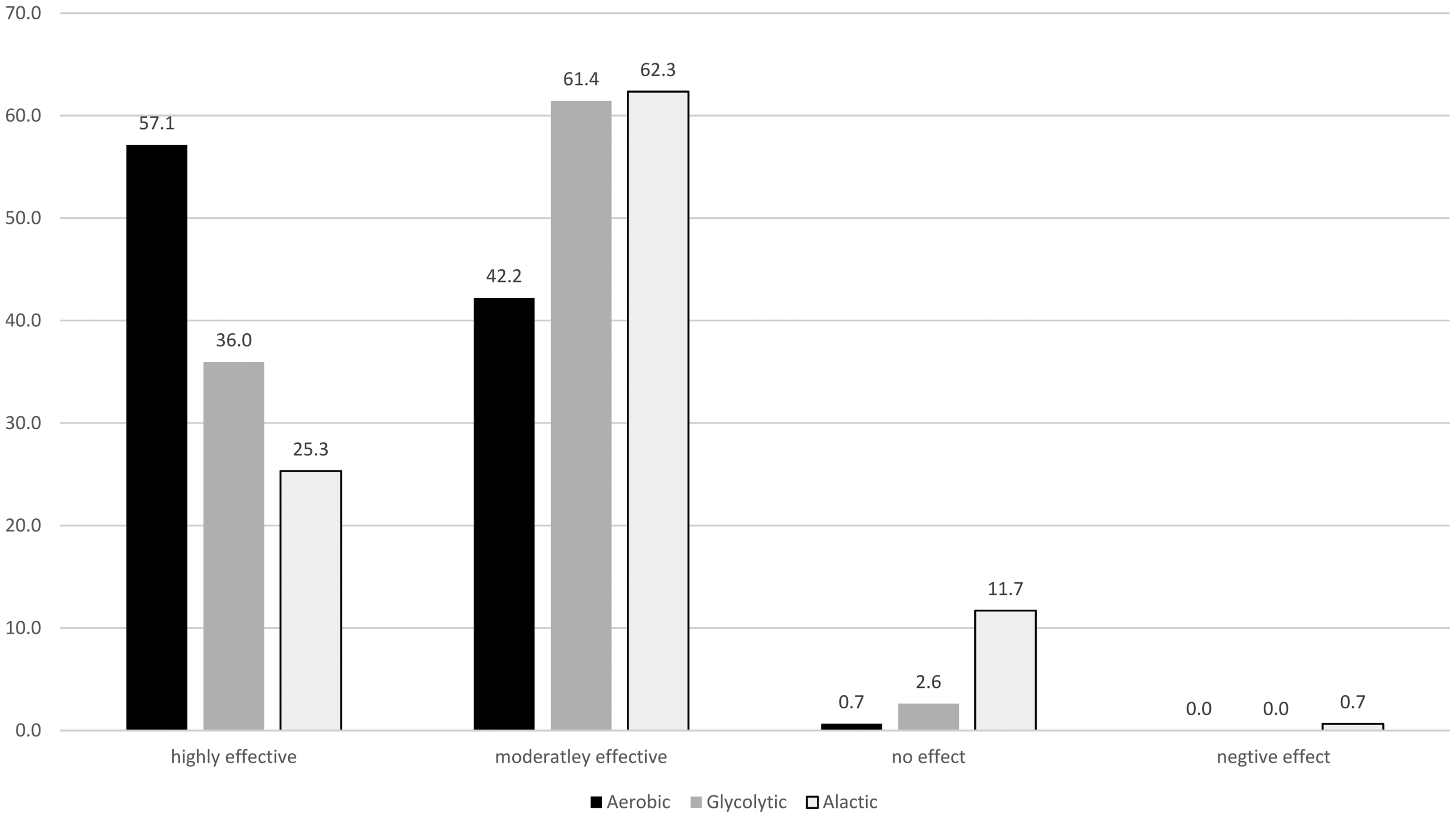
Perceived effectiveness of off-feet conditioning interval training for the energy systems.
The most frequently used form of equipment for OFC was “cardio machines” such as rowing machines, cycle ergometers, and elliptical trainers with 150 respondents (96.2%). The next most common forms of OFC reported were circuit training (75%) and Boxing or other combat sport training (65.4%). Cycle ergometers (94.2%) were the most frequently reported ergometer used, followed by rowing machines (79.5%), and ski ergometers (59.6%). Other modes of OFC are outlined in Figure 2. Athlete needs were the most important reason for choosing a particular type of equipment (44%) followed by practicality for desired results (25.3%)
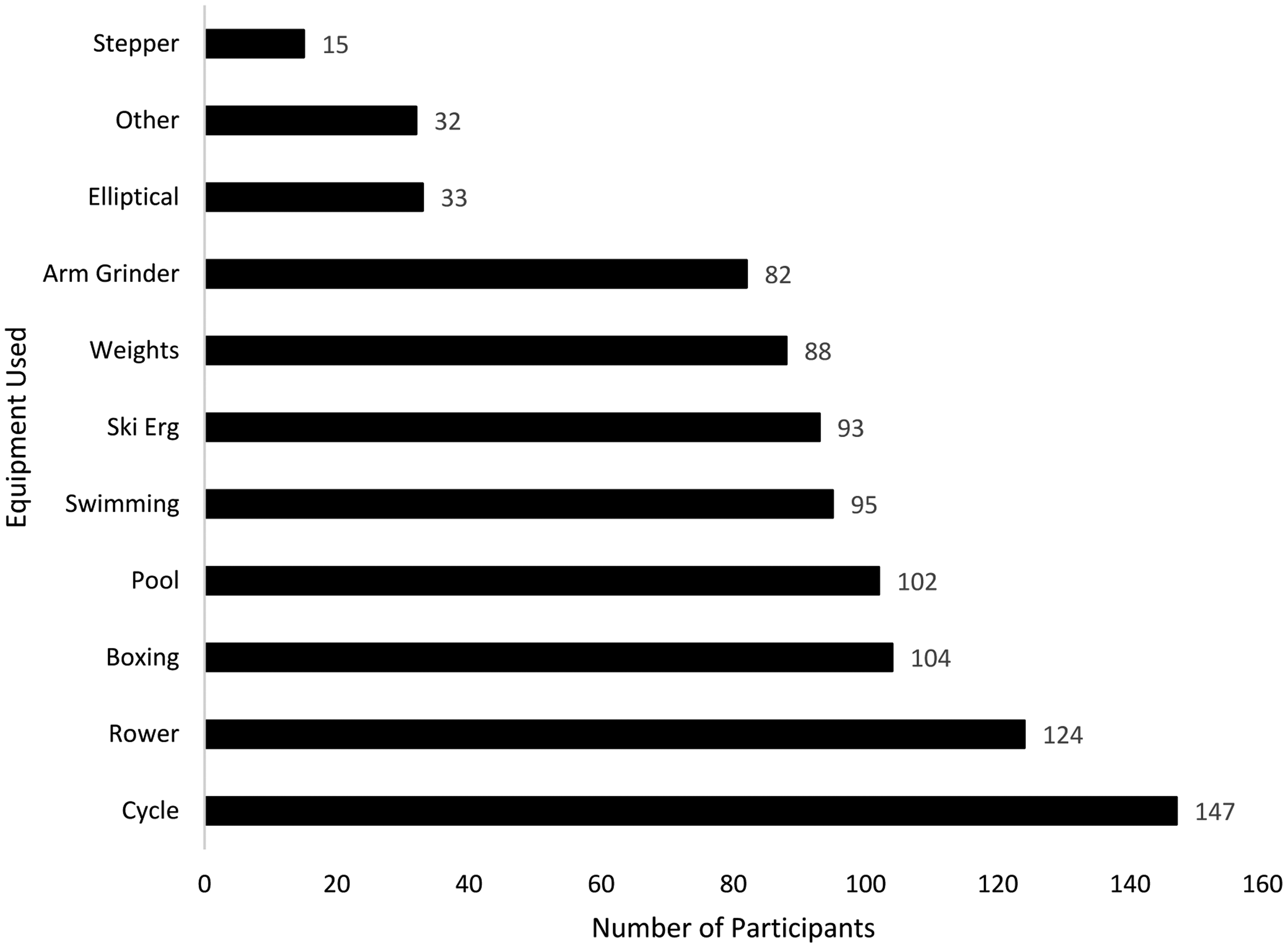
Frequency of different forms of equipment used for off-feet conditioning.
Thematic analysis of the text-based question asking respondents to define OFC resulted in three primary responses. Non-running training was the most common response (35%), followed by “non-weight bearing” or “non-impact training” (26.8%), and “any training to reduce load or reduce impact” (18.5%). There were 15 responses (9.5%) that included a combination of at least two of the three most frequent responses. Other responses included upper-body only training, seated or static training, and any form of non-sports specific training.
Discussion
The results of this survey indicate that OFC is a widely used training tool, with approximately 99% of respondents using OFC in some form, in their programming. Off-feet conditioning is predominately used as a supplemental training modality, typically twice per week and comprising ∼20% of total training. In general, OFC was used to limit lower body training load with a focus on aerobic energy system adaptations. The current survey suggests that practitioners tend to use OFC as a concurrent form of training that compliments rather than replaces sports-specific training.
Interval training is one of the most common training methods for physical conditioning for all energy systems. 19 Interval training is described as repeated high intensity efforts, interspersed with light activity or complete rest. 13 Whilst a wide variety of interval training styles were identified by participants as being employed for OFC, intervals of 15 to 60-s duration were the highest reported interval method. There is some research to support the use of intervals of this duration across a number of physical characteristics. Intervals of 60-s duration on a cycle ergometer resulted in improved running speed in the 30–15 test in elite female field hockey players. 20 Improvements in the Yo-Yo Intermittent Recovery test were also found after a training intervention of multiple 30 s efforts in recreational level team sport athletes. 21 Varied cycling intervals of 10 to 40 s improved running performance in a triathlon specific time trial in moderately trained participants. 17 Intervals of 20-s duration using upper and lower body cycling improved performance in a judo specific throwing test. 22 Low resistance, 30-s high speed OFC sprint intervals have also been shown to improve jumping performance. 23 Thus, it is evident that interval training in the 15 to 60 s range has can improve performance in all three metabolic pathways..
Close to 68% of respondents in this survey also answered that they commonly utilized intervals of less than 15 s duration. It has been postulated that short, high intensity OFC efforts are less likely to cause interference and fatigue in other forms of training. 24 Shorter intervals have been shown to be an effective OFC method to improve aerobic running performance in a small number of studies. Goods, Dawson 25 found 15 × 5-s sprint on a cycle ergometer improved both multi-stage shuttle test performance and 20-m sprint time. A protocol using 10 s effort on a cycle ergometer improved running speed in youth soccer players 26 and 33-m skating speed in ice-hockey players. 27 A study by Nebil, Zouhair 28 using repeated 5-s sprints on a cycle ergometer resulted in improved lower body power and speed in female soccer players. A series of 4 s intervals also resulted in improved countermovement jump performance in recreationally trained athletes. 29 These data suggest that although strength, power, and speed are not generally the target of OFC by respondents to the survey, there is a potential scope for short, high intensity intervals under 15-s to improve power and speed.
Whilst OFC was viewed as being most effective for developing the aerobic energy system, it was also considered a potentially beneficial method of developing all three energy systems. Improvements in aerobic performance from OFC training methods have been found in novice 30 and trained running athletes. 31 Improvements in running repeat sprint ability have also been found in the previous research using OFC training methods.32,33 All-out performance: such as lower body power, strength and speed were the least common target of OFC. These findings are supported by Schneider, Lacroix, 34 who proposed that aerobic adaptations may be more general in nature whilst anaerobic development required a more specific approach. There is however, some research to support the use of OFC to improve sprint running performance26,35 as well as lower body power. 29 Despite these results, greater understanding of the potential effectiveness for OFC to enhance anaerobic performance across different athletic populations such as elite open skill athletes is still needed.
Off-feet conditioning programs will often require equipment requiring a financial outlay. 36 Electronic training ergometers used for energy system development, often referred to as “Cardio” machines, were cited as the most common method of implementing OFC, with cycling ergometers the most commonly used individual piece of equipment. There are several research studies demonstrating a cross-over benefit from cycle ergometers to running performance.17,37,38 The non-running and non-impact characteristics of cycling is in alignment with the more popular definitions of OFC given in the survey. The range of metrics, such as power, heart rate, or distance covered, collected by many modern ergometers allow practitioners to implement and monitor training volume and intensity easily.
A more precise definition of OFC was a sizable aspect of the survey, as it is not well defined in existing literature. It is important to separate OFC from the commonly used term cross-training. The term cross-training is often used to describe training designed to transfer the qualities of one sport or form of training to another, with the intention to improve performance. 38 Cross-training is described as“participation in an alternative training mode or combining an alternative training mode with task-specific training”. 39 Benefits from cross-training may be physical, tactical, technical, or psychological in nature, and training may be in the form of other sports. 40 The three most common replies to the question to define OFC were “non-running training”, “non-weight bearing” or “non-impact training”, and “any training to reduce load or reduce impact”. Therefore, OFC as defined in the survey, may be more helpful. These findings are consistent with phrasing used in the literature to describe OFC which is generally quite limited. Based on the responses from this survey, we propose that OFC be defined as “any non-running or non-impact training, designed to reduce training load and improve physical performance”.
Goods, Dawson 25 state that continuously increasing running volume may lead to excessive loading. At some point, further increasing running load will increase fatigue and injury risk, causing the potential benefits to be outweighed by potential drawbacks. In a rugby setting, Roe, Darrall-Jones 41 found that increased running loads and intensities resulted in higher neuromuscular fatigue than increased body contact. Kavaliauskas, Aspe 42 stated that OFC can be used as a means of reducing the high eccentric loads experienced with high running volumes to potentially decrease overuse injury.
Although reduced load was the most common reason for using OFC, there is not yet a very clear understanding of the impact of OFC on performance enhancement. While “increased fitness benefits” was the second most frequent reason cited for using OFC, the relatively low amount of research may impact a coaches’ belief that OFC may not transfer to performance. These observations suggest that further investigation could aim to help practitioners make better informed decisions when selecting OFC as a means of enhancing performance as well as a load management tool. Research directly comparing the efficacy and transference to performance of OFC protocols and running protocols in open skill sports is warranted to inform coaching practice given the high importance given to meeting athlete needs, the imperative for effective use of training time, and reducing training loads.
Conclusion
A high percentage of respondents employ OFC methods in their typical training programs in conjunction with other traditional and on-feet training. While OFC is most commonly used for aerobic development, research suggests that OFC may also be used to improve other areas of physical performance. Short-interval training (15–60 s) are most frequently prescribed method of OFC and is typically used to target aerobic adaptations. Cycle ergometers were the most common form of OFC, and there is evidence to support the use of cycle ergometers to elicit a transfer effect to running based training. Here we propose that OFC can be defined as “any non-running or non-impact training designed to reduce load and improve physical performance”, which we differentiate from the broader term “cross training” which may include skill and tactical transfer from one sport to another.
Footnotes
Acknowledgements
The authors would like to acknowledge the support and assistance of Conor McNeill, Francesco Sella, Dr Kim Hebert-Losier, Erik Tan, Dr Travis McMaster and the Adams High Performance Centre, Tauranga NZ.
Declaration of conflicting interests
The authors declared no potential conflicts of interest with respect to the research, authorship, and/or publication of this article.
Funding
The authors received no financial support for the research, authorship, and/or publication of this article.
