




Abstract
The purpose of this study was to investigate coach-initiated motivational climate and its relationship with athlete well-being, resilience, and psychological safety in competitive sport. In addition to independent relationships between task- and ego-related climates and the study outcomes, this research also explored the potential additive effects of task and ego climate together to understand if a task climate can buffer against the negative impacts of an ego climate. Self-report survey data were collected from competitive soccer players across Ontario, Canada (N = 298; Mage = 20.38; 58.72% male). Using multiple linear regression, a perceived task-related climate was a significant positive predictor of well-being (ß = .33), resilience (ß = .31), and psychological safety (ß = .54, all ps < .001). A higher perceived ego-related climate was a significant negative predictor of psychological safety (ß = −.23, p < .001), and not significantly related to well-being and resilience. Partial support for the additive effect of task- and ego-related climate together was found for psychological safety, but not well-being or resilience. Specifically, athletes in the latent profile characterized by average task and higher ego scored higher on psychological safety compared with lower task and higher ego climate perceptions. The increase in psychological safety between these two profiles was observed despite both having higher ego-related climates. Although future research is required, the findings offer meaningful contributions to theory and practice in the context of competitive soccer teams.
Mental health has been defined as “a state of mental well-being that enables people to cope with the stresses of life, realize their abilities, learn well and work well, and contribute to their community”. 1 (para. 1) The mental health continuum by Keyes 2 helps address the call for an integrative and complete approach to capture the many factors that form mental health. The continuum differentiates mental well-being and mental illness to illustrate how individuals can flourish or languish in life. To be flourishing is to be filled with positive emotion and functioning well psychologically and socially, whereas languishing is conceived of as feeling emptiness, hollow, and stagnant. 2 In terms of prominence, a large body of the general mental health literature focuses on the symptomology of mental health problems (e.g., depression, anxiety, stress, and psychological difficulties).2–4 However, mental health is more than the absence of mental illness as it includes our emotional, psychological, and social well-being. 2 Given the broader conceptualization of mental health via the mental health continuum, 2 the prominence of mental health literature on the symptomology of mental health problems fails to include positive aspects such as well-being and the conditions which may provoke feelings of flourishing.
Mental health literacy and stigma reduction have been significant focuses within the current literature base on mental health in sports.4–6 Additionally, athlete mental health has been an area that has received increasing attention over the past years and has been directed towards a more positive approach to promoting positive mental health. 4 Specifically, researchers have highlighted the need for a more proactive discourse surrounding the relationship between athlete mental health and the sporting environment.4,5,7 The sporting environment provides the necessary context to nourish or malnourish athletes’ mental health. 7 A thoughtfully constructed sporting environment for athletes may be protective against indices suggestive of poor mental health (e.g., depression, anxiety) and promotive of well-being and positive mental health related outcomes (e.g., resilience and psychological safety).4,7
Relating to the sporting environment, initial investigations in the context of sports revealed psychological safety as an important construct associated with mental health and well-being, thereby warranting further investigations.8,9 Psychological safety captures the extent to which an individual perceives their sporting team environment as safe for interpersonal risk-taking without fear of negative consequences.10,11 However, there is still a limited understanding of the psychosocial antecedents of a psychologically safe team environment, especially in the context of sport. 12 The same goes for individual indices of positive mental health, with literature in sport group dynamics still emerging.
A substantial base of evidence supports the important role coaches play in the lives of their athletes and the potential to greatly impact athletes’ mental health.6,13 Evidence highlights coaches as critical to setting the ‘organisational climate’ that in turn may have important implications on athletes’ mental health and coping skills against specific sport-related stressors (e.g., performance-related anxiety). 6 For instance, Gosai and colleagues 14 found that coach transformational leadership as an antecedent to psychological safety played a significant role in predicting athletes’ feelings of positive emotion and functioning both psychologically and socially (i.e., flourishing). Further, studies have identified leadership behaviours as an important antecedent of psychological safety and its effects on other outcome variables (e.g., performance, mental health, learning). 15 Therefore, education and knowledge designed to teach coaches, who are in positions of authority, how to construct an environment and use their power to promote healthy personal interaction and positive athletic development concurrently with achieving success in sport continues to be of great importance. 5 Despite the vast opportunity this presents, there has been limited research into the role of coaches in supporting and enhancing their athletes’ mental health and well-being. 6
Motivational climate in sport
One construct that has been extensively researched within literature examinining the influence of coaches on the sporting environment is the motivational climate. 16 Motivational climate is defined as “individuals’ composite views concerning situationally emphasized goal structures operating in an achievement setting”. 16 (p144) Motivational climates are designed and established through social agents’ normative influences, evaluative standards, rewards and sanctions, interpersonal interactions, and values communicated within achievement contexts. 17 It is important to note that Achievement Goal Theory (AGT) 18 is the foundation of motivational climate. AGT describes the pursuit of different individual goals across two perspectives, ego (or performance) goals emphasizing outperforming others, and task (or mastery) goals emphasizing learning and improvement. 18 Athletes’ subjective perception of the motivational climate has been identified as a critical factor in predicting subsequent psychological and behavioural responses.19,20
The coach-initiated motivational climate (e.g., task-related or ego-related) that prevails among sporting environments appears pertinent to whether sport participation is more health-promoting or health-compromising for athletes.16,21 For example, Ntoumanis and colleagues 22 conducted a longitudinal examination of coach- and peer-initiated motivational climate in youth sport and its predictive effects on moral attitudes, emotional well-being, and indices of behavioural investment in a sample of British adolescent athletes. The findings of this study revealed that when adolescents perceived their coach-initiated motivational climate to emphasize outperforming others and winning (i.e., ego-related), they also reported greater levels and indicators of burnout. 22 Furthermore, adolescents who perceived a higher task-related coach-initiated motivational climate reported higher levels of vitality and lower levels of burnout. 22 Newton et al. 23 also found a positive relationship between a task-related motivational climate and the construct of a caring climate, to which ego climate was negatively related. A caring climate reflects the perception that a team social and interpersonal context is caring, and although distinct from psychological safety, has some conceptual overlap.10,23
Castro-Sanchez and colleagues24,25 have also found that a task-related motivational climate in sport was related to lower levels of overall life stress, and an ego-related motivational climate was negatively related to anxiety in adolescent athletes. Similar relationships also have been found with respect to the peer-initiated motivational climate. Recently, McLaren et al. 26 found that youth athletes who perceived a task-related climate as initiated by teammates also reported greater well-being and intentions to return to the team in the future.
Preliminary research has also found a relationship between motivational climate and indices of positive mental health shown to buffer against ill-health (i.e., resilience). 27 Resilience is a construct that describes the motivation of individuals to continue their relevant pursuit despite the adversity faced. 28 Importantly, resilience is not just as a personality trait of extraordinary people, but a skill that can be developed. 29 Ungar and colleagues 30 have promoted a social-ecological way of understanding resilience that factors not only the psychological factors of the individual, but also the immediate social environment of the individual that either amplifies or suppresses the chances an individual can demonstrate resilience. Related to the coach-initiated motivational climate, Vitali and colleagues 27 found a perceived task-related climate was positively related to athlete resilience in a sample of adolescent basketball and volleyball players in southern Italy.
Many of the studies to date relating to motivational climate have viewed task- and ego-related motivational climates as separate indicators or as two opposite ends of a continuum. However, previous research has documented that a task- and ego-related climate operate simultaneously, and that treating them in this fashion may ignore potential additive effects. 31 Overall, the findings surrounding motivational climate support the general notion that a task-related climate is associated with positive benefits, and an ego-related climate with negative consequences. However, researchers need to be careful of construct discrimination and the biases building towards each climate. 32
Some research has adopted this view of motivational climate. For instance, Eys et al. 31 used cluster analysis to generate motivational climate clusters based on participant scores, and examine differences between cluster membership on cohesion in youth sport. It was hypothesized in that study that an ego-related motivational climate may only be detrimental for perceived group cohesion when a task-related climate also is not present. The authors found that cohesion perceptions tended to align with task climate perceptions (i.e., higher task climate equated to higher task and social cohesion). However, there was a significant difference for task cohesion wherein the two clusters with higher ego climate perceptions were significantly different from one another. Specifically, athletes in the moderate task/higher ego cluster perceived the team as more task cohesive than athletes in the lower task/higher ego cluster. Although neither scored as high as the higher task/lower ego cluster, this served as preliminary evidence to support a possible additive effect. Using a polynomial regression and response surface analysis, this pattern of relationships was replicated in the context of elite youth athletes. 33 Taken together, the potential positive results emerging from the additive effects of a high task- and high ego-related motivational climate invite future investigation with other outcomes (e.g., mental health).
The purpose of this study was to explore the relationship of coach-initiated motivational climate and athlete well-being, resilience, and psychological safety in competitive sport. In line with previous research,27,34,35 it was hypothesized:
This study also explored the potential additive effects of task- and ego-related climate perceptions for athletes on well-being, resilience, and psychological safety. Given the data-driven analysis approach (i.e., latent profile analysis), no specific a-priori hypotheses could be made because the profiles are unknown.
Methods
Participants
Participants in this study were 298 competitive soccer players who competed at the provincial (64%) or national level (36%) in Ontario, Canada. Convenience and snowball sampling was used to recruit participants through contacting various competitive soccer coaches and team managers in Ontario, who were colleagues of the first author. Participants belonged to teams from different competitive soccer leagues ranging from the provincial to national level. Overall, 59% of the sample self-identified as male, and participants ranged from 16 to 34 years old (Mage = 20.38, SD = 2.71). On average, participants reported that they have played with their current team for 3.52 years. Finally, participants reported an average of 3.85 training sessions per week with their team.
Procedure
After obtaining institutional ethical approval (blind for peer review), data was collected from a total of 15 teams prior to a practice across the province of Ontario. Once approval from the coaches and team managers was obtained, the first author attended the participating team's training session on an agreed time and date. Based on the availability and convenience for the teams and athletes involved, the data collection process took place at various points throughout the competitive season (e.g., pre-season, in-season, post-season, and off-season). Voluntary participation in this research was stressed to all athletes, with no explanation needed to cease participation during any point of the data collection process. All participants first read the participant letter of information and provided informed consent. Upon completion of the survey, athletes were compensated with a $10 gift card to a local eatery.
Measures
Coach-initiated motivational climate
The 33-item Perceived Motivational Climate in Sport Questionnaire (PMCSQ-2 36 ) was used to assess athlete perceptions of coach-initiated motivational climate. The PMCSQ-2 contains two higher-order dimensions (task-related and ego-related climates), each with three subscales. A sample task-related climate item was “On this team the coach wants us to try new skills,” whereas a sample ego-related item was “On this team the coach gets mad when the player makes a mistake.” Responses were given using a 5-point Likert-type scale anchored at 1 (strongly disagree) and 5 (strongly agree). Scores were averaged for task- and ego-related climate. The PMCSQ-2 was found to have acceptable reliability scores (αtask = .91, αego = .91).
Mental well-being
The 14-item Mental Health Continuum-Short Form Scale (MHC-SF2) was used to assess overall mental well-being across emotional, social, and psychological domains. An example of an item from this scale relating to emotional well-being is “In the past month how often did you feel happy.” Participants rated how often they have experienced or felt each item using a 6-point Likert-type scale anchored at 1 (never) and 6 (every day). Higher averaged scores indicated greater overall well-being. The MHC-SF was found to have acceptable reliability (α = .92).
Resilience
Resilience was assessed using the 10-item Connor-Davidson Resilience Scale (CD-RISC-10 37 ). A sample item from this scale is “I am able to adapt when changes occur.” Participants rated how true they believed statements were on a 5-point Likert-type scale anchored at 1 (Not True At All) and 5 (True Nearly All The Time) with higher scores indicating greater resilience,. The CD-RISC-10 was found to have acceptable reliability (α = .84).
Psychological safety
Psychological safety was assessed using the Safety Climate Questionnaire. 10 A sample item from this scale is “It is easy to ask other members of my team for help.” Participants rated their team across each item using a 7-point Likert-type scale anchored at 1 (Strongly Disagree) and 7 (Strongly Agree). Like the other measures, higher scores were indicative of greater perceived sense of psychological safety. The safety climate questionnaire was found to have acceptable reliability (α = .85).
Data analysis
Little's MCAR (Missing Completely at Random) test was run to ensure all data were missing at random. The results of this test revealed the model to be insignificant (p = .86), which meant the data were indeed missing at random. A mean replacement was used to deal with the small amount of missing data. 38
Multiple linear regression via SPSS Statistics 28.0.1 software was used to test relationships in H1 and H2. All assumptions related to multicollinearity, multivariate normality, homoscedasticity, independence, and outliers were satisfied. Additionally, a Latent Profile Analysis was conducted using the R statistics package ‘tidyLPA’ (see online supplement for analysis code). 39 Once the profiles from the Latent Profile Analysis were determined, a one-way between-subjects Analysis of Variance (ANOVA) was used to compare the different motivational climate profiles across the three dependent variables; well-being, resilience, and psychological safety. Prior to running ANOVA, assumptions relating to the absence of multicollinearity, the homogeneity of variance, ensuring independent random sampling, and multivariate normality were satisfied. 40
Results
Descriptive statistics and bivariate correlations
An overview of the descriptive statistics and bivariate correlations can be found in Table 1. Generally, the bivariate correlations revealed small-moderate significant positive correlations between task-related coach-initiated motivational climate and well-being, resilience, and psychological safety. In contrast, non-significant correlations were found between ego-related coach-initiated motivational climate, well-being, and resilience. Further, a moderately significant negative correlation was found between ego-related coach-initiated motivational climate and psychological safety.
Descriptive statistics and bivariate correlations.
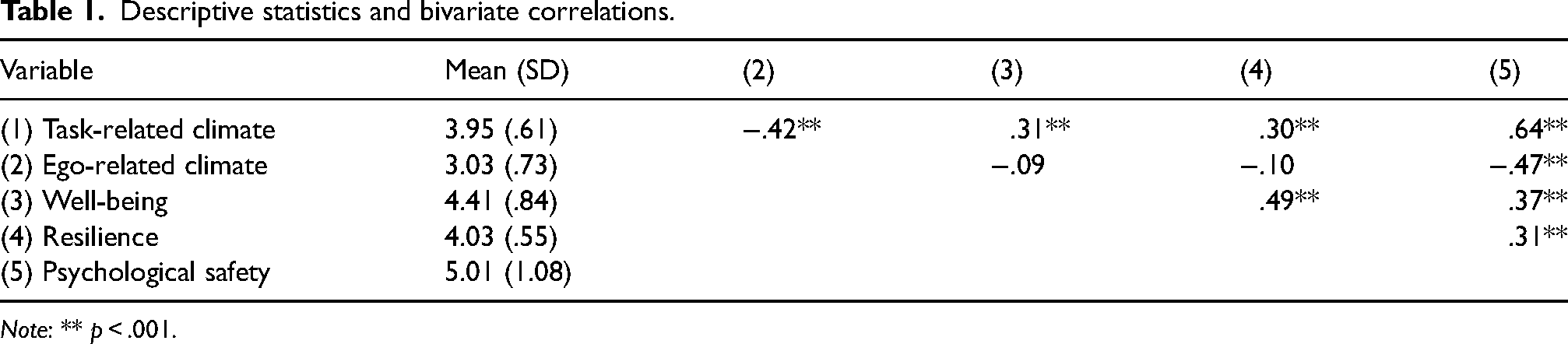
Note: ** p < .001.
Motivational climate as a predictor of study outcomes
For mental well-being, the overall model was significant, F(2293) = 10.35, p < .001, accounting for 9% (Adjusted R2 = .09) of the variance in the dependent variable. In support of the first hypothesis (H1), a task-related climate (ß = .33, t = 5.44, p < .001) was a significant positive predictor, and ego-related climate (ß = .05, t = 0.86, p = .393) was not a significant predictor of well-being. Similarly, the overall model predicting resilience was significant, F(2293) = 14.43, p < .001, also accounting for 9% (Adjusted R2 = .09) of the variance in the dependant variable. Additionally, in support of the first hypothesis (H1), perceptions of a task-related climate (ß = .31, t = 5.08, p < .001) was a significant positive predictor, whereas ego-related climate (ß = .03, t = 0.54, p = .592) was not a significant predictor of resilience.
Finally, the overall model predicting psychological safety was significant, F(2292) = 123.65, p < .001, accounting for 46% (Adjusted R2 = .46) of the variance in the dependent variable. In support of the second hypothesis (H2), perceptions of a task-related climate (ß = .54, t = 11.25, p < .001) was a significant positive predictor, and ego-related climate (ß = −.23, t = -4.88, p < .001) was a significant negative predictor of psychological safety.
Additive effects of task- and ego-related climates
In addition to the regression analyses, this study also considered the combined perceptions of task- and ego-related climates together, as opposed to the traditional sense of separating the two as predictors. Using latent profile analysis, six different latent profiles were considered to determine which model best fit the data, and aligned generally with AGT (see Table 2). To determine the number of latent profiles that were optimal for further analysis, the Akaike Information Criteria (AIC) and Bayesian Information Criteria (BIC) were examined, with lower values indicating a better model fit. 41 Further, entropy scores and a bootstrap likelihood ratio (BLRT) test were used to determine the optimal number of latent profiles. Higher entropy scores were indicative of greater accuracy in profile classifications, whereas BLRT tests the model fit between two consecutive models, with a lower p-value change indicating improvement of model fit.41,42 The combination of these criteria was weighed against more pragmatic considerations, which are detailed in the subsequent paragraph, to ensure profiles also had theoretically-meaningful distinctions.
Model fit statistics of the latent profile analysis.
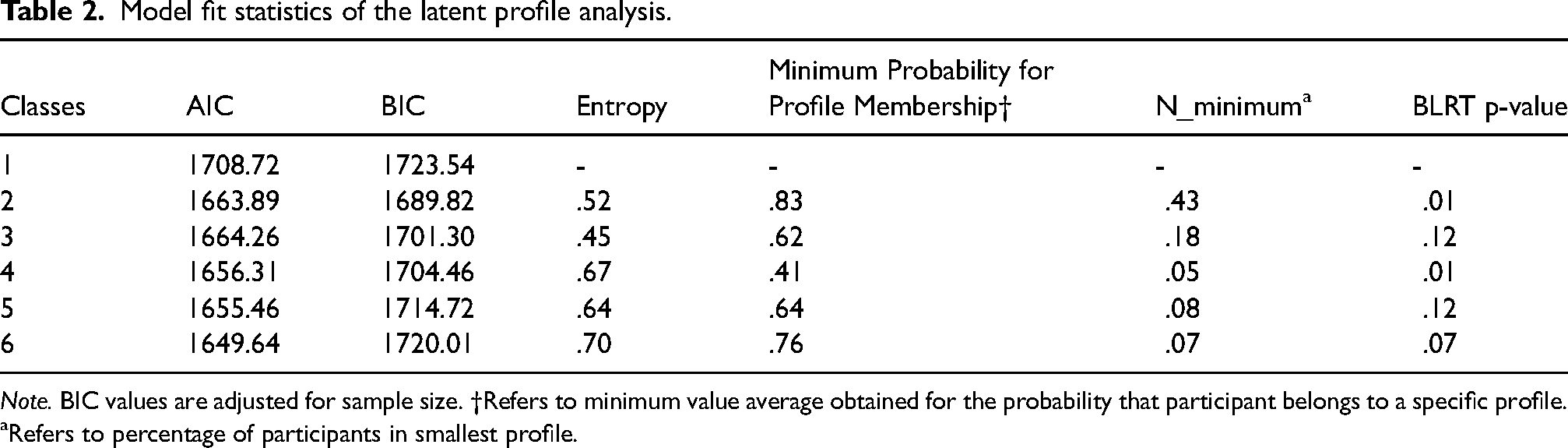
Note. BIC values are adjusted for sample size. †Refers to minimum value average obtained for the probability that participant belongs to a specific profile. aRefers to percentage of participants in smallest profile.
The four-class profile model provided a better fit compared to the other models of three-, two-, and one-class profile solutions. Although the model fit statistics in some criteria continued to improve after the four-class profile, the four-class profile model was the most logically conceptual solution of the different profile classes. Respectively, the one- and two-class profile solutions were irrational given the essence of this analysis to examine the additive effects of the coach-initiated motivational climate (i.e., they reflected high task/low ego, and high ego/low task profiles only). The three-class profile solution presented a model with an entropy value that was deemed low. Further, the five- and six-class model profile solutions simply began to overlap profiles and the BLRT p-value indicated no improvement of model fit. Therefore, the four-class profile solution was considered the most optimal model for this study.
The four profiles were (1) lower task/higher ego (n = 34), (2) average task/lower ego (n = 80), (3) higher task/lower ego (n = 113), and (4) average task/higher ego (n = 70). The terms used to describe each profile rely on stardardized values (i.e., deviation from the mean score), hence the use of higher, average, and lower. Figure 1 represents an illustration of the four motivational climate profiles.
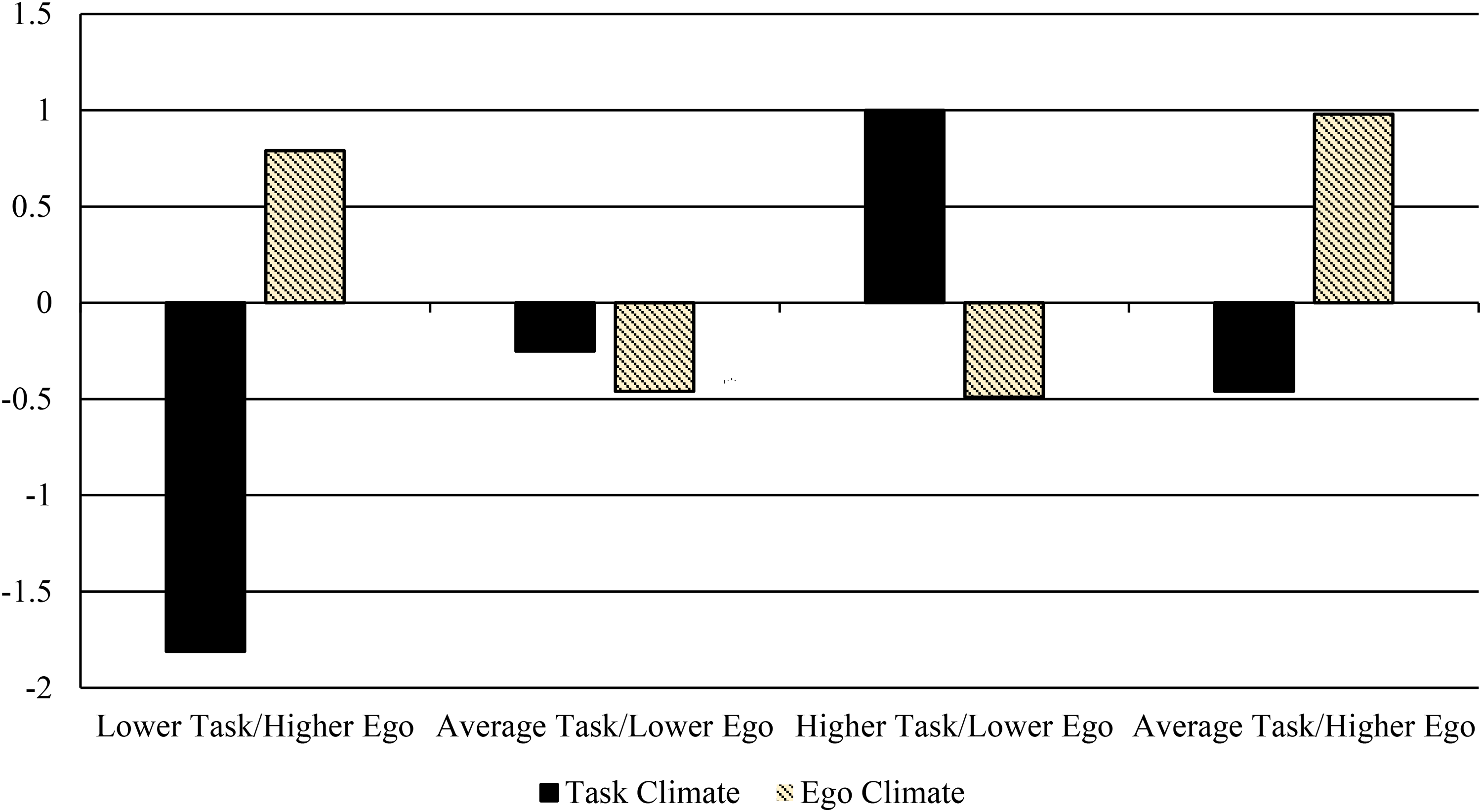
Motivational climate profiles determined through latent profile analysis.
Comparing latent profiles
Three one-way between-subjects ANOVAs were run to test for differences in well-being, resilience, and psychological safety across the four latent profiles. For well-being, the overall model was significant, F(3, 293) = 7.64, p < .001, indicating differences between profiles. Post-hoc analysis revealed that well-being scores for the higher task/lower ego profile (4.68) were significantly higher than in the lower task/higher ego (4.06), average task/lower ego (4.31), and average task/higher ego (4.25; all ps < .01) profiles. The lower task/higher ego, average task/lower ego, and average task/higher ego profiles did not differ significantly from one another.
For resilience, a significant overall ANOVA model also was found, F(3, 293) = 7.14, p < .001. In the same way as well-being, post-hoc analysis revealed that resilience scores in the higher task/lower ego profile (4.20) were significantly higher than the lower task/higher ego (3.76), average task/lower ego (3.99), and average task/higher ego (3.96; all ps < .04) profiles. The lower task/higher ego, average task/lower ego, and average task/higher ego profiles did not differ significantly from one another.
Finally, a significant overall ANOVA model was found for psychological safety perceptions, F(3, 292) = 68.43, p < .001. Unlike well-being and resilience, post-hoc analysis revealed that psychological safety scores for the higher task/lower ego profile (5.79) was significantly higher than the average task/lower ego profile (4.98), which was significantly higher than the average task/higher ego profile (4.39), which was significantly higher than the lower task/higher ego profile (3.81; all ps < .01). This offered partial support of the additive effect of task climate to buffer ego climate in that the change from lower task to average task (both with higher ego) resulted in a significant increase in psychological safety.
Discussion
The purpose of this study was to examine the relationships between coach-initiated motivational climate, mental well-being, resilience, and psychological safety in competitive sport athletes. In line with previous findings, and supporting the first hypothesis (H1), perceptions of a task-related coach-initiated motivational climate was positively related to athlete well-being and resilience. In line with AGT, this finding suggests that when coaches are perceived to promote success as giving maximal effort, personal improvement, occupying an important role on the team, and the encouragement of cooperative learning, this creates a positive social environment wherein athletes also report positive mental health in the form of higher well-being and resilience. 34
A coach-initiated ego-related climate, on the other hand, is one wherein athletes perceive that the coach equates success to winning at all costs, and putting the self before the collective. Interestingly, researchers have hypothesized that an ego-related climate would be negatively related to indices of positive mental health, however like these studies, we found no relationship to well-being and resilience, supporting the first hypothesis (H1).27,33
In an effort to extend the literature, this study also considered a more novel indicator of mental health that considers the team environment – psychological safety. Unlike the other outcomes, higher perceptions of a task-related climate was positively related to psychological safety, and ego-related climate was negatively related to psychological safety, thereby supporting the second hypothesis (H2). This makes sense from a conceptual perspective, wherein the two constructs overlap in that they both involve an assessment of the social environment, to which the coach has a large impact.
When the coach promotes effort, improvement, learning, and cooperative behaviours (i.e., task-related climate), this inherently also promotes an environment safe for interpersonal risk taking and social support. 18 Previous investigations in the context of organizational work teams revealed higher perceived psychological safety is associated with positive team members’ learning behaviours (e.g., embracing errors and sharing them with the team). 10 The similarities of the aforementioned positive team member learning behaviours to a task-related climate, may serve as further support to describing the positive association between a task-related climate and psychological safety.
On the other hand, this study revealed when a coach promotes outperforming others, winning, and punishment for mistakes (i.e., ego-related climate), the psychological safety of the environment is greatly reduced. In a previous investigation of psychological safety in the context of organizational work teams Edmondson notes, “if team leaders act in authoritarian or punitive ways, team members may be reluctant to engage in the interpersonal risk involved in learning behaviours such as discussing errors”. 10 (p356) The close resemblance of punitive behaviours from team leaders (e.g., coaches) to an ego-related climate, may help further explain the negative association between an ego-related climate and psychological safety revealed in this study.
Although the examination of psychological safety is still growing rapidly in the context of sport, recent studies have highlighted leadership behaviours as an important antecedent influencing psychological safety in sport and other contexts.8,14,15,43 The current study supports findings from Gosai and colleagues 14 which revealed coaches who were perceived by athletes as caring, empowering, inspiring, and encouraging of working with others for the same goals were more likely to perceive their team environment as psychologically safe.8,15 However, to the authors knowledge, the current study is the first to examine the potential associations between motivational climate and psychological safety in the context of sport, thereby contributing novel findings to literature and further extending research around psychological safety in sport while underscoring leadership behaviours as an important antecedent influencing psychological safety in sport.
In addition to these independent relationships, this study also considered an additive relationship where task- and ego-related climates are analyzed together as a predictor of positive mental health. Interestingly, there was minimal evidence found for task climate as a buffer against the potential negatives of an ego climate, with exception of psychological safety. Given the lack of an independent relationship between well-being and resilience with ego-related climate, it is not surprising that an additive relationship was not found.
However, concerning the additive motivational climate relationship and its association to psychological safety, this study revealed that those profile groups that were characterized with perceptions of a high ego-related climate in combination with either a moderate or low task-related climate (i.e., low task/high ego & moderate task/high ego profiles) were associated with lower levels of psychological safety relative to the other groups (i.e., high task/low ego & moderate task/low ego profiles). More specifically, the low task/high ego coach-initiated motivational climate profile was associated with athletes reporting the lowest levels of psychological safety, followed by the moderate task/high ego profile, then the moderate task/low ego profile, and finally the high task/low ego profile revealing an association of athletes reporting high levels of psychological safety. As such, these associations may suggest evidence to support the buffering role of a task climate against the potential negatives of an ego climate. Previous work to consider this additive relationship by Eys et al. 31 and Chicau Borrego et al. 32 both found support for an ego-related climate as harmful to cohesion only in the absence of a higher task-related climate. Given the parallels of cohesion and psychological safety again as assessments of the team environment, the partial support for these findings makes sense.
Limitations and future directions
A primary limitation of this study was the use of a cross-sectional design. Although there were pragmatic reasons for such a design (i.e., feasibility of recruiting this high-level sample from a wide geographic region), we are unable to establish a causal relationship. 44 In addition, the geographical separation of teams meant that data collection was conducted at slightly different time points of the season. As such, athletes’ perceptions of the coach-initiated motivational climate, and perceptions of their well-being, resilience, and psychological safety may have changed over time as the competitive sport seasons progressed. In order to address this limitation, future research should utilize a longitudinal study design where data collection consists of multiple time points across athletes’ competitive season. This would allow for a clearer inference of the temporal relationship between athletes’ perceptions of motivational climate and positive mental health outcomes.
To further understand the nuances of motivational climate, future research may wish to explore motivational climate in different circumstances within the sporting environment (e.g., competitions, practices). Indeed, key social agents and their behaviours may vary depending on the relevant situation within the sporting environment. For instance, Eys and colleagues 31 illustrate that coaches may be more likely to approach team competitions/matches in ego-related manner (i.e., attempting to win the game) while creating a more task-related climate during practice sessions (i.e., developing skills and working together). As such, it may be worthwhile for future research to explore these situationally relevant contexts (e.g., practice, competition), and varying task- or ego-related behaviours from key social agents associated with the motivational climate. In line with the above recommendation, the age of this sample (i.e., 16 to 35 years) is relatively older than the youth sample of Eys et al. 31 (13 to 17 years) and Chicau Borrego et al. 32 (12 to 19 years). As such, it would be worthwhile for future work to consider age as a potential boundary condition (moderator) of coach-initiated motivational climate profiles and their relationship with positive mental health and other related outcomes. Relatedly, Chicau Borrego and colleagues 32 suggest the use of ecological momentary sampling approach to closely examine and understand athletes’ perceptions of motivational climate instead of a reliance on cross-sectional questionnaire designs.
Implications
The findings hold important practical implications for coaches and key stakeholders within competitive sporting environments to consider regarding leadership behaviours on athlete mental well-being, resilience, and psychological safety. Coaches should be aware that the way they promote what it means to be successful has an impact both on individual outcomes (well-being and resilience) and how athletes perceive the team environment (psychological safety). Future research in this area is warranted to continue unpacking the nuances found in this study.
Conclusion
The current study aimed to explore the relationships of coach-initiated motivational climate and mental well-being, resilience, and psychological safety in a sample of competitive sport athletes. The findings highlighted a positive relationship between task-related coach-initiated motivational climate and athlete perceptions of well-being, resilience, and psychological safety. Alternatively, a higher perceived ego-related coach-initiated motivational climate was negatively associated with psychological safety, but unrelated to well-being and resilience. When exploring the potential additive effects of the motivational climate through a latent profile analysis, there was partial support for a task-related climate buffering an increase in ego climate, but only for the outcome of psychological safety.
Supplemental Material
sj-pdf-1-spo-10.1177_17479541241278602 - Supplemental material for Exploring the relationship between coach-initiated motivational climate and athlete well-being, resilience, and psychological safety in competitive sport teams
Supplemental material, sj-pdf-1-spo-10.1177_17479541241278602 for Exploring the relationship between coach-initiated motivational climate and athlete well-being, resilience, and psychological safety in competitive sport teams by Achuthan Shanmugaratnam, Colin D McLaren, Meredith Schertzinger and Mark W Bruner in International Journal of Sports Science & Coaching
Footnotes
Declaration of conflicting interests
The authors declared no potential conflicts of interest with respect to the research, authorship, and/or publication of this article.
Funding
The authors received no financial support for the research, authorship, and/or publication of this article.

Supplemental material
Supplemental material for this article is available online.
References
Supplementary Material
Please find the following supplemental material available below.
For Open Access articles published under a Creative Commons License, all supplemental material carries the same license as the article it is associated with.
For non-Open Access articles published, all supplemental material carries a non-exclusive license, and permission requests for re-use of supplemental material or any part of supplemental material shall be sent directly to the copyright owner as specified in the copyright notice associated with the article.
