




Abstract
This Delphi study identifies how elite strength and conditioning coaches prescribe complex contrast training to team sport athletes. Thirty-eight elite strength and conditioning coaches with experience working in high performance settings participated in a three-round survey. Round one was used to collect open-ended responses regarding the programming of complex contrast training. Responses were formulated into statements for rounds two and three, where participants rated their level of agreement using a 9-point Likert scale (agreement threshold ≥80%). In round one, 139 statements were formulated. Twenty-seven statements reached consensus in round two, and four more in round three. Based upon consensus, complex contrast training is best used during the season and dedicated power blocks. It was recommended that strength and power exercises within complex contrast training pairings be performed for 3–4 sets of 3–4 repetitions. Loading of 85–90% of one repetition maximum (1RM) was recommended for strength exercises, with ∼two repetitions in reserve, and BW–30% 1RM for power exercises, with three minutes of rest between contrast sets. Upper body pressing, upper body throwing, lower body squatting and hinging, and lower body jumping and bounding exercises were recommended. Coaches reported using complex contrast training to enhance power-focused training, and because it is more time efficient. Complex contrast training may be a time efficient method of improving athletic performance when training time is limited. Results from this study can guide the development of complex contrast training programs for team-sport athletes, and provides valuable insight into how elite coaches enhance performance.
Introduction
Strength and conditioning coaches working in team sport environments must strike a balance between providing their athletes physiological loading appropriate for game preparation, without overtraining or increasing injury risk. 1 Two of the most important physiological characteristics for team sports are muscular strength and power, with resistance training being the most common method to improve these qualities. 2 The American College of Sports Medicine (ACSM) 3 suggests that heavy resistance training (HRT) is optimal for strength development, which is prescribed using low repetition ranges (≤6) and with heavy loads (≥80% of one repetition maximum [1RM]). Alternately, power is often developed through high velocity, low load exercises (≤30% 1RM) or through high velocity plyometric movements. 3 However, it is important to note that peak power production can vary depending on the movement and load lifted. For example, the peak power in the bench press can peak at ∼55% 1RM, 4 and ∼80% 1RM during the hang power clean, both of which are often used to enhance power development. 5 Developing these physical qualities simultaneously is particularly important for team sport athletes who are required to maintain adequate muscular strength and power throughout a competitive season. When developing these qualities concurrently, traditional training paradigms recommended training strength and power in isolation within a single session,6,7 whereby power exercises are performed first, followed by strength exercises. In order to develop these physical qualities in a time efficient manner, strength and conditioning coaches often employ different within-session training structures, with one such method being complex contrast training. 6
Complex contrast training has been used to improve the performance of athletes for decades, 8 and as such, numerous definitions of it can be found in the literature. More recently, a historical review by Cormier et al., (2022) 6 has defined complex contrast training as a mode of resistance training where the movement load and velocity of paired exercises is altered in a set-by-set fashion, with both exercises targeting the same muscle groups or movement pattern. For example, performing a set of heavy back squats followed by a set of explosive box jumps, then repeating this for a prescribed number of sets. It is theorised that complex contrast training can improve both velocity of movement and force development simultaneously, compared to HRT alone, which primarily increases force, or power training alone, which primarily increases velocity. 6 This is particularly important in more advanced athletes, as they are unlikely to experience the same improvements in peak power and movement velocity that are observed in novice and less trained individuals through HRT alone. 9 Within a single session, performing HRT prior to a low load power exercise has been shown to elicit an activation response, increasing the excitability of skeletal muscle, and allowing greater force to be produced during the subsequent power exercise. 10 While this phenomenon is well established in acute performance settings, 11 there is no agreement on the factors that must be included to maximise the long-term benefits of complex contrast training. Moreover, how elite strength and conditioning coaches use complex contrast training to enhance performance has yet to be explored.
While previous reviews of the literature have indicated that complex contrast training provides significant long-term increases in lower body strength and power,12–14 when examining the individual studies within these reviews it appears that not all implement training protocols that align with the complex contrast training definition put forth by Cormier et al. (2022). 6 In fact, to the authors knowledge, 14 intervention studies have examined the effectiveness of complex contrast training using a protocol that aligns with the aforementioned definition,15–28 with conflicting results. Of these 14 studies, nine reported a positive effect on at least one measure of athletic performance from complex contrast training compared to a control condition,18–20,22–27 four reported significant differences between complex contrast training and a control condition,15,16,21,28 while one used a single group design without a control condition. 17 While the exact reasons for the variations in results is unclear, it is important to note that many of the studies implementing complex contrast training have done so using a variety of prescription methodologies. Within these 14 studies, the HRT exercise prescription ranged from 1–8 sets per exercise, 2–12 repetitions per set, loading from 60–95% 1RM per exercise, and rest periods from 1–4 min between the heavy strength exercise and the lighter power exercise. Similarly, in these same studies the light power exercise prescription ranged from 3–8 sets per exercise, 5–12 repetitions per set, loading from 0 (i.e., bodyweight) – 30% 1RM, and rest periods from 1–3 min between complex pairings (i.e., after completing the power exercise and before returning the heavy strength exercise). Similarly, these studies observed participants from a host of training backgrounds and experience, which is likely to have implications on the effectiveness of complex contrast training. 6 For example, evidence has shown that stronger athletes experience larger performance potentiation responses to a heavy conditioning activity than weaker athletes, suggesting they may be more likely to benefit from complex contrast training. 11 Lastly, it is important to note that while many of the studies above have compared complex training to a control condition, most of these comprised of either plyometric training alone, HRT alone, or in some instances, no training at all. Only four studies compared the effect of complex contrast training to a volume and intensity matched control intervention that comprised of both HRT and lighter power training components,16,20,21,28 of which only one saw a positive effect. 20 As such, the effect of complex contrast training on measures of athletic performance is uncertain.
Although many of the above studies have shown a positive effect with complex contrast training on athletic performance, their methodologies are considerably different, with notable variations observed in the exercises used, and the loads, repetitions, sets, and rest periods prescribed. This high degree of variability may be driven by a lack of consensus on how complex contrast training is prescribed in practice. Despite there being little evidence examining the use of complex contrast training in team sport athletes (a group that is poised to receive significant benefit if effective), it has been used by strength and conditioning coaches for decades. 8 Gaining an understanding of how elite strength and conditioning coaches prescribe complex contrast training to team sport athletes will help identify useful strategies to prepare athletes for competition and provide a foundation from which ecologically valid research interventions can be designed. As such, the aim of the study was to investigate how elite strength and conditioning coaches prescribe complex contrast training to enhance the performance of team sport athletes. Consideration was given to exercise selection, loading parameters (sets, repetitions, rest periods), competition periods (i.e., pre-season, in-season), and potential gender differences.
Methods
Research design
The Delphi survey method was created in the 1950s by the RAND Corporation, and aims to identify consensus amongst a group of content experts. 29 A Delphi study consists of a pre-identified number of survey rounds being completed, with each round of questions adapted from the results of the previous round, 30 and with the survey ending when the pre-identified rounds are completed, or all questions reach consensus. 31 This Delphi study consisted of three rounds of questions, with round one consisting of open-ended responses, and rounds two and three consisting of questions answered using a 9-point Likert scale. 32 All three rounds were conducted using the REDCap survey software (2023; version 13.1.25, Vanderbilt University, Tennessee, USA) with responses exported to Microsoft Excel (2023; version 16.71, Microsoft Corporation, Washington, USA) for analysis.
Participants
All participants were recruited through personal industry contacts or via publicly accessible email addresses. Individuals who expressed interest in participating via email were sent an online expression of interest form (REDCap survey software, 2023; version 13.1.25, Vanderbilt University, Tennessee, USA), the participation information sheet, the opportunity to give informed consent, and the opportunity to provide demographic data to ensure the inclusion criteria was met. The demographic data included age, highest academic qualifications, coaching qualifications, years of coaching experience and the countries they had provided strength and conditioning services in. Participants were also asked whether they had previously coached (or were currently coaching) elite female athletes to identify prior knowledge when responding to questions regarding gender specific differences in complex contrast training prescription.
Snowball sampling was also used to aid recruitment, 33 allowing any eligible participant to pass along the expression of interest form to any colleague or industry contact they believed to be eligible for participation. The inclusion criteria included working (or previous experience working) in a high-performance setting as a strength and conditioning coach (i.e., college systems, international sporting institutes, elite sporting clubs etc.), holding an Australian Strength and Conditioning Association (ASCA) level 2 accreditation or international equivalent (i.e., National Strength and Conditioning Association [NSCA], European Register of Exercise Professionals [EREPS], Chartered Institute for the management of Sport and Physical Activity [CIMSPA] etc.), working (or previous experience working) within a team sport setting, and experience using the complex contrast training method as per the provided definition from Cormier et al. (2022), 6 which was described during the recruitment process. An ASCA level 2 accreditation or equivalent was deemed appropriate as it indicates an advanced level of knowledge pertaining to strength and conditioning coaching and athletic development, which when paired with experience coaching high level athletes, was considered sufficient to be categorised as ‘elite’ for the purpose of this study.
Prior to the commencement of the study, all participants provided informed consent via the expression of interest form. Ethics approval was granted by the University of South Australia Human Ethics Committee (protocol: 205115). Delphi studies are encouraged to aim for 11–25 participants to ensure expert consensus is reached. 34 The research team aimed to recruit 35 participants to account for potential dropouts and ensure a minimum of 25 participants completed the study. Given the uncertainty regarding how many team-sport coaches implement complex contrast training, a total of 227 coaches believed to meet the inclusion criteria were approached to participate in the study, with one additional coach identified via snowballing. Of these, 45 expressed interest and met the inclusion criteria, and were sent the first round of questions. A total of 38 experts completed the first round of questions, 37 completed the second round, with 34 completing the final round.
Procedures
Three rounds of the Delphi survey were sent out to the participants using the REDCap survey platform. The data from each round was stored in the REDCap online data storage system before being exported into Microsoft Excel for analysis. As round one consisted of open-ended responses, it was analysed qualitatively, whereas round two and three were comprised of questions rated on a nine-point Likert scale and were analysed quantitatively. A total of three survey rounds were delivered using REDCap survey platforms. Each round was open for two weeks, with regular reminders sent to coaches who were yet to complete the survey. For clarity, the definition of complex contrast training used for the study as per Cormier et al. (2022) 6 was provided at the start of each survey round.
Round-1 survey
The first round of the survey consisted of 14 open-ended questions regarding how the coaches implemented complex contrast training, with topics pertaining to what exercises they deemed most effective, loading paradigms the used (number of sets, repetitions, loads used, rest periods), and other considerations regarding its successful application in team sport environments. The full list of round one questions can be found in supplementary digital content, Table 1. Responses to these questions were exported to Microsoft excel for thematic analysis. Thematic analysis was conducted for each question, whereby individual codes were generated from the open-ended responses, the codes were collated into potential themes, and the themes converted into statements and associated prescription specifications (i.e., sets, repetitions, exercises, loads, etc.) suitable for rating on a Likert scale used in round two.
Table of demographic information of expert participants (N = 38).
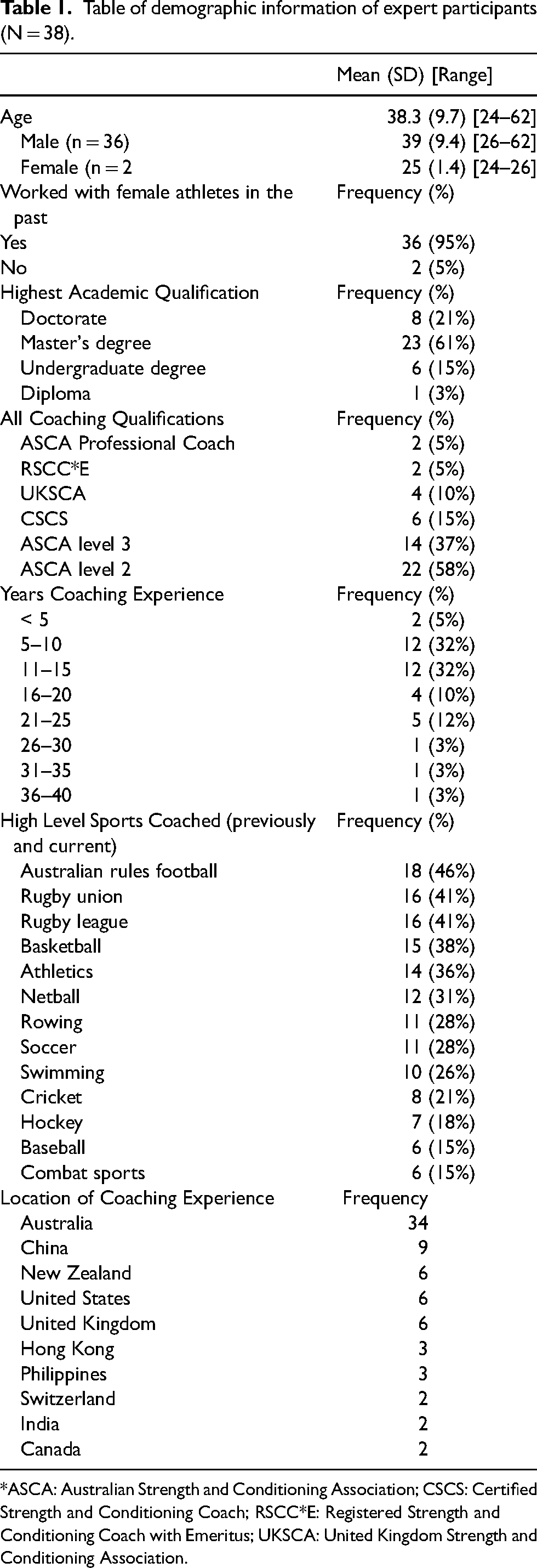
*ASCA: Australian Strength and Conditioning Association; CSCS: Certified Strength and Conditioning Coach; RSCC*E: Registered Strength and Conditioning Coach with Emeritus; UKSCA: United Kingdom Strength and Conditioning Association.
Round-2 survey
Round two of the survey consisted of statements that were developed based on the open-ended responses obtained in round one (Supplementary digital content, Table 2). Participants were required to read each statement and provide their level of agreement using a nine-point Likert scale. Recent research has recommended the use of a nine-point Likert scale, allowing the responses to be split into three, even (three-point) categories. The lower end of the scale (1–3) indicates disagreement with the statement, the middle section (4–6) indicates a neutral response to the statement (neither agree or disagree) and the high end of the scale (7–9) indicates agreement with the statement. 30 Consensus was defined prior to the commencement of the study as ≥80% agreement from responses within any three-point category. For Delphi surveys, there is no definitive consensus threshold that is considered “ideal”, however 70–80% is the most commonly recommended. 29 Therefore ≥80% was chosen as it was considered to be more rigorous.. At the start of the second round of the Delphi survey, the participants were provided with an introductory statement explaining how to respond to each of the questions and how the responses on the nine-point Likert scale were categorised.
Combined results of round two and three.
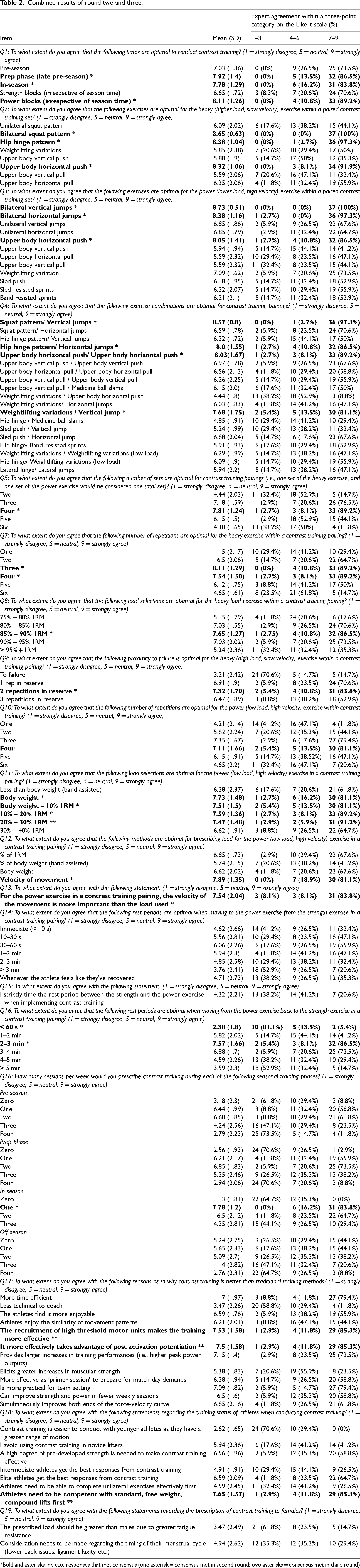
*Bold and asterisks indicate responses that met consensus (one asterisk = consensus met in second round; two asterisks = consensus met in third round)
Round-3 survey
At the start of the third round, subjects were provided with an anonymous report detailing the results of round two, which included overall response rates, ratings of agreement, and a transcript of any written comments. The third round of the survey contained statements that did not reach consensus in round two. The process of round three was the same as round two, where subjects were required to rate their level of agreement to each statement using a 9-point Likert scale. Prior to responding to each individual question, each participant was encouraged to review the round two results to reflect on the responses of the group.30,35
Statistical analysis
Summary data regarding the coaches demographic information are provided descriptively. A thematic analysis was conducted on open-ended survey responses obtained in round one, whereas data from rounds two and three were presented as individual statements. Descriptive statistics were calculated or reported per response from rounds two and three including mean, standard deviation, Likert scores and percentage agreement. All data were collected using REDCap survey platforms and analysed in Microsoft Excel.
Results
Participation by round
This Delphi survey consisted of a three-round questionnaire, administered between February and April of 2023. Round one was distributed to the 45 potential participants who expressed interest in participating in the study, with 38 of those meeting the inclusion criteria and completing the first round of the survey. Of those 38 participants who completed round one, 37 completed round two (97% of round one) and 34 completed round three (89% of round one). The demographic information from the participants can be found in Table 1.
Round-1 results
The participant was to respond to the questions about their opinions regarding the prescription of complex contrast training, with reference to exercise pairings, prescribed sets, repetitions, loading, and rest periods, why they use it over other training methods, frequency of use during different stages of the season, whether training status impacts the effectiveness of complex contrast training, and whether complex contrast training needs to be prescribed differently between genders (supplementary digital content, Table 1). Following thematic analysis of the 14 questions, 139 statements were developed from 129 codes. These statements were circulated to participants in round two of the survey (supplementary digital content, Table 2).
Round-2 results
Of the 139 questions, 27 exceeded the threshold for consensus (≥80% agreement) and were removed from the third round. Majority of the consensus responses pertained to exercise combinations (four), timing of the year, and strength and power exercises (three) suitable for complex contrast training. The remaining 112 questions that didn’t meet consensus were circulated again in round three, with the results from round two provided for participant reference. A summary of the results from round two are provided in supplementary digital content Table 2.
Round-3 results
The third round of the survey consisted of 112 questions, of which four met consensus, leaving 108 that did not meet consensus. The four questions meeting consensus pertained to the loading for power exercises, the benefits of complex contrast training compared to traditional training methods, and regarding the training status of athletes. The results from round three, including those questions that met consensus in round two, are presented in Table 2.
Discussion
This is the first known study to explore how expert strength and conditioning coaches prescribe complex contrast training to team sport athletes. The findings provide insight and recommendations that can be used to guide practice and inform ecological exercise interventions. Prescription recommendations met consensus regarding the time of season complex contrast training can be prescribed, the number of sessions per week it can be performed, movement patterns and exercise combinations that can be used, and how it may be best prescribed with reference to sets, repetitions, intensity, and rest periods. Some additional considerations regarding the effective implementation of complex contrast training also met consensus, although no consensus was met regarding gender specific differences in complex contrast training prescription.
When, and how often, should complex contrast training be implemented
Consensus was met regarding the most appropriate training phases to use complex contrast training, with preparatory phases, in-season periods, and power-specific training blocks all exceeding the 80% agreement threshold. This seems logical considering the development and maintenance of strength and power are a priority in-season for team sport athletes. 1 Within power specific training blocks, the goal of the training period is power development and, as such, the implementation of complex contrast training within this period makes sense as it targets power adaptations whilst allowing the maintenance of strength. 12 The use of complex contrast training during the preparatory phase also met consensus, which may be considered a more unexpected finding given these training periods are often dedicated to developing general qualities such as muscular endurance and hypertrophy. This may indicate that coaches use contrast training to maintain or improve strength and power in preparatory periods in a time efficient manner, while leaving sufficient time to train more general physical qualities. Another point to consider is that the coaches included in this study did not specify whether they used complex contrast training differently during general and specific preparatory periods. As training is likely to become more strength and power focused as athletes move into specific preparatory phases of training (and get closer to competition), complex contrast training may become more prevalent. Interestingly, the pre-season period did not meet consensus, which may indicate that coaches are more inclined to train individual qualities in isolation (i.e., hypertrophy, strength, power) during this period. While the exact reason for this is unclear, it does align with traditional periodisation recommendations, 36 or may be due to having more time available time to train compared to in-season periods. In totality, these findings may suggest that coaches consider complex contrast training an effective means to optimise and maintain strength and power adaptations during training periods where speed-strength and strength-speed are the focus, such as power-specific training blocks, the in-season period, and prepatory training phases.
In-season, performing one session of complex contrast training per week met consensus, however. there was no further consensus reached regarding the preferred number of complex contrast training sessions per week in any other training phase. This finding may be due to the variations in training availability seen at the different levels of competition and between different sporting codes. One and two sessions per week were the highest recommended for all training periods (Table 2: > 55% agreement). This may suggest training frequency is more likely dictated by the need to maintain a balance with other training commitments, rather than what may optimise for training adaptations. It may also be due to the variations in sport observed, where some sporting codes (i.e., rugby) have historically placed greater importance on resistance training than others (i.e., soccer). Within this, it should be noted that when this session should be conducted within a given microcycle was not explored. However, given that high load (i.e., 85–90% 1RM) conditioning activities were often recommended within a complex contrast training pairing, it is likely that these sessions are best implemented early in a weekly microcycle to minimise the likelihood of fatigue impacting on match performance.
Movement patterns and exercise pairings
Those movement patterns that met consensus for strength focused exercises included the bilateral squat pattern (e.g., barbell back squat), hip hinge pattern (e.g., Romanian deadlift) and upper body horizontal pushing pattern (e.g., barbell bench press). The strength exercises that met consensus were all free-weight exercises (not machines, or fixed movement patterns). Some research has suggested that the use of free weight exercises may have a better transfer into athletic performance outcomes compared to machine weights, 37 which may partially explain this finding. Power focused movement patterns that met consensus were bilateral vertical jumps (e.g., countermovement jumps), bilateral horizontal jumps (e.g., broad jumps) and upper body horizontal presses (e.g., medicine ball throws). Exercise combinations that met consensus were bilateral squat patterns with vertical jumps, hip hinge patterns with horizontal jumps, upper body horizontal push with upper body horizontal push, and weightlifting lifting variations with vertical jumps. The pairings that met consensus are arguably the most logical combinations, whereby each exercise paring uses the same movement pattern. 10 Practically, these combinations are also easy to implement, require a relatively small amount of equipment, and are likely to be well-known by most team sport athletes, possibly explaining their high level of agreement.
Complex contrast training prescription (sets, repetitions, and proximity to failure)
Consensus was met for the prescription of four sets of each exercise within a complex contrast training pairing. However, three sets almost met consensus (76% agreement), suggesting this could be a viable option if training time is limited. Coaches also recommended performing three or four repetitions of the strength exercise within a complex contrast training paring, using 85–90% of 1RM, and while leaving two repetitions in reserve each set, which aligns with recent meta-analytic research indicating that 85% of 1RM most often corresponds with a seven-repetition maximum load, and 90% of 1RM a five-repetition maximum load. 38 While these recommendations may seem logical considering they align with the ACSM guidelines for strength development 3 and meta-analytic research39,40 indicating that high intensities and low repetition ranges often lead to superior increases in strength, it is important to highlight that do not align with research on complex contrast training specifically. Indeed, a recent meta-analysis by Cormier et al., demonstrated that complex contrast training interventions using loads of <85% 1RM in athletic populations led to greater improvements in strength and vertical jump performance than loads of 85% 1RM and above. 41 While the exact reason for this is unclear, it may that the coaches in this cohort rely on foundational training research to guide their decision-making with respect to strength training specifically. It is also important to note that when implementing complex contrast training there may be a need to limit excess fatigue between strength and power focused exercises to maximise performance, thus leaving two repetitions in reserve is likely beneficial in this context. Recent research has also indicated that training further away from muscular failure may yield superior strength gains than training to muscular failure, which may have also influenced these findings. 42
For the prescription of power-based exercises, consensus was met recommending that four repetitions be performed per set. However, three repetitions reached 79% agreement, suggesting that it may also be suitable in certain situations where fatigue needs to be minimised or time is limited. Consensus was met for a loading range of bodyweight to 30% 1RM, which aligns with the ACSM guidelines for the prescription of power focused exercises, 3 where power development is said to be optimised using low repetition ranges and low loads (<60% 1RM). Nevertheless, these recommendations should still be considered within the context of the exercises selected. For example, peak power production is often seen with greater loads (>80% 1RM) using weightlifting derivatives such as the hang power clean, which is commonly used for power development 43 As such, the consensus recommendations for lower loading on power exercises, may be influenced by the coaches not using weightlifting derivatives as power-based exercises within a complex contrast pairing. It is also important to note that while specific loading parameters did meet consensus, coaches also agreed that the velocity of the power focused movement is more important than the load lifted, suggesting that elite coaches may be less precise with their load prescription during power exercises if the athletes are moving at the desired velocity.
Complex contrast training prescription (rest periods)
Consensus was not met regarding the recommended rest period duration for inter-set rest, which was interesting given there is a large body of research suggesting longer rest periods (>5 min) maximise the potentiation response thought to underpin some of the benefits associated with complex contrast training.10,11 Indeed, there is evidence that when using heavier loads during a strength focused conditioning activity, rest periods of up to ∼8 min may be required to dissipate fatigue and maximise performance during the following power focused activity. 6 This could imply that coaches may be more likely to prescribe complex contrast training rest periods in accordance with athlete availability and to reduce athlete burden, where shorter rest periods may minimise training time and increase athlete engagement within-session. However, coaches did agree that having two to three minutes of rest between complex contrast training sets was preferred, which again aligns with recommendations coming from the ACSM guidelines with respect to optimising strength and power adaptations. 3 Furthermore, it should be noted the strength level of the athlete also dictates the time course of recovery between the strength-focused conditioning activity and the following power movement, whereby stronger athletes seem to dissipate fatigue and experience potentiation faster than weaker athletes.11,44,45 As such, the lack of consensus observed in the current cohort may be due to the wide array of athlete populations coached, which are likely to have a broad spectrum of strength levels.
Why coaches implement complex contrast training
The coaches included in this study agreed on some of the practial benefits associated with complex contrast training, providing unique insight into why it may be perceived as a useful training method. Coaches identified they used complex contrast training to increases the recruitment of high threshold motor units, take advantage of the potentiation response, and make the subsequent power focused exercise more effective. While it did not meet the consensus threshold of 80% used in this study, complex contrast training being more time efficient and more practical for team sport environments both had 79% agreement each, suggesting these factors may be an important consideration when designing training programs for a high number of coaches working in elite sport. Collectively, these are interesting findings, as while maximising training adaption was identified as an important reason for implementing complex contrast training, the rest periods recommended did not align with that required to elicit a maximal potentiation response.10,11 While uncertain, these findings may highlight the difficult balance that strength and conditioning coaches must strike between implementing training that is optimal, but also fits within the constraints of a demanding team sport environment.
Additional recommendations
Lastly, coaches agreed that athletes need to be competent with standard, free weight, compound lifts before commencing complex contrast training. This is rational when considering complex contrast training is an advance method of training that requires the athlete to complete heavy compound lifts with maximal intent, and competence in those movements is likely to increase safety. It has also been seen that advanced athletes have shown greater responses to post-activations performance enhancement compared to untrained athletes, which may partially explain this finding.10,11 There was no consensus met with respect to whether gender should influence complex contrast training prescription, suggesting it may not be a factor elite strength and conditioning coaches consider when working with team sport athletes.
Limitations
These findings are not without limitations. Firstly, where the participants obtained their knowledge regarding complex contrast training was not explored, which may have explained some of the variation is responses observed. Secondly, as the coaches included in this review did have experience working across multiple different sports, it is possible that differences in commonly used terminology may have influenced some of these findings. For example, it is plausible that different season lengths observed between different sporting codes may influence what coaches may perceive as a “preparatory” or “pre-season” period. Finally, a large majority of the coaches included in this study were from Australia or New Zealand. As such, these findings may not align with current practice in other parts of the world.
Conclusions
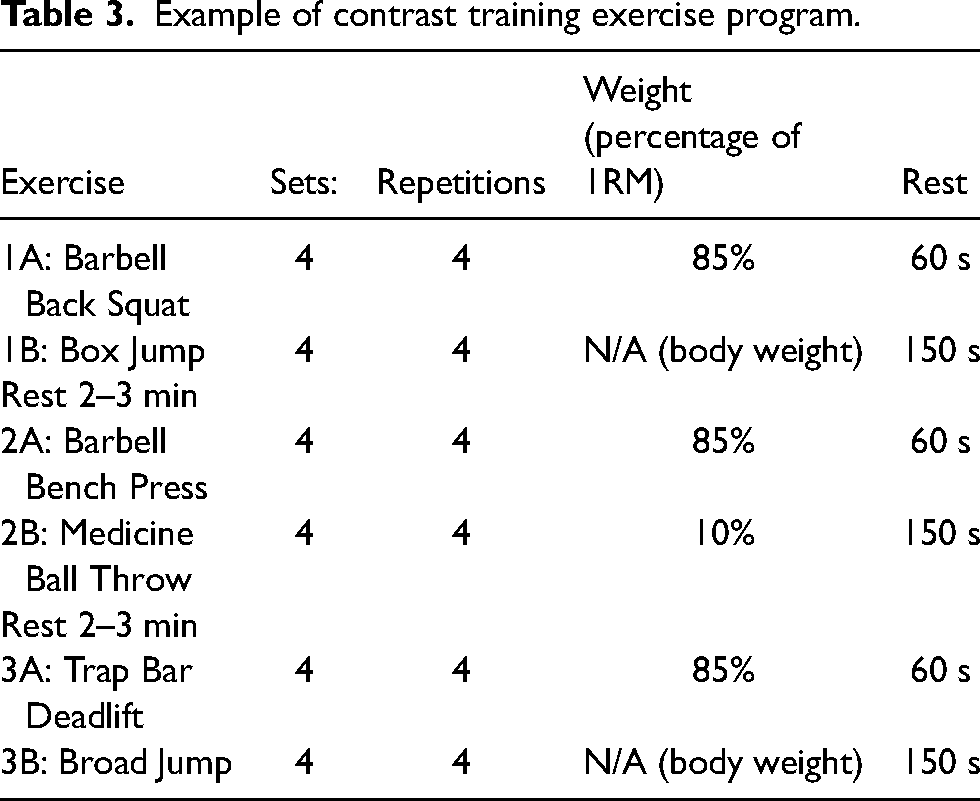
For the first time in the peer-reviewed literature, this paper provides expert consensus regarding how elite strength and conditioning coaches prescribe complex contrast training to improve athletic performance in team sport athletes. Consensus was met regarding exercise recommendations, while four sets of each exercise, a repetition range of three to four for power exercises and four repetitions for strength exercises also met consensus. The recommended weight for strength exercises was 85–90% of 1RM with two repetitions in reserve, and power exercises BW up to 30% of 1RM. Coaches most often provide two to three minutes of rest d at the end each contrast pairing. It was also suggested that complex contrast training is most commonly used during the competitive season when time constraints are the tightest, as it was suggested to be more time efficient than traditional training methods. An example complex contrast training program has been provided in Table 3 that implements the consensus recommendations obtained from this Delphi study. These findings provide valuable insight into how coaches use complex contrast training to enhance performance at the elite level.
Example of contrast training exercise program.
Supplemental Material
sj-docx-1-spo-10.1177_17479541241272256 - Supplemental material for Enhancing athletic performance with complex contrast training: A Delphi study of elite strength and conditioning coaches
Supplemental material, sj-docx-1-spo-10.1177_17479541241272256 for Enhancing athletic performance with complex contrast training: A Delphi study of elite strength and conditioning coaches by Jack Luders, Sam Gleadhill, Joel Garrett and Hunter Bennett in International Journal of Sports Science & Coaching
Footnotes
Acknowledgements
The authors would like to express their gratitude toward all 38 elite strength and conditioning coaches who completed at least one round of the Delphi survey.
Declaration of conflicting interests
The authors declared no potential conflicts of interest with respect to the research, authorship, and/or publication of this article.
Funding
The authors received no financial support for the research, authorship, and/or publication of this article.

Supplemental material
Supplemental material for this article is available online.
References
Supplementary Material
Please find the following supplemental material available below.
For Open Access articles published under a Creative Commons License, all supplemental material carries the same license as the article it is associated with.
For non-Open Access articles published, all supplemental material carries a non-exclusive license, and permission requests for re-use of supplemental material or any part of supplemental material shall be sent directly to the copyright owner as specified in the copyright notice associated with the article.
