




Abstract
The nurturing of young players in youth academies is seen as an important step on the way to becoming a full professional in the sport of soccer. This longitudinal multi-study investigation, spanning 2009 to 2021, analysed the career paths of Spanish academy soccer players. It consisted of three studies investigating players’ transition from academy to professional status and the identification of technical skills and psychological traits which could distinguish future professionals from amateurs. The sample involved 198 male academy soccer players (aged 13.5–17.9) from two Madrid-based professional clubs. Study 1 assessed the outcomes of these players a decade after their academy-level evaluations. Studies 2 and 3 focused on the subgroup of 85 players whose playing status could be verified a decade later. Results showed that 12 players (6.1%) progressed to full-time professional soccer. Of these 12, just 7 reached Spain's highest professional league within 10 years of their final academy tests. Significant differences favouring professional players were observed in the trait of ‘self-confidence’, ‘ball reception’, ‘dribbling forward with the ball’ and coaches’ global technical assessments. In conclusion, the chances of academy soccer players achieving professional status are low. Accordingly, providing more developmental opportunities before deselection is crucial to maximise player potential. Coaches could prioritise players’ self-confidence and ball control to increase the conversion rate of academy players to professional status. Furthermore, recruitment of players who are already strong in these attributes could also improve the productivity of talent development pipelines.
Introduction
Due to the multiple, intertwining factors that can determine success in competitive sport, it is very difficult to accurately determine the emergence of young talent. 1 Recent literature has brought into sharp focus, the receptiveness of an individual to adapt to systematically applied forces in their environment. These forces can be manipulated with a view to inducing a physical, mental or emotional response that equips an individual with the skills and abilities to meet the subsequent challenges which they face within that environment.2,3 In youth soccer, this can be achieved by preparing players in academy systems but, recently, their effectiveness in professional soccer could be said to have come under considerable scrutiny when Brentford FC dissolved its own academy citing financial inefficiency and a low return on investment. 4 Though now reinstated due to tournament regulations, 5 in its place, the club had introduced a ‘B team’ model for developing identified talents aged 17 to 21 in a more competitive setting, offering tangible benefits such as reduced scouting costs and the ability to attract talent overlooked by larger clubs’ own academies. 4 This shift, motivated by the low transition rate of academy players to professional levels, appeared to offer a strategic alternative to the nurturing of young of talent in professional soccer.1–3
Previous work6,7 has emphasised the importance of longitudinal research to come to accurate conclusions with regard to the developmental influences that impact on young athletes as they mature. Such studies are methodologically difficult to execute, not least because of the often erratic trajectory of biological development of youth as they grow and mature over time.8–10 However, a small number of investigations have been carried out in response to raised calls over the last decade. Leyhr et al. 11 examined the development of motor skills in 1134 young German players born between 1993 and 1995 (under 12 to under 15 age grades). Members of the German football association's talent development programme, these players were categorised, based on their eventual adult performance level, into elite (top five German divisions; N = 145) and non-elite players (all other divisions; N = 989) groups. The researchers revealed that future elite players already had better skills than their non-elite counterparts at the under 12 level, maintaining this advantage into the future. Indeed research in young Dutch soccer players suggests that superior players could be identified even earlier based on sprint speed alone. 12 Moran et al. 8 carried out a similar study which examined the erratic trajectory of motor skill development in English Premier League academy players but no predictions of future professional status were made in this case.
In a study that longitudinally examined psychological components only, Verner-Filion and Valler 13 investigated how passion types and need satisfaction influenced young soccer players’ (n = 91) ‘optimal functioning’. Covering a three-season period, the authors concluded that young players did not have to experience psychological distress to perform well in their sport. The researchers 13 implied that players who exhibited a harmonious passion for soccer and a growing fulfilment of their basic psychological needs, could increase well-being and preparation quality, which could ultimately be indicative of greater future performance. Fortin-Guichard et al. 12 evaluated the complexities of identifying young soccer talent through longitudinal indicators, focusing on how evolving skills and abilities influenced the selection of players into professional academies. Involving 110 Dutch male footballers aged 8 to 12 years, the research spanned 4 years and monitored various parameters like anthropometry, physical fitness, motor coordination, technical skills and psychosocial capacities. The study's longitudinal approach assessed not only the players’ abilities but also how these abilities developed over time, finding that the primary determinant of selection into the academy was 30 m sprint speed and indicating that the rate of development in other facets had minimal impact on the selection process.
In another study, which incorporated both physical and psychological measures, Zuber et al. 14 presented an holistic approach to evaluating young elite soccer players’ (n = 119; aged 12 years) development over a 3-year timeframe. The researchers examined the interconnectedness of ‘hope for success’ and ‘fear of failure’ in addition to measures of physical fitness and technical soccer skill, and their relation to future success within the aforementioned timeframe. Using cluster analyses, the researchers observed that players who demonstrated high skill levels across various factors, even if not achieving the top overall scores, were more likely to attain the highest performance levels. Similarly, early-developed players who were physically robust, yet exhibited some technical deficiencies and a fear of failure, had a strong likelihood of achieving mid-level performance. However, players who were either late bloomers with high skill or those with low skill, despite being driven to achieve, did not reach the top performance tier.
Despite the insightful findings of the above investigations, studies that assess the future outcomes of playing success based on coach evaluations undertaken at the academy level are very scarce. Such studies are important as they may indicate the specific characteristics that might be associated with successful progression through an academy system. In this multi-study investigation, we aimed to address identified gaps in the literature, focusing on the progression of Spanish youth soccer players who were in professional academies between the years of 2009 and 2011. We used career outcomes and coach evaluations to describe the characteristics and chances of success for professional and amateur players a decade after academy entry. Longitudinal studies of this nature15,16 are scarce yet they are crucial for understanding the systematic development of youth soccer players as they grow, mature and undertake varying career paths. To address these issues, the current article reports the results of three studies that used 10-year longitudinal data to examine the progression of youth soccer players from the academy level to elite professional leagues (Study 1), followed by an analysis of the psychological traits (Study 2) and technical skills (Study 3) that could differentiate players who achieved elite professional status, as compared to those who did not. The multi-study structure of this investigation mirrors its original conception as three distinct, yet interconnected, pieces of work that have evolved from a singular large dataset. This design reflects the inherently multidisciplinary nature of the project as a research endeavour and allows for a detailed exploration of the data pertinent to each distinct field, while still maintaining a common thread throughout the work. It is our assertion that while these studies are interlinked, forming a coherent narrative arc, they also possess standalone value, with findings that are directly applicable to practitioners within their respective disciplines. The independence of each study is not just a structural element but reflects a deliberate choice to enable a targeted application of the study results.
Study 1
Purpose
The first study presented a descriptive analysis of long-term outcomes of soccer players a decade after psychological and technical skills evaluations at the academy level. The purpose was to describe the various different career outcomes of the entire 198-player cohort and to provide important insight into the chances of achieving success in professional soccer. This descriptive analysis served as a preliminary overview of the gathered data and established the foundation for subsequent comparative analyses.
Methods
Participants
The full sample comprised of 198 male academy soccer players (age range: 13.5–17.9 years) from two professional soccer clubs in Madrid, Spain. All teams completed training sessions, of approximately 90 minutes duration, three times per week and played one competitive match on weekends. The study was approved by Universidad Politécnica de Madrid, the University of Essex and the associated soccer clubs. Participants and their parents provided written assent and consent to take part. The players were also informed that participation was voluntary and that they could withdraw from the study at any time.
Player evaluations were conducted in September 2009, May 2010, September 2010 and May, 2011. Each player's most recent evaluations were included in the analysis. During this timeframe, one of the clubs was competing in Spain's top professional division and the other was promoted to that division. In determining a player's progress from the academy level, his club and playing level in the season that corresponded to the 10th year since his final academy evaluation was recorded. Accordingly, if a player's last documented test was in May 2010, his club and playing level for the 2020/2021 season, and all seasons prior to that, were considered in the analysis. Any player that reached Spain's Segunda and Primera divisions within that 10-year timeframe was considered to have been successful in achieving professional status. Players who appeared in international leagues of a reasonable standard, as determined by teamform.com rankings, were also considered to have been successful in achieving professional status. In relation to evaluating this standard across international leagues, it was decided that a player had to have played professionally for a fully professional club that was typically operating within the top two divisions of a country's professional soccer structure. Professional players not conforming to these criteria would be judged on an individual basis, though no such cases occurred. Clubs’ underage teams were not considered to be professional outfits. A number of internet databases and websites (besoccer.com, fastscore.com, footballdatabase.eu, footystats.org, futmadrid.com, hogaralcarreno.es, lapreferente.com, playmakerstats.com, rffm.es, soccerway.com, transfermarkt), dedicated to reporting professional and amateur soccer news, were used to determine the historic professional and amateur status of players. If a player's details could not be found, they were assumed to have retired from the sport and were labelled as such in the analysis. These classifications were also adopted in Study 2 and Study 3.
The methods used to determine biological maturity status were used previously. 17 In brief, self-assessed Tanner stages of pubic hair development were reported using pictures from Tanner et al. 18 This method describes the nature, initiation, and progression of pubertal development in boys through an assessment of genital development and/or pubic hair growth. 19 The procedure to assess maturity status was overseen by two researchers after parental consent and participant assent were received. The self-assessment was completed at the soccer club under the supervision of two researchers, and one of the player's parents, or guardian, was present at all times.
Statistical analysis
To examine the data gathered from 2009 to 2011, statistical analyses were carried out using JASP (version 10.2, University of Amsterdam). Means, standard deviations and percentages were calculated for the variables of interest. Frequencies were also utilised to analyse categorical variables where relevant.
Results
Table 1 contains the descriptive characteristics of the analysed players. From the original sample of 198 players, 12 (6.1%) graduated to the professional level and 73 (36.9%) became amateurs while the remaining 113 (57.1%) could not be traced and were assumed to have retired. Of the 12 professionals, 7 (58.3%) reached Spain's highest professional league at some point in the 10 years after their final academy test. Five (41.7%) of the professional players also played for teams in Spain's second highest professional league. Four (33.3%) players entered professional leagues in other countries. For the most part, once these players left Spain to pursue opportunities abroad, they did not return to their country of origin to play. Generally, these players left Spain for relatively minor professional international leagues including the United States (Major League Soccer and lower), Venezuela, Paraguay, Bolivia, the Rio de Janeiro state league, Poland and Cyprus. Up to the 10-year point after their final recorded academy test, just two players were playing at a level equal to or higher than their career peak (USL Championship, Cypriot First Division).
Descriptive characteristics of the players analysed in the current study.

Group percentages which do not add up to exactly 100% are indicative of the presence of uncategorised players within the cohort.
Analysis of the frequency with which each Tanner Stage appeared in the various sub-groups revealed the highest representation to be Stage 4 (57.5%), with stages 3 (17.8%), 5 (9.6%) and 2 (8.2%) comprising the remainder. In the professional player cohort, Tanner stage 3 (41.7%) was most common, followed by stages 4 (33.3%), 2 (16.7%), and only one instance in stage 5 (8.3%). In the retired group, Tanner stage 4 (48.7%) was most the frequent followed by stages 3 (27.4%), 5 (15.0%) and 2 (7.0%). Group percentages which do not add up to exactly 100% are indicative of the presence of uncategorised players within the cohort.
Analysis of the frequency with which each quartile (Q) of the players’ birth years appear in the data showed that in the full sample, 44.4% of the players were born in the first quartile of the calendar year with 30.8% being born in the second. Just 18.7% were born in quartile 3 with 6.06% born in quartile 4. Within each category of player status, the following distributions were present: professional: Q1 = 33.3%, Q2 = 41.7%, Q3 = 25%, Q4 = 0%; amateur: Q1 = 39.7%, Q2 = 30.1%, Q3 = 24.7%, Q4 = 5.5%; retired: Q1 = 48.7%, Q2 = 30.1%, Q3 = 14.2%, Q4 = 7.1%.
Discussion
From a purely economic perspective, the progression of just 6.1% of the original sample of 198 players to the professional level, alongside the interesting trend wherein a relatively high proportion of successful academy graduates move overseas to play in leagues of an apparently lower standard, could hold implications for how academies in soccer operate. Despite a low return on investment in terms of the conversion of players from academy to professional status, previous research suggests that soccer clubs in Europe almost exclusively claim that the primary purpose of their academy is to develop players to play in their first team. 20 Yet the low conversion rate of players from the academy to professional levels could call into question the stated purpose of talent development programmes in the sport. In England, for example, only 0.5% of talented children identified at the under 9 age grade, by some of the country's best professional academies, subsequently appeared in their team's full professional side. 21 The chances of achieving professional success in other sports is also very low. For example, in the United States, only 3.5% of high school male basketball players and 4.1% of female players can expect to secure an NCAA berth at any of the three divisional levels of American collegiate sport. 22 Following their NCAA careers, only 1.2% of males and 0.8% of females will continue to the NBA or the WNBA, respectively. 23 Though the success rate of players in the current study appears to be higher than in the aforementioned examples, the wisdom of exposing children to intensive pipelines of talent development, especially when the chances of success are so low, has been questioned from the perspective that it may exert a negative effect on mental health. 24 Indeed, at very young ages the practices of sport sampling and diversification of activity should be some of a child's coach's foremost concerns for their development. 25 This forgoes the pursuit of one single sport for the broader experiences associated with multiple sports participation.
A further notable trend in the current data is the statistic that more than 75% of the players were born in the first 6 months of the calendar year indicating the presence of a relative age effect which makes it very difficult for players who were born in the second half of the year to succeed. This trend was consistent across players even when future playing status was accounted for meaning that not only are players born in the second half of the year not being given the chance to succeed, they were not being selected into the academy in the first place. The relative age effect is a phenomenon that has been observed at other elite Spanish clubs. 26 A selection policy biased towards early-maturing players risks marginalising their late-maturing counterparts, potentially overlooking the ‘underdog effect’. This phenomenon suggests that late maturing players, often facing greater challenges due to their later development or Q4 birth, may inherently possess or be compelled to develop valuable qualities like perseverance and determination to remain competitive. 27 However these attributes, which could significantly contribute to success in sport, might not be as necessary to develop for early maturers or Q1 players who are selected more easily into talent development systems based on physical dominance. Unfortunately, because of this, it could be that the presence of the requisite psychological traits in late matures may be less of an acquired advantage and more of a prerequisite for their sustained participation within the talent development system in the first instance. Early maturing athletes, in contrast, may not have developed such qualities to the same extent given the physical dominance they enjoy can result in infrequent challenges to psychological toughness and the ability to face adversity. 27 This lack of challenge can be erroneously interpreted as authentic physical dominance when it potentially has more to do with the large, yet temporary, physical mismatches that can emerge between two young players of the same chronological age.28,8
Study 2
Purpose
In Study 2 we evaluated psychological attributes in the subgroup (n = 85) of players whose playing status could be verified a decade after their academy assessments took place. Constructs for self-confidence, emotional control, concentration, and motivation were compared between players who achieved professional (n = 12) and amateur status (n = 73). In assessing these factors, we sought to determine whether or not these psychological characteristics could discriminate between players who ultimately achieved success in their careers and those who did not.
Methods
Psychological characteristics
Players completed the Psychological Performance Inventory,29,30 which has been used by the Spanish Olympic Committee to evaluate the psychological variables that could impact upon sport performance in competitive athletes. The test identifies key dimensions which could affect sport performance such as self-confidence, emotional control, concentration and motivation. Questions were answered on a 10-point Likert scale questionnaire. The reliability of the scales used in this study was supported by previous research with reported Cronbach's alpha values ranging from 0.66 to 0.88 in various studies.31–33 The same investigations32,33 have confirmed the validity of the relevant scales in various international contexts.
Statistical analysis
Statistical analyses were carried out using JASP (version 10.2, University of Amsterdam). Due to imbalanced group sizes and the lack of normality in the data as determined by the Shapiro–Wilk test, a non-parametric approach was utilised with Mann–Whitney tests used to compute any differences between groups. Effect sizes were represented by rank-biserial correlations (r) which were calculated to assess the practical significance of any group differences identified through the non-parametric rank-based tests. The effect sizes provided additional context for translating the magnitude of differences between groups and were interpreted using the conventions outlined for the ‘r’ effect size, where: ≤0.3 = small; >0.3 and ≤0.5 = medium; ≥0.5 and ≤1 = large.
Results
The results of the Mann–Whitney tests in Table 2 revealed statistically significant differences in self-confidence (p = 0.007) between the groups, favouring the professional player group (r = −0.49). No significant differences between professional and amateur players were found for emotional control (p = 0.257), concentration (p = 0.192) or motivation (p = 0.343).
Comparative analysis of psychological attributes between professional and amateur players.
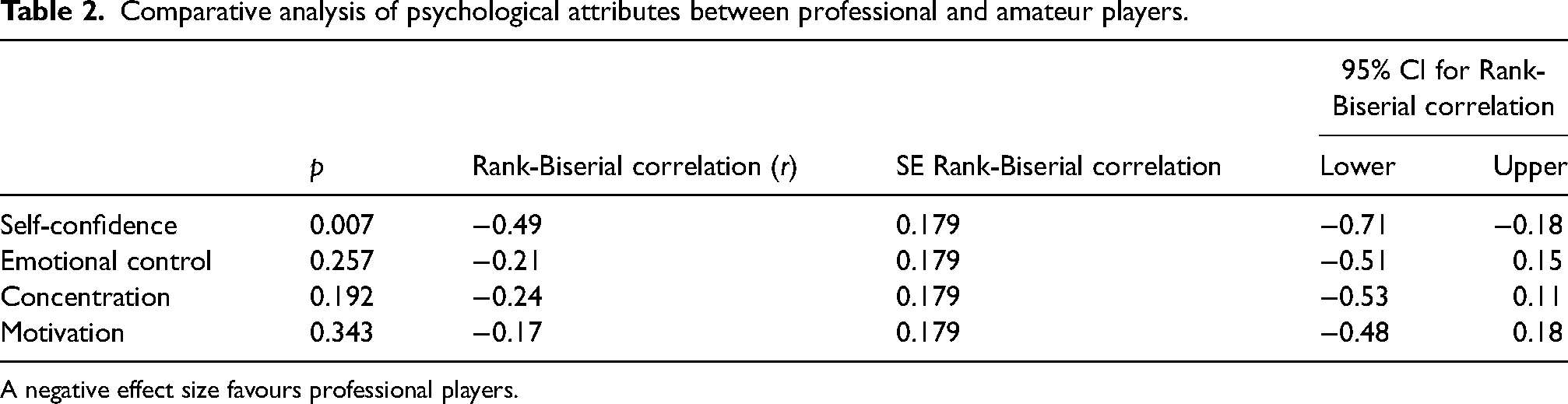
A negative effect size favours professional players.
Discussion
The results of this study suggest that future professional players have higher self-confidence at the academy level as compared to future amateur players. However, there were no significant differences in emotional control, concentration, and motivation between the two groups. Despite a statistically significant difference being observed in one metric only, the observed small to medium effect sizes favoured the professional group in all tests indicating a consistent trend of superiority across each psychological construct.
Similar work in young hockey players demonstrated that eventual elite performers had confidence in their ability to succeed but that this was co-dependent on other factors like motivation levels and willingness to consider coach feedback. 34 Similarly, more recent research 35 in Spanish youth soccer players, which used similar psychological constructs to those in the current study, demonstrated relationships between self-confidence and negative energy control, attention control, motivation level and positive energy. Accordingly, it seems that those young players who exhibit a high level of self-confidence, whether that be innate or instilled by high-quality coaching, also demonstrate other psychological qualities that may facilitate success and differentiate them from non-professional players. Similarly, work by Fortin-Guichard 15 revealed the role that self-regulation can play in the identification of so called ‘sleeping talent’. Such sleeping talent often exhibits the positive abilities required to thrive within the environment of professional sport but because their innate psychological traits may be difficult to identify, these players are often overlooked as their abilities are difficult to detect. Subjective evaluations, including judgments about a player's skill level and their compatibility with a team's strategic approach and principles, might typically be involved in the assessment process. Integrating these evaluations could offer a more comprehensive insight into each athlete's attributes, although compiling a detailed profile of an athlete's abilities requires considerable time. Therefore, maintaining players within academies for an extended period could be advantageous in certain circumstances, as it can allow ample time for such assessments to be conducted. Nevertheless, academies must always remain aware that retaining children in a talent development pipeline, and exposing them to intensive systematic training when the chances of career success are low, may not be optimal for psychosocial development.
Together, the above findings appear to support a two-pronged strategy for coaches to maximise the psychological development of their players. Key constructs such as self-confidence could possibly be used to identify players who are likely to succeed in the professional game if they also display the other requisite traits and abilities to do so. The results also serve to indicate the areas of weakness in which players of lower ability may benefit from targeted programmes of psychological skill development. For example, Bell et al. 36 reported enhanced mental toughness in youth cricketers who partook in a 6-month intervention in which they were exposed to punishment-related outcomes. Though relatively trivial in nature, these consequences, which included having to clean changing rooms, miss training sessions or repeat tests, apparently enhanced threat detection and, in turn, could have dampened emotional reactivity. Accordingly, programmes of this nature that are executed in talent-identified soccer players could be focused on enhancing the various constructs in which the amateur players in the current study were found to be inferior to the professional players.
Study 3
In Study 3 we evaluated technical skills of the subgroup (n = 85) of players whose career status could be verified a decade after their academy evaluations took place. Tests of ball skills, passing and shooting proficiency, along with a combined skill metric, were compared between players who achieved professional (n = 12) and amateur status (n = 73). In assessing these factors, we sought to determine whether or not these technical characteristics could discriminate between players who ultimately achieved success in their careers and those who did not.
Technical skills assessment
The abilities of players were assessed with a battery of skills that included the primary technical soccer skills of shooting, passing and ball control. 17 The evaluated skills were chosen on the basis of their importance for soccer performance as in previous investigations.37,38 Qualified soccer coaches, all of whom were accredited by the Real Federación Española de Fútbol, evaluated the players on a six-point scale with a scoring system in which a value of ‘1’ was considered ‘very bad’ and a value of ‘6’ was classified as ‘very good’. Players were rated by coaches using a standardised paper form with an ‘X’ placed next to the score that best reflected the player's ability in a given area. A similar method, using a visual analogue scale to evaluate youth talent, has previously been used in soccer and other sports, and is considered valid (ICC = 0.81). 39 The use of this type of evaluation was justified on pragmatic grounds given that coaches were able to assess the players based on their actual performance in training and competition. Goalkeepers were not included in the analysis because of the specialist skills associated with their position.
Statistical analysis
The statistical analysis approach in Study 2 was replicated in Study 3.
Results
The Mann–Whitney tests, shown in Table 3, revealed significant differences that favoured professional players for the skills of ‘ball reception’ (p = 0.01, r = −0.44), ‘dribbling forward with the ball’ (p = 0.001, r = −0.56) and the coaches’ global technical assessment (p = 0.01, r = −0.45) of players. For the other skills that were analysed, no significant differences were found between the professional and amateur player groups.
Comparative analysis of technical skill attributes between professional and amateur players.
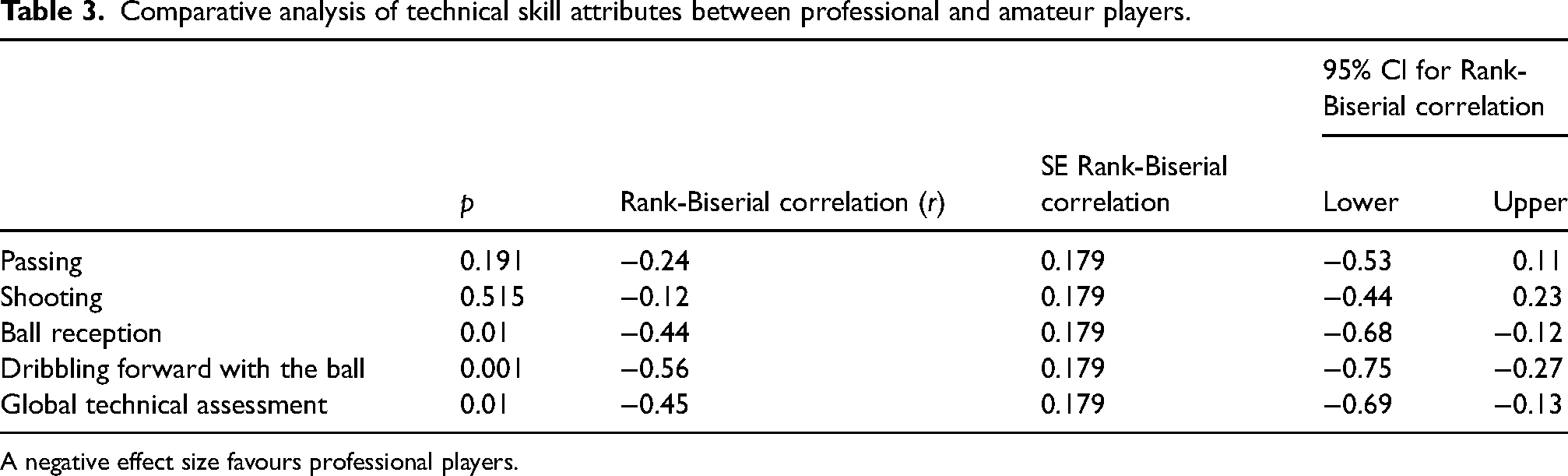
A negative effect size favours professional players.
Discussion
In Study 3, the results revealed significant differences between professional and amateur players in two of the four skill metrics as well as in the evaluation of global technical ability. This indicates that for the skills of passing and shooting, there seem to be no statistically significant differences between professional and amateur players at the academy level. However, skills relating to possession of the ball appear to discriminate between these groups as do coaches’ global evaluations of player ability.
There can be significant difficulty in identifying future talented players during puberty when erratic growth rates and performance levels can mask an individual's true ability. 8 The vast majority of players in the current study were categorised as Tanner stages 3 and 4 for both pubic hair and genital development. These stages are concurrent with the adolescent growth spurt, 40 which causes unpredictability in the performance levels of well-trained young players. 41 Indeed, while some individuals might experience significant increases in performance during this period, others can observe a temporary decrease due to underlying maturational processes that negatively affect motor coordination. 8 Such fluctuations mean that it is essential for coaches to recognise that suppressed performance due to maturational lag might be transient and so decisions with regard selection or deselection could be delayed until such time that the growth spurt has stabilised. 8 If selection decisions are delayed for as long as possible for those players who are considered to be on the threshold of progression, the proportion of players who graduate from the professional academy setting could increase. This is exemplified by previous work 8 which clearly and demonstrably indicates the erratic trajectories of athletic ability in youth athletes and it is entirely possible that such a phenomenon could affect some players to a great extent, and others to none at all. Indeed, it is apt that recent research by Hill et al. 42 reinforced the notion that the maturity status and growth rate of a player can affect how coaches view their performance in certain age categories. Typically, players who are currently undergoing the adolescent growth spurt are believed to have lower performance levels compared to their peers who have not yet entered this growth phase. It is upon these distinctly unstable developing foundations that sport coaches are tasked with making decisions on talent selection, yet, with athletic capability being as fluid as it is during puberty, this would seem to be a thankless task with a relatively low chance of a positive outcome.
Despite the above, it appears that English Premier League soccer coaches have now begun to appreciate that the growth spurt can indeed have a demonstrable effect on performance, though it appears unclear whether there exists a precise and widespread understanding of these changes amongst professional coaching personnel. 43 Increasing efforts to educate coaches might also therefore be a priority for clubs operating at the top level of professional club soccer. It must however be emphasised that the measures recommended above do come with additional financial cost and may not be available to all clubs in all sports. Accordingly, parallel teams of late maturing players could offer a potential solution to this dilemma if they can be adequately resourced by the club, allowing new promising players to enter the academy, but also assisting those with future potential to progress their careers. In addition to this, evidence from Germany 11 offers valuable insight into player assessments performed in professional soccer academies. Leyhr et al. 11 reported that future elite players had already achieved a higher level of skill than their non-elite counterparts by the under 12 levels, maintaining this advantage into the future. This phenomenon could have been at play in our sample also and with significant differences observed between global technical ability and the metrics directly related to ball control, coaches could use such early evaluations to identify talent to determine future success. Accordingly, it is crucial to discover the precise juncture at which such skill disparities become apparent as well as to investigate the determining factors that contribute to their emergence. If key time periods such as this can be identified, academy selection and deselection could become more streamlined, thus enhancing the wellbeing of those players who progress to the professional level, as well as those who choose to pursue other interests.
General discussion
Taken together, the findings of these studies indicate that despite the chances of progression from academy to senior professional soccer being low, there are a number of key technical skills and psychological traits that can differentiate future professional players from amateurs, potentially presenting coaches with an opportunity to develop such characteristics in players through their own actions. It is, however, essential to contextualise the 6.1% progression figure within the scope of existing statistics. 21 While it is true other sources indicate a considerably lower progression rate of less than 1% for young players into the first teams of English Premier League clubs, these statistics primarily pertain to players at the under-nine age grade. In contrast, the focus of our study revolves around adolescent teenage players who have already experienced the initial stages of the professional club's talent development pathway, in higher age categories. Thus, the higher graduation rate of 6.1% observed in our sample, wherein players transitioned to professional clubs in leagues of relatively lower quality worldwide, cannot be directly compared to the trajectory of a 9-year-old player at an English Premier League club. Indeed, with increasing labour mobility, facilitated by the European Union, and the cultural ties that Spanish players often have with South America, there is a diverse range of professional opportunities available to players emerging from Spanish academy systems.
Laterally, the argument as to whether ‘nature’ or ‘nurture’ 44 are more influential on the development of talent has long been debated and this plays a role in the current study. Though the players in this investigation appeared to be more similar than different, it is not necessarily clear if their differences predated their entry to the soccer academy (as per the aforementioned evidence from Germany, 11 or if they subsequently emerged during their time in the academy. Measures of physical performance during youth do not provide as clear a picture of an individual's ability as they would in an adult athlete because developmental changes can confound, or even hide, improvements in ability. 8 This lack of stability in short term performance can create false scenarios in which early-developing youths are selected into sports in which they seem to be talented, but in which they may not necessarily succeed once their late-maturing peers undergo eventual growth spurts of their own. This could therefore erode any advantage that was derived from the previous mismatch in physical qualities between any two given individuals. 27
The presence of a relative age effect in the current study suggests that even though both ball skill and psychological confidence can differentiate professional players from amateur, this is only in relation to a subset of the entire population that are potentially available for selection. During the period when these data were obtained, the number of births per month in the European Union were relatively equally distributed across all 12 months of the year. 45 However, the clubs involved in the current study were selecting players from a population in which 75% of individuals were born in the first 6 months of the year. This represents a large imbalance and possibly eliminates a relatively large number of players who could operate at the professional level of Spanish or international soccer. Given the observation of a relative age effect in the current study, it is reasonably safe to assume that there may have been players who would have been capable of pursuing a professional career in soccer but were not afforded the chance to do so. This finding is important because upon investigation of our sample of players, it appeared that in no case where an individual entered amateur soccer did they re-emerge to later become a professional player. Despite that, a large proportion of players are being discarded from academies despite comparing well to their professional counterparts in a number of different skills and traits. This raises the question of how many players are being lost to the game and how many potential players could become professionals if they were afforded time beyond the age of 15 years to develop their technical and psychological skills. This is unfortunate because it means that players of good potential are being eliminated from the talent pipeline at the very time that they need the most assistance. Our results don’t necessarily suggest that the players who make it to the professional level are not better than those who don’t. However, they do imply that the decisions that are made in terms of selecting and deselecting these players may be made at too early a stage.
The results of Studies 2 and 3 present evidence that could enhance academy coaches’ ability to identify the skills and traits that could be crucial to develop if young players are to overcome the substantial odds against them achieving full professional status at the adult level of soccer. There appeared to be no differences between shooting and passing ability in the professional and amateur players but the respective groups’ ability to receive possession and move forward when in possession were differentiating factors. Similarly, those players who were most confident were more likely to progress to the professional level and while it can’t be discounted that that one's ability to control a ball could be correlated with their level of confidence, 46 it is logical that coaches would implement interventions that concurrently target both attributes. Similarly, these characteristics could be used as mechanisms for the identification of players who might be more likely to graduate to the professional game. It is vital, however, that coaches do not view player attributes such as these through a reductionist lens and that a wide array of skills and characteristics be considered in the identification of talent.
Despite ever increasing knowledge on the career trajectories and potential career trajectories of elite academy soccer players, there are a number of barriers to implementation that must first be negotiated in order to facilitate the optimal development of playing talent. As stated, in 2016, Brentford FC phased out its youth academy due to prohibitive expenses and insufficient financial returns. 4 The club subsequently adopted an alternative approach, establishing a ‘B team’ for identified prospects aged 17 to 21. 4 The team subsequently operated outside the traditional academy structure, playing more challenging matches against stronger opposition with the intent of fostering player growth. The benefits of such a system are clear. Firstly, the financial burdens associated with talent identification can be eliminated. This can present a club with the freedom to search the market for talented players already identified by its rivals or to capitalise on attaining players rejected by larger, richer clubs. Given the low proportion of players in the current study who graduated to professional soccer, it is perhaps understandable why Brentford FC would have taken such a decision. However, this does not necessarily suggest that other clubs should adopt such a model as the purpose of a youth academy can, and should, transcend the development of players only for a team's professional structure (tournament regulations may prohibit this in any case). Currently, with so many youngsters being ultimately unsuccessful in the talent development pipeline of professional soccer, highly resourced clubs who place figurative wagers on these players being successful should be mindful of tending to their wider development and education as people during their time at a club. Furthermore, the process of nurturing talent and selling them on to other clubs has emerged as a genuine revenue-generating strategy which opens new avenues for players to pursue, Manchester City's activity being a recent example of this. 47
Limitations
There are a number of limitations that must be considered in this research. Some of the players (≈40%) undertook professional opportunities abroad in leagues that were not as highly ranked as the Spanish leagues. A player's willingness to play outside their country of origin could be a moderating factor in their classification as a ‘professional’ as there may well be similarly-skilled players who are more than good enough to play abroad but who aren’t willing to travel to do so, with playing at an amateur level in their home country being preferable. It is also important to highlight that players in this sample were only tracked up to 2021 at the latest meaning that a number of them would still have an appreciable timeframe to achieve professional status in the sport. A further limitation relates to the unavailability of item-level data from the PPI which prevented us calculating Cronbach's alpha for the present dataset. This study relied on historical data and while this approach enables longitudinal analysis that is invaluable for talent development projections, it can inherently restrict the ability to perform certain statistical verifications such as the assessment of internal consistency for measured constructs. Although we have cited a range of Cronbach's alpha values from previous studies to support the reliability of the PPI domains, we acknowledge that the direct computation of these values would have provided additional robustness to our findings. The absence of item-level data is thus recognised as a limitation and has been factored into the interpretation of our study's outcomes. We also acknowledge that the players’ technical skill evaluations used in this investigation were subjective in nature, however based on pragmatic grounds in gathering longitudinal data, we considered them adequate for use as all coaches were accredited by the Real Federación Española de Fútbol, the governing body for soccer in Spain.
Conclusion
The results of these studies suggest that there is a low chance of academy soccer players achieving professional status but that the relative age effect continues to exert a sizeable effect on reducing the population of players who can viably graduate to careers in the sport. Accordingly, players should be given more time to develop before deselection decisions are made, the conclusion of the adolescent growth spurt appearing to be a more opportune time to make such decisions. Skills and traits relating to self-confidence and ball control appear to differentiate future professional players from future amateur players and so coaches should be encouraged to focus on the improvement of these elements across the entire cohort of players that they work with so as to maximise the conversion of academy players to professional status. Furthermore, recruitment of players who are already strong in these attributes could also improve the productivity of talent development pipelines. These traits could also be used as differentiators with which selection or deselection decisions can be informed. However, such decisions must be made based on a wide array of different factors relating to a player's technical skills and psychological readiness to compete in professional soccer.
Footnotes
Declaration of conflicting interests
The authors declared no potential conflicts of interest with respect to the research, authorship and/or publication of this article.
Funding
The authors received no financial support for the research, authorship and/or publication of this article.
