




Abstract
Supporting high-level performance is increasingly seen as a team game, reflected in the growth in support services. Coaches and management must work effectively with various practitioners to deliver the required support to athletes. To date, how coaches experience these support teams has yet to be explored. Accordingly, we utilized a qualitative research design with semistructured interviews to examine coach-consumers’ perceptions of more or less effective practice. Eight high-level coaches were recruited, and data was analyzed using reflexive thematic analysis. Key themes generated included the make-up and conduct of high-performing teams, prioritizing coach–practitioner relationships, and professional development considerations for both coaches and practitioners. Data suggest that practitioners are seen as playing a crucial role in elite sports performance, and coaches generally have a positive view of the contributions of sports science teams. Notably, however, several challenges were identified, including communication issues, conflicts over the allocation of resources, recruitment of, and the need for sports scientists to understand the demands of sports and the coaching process. Findings have practical implications for support teams and coaches working in high-performance sports; specifically, in the recruitment and development of sports science and medicine practitioners and coaches.
Introduction
Sport represents a dynamic ecosystem in which success is not solely the product of an individual athlete's talent. Rather, it is a collaborative endeavor; a team of disciplinary experts working together to achieve a shared goal. Aside from the significant contribution made by coaches, substantial investments have been made in science and technology within high-level sports, resulting in personnel infrastructures geared towards optimizing athletic performance.1,2 Structures include large numbers of sports science and medicine staff (SSSM) whose collective efforts are channeled toward the advancement of athlete development and performance.
Despite the acknowledged importance of collaboration between coaches and SSSM staff, however, a notable divide still exists.3,4 Several factors can affect these relationships, including tenure length in a sport, contractual limitations, impact/power dynamics, language used, and level of formal education.5–7 For example, Papa et al., 8 observed that low-quality collaboration across staff (between coaches and medical practitioners, for example), with infrequent face-to-face meetings, contributed to mediocre injury rehabilitation and subsequent poor performance.
To address such issues, our study builds on the key work of Martindale and Nash, 3 now over a decade old. Specifically, we explore this relationship from the perspective of coaches and identify features of effective recruitment, working practices and professional development that can promote cohesion and success in elite sport. In the following section, we discuss the background and rationale for this research.
The composition of high-performing teams
In elite sport, a high-performing support team is important for success. Such a team is characterized by individuals who work cohesively toward a common goal. 9 High-performing teams have clarity on goals and objectives, commonly referred to as a shared mental model. 10 Team members understand what they are working toward, what methods they should use, and why these factors are important. This collective sense of purpose helps motivate and integrate the team, providing frameworks for both fast and slow decision-making.11,12
Notably, these principles of team performance transcend sport, extending to fields such as medicine, the military, and business; all of which appear more mature in their understanding of this complex phenomenon.13–16 These disciplines have highlighted the significance of multidisciplinary, interdisciplinary, and interprofessional collaboration, enabling teams to operate effectively across different modes of work, depending on context.
The exact label applied to the performance team in sports provides a challenge as there are many varieties, with consequent confusion regarding the understanding of terms adopted from other industries, such as multidisciplinary, interdisciplinary, and transdisciplinary teamwork.17–19 For a more in-depth review please see Burns and Collins 17 or McCallin. 20 Both position multidisciplinary as involving a combination of several disciplines, interdisciplinary as between, among, in the mid of, and reciprocal between disciplines, and transdisciplinary as across, beyond, and through disciplines. We believe that, along with other aspects, context is a key factor in defining the approach to, and level of, boundary crossing required. Importantly, these macro (i.e., systemic) distinctions must also be considered in tandem with lower-level meso distinctions (such as role clarity) or micro, individual differences. For example, if an athlete breaks their leg, chances are that they should initially see a doctor rather than a psychologist. However, as the athlete moves into rehabilitation, the team may function along the spectrum of multiintertransdisciplinary based on the needs at that time. 21 Consequently, within any performance sporting setup, exploring relationships between two key groups of stakeholders, coaches, and SSSM practitioners, is warranted.5,19
Coach–Scientist relationships
Integrating SSSM teams within elite sport has become increasingly common over the past few decades. However, their inclusion has caused some disruptions. 22 Teams usually consist of specialists in various areas, for example, strength and conditioning, performance analysis, biomechanics, nutrition, physiology, and psychology. Their role is to provide scientific expertise supporting athletic development and performance. Despite the growing importance of SSSM teams, however, relatively little research has been conducted on the experiences of coaches who work with them.23–25
Traditionally, coaches are responsible for guiding athletes’ training and competition strategies. Meanwhile, and also traditionally, scientists provide the knowledge and tools necessary to understand and enhance physical and mental capacities. When working as a team, effective collaboration can yield significant benefits for all involved; athletes, coaches, and scientists. Importantly, however, there is a lack of consensus on how best to foster collaboration and communication between coaches and SSSM teams.4,6,7,26 Indeed, managing stakeholders and their varied perspectives, personalities, and disciplinary traditions often poses challenges. The dynamics between coaches and practitioners are influenced by various factors such as, but not limited to, program philosophy, leadership support, structural organization, and individual characteristics. 17 Consequently, the dynamics between coaches and SSSM practitioners warrant further exploration, particularly given the unique contexts that exist in high-performance environments.
Despite the recognized significance of comprehending coach–SSSM practitioner relationships, however, empirical studies are limited.2,27 Prior research has identified potential barriers, such as communication breakdowns, methodological disagreements, and conflicts arising from differing priorities.5,28–30 For instance, Brink 5 suggests a more informal, context-based collaboration between coaches and SSSM staff to improve their connection and understanding. Further research is necessary to examine these challenges and devise effective strategies for enhancing coach–SSSM collaboration in high-performance contexts.
Accordingly, our intention was to expand the literature on the experiences of teams, often with highly varied expertise, working together within a high-performance milieu. Specifically, our focus was directed toward high-performance coaches and their experiences of working with the plethora of SSSM support services. We were particularly interested in coaches’ perspectives on effective and less effective practice; specifically, how the former could be facilitated in both the long and the short term.
Methods
Our study was guided by a pragmatic research philosophy, which posits that knowledge is constructed through interactions between researchers and participants who answer practical problems within specific contexts. 31 Our study acknowledges that coaches’ experiences are socially constructed and shaped by their unique contexts, including coaching philosophy, athlete population, and organizational culture. This aligns with the qualitative research approach employed, which emphasizes the exploration and understanding of complex phenomena in their natural contexts. Furthermore, this research adopted a reflexive thematic analysis (RTA) as a framework which acknowledges the researcher's role in engaging with data that influence the outputs. 32
Participants
The sample size was determined using the spectrum approach as defined by Malterud, Siersma, 33 who prioritizes information power over traditional saturation approaches. Criteria for determining information power included the aim of the study, sample specificity, use of an established theory, quality of dialog, and analysis strategy. Following ethical approval from the University of Edinburgh Institutional Ethics process, coaches were recruited via purposive/opportunity sampling. 34 Inclusion criteria targeted coaches at a Summer or Winter Olympic and/or Paralympic Games. Additionally, all coaches had worked in national governing bodies that either employed or contracted sports science and sports medicine practitioners to work alongside them. Limits were placed on the maximum number of coaches from each sport to ensure breadth of experience, thereby narrowing the potential for a larger sample. The decision was made to maintain this criterion to ensure no single sport took precedence. Due to the small sample size that met the above criteria (total coaches N = 8), no further gender or ethnicity criteria were employed. Participant demographic information can be seen in Table 1 (specific sport details redacted for confidentiality reasons).
Demographic information on elite coaches.
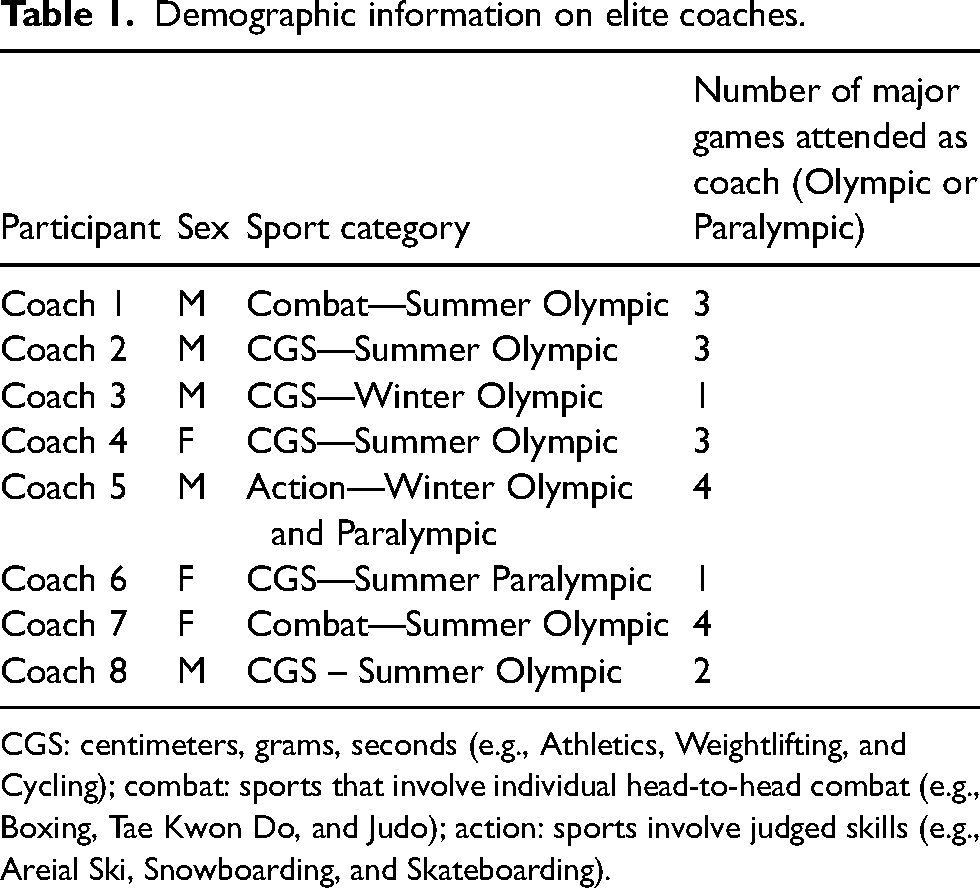
CGS: centimeters, grams, seconds (e.g., Athletics, Weightlifting, and Cycling); combat: sports that involve individual head-to-head combat (e.g., Boxing, Tae Kwon Do, and Judo); action: sports involve judged skills (e.g., Areial Ski, Snowboarding, and Skateboarding).
Data collection
Data were gathered through semistructured interviews lasting 39 to 75 min (average duration: 48 min). Interviews occurred in person, via phone, or video conference, depending on participant preference and location. An interview guide with open-ended questions, informed by prior research, 17 was used to explore coaches’ perspectives on collaborating with SSSM practitioners, the associated benefits, challenges, and factors impacting collaboration. For privacy reasons, data supporting this study's findings are not available upon request, and no additional demographic information is provided to safeguard participant anonymity.
Data analysis
Data were transcribed verbatim, with pseudonyms (coach numbers) assigned and identifying information removed to protect anonymity. Analysis followed a systematic process, including data familiarization, initial code generation, theme identification, theme review and refinement, and final report writing. 35 To bolster credibility and trustworthiness, three researchers independently analyzed the data and cross-verified their interpretations through multiple discussions. The analysis employed an inductive approach, yielding both semantic and latent codes and themes. Member reflections were used to validate themes and enhance data clarity in consultation with participants. The research team brought prior knowledge and experience of the subject to the study, including a lead author with a background as a national coach and elite performance team manager, and a second researcher who had served as a performance director. Importantly, this approach aligns with the principles of RTA, emphasizing the researcher's active role in the process.32,36
During the data familiarization phase, we identified various points of interest that led to the initial coding of the dataset around the experiences of the coaches. The initial patterns identified included (1) valuing the person, (2) expertise as the starting point, (3) understanding the sport, and (4) the good, bad, and ugly of coach–practitioner relationships. As we delved deeper into the dataset (by listening to the interviews multiple times), more latent themes were developed. For example, we discovered how a coach can lead and set up a relationship throughout the recruitment and early stages of engagement, which led to the final theme generation, as seen in the results.
Consequently, while there is room for further investigation into the experiences of elite coaches regarding SSSM teams, this study primarily focused on developing an understanding of the relationships between practitioners and elite coaches (from the coach's experiences) in areas such as performance planning, performance reviews, and delivery of daily training environments. The secondary focus was on the composition and functioning of the team based on the premise that high performance does not necessarily equate to high-performing teams. Finally, we aimed to learn from coaches about developmental experiences that facilitated their working relationships with SSSM practitioners and how these dynamics were shaped and changed over time.
Results
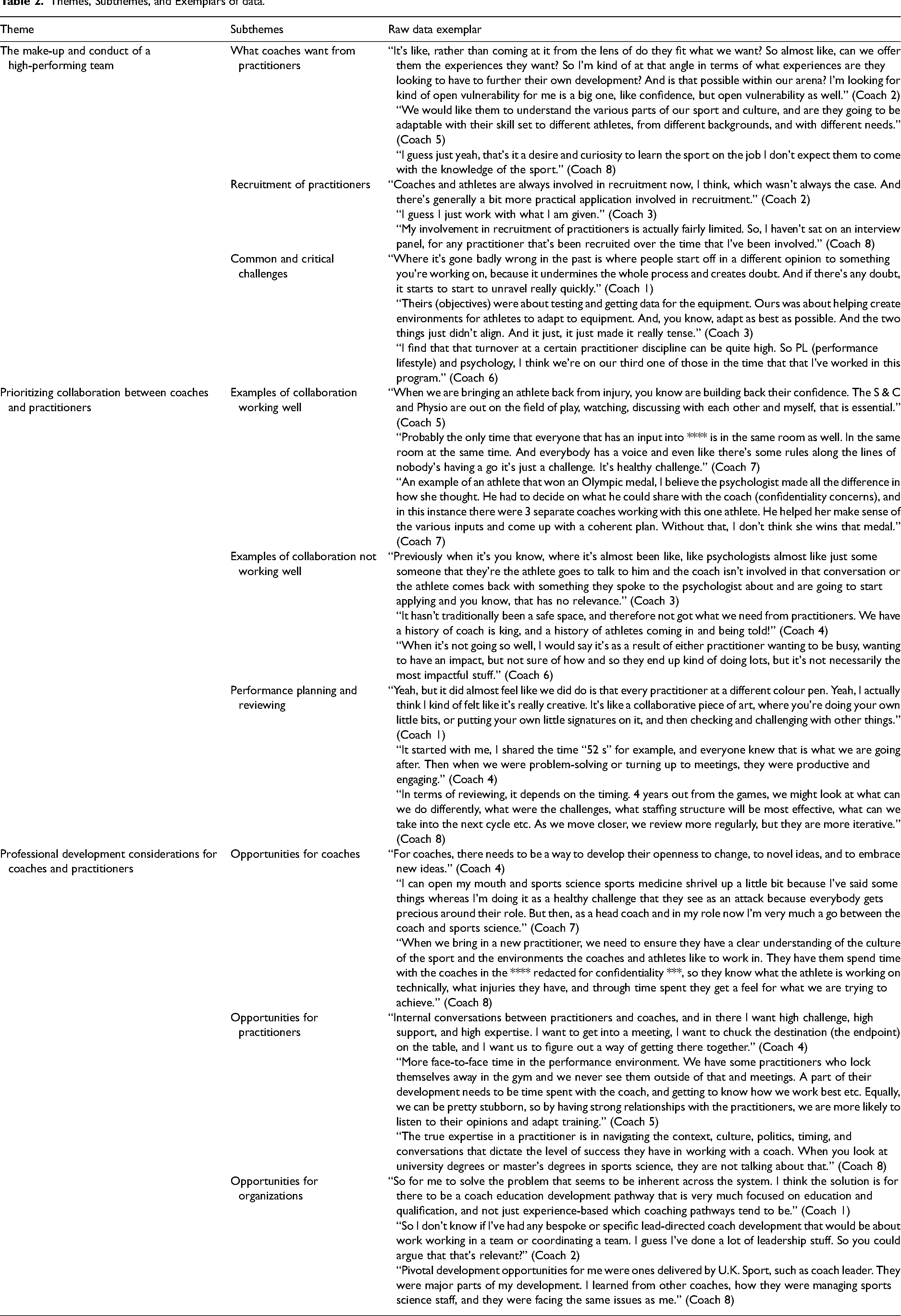
Three themes (each with three subthemes) were generated: (1) make-up and conduct of a high-performing team, (2) prioritizing collaboration between coaches and SSSM practitioners, and (3) professional development considerations for coaches and SSSM practitioners. Themes are presented in Table 2.
Themes, Subthemes, and Exemplars of data.
Theme 1—The make-up and conduct of a high-performing team
Coaches provided various descriptions of the support services available. The proportion of an SSSM practitioner's time allocated to a sport is determined by multiple factors including but not limited to the size of the sport, funding provided to the sport and/or institute, demands of the sport, and philosophy of the program/head coach. Below is an example of an objective centimeters, grams, seconds sport. The general trend across this sample was for physiotherapists and strength and conditioning coaches to be closer to full-time, with smaller contractual agreements with other disciplines such as biomechanics, psychology, and nutrition. We have a team of coaches, four podium, talent staff. Full-time physiologists, part-time psychologists, part-time lifestyle practitioners, full-time performance analysts, and full-time physical preparation coaches. On top of that I call in favors with experts depending on the need of the athlete or program, for example an expert in female health. (Coach 2)
Our physio is full-time and could probably have two full-time physios and still be too busy, we have an S&C coach four days per week, some nutrition support, and a psychologist on a day rate, they are awesome, but we can’t afford them anymore than that. (Coach 4)
Subthemes addressed below detail the key outputs of this theme, exploring in detail the coaches’ experiences and preferences within their teams consisted of three subthemes: What coaches look for in an SSSM practitioner, recruitment practices for SSSM teams, and common and critical challenges in elite sports teams.
Subtheme 1: What do coaches Look for in an SSSM practitioner?
Coaches overwhelmingly expressed the desire for SSSM practitioners to approach the sport with curiosity and understand it, both technically and culturally. Coaches also shared their frustrations when practitioners had a difference of opinion or something to share that could impact performance but stayed quiet. The preference for “having a voice” was evident across the entire sample. It's easier to find people that are good at being a physio or a performance analyst or being like a knowledgeable psych. But it is not easy to find people that will come in and really apply that psychology in a way that really understands your environment, really understands the relationships and the culture and that particular athlete, because that takes a bit more time and a bit more investment to do that. (Coach 3)
We had a physiologist who was really knowledgeable, really new, and was probably quite nervous and timid. She sat on this heat presentation until we practically forced her to share it, and when she did, it blew us away. We told her to ‘never wait.’ You have a seat here, and your view is expected and valued. (Coach 4)
Lastly, coaches were searching for an SSSM practitioner who could operate independently with speed and adaptability, which is an omnipresent feature of sport at the elite end: “we need to adjust weekly, we can’t wait for a report a month later as we have already missed a chance to progress” (Coach 8). This notion was mirrored in the concept of the fast- and slow-working sports scientists, whereby the practitioner can work quickly and sometimes, combine, and summarize the latest research that supports contemporary practice, rather than the slower-acting scientist, who may be working in the background of research that the practitioner may not have time for.
Subtheme 2: Recruitment practices for SSSM teams
There was a large divide within this cohort regarding their involvement in the recruitment of SSSM staff. This may be due to their seniority within the sport (although all had coached at Olympic or Paralympic Games), or the culture, and working practices of that sport. Several suggested they worked with whatever the institute provided them with. Below are two example responses from either extreme: Coaches and athletes are always involved in recruitment now, I think, which wasn't always the case. And there's generally a bit more practical application involved in recruitment. (Coach 2) I guess I just work with what I am given. (Coach 3)
It is all done through the institute, although the coach is always in the room. When recruiting for our support teams, I am looking for a knowledge base. I am going to check and challenge their knowledge base. Also, I am going to see how they respond to challenge, and their response is a criterion for me. Another is their emotional intelligence. Finally, it is their set of experiences, because it is their experiences that shape how they view the world and how they see practitioners and coaches, and how they see their role. (Coach 4)
Although not all coaches indicated they were directly involved in the recruitment of SSSM practitioners, all had a view of what, who, and how they would prefer to find new practitioners for their teams.
Subtheme 3: Common and critical challenges within elite sports teams
The variety of perspectives, personalities, ontologies, and disciplinary lines creates an environment that is primed for task conflict. Coaches in this sample appeared to see this as positive for performance. the great thing about a multidisciplinary team from elite sport is that you really have a continuum of personalities. So, if you look at the physiologist, or strength and conditioning coach, the number of times I've heard a strength conditioning coach thinking they're doing the best job because they can measure their work, ‘wow, look they are so much stronger’, ‘the coaches are shit’, but it's very difficult to measure coaching, it's really difficult to measure psychology. So even though the psychologist is often the person that keeps it all together, they're often the person that people don't see what they do. So, by making them a lead of a project, often gives them more respect and more value as a member of the team, even though actually the impact they're having is greater than most would perceive. (Coach 1)
[On practitioners undermining coaches or other practitioners] …” especially if those conversations were with athletes or whatever. It's like, obviously an element of challenge you want within any team, you don't want everyone just going yeah, this is great, let's all hold hands; like you need that challenge. But you also point out that you need to agree on how you can go about doing things and we need everyone committed to doing it. (Coach 3)
Finally, staff turnover appeared to be a major concern for coaches. One provided an example that neatly encapsulated the position and offered where value can be established quickly, which is echoed in good practice delivery concepts within the literature.23,38
We have had a decent turnover of support staff recently. It's actually been good in a way because then you start to realize, okay, like this is when it works really well. And this is when it doesn't, when you (a) feel like you can pick up the phone to them, but (b) when they pick up the phone because they might have had a conversation with an athlete that you know, you're not aware of or whatever, then the difference in how well things work when you're having those conversations, even if they're not there on the ground. Makes a big difference. (Coach 4)
In essence, coaches expressed a strong preference for a team that demonstrates a genuine understanding of the context, the athletes, and the sport itself. This preference sometimes extends to prioritizing these qualities over disciplinary expertise. Coaches in this sample had clear visions of the type of SSSM practitioner they wanted to work with. However, their level of involvement in the recruitment of such practitioners varied.
The diversity of opinion was something seen as positive in the performance environment, however, managed appropriately (i.e., not in front of athletes, and timed effectively) was something valued by the coaches that practitioners could bring to the team. The following theme addresses the dynamics between coaches and SSSM practitioners in further depth.
Theme 2—prioritizing collaboration between coaches and practitioners
Prioritizing collaboration between the various stakeholders (coaches and SSSM team) as presented by the coaches in this study consisted of three subthemes: when collaboration is working well, when collaboration is not working well, and performance planning and reviewing.
Subtheme 1: When collaboration is working well
Coaches spoke to the notion of effective performance teams having a shared goal or vision as well as clarity in their role in the execution of that plan. Lastly and contentiously, the commitment to go above and beyond one's role in service to that goal was deemed a key criterion of effectiveness. So, for me, I really, it's key to have that great, big, audacious goal. And then it's, you've got a really clear vision of if these athletes are going to be the best of the world, what does that look like? So I've seen it in lots of swimming, it's really easy to say, if I do this time, I'll be the best in the world. So and then it went back from there. In this case, I need to make many improvements every year. It's more difficult to do in a skilled sport, like ********, but actually, it's no different. (Coach 1) I mean, it's definitely the commitment beyond the role, and that doesn't make it right by the way either. But it is, you know, our analysts; for example, I know she's not paid very much money. For the level she offers, organizations like we've worked closely on completely transforming for right or wrong, but completely transforming the way we conceptualize the event, and how we therefore monitor it and what that means for practice. She has buried herself in code, you cannot justify doing that on the money she is on. (Coach 3)
Subtheme 2: When collaboration is not working well
Providing mixed messages to athletes, as well as a lack of accountability and autonomy, as well as working in siloes, appeared to be key features of when collaboration breaks down. When not done well, no accountability, and no one taking a role and just waiting to be told what to do. All shedding blame and looking to someone else to steer the direction. (Coach 4)
The sports science and medicine team all wanted to run their own bits, and they did, and they ran it really poorly. (Coach 5)
An interesting thread that emerged was the notion of responsibility and accountability, whereby the coaches on occasion shared outcome conflict with the S & C coach.
Lack of conversation, which leads to lack of understanding and often it's been with strength and conditioning coaches. I don’t know for sure, but in my mind, it's because their goal is to get the athlete stronger. Yeah. Of course, this is our goal as well, but it needs to be functional. It's not just about how much you can lift them gym, it's about it transferring. (Coach 7)
Next, we explore the book ends of program delivery, namely the planning and reviewing stages.
Subtheme 3: Performance planning and reviewing
The perspectives and experiences of performance planning vary regarding who is involved and how they go about it. Each coach was clear that they “started with the end in mind” and worked backward from there. Start with the end in mind, the tournament is here (date), and this is what the athlete needs to look like. We just start off with like, what's the end needs to be like, and the work back, but also then. Where's the athlete now? So, it is then from that point, it is just that gap analysis. So, I'd look at it in terms of what skills we want to develop at that time? What physical capabilities do we want to develop in that time, and it's really around then creating performance projects that will move us forward? (Coach 1) So, I guess we work back from the Games, there is the ‘what it takes to win model’ as a starting point and that informs a lot of the projects we do, then we look at the specifics of the event. The coaches and athletes come up with a plan about what the gaps are and how we can address them over the cycle, and then we bring in relevant expertise as and when it is needed. (Coach 3)
So a performance review really, for me, it's almost more around the performance of the team, rather than the performance solely of the athlete. So, when we first review, or do more quantifiable things around how, you know, online survey monkeys and stuff like that, able to feedback, it was anonymous, because of that safety, where people might not feel comfortable yet actually saying what they thought in front of other people …. So we didn't do the debrief straightaway. We give people enough time. So, I started the first 15 min saying, What is the burning question? What have you got to get off your chest? That was really quite powerful because everybody was so different. And that really opened my eyes. (Coach 1)
The full team get involved into reviewing performance, and I want them to give me their view and observations on the cycle, or the block, and how that intertwines with the other practitioners, and that leads us to making tweaks … or not. (Coach 4)
Interestingly, even though it has a recent history as a construct in sport, psychological safety (PS) was mentioned numerous times, along with the need for practitioners to share their experiences and perspectives without fear of consequence.
It hasn’t traditionally been a safe space, and therefore not got what we need from practitioners. We have a history of coach is king, and a history of athletes coming in and being TOLD. Now, we need to recognize that performance will come from within the team, and there is no one else. These are the people that are going to get us where we need to be. (Coach 4)
The timing, cadence, and depth of the reviews were discussed by all the coaches. A representative response is detailed below: In terms of reviewing, it depends on the timing. Four years after the games, we might look at what can we do differently, what were the challenges, what staffing structure will be most effective, what can we take into the next cycle, and so on. As we move closer, we review more regularly, but they are more iterative. (Coach 5)
This theme provides examples of the successful traits and practices of teams, as well as the breakdowns in effectiveness. Coaches clearly demonstrated a need to plan for and review the process (specifically within the SSSM team with the coach) in addition to the outcome or performance. In the final theme, we explore the development experiences and needs of both coaches and SSSM practitioners to enhance the effectiveness of this critical relationship.
Theme 3—Professional development considerations for coaches and practitioners
Professional development considerations refer to the opportunities for each party, in addition to wider organizations such as national governing bodies, institutes of sport, and educational institutions to develop the capacity and capability to operate more effectively within the elite sporting setting. The three subthemes explored include opportunities for practices, opportunities for coaches, and finally opportunities for organizations.
Subtheme 1: Opportunities for SSSM practitioners
In addition to the traits and characteristics mentioned in “what a coach is looking for in a practitioner,” there were some interesting points discussed by the coaches that may be useful for sports science teams to reflect on: The first thing I would say is that practitioners need to stop thinking of themselves as practitioners; they need to start thinking of themselves as coaches. So, a coach is somebody who is there to actually support and lead you to a performance. So if you're a nutritionist, you're a nutrition coach. Then, the good thing is, we are all coaches. So we've got a lot more in common. And what a lot of the practitioners forget, even though they are experts. They’re an expert at knowledge. But that's nothing to do with having somebody learn. So that's why I mean, when I say Coach, I mean like that pedagogy. And, you know, if you are a practitioner, if you really understand pedagogy, you understand goal setting, you understand creating a vision, you understand learning, then you are really going to be able to make an impact on the athlete. (Coach 1)
As a young coach, it often felt like it was the practitioner telling the coach ‘This is what you should be doing’ rather than a conversation with the athlete, through the coach and based on those needs. Now, I have been doing this for over 10 years, as head coach I take a lead on translating to the other coaches rather than blinding them with data and numbers. The practitioners have learned that the best approach is to ask questions about what the athletes’ needs are. (Coach 7)
It appears clear from the coaches interviewed that they believe that the practitioner is there to bring about an end, which is the performance of the athlete. This need for coaches to voice this view comes from experiences of SSSM practitioners bringing a disciplinary agenda to the team, rather than an interprofessional collaborative approach to achieving the performance outcomes. Coaches were open and honest in their shortcomings at times in supporting SSSM teams to work in this way, as explored in the following theme.
Subtheme 2: Opportunities for coaches
Coaches reflected on practitioners who have thrived in working with them, in addition to what led to that relationship being effective. A large part was the absence of language barriers and the openness of coaches to asking questions of people with expertise. You're trying to combine art and science at times as well. So, coaches are very intuitive. With no real formal qualifications being evidence-based, just say that I feel that it is correct. We've then got scientists telling us that there's no evidence that that's right and are your facts and so that can easily be conflicted there. (Coach 8)
We tend to be overstretched and time poor, and therefore we give our practitioners a lot of autonomy and we have almost had to rely on them to get on and do what they need to do. We have a weekly meeting where we go through all the different plans and discuss where the focus needs to be and then we trust them to deliver. (Coach 5)
In relation to a shared vision and improved communication, coaches considered keeping the performance support team abreast of the messaging they want the athlete to receive.
So every time I'm having a conversation with them (The athlete), I should be moving forward. Now, if I can make sure that all of the practitioners are really clear, really clued up on the key messages, every interaction that they have is also an intervention, which just moves us forward faster. (Coach 8)
A key feature throughout was the notion that coaches are time-poor and are required to be involved in frequent meetings and sharing their plans with multiple people. The administrative burden appeared to be a burden for the coaches, even though they saw the benefit of providing clarity for everyone in their roles, sharing messages, and expectations. The final subthemes explore what organizations have done and can do to support the collaborative efforts of coaches and SSSM teams.
Subtheme 3: Opportunities for organizations and leaders
Coaches valued the opportunity to explore shared developmental experiences with sports scientists, perhaps more in situ rather than out of their context. A useful avenue to explore is the formal qualifications that organizations can support coaches with So for me to solve the problem that seems to be inherent across the system. I think the solution is for there to be a coach education development pathway that is very much focused on education and qualification, and not just experience-based which coaching pathways tend to be. (Coach 1)
Pivotal development opportunities for me were ones delivered by U.K. Sport, such as coach leader. They were major parts of my development. I learned from other coaches, how they were managing sports science staff, and they were facing the same issues as me. (Coach 8)
The divide expressed (granted by coaches only) within this study is around the shared understanding and appreciation for what each discipline offers, and how coaches can better utilize this expertise to bring about performance. More rigorous education for coaches around the disciplines, as well as how to maximize and lead them is an important factor. Equally, coaches shared a desire for SSSM teams to understand aspects of coaching. The belief is that shared appreciation would greatly enhance collaboration. Organizations may be able to facilitate this both formally and nonformally through providing resources and shared developmental experiences.
Discussion
The primary aim of this study was to explore the experiences of elite coaches in their relationships and working practices with SSSM teams. Data present a clear image of the wants of coaches regarding the involvement, accountability, and commitment of practitioners in their sports. Coaches shared frustration with accountability for performance outcomes sitting solely with them, without practitioners feeling the ramifications of them missing performance targets.
The desire from coaches regarding the practitioners they wish to have in their teams appears to be framed around their commitment. Indeed, in reflections outside of the hard skills (such as disciplinary knowledge, and procedures), coaches are looking for nontechnical traits such as curiosity for the sport and the environment; those who are as interested in the people as they are in the advancement of “their disciplinary measures.” Interestingly, only half of the sample of coaches interviewed had been involved in the recruitment of practitioners. Furthermore, with high staff turnover in certain SSSM disciplines, it is understandable that coaches share some frustrations with the recruitment process.
Effective coach–practitioner relationships begin with recruitment. Coaches seek practitioners with expertise and a passion for learning about the sport.27,39 Open dialog is key. Practitioners should feel free to share their opinions and insights. These findings align with Martindale and Nash, 3 underlining the importance of personal qualities and sports science knowledge. Coaches value practitioners who express their opinions in a timely manner. A common frustration arises when practitioners hold differing views but don't voice them until it's too late (e.g., the competition has already happened, and a practitioner offers a different perspective in the review that could have been shared previously that could have made an impact on performance).
Education, ways of working, and timelines through which the two domains operate provide a series of fracturing lines for collaboration and relationships. Coaches make intuitive decisions on training interventions and rely on their professional judgment to make them. 38 In contrast, the scientific method that most practitioners are steeped in relies on meticulous planning, interventions based on bodies of literature, rigorous data collection minimizing confounding variables, and scrutinizing analysis to arrive at conclusions and recommendations. 4 Overall, however, this does not adequately map to the complexity of elite sports. Certainly, the need for longitudinal, lab-based, empirical studies is clear; however, practicing sports scientists in elite sports need to deal with uncertainty to operate according to the needs of elite sports.
The concept of PS emerged in coach interviews, a currently popular topic in the literature.40,41 However, critical examination of its definition, suitability, and feasibility is lacking, especially when athletes and staff depend on results for funding or selection. Originating from knowledge worker environments of 5–20 people, PS might be transferable within SSSM teams, but less so with athletes. 42 A nuanced and well-considered understanding and application of PS and similar concepts are needed, particularly in high-performance sport, where empirical research supporting its applicability is limited.
What strikes (and pleases) us from the data is the desire of coaches to bring practitioners into their inner circle, to have them “in the tent” of accountability, commitment, and involvement. 5 Regrettably, however, this poses a challenge for individuals working in institutions, as they often find themselves needing (and wanting) to be the kind of practitioner that coaches desire and this conflicts with the standard 37-h 9-to-5 workweek stipulated by human resource professionals in such fields. The desired solutions from coaches to have practitioners integrated and accountable also have consequences for the capacity for practitioners to work across and be allocated to a multitude of sports, providing enough space to work as an interdisciplinary team. 43 It might also conflict with some people's ideas on PS! Striking a balance between the needs of high-performance sports and the mental and physical well-being of staff members is a huge challenge that needs to be carefully managed by practitioners.23,44 Interestingly, very few people are jumping to protect the coaches from burnout. 45
Data presented here provide a perspective from a group of highly experienced World and Olympic-level coaches on their experience with performance support teams. We would point to the education of practitioners to lean toward what is often defined as “soft skills” so that the vital relationships between the support team and the coach can be effectively and efficiently established and developed. Finally, being able to operate as a specialist, but as part of a wider team that contributes to the whole performance, appears to be a skill that is both highly valued and needs to be cultivated.
In a study with such a specific population (elite-level coaches), sample size limitations are inherent. While important to explore the perceptions and experiences of coaches within this study, it warrants noting that this presents a one-sided perspective of the coach–practitioner relationship and providing a voice for practitioners to share their experiences is a worthwhile endeavor. The sample in this study is exclusively a U.K. population, primarily due to the opportunities afforded to the authors for access to such an exclusive group. A challenge with a population sample such as the one in this study lies in how different the environment, education, and experiences may be in other nations. Further research may be warranted to compare the challenges faced in other sporting nations. Although a larger sample size would have been ideal, data collection purposefully encompassed coaches from various sports categories (Winter and/or Summer Olympic or Paralympic), and consistent themes emerged within this group, which can serve as a foundation for further research. Additionally, longitudinal studies examining the dynamics between coaches and sports scientists in the contexts in which they operate together may yield valuable insights. 25
Conclusion
The integration of SSSM and coaching is essential to achieve elite performance. This study investigated the experiences of elite coaches working with performance support teams. Findings indicate that recruiting the “right” person for the role based on personal and interpersonal traits and cultural fit, in addition to required competencies, qualifications, and experience, is crucial. A desire to embed oneself in the sport and develop deep knowledge of it appears to be essential for success in the coach–practitioner relationship, as well as strong communication skills to influence coach decision-making. Issues such as reluctance to step outside of disciplinary boundaries (both physical and cognitive) are blockers of effective working, and practitioners who wait to be told what to do over taking a more proactive approach appear to be derailers of effective collaboration between coaches and practitioners.
Future research should investigate more nuanced case study environments to delve deeper into the workings of performance teams. Furthermore, longitudinal intervention approaches targeting improvements in team functioning should be pursued. By exploring nuanced contexts and various stakeholders within an elite sports team (such as the performance director, head of performance support, coaches, and practitioners), further research may develop a wider understanding of the blockers and enablers of effective and high-performing teams.
Footnotes
Declaration of conflicting interests
The author(s) declared no potential conflicts of interest with respect to the research, authorship, and/or publication of this article.
Funding
The author(s) received no financial support for the research, authorship, and/or publication of this article.