




Abstract
A central, yet still unresolved, question about optimal youth talent development asks whether children should specialize and train systematically in one sport—early specialization—or gain different playful experiences in several sports—early sampling. Based upon theoretical considerations, we problematize dichotomous discussions and offer a complex 2 × 2 × 3 question cuboid differentiating between two goals (performance in adulthood and positive youth development), two continuum-based dimensions (task-specificity and exercise mode), and three perspectives (nomothetic, group-specific, and idiographic). Accordingly, resolving the question about optimal youth talent development involves assembling answers derived from 12 different questions. Through our theoretical contribution, we identified several nomothetic principles offering stakeholders initial recommendations and orientations to estimate the appropriate need for high task-specificity and exercise mode in relation to each goal. We suggest adapting these recommendations according to group-specific characteristics, such as sport and age, and idiographic fine-tuning according to children's biopsychosocial characteristics.
Keywords
Introduction
One premise of developmental science includes childhood experiences influencing what happens later in life. 1 It raises a central, yet still unresolved, question about optimal youth talent development: whether children should specialize and train systematically in one sport—early specialization—or gain different playful experiences in several sports—early sampling.2,3 Each approach represents different answers to the question of optimal talent development in childhood—a different “story” we believe guides our choices and recommendations. Each story has several proponents and entails arguments emanating from two theoretical frameworks: the developmental model of sport participation (DMSP 2 ) and the deliberate practice (DP 3 ) framework (Table 1).
Two stories of talent development in childhood (early sampling and early specialization) and their origins, hypotheses, and proponents.
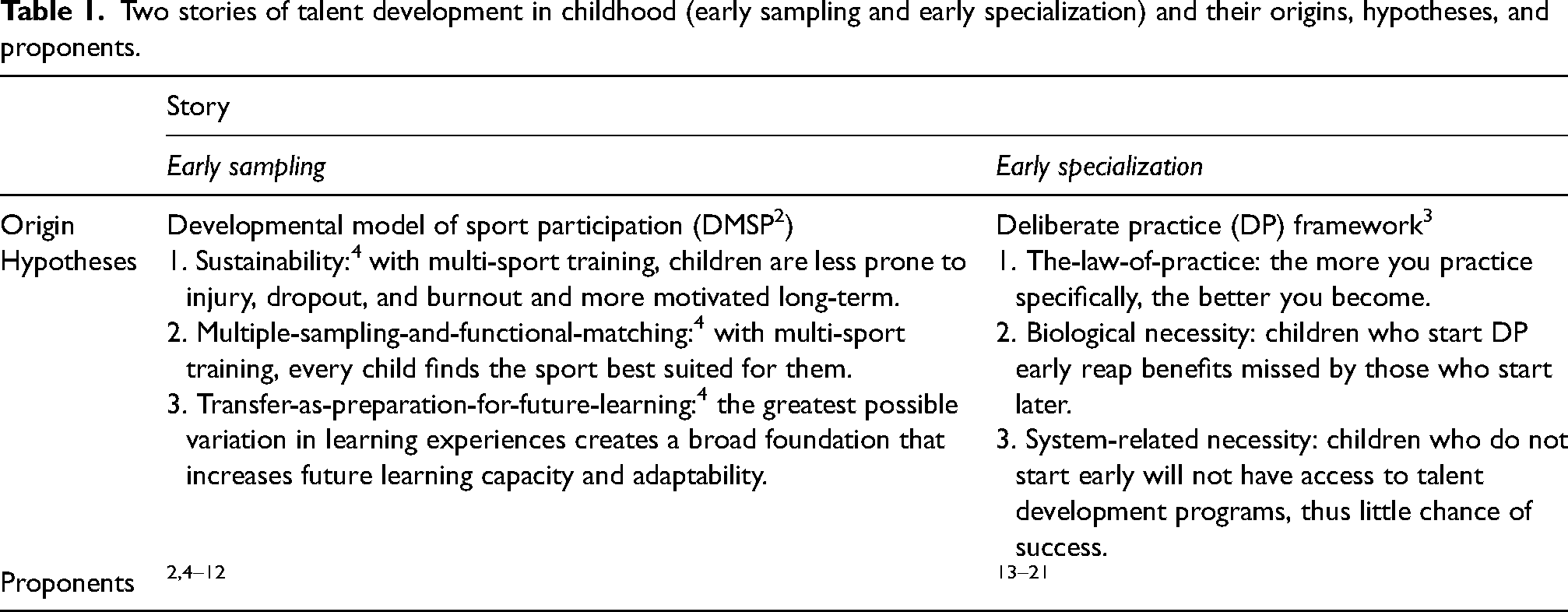
When people believe different stories, conflict results. 22 For instance, proponents of early sampling blame the early specialization approach for jeopardizing positive youth development (PYD) through biopsychosocial health problems, such as injury, 23 burnout, 24 social problems, 25 and compromising long-term, joyful sport participation. 26 In reply, proponents of early specialization point out the lack of evidence for such health problems27,28 and explain such findings with implementation issues, instead of content-related ones. For example, there might be no risk with early specialization per se, and adverse consequences could actually only result from wrongful training methods, implementation, and management. 29 In fact, biopsychosocial health problems might also arise as a potential consequence of the DMSP approach in later career stages: individuals who sampled in childhood have a shorter specialization period spanning from 12 to 18 years (in contrast to 0 to 18 for DP). This condensed timeframe may require them to engage in more demanding training, both in terms of volume and intensity, in order to catch up with those who started earlier. In turn, such endeavor to catch up might increase their risks of injury, burnout, and social isolation.
To sum up, one question captures the debate about early specialization or early sampling pathways: which story—which answer—is better for optimal talent development in childhood?
30
However, an increasing number of dissenting researchers doubt we can reach consensus (see e.g. for swimming,
31
gymnastics,
32
ice hockey,33–35 basketball,
36
and soccer37–39). In response, the present conceptual paper questions the dichotomous—either–or—nature of the proposed choices and introduces an analytical framework. This framework will show that each story provides necessary but insufficient information for theorizing optimal talent development in childhood. Building our analytical framework required restructuring three considerations from current understandings:
Two explicit goals, instead of an unclear mix of three implicit goals Two continuum-based dimensions, not one dichotomous dimension Nomothetic “laws,” group-specific “laws,” and idiographic fine-tuning rather than just nomothetic laws
Theoretical restructuring
Considering two explicit goals instead of an unclear mix of three implicit goals
The dichotomous debate between two stories tends to cover three goals
30
and implicitly expects one story to rule them all:
Performance—success maximization at peak performance age (in adulthood) Personal development in the sense of PYD—self-esteem, social skills, and well-being Participation—attrition versus long-term engagement
However, such expectations can result in conflicting findings and difficulties making informed decisions. Which story should we recommend if one goal is better achieved by the early specialization story, yet the other two goals by the early sampling story? In which order of importance should we rank the three goals? For instance, the DP framework clearly makes recommendations toward one explicit goal—performance—and disregards the other two goals. In contrast, DMSP includes all three goals in its reflections, yet seems to rank the latter two—PYD and participation—higher than performance.
Since DP and DMSP rank goals differently, we argue the problems they investigate are distinctive. Unsurprisingly, the answers they recommend for policymakers are different. Similarly, as different youth sport departments (e.g. elite versus non-elite), researchers, parents, or coaches have varying interests, they probably rank the three goals differently. Although there are plenty of goal-mixing recommendations about what might be best for the child overall,40,41 we are not aware of any study providing clear recommendation for explicitly specified problem.
Our interest lies with stakeholders working in elite youth sport talent development. Their fundamental problem involves leading children through optimal support to international levels, such as earning Olympic medals, at ages of peak performance. 42 Consequently, they prioritize 1 the maximizing performance goal, yet—undoubtedly—must consider PYD for ethical and pedagogical reasons aligned with recent, legitimate discussions.43–45 In contrast, they likely allocate minor importance to the goal of lifelong sport participation (i.e. health promotion and non-elite sports issues for the general population). 42 As such, in elite youth sport talent development, we suggest that only two goals really matter: performance and PYD. 45
Considering two continuum-based dimensions instead of one dichotomous dimension
From one to two dimensions
Four constructs—early specialization, DP, sampling, and play—usually describe training characteristics. Typically, they come in pairs.46,47 For instance, Côté et al. 30 used “the term sampling to define an early environment in sport that included both deliberate play activities and involvement in several sports” (p. 579). Similarly, in their systematic review about “what defines early specialization,” Mosher et al. 48 noted that several authors “suggested it is the type of participation (i.e. deliberate practice) that is a key marker of early specialization” (p. 2). However, criticism emerged against such one-dimensional, “paired” conceptualization because it underestimates the complexity of training realities. 49 For instance, what if children perform only one sport (specialization), yet play that sport frequently, or, inversely, if they perform several sports (sampling), yet they practice deliberately in all of them? In short, such situations call for considering two dimensions instead of just one involving two questions: are children playing or do they practice deliberately and are children collecting experiences in one (specialization) or more sports (sampling)?29,50,51
From dichotomies to continuums
Usually, the four constructs describing training characteristics are understood as (either–or) dichotomies: we speak about sampling versus specialization (cf. titles from23,24) or practice versus play as if pure, clearly separate forms. However, boundaries are blurrier than previously thought; we suggest the presence of continuums (instead of dichotomies) and hybrid, in between forms (instead of a mirage of space between dichotomized constructs). Thus, sampling can be more or less “specialized” and practice more or less “playful.” Such continuum-based conceptualizations respond to Baker et al.'s 52 recent call for rejecting “false dichotomies” (p. 6) to expand the discourse around talent development.
Specialization versus sampling. Accordingly, we advise viewing specialization and sampling as two poles of a continuum. Taking football as example, we believe the combination of football and futsal, football and other invasion games (e.g. basketball), or football and non-games sport (e.g. alpine skiing and artistic gymnastic) does not represent the same kind of sampling but different degrees of specialization.
Practice versus play. We offer the same advice for practice versus play. Instead of thinking of play and practice as dichotomous, we suggest acknowledging infinite nuances between them: children play football on the street with their friends 2 or practice with a playful attitude 53 or deliberately practice specific technical skills with their coaches. 3
Toward a theoretical framework with two continuum-based dimensions
Aligned with such expansive reasoning, Sieghartsleitner et al. 51 deserve credit for three main additions to the discourse. First, they structured the specialize–sample debate with two continuum-based dimensions. On the abscissa in Figure 1, their model considers the dimension “performance orientation”—from play to practice. On the ordinate, it displays the dimension “domain-specificity”—from sampling to specialization. Second, they illustrate that the most popular and scientific contributions to the debate often only address the two extreme poles—low versus high degree of expression in both axes—DMSP 2 versus DP framework. 3 And third, they link a third path to success in adulthood in football 51 and ice hockey 35 : the path of specialized sampling. As depicted in Figure 1, this third path gathers within-sport experiences across the whole spectrum of the performance orientation continuum—play and practice.
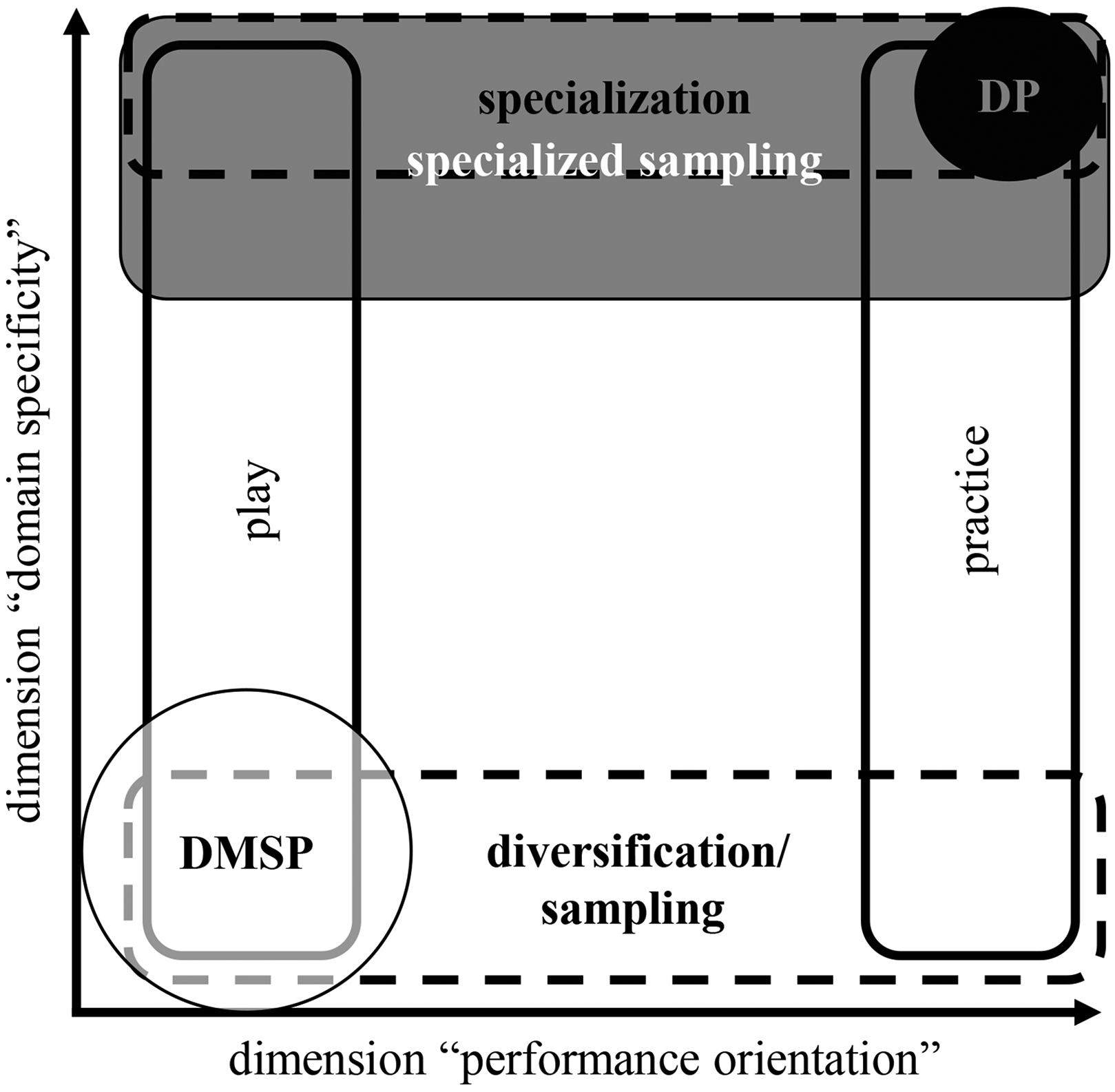
Original two-dimensional model of training approaches in childhood (Sieghartsleitner et al. 51 p. 9). Source: Reprinted with permission from the authors and the publisher Frontiers.
However, fully following the model's two-dimensional continuum-based idea theoretically suggests not three, but infinite, possible paths to success. To fill undefined gaps in the model and provide more orientation, we modified it and expanded its terminology (Figure 2).
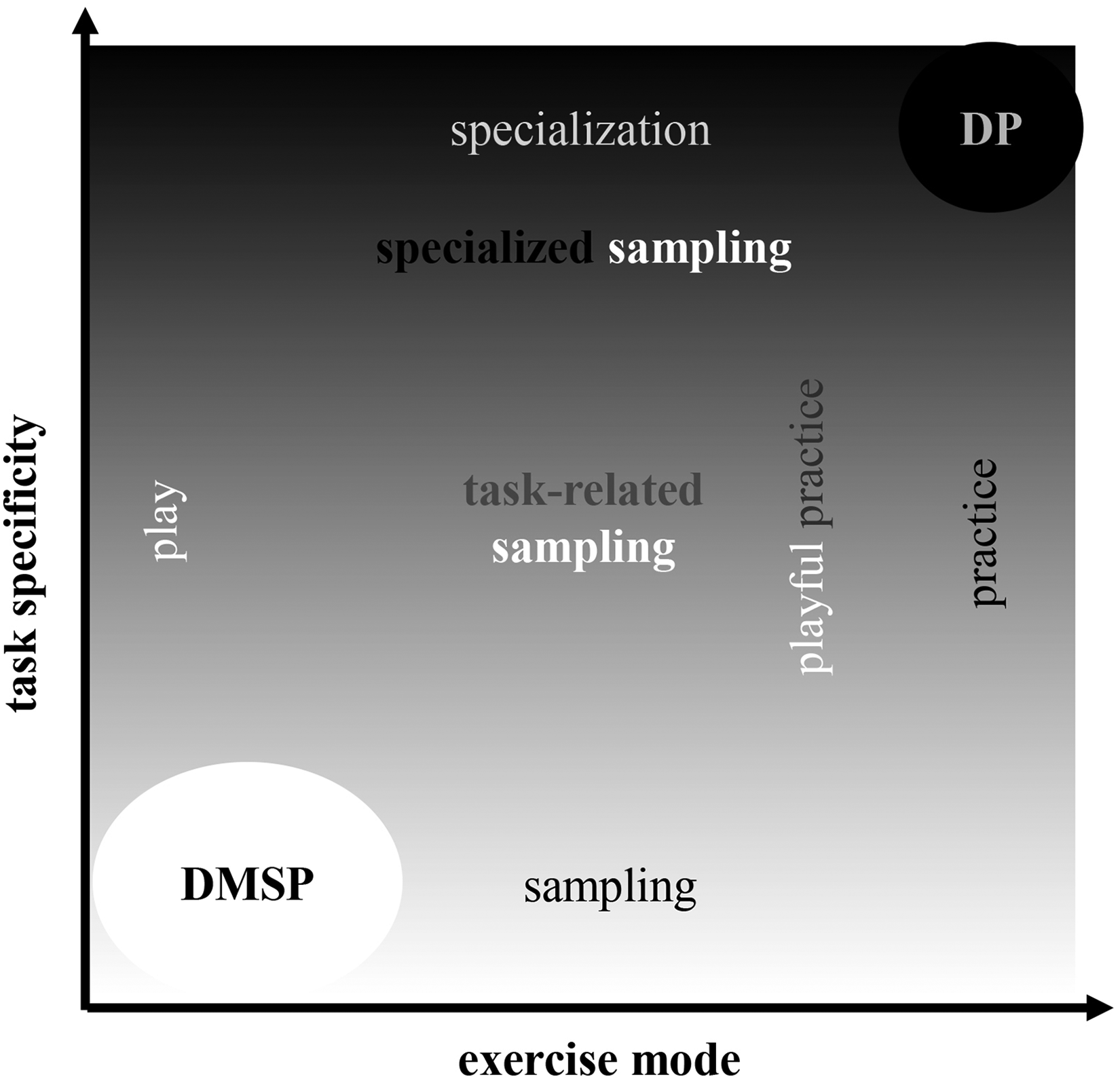
Our modified two-dimensional model of training approaches in childhood.
Task-specificity continuum. Some degree of task-specificity possibly diverges from “specialized sampling” and (any) random sampling—instead corresponding to something in between—suggesting the label “task-related sampling” (Figure 2). Task-related sampling refers to partially diversified training, with several sports within a certain group of sports with some similarities with the targeted sport. In football, basketball, or tennis, it possibly corresponds with ball-related sampling, whereas in artistic gymnastics or figure skating possibly acrobatics-related sampling.
Exercise mode continuum. Similarly, some degree of exercise mode possibly diverges from “play” and “practice”—again corresponding somewhere in between—suggesting the label “playful practice”49,54 (Figure 2). On the one hand, playful practice means learners experience playfulness even when training is more structured, less fun-oriented, and less self-regulated than “play.” On the other hand, learners feel they are practicing to improve, yet the training is more fun-oriented, less structured, and less coach-led and characterized by fewer explicit instructions and feedback compared with the traditional construct of “practice.”
Considering nomothetic laws, group-specific laws, and idiographic fine-tuning instead of only nomothetic laws
Waldron et al. 41 critically reviewed and summarized different position statements from several major medical organizations regarding early specialization. For instance, the American Medical Society for Sports Medicine (AMSSM) concluded “early sport specialisation may not lead to long-term success in sports, and may increase risk for overuse injury and burnout” 40 (p. 12) and the American Academy of Pediatrics posited “young athletes who specialize too soon are at risk of physical, emotional, and social problems” 25 (p. 5). Similarly, when asked “what makes a champion?,” Güllich et al. 4 responded “early multidisciplinary practice, not early specialization” (p. 6). These position statements are nomothetic—unspecific to situations or people, yet concerning everyone—supposing all children and all sports function the same and encapsulating one-size-fits-all expectations regarding PYD and performance goals. As such, like most contributions to the sample-or-specialize discussion (see26,41,55–57), they reduce a complex debate into a simple, tendentious dichotomy of “specialization is bad, sampling is good” for everyone. 58 However, nomothetic perspectives are insufficient for understanding an individual's development. 59 In the developmental sciences, three kinds of “laws” (or perspectives)—nomothetic, group-specific, and idiographic—are established for understanding human development. They trace back to Kluckhohn and Murray's 60 (1948) insight that “all people are like all other people, all people are like some other people, and each person is like no other person” (cited by Lerner, 61 p. 7).
Nomothetic perspective is an appropriate starting point for generating general guidelines. However, since each sport has unique training and competition requirement profiles and different cultures 62 and each athlete has unique characteristics, such as genotypes, environmental characteristics, and phenotypes, 63 seeking only an absolute, nomothetic winner story is designed to fail, such as contending training A is better than training B for all people.
Ideally, group-specific laws—with goals, sports, and ages considered and defined—complement nomothetic laws. For example, training A is better than training B for group C. Initial group-specific analytical attempts exist, yet remain rare and incomplete. For instance, researchers considered training content in relation to sport-specificity and compared different sport category types, yet disregarded age-specificity.4,64 Conversely, others considered age-specificity in theoretical models, such as the Youth Physical Development (YPD) model (see44,65–67), yet omitted sport-dependent adjustment recommendations. In brief, we need more precise developmental theoretical guidelines combining sport- and age-specificity.
Finally, while nomothetic and group-specific recommendations provide a big picture, idiographic fine-tuning—adjusting to individual biopsychosocial characteristics—accommodates details. The International Olympic Committee (IOC) consensus 68 stresses “youth athlete development is contingent on an individually unique and constantly changing base of normal physical growth, biological maturation and behavioral development, and therefore it must be considered individually” (p. 8). However, how to apply idiographic fine-tuning remains unknown.
The 2 × 2 × 3 questions cuboid
We started with a two-sided coin toss to answer only one question: is the “sampling and playing” or “specializing and deliberate practice”, story better? The question reflects the traditional goal-mixing, one-dimensional, dichotomized, nomothetic, either–or thinking from current talent development discourse. However, our considerations demonstrate a substantial “unit of analysis” change. It seems we actually deal with a complex 2 × 2 × 3 question cuboid 2 (Figure 3) made of two explicit main goals for talent development, two continuum-based dimensions, and three perspectives.
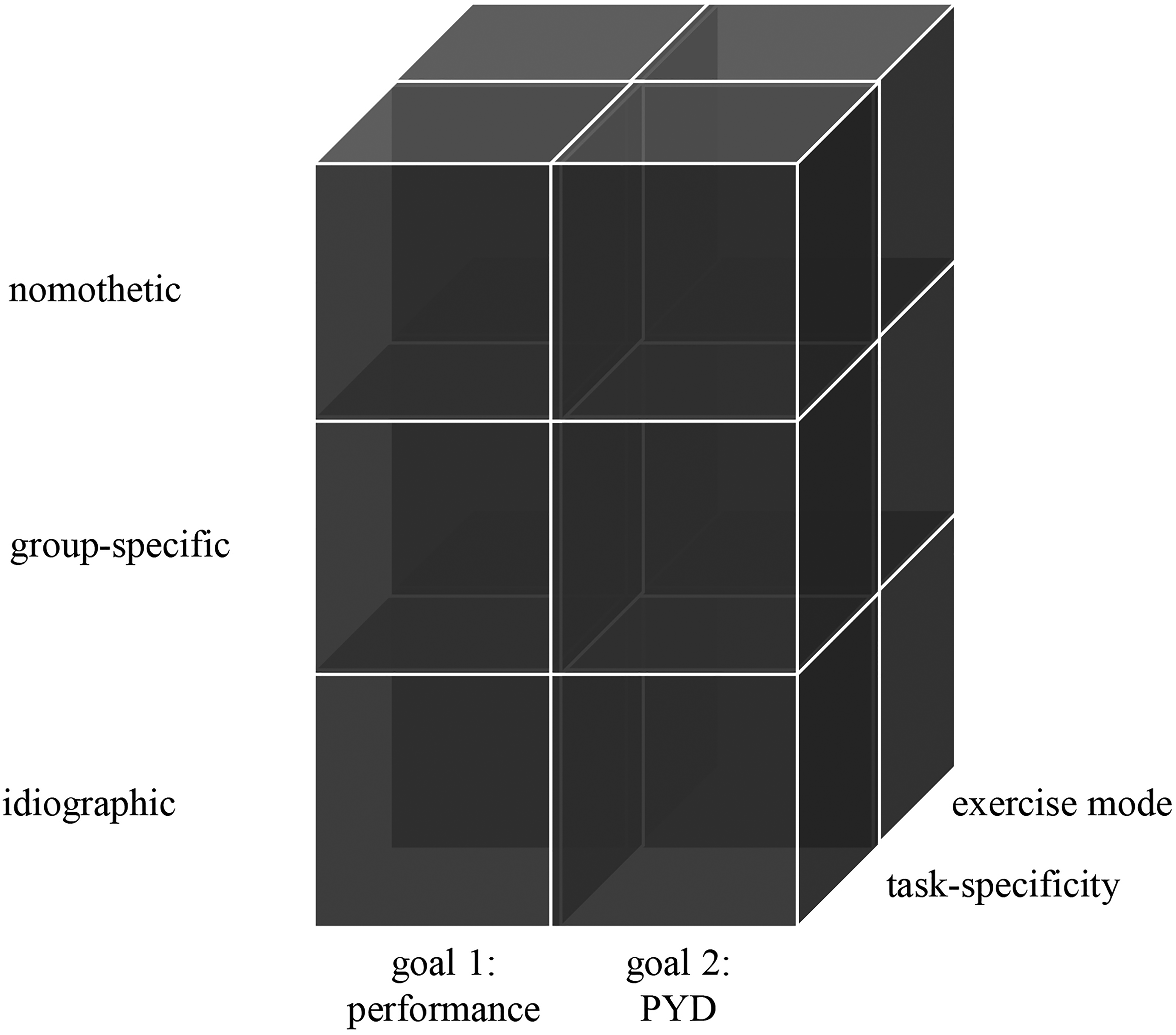
The 2 × 2 × 3 question cuboid of optimal training in childhood within the context of talent development (PYD: positive youth development).
Taken together, 12 questions emerge across nomothetic, group-specific, and idiographic perspectives.
Nomothetic perspective
What degree of task-specificity leads to maximum success at peak performance age?
What degree of exercise mode leads to maximum success at peak performance age?
What degree of task-specificity leads to PYD?
What degree of exercise mode leads to PYD?
Group-specific perspective
What degree of task-specificity leads to maximum success at peak performance age given the “type of sport” and “age” group-specific characteristics?
What degree of exercise mode leads to maximum success at peak performance age given the “type of sport” and “age” group-specific characteristics?
What degree of task-specificity leads to PYD given the “type of sport” and “age” group-specific characteristics?
What degree of exercise mode leads to PYD given the “type of sport” and “age” group-specific characteristics?
Idiographic perspective
What degree of task-specificity leads to maximum success at peak performance age given the group-specific characteristics and the child's biopsychosocial situation?
What degree of exercise mode leads to maximum success at peak performance age given the group-specific characteristics and the child's biopsychosocial situation?
What degree of task-specificity leads to PYD given the group-specific characteristics and the child's biopsychosocial situation?
What degree of exercise mode leads to PYD given the group-specific characteristics and the child's biopsychosocial situation?
When determining an individual's optimal training, we must assemble all answers from the 12 questions. Next, we analyze each perspective to uncover such answers.
Nomothetic perspective
Nomothetic laws are interindividual commonalities generalized for all humanity 69 (for developmental sciences, see Lerner and Lerner 63 ). From our standpoint, we present nomothetic principles most relevant—without claiming completeness—to answer questions 1 to 4. The principles serve orienting purposes to understand what circumstances alter task-specificity and exercise mode.
Goal 1: Performance
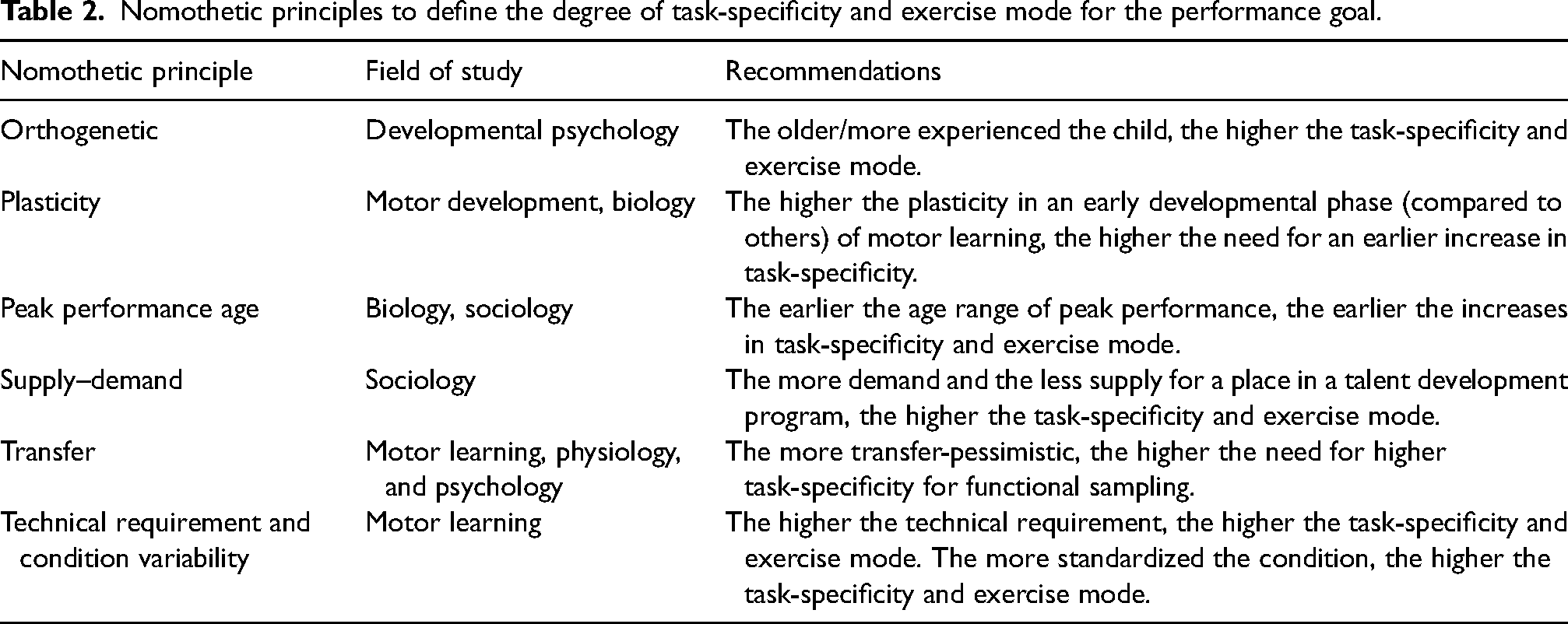
For the performance goal, we identified six principles from multidisciplinary literature (Table 2).
Nomothetic principles to define the degree of task-specificity and exercise mode for the performance goal.
The orthogenetic principle
The orthogenetic principle applies to any variable regarded as developing, such as training. 70 Formulated over 60 years ago by Werner, 71 it stipulates “whenever development occurs, it involves changes from globality to differentiation” 63 (p. 65). In alignment, YPD prescribes changes from globality to differentiation on both the task-specificity—from global fundamental motor skills to more differentiated sport-specific skills—and exercise mode continuums, from unstructured to structured approach, as a function of age. The older or more experienced the child, the higher the task-specificity and exercise mode.66,67
The plasticity principle
Humans can change—they are plastic 72 —and must change to reach certain task levels. Researchers analyzing human plasticity investigate questions, such as how do specific experiences modify our brain circuits; does the timing of experiences—too early or late in life—matter for ultimate attainment; and do critical or sensitive period exist where plasticity heightens? Different research paradigms—the deprivation paradigm (e.g. feral children 73 ) and the impoverished and enriched environment paradigm—shed light on how we change and develop with no, low-, or high-quality environmental input at given developmental times. 74 For instance, can we walk or talk “normally” as adults if we are only exposed to animal habits or confined in a small room deprived of human contact until a certain age, 73 can we reach language proficiency in adulthood with little or no exposure to specific language training until a certain age, 75 and can we reach musical proficiency, such as absolute pitch, with little or no exposure to musical training until a certain age? 76 Similarly, sport science asks whether we can reach sport or motor proficiency with little or no exposure to task-specific and performance-oriented training until a certain age. On some levels, the aformentioned question capture the essence of the specialize–sample debate.
Regarding plasticity of motor skills, the sensitive period hypothesis suggests the central nervous system matures at an accelerated rate—implying heightened neural plasticity—during childhood. Lloyd et al. 77 described “a non-linear decrease in the volume of gray matter in the brain with age, especially after the onset of puberty as the process of synaptic pruning takes place, thus making the ability to learn new motor skills more challenging as children become older” (p. 107). If the sensitive period hypothesis is true—which does not seem to be the case for sport-related movement acquisition so far—78,79 an early increase in task-specificity may be neurologically necessary for some sports. In other words, starting learning too late is a risk, especially if the goal is an Olympic medal. Such risks are not isolated cases in the fields of animal and human development. For instance, “a number of sensitive periods seem to end as animals approach sexual maturity for example, heightened plasticity in the sound localization pathway in barn owls, song learning in some songbirds, and certain aspects of language learning in humans decline as juveniles approach adulthood” 80 (p. 1419). Until proven otherwise, if the fields of language 81 and musical learning 76 are somewhat affected by such a phenomenon, why should motor learning be an exception? Thus, the higher the plasticity in an early developmental phase (compared with others), the higher the need for an earlier increase in task-specificity.
Interestingly, in current neurosciences discourse, Anderson and Mayo 82 noted, “the question shifted from whether sensitive periods exist to what process opens them, keeps them open, closes them, and allows them to reopen” (p. 224). As such, some “windows” may only open later in life or remain widely open lifelong, reducing the necessity of high task-specificity in early childhood. For instance, with regard to the plasticity of functional capacities, such as endurance,83,84 the trigger hypothesis 85 claims plasticity is reduced among children compared with adults. If true—depending on the authors, we are either close 83 or far from it 86 —an early increase in task-specificity is possibly physiologically pointless in certain sports; starting too early results in no gain. In alignment, the YPD model recognizes specific training for certain functional capacities can occur after childhood. 66 Thus, the lower the plasticity in an early developmental phase (compared with others), the later the need for an increase in task-specificity.
The peak performance age principle
The question of when to start task-specific and performance-oriented training depends on the age of peak performance minus the years needed to build corresponding expertise. If two sports demand an equal amount of training years to attain expertise, it can be inferred that the sport with the lower peak performance age would necessitate an earlier starting age. Thus, the earlier the age range of peak performance, the earlier the increases in task-specificity and exercise mode. 57
The supply–demand principle
Generally, the lower the availability of an object and the higher the demand, the higher the price to pay—a principle that does not apply differently when the object is a place in a talent development program. Since performing well in the short-term is crucial for selection, the fewer places offered within a system and the higher the number of applicants—from sport popularity or selection pressure—the more required the task-specificity and exercise mode.35,87
The transfer principle
Motor learning is always based on previous experiences and thus, to some extent, on transfer effects. 88 The two extremes (DMSP versus DP) differ in their position on the continuum of task-specificity (low versus high) because of their different understandings of transfer—the former approach seems highly transfer-optimistic,4,26 while the latter seems rather transfer-pessimistic.3,20 A transfer-optimistic approach assumes “the benefit of other-sports practice is not moderated by the degree of relatedness of the other sports with one's main sport” 4 (p. 17). Presupposing every (random) sporting experience counts and helps future learning capacity (and better career outcomes), it follows children should sample as broadly as they can during childhood. A transfer-pessimistic approach refers to Henry's specificity hypothesis 89 ; it suggests transfer effects are so small they can be neglected. 90 Such a hypothesis implies children should train in highly specialized manners for later success.
Since recent literature reviews give no clear-cut answers prioritizing either transfer-optimistic or transfer-pessimistic approaches,91,92 we now speculate on a range of transfer opportunities using the century-old, yet still well-recognized, law of identical elements. 93 The law of identical elements considers each sports-related movement metaphorically as a kind of a building constructed from fundamental elements—also called modules.94–97 The law of identical elements expects transfer if the same elements are found and trained in two buildings or sports-related movements, such as serving in volleyball and tennis. If not the case, no transfer occurs, such as no overlap from the modular architecture of road cycling and javelin throwing. At its core, the law challenges the idea of every movement experience as useful by seeing “functional sampling” as the only kind of sampling to facilitate the performance goal, such as sport with the degree of congruence with sporting tasks in the main sport or “donor sports.” 98
Since physiological capabilities, such as the “aerobic capacity” element, seem trainable more unspecifically in many sports (e.g. cross-country skiing, road cycling, track and field, soccer, basketball, and tennis), 99 their opportunities for functional sampling are possibly wider, suggesting endurance-based sports more transfer-optimistic. Inversely, technical skills, such as the “serving in tennis” element, are likely trained in more task-specific situations,88,89 implying more transfer pessimism, suggesting sports with high technical requirements need higher task-specificity in order for sampling to be functional, that is, at least task-related or specialized sampling. 98 Thus, the more transfer-pessimistic, the higher the need for higher task-specificity.
The technical requirement and condition variability principle
Just like for language learning, sport requires play and practice, so individuals who only learn by playing never fully master specific intricacies, such as sport-specific movement execution. In contrast, individuals who only practice specific movements, such as only 13-m goal kicks in football, encounter difficulties activating and applying their knowledge in diverse game contexts. 88 However, the importance placed on play or practice varies depending on specific aspects, such as the technical requirements specific to each sport, which can range from low to high, and the variability of conditions in each sport, which can range from standardized to variable.
It seems plausible to assume that the higher the technical requirements of a sport, the more required the practice. Contrastingly, a stronger focus on play may fit more variable conditions. 88 Thus, if a sport possesses a high degree of expression for only one of two aspects, a particular focus on play or practice possibly dominates. For instance, artistic gymnastics is characterized by high technical requirements under standardized conditions (low variability), 100 suggesting a focus on practice. Conversely, alpine skiing might be characterized by relatively lower technical requirements, but it takes place under constantly changing conditions (high variability), suggesting a greater focus on play compared to aristic gymnastics. 101 If a sport possesses a high degree of expression for two aspects, a focus remains undetermined (e.g. ice hockey 35 or football 51 ), suggesting specialized sampling as depicted in Figure 1. Finally, if a sport shows low expression for both factors (e.g. bobsleigh), no focus is necessary. In this case, based on diversity principle (see below), we suggest play rather than practicing deliberately.
Goal 2: PYD
Regarding the goal of PYD, we identified two principles from the literature; we named them diversity principle and implementation principle. The former suggests what degree of task-specificity and exercise mode is preferable for PYD. If implemented, the latter suggests how each theoretically possible degree of task-specificity and exercise mode facilitate or hinder PYD.
The diversity principle
In Baker et al.'s 58 foundational paper, they reported “since 2017, there have been three systematic reviews and 10 narrative reviews/editorials about the negative implications of specialization in sport” (p. 179). So, the scientific community seems to have converging opinions about what is better for children's biopsychosocial health. The lower the exercise mode and task-specificity, the more diverse the training approach and the lower the risk of jeopardizing the goal of PYD. 40 Simply put, diversity over monotony is preferred.
On the task-specificity continuum, when moving from bottom (low) to top (high), the range of experiences becomes narrower and thus less diverse and more prone to monotony. More specifically, the range of opportunities for an open future and diversified athletic identity becomes narrower, 102 risk for overload injury increases from lack of biomechanical diversity, 23 and risk of burnout increases from lack of psychological diversity. 24 Therefore, as task-specificity increases, the risks of neglecting important aspects of PYD also increase. On the exercise mode continuum, practice is less diverse than play; it is more serious, coach-led, repetitive, goal-directed, and intensive and, thus, the kind of training where children are likely stressed, pressured, criticized, or deprived of autonomous choice 103 —in other words, possibly negatively impacting PYD.30,104 Such reasoning increases awareness of valid arguments regarding probabilities of negative or positive consequences as functions of early sport specialization, sampling, play, and practice. However, Baker et al. 58 warn the scientific community by asking a ground-breaking question: “is it too early to condemn early sport specialization?” (p. 179). In response, we contend it is premature because of the implementation principle.
The implementation principle
The labels “early specialization,” “sampling,” “practice,” and “play” have no fixed implementation. Under all degrees of task-specificity and exercise mode, the training can be delivered in ways that are better (or worse) than others to promote physical and psychosocial health. 58
Risks of negative physical consequences surely differs if coaches treat children as “miniature adults” or as children, 105 if they plan training based on short- or long-term success expectations, if they integrate aspects related to injury prevention programs or not, 56 and if they adapt training load according to experience or maturity or not.56,106–110
Risks of negative psychosocial consequences also surely differ according to psychosocial context. According to Vallerand and Losiers's motivational sequence, 111 the social microsystem involved in training and evaluating the performance acts on basic psychological needs for competence, autonomy, and relatedness, 112 which then influences one's intrinsic motivation and leads to different consequences, such as well-being, dropout, and burnout. Accordingly, it definitely matters whether “unsupervised play” takes place with same age peers, younger or older children, or with or without bullies. Similarly, different coaching styles during coach-led deliberate practice, such as controlling or autonomy-supportive; 113 different motivational climates, such as ego- or task-oriented;114,115 and different pedagogical approaches, such as with or without self-concept promoting teaching principles,116,117 represent different contexts, which impact children's basic psychological needs, motivations, and thus PYD differently. 118
Thus, although some correlation between a specific label and risk for PYD is possible, the correlation is likely weak. In fact, correlation is likely spurious, resulting from the fact that unfavorable implementations occur more frequently—yet not necessarily—in training contexts characterized by both high degree of exercise mode and task-specificity. So, blaming a given degree of task-specificity and exercise mode by defining it with a good or bad fixed implementation is inappropriate. Consequently, we suggest researchers reflect upon what kinds of early specialization are “healthier,” sampling “unhealthier,” practice “healthier,” and play “unhealthier” than others. When considering such possible nuances, we agree with Baker et al. 58 : it remains unclear whether the risk of early specialization and the protective value of early sampling are as high as usually claimed. Therefore, as Lerner et al. 119 stated, “scholars, practitioners, and policy makers may always remain optimistic about finding some intervention to reduce problem behaviours” (p. 12).
Group-specific perspective
In the previous section, we highlighted nomothetic principles steering the degree of expression of each dimension either downward or upward. However, in view of the goal of performance, different sports and ages possibly possess different properties regarding orthogenetic development, plasticity-related situations, peak performance ages, supply–demand constellations, transfer opportunities, reliance on technical requirements, and condition variability. For instance, peak performance ages possibly differ between cgs and artistic composition sports, and plasticity-related situations likely also differ for children aged 3 or 11 years. In view of PYD-goal, distinctive sport and age differences regarding inherent diversity potential and implementing training content exist. For instance, ranges of within-sport opportunities for diversity are probably narrower for 100-m sprint compared with ice hockey and narrower for children aged 3 or 11 years. Similarly, regarding typical training implementation, various factors such as age (e.g. age-related biopsychosocial stress resistance) and cultural sport differences play a role. For example, freestyle skiing may appear to be more autonomy-supportive, while artistic gymnastics and figure skating may have a more traditional and controlling atmosphere.120,121 Thus, it makes sense to look for a group-specific theoretical guideline—a guideline considering sport- and age-specificity. To our knowledge, no such guideline exists. Therefore, as texture to complement our theoretical contribution, we reached out to sport federations to seek their perspective on this issue: where do they position themselves in Figure 2 across various age groups? This question relates to questions 5 and 6 mentioned in the cuboid—what degrees of task-specificity and exercise mode lead to maximum success at peak performance age given the group-specific characteristics, “type of sport,” and “age”? Additionally, we investigated how such degrees are possibly problematic regarding PYD (questions 7 and 8). Please note that our interest lies primarily in the positions of sport federations, not in the voices of individual participants. Thus, we see our contribution as theoretical enriched with empirical supplements, not an empirical contribution.
Perspective of sport federations
Participants: between February and April 2022, we interviewed chairs of youth elite sports from 11 sports federations in Switzerland. We aimed to cover different groups of sports occupying central roles in the debate4,64—cgs sports, games sports, and artistic composition sports (Table 3). As leaders within their respective sports federations, our interviewees hold the responsibility of shaping talent development concepts and embody the perspective of their federation.
Sports federation experts interviewed sport categories.

Data collection and analysis: Each interview lasted ∼90 min. The interviews were conducted, analyzed, and critically discussed with explicit reference to Sieghartsleitner et al.'s 51 (2018) model (Figure 1) as part of a post-graduate course that we supervised on the “sampling versus early specialization” topic. The post-graduate course included nine students, spanned 12 weeks from February to June 2022, with weekly meetings of four discussion hours each. In June 2022, we presented our results on sport- and age-specific positions within Figure 2 at a national symposium jointly organized by Swiss Olympic and the University of Bern. The symposium brought together 70 key stakeholders from elite sport in Switzerland, including around 40 chairs of youth elite sports from different sports federations. After the results presentation, the symposium participants were divided into three workshop groups corresponding to their area of expertise: cgs, games, and artistic composition sports (as shown in Table 3). These workshop groups allowed for critical expert discussions (45 min), enabling us to triangulate diverse perspectives and seek consensus on the findings. The original positions remained largely unchanged after the workshops, indicating validation by the community.
Member check: We presented our results to our 11 interviewees three times to ensure communicative validation and trustworthiness of the findings.122,123 Firstly, we contacted the interviewees by telephone two weeks before the symposium in May 2022 to address any uncertainties in interpretation. Secondly, during the expert workshops in June 2022, the interviewees had the opportunity to share their expertise and make any necessary modifications to the results after discussing with other chairs of youth development. Lastly, in September 2022, we sent the results to the interviewees for their final consent and validation. All interviewees provided written informed consent for their participation.
Overview
Figure 4 displays the positions specific to each sport and age group. The positions are shown in three separate graphs, one for each sport group. The colors in the graphs represent the time axis, with darker colors indicating older children. Regarding performance goal, almost all specifications between DP and DMSP appear to be success-promoting (Figure 4), yet neither DP nor DMSP is applied in pure form from starting age (at least) until the end of childhood. There is a vacuum in the bottom right part of the model, suggesting high exercise mode with low task-specificity as an unfavorable or nonsensical strategy in all sports and ages. Regarding the PYD-goal, our interviewees reported biopsychosocial problems as more frequent in sports and ages with higher degrees of task-specificity and exercise mode compared with lower ones. They also indicated a lack of age- and sport-specific information regarding kinds of training implementation, which possibly helps mitigate or eliminate such problems.
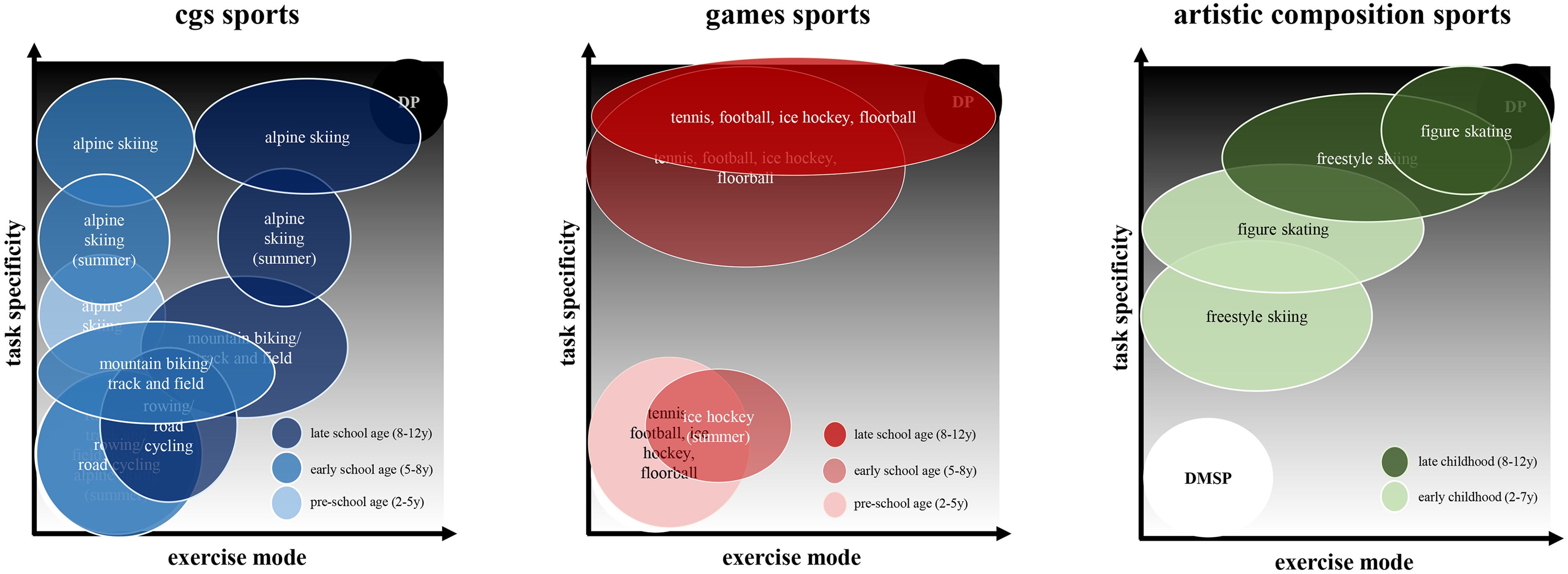
Group-specific perspective on the question of optimal degree of task-specificity and exercise mode according to age and sport from the point of view of the heads of national youth development of selected Swiss sport federations.
Cgs sports
With the exception of alpine skiing, cgs sports possess a slower orthogenetic tempo: they remain at lower levels of task-specificity and exercise mode for an extended period of time. The lower the technical–coordinative demands of the sport considered, the more pronounced the trend seems—for example, the lower position for road cycling compared with mountain cycling. Since cgs sports are often primarily determined by functional capacities, their (relatively lower) age-specific positions on the task-specificity continuum compared with the other sport groups are possibly explained by (supposedly) lower plasticity-related properties in early childhood and/or more transfer-optimistic view and/or more worries to guarantee PYD from inherent lower diversity potential. Relatively lower age-specific positions of cgs sports on the exercise mode continuum are possibly explained by their low expression on both factors of the technical requirements and condition variability principle—meaning no focus between play and practice is necessary. For this reason and considering the diversity principle, children should preferably play.
Game and artistic composition sports
For both game sports and artistic composition sports, faster orthogenetic tempo and higher positions in both dimensions at earlier ages were considered necessary. More specifically, considering factors such as high technical requirements, plasticity potential, peak performance age, and supply–demand ratio, experts in game and artistic composition sports recommended prioritizing experiences including transferable elements in early training stages, such as ball-related and acrobatic-related experiences, respectively. Such a “higher” starting position on the continuum (task-related sampling on Figure 2) is then rapidly followed with a move toward specialized sampling. Accordingly, experts in game sports, artistic composition sports, and alpine skiing tend to lean toward a transfer-pessimistic viewpoint, and this pessimism seems to increase as children mature.
The relatively high age-specific position of artistic composition sports on the exercise mode continuum can be attributed to their high technical requirements and standardized condition variability. Small differences between figure skating and freestyle skiing are possibly attributed to differences in condition variability, with freestyle skiing being less standardized. In contrast, game sports score high on technical requirement and condition variability factors from their complex and unpredictable nature. Consequently, interviewees positioned game sports across the entire range of the exercise mode continuum (implying undetermined focus).
Idiographic perspective
So far, we based the group-specific recipe—for pragmatic reasons—on a homogeneity assumption: Figure 4 displays the success paths of a hypothetical, interchangeable individual with a given age in a given sport. However, individuals are not interchangeable members of a single age- or group-specific class—they are not structurally and functionally equivalent machines devoid of individuality. 124 On the contrary, each person possesses different genetic, 125 biological, 126 psychological, 127 and sociological 128 profiles and thus different probabilities for experiencing negative or positive consequences if they find themselves in specialized, sampling, practice- or play-oriented settings during childhood. As a result, idiographic adjustments of group-specific perspective seem necessary. To our knowledge, only Hohmann et al. 129 discussed the individually fine-tuned relationship between specialization and diversification in youth training. They highlighted the dual dependence of this relationship, considering both the sport's versatility and the individual's athletic versatility. Due to the limited guidance available for researchers and practitioners in compiling information into individualized programs of optimal training for a specific individual, we discuss some issues next.
In principle, to achieve success at peak performance age, increases of task-specificity and exercise mode occur as early as necessary. However, risks associated with delayed task-specificity and exercise mode may be—at least to some extent—compensated (or aggravated) by other factors. For instance, children differ in their plasticity for genetic, 130 biological, 131 or experience-related reasons.78,132 Thus, some can start later or train differently to reach the same future performance levels. Furthermore, training content during childhood is not the only predictor of future success. Other dimensions of the “talent” phenomenon increase or decrease chances for future professional careers,133,134 such as psychological characteristics135,136 or family support.137,138
Similarly, and in principle, to promote PYD, increases of task-specificity and exercise mode training occur as late as possible. However, risks associated with high task-specificity and exercise mode may be—at least to some extent—compensated (or aggravated) by other factors, such as functional and dysfunctional factors for talent development. 139 For instance, “athletes’ entourages […] matter in a variety of ways in athletes’ socialization toward refraining from risking their health in pursuit of greater achievement and outstanding performance” (p. 1). 140 Children specializing in one sport with parents with a background in pedagogy and coaches with jobs independent of short-term success possibly possess lower risk for biopsychosocial problems than children sampling different sports with parents and coaches pushing for short-term success. Furthermore, despite early specialization criticism as “too narrow”26,30 and sampling praised for its breadth, 11 not all children react identically to “narrower” developmental opportunities or react negatively. For instance, a minority of children appears to know their preferences early on. 141 Such children do not feel emotionally disturbed if they specialize instead of being “forced to” experience a wide range of activities. 142 In fact, a narrow focus on their passion possibly satisfies their basic needs for autonomy and increases their DP motivation.143,144 Similarly, if children with strong perfectionist tendencies diversify training too much, they perhaps become good at many sports but not very good at any of them, which possibly jeopardizes basic needs for competence and leads to negative emotions, such as frustration. 111 Such scenarios align with the IOC consensus statement, which states “Appropriate diversity and variability of athletic exposure within a single sport […] can be acceptable and healthy, so long as the youth athlete is enjoying and benefitting fully from the experience” (p. 8). 68 It follows some children need more play or more sampling than others to experience their sporting career as meaningful and motivating. Accordingly, the challenge is to find what specific training approach in what specific context at what specific times in the life span affects what specific outcomes for what specific individuals. 145
Conclusion
Our conceptual work followed two steps. First, the starting point began with a popular question: should children specialize in one sport and train systematically in it—early specialization—rather than gain different playful experiences in several sports—early sampling? So far, researchers disagree on the best answer; the disagreement mainly emanated from one-dimensional, goal-mixing, either–or dichotomic, one-size-fits-all thinking. Second, after elaborating about the need for a new, non-dogmatic approach—a two-dimensional, goal-oriented, non-dichotomous, continuum-based, multi-perspectivist view—we introduced and discussed the 2×2×3 question cuboid. Our analysis suggests three recommendations for future research related to goal-oriented thinking, non-dichotomous and two-dimensional thinking, and nomothetic, group-specific, and idiographic thinking.
Goal-oriented thinking or ranking different goals in different orders of importance means dealing with different problems. Since different problems require different solutions, future studies should state explicitly what goal interests them and what kind of problem they investigate precisely. In talent development, two goals are deemed relevant: performance and PYD.
Non-dichotomous and two-dimensional thinking responds to a recent call from Baker et al. 52 for distancing from the “focus on false dichotomies” (p. 6) and needing to openly and critically challenge existing approaches” (p. 7). We addressed the need by strengthening the idea of two dimensions (task-specificity and exercise mode), not one, and the idea of continuums (random sampling, task-related sampling, specialized sampling, specialization; play, playful practice, practice), not pure dichotomies. We suggest future studies investigate how to objectively define each continuum position.
Nomothetic, group-specific, and idiographic thinking highlighted 12 questions in the debate. From a nomothetic perspective, six performance-oriented (orthogenetic, plasticity, peak performance age, supply–demand, transfer, and technical requirement and condition variability) and two PYD-oriented principles (diversity and implementation) guide understandings about what is generally better for all. Nomothetic principles need to be re-evaluated according to group-specific characteristic—such as answers to questions like what is best in a given sport at a given age—and according to idiographic characteristics, such as what is best for a specific individual.
We recommend future studies investigate our conceptual analysis and address the lack of research in several areas of the 2 × 2 × 3 question cuboid, such as developing the body of knowledge about the three perspectives, two dimensions, and two goals, validating our proposal of sport- and age-specific localization within our adapted model and extending it to other sports, and considering other group-specific aspects modulating such localization. For example, since supply–demand ratio possibly differs between same-aged boys and girls in some sports such as football, 146 add sex-specific aspects. Similarly, since sport characteristics, such as technical requirements, peak performance ages, or supply–demand characteristics, likely change over time from technological innovations or political decisions, consider cohort-specific aspects. Future studies might also consider creating a roadmap for idiographic fine-tuning, 129 for instance, with the help of a person-oriented approach. 147 Such methodological approach helps identify a type of person—with particular biopsychosocial and training characteristics—as more likely to develop on low-, moderate-, or high-risk paths for biopsychosocial health problems and/or (non-)achievement of performance-related goals. 148
Finally, we suspect a 13th question remains—one we purposely unattended, yet should be addressed in the future. Are goals one (performance) and two (PYD) always compatible or perhaps somewhat limited by a trade-off? In other words, does maximizing one goal only happen at the expense of another? If divergent answers emerge, thinking about goal prioritizing and sequencing is essential: if we seek international success, what costs are we ready to let children pay for 41 ? If risking PYD appears necessary in some sports to maximize success probabilities, yet societally, medically, and ethically unacceptable, should our political system promote such a sport at all?
Footnotes
Acknowledgements
The authors thank (a) Swiss Olympic for their support organizing the symposium; (b) interviewees for their expertise and their time; (c) participants in the Master of Science seminar (Valentin Berra, Manuel Burger, Jasmin Hermann, Julia Hernandez, Nina Kaczmarek, David Kurz, Dario Querciagrossa, Yannik Schürch, and Jonas Siegrist) for their input and cooperation in the empirical illustration; (d) Merlin Örencik, Michael Schmid, and Ernst-Joachim Hossner for their helpful comments on an earlier draft of the manuscript; and (e) Kristin Marie Bivens for her editing work and guidance on our manuscript.
Author contributions
All authors substantially, directly, and intellectually contributed to the work and approved it before publication.
Declaration of conflicting interests
The authors declared no potential conflicts of interest with respect to the research, authorship, and/or publication of this article.
Funding
The authors received no financial support for the research, authorship, and/or publication of this article.
