




Abstract
Transformational leadership has been presented as a tool for coaches to foster positive youth development. One component of this concept is individualized consideration (IC), where leaders show care through supporting their followers’ individual needs. Examining the unique context of minor hockey will provide a more nuanced and complex description of IC. Therefore, the purpose of this study is to demonstrate how minor hockey coaches consider individual differences and tailor their practice to athletes’ needs. Semi-structured qualitative interviews were conducted with 10 male minor hockey coaches whose teams consisted of 9- to 13-year-old, predominantly male, athletes. Findings show these coaches demonstrated the use of IC through three steps (a) gathering information about their athletes (e.g. engaging in interactions), (b) assessing individual needs (e.g. developmental) and (c) acting to support IC (e.g. adjusting coaching practices). Findings suggest (a) IC can be implemented to support basic and more complex needs of athletes, (b) IC can be implemented with teams of athletes and (c) the context of minor hockey is constraining the implementation of IC.
Youth sport is a context that can promote positive youth development (PYD), with coaches being a key agent for positive development.1–3 Transformational leadership (TFL) has been presented as a tool for fostering PYD and has been examined within the youth sport context.4,5 Thus, exploring coaches’ understanding of TFL and how coaches implement this concept would bridge the research to practice gap in youth sport coaching.
The full-range leadership model explains the spectrum of leadership styles and presents three types of leadership: laissez-faire, transactional and TFL. 6 Each of these styles can be situated on two continuums, active-passive and effective-ineffective. Laissez-faire leadership is seen as passive and ineffective within the continuum. 6 Laissez-faire youth sport coaching strategies can include an absence of leadership or not showing interest in athletes. 7 Transactional leadership is more active and effective when responding to the behaviours of followers, however, is contingent on a specific behaviour. 6 This type of leadership can be seen as using rewards and punishment or responding to errors in performance, which are generally aimed at shaping immediate behaviours. 7 TFL is an extension of transactional leadership, which focuses more on relationships and attempting to help followers reach their full potential, developing into future leaders themselves. As an extension, TFL is also categorized as active and effective with substantiative evidence suggesting TFL as highly effective across a range of performance contexts (e.g. business, education, sport).8–11
Transformational leaders employ four strategies, colloquially known as the 4 I's (i.e. idealized influence, inspirational motivation, intellectual stimulation and individualized consideration (IC)). 12 First, idealized influence refers to setting an example that guides followers’ behaviour. This strategy helps leaders to develop trust and respect with their followers. Second, inspirational motivation suggests leaders hold high expectations while communicating a shared vision for followers to work toward. This strategy brings groups together and supports athlete's self-efficacy. Third, intellectual stimulation is providing opportunities for followers to reason, solve problems, and give thought to innovative ideas. This strategy supports athlete's confidence and decision-making. Lastly, IC involves supporting unique individual needs and showing care. This strategy helps to foster relationships with athletes. This last ‘I’ – individualized consideration – is the focus of this study.
IC, or adapting to suit the needs of individuals through connection and care, is central to TFL, learning and PYD.13–17 Within youth sport, TFL has been used to suggest ways a coach can tailor their coaching style to better meet youth athletes where they are in their development and support their growth. 18 TFL is comparable to taking an athlete-centred coaching philosophy, a suggested standard for youth sport coaches. 19 Another approach, holistic athlete-centred coaching, suggests that intentionally considering all aspects of an athlete (e.g. cognitive, physical, emotional) to guide them to their full potential. 20 However, when suggesting practical strategies for coaches to embody an athlete-centred coaching approach, strategies are categorically reinforcing the idea of intellectual stimulation and inspirational motivation. 21 Thus, a greater understanding of strategies coaches can enact to demonstrate IC is warranted.
IC is an integral concept to coaching practice as considering the unique needs of an individual athlete may influence the ability of the coach to use the other three I's. For example, without knowing the cognitive ability of a young individual it may be difficult to assess an optimal approach to intellectual stimulation. However, IC seems to be a key tenet that is considered challenging when implementing TFL within team sport settings and confounded with demonstrating care.22,23 Research on TFL training programs for sport coaches focus on assessing skill level of athletes and providing challenging drills. 24 Yet, a narrow focus considering solely athletic performance limits the information considered about the individual, where coaches should be considering other factors (e.g. cognition, attention, memory, neurodivergency, expectations, etc.). Therefore, the focus of this study is to better understand what coaches consider individual differences and how coaches tailor their practice to athletes’ needs (if at all) in their current practice within a team sport setting.
The context of minor hockey
Team sports is an added constraint to IC since coaches have multiple athletes to consider and care for. 22 Thus, coaches were recruited from the context of minor hockey for this study. Minor hockey is an umbrella term that refers to the leagues in which youth ice hockey players participate, varying in skill and age levels (ages 3–18). Specifically, the age group of 9–14 year old players will be examined. Minor hockey is a unique developmental space where players can be drafted into a professional league by the age of 15 and youth sport attrition often occurs around the age of 13. 25 Moreover, the competitive structure of minor hockey has limited coaches’ ability to promote PYD. 26 Examining this unique context that may constrain coaches from implementing IC will provide a more nuanced and complex description of IC. Therefore, research of IC is needed to provide a description of coaching practices that tailor to individual needs within the context of minor hockey.
The current study
The purpose of this study was to explore in-season minor hockey coaches’ experience with and use of IC strategies. Due to the exploratory nature of this research, this study is guided by three research aims: (a) to understand what coaches consider individual differences, (b) to understand how (if at all) coaches implement IC by tailoring their practice to athletes’ within the minor hockey context, and (c) to explore the challenges coaches may face when implementing IC.
Method
Methodological framework
This study was informed by a relativist ontology and constructionist epistemology to understand minor hockey coaches’ experience of using IC. With a relativist ontology, this position holds reality as dependent on an individual's experience where coaches could hold various ideas of using IC strategies.27,28 The constructionist epistemology assumes knowledge is produced from previous experience and information.27,28 Through this study, researchers and minor hockey coaches co-created an understanding of IC strategies in practice.
The theoretical perspective of pragmatism aims to support the human experience by cultivating knowledge in which to solve practical problems. 29 As pragmatism holds knowledge as social resulting through experiences within a social environment, this study aimed to understand the use of IC strategies by minor hockey coaches. 30 A pragmatic paradigm has been presented as coherent with a relativist ontology and constructivist epistemology in sport psychology literature. 31
Recruitment
Prior to recruitment, the institutional review board of Michigan State University approved this study. A voluntary response sampling procedure involved an initial recruitment of contacting various minor hockey organizations and athletic directors in Ontario, Canada and Michigan, USA. After providing the organizations with the purpose of the study, interested organizations contacted the coaches they employed to participate in the study. With organizational referral, coaches who responded positively to involvement were contacted about their participation. Consent forms were provided via email and returned via email or during the time of data collection.
Participants
The sample for this study was 10 male minor hockey coaches that were coaching in-season; their ages ranged between 26 and 51. White men are a dominant group within the demography of minor hockey coaches. Even though there is a current push at the organizational level to ensure minor hockey is incorporating diverse voices within their system, 32 this study used a voluntary response sample. Recruiting a diverse sample of participants was difficult and a distinct limitation to this study. The participants met three inclusion criteria: (1) at least 18 years old, (2) at least 3 years of coaching experience and (3) coached youth between ages 9 and 14 years old in ice hockey. This age group was chosen as minor hockey players have the potential to be drafted by the age of 15 and is considered to be highly influential on their developmental trajectories. Three years was chosen to ensure a level of commitment to coaching and experience in minor hockey was present from coaches.
Three coaches had over 20 years of experience coaching, one coach had 11 to 15 years, four participants had six to 10 years, and two had three to five years of experience. The sample included six coaches from Ontario, Canada and four coaches from Michigan, USA. Six coaches had experience coaching at the AA/AAA level (first and second tiers of travel/club teams) and six had experience with the house league level (recreation-based teams) in the atom (9–10), peewee (11–12), and bantam (13–14) age groups. Eight participants had experience with a head coach position, while five had experience with an assistant coach position only two were actively assistant coaches at the time of data collection.
Data collection
Data was collected at a time and place of convenience for each participant, some were conducted in-person at arenas (n = 4) while others were conducted over the phone (n = 6). Prior to data collection, rapport was built with each participant by asking questions to get to know why the participant wanted to be a coach as well as their experience with hockey. The purpose and procedure of the study was explained, and the signed consent form was obtained. Semi-structured interviews were conducted with each participant, taking between 48 and 68 min (μ = 55 min) per interview. The interview guide consisted of four sections: role of a coach with respect to IC (e.g. What is a coach's role in understanding their athletes?), assessing athlete individual needs (e.g. What qualities of an athlete do you consider when thinking about their development?), coach ability to assess (e.g. When is it challenging to consider each individual athlete's needs?) and degree of adaptation based on assessment (e.g. How would you reflect on or adapt your coaching practice based on this information?). Additional probes were used during interviews for clarification and further exploration of coaches’ responses.
Data analysis
Interviews were audio-recorded (with permission of participants). Further, interviews were transcribed verbatim, re-read to become familiar with the data and uploaded to NVivo (Version 12) for coding. This study used a qualitative data analysis process with three steps: (a) open coding, (b) axial coding and (c) outlining. The first step of the process was inductive open coding, which involved creating meaning units by coding transcripts line-by-line. 33 The second cycle of axial coding was completed to further group meaning units into similar categories. 33 The final step of outlining stimulated reflection for the research to organize categories into a processual hierarchy, which would support the process of using IC strategies in coaching practice. 34 A final step in the data analysis process occurred where interviews were deductively re-coded using the categories. This process reaffirmed the original coding of meaning units and highlighted where data may be misplaced. Through this step, the categories better explained how to engage with IC while one category was eliminated (i.e. outcomes of IC) as it was beyond the scope of the practical implications.
Rigour
Prior to recruiting participants, a pilot study was conducted with two youth sport coaches. This process afforded an opportunity to assess the interview guide for appropriate wording as well as understanding of content. Minor word changes were made to the interview guide. For example, ‘how do you gather information about your athletes?’ changed to ‘how do you gather information about your athletes to assess their needs?’
To ensure the researchers' position was not interfering with the results of this study, a bracketing interview was completed prior to data collection and referred to during the analysis process. The lead researcher was interviewed by a critical friend using the interview guide to draw out assumptions and discuss expectations of the results. A bracketing interview was used to ensure the phenomenon speaks for itself by suspending or ‘bracketing’ the researcher's assumptions. 35 Additionally, the bracketing interview informed data collection by ensuring the researcher is aware of responses that confirm researcher assumptions. The interview guide was then reviewed for questions that would create a power imbalance or promote any bias of the researcher. 36
After conducting each interview, the lead researcher completed a voice memo with initial thoughts and reflections. Further, the lead researcher made notes on each interview based on the progression of the guide as well as content. During the data analysis phase, the researcher kept a logbook to make notes as well as reflect on decisions and classifications of codes. This audit trail allowed for the researcher to ask a critical friend for advice and perspective on decisions throughout the coding process. 36
Results
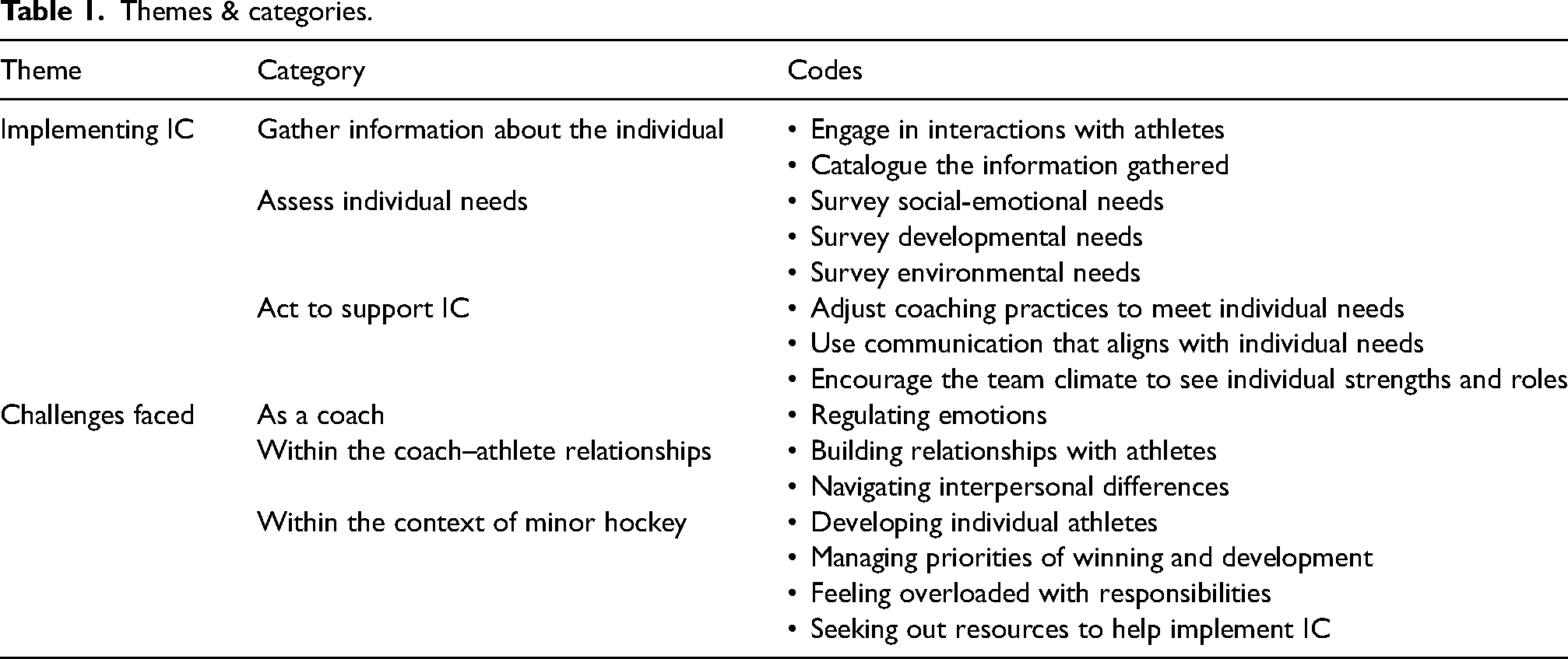
Through the axial coding process, eight subthemes were inductively created. Using an outlining technique, two themes were presented (a) implementing IC shows a processual description of how minor hockey coaches use IC strategies, and (b) challenges faced highlights nested issues minor hockey coaches are faced with when prioritizing the use of IC strategies in their practice (see Table 1 for hierarchy of themes and categories).
Themes & categories.
Implementing IC
Gather information about the individual
Coaches (8 out of 10 of the participants interviewed) described the first step to IC was to gather information about their athletes. When completing this step, coaches engage in interactions with athletes and catalogue the information gathered. Engaging in interactions can mean actively getting to know athletes by finding ways to connect with and talk to them, especially about their hockey priorities. Connor (US, travel) explained how he finds connection: I think you try to find out what makes them tick. You try to find out, whether it be – for a younger age group like one of the teams I’m coaching right now – it might be just noticing a new hat or shirt they’re wearing, ‘Hey do you like the Maple Leafs?’ or ‘Hey do you like the Red Wings?’ Then you start talking about that game and it opens up that connection to those kids more than just ‘I’m the coach and telling you what to do’. I just don’t think that works. But I think when you connect – older kids you can find out more. ‘Hey, how's school going? Hey, how was your ninth snow day this year?’ Those things, so they understand that you’re paying attention to them as individuals and care about them more than whether or not they have a good slapshot, or can backcheck, or can skate, or whatever it might be.
To gather information about athletes, a coach can also observe their athletes during practice to notice how they interact with others (e.g. teammates, parents, coaches) as well as how they play the game. John (US, house) described how he gets to know his athletes by intentionally taking time at the start of his season to observe and assess how his athletes play: Well letting them play without saying, ‘Everybody get in a line and do a drill’. …The first couple weeks when I would give them thirty minutes of practice… that's when it's like, ‘Okay, this is when I do my assessment’, and I just let them go play with the puck.
A final example is through trial and error where a coach can test their assumption about what an athlete needs and track their response.
Through interactions, coaches catalogue the information gathered on each individual athlete as a part of their IC practice. Coaches expressed the importance of cataloguing multiple aspects of athletes including personalities, how to motivate and challenge, changes in body language, expectations of performance, as well as tangible (e.g. skating) and intangible (e.g. communication) skills. Nick (CAN, travel) highlighted a few key aspects of what information is relevant when considering individual needs: Yeah, so this {IC}, it mostly happens in expectations for players. Physical, so in the actual skills and drills. Mental, so in what they can learn and how much they can understand. And emotional, like how they internalize the message; and that individualization happens all the time.
This process of gathering information about athletes allowed for a clear assessment of strengths and weaknesses which led to identifying captains to effectively serve the team. Ron (CAN, travel) shared how important it is to not only focus on weaknesses when assessing players: First of all, assess them in the terms of what their skill sets are individually… Compared to maybe other kids at that level and then also try to make sure that once you have a baseline. If they’re good {fit for the team}, then you find what their strengths are versus their weaknesses and continue moving forward in enhancing both. Not only their weaknesses, but also continue to work on their strengths as well. I think sometimes we lose sight of that because we’re always so focused on working on weaknesses, but we sometimes overlook the strengths because we take them for granted a little bit.
Assess individual needs
Coaches evaluated their athletes by assessing social-emotional (7 out of 10), developmental (9 out of 10), and environmental (9 out of 10) facets of individual needs. The social-emotional components mentioned were maturity, temperament, self-regulation, perfectionistic tendencies, motivation, concentration, working through adversity, communication, and response to instruction and feedback. Connor (USA, travel) shared what he found important to identify: I think the other thing in terms of how you deal with kids' emotional understanding, there's a maturity level that some kids just have. Even if they’re the same age, people and kids develop at different ages or in different ways despite their age. Some kids are just simply mature, and more mature, and mature quicker, physically and mentally and I think that part for me is identifying those people.
Developmental considerations included age, cognitive capacity, basic needs (e.g. autonomy, competence), physical characteristics, skill level, dedication toward an elite pathway and competitive structure. Don (CAN, house) discussed how he develops players based on physical development: You’ve got other kids that are physically a lot smaller. So do you expect them to you know… We talk about playing to your strengths, right? Like, if you are a small fast kid and you’re going up against the big defensemen, do you go right at to the defenseman or do you go around the defenseman? And a lot of times they go right at the guy. I said, ‘You’re playing to his strengths {player name} because he's bigger than you are. So you’re going to come close to him. He's going to want to grab on you or be able to block you and you’re not be able to go anywhere. But if you are faster than he is, you’re small, go around the guy, make him chase you. Now you’re playing to your strengths’. This is the whole idea. You’ve got to help the kids to find out where their strengths are and then play to those strengths.
Vince (CAN, house) further expressed the importance of understanding the developmental and cognitive background of his athletes beyond physical capacity to provide opportunities to grow: The problem is the kids who are not as good, maybe they have learning disabilities, maybe they have behavioural problems. They never get taught how to skate, how to shoot, and they never get better… The kids who are the elite kids, get the best coaches, the most ice, the best training facilities and they always excel. And everyone says – ‘Well they were always good’. But there's never a chance for that kid that maybe just needed a little time.
Coaches also looked to understand the environmental influences on their athletes, such as academic responsibilities, familial upbringing, prior experience or connection with hockey, and other coaching or skill development programming. Norm (USA, travel) discussed being prepared to handle how these environmental factors influence athletes’ performance and not assuming the cause of the problem. He suggested getting to the bottom of the issue and challenges athletes are facing and understanding from the athletes’ perspectives: I try… more positive reinforcement than anything. I’m not a screamer or yeller when it comes to stuff like that {figuring out why athletes are not performing well}. First and foremost, I try to get the technical side of things. Like if something's not going right, we try to get the technical side of things. If we feel like it's an effort thing, my voice might be raised but it's still of a stern ‘…we know how to do this, I’ve seen you do this. What are we doing right now? Is something going on?’ From that standpoint, we are kind of aware as coaches…We’ve sat the kids down in dressing rooms like, ‘Hey guys, what's going on? This isn’t happening, this isn’t happening, this isn’t happening. This is what we need to do to get to our goal. What's happening?’
Actions to support IC
Coaches presented three strategies for supporting IC (a) adjust your coaching practices to meet individual needs (10 out of 10), (b) use communication that aligns with needs (10 out of 10) and (c) encourage the team climate to see individualized strengths and roles (9 out of 10).
Coaches described adjusting their practices to influence differing athletes and to tailor their practice to where the athlete was at. They adjusted their coaching strategies by roles and expectations of their athletes. Across the season, it is critical to scaffold skills at the pace of athletes and come into the season with a structure yet be ready to be flexible as athlete needs arise. In practice, coaches stated how they rarely work with the entire team at once. Don (CAN, house) suggested finding players who are struggling during practice and providing some one-on-one assistance. Connor (USA, travel) suggested pairing skilled with unskilled players in practice. Additionally, Bob (CAN, travel) emphasized the use of stations in practice as well as using video to work with individual athletes (it is important to note here that coaches should be using the Rule of Two when watching video with athletes). 37
Coaches shifted their communication when aligning with the needs of their players. Half of the coaches explicitly stated using positive reinforcement to direct their athletes’ attention and support confidence. There were clear distinctions made between communication during game and practice situations. John (USA, house) explained that there was limited time during games to communicate where instructions were used when players needed direction, whereas practice afforded time for pull aside conversations that could tailor to the specific need and individual. For games, strategies were to get down to the level (e.g. bring board down to their eyeline and not yelling from the top of the bench) of the athlete when discussing anything, as well as offer cues for reflection and arousal regulation while the athletes are waiting for their next shift on the ice. Nick (CAN, travel) provided an example of asking for the athletes’ perspective during a game: ‘What do you think? Tell me what you say in that situation. Talk to me, talk me through what you did’. ‘I don’t remember’. ‘Okay, then next shift let's both really pay attention to your defensive play. And we’ll get off the bench, I want to quick sit then I want to, let's talk about it. Just for two seconds’. And then they come off, and you say – ‘So, what did you see?’ ‘Ah you know what, I was kind of trying to cherry pick a little bit’. ‘Okay, well if you keep doing it were gonna get scored on. And what if we get scored on? Wouldn’t you feel bad?… Well, if we did and you know you’re doing it and I know you’re doing it, then what should be the consequence? What do you think should happen?’
Hearing the athlete's perspective allowed for both the coach and athlete to solve the problem together. Finally, coaches described communicating in practice as both a way to develop relationships and ability. Ron (CAN, travel) talked about how his coaching staff has a chart to check off which players are talked to each practice so to not miss any. Showing care and having individual check-ins were other ways to develop relationships with athletes. Matt (USA, house) stated questions he uses during practice to stimulate athletes’ thinking ‘What happened here?’ and ‘How can that go better?’. Another key strategy was to set expectations depending on the practice or goal of the activity. Specifically, Ron (CAN, travel) communicated a specific focus or objective for each practice with handouts in the locker room and Vince (CAN, house) continually encouraged making and learning from mistakes.
The process of creating a supportive team climate mirrored the theoretical concept of IC, alluding to the idea that consideration of needs is occurring on a group-level. Coaches attempted to support autonomy by using specific strategies to develop cohesion within the team. Specifically, coaches asked their players to identify and choose leaders for their team and then asked for those leaders’ input on key decisions across the season. Colin (CAN, travel) explained his team's process for developing team goals and rules: Especially early on, I like to involve them in a goal setting procedure, that I think other researchers have done. In terms of creating an identity or values and structures and rules or goals and targets and all that kind of stuff. So simply, everybody writes down a bunch of ideas they have individually and then they share with a partner. And then they keep narrowing the list with a partner. And then they narrow their list down with a group of four. And then each group of four presents it to the team. And then as a team, we narrowed down the list to a final list… Like, what's the goal maybe that we have right now? But now they’ve come up with it themselves versus me just dictating it to them. Then it keeps an open dialogue and process throughout those two months in that we review it together at the end and obviously throughout.
Coaches also stated belonging as an important aspect of their team culture. Connor (USA, travel) expressed the importance of roles: You’re trying to build up different ways that kids may fit roles, may fit the ability to work with your team in a way that works with them. They might not be the best skater, but they might be that rah rah guy.
Other strategies were to provide trust and cooperative team building games as well as a space where friendships were valued and could be developed. Finally, coaches stated the importance of balance, especially building lines depending on athlete strengths and weaknesses and how they worked together. Vince (CAN, house) shared his method for balancing the skills of all athletes: Okay, I’m gonna start basic skating and work from there. Go to crossovers. And if the worst guy on the team can do it, then the best guy should be able to do it. And they all got so much better together.
These coaches practiced IC by attempting to adapt their practices to the unique needs of the unique collection of athletes on their team.
Challenges faced
As a coach
Coaches (7 out of 10) struggled or presented issues regulating emotions while coaching. This issue was present across various situations within practices and games with athletes and referees. Coaches that are unable to address and regulate their own emotions face challenges in meeting their athletes needs. Nick (CAN, travel) remembered a distinct moment in his coaching career where he decided he needed to change: It was brought to my attention by one of my bench staff that it wasn’t fun for the kids when you get angry and for me to use that language… I was quite embarrassed, to be honest. That I had been doing that. And I’d be embarrassed anyways but I let my emotions get a hold of me. And it wasn’t every game, but it was getting to be more often. The more it was permissible, the more I did it. Which is why I see it can happen for kids.
Norm (USA, travel) presented his observations of emotional dysregulation with coaches and their players resulting behaviour: You can actually see kids on the ice and the coaches, typically the screamers are going to have the most undisciplined teams, they’re {players} going to be screaming at refs. They’re going to be screaming at parents. They’re going to be screaming at the other team. From a discipline standpoint, they lose focus on what's happening in the game more often or not.
Within the coach–athlete relationship
Two challenges of building relationships with athletes (4 out of 10) and navigating interpersonal differences (3 out of 10) were brought up by coaches. Building relationships with athletes was discussed as a struggle as recent youth sport scandals (e.g. Larry Nassar) have impacted perception and concern for relationship building strategies (e.g. one-on-one conversations with athletes). Instances were coaches abuse power have frightened good coaches from developing strong relationships with athletes. John (USA, house) has refrained from using relationship building techniques with his players: I’ll joke around with them, but this day and age, I do try to keep a nice little distance from getting too personal. I’ll buddy up with the parents or whatever… This year scared me, the fact that there's people associated with the program that are tied directly to the whole Nassar thing. It's in our back yard. It's real and it exists. I have that kind of in the back of my head, that people are hyper-aware and sensitive of those things these days… I’ve been more focused on making sure the friendship stops with the hockey. As far as the kids are concerned. I’ve noticed that a lot of people are doing that now. Which is good. If nothing more than just to set the parents minds at ease… And now it's a different world and I’m definitely sensitive to that.
Moreover, the time it takes to get to know each athlete on their teams is not always feasible, especially in a head coaching role. Vince (CAN, house) stated ‘No, at the house league level, where we’re at, just to get the commitment to the two times a week was difficult’. Coaches stated IC as a ‘trial and error’ process that takes a long time to complete and can be difficult to accomplish when differences between athletes are not blatantly obvious. Some aspects of athletes made it especially difficult, such as those more entitled athletes who do not perceive their coach as useful or quieter athletes that may not provide feedback to go from. Matt (USA, house) presented a difficulty with managing different personalities in the dressing room: Well, the struggle is that they’re all at different maturity levels and they all have different needs at different times. Managing locker rooms is probably the toughest thing for a coach to manage. At least for me, I see it as the most frustrating for me and seems to be the toughest to manage, the locker room. And some kids are bubbly naturally, and that's okay. You want them to be themselves. And some, it just gets loud.
Within the context of minor hockey
Coaches highlighted four challenges within this section: (a) developing individual athletes (4 out of 10), (b) managing priorities of winning and development (4 out of 10), (c) feeling overloaded with responsibilities (3 out of 10) and (d) seeking out resources to help implement IC (3 out of 10). Coaches felt that individual skill development poses an issue when they are working with a whole team, especially within one-season or without resources. Don (CAN, house) found it difficult to balance all players with such a diversity in skill-level: My last year's team I had kids that really should have been playing green and kids that could have been playing red. And we’re all on one team, ‘smarties’ team. They’re calling them when they’re all different colors. That's a lot harder because then you’ve got kids who just physically can’t do what some of the other kids can do. Right. They’re just not there yet. It's not their fault. It just so happens that you’re stuck on this team because there's nowhere else to put you.
Moreover, finding an optimal challenge for each athlete was difficult. Coaches felt unbalanced in their pursuit of development alongside of winning but have been limited by the structure of minor hockey. With the constant drive to win, Collin (CAN, travel) felt unable to provide support for athletes’ individual developmental needs: It's pretty much why it's my last year coaching. I think coaching minor hockey is stupid. I think it's a fool's game because you’re a good minor hockey coach, cares about development and the minor hockey development system does not care about it. So, I go in and coach young kids and say, ‘We’re going to focus on development’, and I’m just getting ripped apart and I’m coaching against other coaches who are there to win and I look like an idiot… Why the hell am I focused on winning hockey games? My job is to develop and yet I don’t have a job if I don’t win. So therefore, I’m focused on non-age-appropriate things sometimes or to a degree and I’ve done my best to not do that.
Additionally, coaches felt that they had many hats to wear which often distracted from their effort toward development. Connor (USA, travel) described the modern era of coaching as a constant: I think the difficult thing is the fact that there are so many balls to juggle as a coach. And I think even today, having been a coach for twenty-five years at different levels, the constant amount of whether it be again dealing with kids and their problems, dealing with social media, and dealing with emails and the constant 24/7 news cycle that we’re on where it seems that everyone needs to be connected to these things.
Finally, Canadian coaches especially felt that their organizations did not provide adequate resources to enhance the coaches’ ability to support athlete needs and implement IC. Vince (CAN, house) stated ‘No there's nothing like Hockey Canada that popped into my head. In fact, I thought it was like a bit of a, I was a little bit embarrassed for Hockey Canada almost. When I did the course’.
Discussion
This study highlighted two main themes describing IC along with the challenges faced by coaches when using IC within their practices. A research aim of this study was to understand how coaches implement IC within the minor hockey context. The Implementing IC theme revealed a three-step process that coaches can follow when implementing IC within their practice. First, coaches gather information about their athletes by engaging in interactions and cataloguing information. Next, coaches assess the social-emotional, developmental, and environmental needs of athletes. Last, coaches support IC by adjusting their practices, using communication, and encouraging the team climate to support individual needs.
The third research aim of this study was to explore challenges coaches are faced with. Results showed that although coaches demonstrated IC, they were still faced with challenges that limited their use of IC. Challenges were seen as coach self-regulation as well as within the coach–athlete relationship through building relationships and navigating interpersonal differences. Coaches were further challenged within the context of minor hockey by limiting the development of individual athletes, dividing priorities of winning and development, feeling overloaded with responsibilities, and seeking out helpful resources for implementing IC.
Overall, the results of this study provide evidence to IC being frequently displayed and recognized by coaches. 38 Three main findings will be addressed in this discussion section (a) IC can be implemented to support basic and more complex needs of athletes, (b) IC can be implemented with teams of athletes and (c) the context of minor hockey is constraining the implementation of IC.
IC can be implemented to support basic and more complex needs of athletes
IC has been linked with the satisfaction of basic needs (i.e. autonomy, competence, relatedness), therefore coaches that are taking the time to get to who their athlete is, what they are capable of, and provide opportunities that optimally challenge them would both meet the requirements of basic needs as well as IC. 39 Findings from this study show that coaches are using autonomy-supportive coaching practices and ensuring belonging within the team. Additionally, coaches that are cataloguing their athletes’ needs use this information to provide optimal challenge and skill progression which can support competence. 24
IC strategies used by coaches can also be used to support the more complex needs of athletes. Coaches demonstrated a systematic approach to IC through logging the complex needs of their athletes. This practice allowed for a holistic understanding of their athletes, which led to an informed decision for drills or support provided to athletes along with realistically setting roles and expectations for athletes. This finding supports the idea of holistic athlete-centred coaching. 20 Another strategy used by coaches to address the complex needs of athletes was the use of communication. Coaches saw communication as a tool to understand athletes’ perspectives to provide preferred support as needs may change from moment-to-moment or depending on the context (e.g. practice or game) and time of season. The suggested strategy of seeking out one-on-one meetings and discussing individual perspectives of performance is consistent with past TFL studies. 40 This strategy is effective from a leadership perspective as well. When leaders, in this case coaches, act in a certain way where their behaviour matches the preferred behaviour of their athletes satisfaction will occur.41,42 Additionally, communication was used by coaches to present clear expectations to their athletes. Providing clear expectations is beneficial to enhance a coach's ability to build a relationship and foster development with their athletes. 43 The results of this study suggest the need for coaches to have strong communication skills when implementing IC.
IC can be implemented with teams of athletes
Findings revealed that IC was being implemented at the group-level, despite the suggested differences between team and individual sport contexts. 22 Coaches noted that competitive minor hockey is a context that can pit players against each other for playing time; when athletes compare themselves to those around them there is a negative effect on self-concept and self-esteem.44,45 However, coaches implementing IC discussed viewing athletes as different puzzle pieces that would fit together. After assessing individualized strengths and weaknesses of players, they would recruit other players that would work well together or to fill a skill gap within the roster. Coaches also found ways to group players during practice based on needs, which helped to mitigate any competition by promoting growth regardless of differences.
In this study, team climate was brought up to be an influential factor on team cohesion. Coach-initiated climate is influential to building team cohesion. 46 Coaches would use their IC assessments to help choose different players to be captains. After this selection, coaches would use autonomy-supportive strategies to reinforce a task-focused climate. For example, when major decisions (i.e. rules) needed to be made, coaches would remind players this was their team and asked what they wanted to do. Although implementing IC led to developing athletes, it may also be contributing to team cohesion. This finding is supported by the experimental research conducted on the positive effects of a TFL intervention on group cohesion. 47 Especially within the context of an interdependent sport such as hockey, coaches are tasked with supporting individual growth as well as team results. Having a coach that shows care for the athletes may model a caring environment for their athletes to mirror.
The context of minor hockey is constraining the implementation of IC practice
Highlighted by both Preston and Fraser-Thomas and the results of this study, balancing performance and development is possible to strive for as a coach, albeit not without challenges. 48 Participants emphasized how constraining the outcome-focused culture of hockey was on their interactions and ability to focus on development. Thus, the coaches interviewed for this study may be inclined to use IC, but the context of minor hockey limits their opportunity to. Currently, youth sport systems are examining their programming to ensure a balance is found between competition and recreation. 49 Using New Zealand's ‘Balance is Better’ initiative as a guide, for example, minor hockey programs may be able to provide support for coaches that are attempting to prioritize development through using IC strategies.
Future directions
An innovative avenue for youth sport research would be to explore the interaction between the minor hockey system and coaches nested within this system. Noted in this study, coaches saw contextual constraints on their ability to implement IC and focus on development with their athletes. A key next step would be to examine the goals of the minor hockey system from multiple stakeholder perspectives (i.e. minor hockey players, parents, coaches and administrators). Moreover, it is critical to evaluate the existing developmental systems. Youth sport is a context in which three subsystems (i.e. family, team and environmental) interact to influence an individual athlete. 50 Systems thinking has rarely been applied to youth sport coaching research, although this approach has informed youth sport participation and prevention of athlete maltreatment.51–53 Research in this area may benefit from a narrow focus on the context of minor hockey to provide more information to enhance the developmental systems currently in place.
Implications
Coach education programs are often focused on presenting professional knowledge and provide less information on and development of interpersonal and intrapersonal knowledge. 54 Programs could present workshops where coaches work through case studies to assess players holistically, problem solve and communicate in practice and game situations, and design developmental plans for individual athletes. These types of contextual workshops that include an emphasis on interpersonal and intrapersonal knowledge will help coaches connect with the content as well as support implementing IC. 38
Another avenue could be to bring coach education programs into a coach's specific context through observation and providing feedback after practices and games. Coaches can learn through structure, reflection and evaluation. 55 Having a coach developer within the youth sport setting to highlight when and how often coaches are implementing IC may reinforce use of such praised strategies. Following observation, educators and mentors could guide coaches through a reflective practice on reviewing when the optimal time to implement IC is in their context. As coaches expressed being challenged by the context of minor hockey, this would be a critical step for coach education. Coaches may feel more confident in using IC with their teams and feel supported by their organization.
Limitations
This study was limited through addressing only the coach perspective of this phenomenon. Further research would benefit from exploring athlete perspectives and preferences of IC in their coaches’ practice. With recruitment, convenience sampling offered a chance that participants were those who have had a positive experience with the content of the research. The experiences and perceptions of participants interviewed for this study may be positively skewed in reporting effective coaching practices. Moreover, convenience sampling within the context of minor hockey led to a white, male sample and diverse perspectives should be further examined.
Finally, this study was concentrated on the context of minor hockey. The results may not be generalizable to other sport contexts or to other levels of hockey (e.g. junior, major junior, amateur).
Conclusion
The purpose of this study was to explore minor hockey coaches’ experiences with IC. Results provided a clearer understanding of the practice of IC based on the experiences of 10 coaches. This study found that coaches were inherently using a three-step process of implementing IC in their practice despite some constraining challenges ranging from those as a coach, within the coach–athlete relationship, and within the context of minor hockey. The findings of this study suggest that (a) IC can be implemented to support basic and more complex needs of athletes, (b) IC can be implemented with teams of athletes, and (c) the context of minor hockey is constraining the implementation of IC, which may have implications for various coach education programs to support the needs and existing knowledge of minor hockey coaches. Future research should explore stakeholders’ perspectives of goals for participants and evaluate the existing developmental systems of minor hockey.
Footnotes
Declaration of conflicting interests
The authors declared no potential conflicts of interest with respect to the research, authorship, and/or publication of this article.
Funding
The authors received no financial support for the research, authorship, and/or publication of this article.
