



Abstract
Previous research has examined the use of phenomenological interviews post-performance with the aim of gaining subjective knowledge of the lived experience of players. However, to date, explicitation techniques have not been used within actual coaching sessions to enable the coach to gain greater insight into players’ decision-making experiences. The aim of the study was to develop the use of explicitation techniques as a pedagogical tool within coaching sessions. As the coach, I (the first author) was one of the participants in the study. I recruited five Korfball players (M = 2, F = 3, aged between 21 and 26 years) as participants to develop my use of explicitation techniques with. The study used an Action Research (AR) approach and data collection methods included audio recordings of the explicitation techniques, fieldnotes, analytic memos and focus groups. Thematic data analysis was used to identify trends and patterns and make sense of the multiple sources of data. The findings were focused on the pedagogical strategies and adaptations used to develop the use of the explicitation techniques in coaching practice. These revealed that facilitating an evocative state through questioning requires practice and experience but is beneficial for coaching practice to understand players’ lived experiences. The approach enabled me to gain greater insight into the players’ reactive decision-making processes and a better understanding of what they were seeing and feeling in decision-making moments. It is anticipated that in turn, this will enable myself and other coaches to design and facilitate better coaching sessions.
Introduction
Phenomenology is regarded as both ‘a philosophy and a methodological approach’, with the aim of gaining subjective knowledge and understanding of existence. 1 Specifically, it can give researchers (me, as the first author and coach in this study), the opportunity to gather a ‘rich’ and more detailed understanding of performers’ experiences of tactical, in-game, decision-making, thus, providing further insight into players’ game awareness. Starks and Brown Trinidad 2 highlighted that phenomenology is aimed at understanding the taken-for-granted elements of an environment. More recently, Mouchet et al. 1 proposed the benefits of a phenomenological approach and how it can offer a more useful insight within the field of sport coaching to understand players’ decision-making in the context in which it occurred.
In building on the traditional views of phenomenology, psycho-phenomenology is seen as the ‘empirical psychology of subjectivity’. 3 Specifically, psycho-phenomenology was developed for ‘introspection and eliciting personal accounts’. 4 The theoretical roots of psycho-phenomenology are in both phenomenology, with Husserl's perspective5,6 and Piaget's 7 work in psychology. According to Mouchet et al. 1 psycho-phenomenology is ‘an original framework which proposes a theory of consciousness, in connection to Husserl's propositions about acts of consciousness, passivity, intentionality and Piaget's propositions about awareness within child development’, whilst being distinguishable from transcendental phenomenology and experimental psychology. Husserl believes that a ‘phenomenological approach’ could unearth the aspects of preconceptions surrounding a mental phenomenon which in turn could play a part in an empirical study. 8 Whilst Sparkes and Smith 9 identified 18 phenomenological approaches in sport-related research studies, and O’Halloran et al. 10 considered 2 main approaches in phenomenology as descriptive versus interpretative, Vermersch developed psychophenomenology as an original perspective with the focus on describing and highlighting the participant's lived experience, with a specific method, explicitation interviewing. 3 In this method, the phenomenological attitude through epoche and reduction with the use of bracketing 1 , favours facilitating an evocative state. Evocation is an important condition for the following questioning allowing awareness and a rich description of actions in sport situations. 3
Previous research11,12 has examined the use of explicitation interviews (a technique grounded in psycho-phenomenology), to gather the subjective lived experience of a participant around a specific moment in a past situation. Here, the interviewer aims to ground the participant into an ‘evocative state’, using questions to create a sensorial anchorage (e.g. where are you standing? Who can you see? What are you thinking?), where they relive a moment as they talk through it in order to access previously unattainable information from their pre-reflective consciousness to understand it better.1,12 This information then, could be used to generate new knowledge of players’ past in-game decisions in order to develop their future performance. 1 For coaches, being able to access this information themselves, directly from the players’ point of view, could enable them to develop a greater understanding of the players’ processes of decision-making and subsequently design more player-informed and individualised practices to improve it.
Several coaching scholars1,13–15 have implemented explicitation interviews to examine the subjective lived experience of in-game decisions. Mouchet 15 for example, used explicitation interviews with individual rugby players post-game to describe in detail, and understand, a decision they had made during the game. The prompts and questions sought to uncover details from the ‘pre-reflective consciousness’ which would otherwise have been unknown to the participant. 11 Furthermore, Gleeson and Kelly 13 highlighted the capacity of such a phenomenological methodology to capture the complex interaction between the simultaneous processes underpinning the decision-making moment. However, whilst such post-game explicitation interviews have been found to be highly beneficial, finding the required time to use the techniques post-event can be problematic. 14 Furthermore, coaches (or researchers) would need to be formally trained to use such explicitation interviewing effectively. For this study, two authors (including the first author) have been trained, and Mouchet is a trainer in these techniques. 1 Therefore, although previous research has shown that the post-game explicitation interview enables participants to access in-depth information, such explicitation techniques have not yet been actualised within coaching sessions.
The ability to more closely examine decisions made by players during game situations in coaching sessions could be beneficial to coaches in further developing players’ learning. 1 Such explicitation techniques would potentially enable the coach to access pre-reflective content that would not be accessible if the player is not ‘taken-back- to the moment’ (e.g. identifying additional visual cues that lead to a decision). Utilising such pedagogical techniques with a ‘touch of explicitation’ 16 within practice sessions, builds upon and extends previous research in the areas of questioning within sports coaching to develop players’ in-action understanding, and provides opportunities to understand how these techniques can be used to inform coaching practice. 17 The first step in achieving this is to explore the pedagogical strategies and adaptations required to successfully implement these techniques during coaching sessions. 16 The aim of this study then, was to develop the use of explicitation techniques as a pedagogical tool within coaching sessions.
Methods
Action Research (AR) approach
This study adopted McNiff's 18 conceptualisation of AR, starting from the current action or intervention, then developing through reflection and planning to develop understanding, as aligned with AR ‘…the knowledge you create is the knowledge of your practice’.
Research design
In Figure 1, we present the design of the study which followed a cyclical process, with each cycle comprising three key stages: (a) data collection in coaching practice; (b) a focus group with the participants; and (c) reviewing data to further develop the study. 18 The study utilised three cycles of AR: the first and third cycles lasted 4 weeks whilst the second was 3 weeks in duration; the duration of cycles fluctuated based on the developments in my own learning of applying the techniques and the awareness shown by participants in the transcripts. Explicitation techniques were run each week during the coaching sessions. In the final week of each cycle, a focus group was held with players to discuss their experiences in relation to the explicitation techniques. The ‘data collection’ in coaching sessions lasted between 3 and 4 weeks with the focus group and reflections occurring the week after, thus each ‘cycle’ lasted between 4 and 5 weeks dependent on the duration of data collection. The ‘full’ data collection period lasted for thirteen weeks.
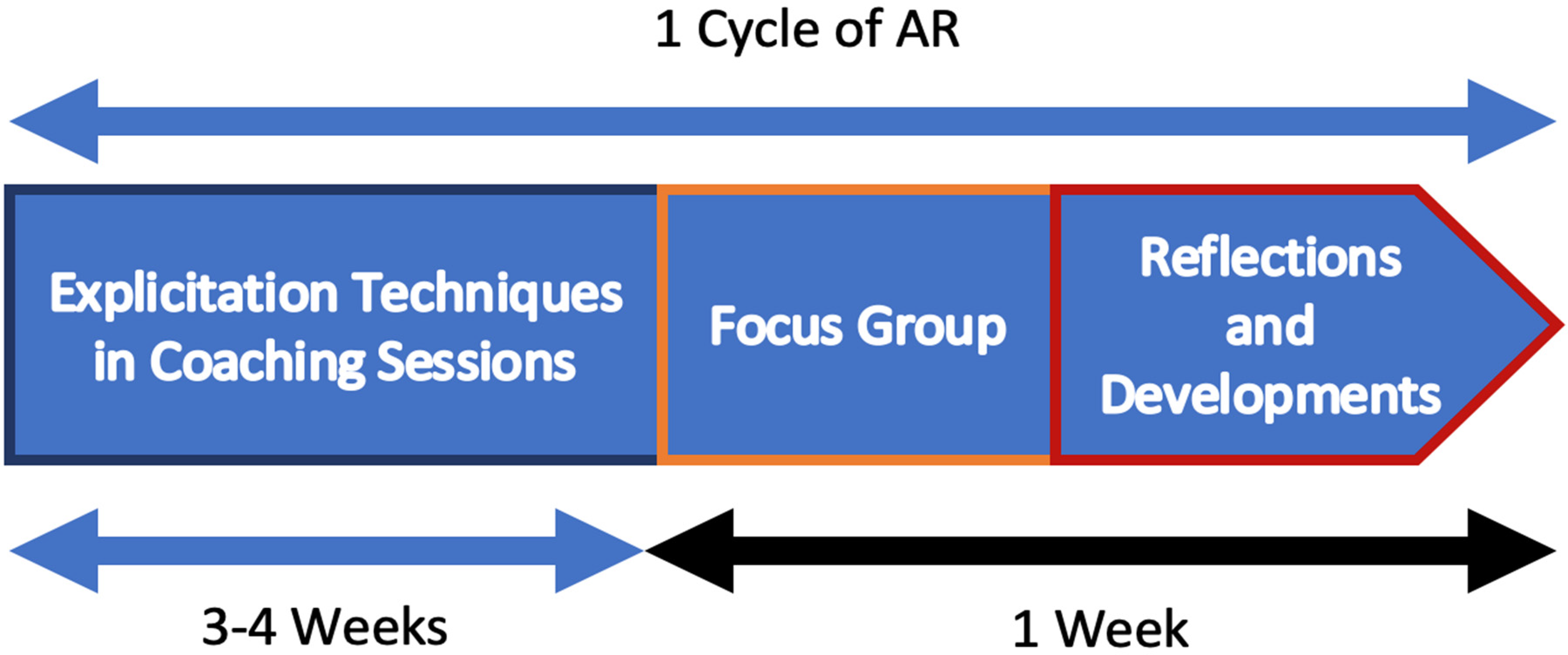
Design of each cycle in the study.
Participants and coaching context
The study was conducted in a Korfball club, where I, the first author already held the role of the assistant coach. Korfball is a mixed-gender sport that has similarities with basketball, netball and handball19,20. The club had 20–30 active members and training was split into two sessions per week: one aimed at beginners and the other aimed at the club's top two teams competing at regional and local league levels. Phil (a pseudonym) was the Head Coach of the club, and he initially agreed to lead sessions allowing me to focus on running the explicitation techniques, and therefore, to help facilitate data collection.
Given the study aimed to develop the use of the explicitation style techniques within coaching practice, the data collection focused on understanding the use of this as a pedagogical tool. Following discussions with Phil, a sampling criterion was decided for players’ participation in the study; a starting first or second team player at the beginning of the season who had been playing the game for more than 2 years. These criteria were used as it was perceived that such participants would have a better understanding of the game than beginners. From this group of up to 20 players, 5 were purposively chosen to participate (M = 2, F = 3), with ages ranging between 21 and 26 years old. Players were then contacted individually by email to explain the study asked about their interest in participating and supplied with an information sheet. After discussions with critical friends, it was decided that five participants would be used to ensure data collection was manageable within the coaching sessions. Furthermore, these were the only five participants who met the criterion,
I, the first author, was also a participant in the study and had built a strong working relationship with the players in this club, which allowed the facilitation of data collection. At the point of data collection, I had held the assistant coach position for 1 year previously and was an International Korfball Federation (IKF) Level 3 qualified Korfball coach. I also had 8 years of coaching experience within Korfball from grassroots to international level as the U19 Wales Korfball Coach. My academic qualifications also include a BSc in Sport Coaching and an MSc in Sport Coaching and Pedagogy, both studied at Cardiff Metropolitan University.
Whilst I was both a coach and researcher in this environment, I was aware that ‘role power’ existed between myself and the players. I attempted to minimise this by not being involved in team selection with only the head coach holding this responsibility, thereby minimising concerns of coercion in participation. 21
Ethical concerns
Before contacting Phil and the player participants, ethical approval for the study was obtained from Cardiff Metropolitan University's ethics committee. Phil has also reviewed this article and agreed for it to be published. Participants were informed that confidentiality and anonymity would be observed where possible and that they had the right to withdraw from the study at any time. Finally, all data were stored in a password-protected cloud file storage in compliance with GDPR regulations.
Data collection
According to McNiff, 18 it is important in AR that both the researcher's and participants’ perceptions and opinions lead the development of the project. As such, it was important to utilise a variety of methods that allowed for the understanding of both my own and the player's experiences. Methods used involved a combination of my own fieldnotes and analytic memos, player focus groups and explicitation technique transcripts. Participants were sent all transcripts in order to check, verify and if required, clarify any points made.
Explicitation techniques
Explicitation techniques were conducted weekly with as many attending players as possible, although Jackie and Maggie both missed two data collection sessions due to other work commitments. The techniques were based on previous research by Mouchet 14 but were much shorter in length, as a ‘full’ explicitation interview was not possible during the actual coaching sessions. In previous studies,11,14 post-game explicitation interviews lasted between 40 and 60 minutes each, however here, the explicitation techniques lasted around 3 to 4 minutes, as players had to re-enter the session after their use. It is acknowledged that the effect on players’ awareness, ‘completude’ (richness) and quality of description cannot be at the same level as during full explicitation interviews. Nevertheless, such explicitation techniques, through brief ‘touches of explicitation’, 10 have already been demonstrated as a pedagogical tool in different contexts such as pupil learning at school, 22 the development of creativity with dancers, 23 and post-lesson debriefing with young physical education teachers. 24
Several different types of questions were used in an attempt to get the participants into a state of evocation; open, closed, grounding, questions about thoughts/feelings, clarification, using their words and tense. These were derived from different types of questions used specifically within explicitation interviews. 12
Without the assistance of an initial video prompt, as used in previous (post-game) research using explicitation interviews, grounding questions were deemed necessary to recollect the specific moment the participants had chosen. 14 The first question in most interviews was ‘Where are you standing on court at the moment?’. This aimed to focus the participants, so they could see themselves back where they were during their decision. Here, I was ‘developing a sensorial anchorage’. 1 Although some participants provided a very detailed answer as to where they were, identifying the location and actions of their teammates, others needed a follow-up question to gain more information after a shorter answer was provided, for example, ‘Who can you see? Do you have the ball?’.
Once the participants were ‘grounded’ within the moment, more detailed questions were aimed at the events that occurred before the decision, such as, ‘What is going on? What are you thinking of doing?’. These questions were not asking ‘why?’ (which could have been perceived as judgemental) but were worded to gain an understanding of the participants’ thoughts whilst they were playing at that moment. These were developed through clarification questions such as, ‘You say you’re holding the ball and waiting?’ using the participant's own words and not leading them further by providing suggestions.
Vermersch,12,25 using Husserl's, 6 theory of consciousness, distinguished two different psychological processes, ‘refléchissement’ and ‘réflexion’, through the verbalisation of actions, that assume two different speech positions when the interviewee is speaking. The first one is an ‘embodied speech position’ which relates to intuitive, experiential relation to the past situation, with sensoriality, as if the interviewee was reliving the past situation and discovering many more details of what they really did. The second is an ‘explicative speech position’, conceptually based on knowledge, which is the more common way of speaking using reflective consciousness. For guiding the interviewee towards this embodied speech position and maintaining the interviewee in evocation, the interviewer uses several techniques6,26 to gain a rich description of actions, the effective goal and operations. Questions concerning ‘how’ and ‘what’ are more appropriate for this goal, avoiding directly using ‘why’ because the interviewee would switch to an explicative speech position, using generalities and declarative knowledge which are held in reflexive consciousness. The description of actions from the first-person point of view helps the interviewee to succeed later to his sense-making about the participants’ subjective lived experience. Finally, when it was felt that a state of evocation had been achieved 2 , questions were used to access more details about the participant's lived experience, their thoughts and feelings during that specific moment: ‘So, you’re taking the shot, how are you feeling as you’re taking it?’.
Each explicitation technique was audio recorded using a voice note application on my mobile phone and then transcribed verbatim by myself following each session using Microsoft Word. The transcripts were then used to reflect on my use of explicitation techniques in order to inform future interventions with participants and to analyse the development of the techniques over the duration of the study. The questions used with participants were unstructured, however, analysis of transcripts and focus groups informed the structure of the intervention and techniques to encourage the interviewee towards this embodied speech position.
Fieldnotes and analytic memos
Fieldnotes were collected from observations of players, using them to ‘comprehensively describe everything that happened’, by devising a series of questions a priori to guide the description of the event, including how I felt the interviews had run, how the sessions were progressing and how the participants were engaging. 27 I used comprehensive notetaking in order to compile notes around both the explicitation techniques, and to describe the context of the sessions.
I wrote further reflective notes, in the form of analytic memos, following each coaching session, and after each focus group with participants in order to highlight positive developments, areas for improvements and critical events experienced ahead of the focus groups. They differed to the fieldnotes as they formed my ‘initial sense making’ and provided me with an opportunity to discuss these issues with critical friends in the study. 27 These memos were composed within 24 hours of the completion of each session or focus group and the themes emanating from them were used to inform the focus groups.
Focus groups
The focus group discussions encouraged all participants to explain and explore their experiences during the explicitation techniques, providing the opportunity to voice and explore opinions regarding the development of these explicitation techniques.28,29 A total of three focus groups lasting between one and one and a half hours took place in the evening in a quiet café local to the sports centre, one at the end of each cycle of AR.
Data analysis
Thematic data analysis was used to identify trends and patterns and make sense of the multiple sources of data, and was chosen as it provides a systematic process to analysis that is still flexible based on the study in question. 30 The initial phase of data analysis began during the data collection phase, as is common with AR so as to inform the development of the project during each cycle. 18 Once the data collection concluded, a process of analysis, as described by Braun et al., was used. 30 After re-familiarising myself with the data, initial coding and line-by-line scrutiny were deployed through inductive reasoning, which produced a broad range of individual codes. This was followed by deductive coding to ensure that all the data were coded in relation to the previously known theory of explicitation interviews (e.g. ensuring the interviewer/interviewees are talking in the present tense). 14
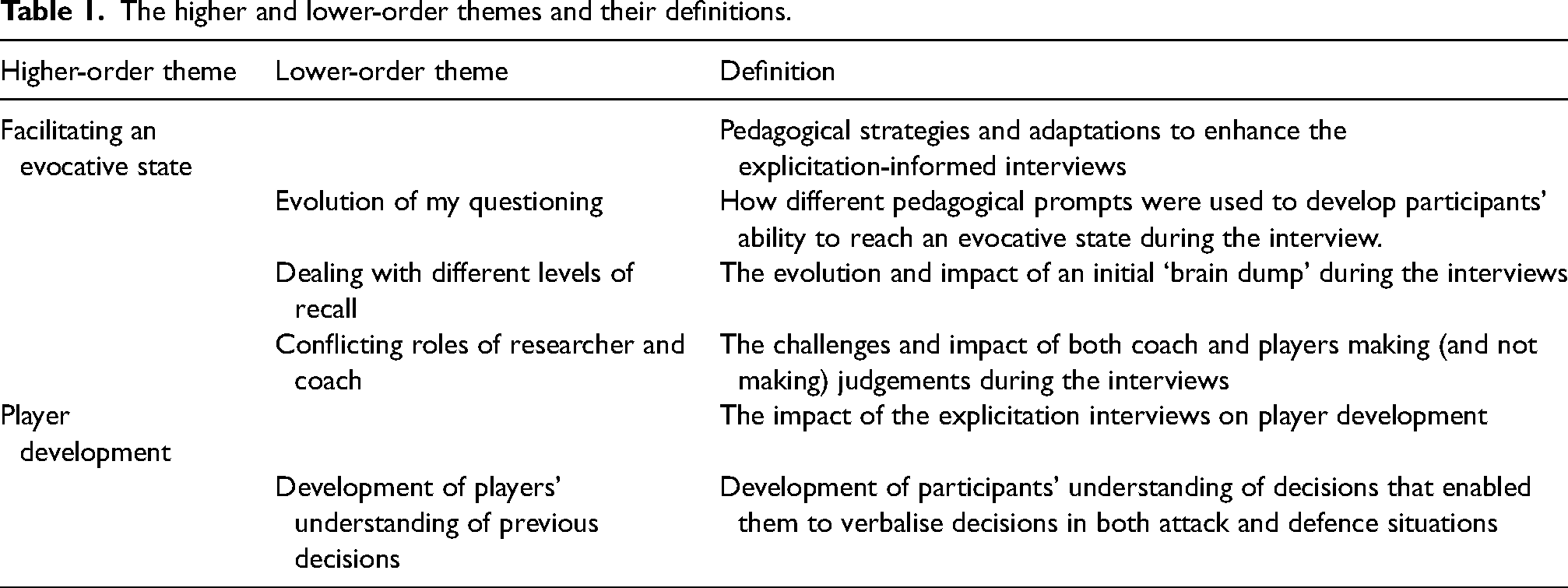
Any data that did not fit the deductive codes were coded inductively to ensure no themes were overlooked, and in order to add to existing knowledge. 31 Themes or ‘central organising concepts’ were then created to summarise the shared meaning of the respective data and highlight the key areas of interest in the study. 31 These were finally amalgamated to allow the organisation of coded data into higher (e.g. facilitating an evocative state) and lower-order themes (e.g. evolution of my questioning) as shown in Table 1.
The higher and lower-order themes and their definitions.
Rigour and trustworthiness
As highlighted, the knowledge created in this article is based on my interpretation and triangulation of the different data sources. It is important in qualitative research for the researcher to consider ‘the role of self in the creation of knowledge’. 32 Reflexivity can be defined as understanding and appreciating that the researcher is an instrument within the data collection and as such will influence the data collection. 33 Specifically for this project, I was an active assistant coach in the environment, and to aid the reflexivity, the reflective researcher narratives were used as a data collection method that aimed to show a part of my internal dialogue. 34 Further steps taken to aid reflexivity included discussing emerging themes during the data collection phase with participants during focus groups as a form of member checking and triangulation.
A further method used to aid my reflexivity was the formulation of a peer support network of ‘critical friends’. 12 This group included the research supervisors, who aided in discussions around themes during and after data collection, providing external views and challenged my assumptions. 12 These ensured any assumptions made were critically analysed by peers outside of the project, thus allowing external insight which could inform and develop my understanding of the proposed findings. 12
Results
This section presents the knowledge developed from using explicitation techniques as a pedagogical tool, to ultimately gain a greater insight into the players’ decision-making processes and regulate my coaching practice. The findings in this section cover four main themes: (1) facilitating an evocative state; (2) dealing with different levels of recall; (3) gaining coaching insights into players’ reactive decisions; and (4) the conflicting roles of researcher and coach.
Facilitating an evocative state
This section reveals how my use of questioning evolved within the AR cycles to develop the participants’ ability to reach and maintain an evocative state during the interviews and was formed out of three lower-order themes: evolution of my questioning, dealing with different levels of recall and the conflicting roles of the researcher and the coach.
Evolution of my questioning
As the study progressed, I became more practiced at asking questions in the present tense to aid the participants in achieving an evocative state; reliving that specific moment.
1
I was also able to influence the participant's narratives when they slipped into using the past tense themselves, getting them back into, and keeping them in, the present tense also, as demonstrated in the extract below: G - In the first game up against yellows I was up against Julian… Researcher (Me) – So, you are marking Julian… G – I am marking Julian… (Greg, Explicitation Transcript, Cycle One, Session Four)
The grounding questions were important to provide me with details about the game situation. However, participants sometimes left me wondering what would happen next in the scenario they were describing, making it difficult to formulate the next question to achieve a state of evocation. I initially used ‘leading’ and ‘closed’ questions. For example, when Greg specified that Mitch was defending him, I repeated his words, ‘So Mitch is defending you…’ and added, ‘is he quite close’. Although intended as a prompting question, this could have led Greg's answer. Upon reflection, I decided future follow-up questions needed to be more ‘open’, and less ‘leading’, for example, ‘How is he defending you?’.
The main difficulty in devising such questions was the reactiveness required to keep the interview flowing and not breaking the participants’ train of thought. The following excerpt from my reflections show some of the difficulties I faced in trying to achieve this in AR cycle One: There's just so much to think about…reacting to what they’re saying, especially when I’m not initially sure what moment they’re talking about… making sure they’re staying in the present tense, ensuring the questions do not lead and just prompt the participants. (Reflections, after Session Three)
Dealing with different levels of recall
It became apparent early on that some of the participants could provide more information from the opening grounding question compared to others. For example, in one of Greg's transcripts, after being questioned as to where he is in the court, he continued to give more detail without prompts: G – I’m standing at the top for a restart, the other team's scored. Olivia has run straight round into a feed, it's not a very good one, it's a little bit far out so I look to the side to see if there's someone to pass to(…)Sarah is not moving too much, but Phoebe is not defending properly either, so Sarah actually has a nice path…she moves back behind Phoebe…so it's a nice pass over the top and I pop it over to her. (Greg, Explicitation Transcript, Cycle One, Session Three)
In contrast to Greg, Maggie required more prompting to draw detail around the moment we were discussing: Me – So what are you seeing, what are you looking at in front of you? M – Dave had the ball in front. Me – So Dave's holding the ball? M – Yeah, he's sort-of unsure if he should throw it to me in the feed or not… Me – Okay. M – I was quite far out, umm… Me – So you can see he's hesitating slightly? M – Yeah. Me – Who else is attacking with you at the moment? Dave has the ball in front of you and? M – Yeah, Dave had the ball in front and Charlotte was round behind the post, and Mitch was on one of the other sides. Me – Can you hear any of them moving at this moment? M – No
In a later focus group, Greg explained why he found it easier to begin the interview with this ‘overview’ or ‘splurge’ as he referred to it: ‘I find a lot easier to sit back think about it, like just go and splurge. I think it's easier to splurge in the present tense.’ (Greg, Focus Group One).
The other participants discussed the idea of a ‘brain dump’ within the focus group, relating to how Greg had found it an easier way to provide more detail and information within the interviews. Consequently, I proposed that all participants start the interview in this manner. This strategy seemed to improve the recall of some participants. For example, Jackie, who could initially only provide limited information, was later able to provide an overview of the whole decision in the present tense: Okay, so I’m standing about 4 ft away from the post and Ieuan runs into feed, looking like he's going to cut the feed, but I pass it back in and then receive the ball back from Ieuan, and then it goes in…everyone else is free around me, and it was a risky pass to make back into Ieuan, but I chose to do it anyway, just as an impulse pass. (Jackie, Explicitation Transcript, Cycle Two, Session Two).
However, whilst Jackie was able to provide that information without interjection from me, Maggie still found difficulty. Consequently, I kept repeating her words to keep her at the moment so she could continue and provide more information: M – Mitch is under the post with a good collect. Me – So you can see that Mitch is under the post. M – Yeah. And then I receive the ball and Lucy is running at me trying to defend. I seem to hesitate. Do not take the shot. And then she's defending me, so I’d sort of missed the opportunity. And then I pass it umm back out to Lizzie. (Maggie, Explicitation Transcript, Cycle Two, Session Three).
Although after further practice, most participants had been able to provide more detailed recall with the ‘brain dump’
3
and found it helpful, others did not like the change in structure. Therefore, I made it optional for participants to start the interview with a ‘brain dump’ after AR Cycle Two. It was interesting to see how the participants had different preferences as to how to start each interview, but grappling with this as the researcher was difficult: When the participants start with a brain dump it gives me a better idea of the situation they’re talking about…it gives a better grounding for the participants and me…if it's not helpful for them then they should have the choice, but it's easier for me with the brain dump. (Reflections, Cycle Three, After Session Three).
Conflicting roles of researcher and coach
As highlighted by Vermersch, making judgements as a researcher ‘opens another space of speech, and has other goals, than the experience of action’. 35 Therefore, the provision of judgement by the interviewer strays from the main goal of explicitation, that of gathering information on the actions of the participant. Furthermore, judgement can only take place in the past tense; it is only possible to judge something once it has happened, which deviates from the ‘evocative state’ where the interviewee relives the experience. This raised a difficult researcher coach ‘role conflict’ for me through wanting to provide feedback or ‘coaching points’ as a coach, but knowing that this would be considered as judgemental, as a researcher.
In the preliminary stage of data collection, it was apparent that there were instances where I was providing feedback as a coach within the interviews, for example, ‘…I wanted to change his perception as he blamed his bad pass; I think he actually made the right decision...’ (Reflections, Cycle One, after Session Three). From reading previous literature, I was aware that I needed to limit this judgement.
15
However, in my dual role, as a coach I had to resist using the interviews as coaching opportunities for learning experiences with the players. The following interview excerpt provides an example: Me – “Yeah, so you said that you should have noticed that Kyle had dropped off, and that you could’ve moved. Instead of you doing that, who else was attacking with you? Say it was Greg, wait it was Mike, so if Kyle was dropping off then what does that mean?” L – “That Mike's a free player?” Me – “Yeah,” L – “So he should receive the ball?” Me – “Yes!” (Logan, Explicitation Transcript, Cycle One, Session Four)
Following the culmination of Cycle Two, it was apparent from the data that my own perceptions about the players’ decisions were still overtly present. Prior to the first data collection session in Cycle Three, I revisited previous research
35
which outlined the importance of setting a ‘pre-interview contract’ and decided to include this within the in-session interviews. I ensured that before the interview I explained the difference between my coach-researcher role in the interviews – this seemed to help as it set the scene better…when I spoke to Greg, he kept to the present tense and there were no judgements provided by myself – I didn’t react when he gave any opinions and just carried on… (Reflections, Cycle Three, after Session One) It seems like I’m now not doing my job as a coach by not providing as much feedback, I wanted to help them develop…maybe they do not need my opinions here; but I still think I should be doing more… (Reflections, Cycle Three, After Session Two) Sometimes I do doubt myself…sometimes I have done the wrong thing…feedback at the end would get your opinion of it… someone confirming for me if I did this right or not. (Jackie, Focus Group Three)
Development of player's understanding of previous decisions
I initially focused on participants’ decision-making in attacking situations, because previous research in explicitation interviews had focused on attack.
15
However, after we had used the techniques in attacking situations, I also wanted to inquire whether the explicitation techniques could provide me with insight into the cues participants were paying attention to when deciding how to defend. I believed that understanding defensive decisions/reactions would be valuable as a coach, and as a researcher, to understand the players’ game awareness. Within AR Cycle Three, two of the participants, chose to use defensive situations within their explicitation-informed interview, the first of which was Maggie; …she'd had a lot of shots in previously from far away and I had to decide whether I was going to go in and fully commit to defending or see if she was going to dummy me and go past for a close running shot. There were people that were quite near the post, not necessarily in an assist position but that could have quickly moved into an assisting position from a rebound position. She then went to put a shot up and I decided to commit and got the defended call and we got possession. [In korfball players are not allowed to shoot when the defender is positioned between them and the post and within arm's reach] (Maggie, Explicitation Transcript, Cycle Three, Week One) I’m about three meters away from the post, two defenders in front of it to the left looking at the post…I'm defending Jackie. (Me - What is happening?) I'm a proper distance from her, about a meter. She's receiving the ball. And I kind of know that she's going to go for a runner, but I overcommit anyway. She runs past me,there's too many people around the Korf so I can't really do anything about it.Kelly tries to go in for the switch, but it's all gone wrong. (Elena, Explicitation Transcript, Cycle Three, Week Four)
Discussion
The aim of this study was to develop the use of explicitation techniques as a pedagogical tool within coaching sessions. The variety of questions and prompts I provided to aid participants in the interview process is consistent with previous research by Mouchet, et al., 1 as both studies highlight the importance of varying questions to probe different answers and gain the participants’ evocation. The authors emphasised various techniques within their questioning such as ‘developing a sensorial anchorage,(…) using sensorial questions, (…) using the interviewee's own language(…)’. 1 All of these were prominent in the current findings in terms of eliciting responses and guiding the participants towards a state of evocation.
As shown through the players’ awareness levels whilst using the techniques, coaching judgement should ideally be avoided within the interviews in order to allow for players’ verbalisation of their decisions. 14 Whilst providing feedback is an important part of any coaching interaction, both my findings and Mouchet's work 14 highlight how, in explicitation interviews, the interviewer should aim not to include any personal bias about the decisions made. Therefore, the removal of judgement is essential, as the interview is concerned with gathering their own version of an experience. Furthermore, the technique's aim is for the participant to relive the moment, in a state of evocation, whilst judgement can only be passed retrospectively.
Although my study's findings support that judgements should be removed from the interviews, this presented challenges. Coaches’ role lends itself to providing judgement in the form of feedback. As a coach, my instinct was to try and provide some formative feedback within the short interview period, which was difficult to ignore. Katz and Kahn addressed the concept of ‘role conflict’ where ‘the simultaneous occurrence of two or more role expectations is such that compliance with one would make compliance with the other more difficult’. 21 As my findings reveal, I experienced some ‘role conflict’ between my role as researcher and coach in providing feedback and my judgements on players’ decisions. Whilst Mouchet's 14 previous research involved researchers running explicitation interviews outside of a coaching environment, the interviews I ran were within the players’ normal training sessions, and as one of their coaches, they expected my judgement and feedback to aid their development. 35 Although judgement should be limited within the interviews in order to gain the players’ subjective lived experience, the players may not be able to learn from this information on its own. They require a more knowledgeable other, in this case myself as the coach, to aid them in learning from this experience in order to develop their understanding. 36 As shown in the results, coach judgement was a necessary inclusion outside of the interviews in order to aid the participants’ understanding of their awareness and to inform future actions and behaviours as a player. Therefore, a later development in the final AR cycle was to add a ‘coaching moment’ following the conclusion of the interview in order to give feedback to players on specific decisions.
Whilst previous work in explicitation interviews highlights the use of questions for sensorial anchorage 12 an initial ‘brain dump’ had not been identified. Instead, video clips had been used prior to the start of the explicitation interview, allowing the researcher to refresh the player's memory and also provide an overview for the interviewer themselves. 14 However, this was conducted in a very different context, post-game. Although ‘brain dumps’ (or free narratives) had not been used, or required, in previous post-game explicitation interviews, they had been used in other situations such as witness interviews in police investigations.14,15,37 Colwell et al., discussed the use of ‘structured interviews’, which is a different technique to explicitation interviews, when conducting witness interviews, including a free narrative of the whole event, moving from open-ended to more detailed closed questions, and finally another account of the entire event. 37 This fits quite closely with the evolving structure that each interview loosely followed by the end of Cycle Three, with the exception of finishing with another account of the entire event. As highlighted in the results, the use of these ‘free narratives’ or ‘brain dumps’ were also beneficial to me, allowing me to recollect the decision-making moment before asking further probing questions. The prompts and questions allowed me to gain access to the participants’ ‘pre-reflective consciousness’ thus improving my understanding of their thinking and game decisions.
Importantly, the findings also revealed that the use of the explicitation techniques allowed us to gain a greater insight into players’ decision-making processes. Developing an understanding of what players saw and felt during game moments could enable me and other coaches to design and facilitate better coaching sessions towards enhancing players’ decision-making.
Limitations and areas for future research
This study was based on the use of explicitation techniques in interviews lasting on average of 3 minutes due to implementing them during coaching sessions. When discussing the notion of the ‘evocative state’, it is important to highlight the difference in duration between the interviews in this study, and the explicitation interviews in previous research. 12 Therefore, it is proposed that, whilst the interviews in the study proved beneficial, in this short space of time a ‘full’ evocative state may be unreachable. Instead, engaging in weekly interviews still enabled me to access the participants’ thinking and to develop a greater understanding of their decisions through a ‘touch of evocation’. 15
It would be beneficial for future studies to explore how coaches engage with explicitation techniques to develop further understanding of the utilisation of these techniques within coaching settings. For example, future research should examine the techniques in other environments and sports, as these may present different contextual difficulties.
Conclusion
This study adds new knowledge and understanding to the existing literature on explicitation interviews and presents a novel way in which explicitation techniques can be applied in sport coaching practice. Whilst previous research 38 has detailed how a phenomenological approach could be beneficial within coaching research, my study advances this field by providing a novel phenomenological coaching approach within an applied sports coaching environment. In doing so, a number of challenges were encountered as discussed, such as developing pedagogies for the strategy to be effectively used in coaching practice. However, this approach did enable me as the coach and action researcher to gain greater insight into the players’ decision-making processes. Gaining such insight provided me with a better understanding of what players saw and felt in decision-making moments. It is anticipated that this will enable me and other coaches to design and facilitate better coaching sessions to enhance players’ decision-making in games.
Footnotes
Declaration of conflicting interests
The author(s) declared no potential conflicts of interest with respect to the research, authorship, and/or publication of this article.
Funding
The author(s) received no financial support for the research, authorship, and/or publication of this article.
