



Abstract
Formula Kite is a high-speed sailing sport using hydrofoils, recently included in the Olympic sports list. In Formula Kite, the riders’ technical abilities to reach and maintain high speed are key to achieving performance. The aim of the present study was to analyze Formula Kite riders’ performance during speed tests in practice sessions by combining qualitative descriptions of their lived perceptual experiences “from the inside” with measured correlates of performance. The courses of experience of four expert Formula Kite riders’ speed tests were analyzed, compared, and discussed in relation to their measured Velocity Made Good. Results of the qualitative analyses provide original insight into the fine technical adaptations of the riders in their pursuit of performance. Furthermore, the comparison between the evaluated performance using speed measurements and the perceived performance assessed by the qualitative analysis shows interindividual differences as well as inconsistencies between the two modes of analysis. Based on these results, the present study opens practical perspectives for improving training practices, consisting in “calibrating” the sailors’ perceived performance with measured performance.
Introduction
In recent years, Olympic sailing has undergone major changes with the introduction of foiling boats and boards. Hydrofoils are appendages used to produce vertical forces to lift the hull up and out of the water, allowing higher speeds to be reached provided the flight is stabilized. 1 This introduction of foiling boats and boards among Olympic classes has two main consequences. First, boat speed and the sailors’ technical adjustments to optimize this speed now appear to be the main key factors of performance, compared to tactical and strategic factors. 2 Secondly, these technical adjustments to control and maintain high-speed flight require continuous subtle perceptual-motor adaptations, in order to ride a very unstable complex system in interaction with a dynamic and uncertain environment.3,4
From the perspective of performance analysis in sailing, these characteristics warrant for researchers, sport scientists and coaches to take a deeper interest in (a) the sailors’ fine technical adaptations in speed test situations and (b) the perceptual-motor experiences in such situations. The aim of the present study is to present a way of articulating some measured correlates of performance and subjective assessment of performance in elite Formula Kite riders during speed tests. The challenge is to take into account the sailors’ perceptual experiences more fully when their performance is analyzed, in order to improve training practices. This position is based on the general idea that “there can be tremendous value in combining descriptions ‘from the inside’ and ‘from the outside’” (p. 315). 5
Research on sailing in sports science has focused on three main topics: (a) physical characteristics of the sailors, studying the biomechanical, physiological, and anthropometric determinants of performance,6–9 (b) psychological aspects of performance, studying the process of decision-making with regard to strategic choices,10,11 and (c) statistical analysis of GPS data to compare the speed and distance covered by the sailors.2,12–14 For example, in Formula Kite, the speed, distance traveled, number of maneuvers, and time spent on the courses of upwind, downwind, and beam reach of Olympic sailors were analyzed. 2 To do so, researchers used data collected through the SAP-Sailing® application during Formula Kite-class World Cups. They concluded that speed and time spent sailing upwind and beam reach are the variables that can best distinguish between a “good” and a “bad” sailor. This study emphasized that at the time of the study, the Formula Kite class demonstrates unique performance characteristics, even when compared to other dinghy sports included in the Olympic program. 2 Indeed, it showed that the variables related to tactics, such as the distance traveled and the maneuvers performed, were not key to differentiating the sailors based on their performance levels in the Formula Kite class. Conversely, the strong influence of the technical variables to optimize speed was underlined. However, although these studies provided insights into key indicators of performance, most of these studies are insufficient to describe and to understand the activity that is actually implemented by the sailors to reach performance. Surprisingly, despite the fact that sailing sports provide relevant situations for analyzing performance of athletes handling complex sport equipment in dynamic environments, the handling techniques have long been a “non-subject” in both the sailing literature 15 and the scientific literature. 16
In recent years, a small number of studies have contributed to the understanding of performance in sailing by studying the relations between the perceptions and actions of the sailors with control of the boat, in representative performance environments.3,4,16,17 In their study, Pluijms et al. 16 studied the visual search behavior of International Laser Class Association (ILCA) sailors together with their movement behavior, dinghy control and the wind speed during a mark rounding. The findings revealed that all four factors are associated with performance. A further study described the focus of attention of ILCA sailors when sailing upwind. 17 The results showed large interindividual differences in focus of attention, and highlighted that using different foci under the same circumstances can lead to the same performance outcomes, and also that using similar foci under the same circumstances can lead to differences in performance. The authors suggested that the lack of relation between focus of attention and performance can be explained by the diversity of sensory modalities involved in handling a sailboat and the possible overlapping of information obtained from different sensory modalities. We further argue that the analysis of the foci of attention without considering sailors’ lived experiences does not allow these foci of attention to be connected precisely to the sailors’ performance. Two recent studies3,4 have taken these sailors’ lived experiences into account. They analyzed the activity of crewmembers on double-handed foiling catamarans. The qualitative analysis of the sailors’ experiences of controlling the boat provided insights into the perceptual experiences of the sailors in relation to the boat's movements. Furthermore, by discussing the role of the boat as a “partner” of the collective coordination, 4 these studies highlighted the interest of a systemic and holistic approach of performance analysis in sailing.
In the present study, we focused on Formula Kite as a newly added Olympic sailing class. Following the conclusions of Caraballo et al. 2 about the influence of technical variables on performance in Formula Kite, this study aimed at exploring the perceptual experiences of elite Formula Kite riders when they are involved in speed tests during training sessions. Speed tests are used during training sessions to compare the speed performance of sailors. Speed tests usually take the form of short runs (about 1 to 3 minutes) between training partners sailing next to each other on the same leg, in order to compare their speed performance in the same conditions.
This study was conducted within the Course of Action framework18–21 which has been used for numerous studies focused on the analysis and improvement of sport performance.22–35 Furthermore, this framework proposes a systemic approach allowing analysis of the athletes’ activity in relation to the sport equipment they use, which is particularly pertinent in sailing3,4 and certain other sports.25–28,30–35 In the domain of performance analysis, it was presented as providing a useful qualitative methodology to describe and to analyze athletic performance “from the inside,” 5 complementary to approaches based on mechanical or biomechanical measurements. This theoretical framework has provided a foundation for various studies using mixed-methods design in sport.25,26,28,30–35 For example, joint analysis of phenomenological data and kinematics data in rowing revealed links between the rowers’ perception of their stroke quality and the kinematics of strokes that were previously unsuspected by rowers and coaches.25,26,28,33 As a result, coaches could define new training objectives to remedy dysfunctions in crew coordination. 28 From a similar perspective in ultra-trail running, Hauw et al. 35 examined the relation between typical activity states experienced by the runners during a race, and the runners’ velocities. Their results suggest that the runners’ perception of being in a given activity state is informed by the variation in elevation velocities. Together, the results of these studies have revealed the empirical fruitfulness and the practical interest of combining phenomenological data with measures of relevant features of performance in various sports.
The theoretical framework of the Course of Action refers to an enactive approach of human activity.18,33 Two main assumptions of this framework guide the analysis of the athletes’ activity in the context of sports performance: (a) performance is situated, meaning it cannot be dissociated from the context in which it takes place, and must therefore be studied in situ, and (b) the interactions between the athletes and their environment are asymmetrical in that each athlete interacts with their own meaningful world, enacted through the history of a dynamical coupling between the athlete and their environment.18,36 These assumptions have one main methodological implication for performance analysis of the Formula Kite riders: to consider both perceptual experiences of riders and relevant measures of the outcomes of their activity in the ecological conditions of real performance situations. Within this framework and in the scope of this article, we refer to perceptual experience as the meaningful perturbations and salient perceptions of the riders in relation to their pursuit of performance. That is, we approach perceptual experience in terms of sense-making rather than in terms of relevant cue recognition of visual search behavior.16–17.
Methods
Participants and situation
Four Formula Kite riders (two men and two women) volunteered to participate in the study, with an age of 24.75 ± 3.5 years (mean ± standard deviation (SD)). They were competing at international level with track records of reaching podiums in European and world championships. The protocol of the study was approved by the Ethical Committee for Non-Interventional Research of the university of affiliation of the authors. All participants provided written informed consent to participate in the study. In order to protect their anonymity, we have used pseudonyms for each participant: KM1 and KM2 for the two men; KW1 and KW2 for the two women.
Data collection
Data were collected during a training session. Four speed tests were performed for the needs of the study: two speed tests upwind (one on starboard tack, one on port tack), and two speed tests downwind (one on starboard tack, one on port tack). The duration of the speed tests ranged between 1 min 47 s and 3 min 20 s. Speed tests were performed one after the other with time between each test for the riders to regroup. Wind speed during the speed tests was measured at 15 to 17 knots. The wind created small waves, and there was no significant ground swell in the sailing area. Riders used kite surfaces ranging between 11 and 13 m2.
Data were collected in two steps. First, the behavior of the riders was video-recorded from the coach's boat during the training session. Each rider was also equipped with an action sport camera (VIRB XE, Garmin) fitted on their helmet, providing a continuous recording of the situation from a “first-person point of view.” Furthermore, a 5 Hz measurement unit with Global Positioning System (GPS, Yachbot, Igtimi) was installed on each rider's board to record the board speed. Secondly, retrospective verbalizations by the athletes were recorded during individual self-confrontation interviews, which took place 2 to 4 hours after the training session. These interviews consisted in confronting each rider with recorded videos of the training to make the rider “re-live” the situation. The researcher and the athlete were installed in front of a computer playing in sync the videos recorded from the action sport camera and from the coach's boat. The researcher used prompts to guide the athletes in a chronological description of the re-lived experience, expressing as precisely as possible what they had aimed for, done, expected, felt, thought, and perceived at every moment. As examples, typical prompts used by the researcher were: “At this moment, what are you doing?”, “What are you looking to do?”, “What are you thinking?”, “What are you focused on?”, or “What are you feeling?” The answers of the participants could then be the subject of requests for more details in order to obtain the most accurate description possible of their first-person experience. Moreover, like the researcher, athletes were able to control the video playback by pausing or replaying sequences to take the time to describe their “re-lived” experience of these moments.
Data analysis
The self-confrontation interviews were fully transcribed. The data analysis was then conducted in three steps: (a) identification of meaningful episodes of the riders’ courses of experience and categorization into episodes of good or bad perceived performance; (b) evaluation of the riders’ performance based on their Velocity Made Good (VMG) for each meaningful episode of the riders’ courses of experience; and (c) comparison of the evaluated performance with the perceived performance of the meaningful episodes of the riders’ courses of experience.
Identification of meaningful episodes of the riders’ courses of experience and categorization into episodes of good or bad perceived performance
The qualitative analysis of the data consisted of reconstructing the participants’ courses of experience on each speed test. We carried out a back and forth progressive/regressive analysis of the data 18 to identify (a) meaningful units of the riders’ courses of experience and (b) the meaningful episodes of the riders’ courses of experience.
The meaningful units were identified through chronologically progressive analysis of the data. Following the Course of Action's methods, one meaningful unit of the course of experience can be documented as an hexadic sign, involving and articulating six components at a given moment18,19: the involvement in the situation (i.e., concerns opened at the instant t), the anticipation structure (i.e., expectations that are delimited by the involvement in the situation), the referential (i.e., mobilized knowledge belonging to the actor's own culture), the representamen (i.e., meaningful elements of the situation considered by the actor at each moment), the unit of the course of experience (i.e., the meaningful accomplished action from the actor's viewpoint), and the interpretant (i.e., constructed or reinforced knowledge at this given moment). 18 We particularly focused on describing the riders’ perceptual experiences, examining two main components of the hexadic signs: the meaningful elements of the situation (representamen), and the meaningful adaptive actions (units of the course of experience), from the riders’ viewpoints.
The meaningful episodes of the riders’ courses of experiences were broader significant structures of their courses of experiences. They were identified through chronologically regressive analysis of the data. 18 In this step, we identified the opening and closing of sets of concerns delimiting the beginning and the end of each episode, respectively. A total of 57 episodes of riders’ courses of experience were identified (14 episodes for KM1, 18 episodes for KM2, 15 episodes for KW1, and 10 episodes for KW2).
The episodes of the courses of experience were then categorized by answering the following question: Was the rider's experience of their own performance good or bad during this episode? The perceived perturbations and salient perceptions documented were used to answer this question. For example, episodes with recurrent perceptions of the board touching the water, or episodes with the rider describing the sensation of feeling the kite pulling in the wrong direction, were categorized as bad perceived performance. In contrast, when the rider described sensations of feeling fast, or feeling settled, the episodes were categorized as episodes of good perceived performance. When no sufficient description of the perceived perturbation and salient perceptions was available to categorize the episode as good or bad perceived performance, the episodes remained uncategorized.
The analysis was conducted by the first author with two of the co-authors acting as “critical friends.” 37 This involved reading transcripts and watching videos, and discussing and asking provocative questions about the labeling of the episodes. Three of the co-authors were experienced in conducting qualitative research within the Course of Action framework. In addition, all co-authors had extensive knowledge of high-performance sailing.
Evaluation of the riders’ performance based on their VMG
Each episode of the riders’ courses of experience was categorized in relation to an objective measurement of the riders’ performance during the speed test: the VMG. VMG is the technical term used in sailing to indicate the measured speed of a sailboat toward (or from) the direction of the wind
VMG in Formula Kite is highly dependent on wind and sea conditions, and the latter can vary at the scale of a speed test. Therefore, we used two complementary measures to evaluate the riders’ performance during each episode: (a) for each speed test, we compared the mean VMG of each episode with the mean VMG of the entire speed test; (b) the mean VMG of each episode of a rider was compared to the mean VMG of their same-gender training mate over the same period of time. When the mean VMG of an episode of a rider was both higher than the mean VMG of the speed test and higher than the mean VMG of their same-gender training mate over the same period of time, this episode was categorized as an episode of “better VMG.” In the opposite situation, the episode was categorized as an episode of “worse VMG.” The remaining episodes were categorized as episodes of “mixed VMG.”
Comparison of the evaluated performance with the perceived performance of the meaningful episodes of the riders’ courses of experience
We compared the evaluated performance with the perceived performance by looking at the quantity of meaningful episodes of the riders’ courses of experience that were evaluated as better VMG, bad VMG or mixed VMG within the categories of good and bad perceived performance. The episodes with uncategorized perceived performance were excluded from this step of the analysis.
Results
The results are presented in two parts relating respectively to: (a) the qualitative characteristics of the riders’ perceptual experiences with regard to their perceived performance and (b) the relations between perceived performance by the riders and VMG.
Qualitative characteristics of the riders’ perceptual experiences with regard to their perceived performance
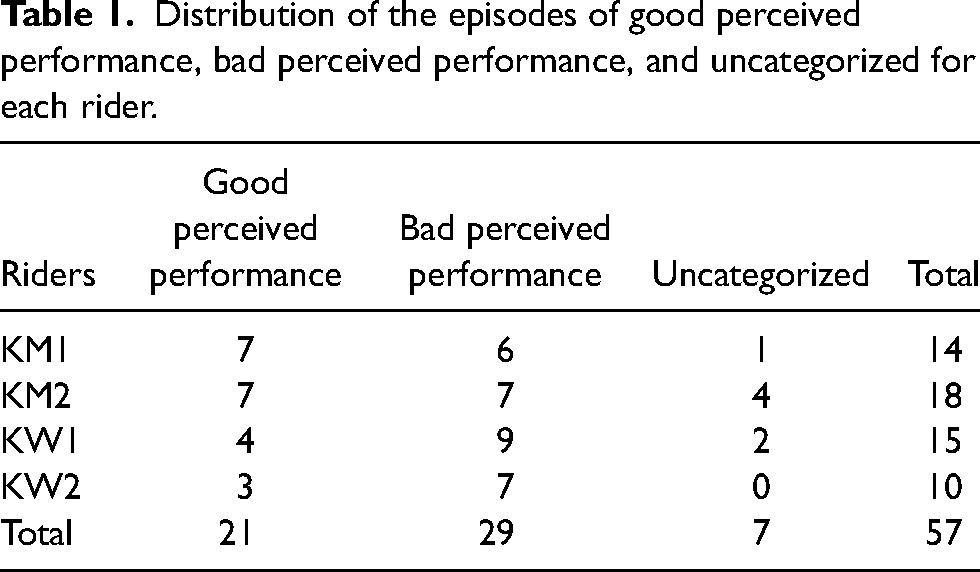
Twenty-one episodes were categorized as good perceived performance from the riders’ viewpoints, 29 episodes as bad perceived performance, and seven episodes remained uncategorized. The distribution of these episodes for each rider is presented in Table 1.
Distribution of the episodes of good perceived performance, bad perceived performance, and uncategorized for each rider.
In the following two subsections, we successively present the meaningful elements of the situation considered by the riders and the meaningful adaptive actions of the riders, related to their perceived performance.
Meaningful elements of the situation considered by the riders related to their perceived performance
Three main categories of meaningful elements of the situation were considered by the riders and associated with the episodes of perceived performance (either good or bad). Those depended on the nature of perceived perturbations and salient perceptions, which were related to features of: (a) one or some particular elements inside the rider/equipment system; (b) the functioning of the rider/equipment system considered as a whole; and (c) one or some environmental elements outside the rider/equipment system. Meaningful elements of the situation included in those three categories were considered by the riders in episodes of bad perceived performance as well as in episodes of good perceived performance.
Perceived perturbations and salient perceptions related to the features of particular elements inside the rider/equipment system. These meaningful elements typically included perceptions of the foil, kite or body positioning.
In episodes categorized as good perceived performance, the riders described their perceptual experiences as being related to the perception of fewer perturbations of the foil, and to good quality of power transmission between kite, body, and board. For example, referring to the second episode of his speed test downwind on starboard tack, KM2 described the feeling of the kite pulling in the right direction (i.e., in the direction he wants to go): “You feel that the kite… you’re being pulled forward, you feel it pulling you in the right direction.”
In contrast, in episodes categorized as bad perceived performance, they described their perceptual experiences as being related to the perception of perturbation of the foil, and to bad quality of power transmission between kite, body, and board. For example, referring to the fifth episode of his speed test upwind on starboard tack, KM1 expressed the feeling of losing lift on the foil associated with an uncomfortable position of his legs: “I extend my front leg and damn, I’m [with my weight] on the back [leg] with the foil losing lift.”
Perceived perturbations and salient perceptions related to the features of the functioning of the rider/equipment system considered as a whole. These meaningful elements included perceptions of the quality of control or flight stability without referring precisely to specific elements of the rider/equipment system.
In episodes categorized as good experiences of performance, the riders described their perceptual experiences as being related to the perception of the system's overall stability. For example, referring to the first episode of her speed test upwind on port tack, KW1 described her perception of a stable flight: “[The flight] is more stable, I feel settled, and so I have fewer small adjustments to make [to maintain a good VMG].”
In contrast, in episodes categorized as bad perceived performance, they described their perceptual experiences as being related to the perception of the system's overall instability. For example, referring to the first episode of her speed test downwind on port tack, KW2 expressed an overall sensation of struggle: “I felt like I was fighting against my equipment all the time to hold on course, and at the same time, have speed.”
Perceived perturbations and salient perceptions related to the features of one or some environmental elements outside the rider/equipment system. These meaningful elements typically included perception of the sea's surface movements and incoming gusts of wind, as well as perception of the training mates.
In episodes categorized as good perceived performance, the riders described their perceptual experiences as being related to the perception of flat-water sections, waves, or gusts of wind offering opportunities to accelerate, and the perception of being faster than the training mates. For example, referring to the second episode of his speed test downwind on starboard tack, KM2 described the way he perceived the waves as opportunities to accelerate: “You really try to read the chop, to be at the top of the wave to accelerate, and you feel that it accelerates when you go down [the slope of the wave].”
In contrast, in episodes categorized as bad perceived performance, they described their perceptual experiences as being related to the perception of waves that hinder speed or balance, strong gusts or big lulls of wind, and the perception of being behind or slower than the training mates. For example, referring to the first episode of her speed test downwind on port tack, KW2 described the perception of sailing at a worse angle to the wind than her training mate, and feeling bad about being behind her: “I kept bearing away, but less [than KW1]. I was a bit behind, I didn’t like that.”
Meaningful adaptive actions of the riders related to their perceived performance
We identified three categories of meaningful adaptive actions of the riders, in relation to their perceived performance: (a) adaptive actions to “let the equipment do its thing,” (b) adaptive actions to reach a maximal speed over a limited period of time, and (c) adaptive actions on specific elements of the system in response to perturbing events. The first and second categories are typical of episodes of good perceived performance and the third category is typical of episodes of bad perceived performance.
Relations between perceived performance by the riders and VMG
Concerning the perceived performance, of the 57 episodes of riders’ courses of experience that were identified, a total of 50 episodes were categorized as good or bad perceived performance (7 episodes remained uncategorized and have not been analyzed). Twenty-one episodes were categorized as good perceived performance (respectively, 7 episodes for KM1 and KM2, 4 for KW1, and 3 for KW2); 29 episodes were categorized as bad perceived performance (6 episodes for KM1, 7 for KM2, 9 for KW1, and 7 for KW2).
Concerning the evaluation of the riders’ VMG, among the 50 episodes that were analyzed, a total of 20 episodes were categorized as better VMG (3, 7, 5, and 5 episodes for KM1, KM2, KW1, and KW2, respectively); 11 episodes were categorized as worse VMG (2, 4, 1, and 4 episodes for KM1, KM2, KW1, and KW2, respectively); and 19 episodes were categorized as mixed VMG (8, 3, 7, and 1 episodes for KM1, KM2, KW1, and KW2, respectively).
Distribution of the episodes of better, worse, or mixed VMG within the categories of good and bad perceived performance
Within the category of good perceived performance (21 episodes), 13 episodes (62%) were categorized as better VMG, 2 episodes (9.5%) as worse VMG, and 6 episodes (28.5%) as mixed VMG. Within the category of bad perceived performance (29 episodes), 7 episodes (24%) were categorized as better VMG, 9 episodes (31%) as worse VMG, and 13 episodes (45%) as mixed VMG (Figure 1). Therefore, the episodes of good perceived performance were more likely to be episodes of better VMG (62%) than episodes of worse VMG (9.5%) or mixed VMG (28.5%). In contrast, episodes of bad perceived performance were more likely to be episodes of worse VMG (31%) or mixed VMG (45%) than episodes of better VMG (24%). Taken together, these results show a better correspondence between perceived performance and the VMG-based evaluation in the cases of good perceived performance than in the cases of bad perceived performance. However, we observe significant interindividual differences between riders (Table 2).
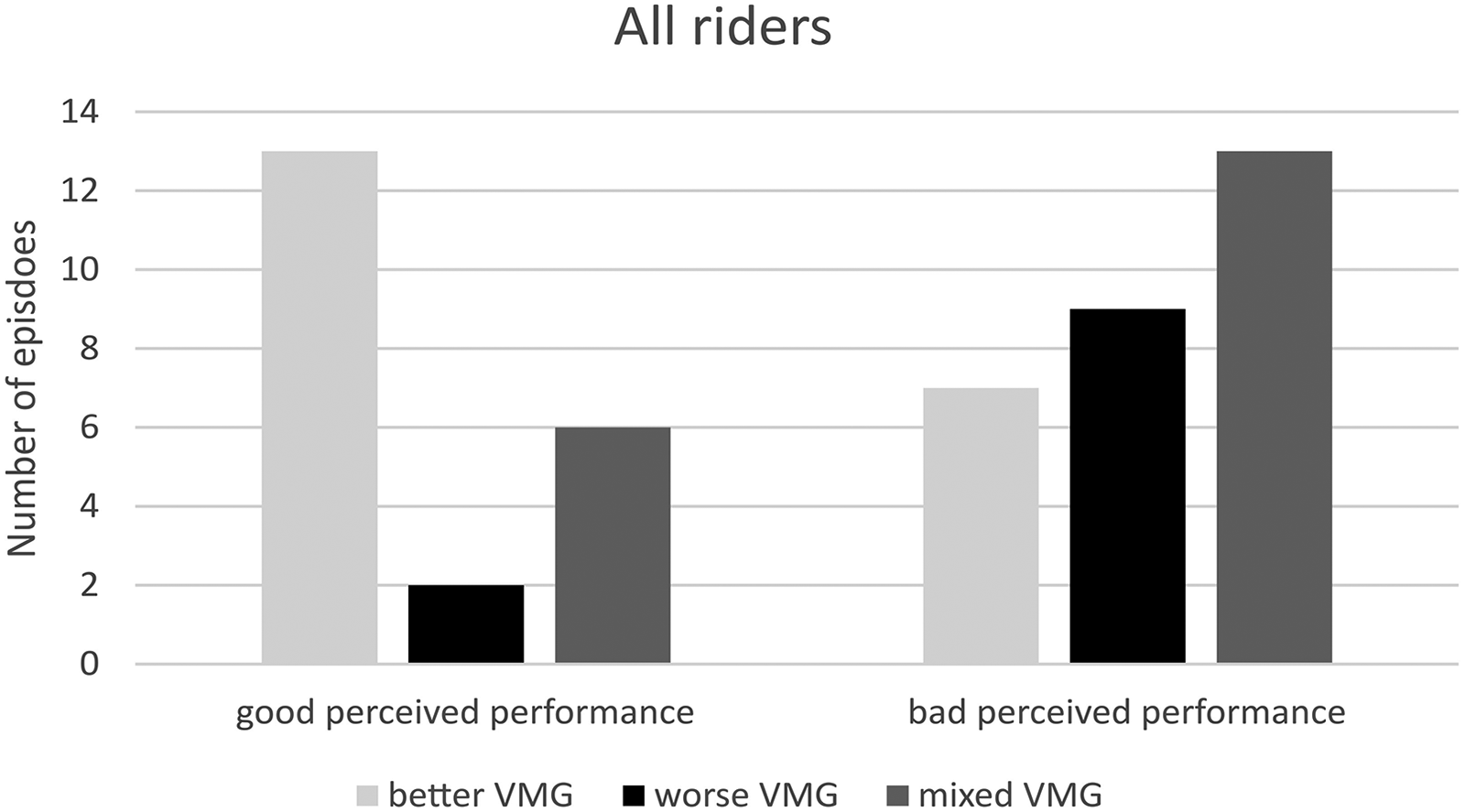
Overall distribution of the episodes of better, worse, or mixed VMG within the categories of good and bad perceived performance. VMG= Velocity Made Good.
Distribution of the episodes of better, worse, and mixed VMG for each rider within the categories of good and bad perceived performance.
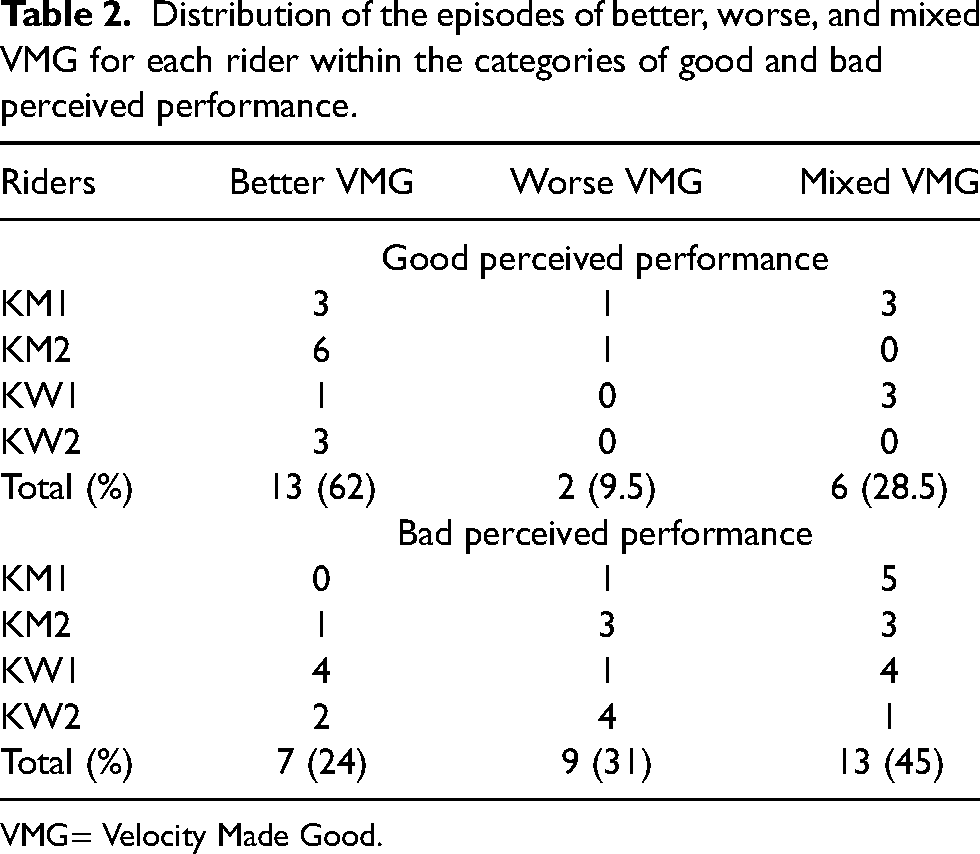
VMG= Velocity Made Good.
Interindividual differences and inconsistencies between perceived performance and VMG
Regarding interindividual differences, a different profile for each rider appears (Figure 2). The specificities of KM1's profile is that all the episodes of better VMG were also categorized as good perceived performance, most of the episodes of mixed VMG were categorized as bad perceived performance (five episodes), and the episodes of worse VMG were equally perceived as good (one episode) and bad performance (one episode). For KM1, therefore, an episode of good perceived performance is not necessarily an episode of better VMG. However, an episode of bad perceived performance is likely to be an episode of mixed, or worse VMG. The specificities of KM2's profile are the high number of episodes of good perceived performance associated with better VMG (six episodes), and the low association of episodes of good perceived performance associated with worse, or mixed VMG (one and zero episodes, respectively). Therefore, for KM2, an episode of good perceived performance is very likely to be an episode of better VMG, whereas an episode of bad perceived performance is very likely to be an episode of worse or mixed VMG. The specificities of KW2's profile is that while every episode of worse VMG is associated with bad perceived performance (four episodes), the episodes of better VMG are distributed among the categories of good perceived performance (three episodes) and bad perceived performance (two episodes). Therefore, in KW2's case, episodes of better VMG were almost as likely to be perceived as good performance, as to be perceived as bad performance. KW1's profile differs from all the other profiles as in her case, most of the episodes of better VMG were associated with bad perceived performance (four episodes), and only one episode of better VMG was associated with good perceived performance. Therefore, in KW1's case, the perception of good performance was clearly inconsistent with her VMG during that training session's speed test.
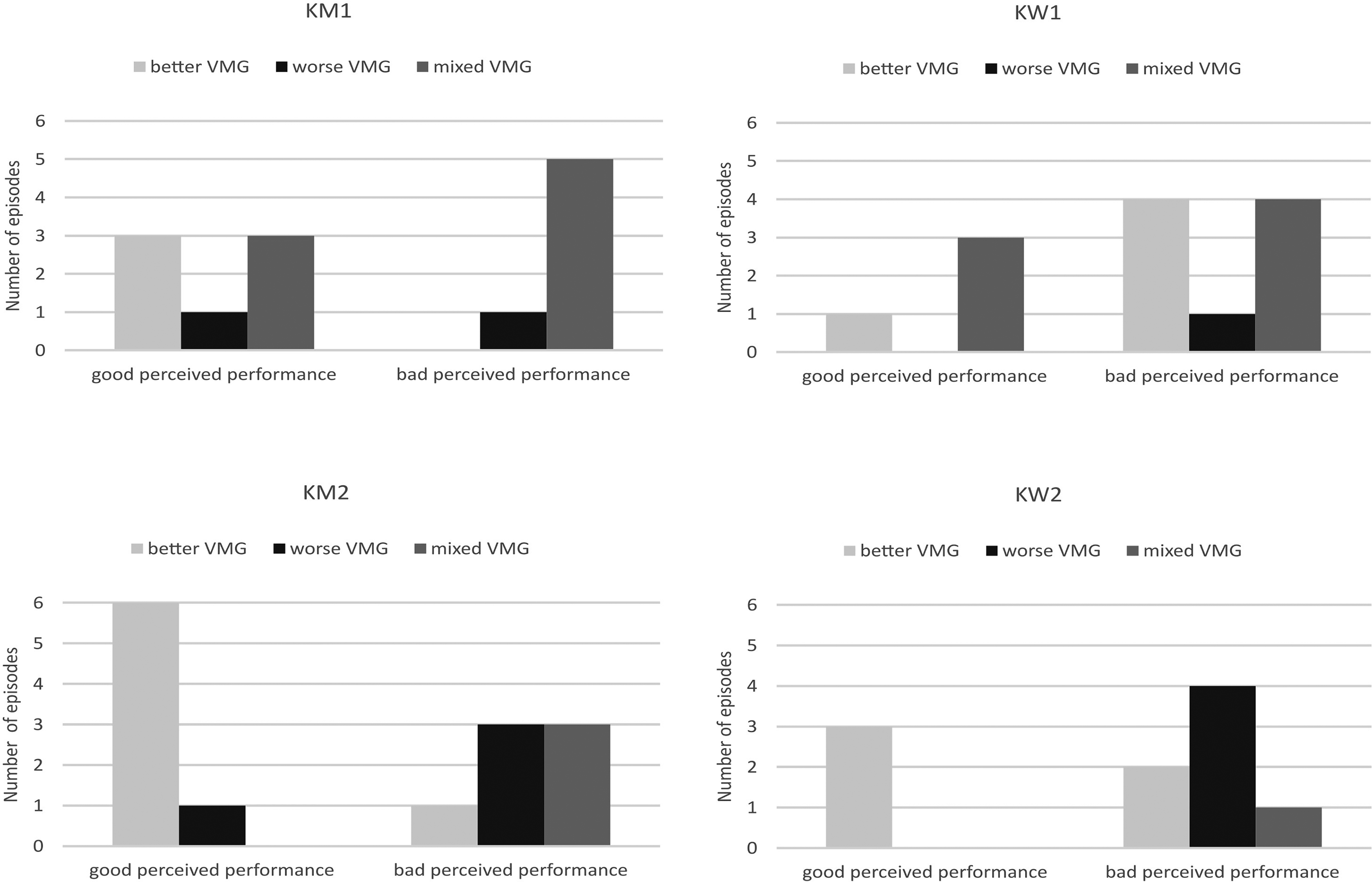
Distribution of the episodes of better, worse, or mixed VMG within the categories of good and bad perceived performances for each rider. VMG= Velocity Made Good.
Regarding inconsistencies between perceived performance and VMG, a total of nine episodes (18% of all episodes analyzed) fell into opposite categories of perceived performance and VMG. For example, during the speed test port tack going downwind, KW1 experienced an episode of bad perceived performance that was actually categorized as better VMG. Referring to this episode, she expressed perceiving vibrations of the foil through her ankles and the need to “lock” her body to overcome the vibrations. Interestingly, it was during this episode that she reached her best speed of the speed test, sailing at an average speed of 25.94 ±1.15 knots during this episode compared to an average speed of 24.36 ±1.33 during her speed test and an average speed of 25.26 ±1.12 knots for KW2 during that same period of time. In contrast, during the speed test port tack going upwind, KM2 experienced an episode of good perceived performance that was actually categorized as a worse VMG. Referring to this episode, he expressed feeling fewer ventilations of the foil, good glide, and a stabilized speed. However, during this episode KM2 was sailing at a lower speed than in other episodes of the speed test and at a lower speed than his training mate, with an average speed of 16.29 ±1.06 knots during this episode compared to an average speed of 17.05 ±1.11 knots during his speed test and an average speed of 18.10 ±0.98 for KM1 during the same period of time.
Discussion
The discussion focuses on two aspects: (a) the relationship between perceived performance and the maintenance and exploitation of possibilities for action by the rider and (b) the relevance of calibrating the riders’ perceived performance with objective measures of performance to improve training sessions.
Relationship between perceived performance and the maintenance and exploitation of possibilities for action by the rider
Results from the analysis of the riders’ courses of experience show that the structure of the perceptual experiences is similar in both categories of episodes: we found the three main categories of meaningful elements of the situation considered by the riders in the episodes of good perceived performance as well as in those of bad perceived performance: (a) features of one or some particular elements of the rider/equipment system; (b) features of the functioning of the rider/equipment system considered as a whole; and (c) features of some environmental elements outside the rider/equipment system. The omnipresence of these three dimensions of perceptual experiences is consistent with the results of Pluijms et al., 17 suggesting that performance in sailing may not be predictable by analyzing a single sensory modality but results rather from the constant integration of information obtained from overlapping sensory modalities.
However, our results show that the characteristics of the meaningful elements of the situation considered by the riders and the adaptive actions associated with episodes of good perceived performance differ qualitatively from those associated with episodes of bad perceived performance, in that they provide the riders with greater or fewer opportunities for actions to optimize their performance. Indeed, regardless of the category of the perceived perturbations and salient perceptions of the riders (i.e., related to a particular element of the rider/equipment system, to the rider/equipment system considered as a whole, or to an outside environmental element), two typical cases can be contrasted. On the one hand, in episodes categorized as good experiences of performance, the riders described their perceptual experiences as of their being little constrained and disrupted by their equipment and/or by the environmental conditions, providing a wide range of possible relevant actions to optimize or preserve their functioning. On the other hand, in episodes categorized as bad experiences of performance, the riders described their perceptual experiences as of their “fighting against” their equipment, the wind gusts or the waves. In this kind of case, riders are highly constrained by their equipment and/or by the environmental conditions, which force them to react in a certain way to preserve flight stability and the viability of their functioning.
Moreover, adaptive actions associated with episodes of good perceived performance are characterized by less effort or more controlled effort than adaptive actions associated with episodes of bad perceived performance. We argue that the reduction of the riders’ effort by letting the equipment do its thing and the controlled effort to reach maximal speed over a limited period of time, characterizing episodes of good perceived performance, can also be associated with a wide range of possibilities for action. As the riders let the equipment “do its thing,” they remain in an unconstrained action-readiness state, 40 allowing them to adapt to the situation flexibly, as expressed by KM2: “you go where you want to go.” Regarding the effort to reach maximal speed over a limited period of time, it is characterized by the capacity of the rider to control the effort and return to the previous state, therefore not exhausting the potential of the situation by preserving possibilities for action. Management of the possibilities for action on sailing boats has previously been described by Terrien et al. 4 on double-crew foiling catamarans. These authors showed that crew members regulate their activity in order to maintain action possibilities for themselves and for their partners, as well as possibilities of movement for the boat. In the present study our results suggest that from a Formula Kite rider's perspective, good perceived performance is associated with a wider range of possibilities for action than bad perceived performance. This is in line with recent developments in ecological dynamic frameworks on the notion of metastable zones,40,41 as states allowing the rapid and flexible adoption of a vast number of different action-readiness states and subsequent actions 40 to achieve optimal performance.
This understanding of the assessment of performance from the riders’ perspective can explain some of the inconsistencies between perceived performance and measured VMG. Indeed, in Formula Kite, riders travel at high speed in a precarious equilibrium resulting from the combination of hydrodynamical, biomechanical, and aerodynamical forces. Maintaining this balance presupposes a resilience of the rider/Formula Kite equipment system. When a rider loses possibilities for action, they become more vulnerable to the environmental variations generating movements of the equipment, thus constraining the rider's action even more. The example presented in the Results section, of KW1 reaching her top speed during an episode of bad perceived performance, illustrates this situation: as she felt vibrations in the foil and locked her body in position, she reduced her possibilities of acting on the system. At such a moment, an unexpected environmental variation could have dramatic consequences on her speed, and therefore is not experienced as a situation of good performance.
“Calibrate” riders’ perceived performance with objective measures of performance to improve training sessions
Our results show that for three of the four participants, the riders’ perceived performance was in line with the performance as evaluated by the VMG. Previous studies have shown that athletes are able to accurately assess their performance and the efficiency of their functioning,35,42 sometimes more accurately than their coaches. 42 Our results suggest that during speed tests, the preservation of possibilities for action seems to be a determinant factor in the perception of performance, and not only speed variations. Indeed, while “objectively” the rider with the best VMG can win a regatta, maintaining a high VMG throughout a regatta presupposes avoiding either technical mistakes or being surprised by unexpected changes in environmental conditions. The main originality of the present study is to propose an approach of performance analysis from the rider's perspective. Understanding performance “from the inside” offers an opportunity to enrich reflection on performance variables commonly used by coaches and sport scientist to analyze performance. Hence, approaching performance analysis through the riders’ perspective is complementary with statistical approaches of performance analysis.2,14 However, while technological developments now provide a wide range of tools to measure performance “from the outside” (e.g., wearable GPS, compact waterproof and shockproof inertial measurement unit), little has been done to measure performance “from the inside” in an appropriate way that takes into account the constraints of the actual practice sessions.
Nevertheless, this study has some limitations, and opens up new points of debate. First, the limited number of participants in the study encourages us to be cautious and not to over-generalize our conclusions. Second, the observed convergences and divergences between the riders’ perceptual experiences and their “objective” performance must be interpreted with caution. Indeed, while the self-confrontation interview is a well-considered method for collecting phenomenological data, the descriptions made by the athletes of their lived experience always remain incomplete. Furthermore, regarding the quantitative data, VMG is undeniably the most relevant performance measurement in sailing. However, in the natural conditions of this study, VMG was calculated using an average wind direction. Yet even if riders stay close to each other during speed tests, on some occasions very local wind shifts can affect the VMG of one rider more than the other for a short period of time, causing a risk of bias in the assessment of relative performance between the riders at these moments. Despite these limitations, divergences and convergences between first-person and third-person points of view are possible and coherent with the ontological definition of the course of experience.18,20,21 Indeed, these points of view are irreducible by nature, even if their joint analysis remains very fruitful and useful for performance analysis in sport.25,28,35 Thus, these limitations highlight a challenge for coaches and sport scientists in sports such as sailing, in which performance must be considered in conjunction with varied and constantly varying environmental conditions, and should be analyzed jointly “from the outside” and “from the inside.”
Based on the results of the present study, we advocate two complementary practical perspectives to improve training and coaching practices, to be developed in collaboration with athletes and coaches in Formula Kite and sailing sports in general. The first perspective is to implement a specific debriefing methodology after a training session, thus allowing the inconsistencies between measured performance and perceived performance to be reduced. The core principle of this methodology is to systematically and thoroughly confront the athlete's perceptual experiences with in-depth recorded traces of their behavior (e.g., video recordings) and performance (e.g., measures of VMG). This methodology, similar to self-confrontation interviews, 5 is likely to enable athletes to become aware of the moments of coherence and inconsistency between their actual and perceived performance. The second perspective is to develop a self-report instrument, as a cost-effective method, specifically designed to allow athletes to systematically report their perceived performance after each training session. This instrument could be based on specific scales to assess performance “from the inside,” to be compared to the relevant measures of actual performance. These perspectives, combining qualitative data about athletes’ experiences and quantitative measures of relevant correlates of performance, are promising directions in the field of performance in sailing, and more generally in all other sports. 5
Footnotes
Aknowledgements
The authors are grateful to the ENVSN's technical staff, and to the coaches of the Formula Kite French team, for their help in the experiments.
Declaration of conflicting interests
The author(s) declared no potential conflicts of interest with respect to the research, authorship, and/or publication of this article.
Funding
The author(s) disclosed receipt of the following financial support for the research, authorship and/or publication of this article: This work was supported by France's Agence nationale de la recherche (ANR), under grant n°ANR-19-STHP-0002 “Du carbone à l’or Olympique” (CtoOr).
