



Abstract
The aim of this study was to quantify longitudinal changes in the games of the 6 Men’s European Handball Championship (EHC) celebrated between 2012 and 2022. A total of 563 match observations were examined. Specifically, the study contained the Number of Goals, Number of Attacks, Number of Shots, Number of Saves, Offensive Efficacy (Number of Goals/Number of Attacks × 100) and Defensive Efficacy (100 − Offensive Efficacy of the Opponent). Data were examined using the Kruskal–Wallis test and linear regression analysis. Results suggest that the number of goals remained relatively constant from 2012 to 2022. However, the number of attacks, shots, saves and defensive efficacy decreased, while offensive efficacy increased. These findings can contribute to a better understanding of how handball is evolving from a structural or tactical viewpoint.
Introduction
Handball is a very popular sport, played by an estimated 19 million players. 1 On the international stage, the best players represent their countries each year either in the Continental Championship or the World Championship. Handball is characterized by brief bouts of high-intensity activity interspersed with variable recovery periods. 2 There is a commonly held belief among coaches, players and media that there has been an increase in the technical and tactical demands of the game during the last decade.
Handball evolves across time due to a combination of several factors, such as modifications of game tactics and rules (e.g. rapid re-starts following a goal, interpretations made by the rule of the passive game or the 7 × 6 rule), use of new technologies, increases of professionalism, improvements in physical, technical and tactical preparation3,4 or even the design of the competition format.5–7 For example, the rule “7 × 6” or the rule “to substitute the goalkeeper with additional field player” was modified in 2016. It allows teams to play “empty goal” while using an additional field player. 8 As it has been noted, 9 with this new rule, different attacking formations have increasingly occurred, such as 7 vs. 6 with two pivots, or 5 + 1 vs. 6, and teams are using this new offensive strategy mainly in situations of equality and numerical inferiority. 10
An analysis from seven handball National Major Leagues between 2002 and 2009 reported an increase in the number of goals per match by around 10%, from 52.9 to 57.9 passes per minute by around. 11 On the other hand, different studies reported that in many major tournaments and competitions the number of attacks per game on average remains constant.12,13 Recently, Singh et al. 14 present a new model, the Markov-match, a bivariate generalization of the Markov-binomial distribution, which gives a better fit to data than the Poisson-match for handball.
However, our knowledge about how handball is evolving, and how it will be in the future is currently inconclusive. Most studies examining the evolution of external load in elite handball are outdated, given that (a) there is few research with data after 2012, (b) they are based mainly on data from World Championship and it has been demonstrated that European teams have superiority in men’s handball over other teams,15,16 (c) the match performance parameters considered should be increased because much more information on technical–tactical performance is necessary, and, finally, (d) the number of seasons considered should be extended.
Previous longitudinal studies in other sports such as football,3,4,17–19 cricket 20 or Australian football 21 have shown how patterns of team structure and play evolve over time. The long-term trends found can be used to better understand how sports will likely continue to change.
Taking into account the aforementioned considerations, this study aimed to quantify longitudinal changes in the games of the 6 Men’s European Handball Championship (EHC) celebrated between 2012 and 2022. Knowing these evolutionary patterns may be useful for a range of applications. These include estimating future game and training demands, assisting in talent identification and player selection, helping coaches to manage the training load to improve players’ performances and reduce the injury rate, predicting the impact of rule changes and general drivers of change on the transition of field sports into the future.
Methods
Experimental approach to the problem
The study was a retrospective correlational design to quantify longitudinal changes in the games of the 6 Men’s European Handball Championship (EHC) celebrated between 2012 and 2022.
Sample
The sample consisted of 563 match observations (282 matches, two teams) from the 6 Men’s European Handball Championship (EHC) celebrated between 2012 and 2022. We have excluded those matches in which extra time was played. In addition, we did not have access to several matches of the competition (see the list below). 1 The EHC is one the most important international competitions because European teams occupy the highest position in the world ranking of national teams. For example, in the 27 editions of the World Championship, only one non-European team has won a medal (Qatar, 2015).
Procedures
The following variables were gathered from each match: Number of Goals, Number of Attacks, Number of Shots, Number of Saves, Offensive Efficacy (Number of Goals/Number of Attacks × 100) and Defensive Efficacy (100 − Offensive Efficacy of the Opponent). Data were retrieved from the official website of the European Handball Federation (EHF). To ensure the reliability of the data collecting and codification processes a reliability test was conducted by two experienced analysts, using Cohen's Kappa test. First, to assess the inter-observer reliability they carried out the codification of 25 randomly selected matches showing a good data quality (above 0.97), and then 25 matches were randomly selected, observed and compared with the EHF® reports showing a good data quality (above 0.97). Previous studies have also used data from the same source.16,22–24
Statistical analyses
Descriptive statistics were presented. The comparison between each European Handball Championship were run using the Kruskal–Wallis test because of the non-normal distribution of match statistics with Scheffe post hoc test being used where appropriate. The level of significance was set at p < .05. Effect sizes (ES) were also calculated to examine the meaningfulness of the difference (Cohen's d). Magnitudes were classified as trivial (<0.2), small (>0.2–0.6), moderate (<0.6–1.2) and large (<1.2–2.0). All these analyses were conducted using IBM SPSS Statistics (version 24.0). To assess changes across time, a linear regression analysis was done using STATA (version 17.0). In the sample, there are observations (matches) that are distinct outliers. Using a conventional rule of thumb, we have re-run the model after removing those observations with a Studentized residual larger than 3 and 2 in absolute values. The results are qualitatively the same. Additionally, in order to show the robustness of our results, we have also run more robust algorithms. A robust regression weighs the variables according to their variance so that automatically dismisses or minimizes the effect of those that are far from the mean. Again the results are similar. Statistical significance was set at p ≤ 0.05.
Results
Table 1 shows match performance indicators across the European Men's Handball Championship from 2012 and 2022. Teams performed less attacks (50.56 vs. 53.89, p < .01; ES: 0.77), with a lower number of shots (44.06 vs. 46.76, p < .01; ES: 0.56) and saves (10.60 vs. 12.45, p < .01; ES: 0.54) in 2022 compared to 2012. While the number of goals varied little between years (p < .41; ES: 0.01–0.19), the offensive efficacy increased by 10% (from 49.49 to 55.12, p < .01; ES: 0.82) over the years and the defensive efficacy decreased by 12% (from 50.43 to 44.65, p < .01; ES: 0.83).
Match performance indicators (means and standard deviations) in the European Men's Handball Championship from 2012 and 2022.
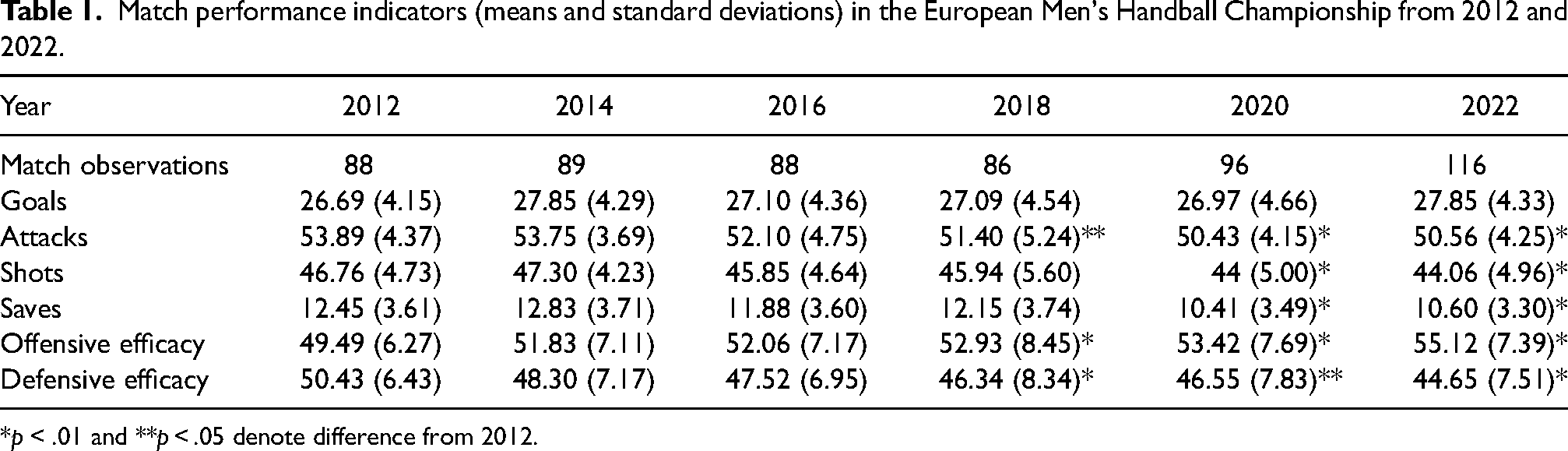
*p < .01 and **p < .05 denote difference from 2012.
Figure 1 shows that the number of goals remained relatively constant across the studied period (r = 0.01, p = .40). However, regression analysis displays a significant decrease in the number of attacks (y = 49.36–0.77 × X; r = 0.08; p > .01) and shots (y = 43.31–0.67 × X; r = 0.05; p > .01) and saves (y = 10.08–0.47 × X; r = 0.05; p > .01). It also shows that defensive efficacy (y = 43.77–1.01 × X; r = 0.05; p > .01) decreased over time significantly. Finally, offensive efficacy increased significantly across the studied period. The regression line shows that offensive efficacy (y = 55.87 + 0.97 × X; r = 0.05; p > .01) increased by 1% in every European Championship.
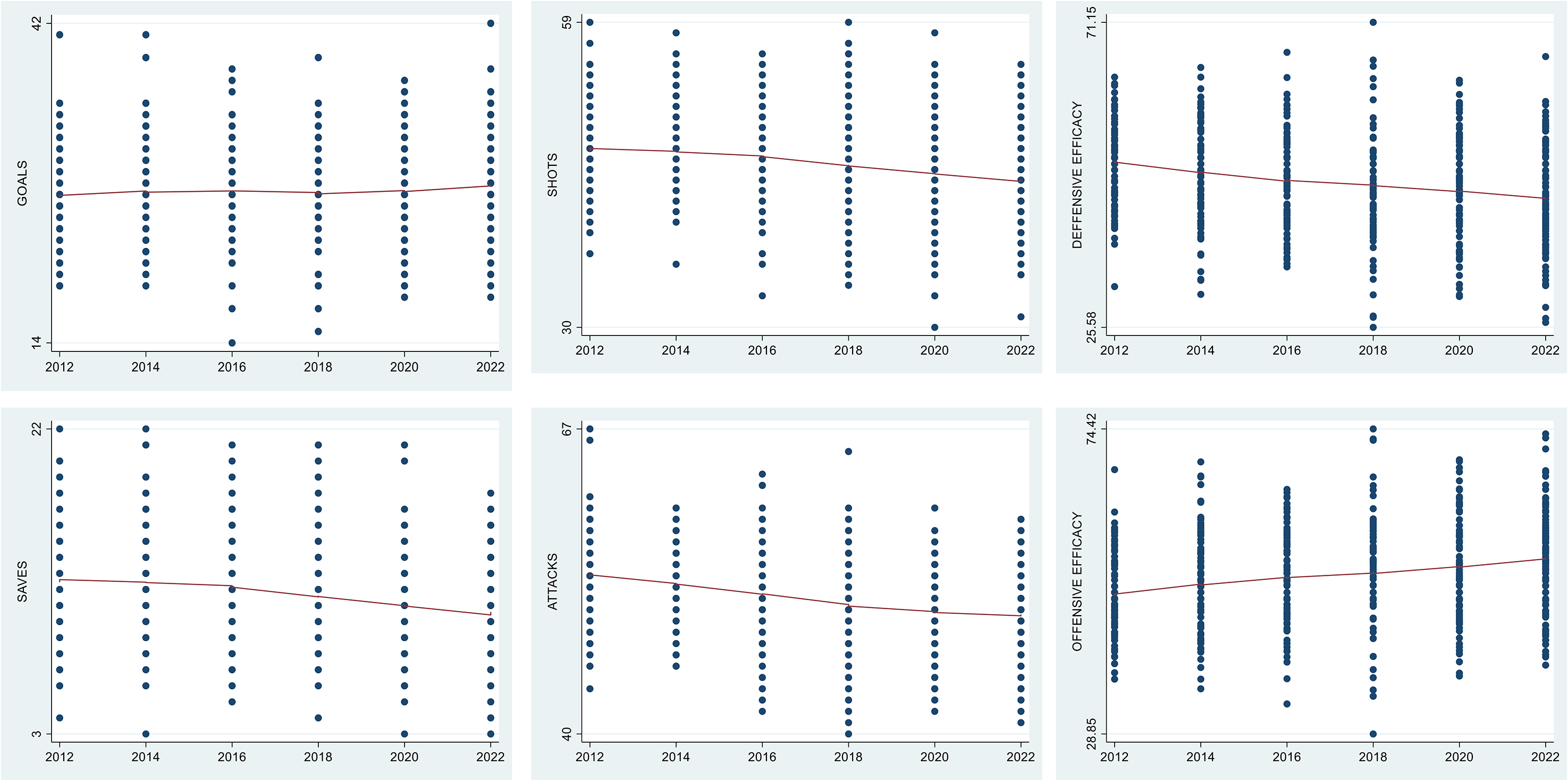
Play structure patterns in European men's handball championship from 2012 to 2022. Top left of the panel shows regression of goals (y = 27.63 + 0.10 × X; r = 0.01; p > .40). Top center panel is the number of shots per match (y = 43.31–0.67 × X; r = 0.05; p > .01). Top right panel shows defensive efficacy (y = 43.77–1.01 × X; r = 0.05; p > .01). Bottom left of the panel displays saves per match (y = 10.08–0.47 × X; r = 0.05; p > .01). Bottom center of the panel shows the number of attacks (y = 49.36–0.77 × X; r = 0.08; p > .01). Bottom right of the panel is offensive efficacy (y = 55.87 + 0.97 × X; r = 0.05; p > .01).
Discussion
Notational analysis was used to assess the evolution of European Handball Championship matches played in the period 2012–2022. Specifically, the study examined the number of goals, number of attacks, number of shots, number of saves, offensive efficacy and defensive efficacy. This research has demonstrated elite level handball has undergone substantial changes in game speed, structure and play patterns. This evolution may be due to different factors such as increases in professionalism, use of new technologies and transformation in selection and training pressures affecting player morphology, physiology and motor skills. This effect is not exclusive to handball. Other team sports such as soccer, cricket and Australian rules football have been shown to have evolved over time.17–21 The trends found in the current research along with those provided by the studies cited above suggest professionals are getting better at the processes of self-selection and conditioning. 3
Regarding offensive performance variables, the current results suggest that while the number of attacks and shots decreased by 5%, the offensive efficacy increased by 10%. These results are in line with those provided by previous studies.11–13,22,25,26 The rule changes focused on the return of the ball in court by the goalkeeper, playing the ball at the center of the court after the opposing team has scored, the 7 × 6 rule and the ratio of pivot position goals to all goals are decisions that probably have contributed to the increased offensive efficacy. In addition, this increase may be due to an improvement in tactical and technical skills and good physical preparation. 11 Handball, increasingly, requires players to be quicker, more dynamic, versatile in both attack and defense and technically qualified. 16
Despite the decreased number of attacks and shots, the total number of goals was unchanged over time (26.69 in 2012 vs. 27.85 in 2022). These results are similar to those provided by Skarbalius et al. 23 They found that the number of goals increased significantly from 52.4 to 56.5 in the European Handball Championships matches played in the period 2002–2010. Probably, this may be due to the fact that the offensive efficacy has increased significantly over the studied period.
Concerning defensive performance variables, the defensive efficacy and the number of saves decreased by 10% and by 15%, respectively, probably suggesting an evolution toward more efficient offensive strategies matched with superior skill and fitness. Future studies should verify this hypothesis.
One of the strengths of the current research is the sample used. Most of the previous studies examining how handball evolves over time are based on data from World Championship. However, it has been demonstrated that European teams have superiority in men’s handball over other teams.15,16 Thus, European teams were ranked in the top six and seven positions in the last two World Championships in 2019 and 2021. It has been demonstrated that in terms of fast break efficiency, European teams have fewer opportunities for fast breaks in competitions among themselves, while they have increased the number and effectiveness of fast break actions against their non-European opponents in the Olympic and World Championships. 16 Other variables contributing to this superiority are the pivot position and back court position efficiencies. European teams use more pivot and break-through positions than back court positions, which are considered as distant throws and less effective than other positions. This probably shows that European teams make more strategic preparation regarding the emphasis on close-range throws and throw-ins.15,16,27 Consequently, data from European Championship better reflect the evolution of elite handball.
The current findings can provide useful information to assist in decisions regarding recruitment and player list management within professional handball clubs. The trend found over the studied period may be useful for estimating future game and training demands and may help coaches to manage the training load to improve players’ performances and reduce the injury rate.
Considering the limitations of the current study, some aspects should be highlighted: (a) due to data source limitations, more physical, technical-tactical, the number of substitutions and positional related variables should be used to verify how handball evolves across time2,3,11; (b) other confounding variables such as the team ability, the quality of the opposition or the number of matches played by season should be included in future studies24,28,29; (c) different countries and competitions should be analyzed in order to verify if the current results are specific to the European Handball Championship matches or can be similar to other international leagues and competitions; (d) this study was limited to the analysis of male national handball teams. Results of the club's level of the teams may be considered separately and (e) gender differences should also be considered to understand handball evolution.
In conclusion, this study on performance analysis has described longitudinal changes in the games of the 6 Men’s European Handball Championship celebrated between 2012 and 2022. Handball at the highest level has evolved significantly and probably will like continue to change. The trends found over time suggest a decreasing number of attacks, shots and defensive efficacy, while offensive efficacy is increasing. These results suggest that professionals are getting better at these through the processes of self-selection, and conditioning.
Footnotes
Declaration of conflicting interests
The author(s) declared no potential conflicts of interest with respect to the research, authorship, and/or publication of this article.
Funding
The author(s) received no financial support for the research, authorship, and/or publication of this article.
