



Abstract
This study sought to design five touch-specific modified games and evaluate the subjective task load responses and movement characteristics. Forty-two high-performance junior Touch players completed five modified games during a single training session. Each game was designed to increase the physical, technical, mental, frustration or temporal load. Subjective task loads were measured after each game using the NASA task load index (NASA-TLX) questionnaire. Movement characteristics were recorded using global positioning systems. Data were analysed using a one-way repeated measures analysis of variance, and the association between movement characteristics and subjective task loads were assessed using linear mixed modelling. Clear between-game differences were observed in physical, technical, mental, frustration, temporal and technical load, indicating that the load for which the game was designed to increase (e.g. physical load = physical game) was higher than all other games (ηp2 = 0.118–0.211, all P < 0.001). No differences were observed across games for effort, performance, mean or total load (ηp2 = 0.004–0.030, P = 0.178–0.947). Small to large differences in the movement characteristics were observed across the five games (ηp2 = 0.057–0.577, P < 0.001–0.017). The most prominent movement characteristic associated with the NASA-TLX responses was relative distance; it was positively associated with physical and temporal load (r = 0.16–0.24, both P < 0.05) and negatively associated with technical, mental and effort load (r = −0.29 to −0.06, P < 0.001–0.353). Overall, coaches and sport scientists can design games for Touch players that increase loads through the rules, intention of the game, and by altering relative distance.
Introduction
Touch rugby (Touch) is a team sport that was founded in the 1960s and is now played at regional, national, and international standards across the globe, with 39 counties considered full members of the Federation of International Touch. 1 The demands of Touch match-play and competition have been documented within the literature,2–5 and due to the high-intensity multi-game and multi-day format, players are required to possess well-developed physical characteristics.5–8 Touch players are also required to possess high levels of technical skill and tactical awareness to achieve the highest playing standards (i.e. international). Owing to these requirements, coaches must consider the most effective training methods to develop key characteristics concurrently throughout a Touch season where often a time for the single-focus session (e.g. ‘conditioning’) is limited as most squad training sessions organised by the governing body take place over between four and eight weekend training camps.
Over the last decade of sport science and coaching research, modified games (e.g. small-sided games) have been extensively researched, and are routinely used within applied practice as a training modality that can promote physiological adaptation, develop the technical ability of players, and promote greater tactical awareness.9–14 The appeal of modified games is the increased ecological validity and ability to concurrently develop key components thought to be important for team sport athletes (e.g. fitness training, visual scanning and decision making, passing skill) through the adoption of similar rules, movement characteristics, technical actions and tactical thought processes.9–14 One of the key benefits associated with modified games is the ability for coaches to alter the format of the game through manipulation of the duration, 15 recovery, 16 time, pitch size, 17 encouragement, 18 player numbers 19 or rules9,20 – all of which influence the external and internal responses.12,18,21 Finally, modified games are suggested to increase players’ motivation to train when compared to traditional methods (e.g. ‘conditioning’). 22 These features are likely to be important in the context of Touch where time for coaches to prepare their squad for the competition is restricted and resources (e.g. finances, personnel and facilities) are limited.
The current literature supports the use of modified games; however, it is important to highlight that much of the existing research is based on soccer or codes of rugby involving contact, and places greater emphasis on the external responses and heart rate. Few studies have evaluated the perceptual responses to modified games where such insight can support practitioners designing and developing games to better reflect that of match-play. One of the few studies on psychophysiological responses to changes in workload was in professional rugby league where Mullen et al. 23 used the NASA task load index (NASA-TLX) – a questionnaire with a multi-dimensional rating procedure to capture overall workload across various subscales 24 – during a single season. The study sought to understand the psychophysiological responses of rugby league players as a consequence of the task (e.g. tackling during a game), the environment (e.g. home/away, playing position etc.) and the skills, behaviours and perceptions of individual athletes. 25 Their results demonstrated that factors such as the number of errors, tackles, sprints and accelerations as well as opposition quality and playing position influenced the responses to one or more subscales. Using this insight, Dobbin et al. 9 developed several rugby league-specific games and were able to provide insight into the perceptual responses (e.g. frustration) with reference to the purpose of the game (e.g. to increase frustration) and the movement and technical characteristics. They described how coaches and sport scientists can include key features of rugby league whilst also being able to manipulate the number of attacking and defensive involvements as well as the movement characteristics to increase NASA-TLX ratings. 9 However, the modified games used by Dobbin et al. 9 were designed for rugby league and may not be suitable for Touch. As such, this raises two important questions we set out to answer in this study: (1) What are the subjective task load responses associated with games that have been designed to specifically increase a subscale of the NASA-TLX? and (2) Which movement characteristics, if any, are associated with a higher/lower rating of subscales? To answer these, the aim of this study was to design five games that were expected to increase a specific subscale of the NASA-TLX and evaluate the responses, movement characteristics and interaction between these.
Methods
Study design
A within-session, repeated measures study design was used, with all participants completing five games of Touch rugby lasting 5 min and interspersed with 5–7 min recovery. As the study took place during an international selection camp, all games had to be completed within a 75-minute period. To account for the potential of fatigue, the participants were split into four groups (10–12 participants) who completed the games in a randomised order.
Participants
A total of 60 junior Touch players were invited to an international training selection camp by England Touch. Permission to complete the study was granted by England Touch's High-Performance Director and Head of Medical Services. Seven days before the camp, a total of 42 participants gave written assent for the study and were permitted to leave a single training session for the study. Consent was provided by the caregiver of all participants. An a-priori power calculation was conducted using the data from Dobbin et al. 9 with a repeated measured, within factors statistical test (α = 0.05, β = 0.80) chosen on G*Power. 26 The required sample for detecting a difference between games that were specifically designed to emphasise a NASA-TLX was ∼24, though to minimise exclusion and ensure it fitted within the structure of England Touch's camp, all 42 were included. Participants were affiliated with England's U15's boys, girls and mixed squads. Ethical approval was granted by the Faculty of Health and Education Research Ethics Committee at Manchester Metropolitan University (No. 40923).
Procedures
Several weeks before the study began, the researchers presented an overview of the study to international coaches with a view of gaining further insight into potential game designs that would increase the subscales of the NASA-TLX (e.g. physical load). This, combined with over a decade of working within various codes of rugby, including Touch, meant that five appropriate games could be designed by the research team. Evidence from a previous study was also considered when developing these games.
9
Each game lasted 5 minutes and the pitch size was 120 m2 per player for all but the technical game, which was 18 m2. All games were run by a rugby coach (UKCC Level 3).
The perceptual responses were assessed immediately after each game, and required players to complete the NASA-TLX questionnaire in paper form. The questionnaire consisted of two sections. Section one involved selecting the ‘most significant contributor to workload’ between two opposing loads (i.e. physical or temporal), where all combinations are presented. Section two required participants to provide a rating on a 21-point scale (0 = low/bad; 21 = high/good) for physical, mental, temporal, technical, frustration, effort and performance. The tally of responses and the overall rating were multiplied
26
to provide a total load for each construct. All players were familiarised with the NASA-TLX before the session which involved defining the specific loads and discussing the measurement scale to ensure the anchors were interpreted correctly. Any questions about the scale during the data collection were answered by the researchers. The Cronbach alpha for the NASA-TLX is 0.83
24
and the coefficient of variation between two halves of simulated rugby league match play is reported to be 6.8%.
23
The movement characteristics were recorded using a 10-Hz microtechnology device fitted with a 100-Hz triaxial accelerometer, gyroscope and magnetometer (OptimEye S5; Catapult Innovations, Melbourne, Australia) was worn by each player with the device positioned in a custom-made vest allowing the unit to be positioned between the participant's scapulae. To exclude intra-device variability, participants wore the same unit throughout all SSGs. Data from the global positioning system (GPS) were downloaded using Openfield (Catapult Sports) and inspected to ensure the number of satellites exceeded 10 and HDOP was less than 2.0 before then being truncated for on-field time only. The data were analysed for relative total and low (< 3 ms−1) and high intensity ( ≥ 3 ms−1) distance, relative distance covered within a PlayerLoad™ band of 0-1, 1-2, 2-3 and > 4 AU, and distance covered at high metabolic power (HMP), defined as above 20 W/kg−1.
Statistical analysis
Descriptive data were presented as mean and standard deviation. All dependent variables were assessed for normality through visual inspection of the data (Q−Q plot). To check for systematic differences in response to the subscales of the NASA-TLX and movement characteristics, a one-way repeated measure analysis of variance (ANOVA) was used with the F statistics, probability value and partial eta squared (ηp2) reported. Partial eta squared was interpreted as ≥ 0.01, small; ≥ 0.06, moderate and ≥ 0.14, large. 28 Where a main effect was found, a follow-up Bonferroni adjusted post-hoc test was run. Separate linear mixed models were constructed to examine the association between the movement characteristics and NASA-TLX responses across the five games. To control for random deviations of observations at individual, game and group levels from the intercept, participants was included as a random factor nested within a game type (five levels) that was nested within a playing group that each contained two teams (four levels). Fixed factors were grand mean centred but as we are not concerned with determining a ‘best’ predictor, they were not scaled. Each fixed factor was included using a step-up approach, where we started with the initial model containing only the random factors. Then, each fixed factor was entered and kept if it significantly improved the model as determined by a reduction in the maximum likelihood estimation and a chi-squared statistic. The t statistics from the final model was converted to an effect size correlation with 95% confidence limits. 29 The magnitude of the correlation was interpreted as < 0.1, trivial; 0.1–0.3, small, 0.3–0.5, moderate, 0.5–0.7, large, 0.7–0.9, very large; 0.9–99, almost perfect; 1.0, perfect. 30 All analysis was completed using Statistics Packages for Social Sciences (Version 27, IMB SPSS Statistics, Armonk, NY) (Table 1).
Random and fixed factors included in the model specification.
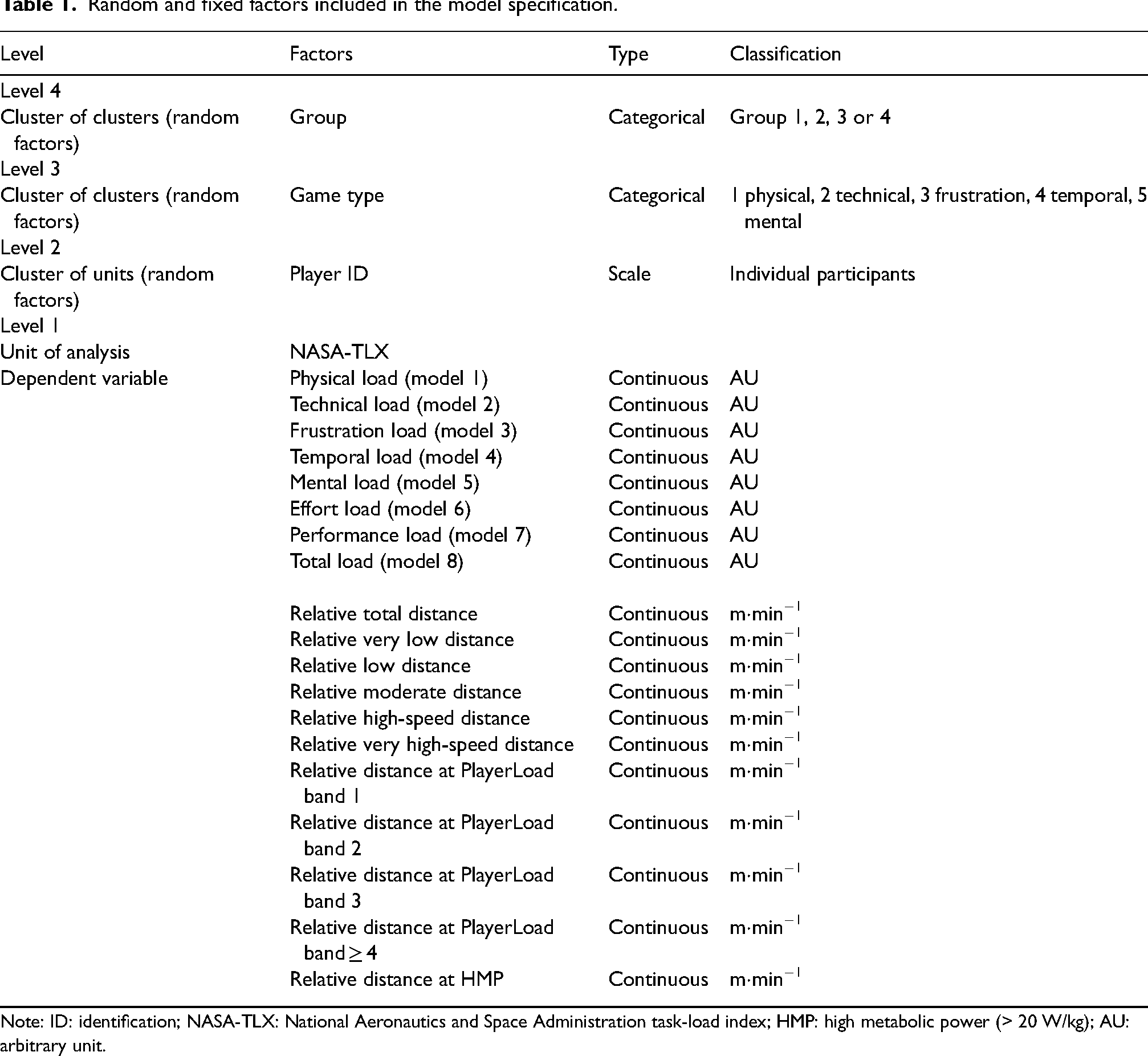
Note: ID: identification; NASA-TLX: National Aeronautics and Space Administration task-load index; HMP: high metabolic power (> 20 W/kg); AU: arbitrary unit.
Results
The NASA-TLX responses to each game are presented in Table 2. The results of the one-way repeated measures ANOVA indicated clear differences between the games for physical, technical, mental, frustration, temporal and technical load. Further analysis of the repeated measures ANOVA indicated that the load for which the game was designed to emphasise (e.g. physical game and physical load), was higher when compared to all other games (Figure 1, Table 2). No between-game difference in effort, performance, mean or total load was observed.
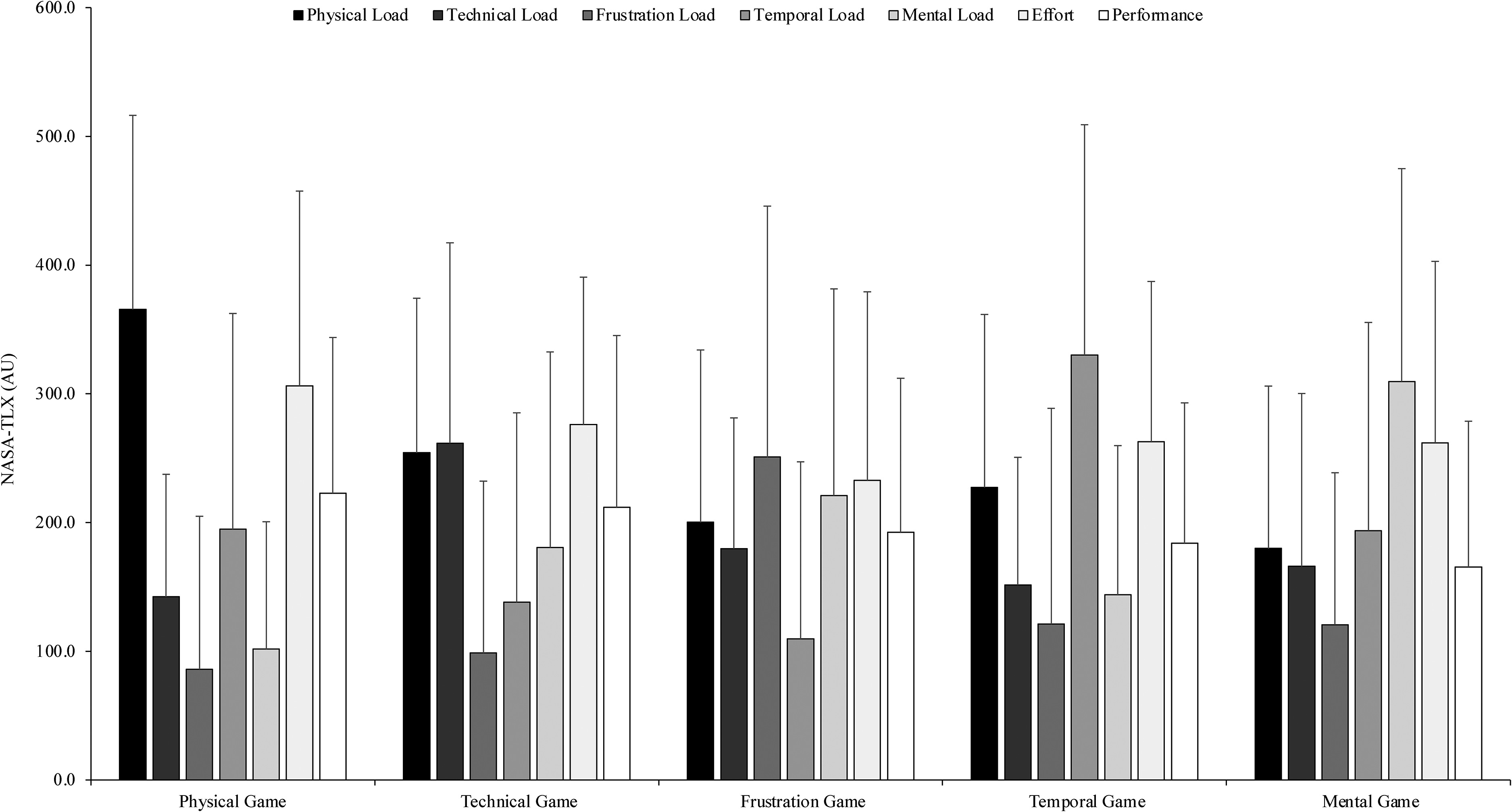
Responses to individual task loads across five Touch-specific games. Data are expressed as mean and standard deviation. Note: NASA-TLX: National Aeronautics and Space Administration task-load index. AU: arbitrary number.
Differences in task load responses and movement characteristics across the five Touch-specific games.
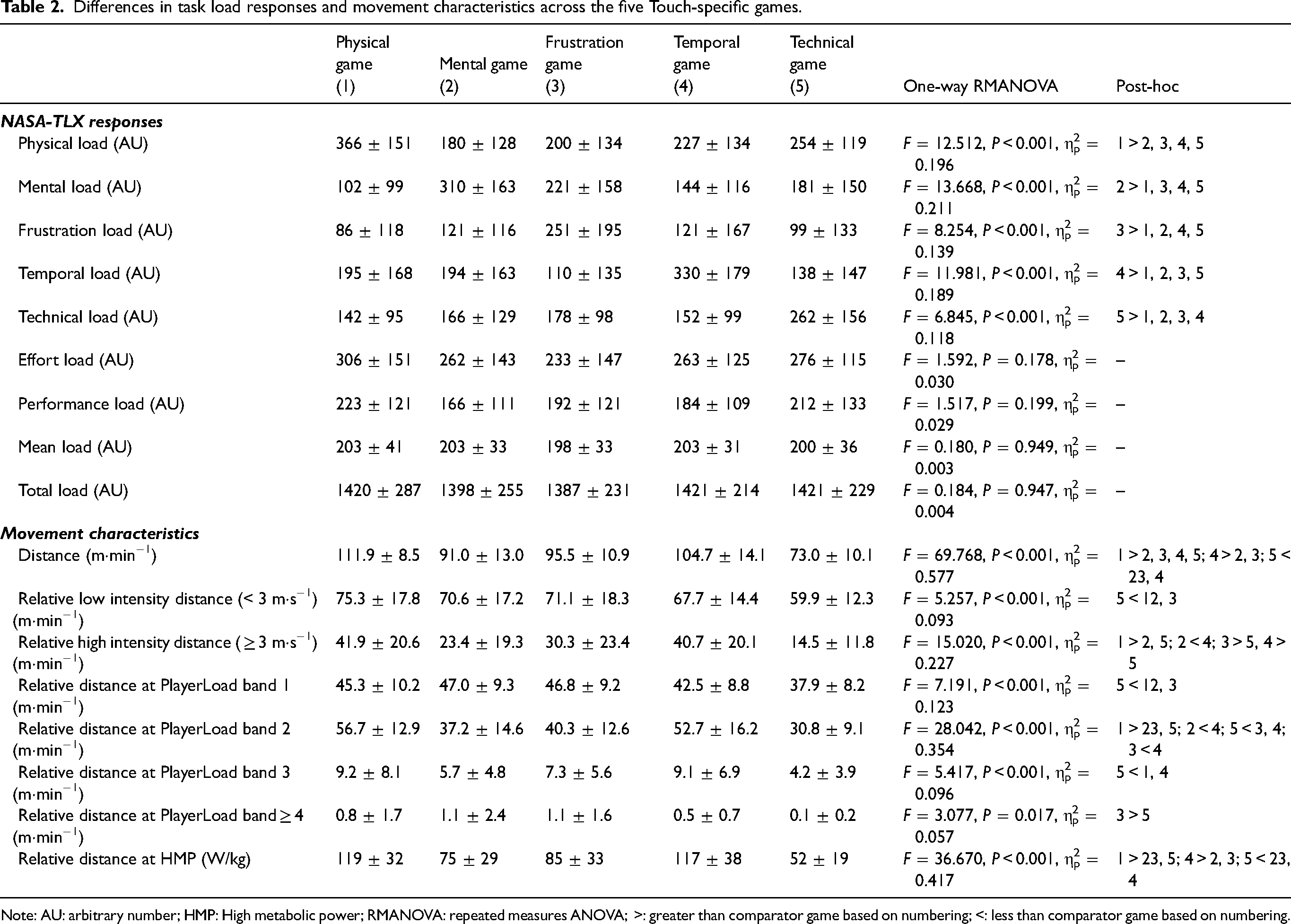
Note: AU: arbitrary number; HMP: High metabolic power; RMANOVA: repeated measures ANOVA; >: greater than comparator game based on numbering; <: less than comparator game based on numbering.
Differences in the movement characteristics were observed for all variables (Table 2), with the results indicating that the physical game resulted in greater relative total distance, high-intensity distance, PlayerLoad™ in Band 2, and distance at HMP compared to most other games. The technical game results in a lower relative total distance, low-intensity distance, high-intensity distance, PlayerLoad™ and distance at HMP compared to most other games. Fewer differences between mental, frustration and the temporal game were observed.
Few associations were observed between the movement characteristics and NASA-TLX responses with relative distance being the most consistent fixed factor (Figure 2). The relative distance was positively associated with physical load and temporal load. The estimate from the LMM indicates that for a 1 m·min−1 increase in relative distance, the physical load would increase by 0.9–3.4 AU (P < 0.001) and temporal load would increase by 0.2–2.9 AU (P = 0.022). Conversely, a negative association between relative distance and technical load, mental load and effort was also observed. The estimate indicated that for a 1 m·min−1 increase in relative distance, the technical load, mental and effort load were altered by −1.2 to −3.0 (P < 0.01), −1.1 to −3.4 (P < 0.001) and −4.3 to 1.5 (P = 0.353), respectively. Relative distance covered at a PlayerLoad™ band 2 was negatively associated with frustration (1 m·min−1 = −0.3 to 0.1 AU, P = 0.005) and positively associated with effort (1 m·min−1 = 0.06–6.68 AU, P = 0.046). Relative distance covered at PlayerLoad™ band 1 has minimal impact on perceived effort, whilst relative distance in band 3 was positively associated with total load, such that a 1 m·min−1 increase would alter total load by 0.1–2.1 AU, (P = 0.036). Relative distance covered at low intensity was negatively associated with performance (1 m·min−1 = −0.3 to 2.2 AU, P = 0.046).
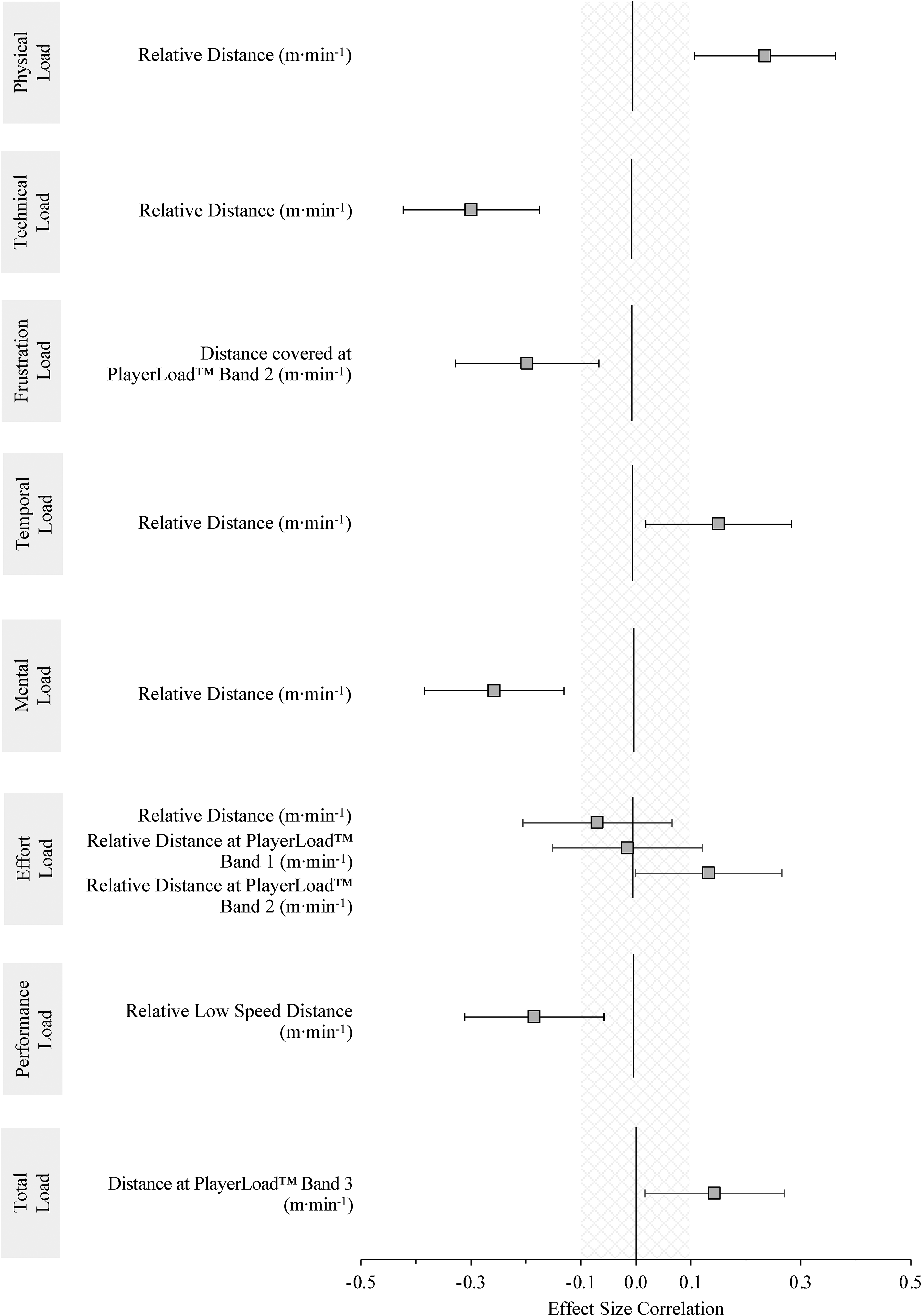
Effect size correlation between movement characteristics and subjective task load responses. Data are presented as an effect size correlation with 95% confidence limits. Note: The shaded area represents a trivial effect.
Discussion
This study sought to answer two research questions centred around the design of, and responses to, purposefully designed games appropriate for Touch. The results of this study support the notion that coaches and practitioners familiar with the sport can design games that emphasise a particular load as measured by the NASA-TLX. We present normative NASA-TLX responses associated with these games along with the movement characteristics and have shown that relative distance, low-speed distance and PlayerLoad™ can be used to increase or decrease the NASA-TLX responses as desired.
The mean weighted rating across the five games were similar to those previously reported by Dobbin et al. 9 and Mullen et al. 23 except for effort, which was considerable higher in Mullen et al.'s study likely due to greater playing duration, the inclusion of physical contact, and the standard of competition. 23 Our results for mean and total weighted ratings indicate minimal difference across the five games, thus all games, regardless of the rules, elicited a similar task load. Such stability in the mean and total task load might serve as a useful property for those using subjective task loads as part of their workload modelling 31 where the sub-scales are reduced to an outcome that describes the entire session. The lack of difference in the mean and total rating might also suggest a lack of sensitivity and failure to account for the large variability in individual sub-scales that has been observed previously using the NASA-TLX9,23 and other scales such as differential RPE.32,33 For example, in our study, Figure 1 shows that the physical game elicited a physical load four standard deviations above the mean value (366 AU) whilst frustration was 2.8 standard deviations below the mean (86 AU), neither of which are reflected in a mean or total load. Our findings emphasise the need to consider and evaluate individual psychophysiological constructs to better understanding the multifaceted demands of Touch games, especially when manipulating the rules to place emphasis on a particular skill or focus (e.g. technical load or mental load).
The observed variation in responses between sub-scales within a specific game is, in part, a consequence of our first research question and the research design. Indeed, this study evaluated the subjective task load responses to five purposefully designed games that were delivered during an international camp, each with the intention of increasing one of five sub-scales (i.e. physical, mental, frustration, temporal and technical). Our results demonstrate that the inclusion of certain task constraints within the game can be used to place greater/lesser emphasis on specific sub-scales of the NASA-TLX. The results from the ANOVA also revealed that the only load to differ from all others was the one for which the game was intended to increase. For example, the frustration load was considerably higher than all others (251 AU vs. 86–121 AU), with minimal difference between all other loads. The results for effort and performance agreed with those of Dobbin et al. 9 suggesting minimal difference across the games. Further interpretation of the ANOVA also indicated that the partial eta squared was considered moderate to large and ‘game type’ explained between 13.9% and 21.2% of the variance in physical, mental, temporal, technical and frustration loads, but only 0.3% and 3.0% for effort, performance, mean and total load.
The emphasis on physical load in this study was achieved by extending the attacking and defensive periods of the game reflecting that of a match whereby players may have to attack or defend multiple set restarts. The approach to this game was highly successful at increasing physical load whilst also maintaining mental, frustration, temporal and technical within the range observed for rugby league match-play, 23 thus potentially maintaining the ecological validity of this game. The success of this game can be explained by the extended period of attacking and defending as well as the set-restart approach (i.e. back in their own half) that maximised the space on the field. Indeed, the attacking team was required to retreat quickly to collect the ball whilst the defending team could press forward to reduce the space. This greater perceived physical load might be informed by a sense of external loads as players also covered the greater relative distance, high-speed distance, PlayerLoad™ at bands 2 and 3, and distance at HMP amongst other technical, tactical, and psychosocial factors. These findings corroborate previous findings that focused on playing time (e.g. this game included ∼100% effective or ball in play time) and pitch size per player, with both inevitably influencing the distance covered and are associated with greater perceived effort.18,34 Therefore, setting a bout period that reflects the upper limit observed in match-play, and having repeated set-restarts is an effective way for practitioners to increase the perceived physical load in the context of a game that maintains other psychophysiological loads.
Mental load and frustration were both increased by the addition of rules; specifically rules that players were unaware of and rules that were incorrectly implemented by the referee, respectively. Whilst the highest load was observed in the intended game, frustration was higher in the mental and temporal games compared to technical and physical, whereas the mental load was higher in the frustration game compared to others. This suggests that there might be an association between frustration and mental demand, such that internal (e.g. misplaced pass) or external (e.g., referee) frustration act as a source of mental load. These sources of mental load may reduce the processing capacity of the working memory system available during a match and potentially result in technical or tactical errors. 35 Data from the GPS also indicate that both games elicited similar external characteristics as well as similar physical, effort and performance load. The inclusion of unknown rules appears to be an effective strategy for increasing the mental demand associated with a game. This finding might have important implications in Touch given the multi-match, multi-day format of the competition, and that mental fatigue can impair the storage and processing capacity of the working and the execution of a technical skill or a tactical play. 35 Similarly, the increased frustration observed when the referee made incorrect calls could have important implications given numerous factors (e.g. referee, opposition, teammates and coaches) are likely to increase frustration during a match. 36 This frustration might result in distraction that ultimately reduces an athlete’s focus and task-related performance. 37 Whilst the approach in this study did elicit the desired responses on the NASA-TLX, it's important to note that the games still resembled a typical match-play and that factors such situational errors, 23 actions by the opposition, skill levels and contextual information (e.g. opposition ranking) might also influence these responses and contribute to the unexplained variances (78.9–86.1%). Skill level is particularly important within this study when considering frustration given the study included junior players with limited playing experience, a wide range in skill levels, and that few players had met previously. All of these likely contributed to errors and potentially frustration. Practitioners in Touch can use the findings of this study to implement periodised games that evaluate and increase the mental and frustration demands and serve as a starting point to understand how games can be altered in this manner.
The implementation of a 3 s rule where players could pass in any direction (off-side Touch) increased temporal load to a much greater extent than all other loads in the same game, whilst the technical game elicited comparable ratings of physical, technical and effort load. The comparable rating of physical, technical and effort load during the technical game was evident despite being completed on the smallest pitch size, resulting in the lowest relative total and high-speed distance, and less distance/time spent performing metabolically demanding actions. This finding contrasts those of Dobbin et al. 9 who observed that technical load was ‘very likely’ higher than physical and effort load in junior rugby players (15–16 years) using the same technical game. This findings could be explained by the playing experience of the group used in this study as the game might have required focus and attention due to a lower effective motor skill execution and less developed perceptual skills resulting in a higher perceived effort. 38 It could also be explained by the fact the technical game was a chase-based game that had a high focus on individual (avoiding being caught) and team (co-operation to ‘tag’ the opposition out) competition which is reported to increase perceived effort. 39 The fact this competition element is not reflected in greater values from the GPS is likely due to the fact players remained stationary outside the pitch for several short periods once ‘tagged’. Nonetheless, the findings do generally support the notion that practitioners who are involved in the development of junior athletes can use key features of match-play (e.g. passing, catching, moving into space, evading and being under a time pressure) combined with what is already known such as player numbers, pitch size and coach encouragement/instruction112,40 to increase the perceived temporal or technical load.
The second question in this study was to determine if an association exists between responses on the NASA-TLX and various GPS metrics to enable practitioners to manipulate these if desired. However, like Mullen et al., 23 very few of the variables from the GPS improved the linear mixed models and were excluded in the final analysis. This suggests that many of the external measures recorded using standardised thresholds for various speeds, PlayerLoad™ and time at HMP failed to explain sufficient variance in the subjective task-load responses amongst junior Touch players. Relative distance was positively associated with a physical and temporal load such that a 1 m·min−1 increase might also result in a 2.0 and 1.6 AU increase in load, respectively. In contrast, a 1 m·min−1 increase in the relative distance would reduce technical, mental and effort load by 2.0, 2.3 and 1.4 AU, respectively. Therefore, practitioners striving for a fast-paced game should look to maximising the distance covered per minute, whilst the reducing distance covered may facilitate a more technically and mentally focused game. PlayerLoad™ in bands 2 and 3 also appeared to be positively associated with effort and total load, respectively, suggesting a game that required changes in the rate of acceleration will increase these loads by between 1.0 and 3.4 for every 1 PlayerLoad™ unit. Overall, these findings suggest that, for the most part, GPS metrics have a limited association but that consideration for distances within a given playing period and incorporating accelerations can be used to alter the subjective task loads.
Limitations and future research
There are some limitations associated with this study and areas for future research identified. Firstly, we highlight that the study only included external characteristics based on GPS and fails to account for technical characteristics that may explain the differences in subjective task load and associations. Unfortunately, whilst the games were video recorded, the quality did not allow for accurate determination of technical characteristics at an individual level so was not included. We also note that standardised thresholds were used for all GPS metrics, and that the association might be strengthened with the use of individualised thresholds. 41 Therefore, future research might consider addressing these limitations as well as exploring the NASA-TLX responses to match-play during a tournament to allow the games to be developed in accordance with the loads experienced during a multi-match, multi-day competition. Such insight is currently unknown but warrants investigation. Furthermore, further research is warranted to explore variations in the games targeted at the same task loads, thus allowing coaches to alternate between games and avoid a possible learning effect.
Conclusions
The results of this study support the idea that coaches and sport scientists can develop games that purposefully target and emphasis specific task loads by altering the constraints in which participants (players) operate including pitch size, player numbers, rules and behaviours others (e.g. referee). Our results also suggest that coaches and sport scientists can design games that purposefully increase or decrease the relative distance required and acceleration demands, and subsequently impact the subjective task loads. The NASA-TLX served as a useful tool to centre the design of games around as well as evaluate them in an applied sport setting.
Footnotes
Acknowledgements
We thank the England Touch Association for permission to attend the international camp and work with their athletes. We thank the participants for their participation and their caregiver for supporting our work. Finally, we thank Solomon Shearer-Holtuis and Niall Manford who helped support participants in completing the questionnaire.
Author contribution
All authors were involved in the conceptualisation of the study, designing the methodology, and carrying out the procedures. ND completed all data and statistical analysis and wrote the initial draft manuscript. CH and AA reviewed and edited the manuscript before all authors approved the final version.
Declaration of conflicting interests
The author(s) declared no potential conflicts of interest with respect to the research, authorship, and/or publication of this article.
Funding
The author(s) received no financial support for the research, authorship, and/or publication of this article.
