



Abstract
The purpose of this study was to determine the relative levels of engagement novice field-hockey players had with the intent of the game's fundamental performance variables while playing on natural and artificial grass surfaces. Twenty novice male and female players (mean age 10.28 ± 0.62 years) were randomly assigned to two groups. A cross-over study design was adopted to ensure players received sessions on natural and artificial grass surfaces. Sessions were delivered over a two-week period. Data was gathered from recorded games in weeks one and two using a video drone 25 m vertically above the hockey pitches. A computer notebook with video analysis software was used for lapsed-time analysis. A specific coding template was developed to determine the frequency of fundamental game skills of ball carrying (<5 m and >5 m); hitting (ball travels <5 m and >5 m); pushing (ball travels <5 m and >5 m), and ball contact during the games. The fundamental game skills of ball carrying, hitting, and pushing the ball >5 m, and ball manipulation, revealed significant (p < 0.01) differences in favour of player performances when playing on artificial grass. In contrast, there was a significant (p < 0.01) percent of short distance (<5 m) hitting and pushing the ball, and greater ball contact on natural compared to artificial grass. The artificial grass contexts allowed the players in this study to better perform the fundamental game skills within the intent of the game of field hockey that was measured in this study.
Introduction
Advances in equipment technology have provided vast improvements in sport performance. For example, in field-hockey (referred to as hockey) the evolution of technology has played a substantial role in progressing the playing surface from natural grass (NG) to artificial grass (AG). Post the 1976 Montreal Olympics, when the first international hockey tournament was played on AG, hockey has, at almost all levels moved from being played on NG to AG. Field hockey has become turf hockey. While AG surfaces have revolutionised all aspects of the game, a perceived disadvantage of turf hockey has been its cost of installation. Hockey communities can often only afford one or two artificial surfaces, which is insufficient in providing access to all players. To overcome the demand, some hockey communities continue to use or supplement their access to AG by using traditional NG surfaces. The group that is assigned to play on NG is often younger children, novice players still in their formative playing years. Their introduction to hockey is still often, literally ‘field hockey’. However, it is unknown whether there is a difference in game-intended outcomes from introductory hockey players who participate in NG compared to those that have been introduced to hockey by playing on AG. Some may argue that the formative fundamental game skills (FGS) of hitting or pushing or manipulating the ball or playing as a team in the tactical shape of hockey, are largely experienced in the same way regardless of whether the experience is on NG or an artificial surface. Previous research reported that relative to artificial hockey surfaces pre-2008, the quality of ball-to-surface contact post that date was vastly improved due to fewer ‘wrinkles’ and ‘bumps’ in the surfaces. 1 The lead author speculated that these improvements resulted in more accurate, faster and longer passes in hockey games, thereby changing the game positively to enable players to be more confident in their play.
To date, the current literature on this topic is scant. While there are studies based on alternative NG and AG surfaces in physiological responses2,3 and other sports, for example, football: grass and AG; tennis: hard court, grass and clay; hockey-related articles are limited and focused on physiological responses4–6 or injuries.7,8 More recently, Sharma and Dasnd 9 reported that in male physical education students (18–25 years) there was no significant difference in motor skill hockey performance on NG compared to AG. However, the study did not involve any gameplay but employed closed-skill motor-skill tests of unopposed dribbling through cones and hitting the ball into a goal.
Currently, as evidenced by the literature there is a lack of knowledge about the effect that NG or AG has on the intent of the game in novice hockey players. Therefore, the aim of this study was to determine the game performance skills of novice hockey players playing either on NG or AG surfaces. It was hypothesised that novices would demonstrate superior performance outcomes in the FGS of hockey10,11 measured in this study when the playing context was on AG compared to NG.
Methods
Participants
Twenty novice male and female players with less than two full seasons of play from a primary school volunteered to be participants in the study. Ethical approval for the study was granted by the institution's research human ethics committee. Written informed consent was obtained prior to data collection from the volunteer's caregivers/parents. The volunteers were randomly assigned to two groups by the school's Head of Physical Education. The groups were comprised of 10 females (mean 10.3 ± 0.8 years) and 10 males (mean 10.3 ± 0.5 years). A cross-over study design was adopted to ensure players received opportunities to practice and play on natural and artificial surfaces. This design ensured the participants received both treatment conditions and their relative scores provided a control for the investigation. The proposed study was for the volunteers to participate in eight hockey coaching practice sessions of 25 min per session over two weeks and two assessment session sessions resulting in players having five sessions on each surface 1 (Table 1).
Study design.

Practice sessions
Practice sessions were included in the study for two reasons. Firstly, in recruiting young novice players for the study it was decided, data collection aside, that the young players also deserved to receive a positive experience from their participation. Secondly, without having an intimate knowledge of the players’ backgrounds, it was felt that delivering all players the same practice sessions on each surface over a fortnight would provide an intense experience that might mitigate, to some extent, against any pre-existing differences between the player's history of playing on these surfaces.
Procedures
Pitches
The dimension of the grass field and markings mirrored those used by the local hockey association on their hockey fields being 44 m × 30 m (1320 m2). As such the NG pitch used in the study had a halfway line marked but did not include any scoring circles, or markings found on standard hockey fields. The goals used in the study were the same width (1.5 m wide) as those employed by the local hockey association. The grass length was cut to 35 mm. The AG allocated by the school for the study was sand based with a pile of between 22 and 25 mm. We note the differences in the length of the pile that could impact the distances the ball might carry. However, the pile length was reflective of that which the players would experience through either the NG or AG such novice players would play on should they play hockey in the local competitions. The area of the turf was 45 m × 20 m (900 m2). Despite the different dimensions because the research groups combined numbers contained 10 players, compared with the hockey associations’ 14 players the relative square individual playing area was very similar, being 94 and 90 m2, respectively.
The players conformed to the national hockey safety guidelines and wore mouth guards and shin protectors. Not compulsory, but some players also used a left-hand protective glove. Players were able to wear footwear they found comfortable and all players opted for multi-function sneaker shoes, legally acceptable on the AG Players did not opt to wear stud-type footwear previously associated with playing hockey on NG surfaces.
Coaching sessions
The practices were delivered over a two-week period by an independent hockey coach experienced in the delivery of the nationally branded junior participation programme 11 at a level deemed appropriate for the age and experience of the players. The player's playing histories were ascertained through discussion with the school's Head of Physical Education and questioning the players. This information was shared with the independent coach employed to undertake the coaching sessions. The coaching sessions were discussed with the coach and agreed they would follow the format advised by the national junior participation programme. The format included warm-up game activities, for example, cats and mice; small-sided games, for example, Rob the Nest; core skills, for example, dribbling and passing and a more structured game, for example, Let's play Hockey. Teams for the in-practice game sessions were selected by the coach ensuring equal group numbers and equal females and males in the groups.
Prior to the warm-down in the first session, players were set challenges based on the coaching resource, stick and ball juggle, as well as a stationary hockey ball drag across a distance of 1 m. At this time, the hockey ball drag test, of one-minute duration, was conducted by all players on the two surfaces. The challenges set in the first lesson provided a friendly and consistent start to the sessions and players were encouraged to demonstrate any progress they had made in their challenges. A warm-down consisted of a light walk and debrief that covered some of the key learning points and comments on what they could expect in the next session. Participants all used their own hockey sticks though a supply of age-appropriate sticks was also available should participant neglect to bring their own or a stick was damaged. A mixture of standard hockey balls was used in the practice sessions, at least one ball each, while a brand ball, circumference 224 to 235 mm, and weight 156 to 163 g (Kookaburra, Melbourne, Australia) was used in the game test sessions.
Session duration
The national junior participation programme did not provide a suggested time for each session and neither did the current national Physical Education curriculum resource. 12 However, earlier Physical Education curriculum documents 13 suggested 30 to 40 min practical sessions for children in this age group. Given that the groups were small and therefore the time on task was high and quite intense, sessions were set at 25 min each. Time was also constrained by the school's out-of-class lunch-time period and the need to ensure the participants had time to return to class.
Data collection
Data on playing engagement was collected on the last day of the cross-over rotations, namely session five for the first rotation and session ten for the second rotation (Table 1). This allowed the players to become familiar with implementing the various performance variables of hockey, for example, dribbling or passing the ball on different surfaces. The collection was by way of video from a drone (model DJI Mavic 2 Zoom, Nanshan District, Shenzhen, China) hovering at 25 m above the hockey pitches.
One-metre drag test
This test was included to provide an albeit informal measure of the likely transferability the novice players displayed when trying to execute this technique in their games on different surfaces.
The 1 m drag test, of one-minute duration, consists of a player in a stationary position ‘dragging the ball using a forehand and then backhand reverse stick pull on the ball across the distance of 1 m’. Each ‘drag’ that covered the distance counted as one, as in there and back equals two. A standard 25 m measuring tape was used to place cones at 1 m intervals with a 2 m interval between the testing stations. Players were partnered with one performing the technique and one observing and counting aloud the number of drags. Observers were instructed to only count those drags that appeared to go the full distance of 1 m as established by the placing of the cones. Each player taking the test had a regulation hockey ball. Players had a brief rehearsal of the test. To ensure comprehension, the players were questioned on how the test would work and then any further questions related to the test were taken. In addition to partner counting of the scores, the coach and researcher oversaw the test. The researcher counted down from 5 s to start the test and also gave a 30 s time indication into the test and counted down the last 5 s of the one-minute test. This protocol was repeated each time the test was performed.
Data collection games
The duration for games and the data collection was set for two halves of 10 min. While, one's best was done to observe accurately these times the nature of this field research, as noted above, impacts these times.
Officiating in the data collection games
Before the games, the players were divided into two groups by the coach and briefed on safety issues. They were told safety would be the main focus of the umpiring. Basic rules such as ball striking the player's feet, outs, and restarts were observed. In order to get some flow into the NG games rather than enforced stoppages umpiring often consisted of verbal instructions to ‘play-on’ or ‘that's their ball’. This pragmatic approach to umpiring was adopted based on the coach's observations of gameplay in the practice sessions.
Video analysis
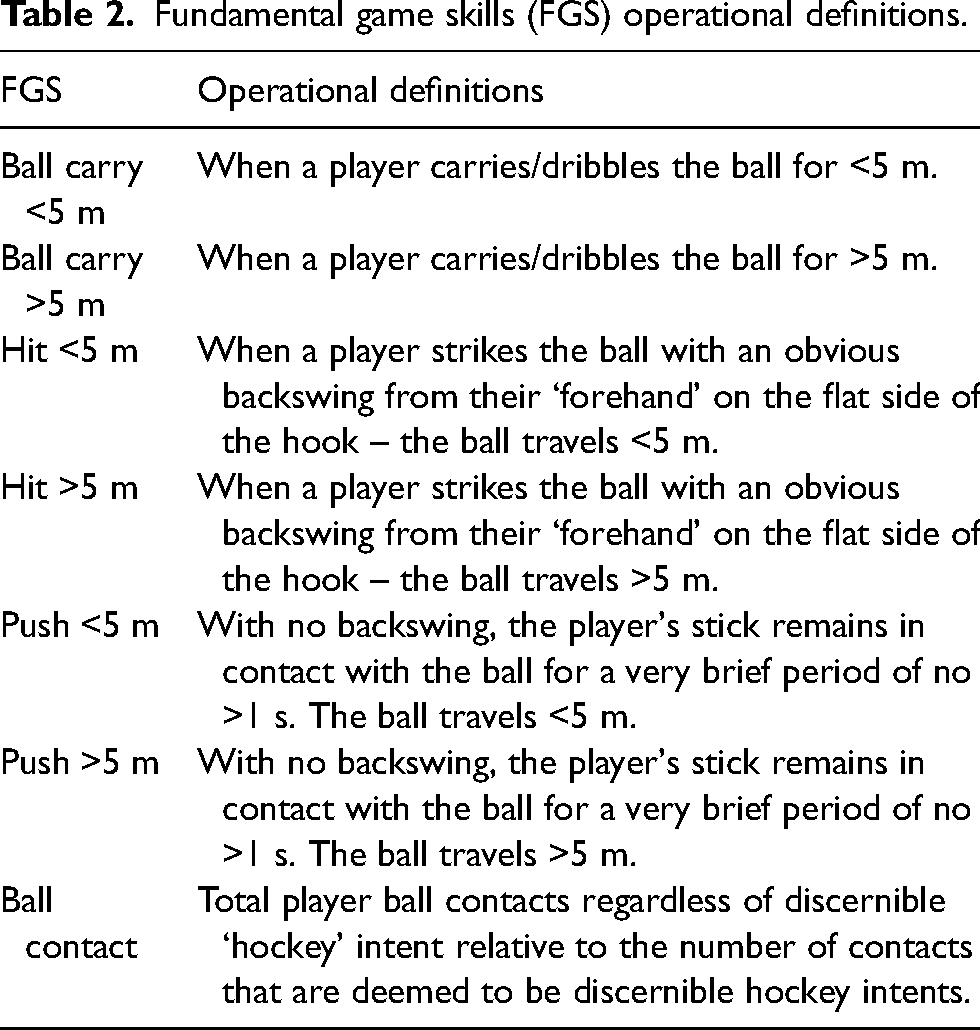
Games in sessions one and ten were recorded using a video drone (model DJI Mavic 2 Zoom, Nanshan District, Shenzhen, China) 25 m vertically above the hockey pitches. A computer notebook (MacBook Pro 3.1 GHz, OS Mojave version 10.14.6) and video analysis software (SportsCode Elite Version 11 Sportstec, Warriewood, NSW, Australia) was used for lapsed-time analysis. To determine the frequency of FGS during the games a specific coding template was developed. Each FGS was assigned an operational definition to determine a successful outcome (Table 2). A two-second lead time and three-second elapsed time were set for each FGS and all video was coded by one analyst. To determine the metric of the ball travelling <5 m or >5 m, a 5 m cone spacing that formed the pitch perimeter was used to calibrate the measurement tool in Sportscode. Using the cursor of the measurement tool the analyst was able to determine the distance of the travelled ball between the two points of interest.
Fundamental game skills (FGS) operational definitions.
Statistical analyses
The percentage of FGS was individually analysed as binomial data after logit transformation using Proc Genmod (SAS, version 9.4, SAS Institute Inc., Cary, NC, USA). The model included the fixed effects of group and surface type. The one-metre drag test was analysed using a paired t-test from the SAS function (Proc t-test). The level of significance was set at p < 0.05.
Results
On AG there was significantly (p < 0.01) more ball carrying over shorter distances (<5 m, 14.7%) and larger distances (>5 m, 14.1%) compared to NG of 5.5% and 0%, respectively (Figure 1). For hitting there was significantly (p < 0.01) more shorter hitting (<5 m, 12.9%) on NG compared to AG (7.85%). In contrast, significantly (p < 0.01) longer hitting (> 5 m, 2.2%) occurred on AG compared to NG (0%) (Figure 1).
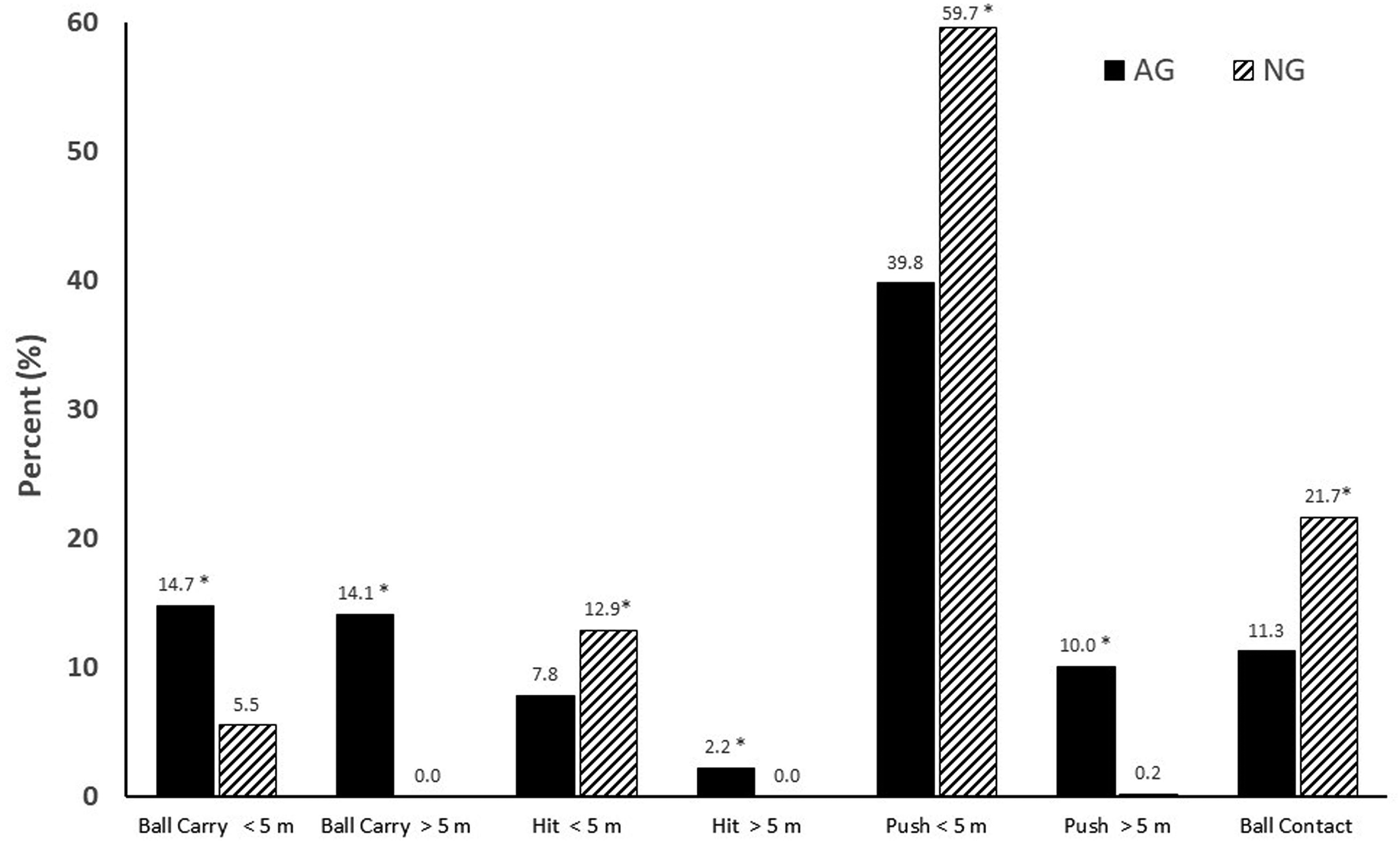
Percentage of FGS on artificial and grass surfaces.
On NG there was significantly (p < 0.01) more pushing over shorter distances (<5 m, 59.7%), whereas larger distances (>5 m) of pushing were significantly (p < 0.01) greater on AG (10%) compared to NG (0.2%) (Figure 1). The ball contact was significantly greater (p < 0.01) on NG (21.7%) compared to AG (11.3%) (Figure 1).
There was a statistical significance (p < 0.01) difference between the 1 m drag scores obtained on the NG compared to AG indicating that a greater number of 1 m drag scores occurred on the AG (Table 3).
Maximum, minimum, average and standard deviation (SD) of the one-metre drag test completed in one minute.
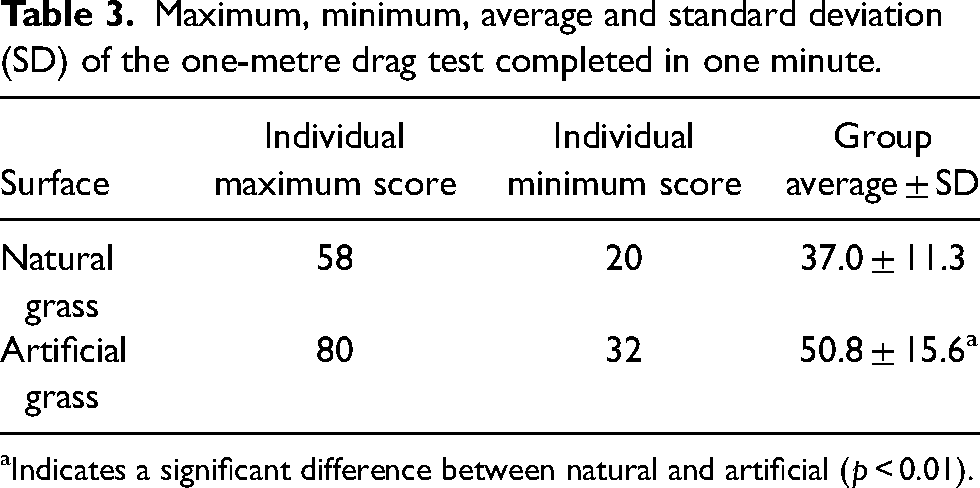
Indicates a significant difference between natural and artificial (p < 0.01).
Discussion
The aim of this study was to determine the game performance skills of novice hockey players playing either on NG or AG surfaces. The findings of the current study illustrate that four of the six FGS of ball carrying short (<5 m) and long distances (>5 m), hitting and pushing over long distances (>5 m) was significantly greater on AG compared to NG. In contrast, hitting and pushing over shorter distances (<5 m) was significantly greater on grass and there were significantly more ball contacts on NG compared to AG. Therefore, our hypothesis that novices would demonstrate superior performance outcomes in the FGS of hockey when playing on AG cannot be satisfactorily confirmed without a thorough discussion of other significant factors that may have influenced current findings.
The current observations are based on what is now standard in teacher education analysis of practical teaching in physical education. Labelled academic learning time (ALT),14,15 it is a means of measuring the time when the learners are successfully engaged in the learning outcomes for the lesson. 16 Research of this nature 17 suggests that skill acquisition is significantly linked to positive measures of ALT in physical education contexts. An ALT analysis of this present study provides a different perspective than a purely quantitative description of the data. For example, one of the key fundamental skills for the current study was to record all strikes by the participants on the game object, the ball. Analysis of the number of ball contacts by the players on the NG surface revealed they had more ball contacts than when on the AG. However, at a qualitative level with ALT applied to the data it could be interpreted as a false positive as on grass many of the contacts are merely rapidly repeated strikes at the ball. While there is contact with the game object, often in the form of ‘a ball hack’ a striking motion similar but not the same as a well-executed hitting action, the outcome is that the ball barely moves, as noted in the data, always <5 m. In fact, only one push of the ball on NG was recorded as measuring >5 m. Through an ALT lens, there is no successful engagement with this key indicator of performance on the NG surface. Conversely, there are fewer actual contacts with the ball when the players are on the AG. Examination of this data, again through an ALT-PE lens, reveals that when playing on the AG the players easily move the ball over distances >5 m. The outcome of these contacts on AG revealed that fewer contacts were required to achieve the playing outcomes of the game both defensively and on attack.
Another factor in this observation of fewer ball contacts on the AG was that because the ball travelled further per contact, there were within the time constraints, fewer opportunities for the ball to be struck or dribbled than on the NG. On the AG, a ball frequently travelled 20 m and when that was not directed as a pass to a specific player, it took the players several seconds to recapture the ball and to apply their hockey skills to the tasks of the game. This was never the case for the play conducted on NG. On the NG, the ball seldom escaped the immediate play of the players. In one instance in grass during the practice game duration, the ball was not once propelled more than 5 m. On this basis, it is difficult to suggest that both surfaces offered the same opportunities to respond to achieve the learning outcome or in this instance the game intent.
In the performance of FGS such as passing the ball to fellow teammates, it was observed that this was seldom achieved as a deliberate action by the players when on the NG surface. As such, it is concluded that the promotion of team-play through passing or adopting tactical concepts, for example, width on attack, is an extremely difficult task and beyond the level of ability displayed by these novices when they play on NG surfaces. Furthermore, the novices’ need for intense visual focus on the ball on the NG surface occupied so much of their attention that they could not attend to secondary but extremely important tasks such as their own and their teammates’ field positions. An NG surface requires greater physical effort to move the ball and players adopt a very strong but almost stationary position when contacting the ball. This body position mitigates against the players running freely with the ball a characteristic they were able to display on the AG surface.
The informal nature of the 1 m drag test has been acknowledged but it may contribute to insights regarding player ball carries or dribbling the ball on different surfaces. The current data suggests differences between the groups on the ability for an individual to dribble the ball, however, despite that difference on the AG, not one player from either group managed an individual dribble on NG that was >5 m. The, albeit informal testing of the 1 m ball drag test, reinforces the performance outcome relative to dribbling on the two surfaces as the drag scores on the artificial surface were significantly higher than when performed on NG.
While informal comments might not make for measured results transferrable to other studies, they can nevertheless sometimes be insightful. Regarding the preferred playing surface, the following comment overheard by the first author of a player and non-participant friend may be reflective of the entire group (n = 20) preference for the artificial playing surface. Player: ‘Hockey is boring’. Friend: ‘But you like hockey and you’re good at it’. Player: ‘Yeah, but not on grass’. Given one factor related to dropout in playing sport by novices is enjoyment 18 a qualitative study on player perceptions of playing their sport on synthetic or natural surfaces could provide an impetus for sporting codes to adopt surfaces that were seen as most favourable by novices in the sport and perhaps increase retention of children playing sport.
In conclusion, the levels of engagement in the techniques in small-sided games of hockey by the novice hockey players in this study were quantitatively and qualitatively more representative of the game when they played on the AG than when they played on NG. Therefore, to promote novice enjoyment of hockey and higher levels of engagement with the FGS of hockey novices should be introduced to hockey by playing on AG surfaces.
Footnotes
Acknowledgements
The cooperation of the schools and the consent of parents and caregivers to allow students to volunteer to participate in this study is acknowledged and greatly appreciated. The organisation and continuity of the study were greatly facilitated by the Head of Physical Education and Sport, Mr Clive Robertson. The assistance, expertise and of Mr Roach, in the organisation of the pilot study and the operation of his drone in the data collection was an essential component of this research.
Declaration of conflicting interests
The author(s) declared no potential conflicts of interest with respect to the research, authorship, and/or publication of this article.
Funding
The author(s) disclosed receipt of the following financial support for the research, authorship, and/or publication of this article: This work was supported by Hockey Manawatu Incorporated.
