



Abstract
Framed in the Ecological-Intersectional Model and the Stages of Career Progression Model, the objective of this study was to explore how women coaching in high-performance settings advanced through the ‘bottle-neck’ path. In total 13 women coaches from Southern Europe between the age of 28 and 46 years working in high-performance contexts were interviewed. In order to assess both the subjective perceptions of participants and the structural factors that prevent women from accessing top-level positions, we adopted a critical realist perspective to perform a thematic analysis. Results show that while women coaches may follow a linear coaching career path in their early career stages, once they try to progress to high-performance settings their careers are shaped by the metaphor of a maze. Women need to navigate through a maze while having to overcome jeopardizing factors to find a succeeding career path in sports coaching. Moreover, previous experience as elite athletes, close entourage, role models, organizational support, precarious working conditions and motherhood influenced women's development of a coaching career, with differing relevance depending on the career stage. Women coaches who reach top-level positions associate their success with casual or external factors, instead of causal explanations related to their own achievements. We add evidence on the specificities of women's coaching careers that should be addressed not only to improve their recruitment and professional progression, but also to work on reducing the probabilities of women exiting the role.
A high-performance coach is ‘someone coaching highly skilled athletes in a sports environment that focuses primarily on performance, as opposed to fun or athlete development’ 1 (p.304) and is expected to achieve successful outcomes at the highest level of competition. 2 With regard to women in coaching positions, evidence suggests that they are present in development sport (i.e. focussing on skills improvement and where the workforce nature is predominantly voluntary), but not so present in high-performance contexts, which prioritizes competition outcomes. 3 Additionally, as the responsibility and visibility of the position increases, the culture of sports aggravates this minoritization and marginalization of women coaches. 4 High-performance coaching implies extra responsibilities including social, managerial, marketing, media, financial, and even legal aspects, 5 and in the case of the few women coaching in high-performance settings, this overload generates additional impact by being the ‘only’ women in their working environment. 6 Scientific literature focussing specifically on high-performance women coaches suggests they are most likely to feel isolated, 7 experience gendered microaggressions, 8 resist different forms of power to thrive, 9 and that they are at a higher risk of stress and mental health issues.10,11
Research on women's underrepresentation within sports coaching has been ongoing for the past decades and the accumulated evidence suggests that many varied and complex barriers along with a lack of support explain the paucity of women coaches regardless of country,12,13 sport, 3 and level of competition.14,15 LaVoi and colleagues structured the findings on the topic of women in coaching positions developing the Ecological-Intersectional Model (EIM).15,16 This model, originally based on Bronfenbrenner's Ecological Model, 17 allows the examination of barriers and resources that influence women's experiences in sports coaching from a multisystem approach. Literature based on this, but also in other approaches, has evidenced far more barriers than supports at individual, interpersonal, organizational, and sociocultural levels that may explain the discrimination of women in coaching.16,18 Among other inequities, women coaches have lower salaries, fewer opportunities, poorer working conditions and relationships, and more conflicts between coaching and family commitments than their male counterparts19–21 due to a lack of organizational policies and cultural norms. 22 The underrepresentation of women coaches is associated with power relations in sports, 23 which is considered as a male-dominated social context where men occupy dominant social roles over women (hegemonic masculinity).24,25 Still, coaching is heavily associated with male characteristics and women are considered invaders when holding positions of power. 26
Despite the plethora of evidence and suggestions to tackle this long-standing problem, the continued underrepresentation of women in the coaching contexts, and especially in top-level positions, has revealed a need to go beyond a ‘snapshot’ approach about barriers and resources. In this sense, LaVoi and Boucher suggested that exploring women coaches’ careers will be useful to know where and when to support by (a) offering located resources at a specific ecological level and career stage and (b) identifying critical aspects that may cause the exiting of coaching. 27 Considering that the investigation of coaching careers is at its early stages, 28 scholars suggest two main trends related to this research topic. The predominant assumption is based on linear stage-based career models in which coaches are typically former athletes who progress to high-performance contexts through the accumulation of experience and knowledge and/or thanks to personal characteristics associated with excellence.29,30 A second trend, however, questions the applicability of linear models in high-performance coaches.31–34 In particular, this second trend suggests that linear models ‘ignore individual backgrounds, sociocultural and contextual differences, and significant life events’, 34 (p.118) hence, more holistic perspectives that illustrate the complexity of individual career development are needed. Literature on specific women's coaching careers is especially scarce but a common conclusion is that women's coaching careers and progression to top level follow a ‘bottle neck’ pathway. 35 This analogy suggests that the higher the women climb, the more constricted the pathway and opportunities become, and only a few women manage to reach the top of their profession 35 (p.455) This narrow road causes women coaches to experience marginalization and lack of control of their coaching progression, especially when aiming to high-performance contexts.34,36–38
In response to the need of advancing in the study of women’s coaching careers, LaVoi and Boucher developed the Stages of Career Progression Model (SCPM) as an evolution of the original EIM, 27 which considers different stages in women's coaching careers. The stages are as follows: (a) entice, characterized by encouraging, convincing, and enticing women into sports coaching; (b) entry, referring to the initial movement into a coaching position; (c) engagement, containing aspects related to the participation of women with, and in, their workplace and colleagues; (d) exit, related to voluntarily or involuntarily leaving a coaching position and (e) energize, where resilience is fostered and the focus is on renewal and personal growth. These phases describe the transformation of the career over time mainly considering the perspective of the individual, but acknowledging the influence of people, networks, organizational structures, power systems, societal norms and ideologies in which the coach is embedded.
As a consequence of these advances in high-performance women coaches, we know already ‘why’ women have difficulties to access top-level positions. However, we still want to know ‘how’ some coaches manage to advance through the ‘bottle-neck’ to access those top-level positions traditionally occupied by men. By drawing on the SCPM 27 our study explores the trajectories of women who accessed high-performance settings to add evidence on the factors that facilitate progression to top-level coaching positions. We seek to provide a greater understanding of women’s coaching careers and the interplay of barriers and supports at different career moments. To do so, we position this study within a critical realist approach, intending to acknowledge not only women's personal experiences but also structural elements in sports context that may explain why women following similar career paths ended up reaching different outcomes (e.g. high-performance coach vs. dropping out from coaching). Such an approach served to identify situated elements that will provide more nuanced knowledge on how to support women coaches across their trajectories.
Method
This study followed a critical realist perspective, which subscribes to the assumption of one external reality that can be understood, evaluated, and studied but never totally comprehended due to the existence of inaccessible factors (ontological critical realism and epistemological modified objectivism), 39 understanding experience as ongoing and inseparable from the sociocultural domain. 40 Drawing on Bhaskar's multilayered conception of reality, 41 scientific realism aims to move beyond the surface level (i.e. observable and empirical data) to identify the underlying processes or structures that produce the studied phenomena. 42 In the present study, we sought to build on the structures of sports coaching context that produce the reality of high-performance women coaches through the connection of their experiences across their coaching careers (i.e. empirical data) and explanatory theories and concepts used in women in coaching literature.
Sampling and participants recruitment
We sought the experiences of women that had been involved in high-performance settings (considered as those environments which are mainly focussed on performance) for at least 5 years who either (a) were working as head coaches or (b) had the highest level of coaching education and were involved in a technical staff but not as coaches. These profiles allowed to detect elements that facilitated the progression of some and caused the abandonment of others. In total 13 women from the Southern Europe context between 28 and 46 years old (M = 36.4; SD = 6.7) participated in the study. Table 1 shows the characteristics of the participants in terms of their professional situation, the positions they were occupying, the type of sport they were involved in, the highest coaching and academic level reached, and their age. To provide participants the freedom for openness during data collection without compromising confidentiality given that they could be easily identifiable in high-performance sport contexts, we do not provide specific details regarding their sport and we use pseudonyms to protect their identities.43,44
Characteristics of the interviewed women coaches.
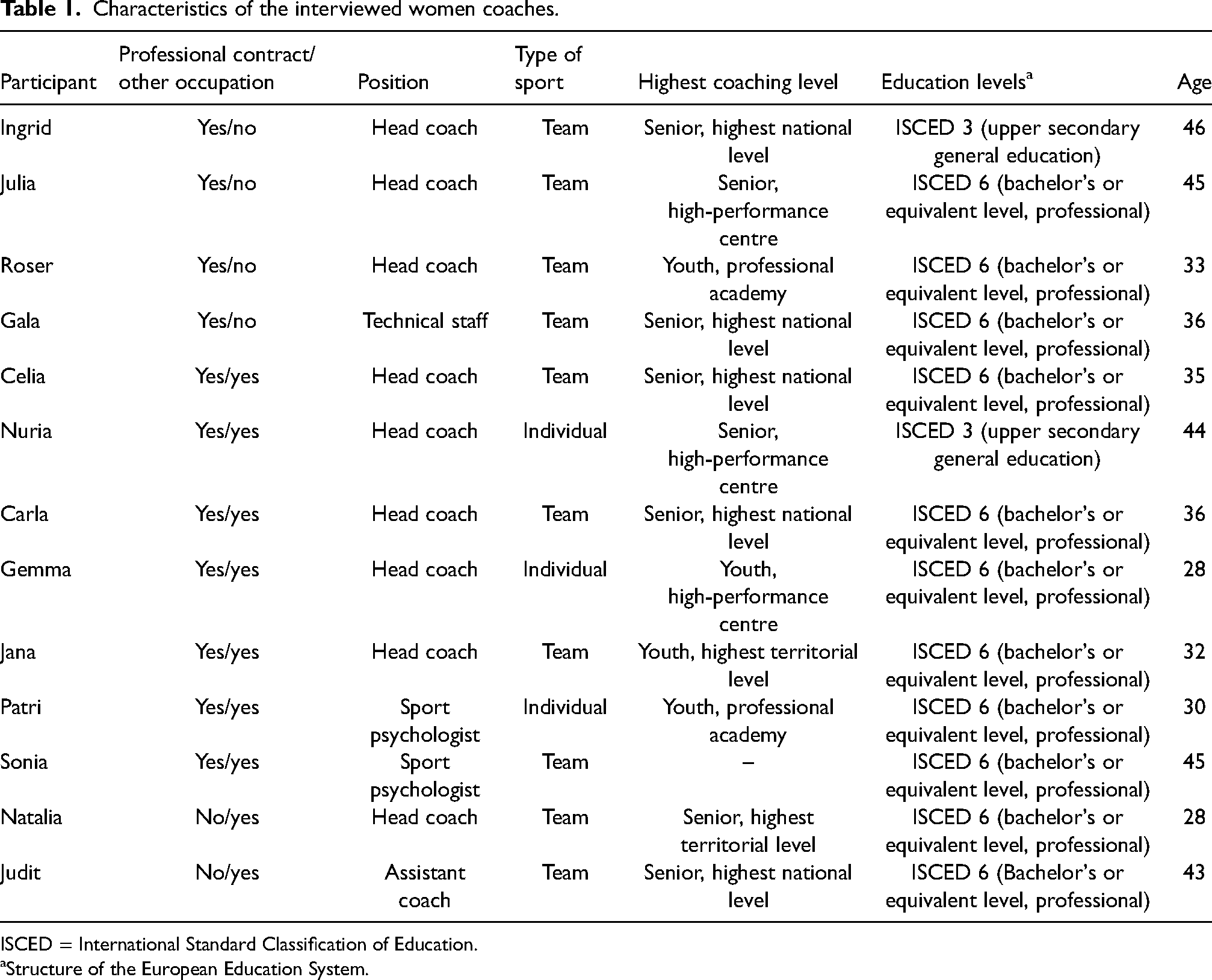
ISCED = International Standard Classification of Education.
aStructure of the European Education System.
Data collection
Following approval from a university research ethics committee (reference 4996), all participants were contacted through the first author's social networks and email, and agreed to partake in the study. Participants signed the informed consent after the first author provided information regarding the voluntary nature of the study. Between June and November 2020, we conducted synchronous computer-mediated interviews via ZOOM with each participant at times convenient to their schedules. The in-depth semistructured interviews aimed at collecting evidence of women coaches’ experiences throughout their journeys to high-performance coaching. Interview guides were designed based on existing literature exploring the experiences of women sport coaches16,18 as well as considering coaching careers from a life-span perspective. 27 We included questions on: (a) women's background in sport, (b) how they were enticed into their first coaching roles, (c) experiences during the early stages of their careers, (d) how coaches progressed (or not) to high-performance environments and experiences in their current positions, (e) aspects related to their tasks that influenced their wellbeing (f) reflections on the role of women in sports coaching. We recorded both audio and video and transcribed all interviews following Jeffersonian guidelines. 45 The duration of the interviews ranged from 24 to 103 min, producing 70 min on average.
Data analysis
We conducted a thematic analysis from a critical realist perspective, 46 in which the first author read actively through the interview transcriptions several times to become familiar with the data. A list of data-driven themes was then elaborated from the first transcript through inductive reasoning. This process was repeated for each interview and, additionally to generate emerging codes from each interview, we deductively checked the similarities of the participants’ experiences. From the demi-regularities and similarities between codes, all authors generated a list with themes about participants’ intentions, hopes, concerns, feelings, and beliefs captured in the data. Next, all authors met several times to convert that list to a list of themes that offered plausible explanations of women coaches’ experiences through abductive (abstract conceptual redescriptions) and inductive reasoning. Finally, all authors reviewed and summarized the themes and discussed about the existence of structural elements influencing in the studied phenomena, to then categorize them all into the EIM and the SCPM. In this work, we define saturation as the moment in which relevant information to answer initial research questions has been found. 47
In relation to the ethical issues within the research, we considered participants as experts and their experiences as primary sources of evidence. We approached their trustworthiness through member reflections (e.g. Can you explain this further?) and reflective questions (e.g. Is there anything else you wanted to explain? Did you feel comfortable sharing your experiences?) at the end of each interview. 48 Moreover, while all authors were involved in the analytical process, the second and last author also adopted the role of critical friends by dialoguing and reflecting on the possibility of multiple truths, perspectives, and results in the research process. 48
Results
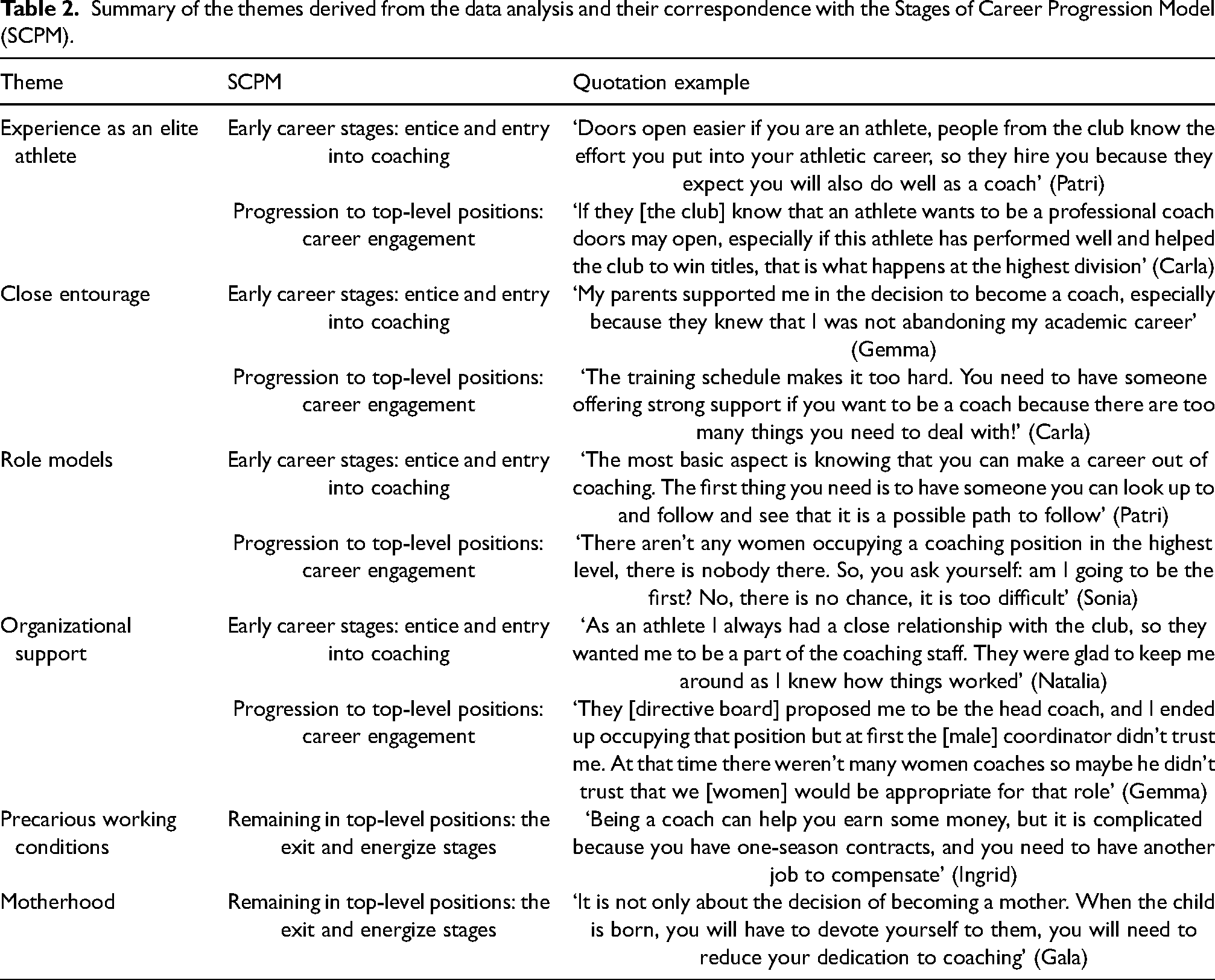
In the following section we organize the results in three separate sections according to the stages of the SCPM: (a) early career stages, the entice and entry into coaching, (b) progression to top-level positions, career engagement and (c) remaining in top-level positions, the exit and energize stages. The main themes that drifted from data analysis include previous experience as an elite athlete, influence of close entourage, presence or absence of role models, (lack of) organizational support, precarious working conditions, and motherhood (see Table 2). Experience as elite athletes, backing of the close entourage, presence of role models, and organizational support suggested a linear progression at early career stages but, as participants progressed to high-performance settings, successful career paths were more difficult to find, and the linear progression was disrupted. From that stage on, participants in top-level positions needed to advance through a maze, turning over when they faced dead-end paths looking for alternative routes that allowed access to high-performance coaching generating sufficient financial income to live and guarantee work–family conciliation.
Summary of the themes derived from the data analysis and their correspondence with the Stages of Career Progression Model (SCPM).
Early career stages: The entice and entry into coaching
In this stage, participants inform about their previous career as elite athletes along with support from their close entourage and sports organizations to enter the coaching career. However, they also indicate a lack of role models that prevent them from starting in the coaching profession.
Focussing on the individual level, experience as an elite athlete paved the way to start a coaching career. All participants had previously developed an athletic career at a high level being aware that it is common for women to leave the sports context completely after retirement to start a professional career in other fields. Although developing a career as elite athletes, only one of them fast-tracked her way to a top-level coaching position. The other 12 started as development coaches, sometimes combining their roles as athletes and coaches for a few years, and without initial expectations of progressing professionally: ‘I never thought of becoming a professional or reaching the position I’m currently at, I simply wanted to coach while working somewhere else’ (Celia). Regardless of the start, previous experience as elite athlete provides useful but insufficient resources to manage the transition from athlete to coach, as participants report difficulties in their early stages: ‘I expected coaching to be easier, that my experience as an athlete would be enough to understand athletes’ needs, but I have realized it doesn't work that way, it is more difficult’ (Gemma).
One aspect at the interpersonal level that facilitated entering into coaching was the availability of a supportive close entourage. Family support ‘plays a key role, you make the decision, but it is important that your close ones help you and encourage you to do it’ (Celia). A barrier at the interpersonal level that hindered women's interest in coaching was the lack of female role models, which may explain why women are hardly enticed into the profession: ‘the first thing you need is role models, if you have someone you can look up to, you will know what you want. If there aren't any, it's hard to perceive it [coaching role] as a plausible option’ (Celia). In general, participants reported that their first coaching role was offered by the clubs in which they developed their athletic career, increasing their interest in coaching. Therefore, at the organizational level, sports organizations enticed and supported the entry of women into coaching. Moreover, sometimes clubs offered the possibility to combine the last years of the athletic career with coaching positions in development sport to increase athletes’ commitment to the club: If you’re happy in a club, you are playing with friends and surrounded by people with whom you’re comfortable and they offer 10 women athletes to coach a team, maybe one or two will end up enjoying it and want to keep progressing (Judit).
In this sense, offering athletes a coaching role within the club was perceived as a win–win practice because it is a way of promotion and, as Natalia explains in her case, ‘the club was very happy that I agreed to accept the job because I had been playing there for some years and I already knew how everything worked’. From the sport federation perspective, there are promotional initiatives such as sponsoring women's coaching education also important for enticing women into coaching: ‘the federation offers a 50% reduction on coaching education fees for women, which may encourage women to enroll in these courses’ (Jana).
Becoming coaches is not the normative step for female athletes, in part due to the lack of role models. However, the minority wanting to start a coaching career are offered opportunities to start in development sport.
Progression to top-level positions: Career engagement
Participants suggest that having been an elite athlete and having connections with people in power positions facilitate the progression (or not) to top level. Moreover, this progression is hindered by the lack of role models and the lack of opportunities provided by sports organizations. While entering is partially supported not only by close entourages but also by sport organizations, a key decision in women's coaching career is staying in development sport or progressing to more competitive contexts. Participants stated that the normative step is to either stay on development levels or abandon their coaching role to transition to an alternative professional career: [Being a coach] it is more common while you are studying or retiring from sport, you have been in the sports context for a long time, so you start working in it. But at the end most of them will end up choosing to develop professionally in their academic field (Gemma).
At the interpersonal level, the lack of female role models also acted as a barrier preventing women from wanting to progress to high-performance contexts because ‘if men occupy fourteen out of sixteen coaching top-level positions, you may think it is not a common path to follow. It is almost impossible for you to be there, like having an invisible wall in front of you’ (Celia), which leads them to stay in development sport.
At the organizational level, the support women coaches perceive from the sports context (i.e. clubs, federations, sports organizations) is essential to develop a professional coaching career, and results show how assistance provided in their early career stages declines as the coaching career advances to more professional endeavours. The clubs offering women coaching positions in development sports did not provide opportunities to access coaching roles in high-performance settings, and this lack of opportunities may cause women to reach a dead-end in their attempts to engage in their coaching careers. Participants suggested that ‘the problem is that women's presence in positions that have the power to offer development opportunities is scarce’ (Sonia). Therefore, sports organizations should increment the number of women on directive boards ‘because there is strength in numbers and maybe then there would be more women coaches’ (Judit). In addition, participants reinforce the importance of having men who are already in power positions acting as allies by supporting the development of women coaches: It was a mere coincidence, he saw my CV on the table and recognized me, the directive board, which consisted of only men, asked him if he knew me and he said yes, so they hired me to be his assistant. I think that communication by word of mouth is more effective than having a perfect CV (Roser).
In addition, the presence of women lowers in coaching education courses as the level increases: ‘you find a lot of women on level 0 where the goal is to safeguard children's development. At level 1 women start to fade and at level 2 there are three or four, so you wonder … what is going on?’ (Sonia). This gradual reduction implies that women abandon the coaching careers and are less qualified and, in consequence, less considered for top-level jobs.
Remaining in top-level positions: The exit and energize stages
Data analysis showed that sustaining top-level positions depends on women finding a way to generate sufficient financial income to live and to conciliate the work–family domain, reinforcing the maze metaphor referred to women's coaching careers accessing to top-level positions.
Precarious working conditions
Participants intending to develop a professional career in coaching often needed to accept precarious working conditions. Women will not become coaches, and especially will not want to engage in the role, if they perceive it is not possible to make a living out of that career. Two participants stated that they exited the coaching profession due to the lack of professionalization of the role: ‘the fundamental aspect [needed] is knowing that you can develop a decent coaching career, the first thing is to facilitate the professionalization of the role’ (Patri). At the same time, the precarious working conditions led high-performance women coaches to combine their coaching role with other professions to generate sufficient income which, in turn, compromised their wellbeing in the energize stage. High-performance women coaches reported tiredness and ill-being symptoms associated to the demands derived from the role and multiple works they needed to engage with: ‘this whole semiprofessional level involves this handicap. In the morning you need to work to earn money and then go to training in the evening, and by the time you get home is almost midnight’ (Judit). Another aspect that compromised their mental health was related to the task of being a high-performance coach, and coping resources were sometimes perceived as insufficient considering the demandingness of the role: ‘you are in charge and that requires a great effort, you need to invest a lot of time and you are under a lot of pressure and sometimes I don't have the resources to cope with everything’ (Celia).
A support at the organizational level was being employed (part or full time). Women who were employed as coaches could prioritize sport over other jobs, which often were complementary and part-time (e.g. teacher in coaching education courses). However, not all women coaching at top level had a contract of employment, so most of them needed to prioritize other jobs as their main financial income. Multiple occupations can be detrimental for the sustainability of women coaches’ careers: ‘it is very hard, especially if you focus on the work domain, because you need to survive and up to day we can't make a living out of sport’ (Celia). An organizational barrier that may cause women to abandon coaching roles in high-performance settings was the uncertainty regarding their future as they are evaluated based on their teams/athletes’ results: ‘reaching the top means insecurity. You will get better paid, you’ll have resources but maybe in two weeks you’ll get fired’ (Jana). Additionally, Gala described the difficulty of long-term planning due to the temporality of their professional contracts: I’ve been a professional for more years than I can remember and I have always had one-season contracts. I sign until the season ends in June and then I don't know what will happen (…) there is a real possibility of firing the whole staff if we start losing games. So long and medium-term goals are not for me, I don't want to have high expectations because I don't want to get disappointed.
If women coaches could, they would prioritize sport: ‘I would love to train in the mornings, waking up and going to train and that my workdays were like that’ (Natalia). In fact, although a minority, some of them were dedicated exclusively to coaching and this type of dedication supported the development of their careers: ‘I’ve been a professional for four years and that changed my whole life, I’ve been able to buy a car, which I couldn't do before. Now I can imagine a future with my husband, have children and buy a house’ (Roser).
Therefore, women will not advance through their labyrinthic coaching career unless they find an open door to being employed as coaches, preferably full time and as professionals to reduce the risk of mental health problems caused by multiple occupations they usually need to have.
Motherhood and the work–family balance
Motherhood is considered a key factor affecting women's decision to continue in the coaching pipeline and it needs to be addressed to energize women in coaching positions. Participants suggest that the decision to become mothers is a turning point in women's coaching careers. It is a cause of abandonment of many due to the uncertainty of how it is going to affect their jobs and, those who decide to continue in coaching after childbirth, report difficulties on the work–family conciliation due to the lack of policies aimed at supporting mother coaches. Gala explained that women coaches are unaware of how pregnancy can affect their position: ‘[maternity] is a taboo. I am not thinking about it now but what if I were? I have a job in which I don't know what would happen and no one there [at the club] would have an answer to that’. This uncertainty about motherhood is often accompanied by fear of losing their coaching job: ‘I planned everything in detail because I was afraid I would lose my job. I have ten-month contracts which I renew every year, and I feared that I wouldn't get renewed’ (Roser), which altogether may explain why women who want to be mothers either stay on development sport or exit coaching. In this sense, women considering motherhood end up facing the decision between following a coaching career or having children: ‘it is hard for women coaches at high-performance settings because when we have a child, we have to stop for two or three years and that places you out of the professional market’ (Julia). Nuria also described how she reduced her dedication to coaching to focus on her family: I stopped coaching at my club. Now I want to devote myself to my family and to work on the family company in the mornings. I’ve gone from being the lifelong coach-manager of a club to be a mother.
This is aggravated in sports that imply travelling for competitions, which is something usual in high-performance settings, as travel requirements may interfere with family responsibilities. This aspect is also relevant for aspiring women who may perceive they cannot pursue a coaching career at top level if they want to have children: If you are a high-performance coach and you need to travel for 30 weeks a year, the situation gets worse, it is very hard. In fact, I think that it is one of the main reasons stopping us [women]. I want to be a mum, I have talked to my partner and it is difficult to make the decision because in the end you need to lower the dedication to sport or to motherhood. We need a solution because right now it is very difficult to combine the two spheres (Gemma).
The support of the close entourage at the interpersonal level facilitated mother coaches development in high-performance contexts. As the demands associated with the coaching role increment, women need more resources to balance their coaching career with the work and family domains. Parents and partners are the key agents providing this support at this moment of their trajectories. For instance, Roser explained how ‘I leave my daughter with my parents because she does not go to school yet and I have to leave for work every morning’. In a similar way, Carla exposes how her husband is her only support: The only one helping me is my partner, he is the one paying the price. He is the one dealing with everything I can't manage because there is no help or anything. Let's imagine I get divorced in the future, who is going to take care of my children when I go to train at night? I’d have to pay for a babysitter, which is not cheap, and with what I earn from coaching it is not enough. It is so hard, we have to find a way.
The support of the close entourage was essential to compensate the lack of support perceived at the organizational level. Mother coaches demand specific actions and policies towards the work–family conciliation. For example, Roser reported difficulties during pregnancy as her club had never experienced a similar case, so they had to create an ad hoc action protocol: When I was 28 weeks pregnant the medical services called me to carry out a labor inspection because it [pregnancy] wasn't considered a possibility within the coaching position since they never had a similar case, they never had to arrange a pregnancy leave before the child was born as they only had male coaches. I was going in and out of the hospital for three weeks just to determine the risk that pregnancy had for the job and how they could manage the situation.
This need of support during pregnancy was also perceived throughout the development of their career as mother coaches: I’ve gone to competitions with my daughter and the organization told me she couldn't be on the field because it was dangerous. What can I do? Where do I leave her? She came with me and I have to coach the game. Federations should do something. The image of coaches having their children on the bench should be normal (Carla).
At the sociocultural level participants consider they hold more responsibilities regarding children care in the work–family conciliation, which may slow down women's coaching career progress and interferes in their energizing. Roser explained how she found differences between her and her male colleagues in this regard: Five male coaches had children at the same time as me. None of them took days off for being a father. They do not even think about reducing their coaching dedication because mothers will take care of their newborn. I am sure they are good fathers, but it feels like we [women] have an extra responsibility when it comes to parenting.
Therefore, women coaches intending to thrive in high-performance settings need to find an available path that allows the combination of being mothers, with all the associated responsibilities, and their coaching careers.
Discussion
This study presents a pioneer empirical examination of high-performance women coaches within the Southern Europe context using the SCPM, 27 offering insights into the interplay of barriers and supports at different career stages, as well as structural elements that should be addressed to tackle the gender imbalance in coaching. Findings show that women's coaching careers in high-performance settings have a linear start with identifiable entry doors to coaching positions, but after the entice and entry stages, the path to progress to top-level positions gets more challenging to find, and their careers eventually take the shape of a maze. Findings in this study suggest that while there are individual and interpersonal factors supporting early career stages (i.e. entice and entry), once women coaches try to advance to professional coaching positions (i.e. engagement stage) the main path gets blurred and organizational and structural factors limit their progression, hindering their personal growth and forcing some women to choose between engaging or exiting (i.e. exit and energize stages). This idea challenges previous literature suggesting that coaches follow linear models of career development, symbolizing career progression as a ladder and implying an advancement through normative career steps. 30 In that sense, the findings align with evidence suggesting that women survive more than thrive in the current sports system.9,49,50 Hence, this study reinforces the need to study women coaches’ careers from viewpoints adapted to their reality and not from traditional career models developed from a male perspective. 27 High-performance women coaches in our study are unaware of how they reached top-level positions and report casual (i.e. with no planning or intention) or external (e.g. through allyship) reasons for their success, in detriment of causal explanations highlighting their own achievements. 51 This perception reinforces the idea that there is no existing career path for women coaches who want to achieve top-level positions.
Moreover, this work is oriented in studying women coaches’ trajectories evaluating each career stage to understand the particularities of each period. Supporting and limiting factors’ relevance varies across women's career stages. Experience as a former elite athlete is key to entering the coaching profession and it is seen as the only way to progress to high-performance settings. While previous research suggested that hiring former elite athletes as coaches is common,38,52 our findings go beyond by pointing that, for women, this is practically a non-negotiable condition. Athletic experience does not exempt women coaches from facing difficulties derived from the change of role (athlete to coach), which points out the need of supporting women during this transition to facilitate the entice and entrance into coaching, and preventing women from abandoning this role due to those difficulties. We thus emphasize the need of studying coaching careers from a transitional perspective, as a process with several stages with specific demands that need to be successfully coped one by one to sustain in the career. 28
The lack of role models seems to be perceived as a key reason that may explain why such a low number of women decide to engage and energize to professional coaching contexts. This invisibility has previously been noted in research,25,27 which also suggests that visible same-identity role models increase women's self-perceptions in male-dominated professions and inspire female athletes to pursue a coaching career.53,54 Consequently, policymakers in sports organizations should work better to increase the number of women occupying coaching roles giving them the notoriety to existing role models. Although clubs regularly provide women with their first job as coaches and sports federations entice women to coach education, a lack of organizational support is perceived when considering opportunities to access high-performance coaching positions and engage with the coaching role. 55 Our participants report that progression in women's coaching career usually depends on the opportunities provided by a man in power, thus supporting evidence about the importance of gender allyship to allow women coaches’ development. Gender allyship considers men as part of the solution as they occupy most power positions within sport organizations, so they can create change by hiring and promoting women coaches 56 not only to increase the number of women coaches but also to create organizational and cultural change within the sports systems. 57
The close entourage seems of key importance for women coaches both at the entice and entry stages by supporting women's decision to become coaches (i.e. family), 52 and also becomes even more crucial further in the career, when women engage with the coaching role by supporting the work–family conciliation (i.e. partners).20,58 The support from the close entourage is essential because it compensates the lack of organizational support perceived in relation to the working conditions and motherhood, which we suggest as two structural aspects that can lead women to engage or exit the coaching pathway and hinder their personal growth. More research on this topic and the role of all the agents involved in the entourage is needed.
When looking at working conditions, women tend to occupy more precarious leadership roles in comparison to their male counterparts. 19 High-performance women coaches often have multiple jobs to be financially stable, which, added to the demands derived from their role might arise ill-being symptoms such as burnout, putting women in increased risk situation of presenting mental health issues.10,11 Therefore, the professionalization of women coaches is necessary to improve their working conditions, which in turn will safeguard their mental health.
Motherhood is not considered to be influential on women's decision to become coaches in the first place, but it becomes relevant in the decision of progressing to top-level positions and in the engagement, exit and energize stages. In addition to supporting previous literature suggesting that children caretaking is unbalanced between genders,20,59 this study adds that uncertainty about the impact of motherhood on women's profession due to the lack of policies that may explain why they disrupt their careers when they decide to have children or slow their professional progress more acutely than their male counterparts. In this line, support strategies should be aimed not only to energize and support mother coaches in the work–family conflict but also to support women who want to have children by supporting them during pregnancy.
Finally, results also show a need for a structural change in the sports context. Sports is a male-created and male-dominated social context in which hegemonic masculinity still prevails and men are seen as worthier and more competent to occupy coaching positions. 19 In this sense, sport policies are created by and for men, which may explain why the combination of motherhood with a coaching career is still an unsolved matter in the sports context.
Practical implications
The results of this research suggest that sports organizations should develop more actions to promote the engagement of women in their coaching careers. For instance, national governing organizations, sport federations and clubs could develop initiatives to increase the visibility of existing female role models to inspire young athletes to follow similar pathways after retiring from sport. In addition, the development of women-only coaching education courses should be considered to entice women into coaching and to increase the number of women progressing through coaching education levels.
Previous athletic experience has shown to be necessary but not sufficient condition to cope with the demands derived from the coaching context. In consequence, mentorship programs in which expert coaches supervise novice coaches can be useful to facilitate women's entry to coaching positions and to prepare them with necessary skills to sustain and thrive in their role and even when women coaches engage in the profession and have the intention to access high-performance positions. In addition, fostering gender allyship should be a goal for policy makers, addressing actions and initiatives to those (mostly men) occupying power positions within sports organizations to educate on their key role in: (a) creating positions for women not only in coaching but also within the whole sports context and (b) creating an organizational culture that appreciates gender equity. In a similar line, national and international government bodies ought to develop actions to provide resources to advance on the professionalization of women's sport to answer the need of specific regulations for women (e.g. support for motherhood), including mother coaches (e.g. support for the work–family conciliation), and the need of improving working conditions (e.g. better salary to focus exclusively on the coaching career). In that direction, Career Assistance Programs 60 may provide support for the optimization of women's coaching careers, in addition to safeguarding their mental health and promoting their wellbeing.
Limitations and future directions
This study contributes to the literature regarding women in high-performance coaching settings but there are a number of limitations that should be addressed. First, the main objective of this work was to retrospectively explore the trajectories of women coaches, hence participants may not recall clearly all their past experiences. Future research should develop momentary evaluations aimed at further exploring each career stage and the transitions between them to generate more situated and specific knowledge, 28 as well as considering interviewing women at each stage of the model. This work includes examples of women who abandoned their intention to become high-performance coaches and transitioned to alternative professional careers to provide different narratives regarding the meaning of success in sport. 61 Those considered nonsuccessful stories belonged to women who never coached in top-level positions, so future research should explore the reality of high-performance women coaches who decide to disrupt their career once in the top level or get fired, especially with ‘older’ women coaches (more than 50 years old) as research suggests it is more difficult for them to re-enter the profession. 62 No participants in this study were in the latter stages of their careers, hence exploring this population would add more evidence regarding the exiting of the profession. Moreover, more research on the energize stage is needed to understand the needs and requirements to not leave or re-enter the profession. On a different level, details of participants in this study were not provided to preserve their confidentiality (e.g. sports they coach). There is a lack of diversity among participants as most of them were white and nondisabled. In this sense, we explore the experiences of women without drawing attention to compounded or overlapping forms or systems of oppression (e.g. ethnic origins, sexual orientations, class, or ability/disability), so future research addressing intersectionality is needed to highlight complexities of the sports system not washing out differences and inequalities under the unitary category of ‘women’. Lastly, results outline the presence of mental health issues in high-performance women coaches but this topic has not been specifically addressed in this research. Future research should further investigate how being a coach and, especially being a high-performance women coach, impacts on mental health of this population.
Conclusions
Through an exploration of factors influencing women’s coaching careers in high-performance settings, we enlightened how women navigated through a maze full of obstacles to sustain in their positions rather than following linear trajectories and advancing through normative steps as if they were climbing a ladder. The available supports refer to individual characteristics (e.g. former elite athlete experience) or to resources provided by the close entourage (e.g. family, partners), being mainly present in early stages of their careers (usually) in development sport. However, as women try to progress into positions with more power, responsibilities, and visibility (e.g. high-performance coaching context), the number of barriers increase and mostly refer to organizational and structural aspects. These limitations reinforce and sustain the marginalization of women not only in coaching but also in other leadership roles in sport. We add evidence supporting the notion that women should not be blamed for their lack of presence in the sports context 25 and that obtaining leadership roles is more than a matter of luck. 51 Accordingly, we call attention to the structural and societal constraints that hinder women's access to leadership roles, so women who are able to reach top-level positions do it ‘despite of’ and not ‘thanks to’ the current sports system.
Footnotes
Declaration of conflicting interests
The author(s) declared no potential conflicts of interest with respect to the research, authorship, and/or publication of this article.
Funding
The author(s) disclosed receipt of the following financial support for the research, authorship, and/or publication of this article: This work was partially supported by the Generalitat de Catalunya under the grant FI-DGR 2018 (2018FI_B_01099), the Healthy Dual Careers project (RTI2018-095468-B-100) funded by the Spanish Ministerio de Ciencia, Innovación y Universidades, and the Spanish network for the promotion of the professional career of female referees, judges and coaches (REFERENTE: 05/UPR/21) funded by the Spanish Consejo Superior de Deportes.
Ethical approval
This study was approval from a university research ethics committee (reference 4996).
Informed consent
Participants signed the informed consent after the first author provided information regarding the voluntary nature of the study.
