



Abstract
The purpose of this study was to investigate the structure of relationships between measures of training load and assess whether these can be modified through non-linear transformations. Ratings of perceived exertion (RPE) and seven external load measures (total distance covered, PlayerLoad, low-intensity running distance, high-speed running distance, sprinting distance, accelerations, and decelerations) were collected from 20 academy soccer players (age = 17.4 ± 1.3 years, stature = 178.0 ± 8.1 cm, body-mass = 71.8 ± 7.2 kg), with 3220 recordings taken across a 47-week season. To control for the effects of session duration, sessions were categorised as short (≤60 min) or long (>60 min). All RPE and sessional RPE-training load (sRPE-TL; RPE multiplied by session duration) were analysed in their raw form and through raising to a series of exponentials. The underlying structure of the data was investigated using principal component analysis. Two components were retained for each analysis and varimax rotation was performed. The first rotated component (RC) was best represented as a measure of volume (RCvolume) with high loadings for RPE and sRPE-TL, whilst the second RC was best represented as a measure of intensity (RCintensity). Non-linear transformations had little effect on loading of modified measures for long sessions for sRPE-TL (RCvolume: 0.87–0.8; RCintensity: 0.27–0.13), and for RPE (RCvolume: 0.76–0.79; RCintensity: 0.17–0.10). For short sessions, the loading became more equal between intensity and volume for sRPE-TL (RCvolume: 0.88–0.41; RCintensity: 0.32–0.36) and more aligned to intensity (RCintensity: 0.52–0.61) compared with volume (RCvolume: 0.44–0.23) for RPE. The present study demonstrates that RPE and sRPE-TL predominantly reflect measures of training volume, however, they can be modified to better reflect intensity for training sessions <60 min in duration.
Introduction
Training load (TL) has been described as an input variable that can be manipulated to elicit a desired athletic response. 1 Monitoring of TL is an essential process in the development and management of high-level athletes.2,3 In soccer, TL data are collected for individual players enabling practitioners to systematically plan and apply recovery and appropriate training prescription to impose physiological and biomechanical stress in pursuit of enhanced functional outcomes.1,4 The adaptations caused by the successful application of recovery load and TL can increase physical performance, improve health, and reduce injury risk. 1 TLs are generally categorised as either internal or external. 1 Quantifiable features of TL describing the magnitude and amount of the physical work are considered the external load,1,5 whereas quantifiable features describing the resultant physiological and biomechanical response are characterised as the internal load.1,5 In team sports such as soccer, external loads are routinely quantified by measures of total distance covered, distance covered within specific velocity thresholds, or changes in the rate of velocity.1,6 In contrast, internal loads are often quantified with heart-rate (HR) derived variables or through subjective measures such as ratings of perceived exertion (RPE).1,6 It is generally accepted that there is no single, criterion measure of either internal or external TL, 7 and as such a range of measures with varying degrees of validity are routinely collected by practitioners.1,7 The validity of a given TL measure may also be influenced by the context in which it is collected, with previous research demonstrating that training mode (e.g. conditioning or skills-based training) can influence relationships between variables.1,7
Subjective measures of TL such as RPE have been recommended as valid and reliable measures of TL.
4
Sessional RPE-TL (sRPE-TL) has also been suggested as a method of accounting for the magnitude of internal load as it accounts for the RPE and the duration of the session, giving some insight into the volume and intensity experienced by the athlete. Whilst the integration of session duration and intensity has been challenged as it is argued that it provides limited insights above considering duration alone,
8
the application of sRPE-TL has become popular due to cost-effectiveness and ease of use within large groups, which are typical for team sports such as soccer.6,9 Impellizzeri et al.
9
reported correlations between 0.50 and 0.85 for sRPE-TL and measures of internal TL such as HR-derived measures including Edwards’ TL,
10
Lucia's training impulse (TRIMP),
11
and Banister's TRIMP.9,12 Banister's TRIMP, whilst shown to be a valid measure of TL, has limitations within practical settings given the need to accurately record maximum and resting HR.
13
Lucia's TRIMP has been suggested to have a greater individualised approach, however, due to the weighting allocation, may not accurately represent the load placed on players experiencing extensive internal demands above the anaerobic threshold.
13
Similarly, whilst Edwards’ TL has been suggested to be more sensitive than Banister's TRIMP, the linear weighting scheme and relatively large increments within this weighting scheme, have been suggested to reduce the measures’ ability to detect subtle changes in load.
13
Edwards’ TL
10
calculates the summed product of the accumulated duration spent in five specific HR zones and their corresponding integer coefficient. Using a similar approach, Lucia's TRIMP
11
includes the integer coefficients one to three and corresponding HR zones reflecting increased physiological demands below the ventilatory threshold (integer coefficient 1); between the ventilatory threshold and the respiratory compensation point (integer coefficient 2); and above the respiratory compensation point (integer coefficient 3). In contrast, Banister's TRIMP
12
accounts for the entire duration of the exercise bout, whilst also accounting for higher intensity exercise via a non-linear weighting factor. Banister's TRIMP,
12
includes a ratio to quantify intensity measured via HR, which includes measures relative to basal and maximal values (equation (1))

In the Banister model, Y is a non-linear multiplication factor that emphasises high-intensity training. This Y factor corrects bias introduced from long training sessions that involve periods of relatively low intensity.
14
This weighting factor can be seen in equation (2):

Additionally, individualised TRIMP (iTRIMP) has been proposed as a method of introducing specific non-linearities into objective measures of internal load. 15 Here the weighting factor Y is calculated using an individual's relationship between fractional elevation in HR and blood lactate concentration.15,16 Bannisters TRIMP 12 and iTRIMP 15 more effectively map to standard theories of TL measurement where non-linearities are introduced such that relatively small changes in intensity towards the upper regions result in substantively greater increases in the calculated TL. The inclusion of non-linearities has rarely been considered in more contemporary subjective measures of load. Considerations of these non-linearities are of relevance and importance to soccer practitioners given that subjective measures of load have been shown to be widely used in practice. 6
In the absence of a criterion measure of load, different variables are frequently compared with each other to infer validity.7,17 Recent research investigating relationships between sRPE-TL and objective measures of TL has generally used bivariate correlations and has reported that sRPE-TL correlates with variables that quantify overall training volume, rather than training intensity.18,19 In addition, research employing principal component analysis (PCA) within codes of football has more effectively described the underlying structure of relationships between variables, showing an intensity/volume divide and providing further support that sRPE-TL primarily reflects training volume.7,19,20 In addition, similar analyses have demonstrated that the intensity/volume divide and the loading of sRPE-TL with training volume remained stable whilst manipulating factors such as the training theme relative to match day. 18 Collectively, the research base in soccer demonstrates that whilst sRPE-TL may provide a cost-effective method to quantify TL, it is likely to provide a bias towards training volume and therefore may not be sensitive to alterations in training intensity. This is of importance and relevance to practitioners as this measure may under-represent the frequent changes in movement and velocity which are critical components of the TL experienced by players. 4 Additionally, aggregating TL across different durations of time is likely to disguise the true nature of the load imposed on athletes.8,21 For example, 10 min of training at an RPE level of 10 and 100 min of training at an RPE of 1 produces the same sRPE-TL value. However, the demands of the exercise bout and the physiological response will be markedly different.
Given the inclusion of non-linearities in objective, HR-based variables this raises the potential that RPE and sRPE-TL can be modified using similar approaches providing the capability to better quantify training intensity or a more effective balance between training volume and intensity. Therefore, the aim of this research was to investigate the underlying structure of TL relationships with professional soccer players and determine whether RPE and sRPE-TL can be modified to provide insight into training volume, training intensity or a combination of the two constructs.
Methods
Subjects
Twenty male professional youth soccer players (age = 17.4 ± 1.3 years, height = 178.0 ± 8.1 cm, mass = 71.8 ± 7.2 kg) were recruited as participants during the 2018/19 season. A total of 3324 individual recordings were collected across the season. In accordance with previous research, 19 data collected from goalkeepers and rehabilitation sessions were removed from the analysis. Non-pitch-based sessions such as gym-based recovery or resistance training sessions were also not included in the analysis as it was considered that these sessions were infrequent, not representative of general training, and more case-specific. Following this exclusion criteria, all team, pitch-based, training sessions and matches were included. This left a total of 3220 individual recordings following the removal of 103 sessions (training recordings = 2524; match-play recordings = 696).
Design
This study employed a prospective semi-longitudinal design across a 47-week season with Scottish professional youth academy soccer players, during which time players were provided with an off-camp conditioning programme. Subjective measures of load were collected via RPE, and objective measures of load were collected via microelectromechanical system (MEMS) devices worn during training and matches. The underlying structure of the relationships between variables was assessed by PCA before and after modifying RPE and sRPE-TL through exponentials raised to a series of different values (1–3) creating different non-linear profiles. Data collected and the prospective nature of the study conformed to the University of Glasgow research ethics policies (200200121) and were in accordance with the declaration of Helsinki.
Methodology
Each player's RPE was collected in isolation, approximately 30 min after each training session using a scale previously used with football players (modified Borg CR10). 22 All players were familiarised prior to data collection as all had previous experience using the scale as part of their training monitoring. Each RPE score was multiplied by session duration to calculate sessional RPE-TL (sRPE-TL). 22 Players wore commercially available MEMS devices (Optimeye X4, Catapult Sports, Melbourne, Australia, Firmware version 7.27). These devices include a global positioning system (GPS) receiver alongside a triaxial accelerometer collecting data at 10 and 100 Hz, respectively. Per manufacturer reference values, velocity and acceleration dwell times were set at 0.6 and 0.4 s, respectively. After training or match play, data were downloaded and analysed (Openfield v1.19, Catapult Sports, Melbourne, Australia). Raw training files were processed to remove inter-drill rest periods to ensure that the data collected reflected the actual load experienced by players. Data collected from matches were processed to remove the half-time period. To avoid interunit error, each player wore the same GPS device for each session. The average satellite count was 10.69 ± 1.73 and the average horizontal dilution of precision was 0.78 ± 0.21. All variables were processed in their absolute form. The variables used to quantify external load are summarised in Table 1. Variables were included for analysis due to their widespread usage in both practice and research. 6 Discussion regarding the validity and reliability of this technology for measuring TL within various sports has previously been assessed. 23
Description of external load variables used within the analysis.
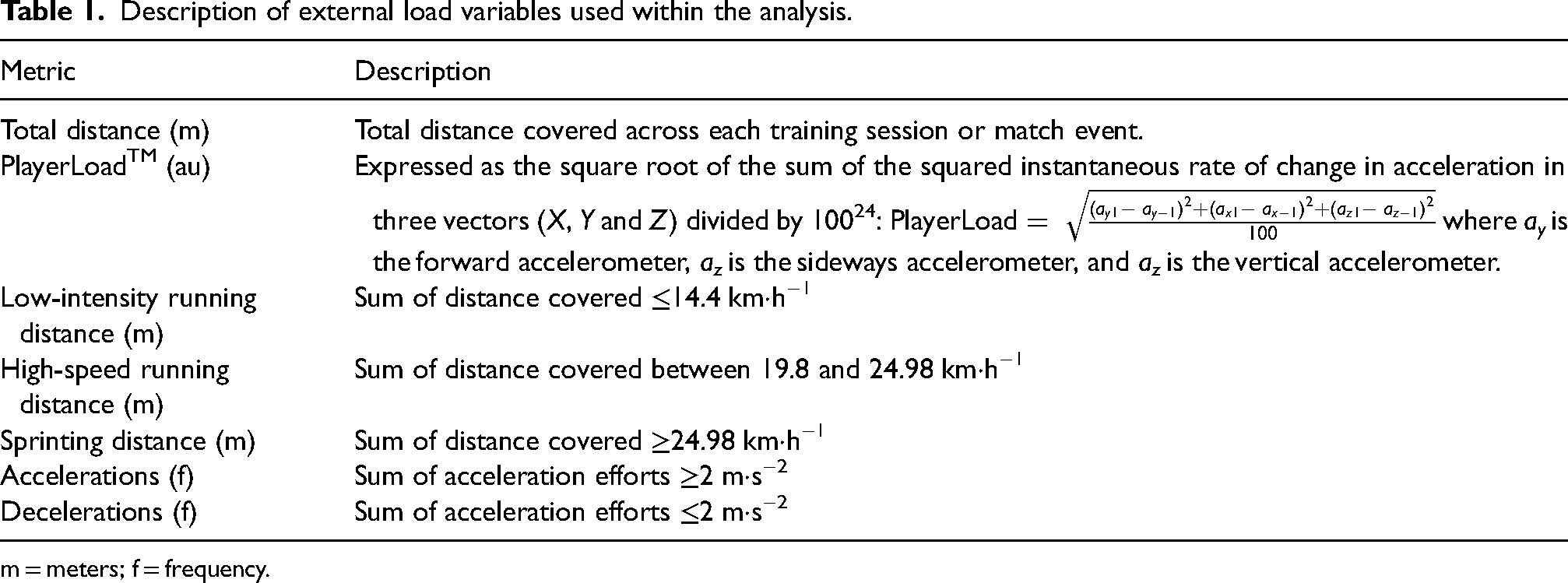
m = meters; f = frequency.
Statistical analysis
Data were analysed in the statistical environment R (v4.0.3). Of the 3220 individual recordings, 2.95% were missing sRPE-TL data, whereas 11.96% were missing external load data. Where data were missing, these were treated as missing at random (primarily due to technical errors such as battery failure) and imputed using the MICE package.
25
To modify low-frequency subjective measures of TL, methods previously used in high-frequency measures
12
were adapted. To create a modified version of Banister's TRIMP (RPEmod), the maximum (RPEmax) and minimum (RPEmin) RPE reported across the season were used to create an RPE ratio (
Relationships between RPE, sRPE-TL, RPEmod, sRPE-TLmod, and external TL measures were described using PCA. The suitability of data for PCA was assessed using the Kaiser–Meyer–Olkin (KMO) measure of sampling adequacy and the Bartlett test of sphericity. 26 KMO values for all session durations were ≥0.5 and all tests of sphericity were significant (p ≤ 0.001). A KMO value of 0.5 or above has previously been identified as a suitable result to perform PCA27,28 and has been used in similar research.7,19 Varimax rotation was performed to produce rotated components. To assist the interpretation of results, all component loadings were then normalised relative to the maximum component loading obtained.
Results
There were 3220 individual recordings included in the analysis, comprising 696 match recordings and 2524 individual training recordings. The distribution of the mean loads is presented for all sessions in Table 2.
Descriptive statistics (mean ± SD) of load variables across all sessions and categorised for 20 academy soccer players based on training duration.
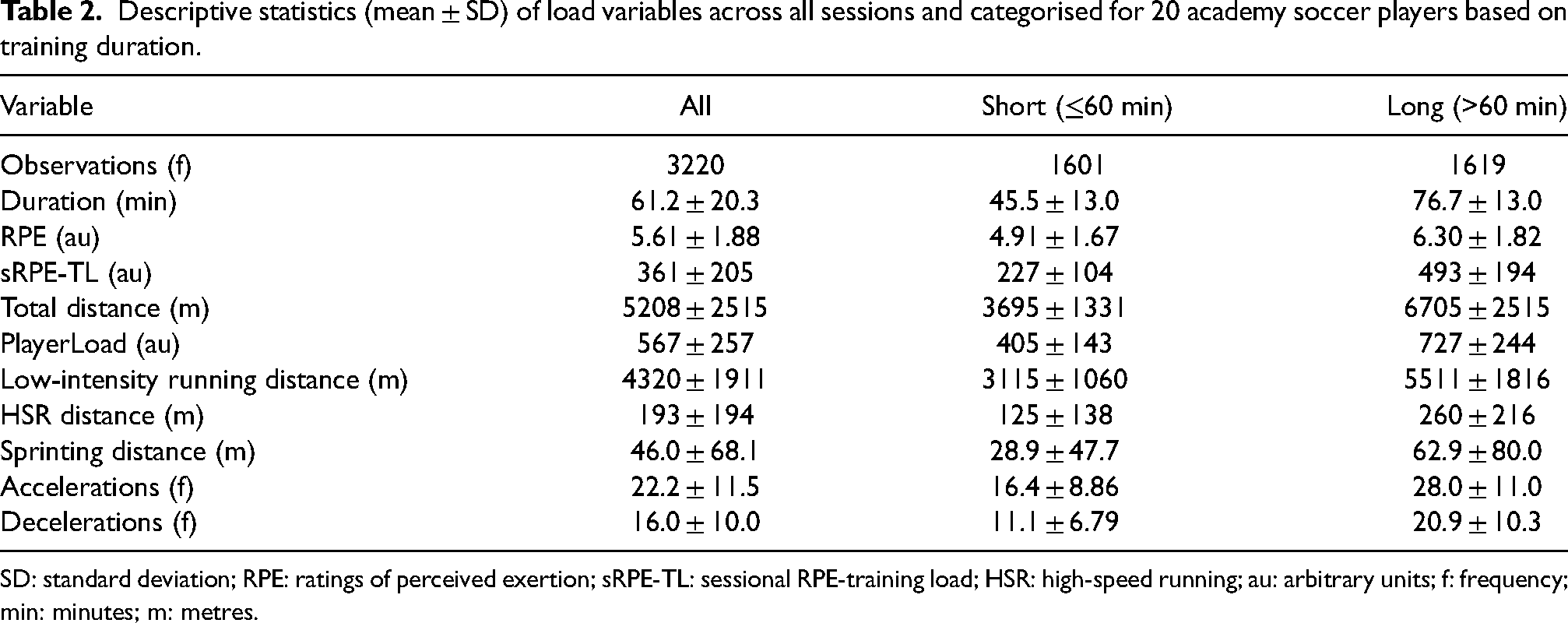
SD: standard deviation; RPE: ratings of perceived exertion; sRPE-TL: sessional RPE-training load; HSR: high-speed running; au: arbitrary units; f: frequency; min: minutes; m: metres.
PCA analyses for all sessions and those categorised as short or long duration are presented in Figures 1 and 2, respectively. Cumulative variance explained for the first and second rotated components ranged from 69.1% to 82.9%. Generally, the first rotated component (RC) was representative of training volume (RCvolume) with the highest loading variables including total distance, PlayerLoad and low-intensity running. In contrast, the second rotated component tended to represent training intensity (RCintensity) with the highest loading variables including high-intensity running and sprinting. Across the entire data set combining both short and long sessions, normalised loading coefficients for RPE contributed more to RCvolume (0.72–0.77) compared to RCintensity (0.16–0.25). Similar results were obtained for sRPE-TL with normalised loading coefficients of 0.81 to 0.93 for RCvolume, and 0.19 to 0.29 for RCintensity. Normalised loading coefficients for both RPE and sRPE-TL remained similar when analysed across long duration sessions only. In contrast, for short duration sessions normalised loadings were more similar for sRPE-TL (RCvolume: 0.41–0.88; RCintensity: 0.32–0.36) and aligned more to intensity (RCintensity: 0.52–0.61; RCvolume: 0.23–0.44) for RPE.
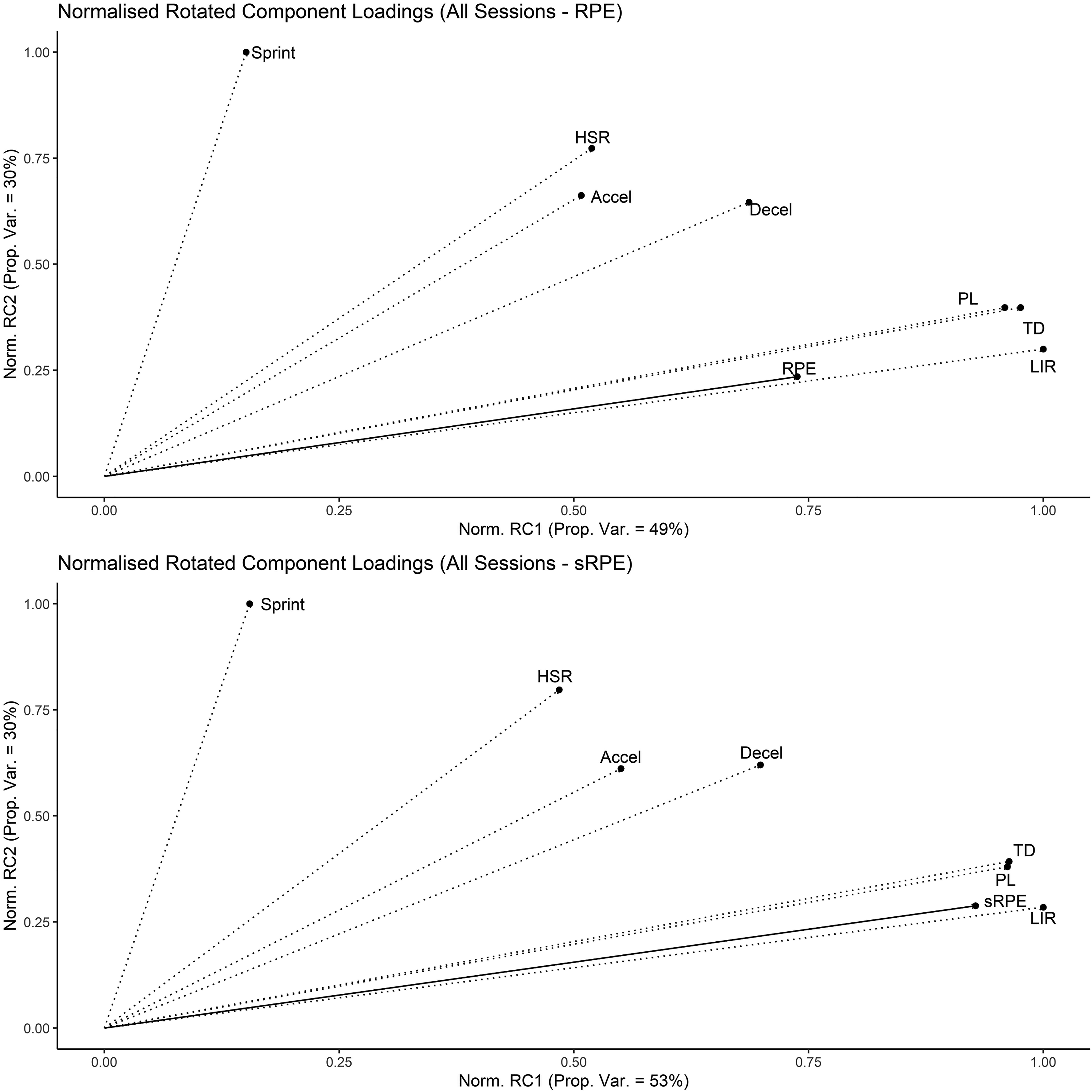
Normalised rotated component loadings for RPE and sRPE-TL for pooled sessions.
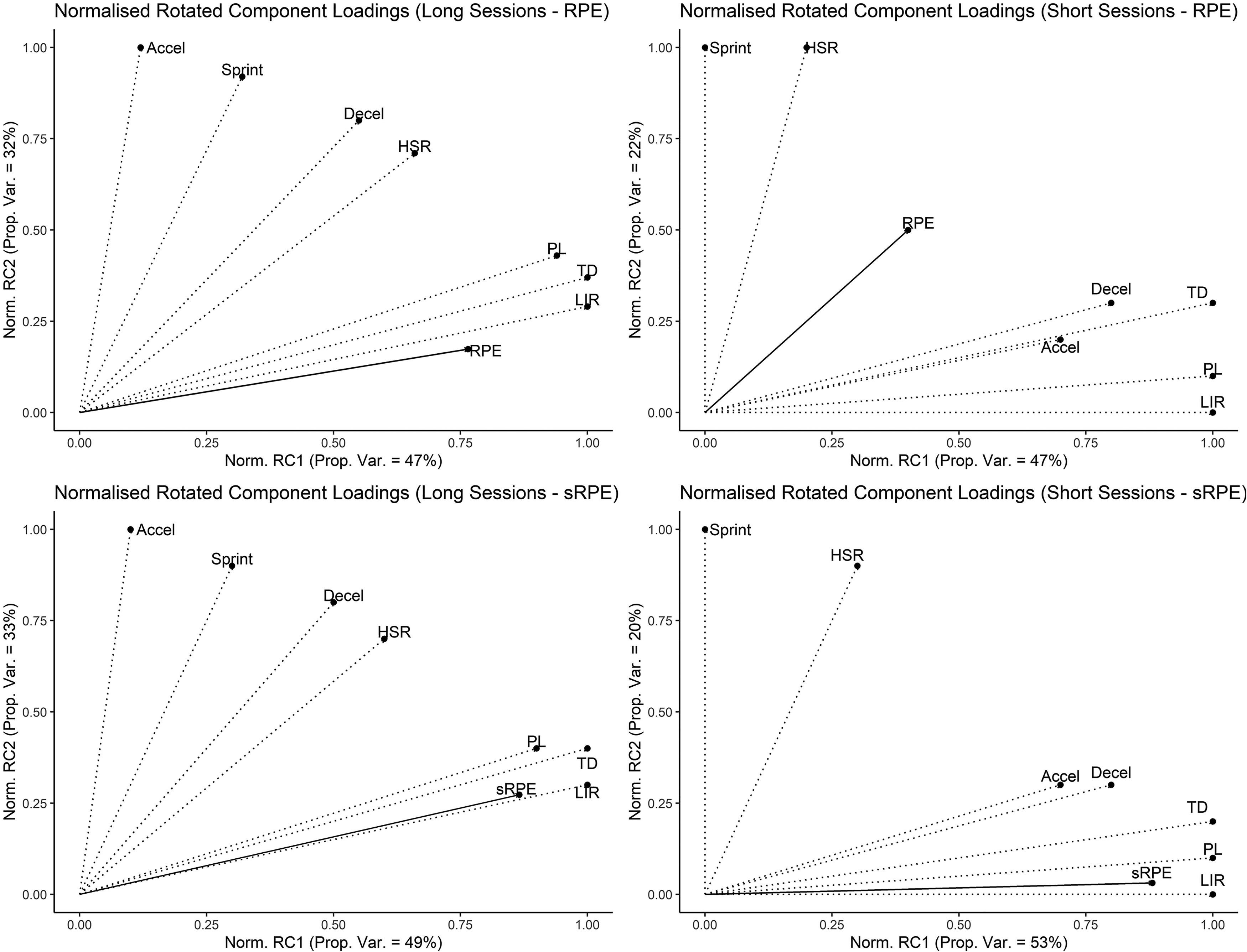
Normalised rotated component loadings for RPE and sRPE-TL for long (>60 min) and short (≤60 min) sessions.
Following modification of RPE, the ratio of RCvolume:RCintensity for pooled (1:0.32–1:0.21) and long (1:0.2–1:0.12) decreased as the weighting component increased from 1 to 3. These findings were also consistent for sRPE-TL with the ratio for pooled (1:0.32–1:0.24) and long (1:0.24–1:0.16) sessions decreasing as the weighting component increased. Conversely for short sessions, the ratio increased as the weighting component increased for both RPE (1:1.58–1:2.61) and sRPE-TL (1:0.49–1:0.87). Ratios of the normalised components between RCvolume and RCintensity are presented in Figure 3 for RPE of short and long sessions, respectively.
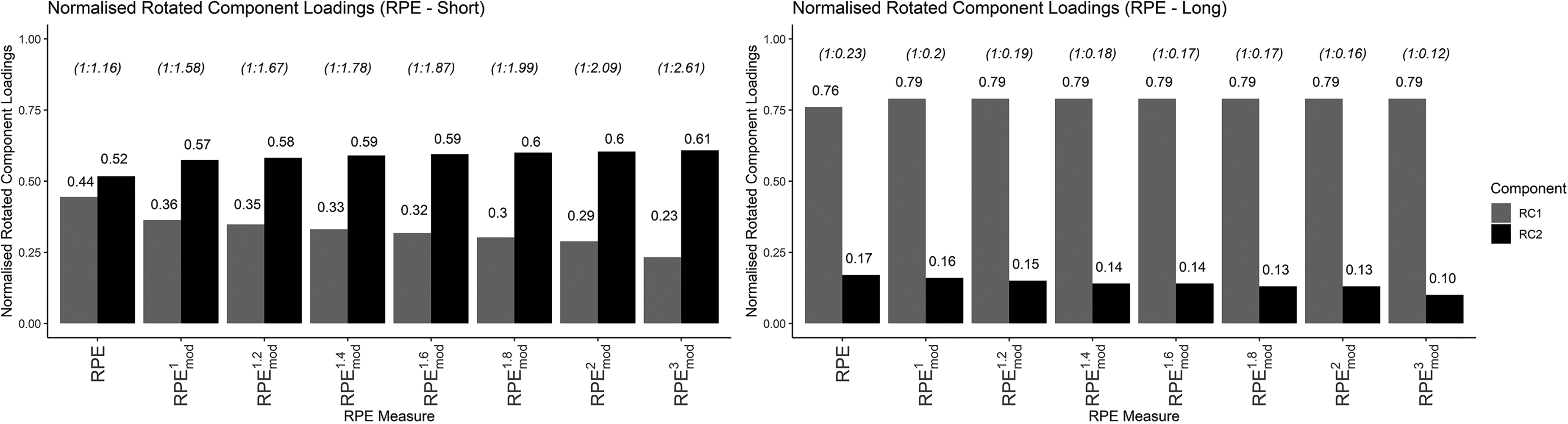
Normalised rotated component loadings for unmodified and modified ratings of perceived exertion (RPE) for short (≤60 min) and long (>60 min) sessions. Ratios of volume: Intensity is presented for each measure in brackets.
Discussion
The aims of the study were to investigate the underlying structure of TL relationships within academy soccer players and determine whether sRPE-TL can be modified to provide insight into training volume, training intensity or a combination of the two constructs. The main finding of the study shows that for short duration sessions, RPE provides insight into both the volume and intensity of TL. However, a greater bias towards intensity can be obtained when RPE is raised to an exponential of increasing power. Additionally, relationships between volume and intensity are more equal following modification of sRPE-TL for short duration sessions. In accordance with our previous findings,18,19 before modifying subjective measures, multiple components describe the underlying structure of commonly collected TL variables in soccer players, with the volume-based component generally explaining most of the variance followed by an intensity-based component. The findings also demonstrate that across all sessions with no consideration of duration, RPE and sRPE-TL predominantly reflect training volume. This volume-based interpretation of TL remains consistent even when undergoing a non-linear transformation similar to Banisters TRIMP. 12
Previous research has shown that by aggregating session duration, time becomes the major contributory component to the variability in TL. 8 Thus, the contribution of training intensity is potentially under-represented. In the present study, we have further evidenced the influence of duration on subjective measures of TL. When not accounting for session duration we showed that both RPE and sRPE-TL were representative of volume. These findings were also consistent when assessing sessions that were categorised as long (i.e. >60 min). However, when assessing short duration sessions (i.e. ≤60 min), we found that RPE was a stronger contributor to the intensity-based component. Additionally, when applying a non-linear weighting coefficient, the loading constant changed from 0.52 to 0.61, as the exponential multiplier increased from 0 to 3 (Figure 3). This result suggests that non-linear modification of RPE may allow a simple and cost-effective subjective measure to better reflect training intensity whilst also being influenced by training volume. Likely permitting practitioners within academy soccer programmes to better quantify and prescribe TLs which are appropriate for training microcycle29,30 and age/maturation of players. 31
To better account for periods of high intensity within an intermittent exercise, TRIMP methods have been applied to higher-frequency load monitoring techniques.10–12 These methods provide a more regular assessment of intensity, rather than aggregating intensity over a single length of time. 8 Additionally, commonly used HR methods, Edward's TL, 10 Banister's TRIMP, 12 Lucia's TRIMP, 11 and iTRIMP, 15 apply weighting factors to better account for intensity within sessions. To increase the frequency of subjective measures, intra-session RPE could conceivably be used within team-sports environments. However, this method may come with challenges related to the increased demands on athlete recall and adherence. A common criticism of the Edward's 10 method is the application of arbitrary values to arbitrary training zones, which does not reflect the individualised response to training.16,32 Whilst Lucia's TRIMP 11 considers physiological systems within the training zones identified, the measure also features arbitrary weighting values. 16 Banister's TRIMP 12 and iTRIMP 15 based weighting values on the relationship between elevation in HR and blood lactate concentration, observed during incremental exercise. 16 This method not only increased emphasis on the higher intensity periods of training, but also accounted for gender 12 or individual 15 differences in the response to incremental work rates. In the present study, we adopted a method to modify RPE by applying high-frequency methods, to lower frequency assessment. Additionally, we have assessed weighting components over an exponential range of 1 to 3 based on values used in previous high-frequency methods. In this analysis, we have used an iterative and empirical method to assess the effect of a range of non-linearities based on previous recommendations. Whilst these results do not propose the use of specific weighting components, they highlight the potential use of modification to allow RPE, when used alongside session duration, to better represent session intensity. This process can be used to generate modified values that best fit the needs of researchers or practitioners, who have targeted objectives.
There are limitations to the present study that should be considered. Restricting TL monitoring to measurements that combine intensity and duration in a linear manner is likely to misrepresent TL when performed at high intensities. However, the best approach to introduce non-linearities to the approach has received limited investigation. 21 For the present study, we adopted a common TL metric (Bannisters TRIMP) substituting RPE values for HR. However, HR data can take a wide range of values, whereas RPE values as collected in the present study were restricted to 10 integer values, which may reduce the sensitivity of the scale. Previous research has also endorsed the use of the Category Ratio 100 scale over the CR10 scale. 33 The use of the CR100 scale to calculate modified measures of RPE and sRPE-TL may enhance the sensitivity of readings by providing a greater range for athletes to quantify perceived exertion. Additionally, average HR potentially provides a more accurate reflection of an overall training intensity due to the increased frequency of measurement. Whereas a single RPE value may not provide an accurate reflection of TL intensity, particularly as session duration increases. This situation could be improved potentially through intra-session RPE, which may give higher resolution and better ability to fit an area under the curve representing total TL. Additionally, the analysis was collected on a single team and findings may be susceptible to the particular idiosyncrasies of the team with regard to training practices and RPE measurements.
Practical applications
This study proposes a novel method of modifying low-frequency subjective measures of load to better represent intensity in soccer training and match-play. The results presented, alongside findings from previous research highlight the need to employ multivariate measures when analysing load. Additionally, these results also reinforce previous assertions that factoring load based on measures of volume and intensity would be appropriate. Larger scale research investigating the underlying structure of relationships across variables for multiple teams and sports and the potential for non-linear modifications such as that investigated here are required to better understand the process.
Conclusions
Introducing non-linearities into a single measure of TL that combines volume and intensity is likely to be important. The present study considered a modification of one of the most common approaches used in sport and exercise science (Bannisters TRIMP). To identify appropriate weightings further research is required, or practitioners may wish to combine previous data and various analytical models to select values. In the present study, we used the underlying structure of a range of TL metrics to identify which weighting values may be appropriate in attempts to increase the intensity-based component. In contrast, where previous data exists, other models may include a collection of coach-based assessments of TL and attempt to establish weighting coefficients which best align the objective measure and expert opinion. Alternatively, where practitioners use integrative training and performance models such as the Bannisters fitness-fatigue model, weighting coefficients may be established to obtain the best fit of model predictions and measured performance. Irrespective of the approach adopted, a substantive increase in research in this area is required to enhance practice. Additionally, further analyses considering higher-frequency subjective measures of load, such as intra-session RPE, should be considered, however, their practical implementation should also be appraised.
Footnotes
Acknowledgements
The authors wish to thank the players and staff of Aberdeen Football Club's Development Squad for their participation and engagement with the study.
Declaration of conflicting interests
The authors declared no potential conflicts of interest with respect to the research, authorship, and/or publication of this article.
Funding
The authors received no financial support for the research, authorship, and/or publication of this article.
