



Abstract
Equestrianism is part of a global industry influenced by a rich history of over 4000 years of culture and tradition. As the only interspecies Olympic event, equestrianism is facing negative public perceptions of competition performance and traditional coaching practices. In this position paper, we propose a constraints-led approach as a framework for contemporising equestrian coaching practice. Ecological dynamics is the theoretical framework that underpins a constraints-led approach methodology, providing guiding principles that inform a nonlinear pedagogy in sport and physical education. A constraints-led approach focuses on the individual (organism/s), task and environmental constraints acting over multiple nested timescales and what this means for how behaviour emerges. Using examples from the equestrian discipline of showjumping, we outline how a constraints-led approach can inform coaching behaviour and practice design to support skill acquisition through co-adaptations in the horse-rider dyad system. By focussing on the horse-rider dyad as a complex system, there is a move away from a human-centric perspective of compliance and control of the horse, toward system agency and intentionality in problem solving. Practice design principles of intention, representativeness, constraints manipulation and functional variability support the dyad to co-adapt and interact effectively through practice to achieve performance goals. Skilful performance is developed through attunement to perceptual information that invites opportunities for action (affordances). Understanding the development of affordance perception in the horse-rider dyad could guide the application of a constraints-led approach to equestrian coaching practice.
Introduction
Equestrianism is part of a global industry with an estimated economic impact of $300 billion per annum. Despite including three Olympic disciplines, as well as a higher proportion of disabled, female, and over 45-year-old participants than any other sport, 1 there is little published research currently exploring pedagogy and coaching practice in equestrian sports and activities. A significant characteristic of equestrianism is the performance partnership between a horse and a human: a complex adaptive system formed by two animate components with different perceptual, motivational, and communication characteristics.2,3
Successful equestrian performance has been described as highly embodied, and synchronous, capturing the aspirations of riders to become centaur-like in their relationship with their horses.4–6 Indeed, ethnographic accounts of riders capture experiences of co-being, co-creating behaviour and a sensation of feeling ‘part of the animal’.5,7 Further, skilful performance has been described using metaphors from music (e.g. rhythmic harmonisation, accentuation).4,7 Despite these insights alluding to collaborative partnerships, traditional approaches to training and coaching in equestrianism emphasise a hierarchical relationship between rider and horse, typically characterised by methods demanding equine compliance and obedience.8,9 Increasingly, animal rights groups 10 frame equestrianism as inherently abusive in nature, primarily due to the lack of agency of the horse. 11 For example, Hall et al.’s 12 review on equine learned helplessness concluded that, ‘there is little doubt that the techniques and devices used in the training and riding/driving of horses, as well as during their management, have the potential to place horses in a situation where they could develop this phenomenon’ (p. 263).
In this position piece, we examine how a contemporary approach to skill adaptation 13 has the potential to develop performance competency, while also addressing some current challenges facing equestrianism. Focusing on showjumping, we examine current underpinning theories before outlining how ecological dynamics could provide a theoretical framework for understanding performance enhancement in the horse-rider dyad system. We embrace principles of a nonlinear pedagogy 14 as an alternative for supporting skill adaptation through the use of a constraints-led approach (CLA) in coaching and practice design. Finally, we highlight future research areas that warrant further investigation.
Theoretical underpinnings of traditional practice in equestrianism
Traditional training and coaching methodologies are underpinned by two main theories of performance, cognition and learning with incompatible ontological roots.15,16 Firstly, behaviourist theories from the late 1800s and early 1900s focus on learning being formed outside of the individual through external reinforcement and rote repetition. 17 Behaviourism underpins the traditional instructional practice of humans 17 and the training of all animals, including horses. 18 Promoting the notion that learning is a passive process, based on conditioned responses to environmental stimuli, behaviourism ignores the organisms’ agency in learning experiences. Behaviourism is still the main underpinning theoretic framework used for training the horse through reward, reinforcement and punishment to recognise and obey commands issued by the rider.19,20 As Blokhuis and Lundgren [p. 4] emphasise ‘horses are seen more as objects responding to humans’ initiatives that subjects interacting with humans’. 6 Secondly, supporting the coaching of riders, current UK coaching qualifications espouse both behaviourist (framed as coach-led) and constructivist (framed as student-led) informed coaching styles. 21 Constructivism posits that learning is an active process constructed in the mind of the individual in response to their experiences, separating the organism and environment during interactions. 16 However, particularly with novice riders, coaching behaviour typically comprises a coach stood on the ground providing explicit instructions based on ‘optimal’ techniques and what the coach believes the rider needs to do to improve performance. 17 This learning approach results in the rider being passive, rather than active, in knowledge construction. 21
In conjunction with other sports, training methods have become dominated by an inherent focus on error-correcting toward idealised form and technique.13,22 This is likely a result of coaching pedagogy and qualifications predicated on behaviourist and/or constructivist learning theories, combined with information processing theories of skill acquisition that focus on attaining ‘correct’ movement techniques. 22 In equestrianism, an unintended consequence may be the use of controlling and restrictive training aids and gadgets in practice (e.g. draw reins and severe bits). While research has led to some positive changes to competition rules,23,24 many banned practices prevail outside competition due to beliefs about how horses learn to become skilful. In summary, a lack of a coherent, contemporary theoretical framework for understanding learning and skill adaptation in both organisms, combined with a human-centric perspective, underlie traditional ideas and coaching pedagogies underpinning practices in equestrianism.
Ecological dynamics and nonlinear pedagogy: A contemporary framework for using a CLA for coaching in equestrianism
To negate the issues outlined in the section ‘Theoretical underpinnings of traditional practice in equestrianism’, we propose ecological dynamics as a framework for understanding skill adaptation in equestrian practice, which provides a fusion of ecological psychology and dynamical systems theory.25,26 Ecological psychology 27 avoids an organismic asymmetry (favouring internalised, mental explanations for behaviour localised within the brain of an organism). 28 Rather, it proposes that all organisms have evolved to perceive and progressively develop sensitivity to surrounding information in their environment that informs the continuous regulation of their behavioural interactions.29,30 Opportunities available to the organism inviting actions and interactions within the environment (termed affordances) emphasise the meaning of the environment for the organism, and the value of the information for facilitating goal-directed movement. 31 The process of becoming skilfully attuned to perceptual information that supports such opportunities for action results in tighter coupling of perception and action sub-systems with practice. 32 From an ecological perspective, an organism’s interactions with its environment are conceived as the appropriate scale of analysis for understanding behaviour, due to the inextricably entwined nature of cognition, perception and action.
Originating in mathematics with notable early applications to weather forecasting, ecology, 33 and later to quadruped coordination dynamics and gait transitions, 34 dynamical systems theory explains coordination behaviours in complex adaptive systems, such as horses and humans. The horse-rider dyad, considered as a bio-tensegrity system, is an example of a haptically coupled (emphasizing information from compression, touch and pressure), complex dynamical system.35,37 Bio-tensegrity systems, like horse-rider dyads, maintain stability through a balance of pre-compression and tension, allowing the perception and communication of pressure and touch through the distortion of the pre-tensioned structures such as muscles, bones, facia, ligaments, tendons and even cell membranes. 35
Ecological psychology provides a theoretical explanation for understanding the integration of perception, action, decision making and cognition. Dynamical systems theory seeks to explain how movement organisation, adaptation and control emerges from a complex adaptive system with many degrees of freedom that need to be (re)organised (e.g. muscles, limbs, joints, facia, neurons). 38 Ecological dynamicists rationalise how complex systems interact with challenging performance environments by coupling movement to perceptual information, exploiting intentions and harnessing cognition, to make decisions, solve problems and coordinate functional behaviours. 25
In nonlinear pedagogy, the focus of coaching moves away from the notion of training of idealised, ‘putatively correct’ techniques with linear progressions. 22 Instead, the guiding principles of nonlinear pedagogy support coaches and support staff in becoming practice activity designers, 14 acknowledging that behaviours of horses and riders need to be considered in horse-rider dyads, continuously influenced by multiple interacting constraints. This perspective recognises the nonlinearity of emergent skilful behaviours in adaptation to a performance environment. Coaches and support staff can use a CLA to facilitate the co-adaptation of the horse-human dyad in the process of becoming an integrated, skilful system (see Figure 1).
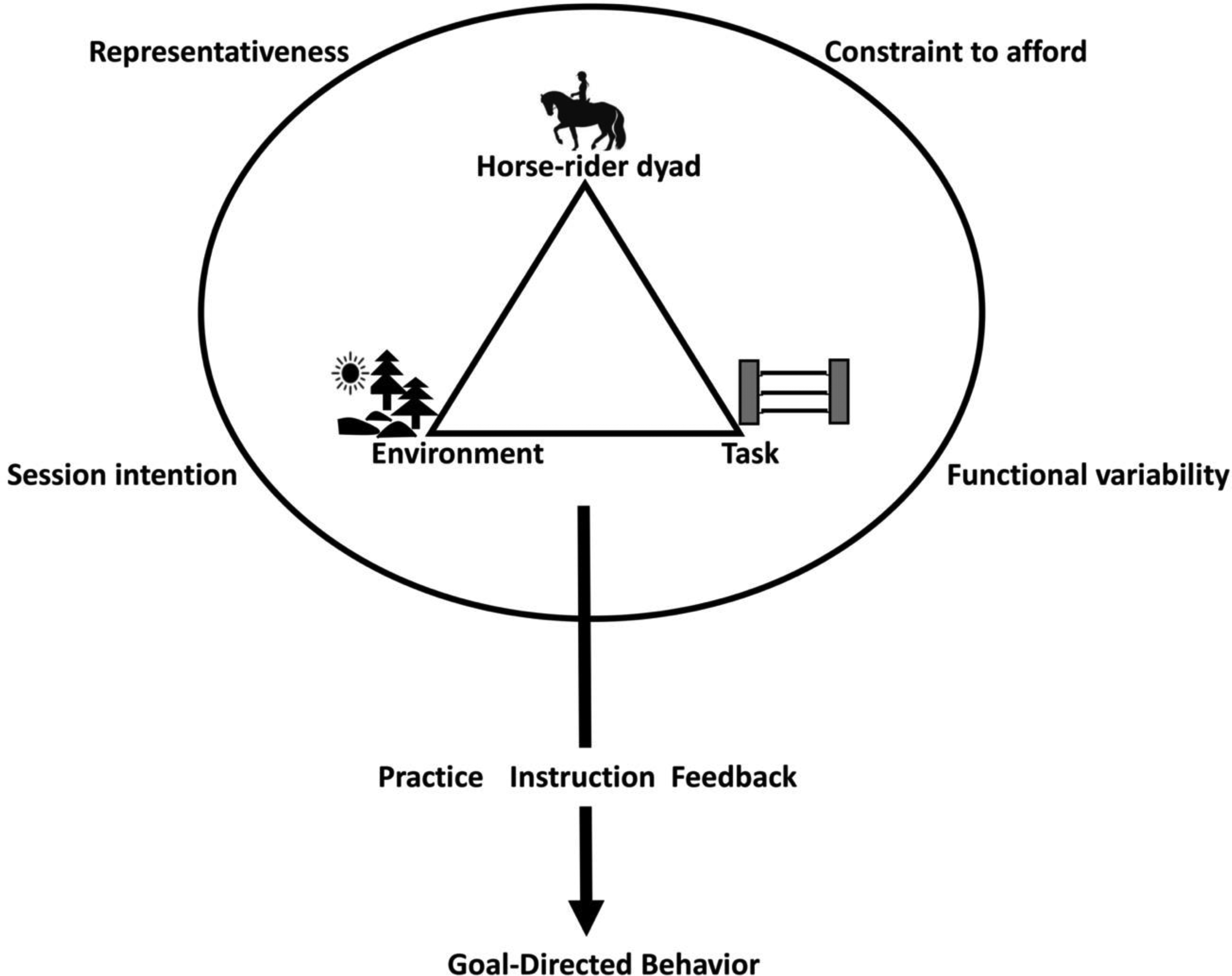
A constraints-led approach for skill acquisition in the horse-rider dyad.
Using the practice design principles of intentionality, representativeness, constraints manipulation, and functional variability, the horse-rider dyad system becomes attuned to shared affordances in realising goal-directed behaviours.
The horse-rider dyadic system
Supporting ethnographic accounts of embodied centaur-like experiences, 7 research examining horse-rider performance has repeatedly shown that experienced riders are biomechanically coupled and synchronous (in-phase) with the movements of their horses.38–40 These studies postulate that skilled riders coordinate and couple their movements with the horse through their capacity to anticipate, attune to, and use, perceptual information from their continuous interactions as a dyad.38,41 The co-adaptation of the horse and rider is hypothesised to be integral to both learning and performance, learning from each other as they become attuned to the affordances available to the horse-rider dyad as an informationally coupled system.
Phenomenology has been used as a method to focus on the lived experiences of the rider and horse in their interspecies relationship during riding.42–44 Phenomenological research highlights that rider perceptions are not those of mastery over, but reciprocity of learning and ‘becoming one with the horse’.44,45 The notion of ‘becoming one’ aligns well with an ecological dynamics perspective of the dyad functioning as a single complex adaptive system, in which both components need to become attuned to surrounding information and shared affordances in performance. Maustrad et al. 5 [p. 326] assert that horse-human communication ‘crosses the species divide through somatic attunements and attentions that are partly about uncovering and discovering what bodies do, and partly about taking control of them, creating and making sense of body kinetics’. Pressure from touch as a channel of interspecies communication through haptic perception to continuously regulate co-adaptive actions may provide a theoretical explanation for the elusive concept of ‘feel’ in equestrianism. Ecological dynamics proposes that intentionality and emotions in the dyadic system can be channelled through haptic information. 35 For example, haptic information can inform the horse of a rider’s intentions, such as to turn left or speed up. Riders can learn to feel a horse’s emotions and intentions in jumping over a barrier.
Using the practice design principles of a CLA for coaching showjumping
Showjumping competitions comprise a set course of knock-down jumps of specified dimensions, with specific rules about distances, speed, course time limits and number of rounds. 46 With practice and experience, the two separate animate systems (horse and rider) need to become attuned to critical information sources that have value and meaning for perceiving affordances (opportunities for action) such as ‘jump-ability’ and ‘time-to-contact’ with a fence. Some information sources that the horse-rider dyadic system becomes attuned to with practice when approaching a jump, include surface terrain and incline, obstacle shape, orientation, height, appropriate take-off distances, speed and stride length approaching the obstacle, and probability of success. 47 In the following sections we will expand on the four practice design principles of a CLA.
Session intention
Nonlinear pedagogy informs the design of practice activities that are meaningful in terms of the rider’s goals, realised through horse-rider dyadic interactions with movement challenges and problems. The horse-rider dyad engages in problem solving through attending to shared goals, affordances and specifying information. To achieve this aim, the performance of the dyadic system in performance and practice should be based on making decisions and calibrating actions, rather than just passively responding to coach instructions. 14 Manipulating constraints of practice environments is a key to enrich the performance of the dyadic system. 48
Constraints manipulation: Supporting self-organisation
Constraints are informational sources that act as boundaries, shaping performance over multiple nested timescales. 48 Categorised as organismic, task and environmental, constraints shape or guide the (re)organisation of behaviour in complex systems. 49 In showjumping there is a rich tradition of using task constraints such as positioning poles to create ground lines, fillers, grids (lines of jumps), 50 and equipment use, such as draw reins, side reins and martingales to constrain horse movements. However, using constraints in this way is not always the same as using a CLA to facilitate horse-dyad learning interactions. A CLA is a theoretically informed methodology for designing practice activities, using principles of a nonlinear pedagogy, predicated on key concepts in ecological dynamics. 48 By manipulating constraints, coaches seek to design practice activities that dampen affordances for movement solutions that are less functional and amplify affordances that are more functional, without prescribing movement solutions. 22
Using poles on the ground to facilitate a horse to adapt stride length and speed when navigating obstacles different distances apart would be aligned with principles of a CLA. However, using poles to dictate exactly where a horse can take off over a jump would not be, because the horse is entrained to the information from the poles to calibrate the approach phase. The horse-rider system is no longer able to explore, calibrate, learn and adapt, using multiple sources of information. Examples of effective constraints used in showjumping include building courses with shorter related distances between the jumps to encourage a short and bouncy more powerful canter, or putting up poles in a cross shape or at the sides of a jump to invite a straight jump. 50 Essentially constraints manipulation needs to support information movement coupling. Practices such as rapping, used to condition horses to make an idealised forelimb shape and be more ‘careful’, following punishment or a perceived increase of proprioception, continue because they are believed to be effective. However, an ecological perspective suggests that these practices are likely to compromise the development of information–movement coupling in horses. 32 Rather than supporting long-term skill adaptation, the horse will learn that it cannot trust the perceptual information offered by a jump, despite any actions it decides to take.
Representativeness
Each level of Showjumping competition has shared rules and characteristics, including maximum jump heights, related and overall distances, course complexity, and time allowed. 46 Instead of de-contextualising practice, a CLA encourages the use of practice activities that are representative of competition demands. These include such things as jumping on multiple surfaces, with an audience, background noise and other distractions, in addition to task manipulations such as changing jump combinations, and variations of speed, stride length and approach angles. 50 This does not mean that practice needs to always simulate full competition conditions. Rather, the information that specifies movement (re)organisation in competition needs to be present in practice sessions.
The importance of self-organisation and the need for adaptability have been highlighted in many sports involving a run-up to a target. 51 Research in long-jump elucidates the individuality of gait regulation distributed across run-ups, particularly in relation to environmental constraints such as wind strength and direction. 52 Key findings note that run-ups cannot be split into distinct phases, and take-off is not just a position of a footfall, but the orientation of the whole body such that it can be propelled upward and forward. 53 The implications of this information for equine showjumping practice would be to design training activities that are high in context-specificity such as jump specifications, speed over the ground, the distance between jumps, number of jumps, and course length. This representativeness provides the horse-rider system opportunities to search for, explore and exploit key information for calibrating gait adaptations to take-off.
Functional variability
Functional variability relates to the principle of repetition of outcome without repetition of solution. Research in springboard diving 54 highlighted the negative implications of practising only perfect run-ups (hurdle steps). In competition, divers can incur penalties if unable to adapt to imperfect run-ups, lacking the ability to recover from perturbations. In showjumping, this practice design might include varying starting positions, lines, rhythms, speed, and angles once a stable outcome becomes established, then varying task and environmental constraints such as jump types, weather, light, inclines and surfaces without prescribing idealised movement biomechanics.
Focus on affordance perception: Can’t jump, won’t jump
Language is powerful in creating and maintaining cultural norms, practices, and behaviours. 55 In the United Kingdom, problematic and deeply enculturated language is used to describe horses as well as our interactions and relationships with them. For example, horses are regularly described as being ‘honest’, ‘naughty’, ‘lazy’, ‘bombproof’, needing to be ‘squared-up’, ‘kicked-on’ or ‘taught some respect’. An ‘honest horse’ is a horse that is obedient to commands or cues and will jump when demanded, even if the rider has made an error, or if the horse does not perceive an affordance to jump that a rider does. Incidences such as the eventing horse Raphael jumping into a clearly unjumpable barrier during the Pau CCI5* in 2019, 56 highlight the potential dangers of training a horse to trust or fear the rider, rather than utilising their own perceived affordances to jump successfully.
An important change would be to move away from punishing horses for stopping or running out at jumps, toward designing more sophisticated jumping practice environments. Practice needs to support the education of the horse and rider’s systemic intentions, attention and (re)calibration of information perception and movement. By forcing the horse to choose between jumping or being punished, to obey cues from a rider instead of acting on perceived affordances through specifying information, there is a failure to consider that the horse is an organism that has evolved with acute direct perception of relevant information for action from its environment, related to its internal dynamics and action capabilities. By attempting to thwart the horse’s affordance realisation, the rider is over-riding system functionality through attunement to shared affordances that harness the horse’s action-capabilities
In summary, if horse-rider systems need to move with intentionality to become skilful, there is a necessity for both components to be able to calibrate to the challenge of negotiating different obstacles over different surfaces and inclines in different environmental conditions. Practice designs in equestrianism require the provision of opportunities for the dyadic system to engage in, and solve, movement problems and challenges. Movement problems in practice need to be representative of competitive performance goals, to have meaning and value. Above all, practice designs should aim to facilitate adaptability and (re)calibration of perception and action in the horse-rider system. Coach and rider expectations may require a re-evaluation of what may be misconceived horse ‘disobedience’, potentially due to a rider’s inaccurate or badly timed cues, based on poor perception and misuse of affordances. A major aim of practice in equestrianism is to facilitate skilled intentionality and perception–action coupling in the horse-rider system (will jump, can jump!).
Conclusion and further research directions
In this paper, we proposed an ecological dynamics rationale for skill adaptation as a way forward in contemporising equestrian coaching practice. From this perspective, becoming skilful is a process of attuning to emerging affordances for action available within a performance landscape shaped by individual organismic, task and environmental constraints. Through self-directed intentional interactions with these affordances, changes in action capabilities (coordination and capacity) invite the possibility of further affordances. 53 An ecological conceptualisation of skill adaptation suggests a need to shift the role of coaches and support staff from being solution providers to learning environment designers, using constraints manipulation to support perception–action coupling and attunement to affordances offered within organism–environment interactions. 51
Effective and sophisticated practice design in showjumping requires an understanding of the performance demands and the shared affordances that skilled showjumping dyads need to become attuned to for successful performance. 58 These affordances are likely to be a mixture of opportunities offered both ‘to’ and ‘by’ the horse as part of the embodied dyadic partnership, and affordances for goal achievement developed through the experience of shared system affordances, such as time-to-contact and jumpability.
Further research is needed to understand the implications and effectiveness of adopting a CLA in equestrian sports along with the challenges and opportunities that coaches are likely to face. Other potential areas of research include attempting to identify the specifying information sources that are used as affordances for jumping by horses and the range of coordination strategies for calibration of movement toward affordance realisation, with and without riders. Research in these areas would support coaching and training practice and, potentially the design of safer jumping courses.
Finally, further research is needed to understand how the dyadic horse-rider system can reconcile the need for an agency of both partners whilst still ensuring both human and equine safety. To achieve this aim, there is a need for the human partner in the dyadic system to become a better haptic communicator, enhancing their attunement to the horse’s needs and affordance perception.
Footnotes
Declaration of conflicting interests
The authors declared no potential conflicts of interest with respect to the research, authorship, and/or publication of this article.
Funding
The authors received no financial support for the research, authorship, and/or publication of this article.
