



Abstract
Contemporary coaching practices such as the Constraint-Led Approach (CLA) have gained traction in recent years within academic literature and applied practice. However, despite the growing popularity of the CLA there remains challenges with the successful implementation across applied settings. Formal education that adopts top-down hierarchical approaches and is decontextualised from coaches’ sociocultural contexts has been attributed to this challenge. To investigate this problem further, the purpose of this study was to explore the feasibility of implementing a CLA curriculum within British Diving’s Learn to Dive programme. Twenty-one British Diving coaches (10 male and 11 female) were interviewed for this study. The coaches’ insights indicated that a new model of coaching was needed to improve the learning and development experiences of the Learn to Dive participants; however, factors such as opposing philosophies about learners and the learning process, path dependency, and operational priorities were identified as potential barriers to implementation. These findings suggest that the implementation of alternative coaching methods should be considered in the context of the sport and the coaches’ needs, experience, and sociocultural–historical biases. Documenting context-specific learning experiences through qualitative research designs can start to address the challenges and provide potential solutions to successfully implementing contemporary learning designs.
Introduction
The constraints-led approach (CLA) is a pedagogical method to support the development of motor skills. 1 Guided by the theoretical framework of ecological dynamics, the CLA views performers and athletes as complex adaptive systems where sub-components (e.g. systems of the body) are continually interacting to form synergies for action. A key principle of a complex adaptive system is the concept of self-organisation under constraints. When athletes develop the functionality to satisfy a range of environment (e.g. weather conditions), task (e.g. a rule change in game a soccer), and individual (e.g. grip strength deficiency in climbing) constraints experienced in practice and competition, they self-organise to generate effective movement solutions to task goals. 2 To exemplify constraints in action, across a 12-week intervention, elite female springboard divers were challenged to break from the tradition of baulking (i.e. the action of terminating a dive), when perceiving the approach and hurdle phases not to be optimal for performance. 3 Post intervention analysis demonstrated how divers explored and successfully adapted their movement patterns under more varied take-off conditions to achieve greater consistency of completed dives. Demonstrating that performers are capable of self-organising under specific task constraints (i.e. no baulking) to coordinate and control functional movement patterns to achieve task goals.
In applied practice settings, the concept of self-organisation under constraints can be exploited by coaches to support the emergence of appropriate movement skills. In the sport of baseball, for example, a CLA can be used to facilitate the desired pitching action while at the same time reducing the risk of injury by using a “connection ball.” 4 Gray (p. 1) 4 described how pitchers can be tasked with placing a large rubber ball (connection ball) between their arm and body while throwing “the baseball such that when the connection ball falls out it moves forwards” shaping the desired pitching action (for a detailed explanation see https://perceptionaction.com/connectionball/). A challenge for coaching practitioners, therefore, is to carefully design task constraints (environmental and individual constraints are still relevant in applied settings but are less likely to be influenced by the coach in the short term) to shape or guide the (re)organisation of an athlete's movement so intended task goals can be achieved.4,5
Although the CLA is growing in popularity across applied settings, Renshaw and Chow 6 have suggested that the complex academic language and lack of understanding about its key theoretical concepts, have led to obfuscated applications. In addition, there is minimal evidence of its effective application in sport and physical education environments, and as Roberts et al., 7 suggested, just because sport practitioners “call it CLA does not necessarily mean it is CLA” (p. 165). However, the challenge of coaching differently is not special to the CLA; any contemporary pedagogy that challenges coaches’ beliefs and assumptions about what good learning and development looks like in practice, is always situated in a complex sociocultural–historical milieu. 8
Influential traditions of learning and development are particularly relevant in sports like springboard diving, where models of performance based on rigid biomechanical principles and pre-performance routines are promoted. 9 Basing performance preparation practices on optimum movement techniques can lead to an overemphasis on specificity of practice, where learners engage in highly repetitious drills in dedicated performance contexts, with the aim of stabilising movement behaviours during practice and competition.3,10 However, intensifying specialised training in performers can result in problems related to physical, psychological, and emotional loading and intensity. 11 These issues can arise in developmental pathways such as British Diving's Single System, 12 where a “technical blueprint of ‘gold standard’ exemplars in all areas of physical, skills, technique and aesthetics of diving” (2018, p. 8) promote optimum movement techniques through the specificity of practice methodologies.
Despite the emphasis on contemporary pedagogies in the academic literature and across many National Governing Bodies (NGBs) coach education programmes, there remain challenges with the successful implementation of such approaches. 6 Although attitudes and assumptions towards learning and development are continually shaped by “power hierarchies, occupational expectations, and personal histories” (p. 2), 13 Moy et al. 14 have demonstrated that these beliefs can change through formal education programmes. However, formal education can be ineffective if the content is decontextualised from coaches’ contexts, 15 and when top-down hierarchical approaches are employed. 16 Consequently, attention needs to be paid to coaches “real-world needs” if alternative and contemporary pedagogies are going to be implemented successfully (p. 81). 16
To that end, the overarching purpose of this paper is to explore the feasibility of implementing a CLA curriculum in British Diving's Learn to Dive programme (an entry-level diving scheme), to inform potential changes to future curriculum designs. To achieve this purpose, we address the following aims. First, to avoid implementing future coach education programmes that do not consider the context that coaches operate within, we aim to draw on coaches’ experiential knowledge of British Diving's Learn to Dive programme. Second, we aim to examine Learn to Dive coaches’ perceptions of the CLA to establish the pedagogical feasibility and potential implementation with future programmes.
Method
Research design
Interpretivist qualitative inquiry in the form of individual reflexive semi-structured interviews was employed for this study. For Brinkman, 17 the interview provides an opportunity for conversation, presenting the interviewee with an opportunity to share and describe experiences, while at the same time offering perspective on these experiences. More specifically, interviews were selected because they presented an opportunity to delve into the participants’ coaching contexts and their own coaching practices. These insights also served to illuminate how British Diving's sociocultural practices shape perceptions towards learning and development, highlighting potential barriers and opportunities to implement a CLA in future programmes.
Participants
Twenty-one British diving coaches (10 male and 11 female) volunteered to participate in the study. Participants were purposefully sampled based on their experience of coaching on British Diving's Learn to Dive programme, and because: (1) they were a qualified diving coaches under the United Kingdom Coaching Certificate Level 2 certificate, and (2) they had no prior knowledge or experience of applying the CLA in practice. The second sampling criteria were important because we wanted to explore the pedagogical feasibility, and the theoretical underpinning (e.g. self-organisation under constraints), of the CLA with coaches who did not have previous biases. To ensure anonymity, the coaches’ specific clubs and roles are not outlined. However, to provide context, eight of the participants held Head Coach positions, four were Assistant Head Coaches, six were British Diving pathway coaches, and three held coach development positions within British Diving. The first author recruited participants via email informing them of the studies aims, and all participants provided informed consent before the data collection process commenced. Ethical approval to conduct the study was sought and provided by the host University.
Data collection
To maximise the effectiveness of the interview to elicit key information relevant to the research aims, data collection followed a three-staged process. Initially, the first author designed a CLA resource pack (e.g. Figures 1-4) that was emailed to all the participants, providing a rationale (why to utilise) and applied examples (how to utilise) of a CLA within coached diving sessions. Within the pack a clear explanation (avoiding academic jargon), using specific examples, was provided explaining how adopting a CLA would differ from traditional diving coaching practices. These examples included emphasising the importance of learner-environment mutuality, attunement to information in the environment, providing boundaries so learners can explore and exploit movement solutions, and not prescribing goal-directed behavior. 5 Second, following the participants’ confirmation that they had received and read the resource pack, a further email was sent inviting them to an online workshop. The first and second author designed the workshop which was aimed at providing further rationale as to why a CLA might be adopted on the Learn to Dive programme. During the workshop (delivered by the first author) the underpinning theoretical position was presented and discussed, and further applied examples were shared via short videos. For example, the first author prepared video footage of him coaching the hurdle step (for the approach on a springboard dive) using a traditional and CLA approach, links were then made back to the theoretical principles to explain the difference between the two approaches. Participants were then given the opportunity to discuss and critique the session exemplars, and finally, an open discussion took place where participants were encouraged to offer their views about the resource pack and the appropriateness of the CLA more generally.
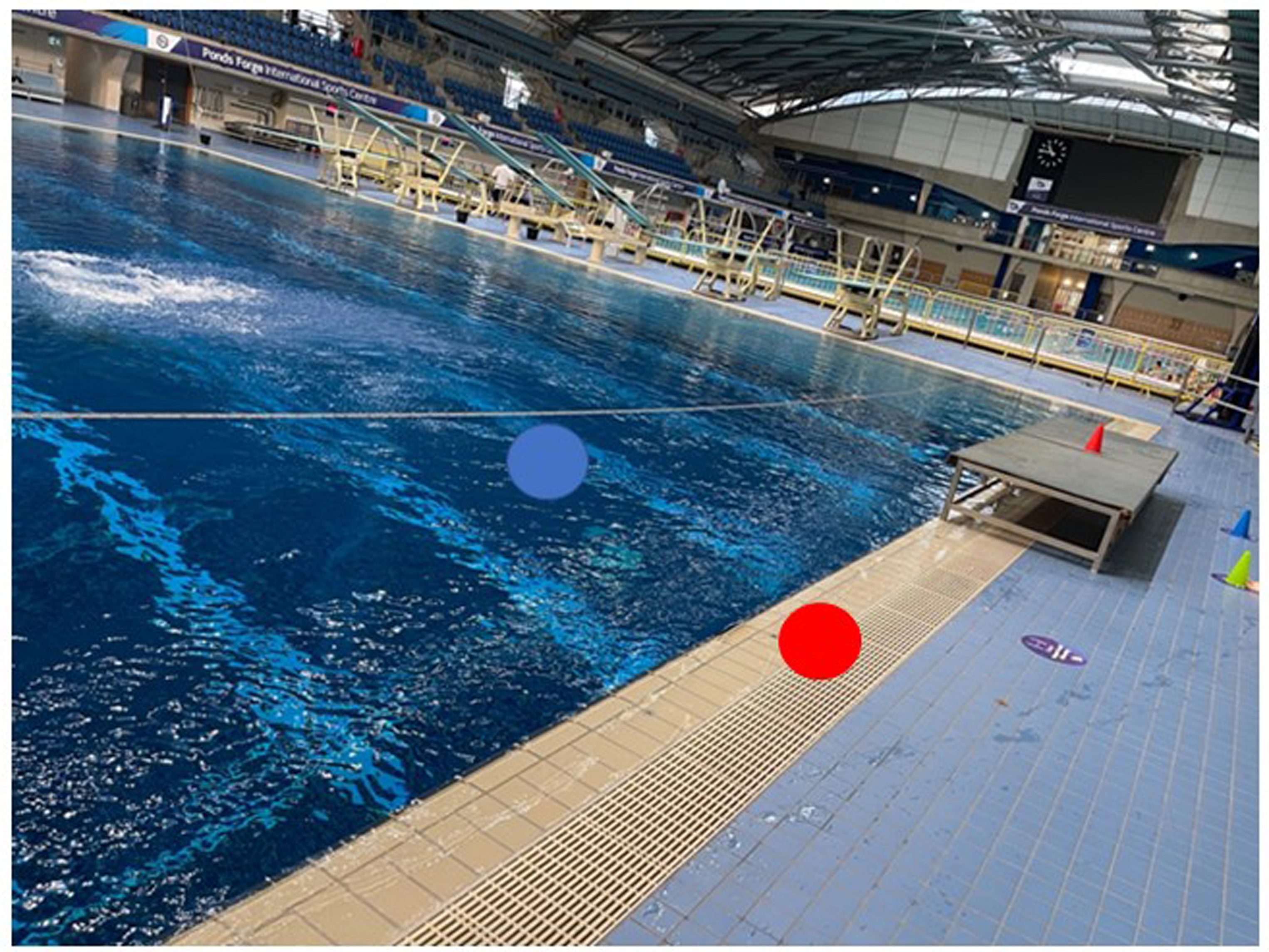
This practice task uses a boundary to restrict the area a diver can land in. The diver is challenged to manage height, rotation, distance, and entry landing away from the poolside while landing within the boundary. Boundary size, dive type, and landing zone are consistently manipulated to challenge the self-organising tendencies of the diver. The red circle indicates the start position, and the blue circle indicates the landing area.
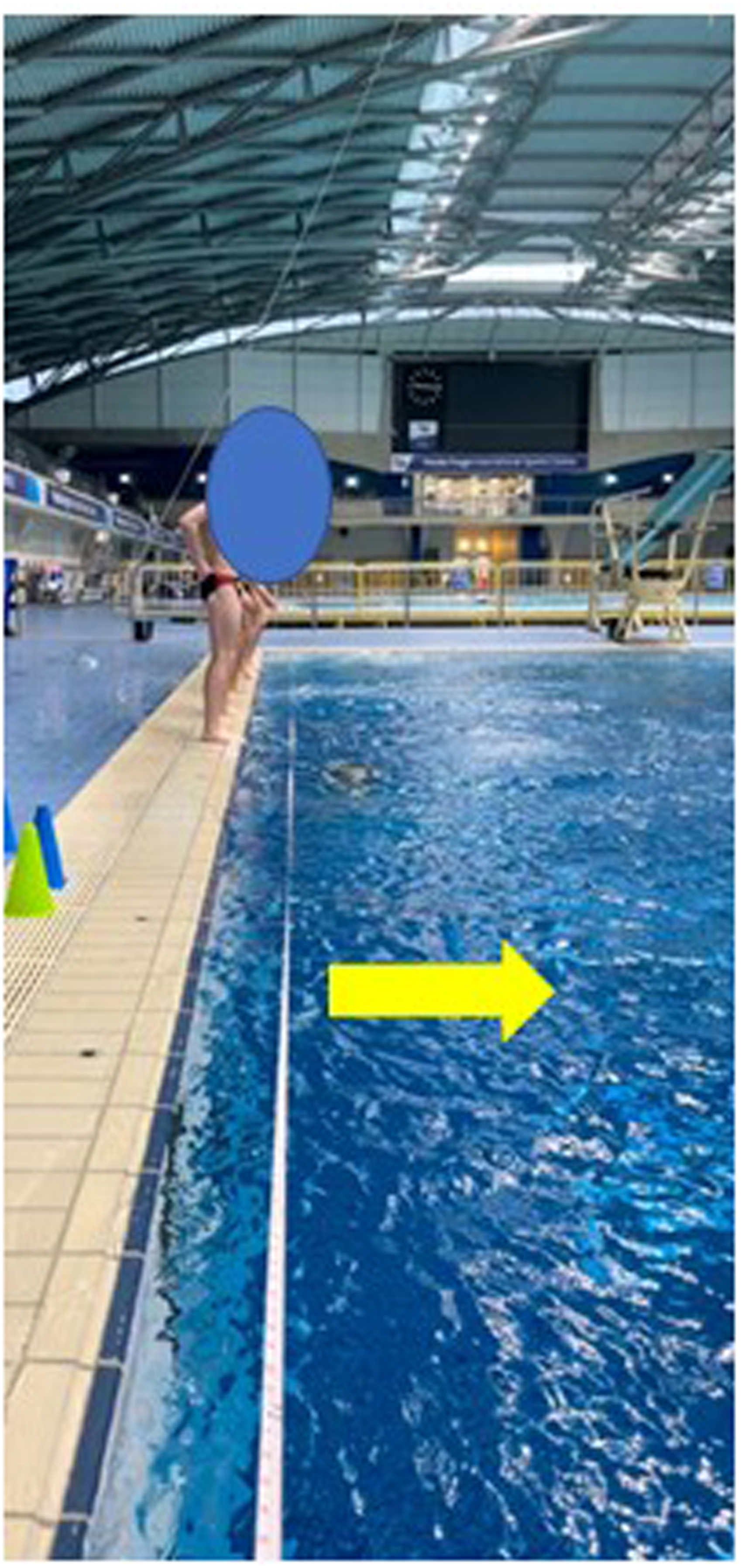
This practice task encourages divers to land over the boundary. Divers are challenged to execute different dives while landing upright and finding a clean rip entry (entry through the water without splash). This practice task also affords diverse opportunities to adapt take-off power to perform higher dives. Moving the boundary away from poolside (in the direction of the yellow arrow) requires the divers to explore movement and power capabilities to land in the desired way, without the need for an overemphasis on coach instruction and feedback.
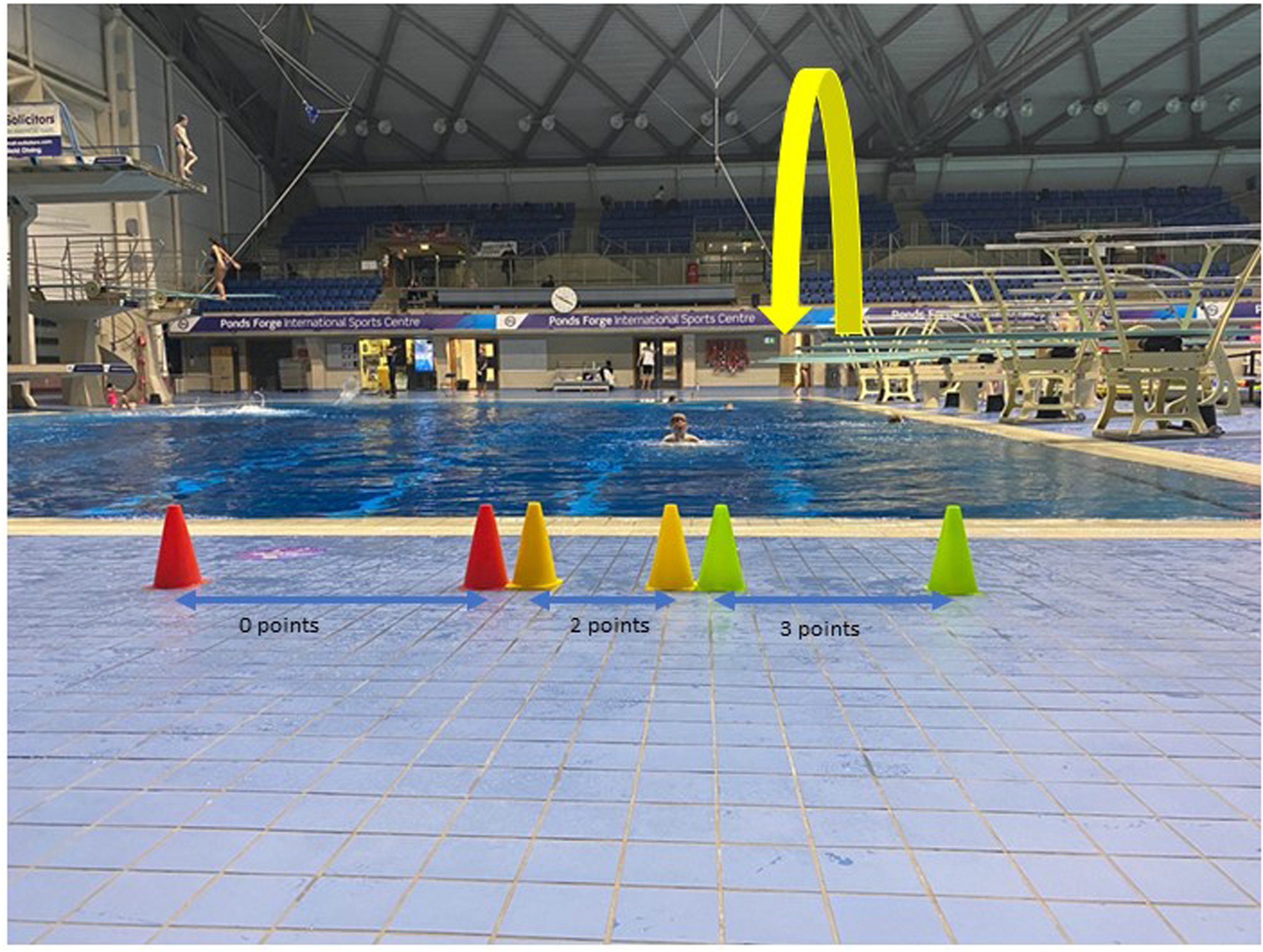
This springboard practice task challenges divers to land in different zones (3 points for green, 2 points for amber, and 1 point for red). Landing closer to the board (i.e. in the green zone) requires greater movement control to manage rotational speed and upright rip entry. This challenge can be scaled up and down by increasing or decreasing the size of the zone, or by changing which zone to enter.
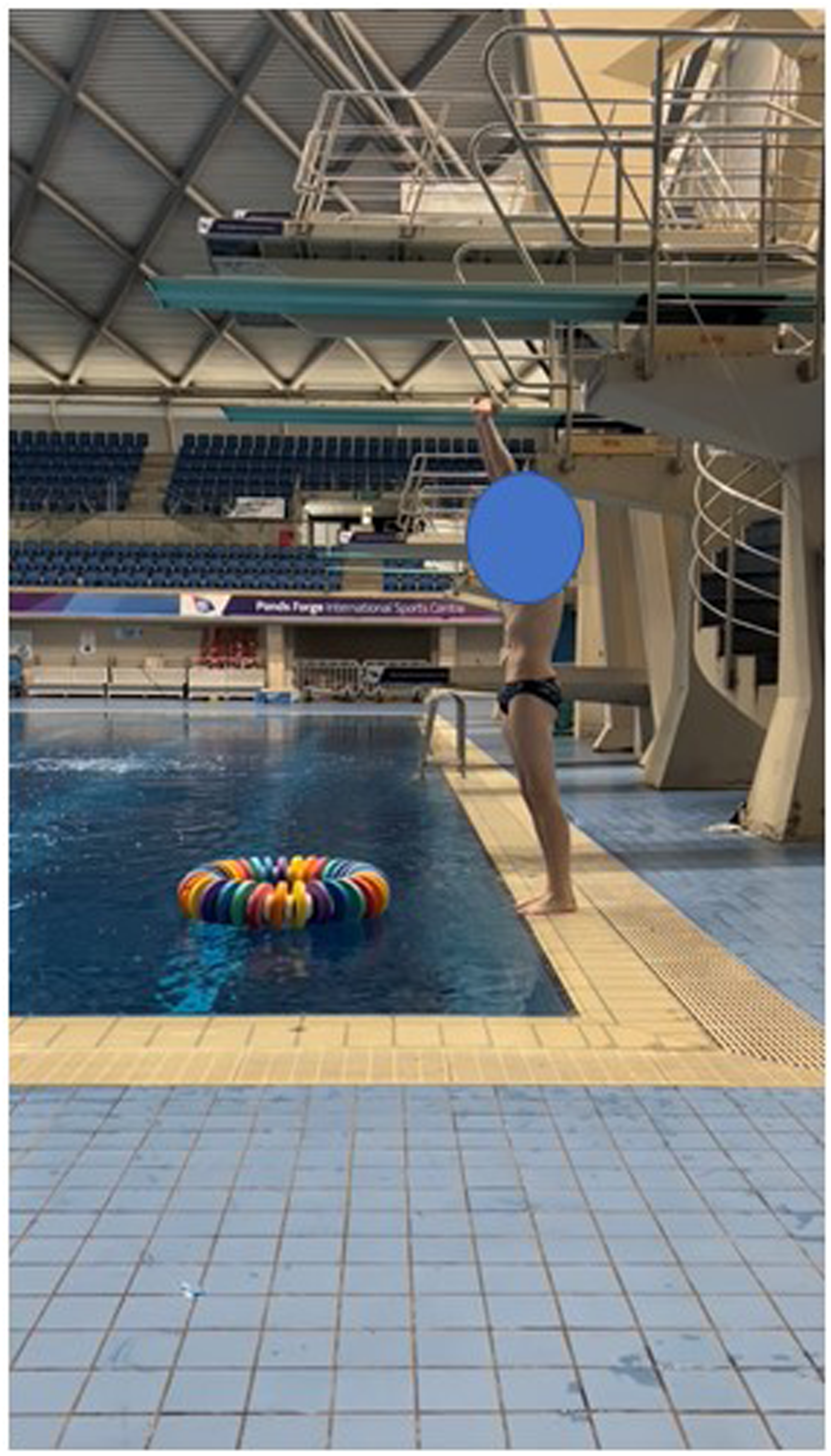
This task constraint provides the diver with a target to travel through while finding upright and clean rip entry landings. The driver is encouraged to find a functional solution to manage push, distance (balance), rotation, and entry position to travel through the hoop. The hoop location can be manipulated so specific elements of the dive can be challenged.
In the final stage, semi-structured interviews were conducted within two weeks of the workshop. To facilitate the interviews, a semi-structured interview guide was developed with a series of open-ended questions, informed by the authors’ knowledge of the CLA and the diving coaching landscape. The interview guide consisted of six main sections with questions exploring: (1) diving background and current role (e.g. “Tell me about your current role and background?”), (2) current coaching culture within own club and within diving (e.g. “can you describe the current coaching culture within British diving and the diving club?”), (3) personal coaching practice (e.g. “can you describe how you would typically deliver a diving session?,” (4) insights into the participants’ views on a CLA (e.g. what are your views on the CLA?”), (5) the feasibility and sustainability of a CLA (e.g. can you tell me whether you think it is feasible and sustainable?”), and (6) any limitations, barriers or recommendations for implementing this approach (e.g. are there any recommendations that you would make based on our discussions about the CLA?”). In addition, follow-up questions and probes were used throughout to encourage participants to expand on their answers. 18
Data analysis and reflexivity
To raise awareness about the way in which the research process is embedded in subjective values and biases, the first author employed reflexive practice at all stages of the study. 19 At this point, it is important to acknowledge the first author's (SH) personal history within the sport of diving. SH has extensive experience in competitive diving and is employed as a full-time diving coach and works occasionally as a coach educator for British Diving. Although this positionality provides a physical–cultural insider status, presenting many advantages in terms of securing access to the field and familiarity with the diving lifeworld, 20 it also presents considerable challenges in terms of subjective values and biases; however, it is this biographical history that enables interpretation of the phenomena under study. 21
Although we recognise that detaching oneself from their own social, cultural, and historical situatedness is an impossibility, 22 throughout the data analysis process best efforts were made by the first author to step aside to adopt a self-reflexive and critical perspective when analysing the interview data. In a similar approach to McNarry et al., 19 to complement this process the second author (who was a complete outsider to the swimming lifeworld) challenged taken-for-granted assumptions and posed naive questions in relation to the findings. This process was repeated to challenge assumptions and preconceptions, helping to refine the themes in the context of the research aims.
Results and discussion
Opposing philosophies about learners and the learning process
The participants had conflicting views about the appropriateness of a CLA curriculum in supporting the development of learners on the Learn to Dive programme. This is not surprising, as coaching is considered a social process and therefore key actors are embedded within very personal and specific sociocultural–historical factors. 23 For Stone et al., 24 the notion of a sports traditional culture is one of the main drivers that serve to maintain the status quo with specific coaching practices, highlighting how the implementation of alternative coaching methods should be considered in the context of the sport and the coaches’ needs, experiences, and biases. Although we appreciate that the findings cannot be generalised beyond this sample, the participants’ opposing views support critiques aimed at the top down and one-size-fits-all approaches that sport organisations adopt to coach learning. 25 Given that NGBs try to shape the pedagogical practice of practitioners, coach educators, and developers should approach education programmes with caution considering the varied experiences and beliefs that coaches hold. 26
The incongruity displayed by the coaches was manifest in their views about the application of a CLA, highlighted by the following comments. Coach 12 suggests that a CLA curriculum could support participants to take ownership of learning, to develop the capacities and abilities to cope with performance preparation. ……..while you're in a competition you can't redo the dive. I think adapting them to if you're going to be on the corner of the board, how do we alter our dive? To make sure that we still score a reasonable score. Similarly, if you're too far back on the board, how do we alter that? I think all these tools that you've put together can be used to do that, because then they'll understand if their chest is too far back, or if their hips aren't under? How does that affect their dive? And how do they have to then tweak their body in the air to land on their head to not land halfway down the pool. (Coach 12)
I think the easiest way to attack this, and this is something that I did, was that it comes down to that guided free time. So rather than you know, at the end of your session you've done 25 min you've got five minutes left, rather than just saying ‘off you go free rein’, you then say we're gonna play this game where you jump through the hoop or you land in a specific spot. So, it's still fun, and you're getting both elements and I think that is better. (Coach 14)
Further opposing beliefs were evident in the coaches’ perceptions of constructing learning environments, and in how they viewed the participants’ role in the learning process. In ecological dynamics, maintaining the intertwined nature of the individual environment system in practice is an important goal for coaches and sport science practitioners, providing context for skilful and emergent actions to emerge.
27
The CLA provides a practical framework to design learning environments that position and maintain a deeply embedded and reciprocal relationship between an athlete and the environment. In a CLA coaches guide athletes to explore practice landscapes to develop deep knowledge of performance environments.
28
Woods et al. (p. 4)
29
have characterised this process as wayfinding, drawing attention to the value of athletes “solving problems, seeking and detecting information, utilising affordances and (re)organising goal-directed actions” when self-navigating through performance contexts. Coaches recognised how a CLA could support the design of learning environments. Coach 2 and 19 elaborate. I agree with the principles, I agree that it's a good tool to use. I think it does help create that sort of stimulating learning environment, both for the coach and athlete because it does make the coach think from a development point of view. (Coach 2)
I think that it is really, really positive and practical because you put the pack together …….. and that is allowing athletes to become more in control of how they learn and less do as I say, which I think is very, very positive. (Coach 19)
Conversely, some of the participants valued more traditional teaching and learning approaches, based on the acquisition, retention, and reproduction of specific movement templates. Montuori
30
has categorised this type of reproductive learning as machine like, where learners are empty vessels waiting to be filled with knowledge or skills by instructors or teachers, in the quest for conformity, specialisation, and certainty of actions. Coach 9 describes this method as a numbers game where the aim is for athletes to complete high volumes of dives or achieve ‘10,000’ hours of practice to develop and reproduce competent diving skills. I think especially as you get higher in the ladder it is more about that numbers. They said like the numbers game. I think a lot of it is based on the 10,000-h rule, but a lot of sports are based around that now which I think it's really, really good. But it's important to dedicate that much time. But yeah. It is just you do what your coach says. You try and make that correction. And you go and get on with it, that's how I see diving. (Coach 9)
Path dependency
The notion of path dependency highlights how institutions structure their values, rules, and ways of working along established historical paths. 31 The decisions individuals make based on these established institutional behaviours, and the subsequent changes to policy or practice, can become very difficult to change once a certain path is chosen. 32 As Duit 33 suggested “path dependency has been formulated as a notion of bifurcation points (or critical junctures) along a historical path; events and decisions at certain instances in a historical development are more important than others, since non-reversible development changes tracks at these points” (p. 1100). In sport, there are many examples of historical critical junctures that in the present day constrain current practice and innovation. The practice of training periodisation is one example of this, and even though contemporary insights have rejected the original theoretical and conceptual assumptions upon which periodisation is based, traditional training planning models remain unchanged. 34
Institutional path dependency was evident within this study, where British Diving's programmes and resources were discussed about influencing an ‘institutionalised method of coaching’ (Coach 2). The dominant method of coaching aligned to specific rules about standardised techniques and structured linear session plans that were passed on from coach-to-coach, and subsequently isolated embedded belief systems from scrutiny. Coach 8 highlights the social nature of coach learning that compounds challenges of path dependency. A lot of my coaching style is taken from former coach and how I was coached, looking back now. (Coach 8)
Single or optimal systems, as exemplified here, can be a major barrier to innovation or implementing contemporary approaches to athlete development. Philosophically and theoretically, gold standard techniques and step-by-step coaching methods are at odds to the foundations of a CLA. In a practical sense, shifting philosophical beliefs upon which traditional athlete development assumptions are supported, come with temporal, financial, and personal challenges. This means that organisations are more likely to stick to tried and tested ways of operating rather than searching for innovation.
35
This challenge was identified by coach 17, who questioned the compatibility of a CLA and the single system. How do you see the constraints-based coaching falling in line with a single system? Obviously, the constraints-based coaching, you're asking for the divers to discover their own way of doing skills and movements and could lead to variability in technique? And as a sport, we've pushed for a single system and an optimised standard technique. So, do you see there being conflict or working together or how do you see that going? (Coach 17)
The notion of moving away from the characteristics of the single system described here could be considered a lot more complex than the methodologies promoted by British Swimming. Deterministic explanations of learning that sit firmly in Western societies path-dependent view of education, sport, and the workplace contribute to this ideological inertia.
36
The taken-for-granted, highly structured and linear nature of session planning and delivery within British Diving, have wider social and cultural significance. Therefore, expecting programme managers and coaches to deviate from the status quo to adopt pedagogical practices that run counter to normalised beliefs may be unrealistic. Coach 20 demonstrates this challenge by outlining the traditional approach to delivering Learn to Dive sessions (note the linear, step-by-step approach). Basically, it’s your half hour you’ve got twenty-five minutes pretty much following the session plan exactly as is. Because the session structure is basically, you know, this week with levels 2 s and 3 s, you’re gonna do backwards. So, you’re gonna work on crouching back dives, you’re gonna work on normal back dives. So, you know, spend a certain amount of time doing some circles, doing crouching back dives, doing crouching jumps that kind of stuff and then do your back dives.
Operational priorities
There is a propensity for applied talent development and sport coaching research to prioritise operational factors that preference understanding of administrative organisation, systems implementation, and the management of staff development.37,38 Although important, solely focusing on operational factors can detract from athlete preparation and development challenges because it does not tell us much about the learning designs that athletes and coaches need to undertake. This means that the introduction of innovative and contemporary models of coaching may not be valued; however, time and again operational factors seem to be prioritised over theoretically informed models of athlete development that address micro (i.e. practice designs) and macro (i.e. talent system design) challenges. 39
An operational focus was evident within this study, where the CLA was viewed as a threat to financial income and Learn to Dive assessment methods. These operational matters presented a dichotomy between supporting and enhancing participant development and satisfying established operational practices. By way of example, participants suggested that parents may not perceive the CLA as a viable coaching approach due to a pedagogical shift away from traditional methodologies (e.g. due to a more hands off approach). Coach 5 suggested that these differences could impact upon income generation. If you’re junior Learn to Dive like you’ve got to make the money, you’ve got to have the people coming in and people come in for maybe a half an hour lesson a week like, they [parents] want that to be full of their kid doing diving [e.g., the coach providing instruction and feedback aligned to repetitious practice]. (Coach 5)
Operational challenges were also associated with the assessment process on the Learn to Dive programme, where participants are assessed on their ability to reproduce ‘specific skills’ (participants cannot move up levels without passing the assessment). The CLA was considered a barrier to participant progression because unlike traditional methods, practice encourages the exploration of functional movement solutions to satisfy interacting constraints. In this approach, specific skills are not rehearsed and continuously repeated until they fit an optimal movement standard, rather, participants explore movement boundaries under specific constraints to satisfy task goals. As Fitzpatrick et al.
41
demonstrated in their study of mini tennis players, task constraint manipulations in the form of recovery box location and centre line manipulation channelled players towards tennis specific movement solutions (i.e. shot selection), resulting in greater post intervention backhand and forehand proficiency. Therefore, assessment in CLA, would be based on an individual's ability to satisfy interacting constraints while adapting movement functionality to a specific task. This means that a CLA and the assessment of specific skills are not congruent, they do not fit. This lack of alignment was identified by Coach 7, who observed that implementing a CLA with traditional assessment methods could affect participants’ progression. My only challenge with this and I raised this on Monday in the meeting, was how we make sure maybe at a Learn to Dive level that we still can get kids progressing through. We still get that sense of attainment and achievement and I know there was comments whether we look at different assessment criteria because at the moment it (the CLA) doesn’t, it doesn’t necessarily match with the assessment criteria that we have for the learn to dive scheme because we’ve got very specific skills that we’re assessing. (Coach 7)
If the assessment is important to maintain a ‘sense of attainment and achievement’, CLA informed learning and development programmes need assessment methods that more closely align to an ecological dynamics framework of motor and skill development. Ng and Button 42 have highlighted this challenge with general movement assessment batteries, suggesting that assessment methods must account for an individual's ability to adapt movement to the dynamic constraints that impinge on performance. Applying these ideas to assessing diving skills signals a rethink in the way coaches assess divers at the novice end of the performance spectrum, while still recognising that optimal diving techniques are the focus of high performance.
One way to achieve this is to assess the time novice divers spend self-organising body components between stable (i.e. persistent behaviours) and flexible (i.e. variable behaviours) states while exploring diving tasks. By way of example, the skill of executing a clean ‘rip’ entry (entering the water without splash) from different dive positions could be used by a coach to monitor a diver's resistance to perturbations while reproducing similar movement patterns. The amount of (more or less) time a diver takes to adapt to the varying dive positions, while achieving a clean rip entry, could indicate the capacity for adaptability in self-organising to achieve functional movement solutions to specific task goals. 43
A new model of coaching is needed
Although participants disagreed about which coaching methods were better suited to enhancing participant development, there was a general feeling that a new model of coaching was needed within the British Diving pathway. Coaches suggested that current approaches did not support learning environments that fostered fun and continued participation, two areas that were deemed important for participant development and progression. Continued participation, specifically, was a concern for the coaches who indicated that deliberate practice characteristics such as high volumes of repetition and feedback can negatively impact upon engagement and motivation.
44
Coaches recommended that learning environments needed to be more dynamic (i.e. less coach centric) to keep participants more engaged to sustain participation. Exemplified here by Coach 19, who recommended that a change from the traditional approach is needed. I think if you start let's say, stage one, brand new group of kids, I think if you don't establish a certain normality of do a dive, give feedback, do a dive, give feedback. I think if you change it up quite a lot, it might be quite a dynamic environment for them. And they might be more engaged.
I don't think it happens at either end enough, bottom or top. I don't think it happens enough. It's too serious, the environment of diving is way too serious, I think there's got to be more fun incorporated.
Light and Lémonie 45 have suggested that the notion of fun in children’s sport has a different meaning for different children, however, within the literature, there is a consensus that fun relates to a child's perception of achievement (i.e. skill mastery and perceived competence), social (i.e. friendship groups and social recognition), and intrinsic factors (i.e. sensation and excitement). 46 These categorisations of fun can help inform the design of pathway programmes that are more aligned to children's motivations, alleviating issues raised by the coaches.
Conclusion and future challenges
In this article, we have aimed to give diving coaches a voice to explore the challenges of implementing a CLA curriculum in future Learn to Dive programmes. Rarely do sports organisations consider coaches’ sociocultural contexts when implementing new coach education programmes. When in fact, sociocultural factors construct coaches’ views of what good learning and development looks like, illustrating the multiple and complex layers that curriculum designers must navigate to ensure the successful implementation of new coaching approaches. This challenge was evident within this study, where opposing coaching and learning philosophies, path dependency based on traditional notions of coaching practice, and operational matters taking priority over learning and development, were identified as potential challenges to implementing contemporary curriculum designs.
Although professional development, in the form of context-specific learning experiences, may be one way to navigate the barriers to implementation, 16 we are certainly not advocating more of the same initiatives that have failed to impact on coaches’ practice. Rather, documenting learning experiences of this nature through case study designs and ethnographies, can provide rich context-dependant insights that are more likely to connect with the challenges policy makers and coach developers face on a daily basis. Qualitative methods of this nature can start to identify transferable ways to address issues associated with path-dependant biases, opportunities for change, and the unique and varied challenges that come with trying to implement change programmes. The extent to which qualitative findings are transferable to other settings depends on the degree to which policy makers and coach developers believe that research connects with their own situation. However, if this type of research does connect it has the potential to get to the heart of these challenges so opportunities for change can be realised.
Footnotes
Declaration of conflicting interests
The author(s) declared no potential conflicts of interest with respect to the research, authorship, and/or publication of this article.
Funding
The author(s) received no financial support for the research, authorship, and/or publication of this article.
