




Abstract
Although there seems a willingness to adopt pedagogical approaches that address the complexity of team games, there is little guidance as to how. Transforming coaching practice does not happen overnight, therefore developing non-linear approaches to coaching assumes the development of new knowledge. These approaches to coaching privilege social interaction and the use of questioning in the coaching process, which is far removed from the traditional approach to coaching. Greater exploration is needed as to how to support coaches in developing their application of non-linear coaching practices to support transformative coach learning. Research identified the challenges coaches face when trying to incorporate questioning into their practice. Recognising the pedagogical nature of coaching, this paper draws on Lev Vygotsky to support coaches in improving their coaching with game-centred approaches and the use of questioning. The study aim was to improve my practice as a coach educator to enhance rugby coaches’ understanding and application of the game-centred approach. It involved a group of six student rugby coaches. Using action research, coaches delivered an 11-week rugby programme to a class of year 5 children. Findings emphasised the importance of social interaction, privileging the use of language in developing coach autonomy. Providing time to build a collaborative relationship between the educator and coach assisted coach development. The major contribution this paper makes is to illustrate the value of effective questioning. The importance of questioning cannot be understated in coaching and coach education, with it leading to social interaction and facilitating opportunities to develop co-construction of new knowledge.
Introduction
Within team games where the people, learning and performance are inseparable from the dynamic, physical and socio-cultural context, 1 game-centred approaches (GCA) are increasingly advocated.2,3 In the 1980s, David Bunker, Rod Thorpe and Len Almond developed Teaching Games for Understanding to address concerns about how Physical Education (PE) in schools did not develop good games players. 4 Since then, other GCA have emerged, such as Game Sense 5 and The Tactical Games Approach. 6 While all different, they share four key pedagogical features; the design and manipulation of practice games and activities, use of questioning, opportunities for dialogue, and building of a supportive sociomoral environment. 7 Although there seems to be a willingness to adopt pedagogical approaches that address the non-linearity and complexity of team games, there is little guidance for those wishing to do so. 3
Evident in the GCA literature is a focus on the importance of questioning and language; a belief that the coach should ask open-ended questions to encourage understanding of the tactical dimensions of games and the appropriate performance of skills. 8 Research has emphasised the difficulty and challenging nature of questioning. 7 Even before feeling underprepared for the interactions that questioning would precipitate, coaches often recognise their shortcomings regarding lack of content knowledge and too little preparation time.9–11 Addressing how to support coaches in tackling such shortcomings is vital to improve coaching practice. Not supporting coaches in developing their coaching pedagogy will result in them reverting to the status quo of a ‘traditional’ coaching approach characterised by a dominant focus on directive ‘command’ style instruction. 12 Thus not moving on and facing the issues identified 40 years ago.
Groom et al. 13 emphasised the potential within sports coaching to address the non-linearity and collaborative nature of learning by highlighting the work of Lev Vygotsky. Vygotsky's work has been applied extensively in education14,15 and child development. 16 However, there has been limited application of his work in sports coaching and none specifically within coach education. Theoretical inroads have been made into Vygotsky's potential application in sports coaching.13,17,18 Vinson and Parker 3 and Pritchard 19 have attempted to provide guidance in applying Vygotsky's notions to sports coaching (Table 1).
How Vygotsky's notions are routinely drawn on in coaching.
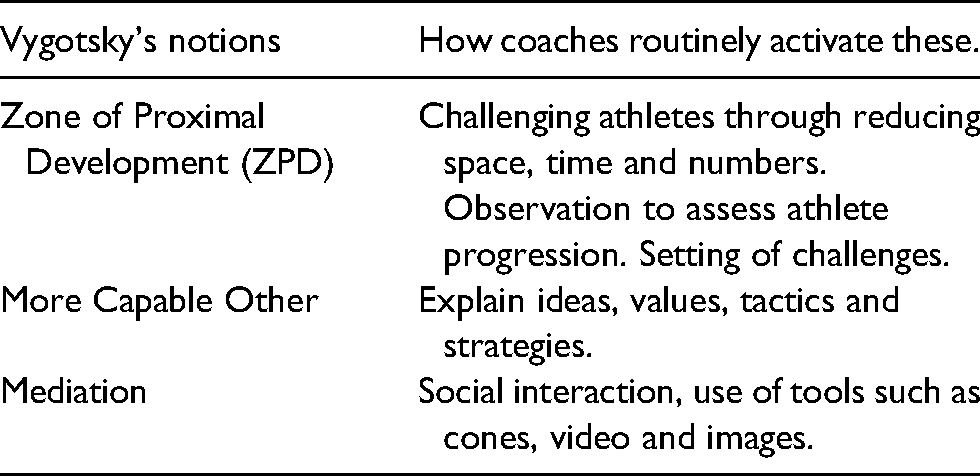
Notions such as the More Capable Other (MCO) and the Zone of Proximal Development (ZPD) have garnered much coverage.13,17,18 However, Vygotsky's work on mediation has only been tentatively explored to date in sports coaching and holds potential in the coach education field. 18 Vygotsky argued for the importance of language and mediation in supporting cognitive development, emphasising that ‘… words can shape an activity into a structure’ 20 (p. 28). Mediation is associated with the use of cultural and psychological tools to bring about qualitative changes in thinking, primarily through the application of these tools (including language), in order to explain or represent the world and experiences within it. 20 Mediation recognises the co-construction of knowledge and understanding between the learner and the MCO, with questioning being a form of social assistance to support the process.14,20 Adopting a Vygotskian lens to support coaches’ development of using questions in their coaching of GCA may begin to address some of the challenges mentioned.7–11
Previous research has revealed the successes and challenges of educating coaches in applying GCA. Evans and Light
21
used action research (AR) to improve a rugby coaches’ application of Game Sense by using a sports pedagogue to help facilitate change.
22
The focus of this eight-week study was evaluating the impact of a change in coaching pedagogy as perceived by the players and coach. The study recognised the potential benefits of GCA and AR for coach development but did not fully elaborate on the collaborative approach used to develop the coaches’ understanding and application of GCA. Reid and Harvey
23
researched a National Governing Body coach education programme to promote GCA. Criticisms ranged from a lack of support for the coaches, confusion amongst the coach educators as to what Game Sense was and the decontextualised nature of the course. Recent approaches to coach education have attempted to address such difficulties, addressing the collaborative nature of learning through the use of an AR approach to make a sustainable impact on coaching practice.24–26 The studies mentioned to date have focused on the coaches’ practice. This study focused on my development as a coach educator to support coaches’ development of GCA, addressing a gap in the literature. Adopting an AR approach, the aim of this study was to improve my practice as a coach educator to enhance rugby coaches’ understanding and application of game-centred approaches. The aim was addressed through two interrelated objectives:
To improve my practice as a coach educator (using Vygotskian theory). To explore the impact this has on the coaches’ learning and practice.
Following this introduction, the methodology and methods are presented. This is followed by the results and discussion that aims to capture and discuss the key findings. The article concludes with a summary of the principal findings, and considerations for future directions.
Methodology
Action research
The process of AR has cycles of observation, interpretation, action and reflection that enables the continuous development and testing of explanations in practice. 27 As opposed to traditional research that implies an end point, AR is directed towards a greater understanding and improvement of practice over time. 28 The systematic process of AR is monitored over varying agreed periods of time, through a variety of data collection methods that can be used to make changes in practice through modifications, re-orientating definitions and engaging with problem-solving. 29 Its aim is to bring a sustainable and lasting benefit to an ongoing process, rather than a final solution. 30
Participants
My role in the study was that of researcher and coach educator. During the study, I lectured at the participating university and coached in the extra-curricular rugby programme. At the time of the research, I was studying for a Doctorate in Sports Coaching, held a master's degree in Sports Coaching, was a qualified primary school teacher, held an RFU Level 2 rugby coaching qualification and had played rugby for over 20 years. I had 6 years of coaching rugby in various contexts; adopting GCA as a central tenant of my practice and had a good theoretical understanding of GCA. This was my first formal experience of educating coaches.
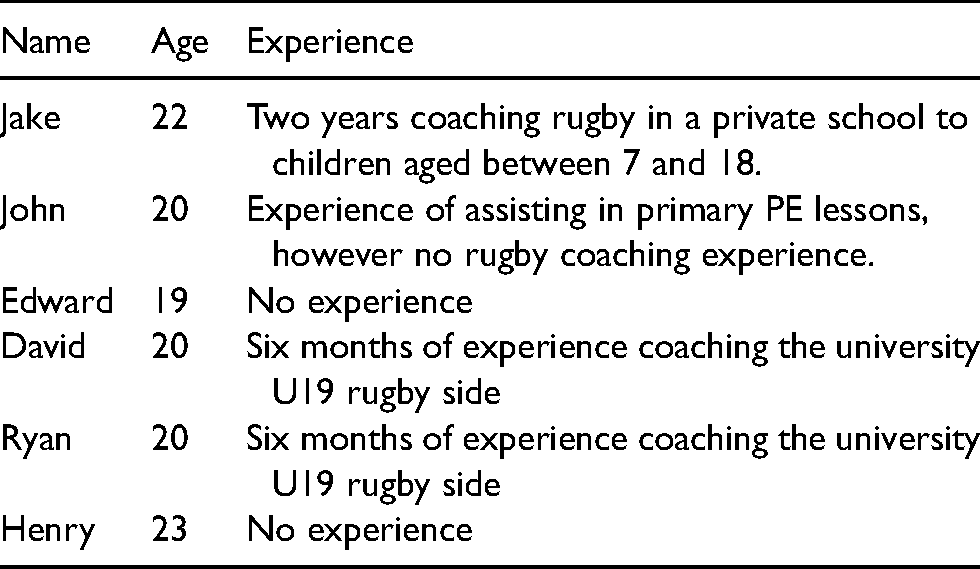
Six rugby coaches aged between 19 and 23 years volunteered to be part of the coaching group. The coaches (see Table 2 which details the pseudonyms of the coaches and their experiences) were enrolled at the university as full-time students on a sport related course. They expressed a willingness to develop their rugby coaching and had enhanced DBS certificates.
Summary of coaches’ experience (coaches have been given pseudonyms to protect anonymity).
A Primary School class of 30 years five children, attended the university on 10 occasions during the spring term for approximately 50 min (during curriculum time) to receive rugby coaching sessions.
Critical friends
Two critical friends, my doctoral supervisors, were part of the project. Both critical friends are experienced sports pedagogues and coach educators, with significant knowledge and experience of playing and coaching rugby union. The role of my critical friends was to discuss my work sympathetically, but critically evaluating all aspects of the research, challenging my assumptions, and considering the ethical issues and usefulness of the study. 31 They observed each session and provided thoughtful and constructive critique.
Ethical procedures
Ethical approval was gained from my university's ethics committee. The purpose of the study was outlined, and consent was gained from the coaches and the Head Teacher of the pupils being coached. Confidentiality, anonymity and the protection of personal information were assured, and it was highlighted that participation in the study was voluntary and that the participant coaches could withdraw at any time.
Given my previous relationship with the coaches, it was ethically important to recognise that I was a central figure influencing the coaches’ thinking and thus the co-construction of knowledge. 30 Rather than ignore my presence, I embraced this as an opportunity to develop their coaching practice, as opposed to a view that it could hinder it. To facilitate and develop intersubjective understandings, I ensured I acted reflexively. Reflexivity is ambiguous. However, it involves looking outwards at the social artefacts and forms of thought which saturate our practices and inward to challenge the processes by which we make sense of the world. 32 In acting ethically, I ensured I looked outwards in terms of observing the coaches’ practice by continually engaging with literature to inform my observations of the coaches’ delivery. Looking honestly and openly at my own thoughts to ensure accurate and honest interpretations and understandings of practice were emerging. My critical friends supported me in acting reflexively.
Data collection
Data was collected over an 11-week period using three methods: my weekly reflective logs; observations of coaching; and focus groups with the coaches.
Reflections
Due to the reflective nature of AR, it was deemed purposeful for me to keep a reflective journal to provide ongoing data that I could reflect on and return to. 30 The journal was used to illustrate points around my role and development as a coach educator and the coaches’ understanding and application of GCA by creating thick descriptions that showed complexities. 33 The reflective log included details of pre and post-coaching meetings, my observations within the coaching sessions and the feedback from critical friends.
Observations and field notes
Observation plays an important part in data collection within most AR projects. 31 I observed all coaching sessions, which involved me living in the context and being part of it. 29 I adopted the role of the MCO. 21 My knowledge and experience as a coach and using GCA meant I had the rugby and pedagogical knowledge to make informed judgements on the coaches’ practice and their implementation of GCA. These field notes were written up within 4 h of the session, allowing for clarity and accuracy in translation. 31
Focus groups
Focus groups were used to draw upon the attitudes, beliefs and experiences of the coaching group in relation to the aim of the study. Focus groups are driven by the interaction within a group. 34 Kitzinger 35 argued that interaction is the key feature of focus groups because it highlights the participants’ view of the world, the language they use about an issue and their values and beliefs about a situation.
Three focus groups took place: one at the beginning and the other two at the end of each AR cycle. Each one lasted approximately 1 h, recorded via an iPad and transcribed verbatim. The focus groups aimed to be a collaborative learning forum 31 for the coaches to further develop their understanding and application of GCA, whilst also being a form of evaluation to complete each AR cycle. The first focus group was used to establish baseline data around the coaches’ experience of being coached themselves and of coaching rugby, along with their understanding of GCA. The second and third focus groups evaluated the progress of the study, whilst also planning the evolving focus for the study. I met with the coaches on a weekly basis; the day before the sessions to clarify content for the following day and gather their thoughts and reflections a week after the previous session. There were immediate post-session meetings, lasting approximately 30 min for the coaches each week to reflect on their practice in a group context.
Action research procedures
There were two AR cycles; the first being 6 weeks and the second 5 weeks. The children were split into four groups and stayed in those groups for the two cycles. For the first 5 weeks of the study, the children had the same coach for each session to enable the coaches to build relationships with them. After 5 weeks, the coaches delivered to a different group each session as they wanted to work with different groups to experience how they might need to adapt their delivery for different children.
Before the intervention phase of the study, I met with the coaches to explain what the study entailed, the aim and my role. During the first focus group, the coaches and I discussed the game of rugby to generate an understanding of the coaches’ knowledge and understanding and to decide what principles of the game to focus on. The coaches identified principles of the game with certain phrases such as ‘move forward’ and ‘capitalise space’, so move forward into space became the starting principle. During the second focus group, the coaches recognised they needed to be more specific in their messages and careful with the language used, so the principle evolved into move forward into space, width and depth.
Each week the coaches and I met before each coaching session to reflect on the previous week, to discuss and clarify the content for the next session. The following day the coaches would coach the children. Post-session the coaches and I would meet for me to share my observations, for them to reflect, share their thoughts and discuss possibilities of action and change for the following week. The following day I would meet for 1 h with my critical friends for them to share their observations, question me and discuss how to progress the study.
Data analysis
Consistent with AR, the analysis started after some of the data had been collected, with the resultant analysis informing the next phase of the data collection. 36 The GCA and Vygotskian literature frames initial analysis as deductive, focused on generating a detailed analysis of some aspects of the data. 37 A supportive inductive analysis was then used to establish context-specific ‘theory’ 38 of the collaborative practices used to develop coaching practice.
Results
The results are presented as two higher-order themes with a clear focus on my learning as a coach educator. The first higher-order theme focused on improving my facilitation skills to enhance the coaches’ ability to develop an effective GCA learning environment. The second higher-order theme addressed how I helped the coaches to improve their social interactions with the children in their delivery of GCA. Within the first higher-order theme, how I assisted coaches’ ability to apply rugby principles within the game context and how I provided more direction to the coaches to improve their ability to address children's misconceptions of Rugby concepts are presented as lower-order themes. Within the second higher-order theme, how I assisted the coaches to improve their use of questioning, and in developing their use of language are the focus of the lower-order themes.
Improving my facilitation skills to enhance the coaches’ ability to develop an effective GCA learning environment
How I assisted coaches’ ability to apply rugby principles within the game context
Initially in AR cycle 1, I presumed the coaches would be able to apply the concept of move forward into space within GCA, as a result of their previous rugby experiences. However, this was not the case: The coaches moved away from the planned content. The coaches introduced passing to the group in isolation. They had removed it from the game.
(Observation of Session Week 2)
I had taken for granted the coaches’ ability to contextualise learning and presumed that, as they played rugby themselves and had been coached previously, they would seamlessly apply the agreed pedagogical principles. Here, my theoretical knowledge of a variety of different GCA and my own previous coaching experiences fed into the social interactions with the coaches. Recognising their need for more structure to support them in their practice, I introduced the TGA to them, due to its session structure.6,8 Utilising the TGA seemed to have a positive impact on the subsequent sessions, with the added structure helping the coaches: Placing the children in a 3 v 3 or 4 v 3 game for the majority of the session, seemed to engage the children, and progress them quicker than they had in the previous weeks. Having a section for questioning also seemed to help the coaches structure learning opportunities.
(Observation of Session Week 3)
It was identified that the children were struggling with how to support the ball carrier, which had a detrimental effect on their ability to move forward into space as a team. My role as the MCO here was to support and facilitate the coaches in how they coached these principles, ensuring they had relevant rugby knowledge to coach it. Asking the coaches how they could coach support promoted discussion amongst them as to how they could address it in practice: They discussed perhaps doing a 3 v 1 first, getting the support player to start really deep, start behind, take the ball off the ball carrier etc. There is no right answer, the coaches are having the freedom to play around with the concept.
(Pre-Session Reflection Week 5)
Towards the end of the first cycle, as a result of my constant social interaction with the coaches and their increasing experience, they started to think more about how to provide greater context to the activities they were coaching. As a result of me guiding the coaches to manipulate the game elements and expose the children to different situations within the game, the children's understanding around move forward into space improved. The improved pedagogical approach I facilitated with the coaches manifested in the children's learning: In David's group the children were engaged and talking about their approach to the game. They were creating strategies and David could facilitate with one or two probing questions around the game.
(Coaching Reflection Week 5)
During the second cycle, the collaborative relationship between the coaches and I evolved with them taking on more responsibility when planning. There was more clarity in their articulation of ideas, highlighting increasing knowledge and confidence in their understanding of rugby principles. Their increased understanding enabled them to manipulate game conditions and interact with the children more effectively to promote learning. This enabled me to take on more of a facilitation role: My role has become less about leading it and more about being a sounding board for the coaches, posing new challenges, helping them think differently and assist them in approaching things differently.
(Coaching Reflection Week 10)
How I provided more direction to the coaches to improve their ability to address children's misconceptions
During the first focus group, I did not explicitly ask the coaches to address misconceptions in the children's play, rather just reinforce the concept of move forward into space. This lack of direction resulted in the coaches’ missing learning opportunities and allowed misconceptions to develop: There were opportunities where the children stopped or ran backwards, yet this was not identified by the coaches or acted on … it is important they begin to recognise learning opportunities and address misconceptions.
(Coaching Reflection Week 1)
Despite me planning the first session, the coaches needed more structure and support. Privileging social interaction, I asked them how they thought their first session had gone in relation to promoting move forward into space: Henry and Jake recognised they had missed learning opportunities in relation to the overall objective of move forward into space. That was the big focus for the session to correct any misconceptions.
(Pre-Session Reflection Week 2)
As the concept evolved in the second cycle, there were inconsistencies in addressing the children's misconceptions and identifying learning opportunities between coaches: … the children were not moving forward into space as much. Ryan was not interjecting, so I asked him what they needed to do to improve. He replied, ‘they need to come short’. … John reinforced the use of width and depth, referring to the objectives. He gave the children opportunity to play but interjecting at appropriate times to emphasise learning and question around their understanding.
(Observation of Session Week 8)
The gap in some of the coaches’ understanding and application of the concepts needed to be addressed in terms of their identification and understanding of how to address misconceptions. This emphasised the importance of individual support for the coaches and my ability to have an understanding of the coaches’ ability to provide personalised support. At times during the sessions, I interjected to address developing misconceptions; the intention being to promote learning in the children and coaches by illustrating an initial method as to how to address misconceptions. Ryan demonstrated he had an understanding of the misconception in the children's play; therefore, it was his ability to address it that needed support. He later demonstrated his ability to engage with the scaffold provided, manifesting in his improved application of addressing the children's misconceptions: One of the girls put a 6-7m pass across to her teammate who was opposite a defender, however they had a support player in between, but too deep. I froze the game and asked the support player how she could get the ball. She replied, ‘Get closer’. She moved closer. I asked her what was in front of her, and the girls replied with ‘space’. As play progressed, they started attacking more and throwing shorter passes.
(Coaching Reflection Week 8)
Ryan slowed it down and spoke with the players about actions they could take when they had the ball, linking it around width, space, and depth. He drew on their opinions to involve them in the process.
(Observation of Session Week 9)
How I helped the coaches to improve their social interactions with the children in GCA
How I assisted the coaches to improve their use of questioning
Near the beginning of cycle one, I emphasised the importance of questioning with an emphasis on open questions to provide the children opportunities to elaborate and articulate thinking
20
: I asked the coaches to ‘drill down on the detail’, correct any misconceptions and engage the children by questioning how they are doing something. David added they need to focus on the how, what, where and when, and apply it when questioning. Ryan highlighted they need to draw the information out of the children.
(Pre-Session Reflection Week 2)
Despite the coaches seemingly recognising the importance of questioning they did not apply this in their early practice: ‘The coaches were not detailed in terms of questioning around the concept of move forward into space’ (Observation of Session Week 2). Along with asking the coaches to be more detailed in their questioning, I interjected during their sessions to encourage the children to articulate their understanding. By providing examples of how to question, the coaches could see this in action and hopefully use it more effectively.
Along with examples, I ensured frequent social interaction between myself and the coaches during sessions. These interactions were intended to promote the coaches’ thinking, understanding and application of questioning as part of their game-centred pedagogy: I interacted with the coaches frequently. I questioned them regularly and asked why they were doing certain things. I asked them to be more precise in their interactions, generate understanding from the players and build on their knowledge.
(Coaching Reflection Week 2)
As the concept evolved into the second cycle, whilst continuing to ask open questions focusing on move forward into space, the coaches were also promoting the children's understanding of the game principles of width and depth. A pedagogical principle of GCA is the importance of social interaction and emphasising questioning to generate dialogue, which should in turn facilitate the internalisation of concepts and understanding of games (20, 22). This required the coaches to become more specific in the content of their questioning, whilst still ensuring an element of openness as to not restrict the children: Henry: … say that was the one cone (moves and points to paper on the table), I’d position the cones and position them quite far back and I’d ask what's the problem? One pupil answered, ‘it would probably be a hard pass for the person to do’. I then asked what else … (Pupil replied) ‘Well if they’re that far back when they receive the ball the defence is just going to come up. If you move the cone here (moves the paper forward) if you pass the ball there you could run through the gap before the defender fills the gap, so it would be easier to score if you flatten up.’
(Final Focus Group)
How I developed the coaches’ use of language
Towards the end of cycle one, the coaches recognised (following some prompting by myself) that they needed to pay more attention to the precision of language they used to have a shared understanding of the game concepts, between themselves and the children. They argued it was important to develop contextual language in collaboration with the children: John: What's helpful is actually letting them create the language. Ask questions and they will come out with words they use and then you can use those words they’ve come out with rather than words they might not understand. This way they already have an understanding.
(Mid-Point Focus Group)
During cycle two, move forward into space evolved to incorporate width and depth, as a result of recognising the importance of language when coaching. The coaches now had the autonomy to co-construct meaning with the children. This meant taking care with language became even more of a priority due to the increased complexity of the concepts: I emphasised that it's important that whatever they do, it's their approach that's important, including the language they use to mediate learning, and that it's collaborative between them and the pupils.
(Pre-Session Reflection Week 8)
As cycle two progressed, the coaches continued to define terms collaboratively with the children, allowing the children to share their ideas within their group: One of the children in the group explained what was meant by width. He said, ‘width doesn't have to be wide; it can be narrow’. Jake asked, ‘What do you mean?’ ‘It doesn't have to be on the side-line, it can be in between 2 defenders, so it is narrow width’.
(Observation of Session Week 10)
Discussion
Results from the study demonstrated the potential use of using the work of Lev Vygotsky to support the development of coach learning. To facilitate pedagogic change in coach delivery of GCA, developing a collaborative relationship with the MCO (the coach developer) over a prolonged period of time assisted with facilitating coach development. At the heart of this relationship was the emphasis on social interaction, privileging the importance of language in developing coach autonomy. Identifying the coaches’ subjective ZPDs at the start would have further aided coach development. 39 However, the major contribution of this paper is to illustrate the importance of questioning in coaching and coach education. Not just any questions, but the best types of questions to illicit learning.
Questioning is one of the central learning tools that should be used in GCA, yet coaches have difficulty utilising questions within their coaching. 7 Despite Vygotsky not providing a specific pedagogy, he wrote about collaboration, direction and assisting learners through demonstration, leading questions, and introducing initial elements of a solution. 40 The vagueness of Vygotsky's words and the challenging nature of questioning was mirrored in my initial support to the coaches. Asking the coaches to ‘drill down the detail’ was devoid of any specific guidance on how to question, failing to support them in a challenging facet of coaching pedagogy, resulting in the coaches not addressing misconceptions in the children's play. There was no reference to the language needed to question effectively.
Vygotsky14,20 emphasised the importance of language when co-constructing knowledge and understanding, drawing attention to the types of questions being asked. On reflection, I wanted the coaches to ask more open-ended questions, to promote thinking and dialogue in the children. Not paying enough attention to my own questioning and language, reduced the coaches’ ability to apply high-quality questioning in practice.2,41
Learning from a Vygotskian perspective occurs in a social context. The ideas an individual learns are mediated through their social interactions and relationships with an MCO,16,18 with language a key mediator. 20 As the MCO I needed to mediate the coaches’ learning of GCA and their ability to apply high-quality questioning. The ability to question was vital to improving practice as Vygotsky argues that ‘direct instruction is pedagogically fruitless’ 42 (p. 170).
Introducing the TGA emphasised my role as the MCO. 20 The TGA scaffolded the coaches’ practice; effectively mediating their learning through a Vygotskian approach. Collaborating, providing direction through assisting, asking leading questions and introducing initial elements of a solution were all realised in mediating coach learning. 40 The TGA provided the initial elements of improving coach delivery; structuring coaches’ sessions enabled confidence to develop and reduce anxiety in terms of what to do and when. Asking open-ended questions around various pedagogical considerations such as suggesting game scenarios facilitated discussion and promoted the collaborative learning relationship.14,20,42
The coaches leading into week 5 struggled with coaching support play, however, being explicit with the language I used influenced what the coaches did and did not internalise.43,44 For example, ‘How could you coach support?’ Asking ‘How?’ creates discussion and promotes thinking which leads to a well thought out solution. In this example, it meant creating many different 3 v 1 scenarios. Questioning leads the interaction. This was again evident in the final focus group where Henry presented a game scenario to the children to solve. He asked, ‘What's the problem?’ Again, questioning led the interaction. Further questioning following their response of ‘What else?’ forced the children to elaborate. This generating a deeper knowledge and understanding of the problem. The collaborative relationship between the MCO and the coaches and the coaches to the children were important in constructing shared understandings. Questioning initiated the interaction that facilitated the collaborative relationship, co-construction of new knowledge and ultimately, the coaches got better at coaching through GCA. Consequently, the children became better rugby players and developed a greater understanding of the game. 45
Whilst acknowledging that all coaches improved and made progress in their development, it was not a ‘one size fits all’ approach. The collaborative learning relationship was nuanced for the individual. Each coach developed at different rates and needed different support; drawing attention the coaches’ ability to imitate. A person's ability to imitate according to Vygotsky is the basis of a subjective ZPD. 39 Vygotsky's view was that imitation is not a mindless copying of actions but refers to ‘all kinds of activity of a certain type carried out by the child … in cooperation with adults or with another child’ 20 (p. 202).
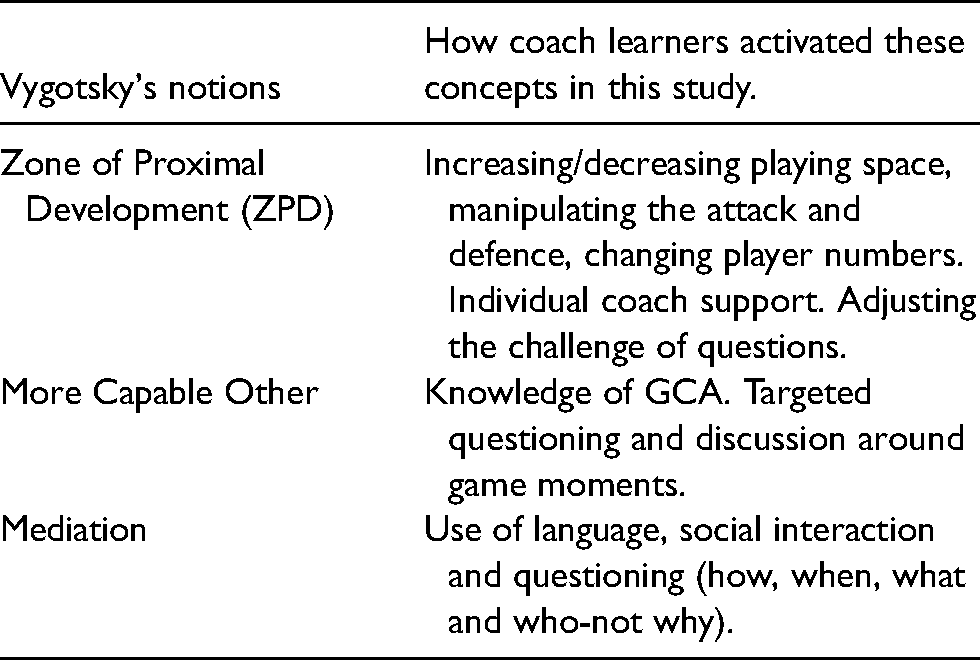
Privileging social interaction through collaboration, demonstration and questioning, 20 I assisted Ryan by questioning one of the children who was developing misconceptions, to provide an example that we could discuss. As detailed in the results, a ‘How?’ question led the interaction, a ‘What?’ question encouraged the elaboration. Consequently, he was able to act on the modelling of asking questions and apply this in his own practice the following week. 20 It was the consideration of the social assistance and time required for Ryan to internalise the ideas that were needed to improve practice. This idea is echoed by Vygotsky who gave primacy to social relations and context as crucial to development (18), with this idea underpinning the activation of Vygotskian theory in this study (Table 3) and provide a practical example to facilitating coach improvement.
How Vygotsky's notions were activated during the study.
Activating Vygotsky's theory can support the constantly changing world of learning in sports coaching and coach education. Although Vygotsky sadly passed away in 1934, his work could be argued is more vital today in addressing coach development. Coaching and coach education is being seen more and more as a contested human endeavour, that being learner-centred with the purpose of developing relationships to support both coach and athlete learning. 46 Great coaches and educators individualise their actions based on the needs of the learners; Vygotskian theory emphasises this by prioritising social relationships and context as vital to development. 18 Vygotsky can help put some order on this increasingly complex process known as learning.
Conclusion
Although not the initial intention, the study drew out helpful new evidence around when and how to question. The challenging nature of questioning was raised in the introduction, 7 however, this paper puts some concrete footings into an abstract concept. When is a time question. Where is a question about space. What and how questions allude to identifying a problem with an initial solution, further discussion, and elaboration. What, where, when and how embodies Vygotsky's thinking around learning.
Drawing on Vygotskian theory drew attention to this by paying careful consideration to the language used; facilitating the coaches’ internalisation of knowledge so they could ‘make sense’ of their experiences and develop useable knowledge to apply in practice. 20 As a result of improved questioning the children improved their knowledge and understanding, emphasising the importance of the ‘MCO’. 20 Ensuring the coach educator has the content and pedagogical knowledge to illicit learning is crucial to support coaches in applying non-linear coaching pedagogies more effectively. 47
When to question emerged as a key finding in the study. Questioning led the social interaction. They initiated conversations and situated the interaction. The importance of learning how to interact is crucial for both coach educators, and coaches alike. Coaches are central to developing players and ultimately securing the future of the game. Coach educators are responsible for working collaboratively with coaches to facilitate this. 48
Vygotsky's work on mediation recognises the co-construction of knowledge and understanding between the learner and the MCO, with questioning as a form of assistance to support the process.20,42 Providing time here to internalise this new knowledge is essential for coach education, as traditional approaches to coach education do not afford this luxury.5,42 The findings from this study can support coaches and coach educators in providing more concrete support and ideas of application for a challenging concept. Collaborative approaches to coach education need to be prioritised to illicit coach learning and long-lasting change.24–26
Moving forward, Vygotsky's work holds great potential for coach education and coaches. Drawing on Jones and colleagues 18 theoretical work and potential suggestions, coaches and coach educators can draw on their suggestions and apply Vygotskian ideas in empirical studies. Collaborative approaches to coach education that draw on Vygotskian principles could be explored. Experimenting with other Vygotskian notions such as concept formation are research areas for coaches to engage with in the future to continue to move Vygotsky's theory from the abstract to the concrete in sports coaching and coach education.
This research does not stand alone in my coaching journey, nor is it just contextualised working with novices and children. Rather this body of work around Vygotsky and questioning provides the foundations of my coaching practice in semi-professional rugby. Questioning leads to the interaction pre-training, ‘How was your day? How are you feeling?’ Built on the social relationships I have developed. Questioning leads the technical and tactical coaching, ‘What pictures are the defence presenting? How will you manipulate them?’ are examples of the start of the interaction, with the intention of the players then articulating their understanding. How to illicit learning in the players that I coach is a constant wrestle and developing the art and practice of questioning to support this is definitely a key component.
Footnotes
Declaration of conflicting interests
The authors declared no potential conflicts of interest with respect to the research, authorship, and/or publication of this article.
Funding
The authors received no financial support for the research, authorship, and/or publication of this article.
