



Abstract
Objective
Talented junior tennis players are exposed to high training loads and congested competition schedules. Understanding the demands of training and competition is important to prescribe training and recovery programmes that optimise performance. The purpose of this study was to systematically review and appraise the literature available on training and match-play demands in an elite and highly trained junior tennis population to inform practice and future research opportunities.
Methods
A systematic search of PubMed, SPORTDiscus and Scopus databases was conducted according to the PRISMA guidelines in November 2021. The following keywords were used: ‘tennis’, ‘match-play’, ‘match’, ‘training’, ‘drill’, ‘practice’, ‘coaching’, ‘session’, ‘competition’ and ‘tournament’. Filters were applied to retrieve articles conducted on junior tennis players.
Results
The search returned an initial 879 articles. Following the screening process, 21 articles were accepted for analysis. Articles were organised into four themes: training demands, match-play, court surface and recovery. Results highlighted that training sessions failed to induce the same physiological and perceptual demands imposed by tournament match-play. Rallies were 22% longer on clay courts, and associated with increased playing time, heart rate, blood lactate and ratings of perceived exertion compared with hard court surfaces. Competing in multiple matches per day negatively impacted performance indices including jumping, sprinting and change of direction. Increased ratings of muscle soreness, fatigue and pain were also reported.
Conclusion
Additional work is warranted to substantiate these findings and determine the efficacy of current training strategies and competition demands imposed on elite and highly trained junior tennis players.
Introduction
Tennis is one of the most popular sports in the world, played by more than 87 million people, including over 7000 elite junior players. 1 Participation in elite tennis tournaments at the highest standard is occurring at progressively younger ages. A player's first international tournament could be around the age of 15 years for girls and 16 and a half years for boys. 2 In order to compete at the highest level, tennis players are required to manage high training and competition loads. 3 Young tennis players commonly compete in 15–25 tournaments per year (equating to 50–120 matches), 4 and train 15–20 h per week, often multiple times a day. 5 Therefore, it is important that the training and match demands of junior tennis players are elucidated to optimise performance and recovery during competitive schedules.
In order to develop high-performance tennis players and prepare them for tournaments, they are exposed to a myriad of training stimuli, including technical and tactical drills along with simulated match-play (SMP). 6 High day-to-day variation in training loads and content has been reported in tennis, with many coaches said to prioritise integrated sessions that blend technical and tactical development with match-specific conditioning. 7 This can be achieved using training drills (TDs) and SMP that closely replicate match-play demands. Such protocols are designed to improve sport-specific fitness and prepare players for the demands of competition. 8 Given the volume of training and competition cited during developmental years, a better understanding of the actual demands imposed on elite junior players is needed. 9 This is particularly important to manage player development and maturation, with junior athletes more vulnerable to injury due to growth-related factors such as the adolescent growth spurt.5,10
Competitive junior tennis players are exposed to a demanding competitive calendar. Although less common at a professional level, junior players usually take part in multiple matches a day and may enter several draws (doubles and singles). 11 This, coupled with the high training demands previously stated, can result in sub-optimal recovery. 12 Recovery is a multifaceted restorative process, which when disturbed results in fatigue accumulation. 13 Although a certain degree of fatigue is required for performance adaptation, 14 prolonged exposure with insufficient recovery may lead to overtraining syndrome, 15 characterised by immunosuppression, muscle soreness, reduced appetite, sleep disturbance, and changeable mood. 16 In order to negate such negative consequences and optimise skill development and fitness for competition, coaches are required to implement manageable, periodised training loads with appropriate recovery periods and techniques embedded into players’ schedules. Effective monitoring of player readiness is also required to support the effective planning and periodisation of training and recovery. 17 Yet, without quantifying the impact that training and competition has on physiological and psychological markers and recovery status, the ability of the coach to periodise evidence-based training plans and implement effective recovery practices is compromised.
This review takes a systematic approach to organising the literature documenting the training and match-play demands in elite and highly trained junior tennis players. To the best of our knowledge, no systematic reviews have been published on elite and highly trained junior tennis players. Developing a better understanding of the training and competition demands and their impact on recovery and subsequent performance will inform coach and player practice and identify future research opportunities.
Methods
Search strategy
A systematic review was conducted according to the PRISMA (Preferred Reporting Items for Systematic Reviews and Meta-analyses) guidelines (http://www.prisma-statement.org) to evaluate the training and competition demands in elite and highly trained junior tennis. In November 2021, the following databases were searched: PubMed (1950–present), SPORTDiscus (EBSCOhost; 1892–present) and Scopus (1960–present). In addition, manual searches from the reference lists of the published manuscripts retained were conducted. The literature search used the following keywords: ‘Tennis’ AND ‘Match-play’ OR ‘Match’ OR ‘Training’ OR ‘Drill’ OR ‘Practice’ OR ‘Coaching’ OR ‘Session’ OR ‘Competition’ OR ‘Tournament’. Filters were applied to retrieve articles conducted strictly on junior tennis players (see eligibility criteria), and original publications where full English text was available.
Eligibility criteria
The selection criteria were developed by the lead author (J.F) and agreed by the co-authors (L.D.H and R.J.N).
Type of study
Studies that investigated tennis training sessions and match-play were included in the review. Tennis training had to include technical elements (e.g., striking skills) and included SMP protocols. Tournament match-play (TMP) was defined as matches played under tournament conditions, governed by the rules of the International Tennis Federation (ITF). Articles were excluded if: (1) players exceeded age eligibility, (2) players were not considered highly trained or elite, (3) playing demands were not investigated, (4) it included tennis test protocols only, (5) it took the form of a review article or (6) it could be classified as grey literature.
Type of participants
Articles eligible for review included tennis players aged 18 years and under (in line with eligibility to enter junior competitions from national (LTA) and international governing bodies 18 ). Participants were highly trained and/or competing at an elite level. Highly trained was defined by players training several times per week and competing regularly in TMP, and/or representing their county, region, or province. Elite refers to players competing at the national or international level (i.e., on the ITF or Tennis Europe tours). Professional players were defined by those with Association of Tennis Professionals (ATP) or Women's Tennis Association (WTA) rankings. The population was not limited by sex.
Quality assessment
Study quality was assessed in line with a 16-item quality assessment tool, previously developed by Sarmneto et al. 19 All criteria were equally weighted, with a score of one obtained if the criterion was satisfied. These criteria were based on whether articles included: (1) a clear study purpose, (2) a review of relevant literature, (3) an appropriate study design for the research question, (4) a detailed description of the sample, (5) a justification of the sample size, (6) informed consent, (7) reliable and (8) valid outcome measures, (9) a detailed description of methods, (10) statistically significant findings, (11) an appropriate method of analysis, (12) justification for importance to practice, (13) a description of drop-outs (if any), (14) appropriate conclusions, (15) implications for practice and (16) limitations of the research. An option of ‘not applicable’ was provided for item 13 (reporting of dropouts). If this criterion was not applicable, the criterion was excluded as an option. This eliminated the negative impact that a zero score may have on the article quality. For example, observational studies will not necessarily have drop-outs to report. A percentage was calculated for each article (summation of the quality score divided by the relevant criteria included for that research design), allowing for comparisons among articles of different designs. A random sample of studies (n = 9) was reviewed by another author independently (A.F). Discrepancies in ratings were discussed between the lead author and A.F to reach a consensus. Studies were characterised as having either low (50%), good (51% to 75%), or excellent (>75%) methodological quality.
Results
Identification of studies
The initial searches yielded 879 records following the removal of duplicates (n = 368). Following the omission of studies that did not comply with the selection criteria, 18 articles remained. The bibliography/reference lists of the remaining articles were read, leading to the identification of three further studies. Twenty-one articles were accepted for the systematic review following the full screening process. The PRISMA flow chart detailing the study identification procedures is included in Figure 1.
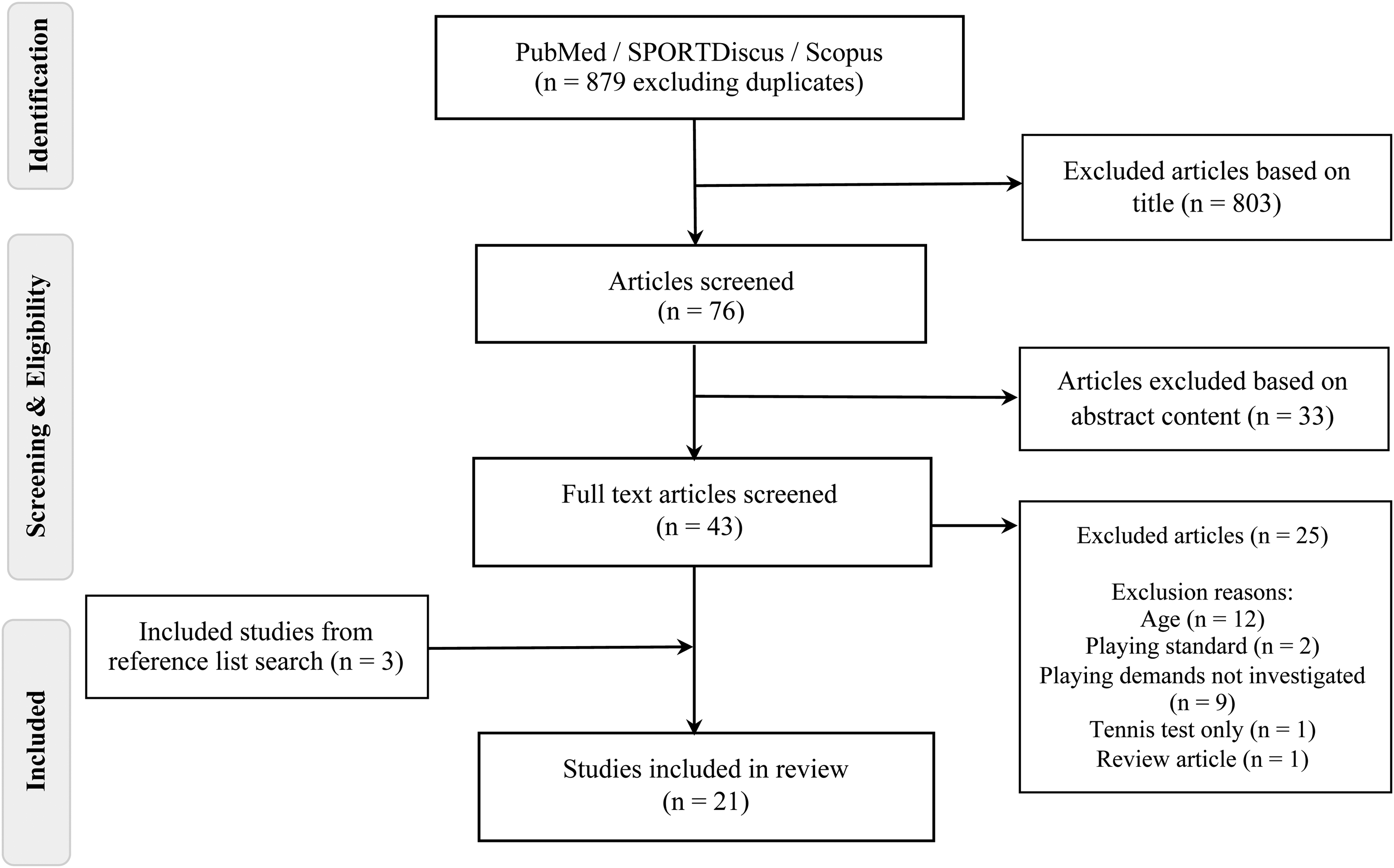
Flowchart of the review process.
Quality assessment
Quality scores ranged from 80 to 94% (mean: 90 ± 4%) with all 21 studies achieving a quality score of excellent (> 75%). None of the studies justified their sample size (criterion 5), and many failed to address the limitations of research (criterion 16; n = 6). A full breakdown of quality scores is reported in Table 1.
Quality assessment of the articles for the review.
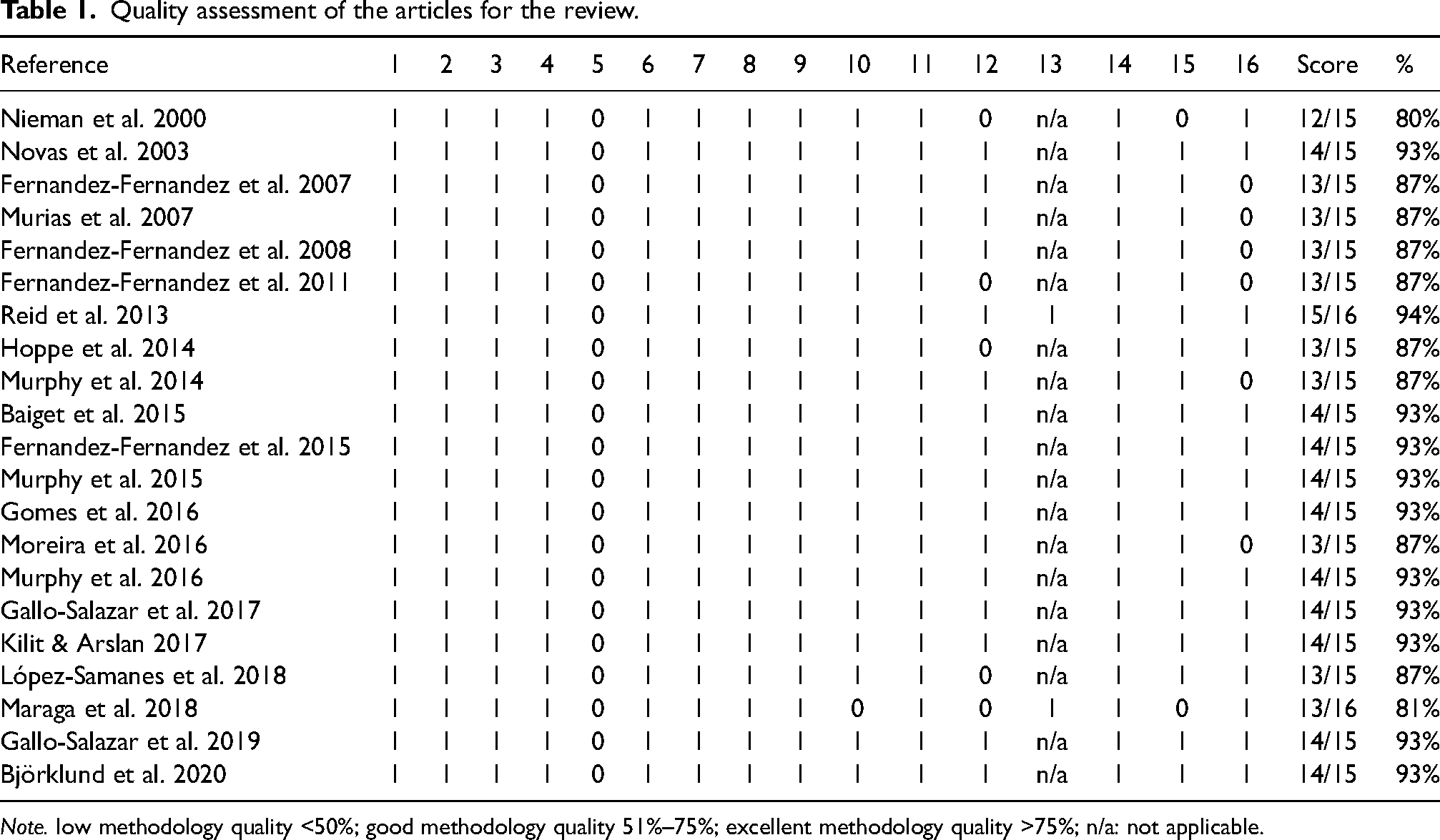
Note. low methodology quality <50%; good methodology quality 51%–75%; excellent methodology quality >75%; n/a: not applicable.
Data extraction and data analysis
The lead author (J.F) extracted the following information from each article: authors and year of publication, participant information, protocol, variables measured and key findings (Table 2).
Characteristics of studies.
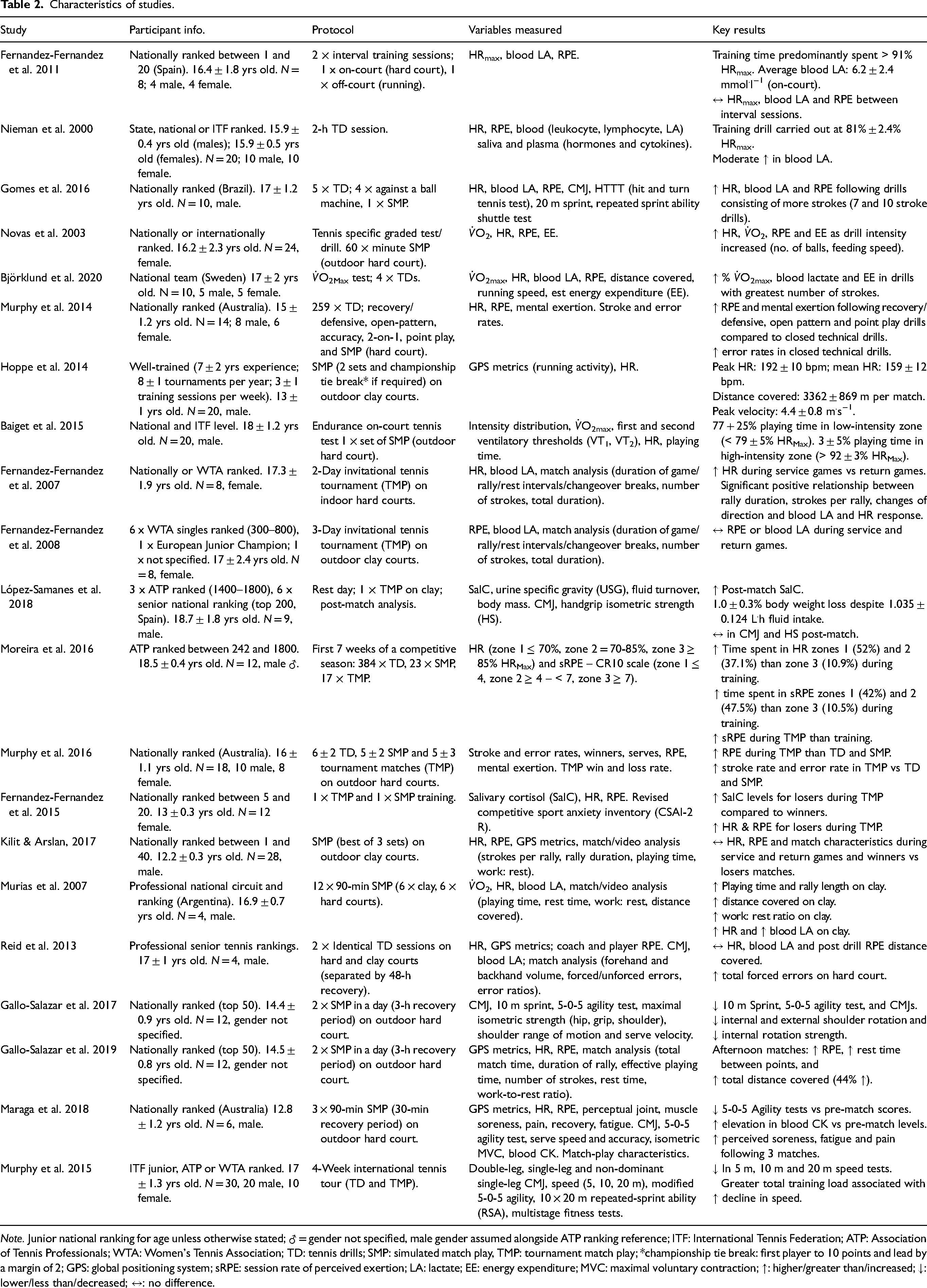
Note. Junior national ranking for age unless otherwise stated; ♂ = gender not specified, male gender assumed alongside ATP ranking reference; ITF: International Tennis Federation; ATP: Association of Tennis Professionals; WTA: Women's Tennis Association; TD: tennis drills; SMP: simulated match play, TMP: tournament match play; *championship tie break: first player to 10 points and lead by a margin of 2; GPS: global positioning system; sRPE: session rate of perceived exertion; LA: lactate; EE: energy expenditure; MVC: maximal voluntary contraction; ↑: higher/greater than/increased; ↓: lower/less than/decreased; ↔: no difference.
Study characteristics
A total of 289 tennis players were included in the studies reviewed. Most studies (n = 14; 67%) recruited participants competing at the national or international level (ITF and Tennis Europe tours) with national rankings for age (ranging from 1 to 200 where specified). Five studies (24%) included players with national or professional rankings (ATP, and/or WTA; range 300–1800), and one study recruited professionally ranked players only (ATP; rankings not specified). The remaining study classified playing standard as well trained (7 ± 2 years of experience; 3 ± 1 training session per week; 8 ± 1 tournaments per year). The mean age of participants was 16 ± 1 years old. The majority of studies recruited exclusively male players (43%, n = 9); six recruited both genders (28.5%), four included exclusively female players (19%), whilst two studies failed to specify (9.5%). A total of eight studies investigated SMP, four studies investigated tennis drill (TD) training and two studies a mixture of both. Tournament match-play was investigated in three studies, one study investigated TD and TMP, and one study investigated SMP and TMP. Two studies investigated TD, SMP and TMP. Sixteen of the studies analysed in this systematic review were published since 2011; three between 2007 and 2009; one in 2003 and one in 2000.
Organisation of data
The studies within this review included relevant information relating to the demands of training, match-play, and tournament tennis. Records were categorised into four main themes, with some articles containing data related to several themes. These themes were as follows: (i) training demands, (ii) match-play, (iii) court surface, and (iv) recovery. Themes were classified by the lead researcher, and where ambiguity occurred, a constructive debate ensued until a consensus was achieved.
Training demands
Several studies investigating the effect of controlled TD protocols reported increases in HR, blood lactate and perceived exertion.17,20,21 Fernandez-Fernandez et al. 20 reported drill intensity > 91% HRmax (mean 96.1 ± 2.2% HRmax), mean blood lactate concentrations of 6.2 ± 2.4 mmol.l–1 and RPEs of 16.3 ± 1.8 (equating to the verbal descriptor ‘hard – very hard’) following an on court interval training session (consisting of 4 × 2 min efforts followed by 90 s of passive recovery). Nieman et al. 21 investigated the effects of a two-hour training session consisting of a series of drills (including cross court rallies, overhead recovery, approach shot and dropshot drills). The authors reported a mean HR of 159 ± 4 bpm (81 ± 2.4% HRmax), blood lactate elevation from 0.86 ± 0.07 mmol.l−1 to 2.06 ± 0.39 mmol.l−1 and RPE of 12.8 ± 0.8 (somewhat hard). Gomes et al. 17 investigated the physiological responses to TDs and identified that HR, blood lactate and RPE were stroke/time dependent. For instance, the physiological responses were elevated by the greatest magnitude during 7 and 10 stroke drills compared with 2 and 4 stroke drills, and SMP. Moreover, Novas et al. 22 reported increased HR, V˙ O2, RPE and energy expenditure (EE) as drill intensity increased (number of balls per drill and ball feeding speed). Similarly, Björklund et al. 23 observed the highest fractional utilisation of V˙ O2max (% V˙ O2max), EE and blood lactate during drills consisting of a greater total number of strokes. In a separate investigation of 259 individual drills (including recovery/defensive, open pattern, accuracy, 2-on-1 open, 2-on-1 net-play, closed technical, point play and SMP) by Murphy et al., 24 the highest %HRmax, RPE and mental exertion were associated with recovery/defensive and open pattern drills. The highest error rate was more closely associated with closed technical drills (19.2 ± 11.1%) than open-pattern (12.4 ± 4.2%), 2-on-1 open (12.8 ± 5.8%), 2-on-1 net-play (11.8 ± 3.4%) and point play drills (13.2 ± 4.9%).
Elevated physiological responses were also established during SMP training. Hoppe et al. 25 investigated the activity profile of SMP training (2 sets and a 10-point tie break) on clay courts and observed mean HR values of 159 ± 12 bpm and a peak HR of 192 ± 10 bpm. In the same study, players covered 3362 ± 869 m per match, and a peak velocity of 4.4 ± 0.8 m.s−1 was achieved. Baiget et al. 26 investigated intensity distribution during SMP training (one-set on outdoor acrylic courts) and observed that a large portion of playing time was spent in the low-intensity zone (77 ± 25%; V˙ O2 at or below ventilatory threshold [VT]1), 20 ± 21% in the moderate-intensity zone (V˙ O2 between VT1 and VT2), and 3 ± 5% in the high-intensity zone (V˙ O2 at or beyond VT2). Assessments of V˙ O2max and VT were determined via completion of an incremental tennis-specific field test whilst wearing a portable gas analyser prior to the SMP protocol. Under similar conditions (60-min of SMP training and gas analysis on an outdoor hard court), in a subgroup of 6 female players, Novas et al. 22 reported a mean HR of 146 ± 20 bpm and EE of 1853 ± 253 kJ (443 ± 59 kcal).
Match play
In the three studies that investigated TMP in isolation, significant physiological stress was observed. Heart rate values of 161 ± 5 bpm9, blood lactate concentrations of 2.0 ± 0.8 mmol.l−1 9 and 2.2 ± 0.8 mmol.l−1, 27 and a 2.2-fold increase in salivary cortisol from pre-match (4.0 ± 2.4 nmol.l−1) to post match (8.7 ± 5.7 nmol.l−1) 28 was observed. Service games induced significantly greater HR responses than return games (166 ± 15.4 bpm vs. 156 ± 19.6 bpm, respectively) amongst nationally and internationally ranked junior female players. 9 Yet, a follow-up study by the same lead author established no significant differences in RPE between service and return games (12.2 ± 2.4 vs. 12 ± 2.2) in a female WTA ranked cohort. 27 A further study by Fernandez-Fernandez et al. 29 in 2015 investigated the psychophysiological responses to TMP and SMP in female nationally ranked juniors, reporting clear differences between winners and losers during TMP. Losers elicited higher salivary cortisol levels at all points during TMP when compared to winners. Heart rate and RPE values were also significantly higher for losers than winners during TMP (HR, 158.9 ± 8.3 bpm vs. 168 ± 67 bpm; RPE, 12.9 ± 1.2 vs. 15 ± 0.8). Winners of TMP and SMP also elicited significantly higher self-confidence and lower cognitive and somatic anxiety than losers. In contrast, Kilit and Arslan 30 reported no differences in psychophysiological responses and match characteristics between winners and losers or type of game (service and return). This investigation was carried out alongside SMP and amongst national-ranked junior male players.
Two studies investigated the demands of TD, SMP and TMP.8,31 Eighteen national-ranked junior tennis players participated in 6 ± 2 TD, 5 ± 2 SMP and 5 ± 3 TMP protocols. Results indicated that TD and SMP training failed to replicate the demands and activity profile of TMP.
8
Training sessions were significantly shorter in duration than TMP (∼70 min vs. ∼83 min respectively; exact data not reported), and effective playing time (work duration) was significantly longer during TMP than SMP (29 ± 9.8 min vs. 20 ± 7.0 min). Stroke rates during TMP (14 ± 3.6.min−1) significantly exceeded those recorded during TD (7 ± 1.min−1) and SMP (10 ± 5.1.min−1), and the serve was used significantly more during TMP (3.4 ± 0.8.min−1) than SMP (2.6 ± 1.3.min−1). Moreira et al.
31
investigated training intensity distribution during the first 7 weeks of a competitive season (including 384 TD, 23 SMP, 17 TMP) via HR zones (Zone 1 ≤ 70% HRmax, Zone 2 = 70%–85% HRmax, Zone 3 ≥ 85% HRmax). Significantly more time was spent in HR Zones 1 (52%) and 2 (37.1%) than Zone 3 (10.9%) during training. Session RPEs (sRPE; CR-10 scale) were also divided into three zones; Zone 1 (low intensity:
Court surface
Two studies investigated the impact of court surface (hard vs. clay) on metabolic, perceptual and technical indices of performance.32,33 Murias et al. 32 observed significantly greater playing time (rallies 22% longer; 8.8 ± 5.3 s vs. 7.2 ± 4.4 s), distance covered (1447 ± 143 m vs. 1199 ± 168 m), HR (143 ± 22 bpm vs. 135 ± 21 bpm) and blood lactate (1.65 ± 0.6 mmol.l−1 vs. 1.16 ± 0.34 mmol.l−1) on clay courts compared to hard courts during SMP training. In contrast, Reid et al. 33 investigated TD responses on clay and hard courts and observed no difference in mean or peak HR, blood lactate and post drill RPE. Additionally, no difference was observed in distance covered between courts (4.79 ± 0.75 km clay vs. 4.82 ± 0.69 km hard). Players made significantly more forced errors (8.5 ± 1.64 hard vs. 4.7 ± 2.73 clay court), and a large effect was evident in unforced errors (68.7 ± 4.03 hard vs. 64.3 ± 10.73 clay, d = 0.8) between court surfaces.
Recovery
Two studies assessed the impact of two simulated matches in a day (separated by a 3-h rest period) on physical performance 34 and match characteristics. 12 Gallo-Salazar et al. 34 observed small to moderate effects for reductions in 10 m sprint (−3.3%, small effect), 5-0-5 agility tests (dominant –4.6%, non-dominant –4.2%, moderate effect) and CMJ (dominant leg –7.2%, non-dominant – 9.1%, small effect) following two matches in a day. Reductions in internal shoulder rotation (−4.2%, small effect), dominant shoulder external rotation (−10.7%, moderate effect) and internal rotation strength (−9.3%, small effect) were also observed. Longer rest periods between points (24.9 ± 3.9 s vs. 20.8 ± 1.5 s) and higher RPE values (5.4 ± 2.6 vs. 3.6 ± 1.9) were reported in afternoon matches by Gallo-Salazar et al. 12 Players covered significantly more distance in the afternoon compared to the morning matches (4307 ± 1080 m vs. 2992 ± 1030 m; + 44%) linked to increased total match time, with similar HR values reported (morning 157 ± 7 bpm vs. afternoon 154 ± 10 bpm). A further study by Maraga et al. 35 investigated the influence of three simulated matches in a day (with 30-min recovery periods) on physical, physiological and perceptual responses. Maraga et al. 35 also observed reductions in 5-0-5 agility scores (2.48 ± 0.12 s – 2.59 ± 0.09 s right leg; 2.50 ± 0.13 s – 2.65 ± 0.17 s left leg), and shoulder rotation (7.4 ± 1.9 kg – 6.7 ± 1.1 kg, internal; 7.3 ± 1.1 kg – 6.6 ± 1.0 kg, external) following three matches in a day. Players reported increased perceptual soreness (4.0 ± 1.9 – 6.7 ± 2.3), fatigue (3.2 ± 2.0 – 6.5 ± 1.4) and pain (2.8 ± 1.3 – 6.2 ± 2.1), assessed against a 11-point Likert scale (0 = normal; 10 = maximal). Elevations in creatine kinase concentration were also noted, increasing incrementally following each match (181 ± 48 units.l – 385 ± 166 units.l). Reductions in total stroke count (222 ± 23 vs. 177 ± 35), distance covered (3785 ± 356 m vs. 3509 ± 364 m) and average speed (2.5 ± 0.2 km.h vs. 2.3 ± 0.2 km.h) were also reported after two matches. However, in match three, these values returned to similar values to match one.
The effect of a 4-week international tennis tour on physical capacity characteristics was also investigated by Murphy et al. 36 Batch fitness tests were completed pre and post tour. Murphy et al. 36 observed moderate effects for a decline in 5 m (3.6 ± 0.6%), 10 m (3.3 ± 0.6%) and 20 m (2.2 ± 0.6%) speed. Reductions in double leg CMJ (−2.0 ± 0.7%), non-dominant leg CMJ (−1.8 ± 0.5%), dominant leg CMJ (−1.8 ± 0.6%), multistage fitness (−1.9 ± 0.5%), repeated sprint ability (1.4 ± 0.6%) and 5-0-5 agility (left leg pivot, 1.5 ± 0.6%; right leg pivot 0.9 ± 0.7%) were also demonstrated post tour, with small (d = 0.2–0.4) and trivial (d < 0.2) effects reported.
Discussion
The purpose of this systematic review was to collate, summarise and evaluate current literature investigating the demands of tennis training and match-play to highlight common research trends, identify future research opportunities, and inform coaching practice and training prescription. This review presents evidence of (1) significant physiological strain associated with tennis performance; (2) notable differences between TDs, SMP and TMP demands; and (3) the deleterious effects of multiple matches in a day on indices of performance and recovery.
The physiological demands and impact of training and competition are major components that inform the optimisation of a junior athletes’ physical development and maturity.5,37 Understanding the intensity of training and match-play is important to enable a tailored approach to performance planning, programming, monitoring and evaluation. 38 To date most of the empirical evidence has investigated either TD, SMP or TMP protocols in isolation, with only two studies comparing between training, SMP and competition demands. Research illustrates that players are exposed to a significant increase in internal load (including HR, fractional utilisation of V˙ O2max, blood lactate and RPE) during training and match-play, with notable differences established between court surface, TD content and match context. However, it is difficult to draw comparisons between research to date, with notable variability in protocols employed (i.e., drill/match content, duration, playing conditions, participants). In the two studies that investigated the demands of TDs, SMP and TMP, findings indicated that TD and SMP training was played predominantly at low-to-moderate intensities (< 70% HRmax; Moreira et al. 31 ), in contrast to the demands elicited during TMP.8,31 Higher HR values and RPE were also observed following TMP in comparison to SMP.8,31 Additionally, stroke rates during TMP significantly exceeded those recorded during training, and the serve was also performed significantly more frequently. These observations illustrate that TD and SMP protocols do not replicate TMP demands, arguably failing to optimise match-play preparation. 8 Future research is required to enable a better understanding of the demands of TMP and different TD sessions (including SMP), to enable accurate prescription of training protocols that mimic match-play conditions and optimise player development. Methods including RPE, and differential RPE (dRPE), readiness questionnaires, and wearable technologies such as GPS units and accelerometer devices are advocated.
Court surface
Tennis is played across multiple surfaces, which are associated with varying speed and playing demands.32,33 The most common surfaces used are clay courts and hard courts, with a short period in the season played on grass courts. 39 Clay courts possess higher friction than hard and grass courts, and are characterised as a slow court, resulting in longer rallies, and a higher number of strokes per rally. 40 Faster surfaces, such as hard and grass courts, limit the time available for players to hit the ball and promote offensive playing styles. 32 The first study to quantify the metabolic and functional responses to different tennis courts was carried out by Murias et al. 32 in 2007. Empirical observations of twelve 90-min SMP sessions established a significant increase in HR, higher mean blood lactate accumulation, and further distance covered on clay courts than on hard courts. These findings may be attributable to the increased playing time associated with clay court tennis, with rallies on average 22% longer on clay. Similarly, research by Reid et al. 33 established large effects for increased HR, blood lactate and RPE on clay compared to hard courts. Greater shot error rates were also observed on hard courts compared with clay courts, associated with increased ball velocity, reduced time available to recover and prepare, and a subsequent increase in time under pressure characterised by hard court play. Initial insights from research clearly indicates the importance of adjusting training, conditioning and recovery programmes according to playing surface to account for the specific physiological challenges imposed by the varying court surfaces. Further work is required to substantiate current findings and investigate other court surfaces (including indoor) to enable coaches to better equip their young athletes when exposed to different playing conditions.
Training demands
Planning and programming training content to develop junior players and meet competition demands remains a key challenge for coaches. Many coaches opt for integrated sessions which blend technical and tactical development with specific match conditioning. 7 However, this assortment in TD application and content, and lack of specific categorisation (i.e., technical/tactical/psychological/physical) may not be optimising player development and match readiness. 17 To quantify the most appropriate training protocols, the demands of various TDs (including SMP) must be evaluated to determine their transferability to TMP performance. 41 Literature to date suggests that drills with a higher number of strokes induce greater physiological and perceptual demands than those drills with fewer strokes17,22–24 Specifically, Gomes et al. 17 observed 7 and 10 stroke drills to induce elevations to a greater magnitude in HR, blood lactate and RPE when compared to SMP conditions. Björklund et al. 23 also established increased blood lactate, % V˙ O2max and EE following drills with the greatest number of strokes and changes of direction. This was further supported by Murphy et al. 24 who established that defensive drills, also characterised by the largest number of strokes, induced the highest internal (RPE, HR) and external loads (shot error rates). However, findings to date are restricted to a limited number of papers, and a discrete number of drills investigated, making it difficult to relate findings to the vast number of drills typically used during a periodised training programme. 7 Further research is needed to validate initial findings and develop a better understanding of how manipulating training content can alter player load, to inform coaching practice and training prescription.
Match play: service versus return games
The service (the initial shot of a point) is an important aspect of modern tennis and is considered the key to the game. Service games are an important means to take charge of the point and gives the player an opportunity to win the rally, either directly through an ace, or indirectly through the advantage of a good serve. Although junior players have been shown to gain less of an advantage than their adult counterparts from the serve, 42 winning service games is considered integral to being competitive and successful. 43 Three studies to date have assessed the physiological and perceptual responses to the game type.9,27,30 Significant increases in HR during service games were observed on indoor hard courts, associated with higher psychological stress and the need to win the service games. 9 In contrast, when players were observed on clay courts, no differences in perceived exertion, 27 physiological, or performance responses 30 were established between games. This may be attributed to the speed of clay courts, giving players more time to react and less free points to the server, than on grass and hard court alternatives. 44 It is feasible that players place less emphasis on having to hold their service games on clay, anticipating more opportunities to break serve on this surface compared to faster courts. Further research is required to support this premise. Future research should also investigate male and female responses to TMP, to establish gender-specific differences and enable greater insights for practitioners working in the field.
Recovery
Balancing training and competition stress with appropriate recovery is integral to achieving optimal athletic performance. 45 Although less common at a senior professional level, junior players usually compete in multiple matches in a day. 34 Considering the training demands associated with 2–3 sessions a day in junior tennis, the importance of recovery cannot be underestimated.36,46 Yet, recovery from tennis performance in a junior population has received little attention in the literature. Initial insights suggest multiple matches per day can negatively impact performance indices including jumping, sprinting and change of direction. 34 Players also take longer rest periods between points 12 and report increased perceived exertion, 12 muscle soreness, fatigue and pain, 35 highlighting that playing multiple matches a day may predispose junior players to elevated levels of psychological stress, compromised movement, increased injury risk and ultimately reduced match-play performance. Thus, it seems prudent to consider within- and post-match recovery strategies to attenuate the detrimental implications of competing in numerous matches on the same day. Priority should be given to the replacement of fluid and electrolyte losses and restoration of carbohydrate stores to support the maintenance of euhydration and energy provision. 47 Cold water immersion (ice baths) immediately post-match and full-body compression garments have also been shown to aid recovery in tennis players when exposed to multiple tennis sessions in a day, 48 and as such, may be an avenue for further investigation.
Reductions in speed were observed by Murphy et al. 36 following a 4-week tennis tour. Interestingly, those who completed the greatest volume of work reported greater declines, illustrating a need to manage training loads during intensified periods of training and competition. It is important to note that the included studies did not consider specific recovery interventions or discuss any recovery practices embedded during the research. They also failed to consider the importance of nutrition as a potential recovery tool; shown to have a direct influence on optimising energy stores, reducing fatigue, preventing injuries, promoting recovery, and improving health status. 45 In order to support coaches and players exposed to heightened match or training loads, further research is required. Specifically, the impact of TMP, and training loads during training camps need to be considered. Further investigations specific to an elite and highly trained junior tennis population are also required, to determine nutritional and recovery strategies, and behavioural practices 47 to enhance player readiness and recovery status.
Limitations
The conclusions drawn from this systematic review are limited by the quality and confined by the quantity of existing literature in the field. Methodological inconsistencies within the literature (e.g., competitive level of the players, playing style and environmental playing conditions) may have affected the analysis of the studies. However, given the limited number of studies on elite and highly trained junior tennis players, all applicable studies were included despite some lacking experimental rigour. Nevertheless, our quality assessment classified all 21 studies as excellent. Another important confounder includes gender differences, a factor that was not comprehensively addressed in the studies including both male and female participants. It was deemed important to include both genders within this review with such limited research to date in this field. Focussing solely male cohorts would have led to the exclusion of 12 studies (57% of the review). Lastly, the inclusion of studies published in English may have eliminated other relevant published literature in other languages.
Conclusions and directions for future research
To prescribe efficient and productive training and recovery programmes coaches are encouraged to develop a clear understanding of how junior players respond to the demands of training and competitive matches. 49 TDs can vary (ranging from, but not limited to, closed technical drills focussed on stroke technique, to recovery drills from positions under pressure) and have been shown to elicit variable physiological-perceptual responses. Given the variety of participants, and the influence of situational variables on tennis performance (e.g., court surface, environmental conditions, playing style, quality of opposition and match context), the inconsistencies in research to date are unsurprising. Nevertheless, the research included in the current systematic review illustrates that TDs and SMP often fail to impose the same physiological and perceptual demands on players as TMP. Whilst it is difficult to explain such differences, variation in coaching philosophies, focussing more readily on technical and tactical skills ahead of physical attributes during adolescent years may be a contributory factor.
Ensuring players are exposed to TDs and SMP that mimic those seen in TMP and tournament scenarios is required to enable junior players to cope with the highest demands placed on them during competition. 8 Work-to-rest ratios of 1:3 and 1:5 for TDs are advocated in order to simulate match conditions and develop tennis endurance. 49 However, being able to replicate the psycho-physiological stress associated with TMP appears difficult to do during training sessions and requires further investigation. Further research is required to help determine practical guidelines for coaches to enable effective periodised training programmes to be implemented in junior tennis. It is apparent that court surface also impacts physiological and perceptual demands on junior players, with slower surfaces, such as clay, shown to increase HR, blood lactate, distance covered 32 and perceived exertion 33 compared to hard courts. Consequently, coaches, nutritionists and junior players must take note of the increased load associated with different court surfaces and adopt appropriate nutrition and recovery strategies to optimise performance. The implementation of regular monitoring of internal and external training and match loads via methods such as RPE, readiness questionnaires, GPS units and accelerometer devices is encouraged.
Less apparent is the impact of multiple training sessions/matches in a day on junior players’ recovery and subsequent performance. It appears that physical and perceptual demands are increased when exposed to repeated SMP conditions in a day,12,34,35 and tennis tour demands, 36 yet greater research is required to corroborate initial findings. Elite junior tennis players are commonly exposed to high training and competition loads. 36 It is not uncommon for junior players to train > 15 to 20 h per week and enter multiple draws during tournaments, 7 placing greater stress on young athletes. Coaches, support staff and parents/guardians need to be better informed of the signs and symptoms of overtraining and sub-optimal recovery and equipped with the tools to effectively manage cases. It is recommended that future research considers the efficacy of recovery interventions (such as acute refuelling, ice baths/hot water immersion, compression garments and sleep), with particular attention to the role of nutrition on subsequent junior performance. The use of contemporary methods including tracking devices (i.e., GPS, accelerometry), biochemical (saliva samples, blood metabolites, muscle biopsies) and hydration assessment (urine markers), and sleep and wellness profiles is advocated to assist in making informed decisions about a junior player's readiness to perform.
This systematic review has explored the literature currently existing in relation to the demands of elite junior tennis. With research still in its infancy, further research into the training and match demands of elite junior tennis players is warranted. Particular focus is required to investigating periods of heightened training loads such as training camps, and competition periods, with greater emphasis and consideration for recovery interventions. This would provide valuable information for coaches and sports scientists working within junior tennis, to aid athlete development, support health and promote tennis career longevity.
Footnotes
Author contributions
JAF, RJN and LDH planned the study. JF conducted a systematic search of databases and LDH and SL adjudicated. JAF carried out the quality assessment, AF supported. JAF wrote the first draft, and all authors reviewed the manuscript at various stages throughout the editing process and approved the final draft for publication.
Competing interests
All authors declare that they have no competing interests applicable to the content of this review. No financial support was sought or received for this study.
Declaration of conflicting interests
The authors declared no potential conflicts of interest with respect to the research, authorship, and/or publication of this article.
Funding
The authors received no financial support for the research, authorship, and/or publication of this article.
