




Abstract
Research has shown that short points (points of 0–4 shots) are crucial in determining the outcome of elite men’s and women’s grass court tennis matches. However, research has not explored the importance of short points in more detail to inform practice design. This study aimed to establish the prevalence and importance of individual rally lengths within short points (i.e. points of 0, 1, 2, 3 and 4 shots) in terms of winning elite grass court tennis matches. Using the recently-validated PWOL (Percentage of matches in which the Winner Outscored the Loser) method, point-level data from 211 men’s and 209 women’s Wimbledon singles matches between 2015 and 2017 were analysed, with short points stratified into individual rally lengths. Results revealed that 1 shot (aces and missed serve-returns) was the most common rally length, with 0 shots (double faults) the least common. Points won of 1 shot, 2 shots and 4 shots were associated with winning matches and can therefore be considered important, but points won of 0 shots and 3 shots were not associated with match outcome. These results highlight the importance of serving and returning strategies at Wimbledon, and indicate that serves and serve-returns should be afforded focus during grass court training. However, the findings appear to contravene anecdotal assertions that ‘serve plus one’ strategies (points won of 3 shots) are crucial in elite tennis, as they did not differentiate winning and losing players; so coaches should consider the associated practice designs and amount of time afforded to such strategies.
Introduction
It is well documented that tennis has lagged behind many other sports in its use of notational analysis data to enhance performance. 1 In recent years, however, several notational analysis studies have been conducted within elite tennis, as part of a conscious effort to advance research in the area.2–8 For example, Reid et al. 2 examined sex differences in stroke and movement dynamics at the Australian Open, revealing that female players contacted the serve-return closer to the net and lower to the ground than male players. A comprehensive shot taxonomy has been developed based on spatio-temporal match-play data, 4 and a new data analysis method (Percentage of matches in which the Winner Outscored the Loser, PWOL), designed to improve coaches’ engagement with performance data, has been validated. 6 Complementing these quantitative analyses, contemporary, qualitative research has also been undertaken, with Vernon et al. 9 interviewing former and current professional male players to investigate the anticipatory information sources available to them when returning serves. Researchers have also begun to explore doubles match-play, with recent studies investigating point ending characteristics 8 and serving and returning tactical formations in men’s doubles. 10 These studies have facilitated several practical applications, with perhaps the most relevant for coaches being provided by Reid et al., 2 who were able to inform sex-specific, hard court training designs for elite players.
Court surfaces in tennis each exhibit different ‘playing speeds’. Each surface is characterised by its coefficients of friction and restitution, which influence the interaction between the ball and the court surface when the ball bounces. 11 On a surface with a low coefficient of friction, the ball loses less horizontal velocity than on a surface with a high coefficient of friction, and on a surface with a low coefficient of restitution, the ball bounces lower than on a surface with a high coefficient of restitution. 12 For this reason, court surface has consistently been shown to affect the characteristics of match-play.2,13 Mean rally lengths (i.e. number of shots per rally) have consistently been shown to be lower on grass courts than any other surface,14,15 and the serve is typically most dominant on grass, with more aces and unreturned serves occurring on grass than on clay and hard courts.13,15 This is likely due to the faster, lower bounce of the ball on grass affording players less time to retrieve each stroke,12,16 and therefore increasing the likelihood of an error occurring.
Fitzpatrick et al. 5 recently investigated the performance characteristics of elite men’s and women’s tennis match-play at Wimbledon and Roland Garros, to establish the importance of each characteristic in terms of winning matches on grass and clay court surfaces. By analysing 241 (men’s) and 249 (women’s) Wimbledon matches, Fitzpatrick et al.’s 5 study was among the first to address the sample size issue that had been typical of previous grass court tennis research (e.g. Takahashi et al. 17 n = 6 matches, Hughes and Moore 18 n = 7 matches, O’Donoghue and Liddle 19 n = 10 matches per group). Results revealed that points won of 0–4 shot rally length (i.e. short points) was strongly associated with success, particularly on grass courts, with male and female players who won more short points than their opponent winning the match in approximately 90% of cases. 5 Results also revealed an underlying prevalence of short points (compared to medium length and long points) on grass courts for both sexes, with 66% (for women) and 72% (for men) of all points played at Wimbledon between 2015 and 2017 ending in fewer than 5 shots. 5 These results supported the empirical findings of Carboch et al. 20 and the subjective opinions of several tennis practitioners, who have suggested that the first four strokes of each rally are crucial in elite tennis match-play,21–23 thus indicating that short points should be a key area of interest for coaches.
Despite their importance, research has not investigated short points further; for example, breaking down the more typically used ‘0–4 shot rally length’ category to analyse each individual rally length (i.e. 0 shots, 1 shot, 2 shots, 3 shots and 4 shots, respectively) separately. Stratifying the 0–4 shot rally length category this way could provide more practically relevant insights, such as revealing the single most common rally length (i.e. 0, 1, 2, 3 or 4 shots) and the most important rally length in terms of winning matches (i.e. the rally length that winning players dominate to the greatest extent). Additionally, researchers and expert tennis practitioners have described the serve and serve-return as the two most important strokes in tennis,22,24–26 but limited empirical research has sought to objectively investigate their importance. Stratifying short points to analyse individual rally lengths could provide clearer insight into the importance of the serve and serve-return in elite tennis. The relative dominance of the serve on grass,13,15 the high prevalence of short points and their strong association with winning matches at Wimbledon, 5 suggest that this type of analysis may be most pertinent for grass court tennis. It is well documented that our understanding of elite tennis match-play should be used to help guide and structure the development of on- and off-court training programmes. 27 In this way, results would support coaches aiming to develop evidence-based, grass court training designs, by indicating specific areas of focus for practice, informed by elite match-play data.
Therefore, this study investigates men’s and women’s points won of 0–4 shot rally length (i.e. short points) at Wimbledon. The aim was to identify the prevalence of each individual rally length and the importance of each rally length in terms of winning elite grass court tennis matches.
Method
Matches
With institutional ethics approval, point-level data from men’s (n = 211) and women’s (n = 209) Wimbledon singles matches played between 2015 and 2017 were obtained from the Wimbledon Information System. 28 Access to the data was provided by International Business Machines Corporation (IBM), with permission granted by The All England Lawn Tennis Club. Data were available only for matches where a serve speed radar was in use. Data from matches involving retirements, walkovers or defaults (n = 8 men’s matches, n = 3 women’s matches) were excluded from the study.
The 2015 to 2017 time frame was selected, firstly, because prior to 2015, limitations meant that such data were only available for a smaller and therefore less representative sample of matches. Secondly, data from these years were the most contemporary available, and are therefore more pertinent to current coaches. 29 Finally, Fitzpatrick et al.’s 5 assertion that short points were the most important performance characteristic was based on analysis of Wimbledon match-play between 2015 to 2017, so retaining this time frame ensures relevant interpretation in the context of previous empirical findings.
The following information was obtained for all points in each match: point ID, match ID, point winner, match winner and rally length (i.e. the exact number of strokes per point). The rally length of a point was comprised only of successful strokes (i.e. strokes whereby the ball crossed the net, to the side of the opponent, and landed inside the court); errors were not counted. 30 For example, a point of 0 shots would be a double fault, and a point of 1 shot would either be an ace or a missed serve-return.
Data processing and analysis
Using Microsoft Excel (Microsoft Corp, Redmond, WA, USA), the data were stratified by sex and filtered to exclude all points with a rally length of greater than 4 shots. Points were then stratified into five individual rally lengths (i.e. points played of 0 shots, 1 shot, 2 shots, 3 shots and 4 shots, respectively). To establish the prevalence of each individual rally length for men and women, respectively, the number of points played of each rally length was first summed at match level. Using SPSS (v23.0, SPSS Inc, USA), one-way repeated measures Analyses of Variance (ANOVAs) were then undertaken to identify differences between the mean number of points played of each rally length (per match), for men and women respectively, with the Greenhouse–Geisser correction used if the assumption of sphericity was violated.
31
Bonferroni post-hoc tests were conducted, and effect sizes for ANOVAs (
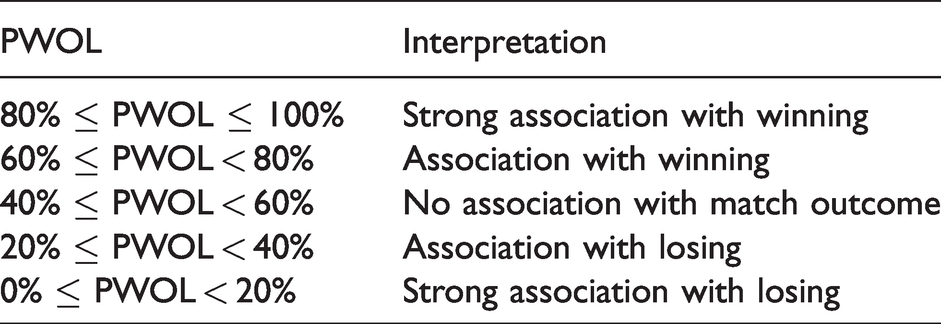
Derived from the ‘point winner’ and ‘match winner’ columns, a new column was calculated to establish which player won each respective point; the match winner (coded ‘1’) or the match loser (coded ‘0’). Then, the total number of points of each rally length won by the winning player and the losing player, respectively, was summed at match-level. For each individual rally length, the number of points won by the match winner was compared to the number of points won by the match loser, to identify which player ‘outscored’ the other (at match level). Then the Percentage of matches in which the Winner Outscored the Loser (PWOL) 6 was calculated for each individual rally length, for men and women, respectively, and used to evaluate associations with match outcome. The PWOL method was developed as a more user-friendly alternative (to point-biserial correlations and t tests) for coaches, to facilitate their understanding of match-play data analysis; see Fitzpatrick et al. 6 for a detailed validation. Table 1 shows the interpretation of PWOL values (displayed in Table 3).
PWOL interpretation.
Results
Table 2 displays the mean number of points played (per match) of each individual rally length, for both sexes, and Figure 1 shows these values normalised to percentages of the total number of short points played per match. One-way repeated measures ANOVAs revealed a difference in the prevalence of each rally length for men F(1.419, 297.909) = 951.074, p < 0.001,
Mean (± sd) number of points played per match of each rally length, by both sexes.
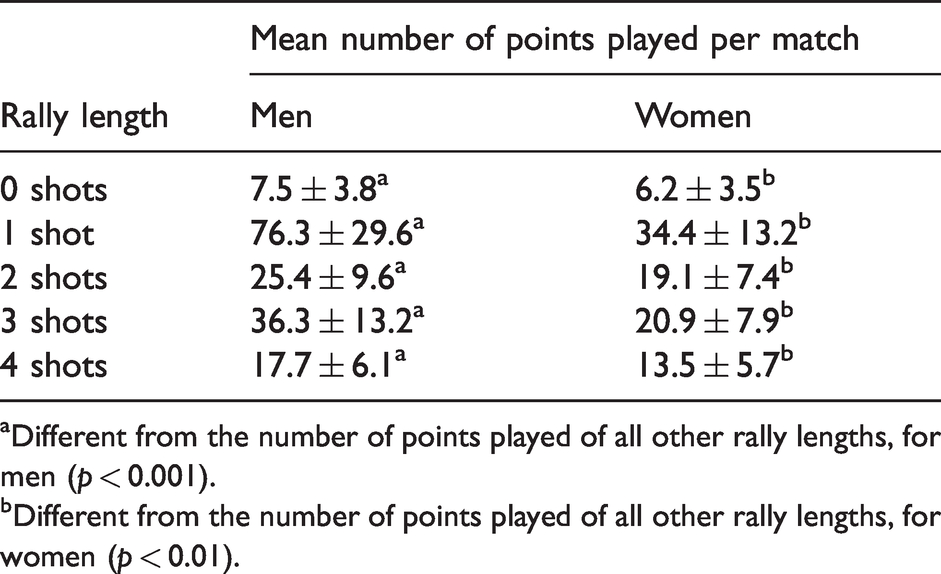
aDifferent from the number of points played of all other rally lengths, for men (p < 0.001).
bDifferent from the number of points played of all other rally lengths, for women (p < 0.01).
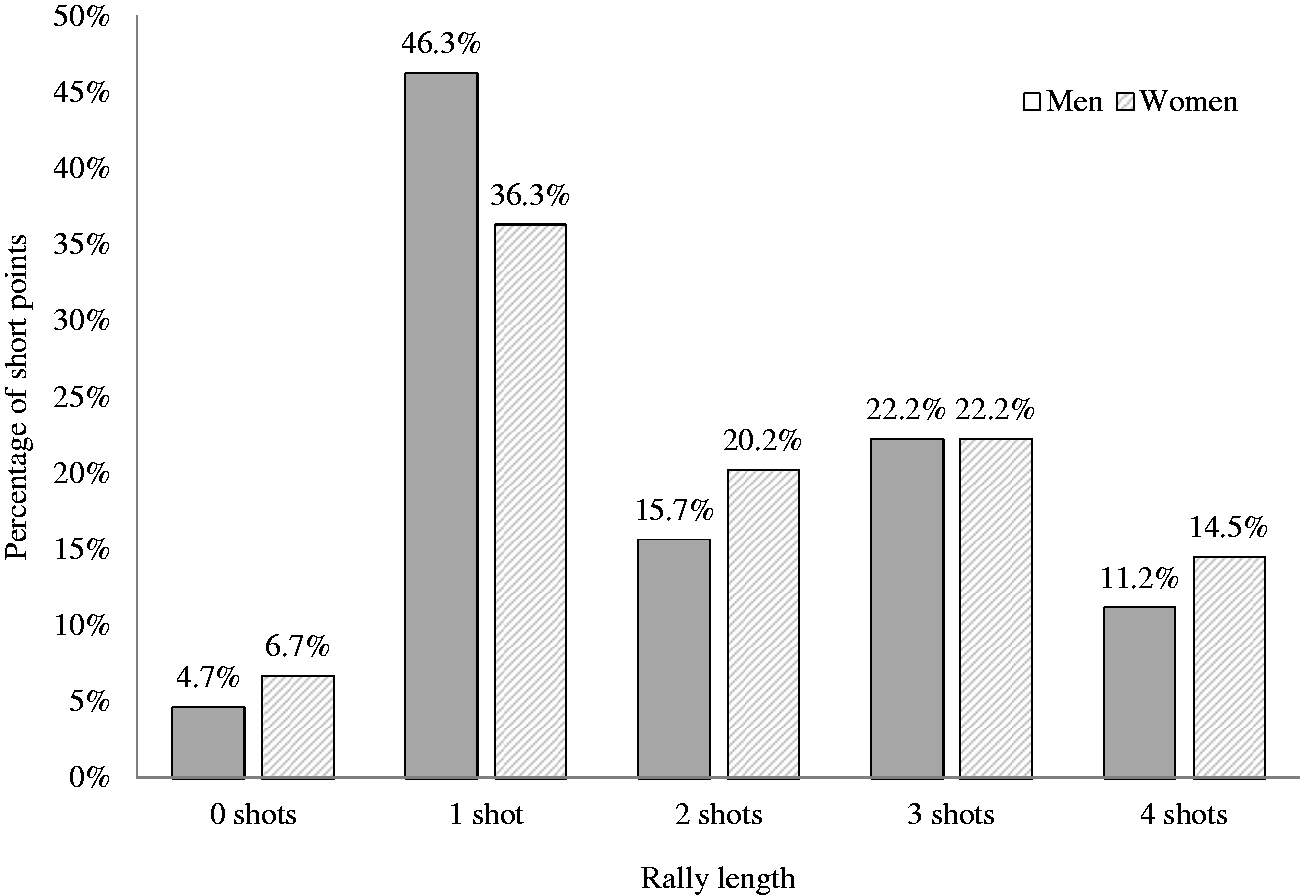
Mean percentage of points played per match of 0, 1, 2, 3 and 4 shot rally lengths, for men and women.
Table 3 shows the mean number of points won of each individual rally length (per match) by winning and losing players, respectively, and corresponding PWOLs, for both sexes. For context, points won of 0–4 shot rally length (in total) are also included.
Mean (± sd) number of points won of each rally length by winning and losing players of both sexes, and corresponding PWOLs.
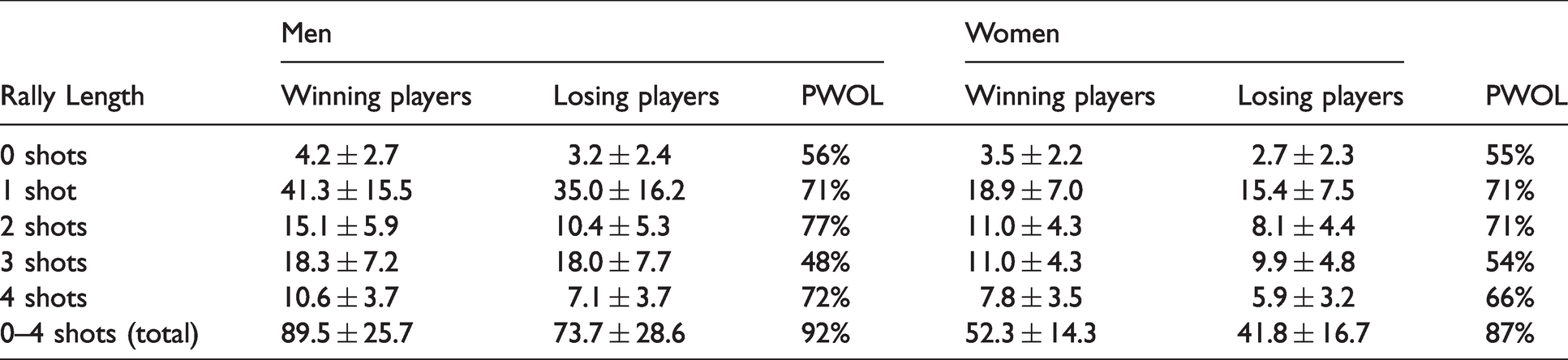
Table 3 shows that, of the five individual rally lengths, points won of 1 shot, points won of 2 shots and points won of 4 shots were associated with winning matches, whereas points won of 0 shots and points won of 3 shots were not associated with match outcome. The combination of all five rally lengths (i.e. points won of 0–4 shot rally length) was strongly associated with winning matches for both sexes. No rally lengths were associated with losing matches.
Discussion
The aims of this study were to identify the prevalence of each individual rally length (0 shots, 1 shot, 2 shots, 3 shots and 4 shots) and establish the importance of each rally length in terms of winning matches, for players of both sexes at Wimbledon. The most common rally length was 1 shot and the least common was 0 shots. Points won of 1 shot, points won of 2 shots and points won of 4 shots were associated with winning matches for both sexes and can therefore be considered important. However, points won of 0 shots and points won of 3 shots were not associated with match outcome. These results can help provide a more detailed and contextual insight for coaches into the importance of short points in elite grass court tennis and better inform practice designs. Results are discussed in ascending order of rally length.
Rally length of 0 shots
For players of both sexes, 0 shots (i.e. double faults) was the least common rally length, comprising less than 5% (for men) and 7% (for women) of all short points on grass courts. This supports the low prevalence of double faults reported by Filipcic et al. 33 in elite clay court tennis (mean ≤ 2.11 per player per match, for men and women). However, at Roland Garros it was demonstrated that match winners committed fewer double faults than match losers, 33 whereas here, points won of 0 shots were not associated with match outcome for either sex, and can therefore be considered not important in terms of winning matches at Wimbledon. With 0 shots being the least common rally length at Wimbledon, the lack of importance of points won of 0 shots can be expected.
Rally length of 1 shot
For both sexes, 1 shot was the most common rally length, comprising almost half of all short points in the men’s game and over a third in the women’s game. Points won of 1 shot were associated with winning matches for both sexes and can therefore be considered important. A rally length of 1 shot occurs when the serve is an ace, or the serve-return is an error; either way, the server wins the point. So, results show that players who utilised their serve more often to gain a tactical advantage (i.e. create a perturbation by destabilising the dynamic equilibrium of the point) that led to them immediately winning the point, either with an ace or a missed serve-return, won the match in over 70% of cases. Several previous studies have subjectively suggested that the serve is one of, if not the most important stroke in tennis;26,34–36 these results provide strong evidence of the importance of the serve in terms of winning matches at Wimbledon.
With the high prevalence of the 1 shot rally length, the importance of points won of 1 shot can be expected. The high prevalence of the 1 shot rally length exemplifies the difficulty of returning serves on grass courts, particularly for men; as identified by Meffert et al., 37 the low and fast bounce (compared to other court surfaces) gives serving players a greater advantage at the start of each point. From a practical perspective, there are several aspects of the serve that players can manipulate to attempt to gain a tactical advantage, such as ball speed,37,38 ball spin, 35 ball placement37,39 and technical disguise, 40 the effects of which can be enhanced by a faster court surface, such as grass. It is crucial that coaches develop players’ understanding of both how and when is most appropriate to exploit each of these factors, to enhance their likelihood of success.
Rally length of 2 shots
For men and women, 2 shots was the third most common rally length. Points won of 2 shots were associated with winning matches and can therefore be considered important at Wimbledon. A rally length of 2 shots occurs when the serve-return is a winner, or the server’s second stroke is an error; the returner wins the point. The importance of points won of 2 shots here highlights the importance of the serve-return stroke. Several aspects contribute to the successful execution of serve-returns in tennis, with anticipation, 41 reaction time 9 and movement speed 9 particularly crucial. Results indicate that players who excel in these areas, and can therefore return their opponent’s serve more effectively (i.e. by putting them under immediate time or positional pressure by hitting a direct winner or forcing the server to commit an error), win the match in the majority of cases. This is supported by Vernon et al.’s 9 exploration of the anticipation sources used by elite tennis players when returning serves. Participants (former and current elite male players) explained that the best returners are able to take the ball early and move into the court when striking the serve-return, allowing them to hit the ball harder and more accurately, especially on important points. 9 In theory, this may sound relatively simple, but in practice, it is a risky strategy that can be difficult to execute successfully, 35 as the serve tends to be an effective weapon for most players. In turn, returning players can face considerable time constraints and are often required to perform the serve-return in a biomechanically suboptimal body position. 24 Therefore, the likelihood of them not only neutralising the serve (i.e. re-establishing the dynamic equilibrium of the point), but immediately countering with an attacking serve-return that the server will be unable to retrieve, is small. Second serves (as opposed to first serves) typically present the best opportunity for returning players to execute this type of strategy successfully, as most elite players opt for a faster first serve, slower second serve strategy, when serving.42–44 With this ‘fast-slow’ serving strategy, second serves travel comparatively slower through the air, which affords the returning player more time to position themselves optimally to execute an attacking serve-return. For this reason, first serve points and second serve points should be analysed separately where possible.
It is worth noting that in the men’s game, points won of 2 shots appear to have been particularly decisive and influential to the outcome of matches at Wimbledon, with a PWOL of 77%. This may be considered surprising, as only 15.7% of men’s short points had a rally length of 2 shots. Based on this result, it could be argued that the serve-return is more crucial than the serve for male players at Wimbledon, which supports Vernon et al.’s 9 assertion that the serve-return is the “most influential situation” in tennis.
Rally length of 3 shots
For players of both sexes, 3 shots was the second most common rally length. Despite this, points won of 3 shots were not associated with match outcome for either sex. A rally length of 3 shots occurs when the server hits a winner on their second stroke or the returner makes an error on their second stroke; the server wins the point. In tennis, the serving player can attempt to use their serve to tactically ‘set up’ the point, by aiming their serve close to the side line (i.e. wide) and taking their opponent away from the centre of the court in order to create free space to exploit with their second stroke. 45 From the server’s perspective, this type of attacking combination, involving the serve, (the serve-return) and the server’s second stroke is often referred to as a ‘serve plus one’ strategy.46–48 Although no empirical research has specifically investigated serve plus one strategies thus far, tennis practitioners anecdotally consider them to be crucial components of an elite tennis player’s arsenal.49–51 Despite this, the PWOLs for points won of 3 shots indicate that serve plus one strategies did not differentiate between winning and losing players of either sex. Given their perceived importance among tennis practitioners, it is possible that serve plus one strategies are not differentiating factors because they are so heavily practised by all elite players, hence winners and losers perform them equally as well as each other during match-play. In turn, this result presents a challenge to coaches, who must decide how much time their players should spend practising serve plus one strategies during grass court training sessions, given that points won of 3 shots did not differentiate winning and losing players at Wimbledon. In contrast, points won of 1 shot and points won of 2 shots did differentiate winning and losing players. Therefore, coaches may wish to focus more on aspects such as the serve and serve-return in training, as this may be more likely to give players an advantage over opponents during match-play. Such adaptations to the design of practice must be carefully considered, however, as, crucially, under-practising serve plus one strategies may cause a player to fall behind fellow competitors in their execution of 3 shot rallies. It is also important to note that individual playing styles influence match-play strategy and performance, so coaches should tailor the application of these findings to the specific needs and gamestyle of each player.
Rally length of 4 shots
Of the five individual rally lengths, 4 shots was the fourth most common for both sexes. Despite this, points won of 4 shots were associated with winning matches for both sexes. A rally length of 4 shots occurs when the returner hits a winner on their second stroke or the server makes an error on their third stroke; the returning player always wins the point. This demonstrates that, in addition to serving strategies, returning strategies are important at Wimbledon.
While serve plus one strategies (i.e. strategies for the serving player) have often been afforded attention on tennis media platforms,48–51 equivalent strategies for returning players (i.e. return plus one strategies) are seldom mentioned (for an exception, see O’Shannessy, 2017). 52 This could indicate a (mis)perception among practitioners that returning strategies are less important for elite players than serving strategies. One reason for this perception may be that the serving player, rather than the returning player, controls the beginning of each point with their serve. 53 In this way, the returner’s behaviour or strategy emerges, then, partially as a result of the server’s strategy. This could imply that the returning player has limited influence over their serve-return, and in turn, that planning a returning strategy may be futile. However, it is important to note that strategy and tactics are relevant aspects that intrinsically influence and contribute to the returning player’s emergent behaviour. 54 Additionally, it is possible for the returner to influence the server’s strategy and subsequent serve performance; elite players have reported using movement and court positioning while waiting to return serve, to put pressure on the server and force them to doubt and/or reconsider their planned serving strategy. 9 For these reasons, the importance of returning strategies should not be overlooked by coaches, when planning appropriate training practices for their players.
Tennis players have also reflected that, not only is the serve-return an under-practiced stroke, but also that its practice is not sufficiently specific. 9 Elite players suggested that junior competitors would benefit from increased exposure to different serve types and trialling alternative serve-return positions during training, to enhance their awareness of contextual and kinematic information sources and develop adaptability as returners. 9 Given the importance of the serve-return highlighted here for players of both sexes, coaches should consider introducing these elements into players’ training sessions to ensure specificity, if they do not currently feature.
Sex differences
The PWOLs for points won of 2 shots and points won of 4 shots were 6% higher for men than for women. This suggests that the serve-return and associated strategies are more important for men than for women on grass courts. This is likely linked to the commonly reported differences in serve speed between the two sexes. As men typically serve faster than women,55–57 male returners have comparatively less time to react and execute the serve-return. 2 With these stricter time constraints, it could be argued that returning is a more difficult skill for men, and therefore that being a proficient male returner affords a greater advantage over opponents than being a proficient female returner (as more women are likely capable of satisfying the constraints of the serve-return), hence men’s higher PWOLs. This would also explain why women are able to successfully execute a higher percentage of serve-returns into play 2 and why women’s serve-return speed has been shown to be higher than men’s, 2 as women have comparatively more time to adopt an appropriate court position and prepare to execute the stroke.
Limitations and future research
Limitations of the current analysis prevented the stratification of first serve points and second serve points; due to the technical and strategical differences between first and second serves previously reported,42–44 future research should aim to analyse them separately. Situational context was not considered here, but game score has been shown to influence serving37,58 and returning strategies 9 in elite tennis, so its future inclusion may reveal further contextual insight. Additionally, while stratifying short points allows us to identify the prevalence and importance of individual rally lengths, and in turn inform coaching practice, establishing how short points are typically won may be more pertinent for coaches. As such, future research should seek to investigate the tactical strategies employed by elite players to win short points, to further support coaches in their design of appropriate practices.
Conclusion
This study has provided new insights into the prevalence and importance of points of different rally lengths in elite grass court tennis. Irrespective of sex, 1 shot was the most common rally length, and points won of 1 shot were important in terms of winning matches, which affirms the importance of the serve and associated serving strategies. Points won of 2 shots and points won of 4 shots, both of which are won by the returning player, were also important, thus suggesting that the serve-return and associated returning strategies are important and should be afforded focus within grass court training. In contrast, points won of 3 shots did not differentiate winning and losing players, which challenges anecdotal claims that serve plus one strategies are crucial in elite tennis. Results from this study can inform coaches and practitioners aiming to plan training sessions that are more representative of elite men’s and women’s grass court match-play, and exhibit high specificity. Future research into the serving and returning strategies employed by elite players at Wimbledon would further facilitate this application and potentially reveal the most common and most successful and/or unsuccessful strategies.
Footnotes
Acknowledgements
The authors would like to acknowledge IBM and The All England Lawn Tennis Club for facilitating this study.
Declaration of Conflicting Interests
The author(s) declared no potential conflicts of interest with respect to the research, authorship, and/or publication of this article.
Funding
The author(s) received no financial support for the research, authorship, and/or publication of this article.
