



Abstract
Drop out and attrition rates in youth sport are well-documented in the literature. Research has found that children overwhelmingly state that enjoyment, fun, and positive experiences are the primary reasons to participate in sport. Competitive Engineering (CE) is a structurally-based competitive climate process designed to create a more positive experience in youth sport. CE encompasses changes to league structures, equipment, pitch-size, and game rules. For example, rule changes that stipulate greater involvement (e.g., playing time) or action (e.g., increasing scoring opportunities) are designed to improve engagement. Despite this, few studies have examined whether CE-based rule changes influence factors known to influence drop out from sport. The aim of this study was to assess the impact of a rule change in youth rugby whereby any player selected as part of a match day squad must play at least half a game or equivalent (i.e., the ‘Half-Game Rule’). To achieve this, we studied the influence of the rule change on player reported outcomes throughout the 2017/2018 playing season. Players who “always or almost always” experienced playing at least half a game more often than other players; reported higher enjoyment, than those who played less regularly (F = 35.6, P < .001). Importantly, players who reported higher levels of enjoyment also reported greater intentions to continue playing rugby (F = 6.4, P < .002). Findings support the use of CE to facilitate player enjoyment in team sports and could lead to reduced attrition in youth sport more generally.
Introduction
Competitive Engineering (CE) represents a structurally-based competitive climate process designed to create more positive experiences in youth sport and encourage intrinsic motivation among participants.1–3 CE utilises manipulations of game rules, rather than relying or focusing on the coach to foster player motivation. Furthermore, CE looks to ensure that the activity is developmentally appropriate and increase the chance that learning objectives can be met. 4 Examples of CE include changes to competitive structures (leagues), modifications to equipment or the playing area and rule changes. Rule changes are designed to increase engagement within competition by increasing ‘action’ and personal involvement or by promoting scoring opportunities and maintaining closer score lines, potentially reducing the occurrence of mismatches which can be both physically and mentally damaging.5–7 Recently, Harwood and colleagues 5 reported positive impacts for key performance indicators in youth cricket (e.g., number of playable deliveries), when the pitch length was reduced, which led to more engaging matches for all players (e.g., batters, bowlers and fielders) Morley et al. 6 also observed increased opportunities for players to demonstrate technical skills (e.g., number of passes) in junior rugby league matches with modifications to pitch size, player numbers, and tackle requirements. Similarly Thomas and Wilson 7 found age-group specific rule changes in rugby union increased the proportion of time the ball remained in play, thereby increasing passing and ball carrying actions; states of play which young people find engaging. Thus, it would appear that simple modifications to rules within youth sport enable positive outcomes for players in terms of greater involvement with in-game ‘actions’, as well as the successful completion of these.
Despite numerous studies exploring constructs such as engagement and fun, few studies have examined whether CE based rule changes influence factors known to cause drop-out from sport due to negative experiences. One preliminary study of 3rd and 4th grade players (n = 47) implemented a rule change designed to reduce the physicality of flag football and create more scoring opportunities. 2 Rule changes doubled game scoring and reduced subsequent season attrition (drop out) by half, evidencing the potential of CE to curtail drop out. Given the well documented statistics in drop out from youth sport (approximately one-third each year),8–11 worldwide declining youth activity profile,12–14 and disengagement in physical education classes,15–17 there is a pressing need to innovate (i.e., through the use of modified rules and coaching strategies to minimise drop out. It is argued that CE interventions are one solution that can be implemented to combat these declines. Whilst children may drop out of sports due to factors outside the control of coaches and governing bodies (e.g., financial constraints, competing pressures of school-work, from other sports, activities and peers), prior literature reports the primary reason is that the sport is no longer enjoyable.18–20 Although children are also more likely to continue in sports for a variety of reasons (e.g., perceived competence, physical activity and the connection to coach and team-mates), enjoyment has consistently been identified as an important, independent predictor of intention to continue.21–23 Kimiecik and Harris 24 suggested that enjoyment allows for the development of intrinsic motivation, a notion supported by Deci and Ryan 25 who argued that a high level of intrinsic motivation stems from feelings of enjoyment and low levels of anxiety. Thus, enjoyment is both a positive affective response and a motivating factor in determining and sustaining participation.22,26 Within educational contexts, enjoyment has also been identified by teachers as an important outcome of planned activities,27–29 with young people consistently citing ‘fun’30–33 and pleasure34–36 as primary reasons to engage in sports. Furthermore, recent qualitative research has shown that un-creative sport pedagogies can further alienate young people, especially females. 36
An expert panel statement on drop out in youth sport recommends defining success not as winning but in terms of enjoyable (fun) participation that allows players to develop skills. 18 O’Sullivan suggests that the emphasis should be directed towards enabling participants to have a sense of involvement and achieving appreciable playing time. 37 Moreover, rules should be implemented to increase overall playing-time, to maximise the opportunity to develop, especially in younger players.37,38 Further, the Developmental Model of Sports Participation (DMSP) 39 also promotes an emphasis on providing younger athletes with ‘healthy competitive opportunities’ over winning and particularly long-term success in league or cup competition. In order to maximise these benefits, however, children and young people must get the opportunity to regularly train, compete, and play. Indeed, playing time itself may be one of the biggest influences on player retention. In support of the importance of ‘on-field’ time, Talpey et al. 40 found that one of the best predictors of player retention in junior grade cricket (u16) was the number of innings batted and overs bowled (i.e., playing time). In spite of this, unfortunately, within age-grade rugby (u7-u19) it has been shown that coaches select (provide playing time) relatively older (physically mature) players, due to a focus on game performance and winning. 41 Thus, limiting playing time for younger, smaller players, factors outside of a child’s control.
Context, aim and hypothesis
The rules of age-group (u13-u19) rugby union played in England are overseen by the Rugby Football Union (RFU). Following an internal review of age grade rugby which evidenced a significant amount of player drop out (approximately 10,000 per year) the RFU decided modifications to the game were required to retain players. The RFU have previously made successful modifications to the age-grade game. 7 Traditional rules for any age group do not place any regulation upon substitutes being required to play. During the entire 2017/18 season four English counties consisting of two County Bodies (CBs) and two County School Unions (CSUs) were nominated to participate in the ‘Half Game Rule’ (HGR) pilot. The HGR is designed to enable playing time for all players. Two counties (1 CB and 1 CSU) from the other 35 constituent bodies acted as a control and carried on playing by the traditional rules.
The HGR states;
“Any player selected as part of a match day squad must play at least half a game or equivalent, unless doing so presents a risk of injury to the player or compromises safety.” 42
The aim(s) of the current study were to firstly; investigate if the manipulation of a rule of play (i.e., ‘HGR’) related to playing time would influence player enjoyment and subsequent intention to continue playing sport; secondly, would the HGR impact upon game outcomes (winning and losing) and game scoring. We hypothesised that (1) the HGR would increase player enjoyment and subsequent intention to continue; and (2) not impact upon game outcomes.
Methods
Overview
The RFU provided the intervention and the researchers designed and carried out the evaluation. The research project was composed of two separate evaluation parts:
Part 1: Player survey Part 2: Statistical analysis of game scoring
Participants and study design
During the 2017–18 season, the RFU gave permission to contact rugby clubs and rugby playing-schools within six regions from the 32 constituent bodies that comprise the union. The four pilot regions were; Lancashire Schools, Sussex Schools, Dorset & Wiltshire Clubs, and Eastern Counties Clubs and two control regions: Surrey Schools and Middlesex Clubs (Figure 1). Prior to any data collection, ethical approval was sought and gained by the authors’ academic institution. Schools and clubs were asked to volunteer by regional RFU staff and those wanting to take part were contacted by the researchers. The research team provided study information in written form and a short video explaining the purpose of the research. Teachers and coaches from 11 clubs and 10 schools gave their consent before commencing the online data collection process. They were provided with a hyperlink to the live survey (Qualtrics, Provo, Utah, USA) which they distributed to male players aged between 11 and 16 years (years (n = 270; 13.4 ± 1.1 years) toward the end of the season (Spring, 2018). Cross-sectional data were then collected over a three-month period (i.e., March, April and May 2018).
Part 1: Player survey pack
Survey questions for the players and scoring for each item; intentions to continue, reported enjoyment and playing time are provided below.
Intention to continue (ITC)
We used the one-two items to measure the likelihood of dropping out of sport.
43
The question ‘Is it likely that you will drop out of your
Enjoyment
The four-item Enjoyment subscale from the Sport Commitment Model 44 assesses; enjoyment, happiness, fun and liking of the sport experience. Again, we modified items replacing ‘sport’ with ‘rugby’ and provided unmodified responses scored from 1, (Not At All) to 5 (Very Much). The sum of all four items describes overall enjoyment.
Playing time
Playing time was assessed using a single item: ‘In rugby matches this season, how often have you played for at least half the match?’ with responses scored from 1 (Almost Never) through 4 (About Half the Time) collapsed to form a category ‘Sometimes’. Two further categories were created and labelled eponymously from responses 5 (Most of the Time) and 6 (Almost Always).
Part 2: Statistical analysis of game outcomes and scoring
Statistical analysis of publicly available data (https://www.schoolsrugby.co.uk/) compared the existing (2016/2017) competition results (game scores) with the 2017/2018 playing season to determine the effect of the HGR on game outcomes. The following data was analysed; number of fixtures played, win/loss, points for/against, total points and point’s difference. Data were used for comparison when recorded across both seasons, which equated to approximately 75% of all games played.
Statistical analysis
A one-way ANOVA was used to assess the between-group differences in both Enjoyment and Intention to Continue. In addition, ANCOVA was used to help describe the association of playing time and Intention to Continue, including Enjoyment as a covariate. The main effect of playing time between unadjusted and adjusted models were compared against one another. Paired analysis of changes in enjoyment was performed utilising a paired t-test, with changes in playing time assessed by a non-parametric Wilcoxon U-test. All analyses were performed using SPSS 25.0 software for windows (SPSS, Inc., Chicago, IL, USA).
Results
Part 1: Player survey
One way ANOVA showed there were differences in enjoyment between playing-time groups (F(2, 267) = 35.6, P < .001 ηp 2 = 0.12). Figure 2 shows respondents who ‘almost always’ played half a game and those who played half a game ‘most of the time’ had higher enjoyment scores than those playing ‘sometimes’ or less often.
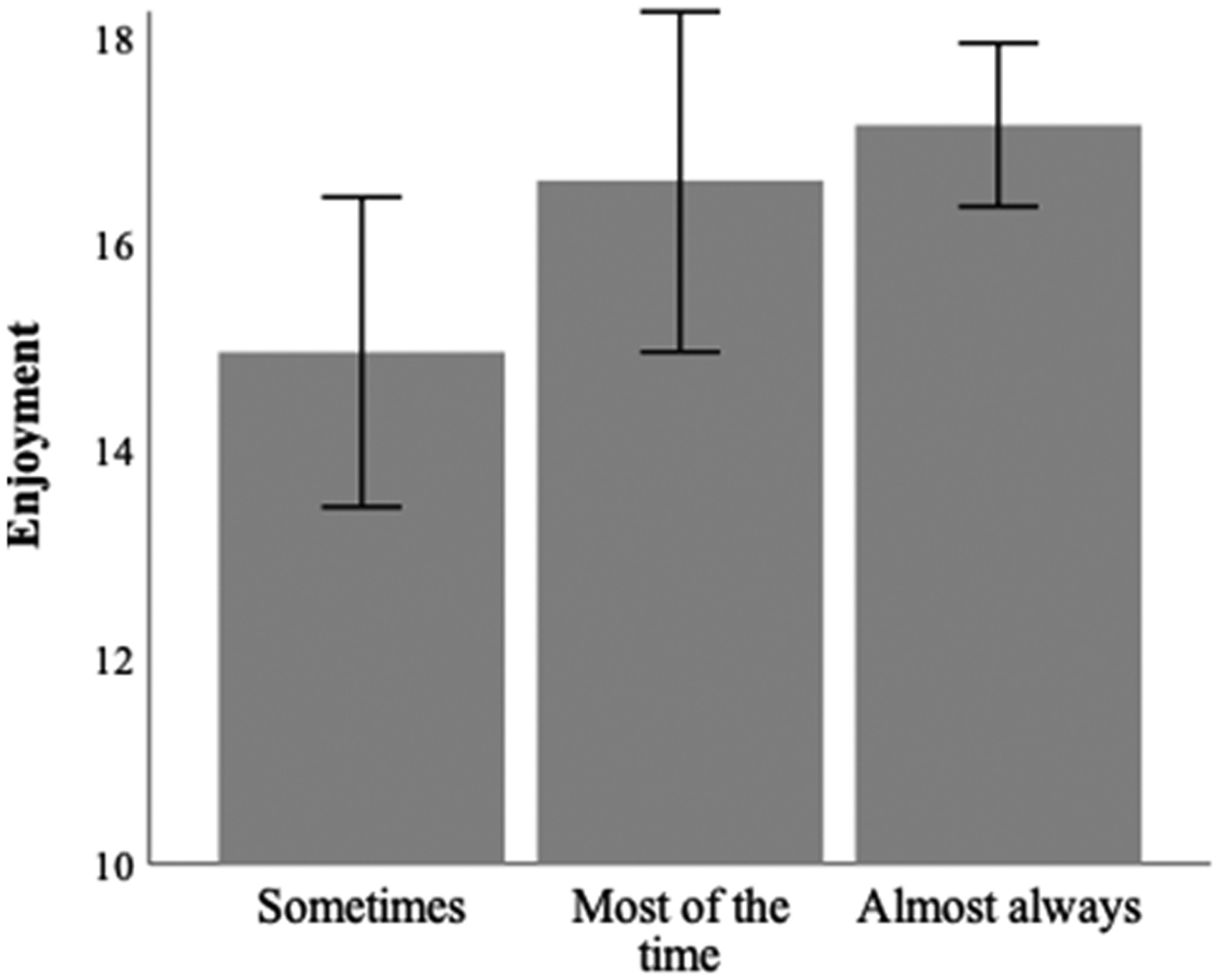
Differences in Enjoyment between players grouped by playing time.
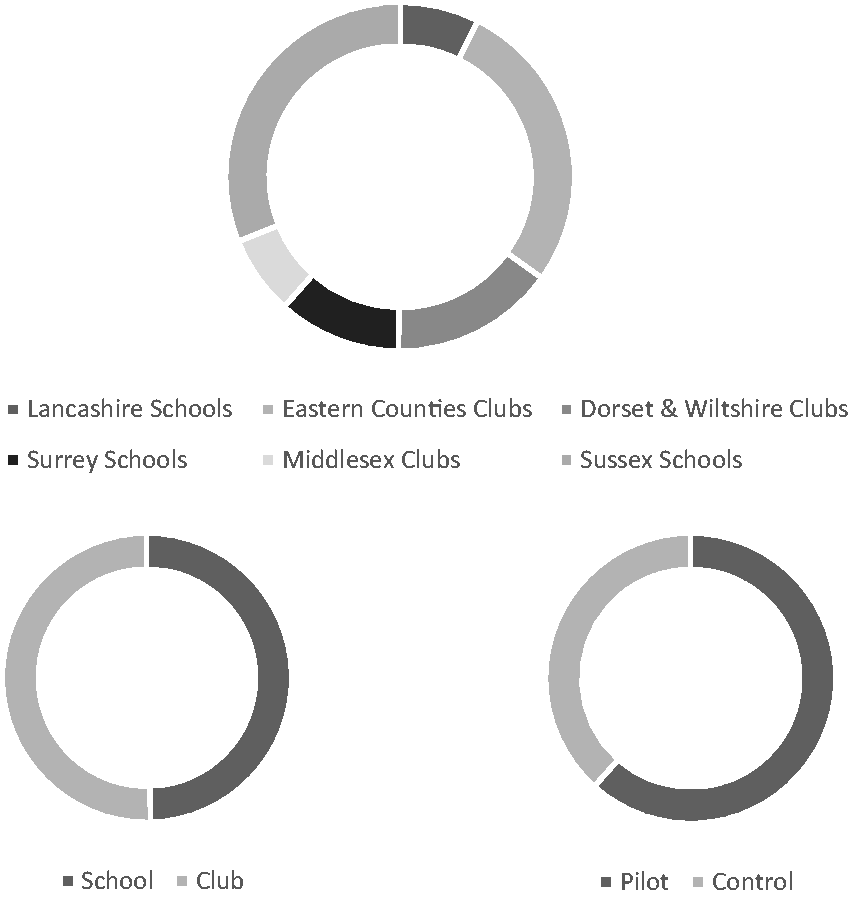
A breakdown of the survey respondents by county, school and club and control and pilot groups. Survey responses were received from all regions, with a 51-49% split between clubs and schools respectively.
Figure 3 (left panel) shows intention to continue was strongest in players who almost always played half a game and lowest in those who sometimes played half a game (main effect ANOVA (F(2, 267) = 6.4, ηp 2 = 0.08 P < .002)) post hoc test showed a statistically significant (P < 0.04) difference in intention to continue between the ‘almost always’ and ‘sometimes’ groups. The largest between group differences were between those playing half a game ‘Sometimes’ and the remaining two groups.
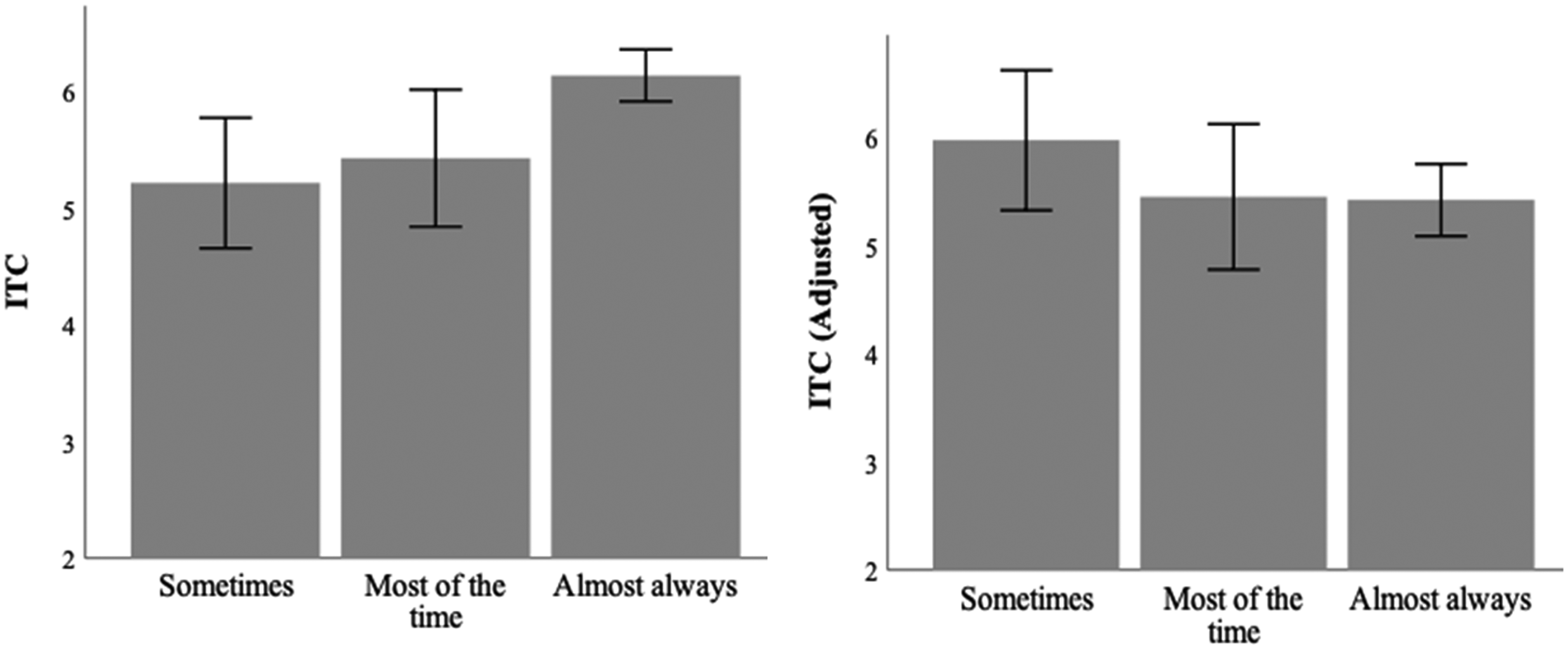
Association between playing time and intention to continue playing rugby before (left panel) and after adjusting for Enjoyment.
Figure 3 (right panel) shows the association between playing time and intention to continue was attenuated (Main Effect (F(3, 266) = 1.16, ηp 2 = 0.00 P>.05)) when we introduced ‘Enjoyment’ which was a significant covariate (F(3,266) = 35.2 ηp2 = 0.55, P < .001).
In a sub-sample of n = 120 players, we assessed whether there were differences in enjoyment across the seasons spanning the HGR introduction. Using a paired t-test we found a statistically significant increase in enjoyment t = 2.2, P0.03. The mean difference between seasons was 0.52 (95%CI: 0.05-0.98).
We used a Wilcoxson signed rank test in order to assess differences in raw scores for how often participants reported playing half a game between the two seasons. There was a statistically significant (z = 6.4, P < .001) increase in raw scores indicating a higher frequency of playing half a game.
Part 2: Statistical analysis of game outcomes and scoring
Statistical Analysis of game scoring for Sussex Schools, Lancashire Schools and Surrey Schools league competitions was accessible for further analysis. The following data was considered; number of fixtures played, win/loss, points for/against, total points and point’s difference (Table 1).
The mean number of fixtures stayed constant between seasons as did the number of wins and losses (including draws). There was a five-point decrease in the number of points scored per game and a five-point decrease in average points difference match.
Discussion
Continued participation in sport is a primary goal of any NGB,
45
coach, or physical education provider. However, drop out from organised sport,8–10 increased decline in physical activity levels12,13 and a lack of engagement in physical education classes by young people16,17 are well-documented. This research project discusses the evaluation of the ‘half game rule (HGR) pilot, an initiative devised by the rugby football union (RFU) to combat youth drop out in rugby. The main findings of the study were;
players experiencing more playing time, generally reported better intentions to continue playing rugby players experiencing more playing time, also reported higher levels of enjoyment when intention to continue was adjusted for enjoyment, playing time wasn’t considered important.
The HGR increased the frequency of players ‘almost always’ playing half a game and this was accompanied by an increase in their enjoyment. Game scoring analysis revealed that overall outcome of games (win versus. loss) were unaffected by the HGR, however, game scores appeared closer between teams as a result of the intervention.
CE approaches have been used within youth sport,1,2 with a primary focus to create more engaging and enjoyable playing experiences. 1 For example, adaptations within youth rugby to maximise ‘ball in play-time’ through the removal of ‘set piece’ play, led to 25% more ‘ball in-play time’, 55% more running with the ball, more successful passing and greater game scoring. 7 Although this CE approach facilitated player involvement, it did not specifically look to modify ‘game time’ itself. In the current study, the HGR increased the frequency of players playing more, alongside an increase in enjoyment. Moreover, greater playing time was associated with increased intention to continue playing the sport. Taken together, these findings suggest that the HGR could be utilised by coaches and NGB’s to reduce player attrition in rugby and it should be noted that when enjoyment was taken into account, playing time itself was not important. As such, while enjoyment is related to playing time, the current findings suggest, coaches cannot just increase playing, there is a need to increase ‘enjoyable’ playing time. Burton et al. 1 propose that all CE based interventions should be based around what young players like most about sport in order to facilitate athlete engagement and ultimately a long term healthy association with their chosen sport. Fun and enjoyment are heavily ‘voiced’ by young people as a primary reason for taking part and continuing in sport,30,33,46 with present findings supporting this. From an allied perspective coaches should look to create not only enjoyable playing opportunities, but also fun and engaging practices,18,37,47 through which player competence and self-esteem are enhanced. This is supported by Atkins et al. 21 who conducted a multivariate analysis examining the motivational climates created by parents, peers and coaches on adolescent male athletes. Findings demonstrated how intention to continue in sport was primarily predicted by enjoyment, followed by self-esteem. Enjoyment plays a pivotal role within sport retention and should remain a focus for all sport stakeholders.
Game outcome and scoring
Statistical analysis on game outcome and scoring was carried out to assess the impact of the HGR across the 2016/2017 and 2017/2018 playing seasons. Score data revealed that the mean number of wins, losses, and draws stayed consistent between seasons (i.e., unchanged by the HGR). There was a 5-point decrease in the number of points scored per game and a 5-point decrease in average points difference. Overall, this suggests that the results of 2017/2018 games were 5-points closer than in 2016/2017. Notably (and based on the available outcome data), better performing teams in the first season seemed to fair slightly worse in the second season (i.e., HGR intervention), whereas, the reverse was true for the lesser performing teams in the 2016/2017 season. Although there may be other factors contributing to this effect, it would appear that the HGR helped to ‘close the gap’, as evidenced by the reduction in absolute points difference (-4) thereby facilitating competitive equity. Coakley 48 previously reported close scores as a youth preference and Burton et al. 1 suggest that CE based rule changes should include mechanisms in which to facilitate the closing of scores. It has also been documented that players enjoy taking part in closely contested/competitive matches, more so than winning.2,7 For example, Cumming et al. 49 found that in youth basketball players (aged < 16 (male and female)) sport enjoyment and evaluations of their coach were more strongly related to coaching behaviours than to their team’s win-loss record. Additionally, Cumming et al. 50 have shown that a more physically balanced competitive environment (through bio-banding i.e., grouping players by maturation status rather than age) in youth (11-14years) football facilitated more strongly contested and competitive games that players perceived to be beneficial to their sporting development. Junior rugby in New Zealand have utilised the use of ‘age-weight’ banding (i.e., grouping players by weight, rather than age) to create a safer contact environment, with mixed findings. Heavier, more mature players asked to ‘play up’ were more likely to quit and those in the weight restricted division more likely to be retained. 51 Closer interrogation of the data, evidences an overall net effect of positive retention, due to a higher level of retention in the weight restricted groups (i.e., smaller players) which represent a greater proportion of the overall sample. World Rugby 52 suggests that this approach in modifying youth rugby does not take into account facilitating player enjoyment, playing with friends, or playing at an appropriate level. However, it could be argued that the age group system approach similarly fails to account for differences in motor and psychosocial development among youth athletes. As such, all modifications to youth sport need to be considered holistically and within social context. To this end, and within educational theory there is evidence to suggest that mixed age and ability grouping is beneficial for younger and older students, with peers acting as ‘more capable others’ to co-construct knowledge and facilitate more productive learning environments. 53 Collectively, the present study and the growing body of CE based literature demonstrate that regardless of sport type, sporting enjoyment and competitive experiences are key determinants for youth sport retention. Various innovative initiatives are being carried out to encourage young people to engage with sport,15,54 physical education55,56 and physical activity in general.57,58 It is important to understand the reasons young people have for participating and not participating within these environments. The need to promote equitable sporting opportunities for children has been highlighted previously59,60 and within the findings of this paper. It is important to note, that while winning defines the essence of sportsmanship at any level of amateur or professional play, winning is not all-important. Indeed, we would argue that any definition of sportsmanship would also include the values of fellowship and goodwill and as such, rule modifications such as the HGR help to preserve the balance between the many dimensions of sportsmanship including winning, fellowship, and goodwill. Therefore, based on our research findings and others, CE is one method NGBs and other stakeholders can make sure participation initiatives strike a balance between winning and goodwill.
Some caution should be applied to the current findings and limitations to the study include a male only sample and the age of respondents,12–15 reducing the generalisability of the results. Age and developmental level can play an important role in youth responses as it has previously been shown that enjoyment in sport may differ depending on developmental level or expertise. 61 Similarly, research has shown that gender is an important factor to consider as drop-out from girls is particularly evident as they progress through adolescence. 62 Whilst young females also cite fun as fundamental reason to participate in sport and activity,3,30 differences in motivations to take part 63 exist between genders. Given the increasing numbers of female participants within youth rugby, 64 caution must be noted when applying CE approaches across genders. Importantly, game scoring data must be interpreted with care. Numerous factors can contribute to game scoring and outcomes 65 and whilst seasonal data was matched and rule application (data not presented) rates were high (72%) amongst coaches, the HGR may not account for all results and outcomes. Additionally, previous research has utilised single time point questionnaires and retrospective questioning with success,66,67 however, multi-time point longitudinal assessment are considered an exemplar methodology. Finally, the intention to continue construct in the present study was used as a proxy measure for future participation in the game. In order to fully assess the impact of the HGR upon player retention, follow-up analysis is warranted.
At the time of writing, it is important to note that we are amidst the second-wave of the COVID-19 pandemic in the United Kingdom. As such, we would like to acknowledge how COVID is prompting us in coaching and youth sport to think more creatively about how we can build youth sport back better.68,69 As Fitzgerald et al. 70 have pointed out, the pandemic is disrupting youth sport and is thus threatening and displacing traditional models of grass roots sport. We suggest as sport eventually returns to normality, it is a good opportunity for NGBs to employ CE adjustments as the world is becoming increasingly open to new ideas (e.g., the work from home “revolution” and the rise of PE with Joe Wicks during lockdown). There is much uncertainty about what life will be like once the pandemic is under control and an effective vaccine is available. However, one thing is for certain is that many of the changes we have adopted and implemented under lockdown may become permanent, meaning there is a real threat that more inclusive forms of physical activity made possible by technology may dissuade even more youth from participating in traditional forms of sport in the UK and globally.
Aggregated data collected for all age groups, u13s and u14s.
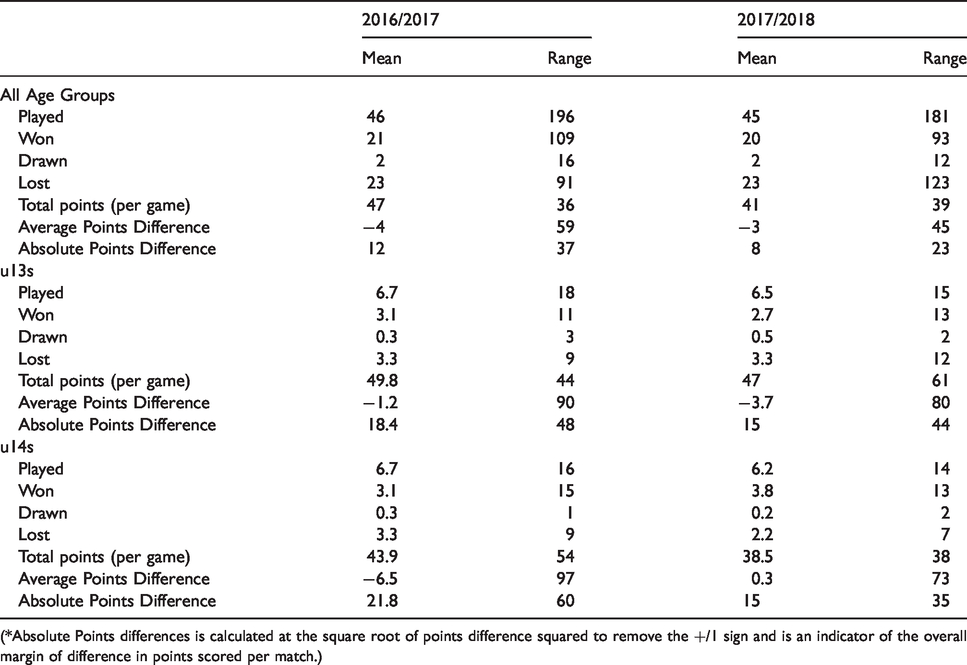
(*Absolute Points differences is calculated at the square root of points difference squared to remove the +/1 sign and is an indicator of the overall margin of difference in points scored per match.)
Footnotes
Acknowledgements
The author(s) would like to express their thanks to the county school unions, county bodies, participants, and parents in the study.
Declaration of conflicting interests
The author(s) declared the following potential conflicts of interest with respect to the research, authorship, and/or publication of this article: In accordance with SAGE policy and my ethical obligation as a researcher, I am reporting that Dr Ben Jones and Dr Gavin Sandercock, have a potential personal conflict as they acted as consultants for the Rugby Football Union the National Governing Body that oversees the rugby competitions played, in which the evaluation took place. The authors have disclosed those interests fully to SAGE.
Funding
The author(s) disclosed receipt of the following financial support for the research, authorship, and/or publication of this article: This work was supported by the Rugby Football Union [RFSR010083].
