




Abstract
The purpose of this study was to examine the relationship between legal stops and winning in team handball. Real-time analysis was performed on all games played in the Icelandic elite division for both males and females (regular season and playoffs) between 2017–2021 (854 games [570 male games, 284 female games], 32,392 legal stops in total). Legal stops were assessed as any physical action by a defensive player that resulted in the stop of play, without the defensive player being penalized or the offensive player receiving a 7-meter throw. The results from a multinomial logistic regression analysis indicated that legal stops were significantly associated with winning games in the male league. No statistically significant relationship was found between illegal stops and game outcome for either sex. However, 2-minute suspensions were found to be positively associated with winning in the male league.
Introduction
Team handball is an invasive, fast-paced, Olympic sport that is played by both males and females all over the world.1,2 As in most other invasive team sports there are a number of axioms circulating in the handball world that warrant investigation (e.g. “you can't win if you do more than ten unforced errors”). One axiom that is frequently touted by defensive-minded coaches, is that “the team that commits the most fouls wins the game”. For clarity, the fouls being referred to are what will henceforth be referred to as legal stops. Legal stops being any physical action by a defensive player that results in the stop of play, without the defensive player being penalized or the offensive player receiving a 7-meter throw. Contrastingly, an illegal stop would result in the defending player being penalized with a 2-minute suspension or a red card, or the offensive player receiving a 7-meter throw.
Gameplay in handball is highly structured and is built around predetermined sequences and actions that are designed to create space between defenders. If the defensive team can disrupt the offensive team's execution of said predetermined sequences using legal stops, the offensive team's ability to create space would be severely impacted. Because of the limited time the offensive team has at their disposal in any given possession, and the time it takes to start and execute a new sequence, there could be substantial cumulative gains from amassing legal stops. There are of course other ways to score goals that require less space, but those usually demand a higher degree of skill and effort, meaning that they are less effective in the long run.3,4
A legal stop is generally considered a positive defensive action,5,6 but previous studies that have attempted to quantify the immediate effect of legal stops in team handball are inconclusive.7,8 Fasold and Redlich 7 found no association between making a legal stop in any given defense and conceding a goal in said defense in the top three male leagues in Germany. However, they did find a positive relationship between legal stops and passive play. Wilhelm et al. 8 replicated Fasold and Redlich's study on the female leagues in Germany but came to a different conclusion. While legal stops were found to be negatively associated with conceding goals at the elite level, the opposite was found at the amateur level. While any attempts at explaining the divergent findings were only speculative, the theory was that hurried shots at the amateur level had a higher probability of success than at the elite level. It must be noted that both studies only analyzed small sections of the games, excluding many of the circumstances where breaking up the play would be either advantageous or detrimental to the teams’ success (e.g. 5 vs. 6, 6 vs. 5, and the final minutes of the game).7,8
With previous studies on legal stops being inconclusive, and no prior studies examining the cumulative effects legal stops may have on match results, the aim of this study was to test the veracity of the aforementioned axiom by investigating whether the team that makes the most legal stops is more likely to win a game of team handball. Additionally, the study aimed to investigate the role illegal stops and 2-minute suspensions play in determining the match result and whether the findings vary across sex (i.e. male league vs. female league).
Methods
Data and variables
HB Statz provide a user-friendly statistical software that allows handball clubs to categorize and tally every action on the field and is the official statistics partner for the Icelandic Handball Association. HB Statz, in collaboration with the participating clubs, has compiled various individual- and team data on the Icelandic elite divisions (male and female) since 2017. Data were gathered from a total of 854 games (570 male games, 284 female games; 768 during the regular season and 86 during the playoffs) across four seasons (2017–2021). The data collection was performed in situ by representatives from the home teams, who have all receive training from HB Statz before using the system; a process which has previously been found to be both reliable and effective. 9 While there are several actions in the HB Statz software that require subjective interpretations of the proceedings (e.g. assists), the number of legal stops is a straightforward objective measure. Every time a defending player stops an opposing player resulting in the referee signaling a free-throw, without the defensive player being penalized or the offensive player receiving a 7-meter throw, will be counted as a legal stop. Other variables of interest were game outcome (win, loss, or draw), number of illegal stops (2-minute suspensions, 7-meter throws given, and red cards), the sex of the participants (male or female), tournament stage (whether the game was a part of the regular season or the playoffs), match location (whether the game was played at home or away), and team quality (average league standing during the period in question). Ratio data (e.g. legal stops and illegal stops) were transformed into nominal data (i.e. more legal stops than their opponent, fewer legal stops than their opponent, and tied for legal stops) for statistical analysis.
Data analysis
Multinomial logistic regression models were used to assess the influence the independent variables (legal stops, illegal stops, 2-minute suspensions, tournament stage, match location, and team quality) exerted on the game results. The non-linear models produced an odds ratio (OR) and 95% confidence intervals (CI) for all independent variables. All statistical analysis was performed in SPSS (version 27.0; IBM Corp., Armonk, NY), with significance accepted as long as the 95% confidence interval of the odds ration effect size did not include 1.
Results
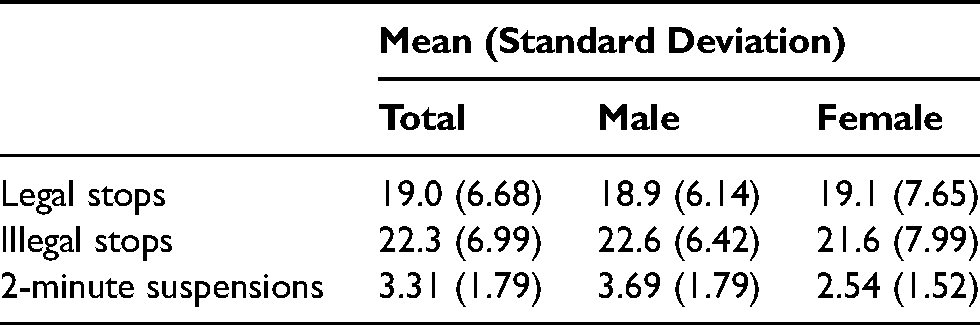
In total, we analyzed 32,392 legal stops and 11,489 illegal stops across 854 games. Descriptive statistics for all ratio variables can be seen in Table 1 below.
Descriptive statistics for the measured ratio variables.
The results from the multinomial logistic regression analysis, containing all available data, (Nagelkerke R2 = .204, χ2 = 316.72, p < .001) showed that having fewer legal stops than the opponent increased the odds of belonging to the lost the game category compared to the won the game category (OR = 1.73, 95% CI = [1.38, 2.18]). Amassing fewer 2-minute suspensions than the opponent also increased the odds of belonging to the lost the game category (OR = 1.36, 95% CI = 1.00, 1.85). There were no statistically significant association between illegal stops and the likelihood of winning games. Team quality, gender, and tournament stage were all statistically significant covariates. No other statistically significant associations were found (for all estimates see Table 2).
Results from the multinomial logistic regression analysis.
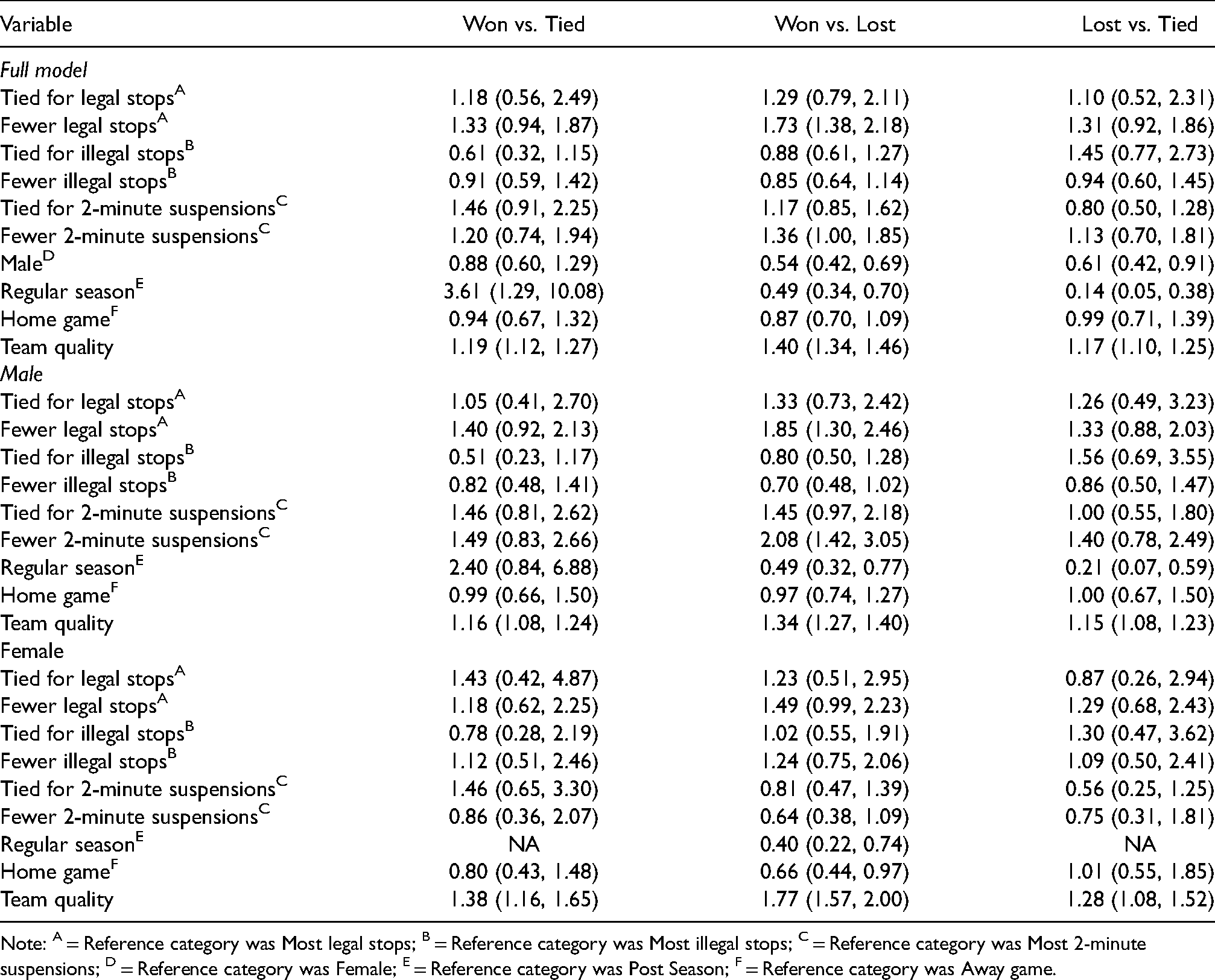
Note: A = Reference category was Most legal stops; B = Reference category was Most illegal stops; C = Reference category was Most 2-minute suspensions; D = Reference category was Female; E = Reference category was Post Season; F = Reference category was Away game.
When the sexes were analyzed independently the results from the multinomial logistic regression analysis containing the male data (Nagelkerke R2 = .206, χ2 = 219.79, p < .001) showed that having fewer legal stops increased the odds of belonging to the lost the game category compared to the won the game category (OR = 1.83, 95% CI = [1.38, 2.42]). The same applied to amassing fewer 2-minute suspensions than the opponent, which also increased the odds of belonging to the lost the game category (OR = 2.08, 95% CI = 1.42, 3.05). Team quality and tournament stage were both statistically significant covariates. No other statistically significant associations were found. The analysis of the female data (Nagelkerke R2 = .270, χ2 = 147.00, p < .001) found that none of the independent variables had statistically significant associations with the outcome. Team quality, tournament stage and match location were all statistically significant covariates (for all estimates see Table 2).
Discussion
In line with the axiom that set the premise for the study, the results indicate that the team that amasses the most legal stops is more likely to win a game of team handball than the team that amasses the fewest legal stops. These findings are in congruence with the findings of Gruić et al. 10 Rogulj et al. 11 and Milanović et al. 12 who found that losing teams often had problems building systematic, organized, and collective attacks, therefore having to make do with suboptimal shooting opportunities. Rogulj et al. 11 noted that these offensive struggles were at least partly down to the legal stops committed by the opposing team, which fragmented the offensive team's efforts. Conversely, illegal stops do not appear to have any bearing on the match result.
Analyzing the sexes separately indicated that different mechanisms may determine success for male and female handball teams. These results are in line with Michalsik and Aaagaard's 2 study which found that male and female handball differed concerning both locomotion and physicality. While the males relied more heavily on power and acceleration, the females relied on their stamina to a much greater extent. Additionally, males have been found to have a more aggressive approach to the game, where they both perform and receive more tackles than their female counterparts. 2 However, the differing degrees of aggressiveness may not appear in the number of legal stops due to sexist bias in refereeing, where females tend to be penalized for infractions that the males get away with. 13
Somewhat surprisingly, amassing more 2-minute suspensions than the opponent was positively related to winning for the male teams. While performing better as a result of being at a competitive disadvantage is counterintuitive, it is not unheard of, as illustrated by Debanne 14 who found the same trend in the French elite division. However, a study by Prieto et al. 15 found that the numerical advantage gained during a 2-minute suspension was not as advantageous to the benefitting team as one would assume given the parameters. While the incongruity between expectations and outcomes can be rationalized through the interplay of various psychological- and tactical factors (e.g. choking [i.e. not being able to perform under pressure when expectations are high 16 ], substituting the goalkeeper, slowing down the pace of the game, or closing passing lanes), the results of this study indicate that the short term benefits of numerical superiority may be outweighed by the cumulative effects of being the more aggressive team throughout the game. This trend does not appear to apply to the females, who have been found to have a less aggressive general approach to the game as well as having a relatively larger spatial advantage during the temporary numerical superiority (due to being smaller in stature than the males). 2
The findings of this study may partly challenge the long standing assumption that all fouls are not created equal; meaning that running around collecting legal stops for the sake of it would not be beneficial to the teams’ success, and that legal stops should only be performed in certain areas of the field, under certain conditions that are deemed exceedingly advantageous to the offensive team.7,8 While stealing the ball is always preferable to making a legal stop (for the obvious reason that the former results in the change of possession, while the latter does not), an offensive sequence that appears unthreatening can become so in an instant, with little time to make a reactionary stop. Taking a more proactive approach to defending can therefore prove fruitful in stifling the opponent's offensive efforts before they become dangerous. It should be noted that there are of course other ways to proactively disrupt offensive sequences, such as zoning out players or cutting off passing lanes, but those are not as easily quantifiable and can be difficult to measure objectively.
While this study answers some of the questions regarding legal stops and their relationship to match results, it prompts many more that future research will have to address. While the study's strengths are the large sample size, the reliability of official data, and the objective and easily categorized measures, the methodology has its limits. While assessing the between-game dynamics has provided valuable preliminary knowledge, the next step will be to use multilevel modeling to analyze within-game dynamics to gain a more nuanced understanding of the relationship at hand (i.e. considering the intra-game dynamics as opposed to focusing solely on the inter-game variability).
Future research should also explore the difference various defensive formations may have on the relationship between legal stops and match results, to determine whether legal stops are more or less advantageous in certain defensive formations. Ascertaining whether the current findings are applicable outside of Iceland would be advisable as well.
Footnotes
Declaration of conflicting interests
The author(s) declared no potential conflicts of interest with respect to the research, authorship, and/or publication of this article.
Funding
The author(s) received no financial support for the research, authorship and/or publication of this article.
