




Abstract
Sport psychology has become widely applied in coaching practices to assist in athletic success. Despite the increased use, there is a lack of evidence-based sport psychology information available to coaches in the form of informal sources. The aim of this study was to conduct a pilot test to explore coaches’ perceptions and use of an evidence-based sport psychology website. Eight coaches participated in semi-structured interviews. Based on engagement, five of the coaches’ data was analyzed using thematic analysis on their experiences and revealed two main themes, website use and website enhancements. The remaining three coaches’ data was analyzed for their reasons for having limited engagement with the website and used to help identify ways it could be enhanced. In general, coaches perceived the website to be a reliable source that offered practical information (e.g. worksheets) that could be used directly with athletes, and was perceived as easy to navigate and to access information. There were, importantly, various improvements suggested for the website including delivery modality and guides for navigating the order for reading the information. This study offers evidence on the value of online resources in providing coaches with informal and evidence-based sport psychology learning opportunities, and also addresses a number of barriers to engagement as insight for website developers.
Many sport coaches recognize the benefits and relevance of using sport science research within their own sport.1,2 Accordingly, these individuals, especially high-performance coaches, seek new ideas to enhance athlete performance and this includes the use of sport psychology.3,4 Although coaches recognize the benefits of athletes’ psychological skill use, the application of evidence-based sport psychology practices by coaches seems to be limited. 3 Reade et al. 1 surveyed 205 Canadian university coaches and found 39.9% believed sport science research contributed useful new ideas in the area of mental training and preparation, but only 13.2% thought these could be utilized by coaches, and 50% reported difficulties in accessing research. Thus, there appears to be a gap between the dissemination of new ideas by researchers and the retrieval and use of these ideas by coaches.
It is important to consider how coaches access new ideas in sport science to better understand how to bridge this knowledge translation (KT) gap. Previous research has suggested coaches gain knowledge through a myriad of sources.2,5–8 According to Nelson et al. 9 coaches’ sources of learning can be categorized as formal (e.g. university courses on coaching), nonformal (e.g. attending a sport leadership conference), and informal (e.g. conversations with coaching peers). Formal and non formal learning were frequently identified as sources of learning, 9 yet coaches have identified informal sources as their actual and preferred source for gaining information and new ideas.6,8,10,11 This preference for informal sources is largely driven by the style of information delivery. 10 Nelson et al. 9 argue that self-directed (informal) learning has a greater influence on coaches’ learning as they have the autonomy to develop strategies to overcome higher priority coaching dilemmas. Coaches can seek out methods of solving specific issues and thus take a more active approach to learning. 11
A common informal source of sport science research is the internet. 1 With over 4.47 billion users worldwide, the internet continues to transform how information is shared and has become an integral part of daily life. 12 Due to its immediate availability and the prevalence of smart phones, in contrast to scheduled learning opportunities such as coaching clinics or seminars, 13 the internet may serve as an attractive source in mitigating barriers to sport science information. This may be particularly important to coaches, who often report having limited free time and indicate other coaching priorities take precedent over attending in-person certification programs and conferences. 4
Considering the numerous barriers associated with formal learning settings for coaches, in particular with accessing sport psychology information, Pope et al. 3 conducted a needs assessment study, concluding that a website could be a practical method for researchers to present new ideas in sport psychology to coaches. Coaches indicated they would use such a resource to uncover information on sport psychology skills (e.g. goal setting, team building, focusing/refocusing and motivation) and how to implement sport psychology into their practices. The coaches in Pope et al.'s 3 study indicated they would use online sport psychology resources frequently due to the convenience of this delivery modality. Coach participants also indicated they would be more inclined to consult an online sport psychology resource if the information was credible, and if the website provided practical activities such as print outs and methods to facilitate active participation (e.g. modules for coaches to complete). 3 This work therefore served as guide for the development of an online sport psychology resource.
Translating knowledge into practice has been acknowledged as a challenge, with statistics indicating it takes approximately 17 years for a small proportion of research to move from the lab into clinical practice within the healthcare context. 14 Graham et al.'s 15 Knowledge to Action framework has been adopted by funding agencies and researchers to help guide strategies to circumvent this gap. Although a similar framework has not been applied in the sports science discipline, articles in this area have acknowledged that research may not be impacting coaching practices at the desired magnitude. 16 In their proposal of a framework to guide KT within professional sport, Bartlett and Drust 17 highlight the challenges of KT and the need for collaboration between sport scientists and other practitioners (e.g. coaches, performance support staff) to identify what information is valuable to stakeholders as well as how best to communicate information to specific stakeholders so that it will impact policy and practice. Holt et al. 18 also highlighted the need for more focused KT within sport psychology. Targeting youth sport psychology, they argued that with improved KT, there likely would be widespread improvements in developmentally appropriate coaching practices, decreases in injury rates, better psychological adjustment, and longer sport participation. To address this caveat, the website sportpsychologyforcoaches.ca was developed by four sport psychology researchers primarily based on the findings from Pope et al.'s 3 needs assessment.
The website aims to bridge the KT gap by providing evidence-based information that was relevant and in a form that is meaningful to coaches. 19 In brief, the website provides: (a) information on various mental skills (e.g. concentration, anxiety regulation, imagery), (b) direction on how to integrate the skills into coaching practices through activities and worksheets (e.g. performance routines, breathing worksheets, audio of a guided imagery script), and (c) an Ask the Expert section to allow coaches to direct questions to a sport psychology professional. 1
As powerful and accessible as the internet may be for obtaining information, it is of limited value if no effort is made to make sense of individuals’ engagement in webpages. 20 Understanding how and why coaches engage with websites such as the sportpsychologyforcoaches.ca will allow website developers to improve their sites and ultimately the accessibility of evidence-based sport psychology information and approaches. This is part of the action cycle in the KT framework,8,15 whereby knowledge tools must be adapted and assessed based on real-world applications so that researchers can develop effective interventions that help to move the knowledge tools into widespread practice. The current study was a first step in understanding how coaches interact with a specific website and how it can be improved. Thus, the purpose of the present study was to investigate coaches’ perceptions and use of the sportpsychologyforcoaches.ca website. An additional purpose was to use the information provided by the coaches to inform present and future developers about website access and usability.
Methods
Participants
Coaches were deemed eligible if they: (a) coached varsity (university/collegiate), provincial, national, and/or international levels sport, (b) were older than 18 years of age, (c) able to read, write, and speak English, (d) had access to a device with internet access, and (e) had not previously interacted with the website sportpsychologyforcoaches.ca.
Eight coaches (2 females, 6 males) initially participated. Coaches reported between 8 and 35 years of coaching experience and indicated that the highest competitive level of athlete they had coached was university/collegiate (n = 2), provincial (n = 1), national (n = 3), and international (n = 2). The primary sports coached included rowing (n = 1), rugby (n = 1), golf (n = 1), wrestling (n = 1), cross-country/track and field (n = 1), and swimming (n = 3). To be considered for post interview analysis, participants had to have spent more than 15 min interacting with the website (as this was believed enough time to read and engage based on the content). 21
Data collection
Following ethics approval, the Department of Athletics at the university of the first author provided a potential contact list of coaches. With a goal sample size of 12, that would be large enough to identify patterns, 22 coaches on the list were sent an e-mail and interested coaches then reached out to the primary researcher. Coaches agreed to have two in person interviews, both audio-recorded, and their engagement on www.sportpsychology.ca tracked via Google Analytics.
The first author conducted the interviews and had 1 year of previous experience in qualitative interviewing and data analysis. A mock interview was done between the first and second author to test the questions and refine probes. The first interview ranged from 14–73 min; these were recorded and transcribed verbatim, which produced 49 pages of typed data. Coaches were then asked to create a user profile on the website and share their username with the investigator for tracking purposes. The coaches were asked to log-on to the website and use it as often as they wanted over the next eight weeks. As previous research has found coaches would be likely to consult an online resource at least once per month, 3 this period (eight weeks) was chosen to provide sufficient time for the coaches to make use of the website. One month following the first interview, three of the coaches were sent an email reminder to login to the website to remain eligible for the study. The second interview was scheduled two months after the participant's first interview. The second interview ranged in time from 7–52 min; they were recorded and transcribed verbatim, which produced 40 pages of typed data.
Qualitative research perspective
The study was guided by a relativist ontology (realities exist as multiple), with a subjectivist epistemology (subject imposes meaning on an object). This means that criteria for judging the quality of qualitative work are drawn from a list of characteristics rather than a set of universal criteria. 23 The list included the following criteria: worthiness of the topic 24 ; width, which is providing quotations to support findings (p.73) 25 ; rich rigor in developing a sample appropriate for the purpose of the study; and transparency by having another person provide alternative explanations from the data. 24 The study also aimed for resonance (e.g. naturalistic generalizations) so that the findings can be transferred into the way coaches learn other domains of sport science. 24 Finally, the methods used to collect data were expanded to include quantitative data obtained through Google Analytics. Each coach's reported use of the website during their second interview were matched with their data from Google Analytics as a way to minimize the bias that may arise from memory recall. 26
Interview guide
Two semi-structured interview guides for the first and second interviews were adapted from an online questionnaire employed by Pope et al. 3 The questions were open-ended to encourage thick and rich descriptions from the coaches, but not so vague that the focus of the research would be easily lost 27 Probes were used on an individual basis as required to gain full understanding of the coaches’ responses and to invite the coaches to elaborate on a point or clarify it. 27
The purpose of the first interview was to gather background information on coaching and sport psychology experience (e.g. how many years have you been coaching?). The interview was divided into three sections beginning with introductory questions to collect information on the number of years coached, sports coached, and the level of athletes coached. The second section focused on coaches’ current perceptions of sport psychology. Coaches were asked to define sport psychology (e.g. what comes to mind when you hear the words “sport psychology”?), their experience with the area (e.g. discuss any sport psychology experience or background that you have?) and ways it relates to their coaching practice (e.g. discuss how sport psychology is relevant to your coaching practice?). Lastly, the interview explored perceptions of online resources (websites) and what resources coaches consult. They were asked the time they spent consulting online resources, the topics most often researched, as well as barriers to accessing new ideas.
The purpose of the second interview was to understand the perceptions and experiences (including opportunities and barriers) with the sport psychology website. The interview was divided into two sections. The first aimed to uncover any changes in coaches’ perceptions of sport psychology after using the website. Example questions included “after using the website do you believe sport psychology is more relevant to your coaching practices?”, “how did you implement the new sport psychology activities from the website with your athletes?”, and “has your confidence levels applying sport psychology within your coaching practices changed?” The second portion of the interview targeted coaches’ engagement on the website and their perceptions of the resource. Coaches were asked about the time they spent using the resource, and the features that they enjoyed. They were also asked to share their perceptions of the material on the website. Lastly, coaches were invited to share recommendations to enhance the website experience.
Digital analytics
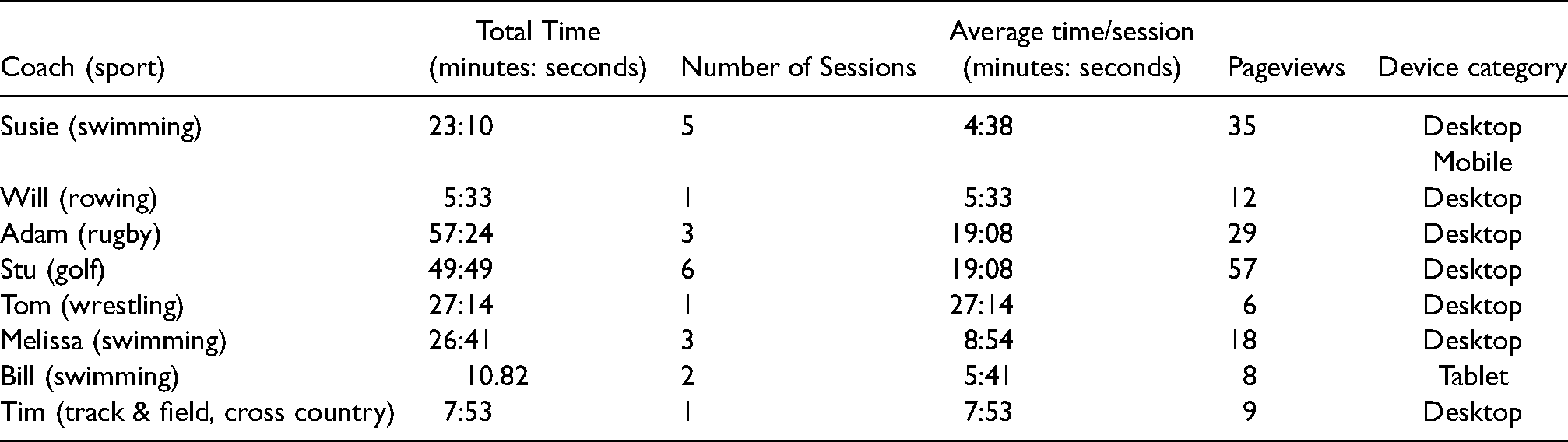
Digital analytics were examined via Google Analytics to gain a deeper—objective—understanding of coaches’ engagement on the website, which is important to improve the website user experiences. The parameters chosen were based on Fareny's (p. 17) 28 suggested list of important data points and web analytic tools, as well as two other measures (time and device category) deemed necessary. The parameters of interest were total time, number of sessions, average time/session, number of pageviews, and device category (e.g. desktop, mobile). The total time was the measure of the time each coach spent on the website during the intervention period. Sessions were measured by the activity taking place within a given time frame (30 min) such as browsing pages or downloading content. 29 If a coach was inactive for 30 min or more, any future activity was attributed to a new session. 29
Pageview metrics were counted based on the number of pages loaded or reloaded in a browser. Since a large majority of Canadians are accessing the internet using mobile devices 30 the metric of device category (i.e. desktop vs. handheld device) was also measured.
Data analysis
Pseudonyms were assigned to each coach to ensure anonymity of the coaches. The objective of the analysis was to classify and identify themes from the data to represent coaches’ perceptions, experiences, and use of sport psychology. An inductive and thematic analysis approach was taken to identify patterns across the qualitative dataset using Braun et al. 22 recommendations for sport and exercise research. The first and second authors initially analyzed the transcripts separately. Each author first read through the transcripts to become familiar with the data, followed by additional readings to recognize patterns and develop themes. These two authors then came together to discuss and finalize the sub-themes and main themes. For example, when coaches discussed using work sheets, this was coded under worksheet use, and then was refined to application of tools (sub-theme) under the main theme of website use.
Following the post interviews and analysis of web metrics, three coaches’ engagement with the website was found to be quite limited. For these three coaches, post interview comments were only analyzed and included under barriers to engagement.
Results
Data collected through the interviews resulted in two themes, and seven sub-themes. For the purposes of this pilot study, the main themes were drawn from the second interview and were labeled: website use and website enhancements. The sub-themes are explored under each theme heading. Participants also discussed three themes from the first interview, including current use of sport psychology skills and sources of information, accessibility, and attitudes. While these data offer valuable insight into the subjective experiences of the participants and may have influenced their perspectives of the website, we chose to include them in a Supplementary File as they did not address the primary scope of this paper (see Supplementary File 1).
Website use
The following data were obtained during the second interview and following the coaches’ engagement period with the website. The identified themes were application of tools, coach feedback, barriers, and intentions for future use. An illustration of the theme breakdown is given in Figure 1.
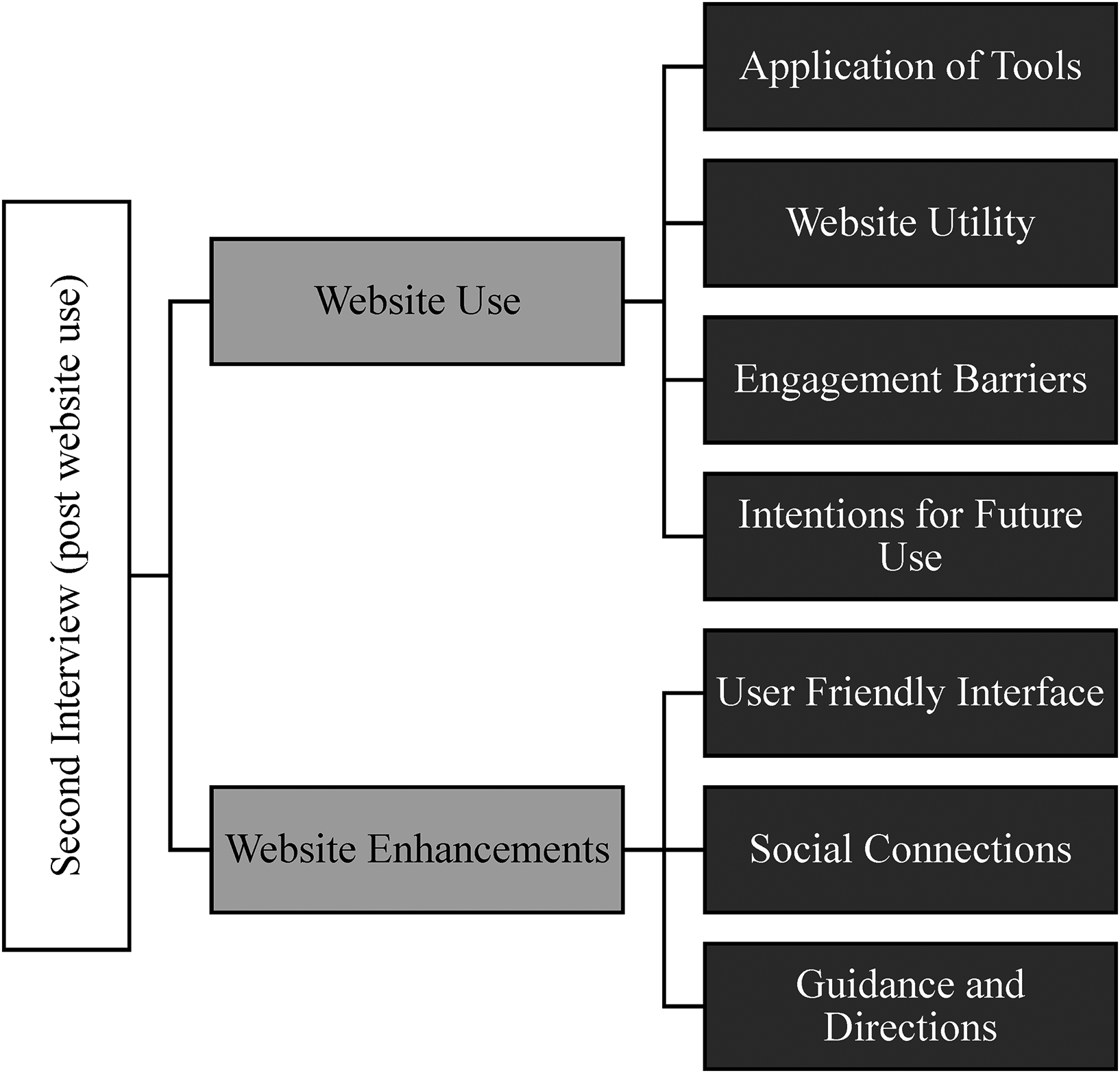
The themes (and subthemes) from the second interview: website use and website enhancements.
Data from Google Analytics revealed in further detail coaches’ actual use of the website. The average total time coaches spent using the website was 25.25 min (SD = 18.26 min, min: 5.41 min, max: 57.24 min). The average number of sessions per coach was 2.75 (SD = 1.79) and the average time per session was 9.14 min (SD = 7.54 min). Finally, the average time spent on each page was 1.14 min (SD = 1.15 min), and coaches primarily accessed the website using desktops. Only two coaches used either a mobile or tablet device. Table 1 provides a full breakdown of coaches’ engagement with the website. Overall, data from google analytics revealed the most frequently visited pages on the website were: Anxiety Regulation (17 views), Biofeedback (17 views), Concentration (15 views), Goal Setting (9 views) and Imagery (9 views). Pages with only a single page view were Para-sport, The Coach-athlete Relationship, Arousal Archives, Ask an Expert, Past Experts, Body Language and Upcoming Events. The pages Sport Psychology for Coaches: What it is and How to Use it (home page), Edit-Profile, Activate Your Account, and Create an Account were not included in the analysis of page views as they did not contain any relevant details for the purpose of this study.
Google analytics report of coaches website Use.
Application of tools
Coaches discussed the different pages and resources they used most when interacting with the website. Stu said: I have used two or three of the activities one of the biggest ones being the breathing one. For example, when we have anxious athletes even in practice, we get them to remember their breathing and go through it and it is amazing how they can calm themselves down and decrease the tension.
Similar to this, Tom also gave anxiety regulation handouts to his athletes and said, “there was a sheet about anxiety. One side was positive, and the other side was negative. Anyway, I gave it to a couple of athletes as a tool for them to use if they wanted to.”
Another page frequently visited by coaches was concentration. Even with limited time, coaches were able to quickly find and apply an activity with their athletes: I haven't had a lot of time this week we have been busy, but we did print off some of the stuff especially for anxiety and concentration. [Anxiety and concentration] were the big ones right now … as soon as I went on [the website] for concentration because we were having those issues with the little boys, I found stuff right away. (Susie)
Other common activities and areas coaches said they were interested in examining were goal setting, group cohesion, imagery, and self-talk.
Website utility
Following their interactions with the website, coaches shared many comments pertaining to the website utility. First, many coaches commented on the organized layout of the website. Tom said, “I thought it was easy to navigate like the headings and you know it kind of had it broken down into what you are looking for.”
Finally, the activities found on the website were rated as easy to apply with their athletes and into their coaching practices. For example, despite mentioning in the pre-interview not being confident in his skillset, Tom found the material simple to integrate: “you know, I looked through some of it, some of the activities they had, and I thought they were fairly easy to implement.”
Two coaches found the material to be lengthy in text and could be broken down into simpler terms. Stu outlined One of the things that I did was on some of those activities I actually got 10, 11-year-old kids to read it and see whether or not they understood. So some of the activities were very easy to understand … some of those got a little academic and it was difficult, I had to read it a few times on certain part and that is where that balance between the world of academia to the world of how to play and how to use it.
Two coaches discussed that the website was helpful in bridging the knowledge gap between researchers and coaches by providing one easy-access place for reliable sources: We [the coaches] are compiling everything from all over because one of the things we talked about [in the first interview] was that I don't know where to look … this [website] is like … a vetted stream of really reliable, really interesting resources. (Adam)
Furthermore, Adam's comments reflect how many of the other coaches experienced no concerns with its credibility when asked if they found the information to be trustworthy.
In terms of language, Melissa said, “I think putting it in more user-friendly language and like an easier to navigate structure would be great … always keeping in mind who this is for. This is for the average coach, not someone who has got a PhD or a Masters.”
Engagement barriers
While all the coaches did interact with the website at least once during the study period, they expressed various barriers which hindered their engagement with it. To start, three coaches said the time of year that they were given access to the website was a barrier. This is emphasized in the following quote: Unfortunately, when it got up and running and with crazy stupid things like snow days at the end of a new semester and I was teaching new things, and when I was interviewing and getting this job it was not as long as I would have liked. (Adam)
For Tom, receiving access near the end of the wrestling season was a hinderance. “I didn't want to start introducing too much near the end and taking away from training so that is one hinderance personally that I found” (Tom).
Another hinderance for some coaches was a lack of confidence in applying sport psychology and not knowing where to start with information. Stu said: The hardest part I have as a coach is knowing where to start, and what is the next step and sure I might realize that ‘Sally over here has poor concentration’ but it could actually be because she doesn't understand a different skill. That's my challenge for me as the coach. I don't know where to start with all this information. There's no plan.
Tom shared comparable feelings, “you know again, just the sport psych thing in general is not being an expert in, it can be a little intimidating to try and lead a session or introduce it to a team.”
For the three coaches who only interacted with the website for less than 15 min, it was of interest to learn why they did not interact with it as much as the other coaches in this study. A common barrier shared by Will, Bill, and Tim was the time of year they were given access to the website. For instance, Will stated During the time I was on the website I can't say I came across a sport psych dilemma where I felt like I needed to refer to it. I am sure as I go along at some point an athlete will come up to me and say, “I am struggling with this or I need help”. It just didn't come up during this testing period.
Despite finding value in the resources made available through the website, many of the barriers mentioned before engaging on the website continued to be obstacles for these coaches. Time was a major obstacle that hindered their engagement. For instance, they did not feel they needed to access it based on where their athletes were at in their competitive season. Bill expressed this feeling by saying “I haven't had a lot of time this week we have been busy”. Tim felt similarly in sharing: I don't have a lot of spare time. For me, my spare time when I am looking up things for coaching is more in the summer because that is when I have time to go and read stuff and like learn more about my coaching and see what other people are doing.
Intentions for future use
When asked during the post interview, all coaches stated they would continue to consult the website in the future. Many said they would add it to their current resource list and merge the content from sportpsychologyforcoaches.ca with the other resources they use.
Some coaches shared that they intend on integrating more content (e.g. worksheets on anxiety and deep breathing) from the website into the next competitive season. These future intentions are highlighted by the following quote, “my actual plan is to look at it over the summer when I have more time and try to pick one or two things that we can incorporate into September and build into the program” (Tom).
Website enhancements
Three sub-themes identified in relation to the theme website enhancements were: user friendly interface, social connections, and guidance and direction. An illustration of the coding breakdown is presented in Figure 1.
User friendly interface
Following the second interview, many of the coaches provided suggestions to enhance the website. The most common suggestion was making the website more user friendly. For instance, Adam said: If there's like a sample video or you know this is how it should look or sound, you know a short one. No one wants to watch a 45-min video but maybe this is how your setup in the room might be to do this activity. You know and maybe an area, every topic varies, but something like if you’re trying to get a discussion going and no one answers and I am just left up there, standing, maybe some sample questions or answers.
Another way to increase interactivity of the website was shared by Stu, “something like podcasts but more of an audio file because for me I am thinking if I am a parent and I am watching my kids practice you know I could easily have my earbuds in and listening and learning at the same time right so an audio version of the information is another big thing.” It was apparent that coaches wanted the website to be more interactive and have alternative modes of delivery.
Social connections
The need for a network for coaches across different sports to share their experiences was brought up by many of the coaches interviewed as a beneficial tool to improve the website. This network was suggested to be in the form of a forum for coaches to share their experiences using sport psychology, a testimonial page or a list of sport psychology professionals to contact in different geographical areas. Melissa expressed her desire for a coaches’ forum to consult: That would be super helpful especially when you just have something where you’re like ‘this is my issue; I don't know which category or title it falls into … That would be great because the other thing too, we have a lot of coaches, that aren't professional coaches, they are volunteers so they need information that is inexpensive and accurate and in one place so if they could inexpensively put on here you know a question and get an answer, I find that would be super helpful.
Susie highlighted the importance of having a resource list to contact when needed by sharing an experience with one of her high performing athletes: I think the thing with sport psych that I would like to see is that there becomes some kind of base for contact so that if coaches need someone to come in or want to set up something, somewhere people can work with a sport psychologist … Some kind of network would be good.
Guidance and direction
Lastly, it was commonly brought up by coaches that they understood the content on the website, however they do not know how to incorporate it into their coaching practices. Stu touched on how a “where to start” feature would be of value for coaches because many coaches are unsure where to begin when it comes to applying sport psychology. He then went on to say, “if the coach is confused, or doesn't understand something, there are very few that will actually go out and try and figure it out. Most of them will be like well I don't understand this, so I won't put it in my toolbox.”
Discussion
Limited research has explored the interactions between coaches and online sport psychology resources,11,31 despite the growing demand for online coach education opportunities. 13 Sportpsychologyforcoaches.ca was designed as a KT tool to help bridge the gap between sport psychology research and coaching practice. However, the “if you build it” notion of developing a tool does not guarantee that “they will come (and come back) to use it”. This study explored coaches’ engagement with and use of the website, and to use the information about the coaches’ perceptions to inform developers, both of the present website and others, on how to improve websites for access and usability. These are important components in Graham et al.'s 15 KT cycle that lay the foundation for developing and evaluating interventions exploring the effectiveness of KT tools.
Before asking coaches to engage with the website, their current perspectives and use of sport psychology was examined and this information is provided in the Supplementary File. While this was not the focus of the study, it is worthy to note that the findings supported other relatively recent research. Coaches shared a common belief that sport psychology is relevant to all the athletes they coach 32 and employed a variety of mental skills (e.g. goal setting, helping regulate emotions) including in situations outside of sport. 3 Although coaches believed sport psychology to be relevant and useful, there was an overall lack of confidence in their ability to teach sport psychology skills. Coaches discussed using sport psychology with their athletes, but most stated they would not be comfortable applying anything outside of “the basics”. It is possible this lack of confidence stems from a general lack of understanding of the field 33 or a need for learning opportunities designed with enhancing coaches’ efficacy in mind. Finally, again supporting previous research, it was suggested that coaches use online resources because they are readily available, 34 or to take an active approach to learning to solve specific issues. 11
Effective KT requires both tailoring information to the local context and understanding the barriers that may limit knowledge uptake.8,15 After reviewing the sportpsychologyforcoaches.ca website, coaches shared perspectives that both shed light on the context of their lives as coaches as well as the extent to which the website would help to address barriers in their implementation of sport psychology skills within their coaching practice. Overall, coaches deemed the website to be easy to navigate, the content was credible and applicable, and was written in terms that were relatively easy to understand. This is critical given that perceived usability of a website is positively linked to consumer trust and satisfaction 35 and that previous literature—and our initial interviews—suggests that coaches are hesitant to use online sources due to reliability concerns and perceived ability to apply the information.1,3 However, participants also noted that some content was written at a level that would be difficult for some of their younger athletes to understand. While website information was written with coaches in mind, this highlights the need to consider how coaches might use this information (e.g. share with parents, athletes to review on their own) and to clearly identify which materials may be appropriate for multiple audiences. Website information may be more related if directed to an athlete perspective, as previously it has been found that coaches acquire much of their knowledge from “being an athlete” and may be better able to relate and relay this information to their own athletes if presented this way. 8 Participants’ feedback highlighted ways in which coach perspectives can inform the development of more effective KT methods and tools. While much of the KT activities in sport may be considered end of grant KT (i.e. developed after research projects are completed), 36 sport psychology researchers should consider integrated KT approaches (i.e. coaches are included in the research process from start to finish and KT principles are embedded throughout) that may improve the quality of KT products and ensure that KT efforts are focused on topics that address coach-identified needs.
With respect to website content, Google Analytics showed that the coaches frequently visited the pages or topics that previous research has shown coaches often express interest in. 3 The pages frequently visited is similar to the content that is covered in introductory sport psychology courses. For example, a prevalent issue in sport is anxiety which can have a debilitating impact on athlete performance. 37 Thus, it is not surprising that “Anxiety” was tied for the most commonly visited page in the present study. Accordingly, coaches shared in their interviews that they sought out new ideas from the website to assist their athletes struggling with anxiety. The variety of pages explored in the present study could suggest that coaches desire to discover new areas in sport psychology beyond “the basics” they referred to during the first interview. For example, biofeedback was not highlighted by coaches as an area of sport psychology that they were interested in, but it was viewed as often as the anxiety page. This is an encouraging finding as it suggests the website may have been able to increase awareness across various sport psychology topics.
Coaches suggested several ways the website could be improved. They recommended making the website more user friendly by adding features such as short “how to” videos. One coach recommended a “where to start” feature that would be of value for coaches because many coaches are unsure where to begin when it comes to applying sport psychology. Finally, they requested more guidance in applying sport psychology. This suggests that even for nonformal (self-directed) learning opportunities, having prompts to guide coaches through the steps for learning about sport psychology concepts and applying them in practice may be important for engaging coaches in the material and progressively building their efficacy beliefs.
Coaches also suggested the website should provide interactive opportunities such as a forum for coaches to share their experiences using sport psychology. This is consistent with coaches’ openness to both interpersonal and independent learning. 11 Despite expressing a common desire for a method to interact and for information on how to connect with sport psychology practitioners, Ask an Expert had only one-page view. One coach mentioned that he did not want to be the one to initiate the conversation. This suggests that the “expert” or a moderator may need to prompt the conversation, asking coaches to share their reflections and experiences. 38
A major barrier to finding new ideas in sport psychology is a lack of time. 4 This barrier is evident in the present study by the relatively few site visits and low time spent on the website by each coach. Research has reported that on average coaches anticipated they would visit an online sport psychology resource “once per month”. 3 Not surprisingly, some of the coaches only visited the website once during the present study, over a two month period. This could be due in part to whether coaches felt the website would be relevant at that point in their season. In fact, the coaches who engaged least with the website indicated they felt they did not need sport psychology support at that point in time. However, although the time on site metrics may appear low, high time spent on websites could result from confusion or problems among users, while a low time may indicate a website's efficient layout and display of information. 39 Self-paced online learning modules have been suggested as a way to engage coaches in different information at a low burden.40,41 More research is needed to understand the most efficient way for coaches to receive the information needed to implement sport psychology practices within their teams.
It was of interest that only one coach accessed the website via a mobile and one used a tablet device. A preference for mobile device use was uncovered during the first interview, yet it was not reflected in the quantitative findings. Although the preference for desktop devices instead of mobile devices was not addressed in the second interview, it is possible the preference for desktop can be attributed to a lack of responsive web design 42 and that the website was not compatible for mobile device screens. The website has not been optimized for such devices resulting in a less appealing layout, such as having to zoom in to read content and distorted images. This reflects the timing of website development, and it is important to note that with new developments, researchers and content developers should be able to make new ideas in sport psychology more accessible. This could also be related to coaches’ perceptions that the website would benefit from more “on the go” information, such as smaller chunks of information and short video or audio clips that could be accessed by parents or coaches at sport venues.
Strengths, limitations, and future directions
Taken together, a strength of the current study is that it is the first known study to focus exclusively on coaches’ experiences and perceptions using an online sport psychology KT resource. While our results illustrate the very personal use of such a resource, we focused on the common themes of website use and website enhancements. Gaining coaches’ perspectives of and experiences with the website provides coaching tool developers with evidence-informed knowledge of the preferences and needs of coaches, and possible ways to facilitate content development and bridge the KT gap. Indeed, this contributes to the scant research outlining attempts at KT specifically within sport psychology and to a range of stakeholders (e.g. Holt et al. 2017). 18 In addition, a combination of qualitative and quantitative approaches was used that provided a more in-depth understanding of coaches’ perceptions towards sport psychology and what topics are of most interest to them.
Despite these strengths, there are some limitations that need to be considered when interpreting the data. The coaches’ perceptions and use of the website was likely influenced by their interest in an online sport psychology resource because they were informed about the nature of the study before they agreed to participate. Coaches not interested in this type of resource might perceive and use such websites differently, if at all. Also, only coaches of higher-level athletes (i.e. university, provincial, national) participated and it would be worthwhile to study the experiences of those coaching at the amateur, novice, and youth levels with such websites. Exploring the effectiveness of KT attempts with various stakeholder groups is important for advancing our understanding of how to bridge this gap in sport. 18 Finally, the short interview times may reflect the interviewers experience of only one year. Although, the author had conducted interviews previously, as well as practice interviews for the present study, additional probing may have revealed more information for some coaches, especially in the second interview with those who had less engagement (i.e. more on engagement barriers). This is an area for future researchers to explore more in depth to help with improving website utility for engagement.
Conclusion
Based on the experiences of the coaches, websites such as the one employed in the present study are viewed as positive informal online resources for coaches to consult to gain sport psychology information. The present study offered valuable insight for website developers to consider including suggestions to offer a guide for navigating the website, as well as alternative modes of delivery of information to increase use. From an applied perspective, understanding coaches’ experiences using an online sport psychology resource provides useful information for both those interested in coach education and researchers interested in KT. In conclusion, it seems if you build it, some coaches will come.
Supplemental Material
sj-docx-1-spo-10.1177_17479541211066382 - Supplemental material for If you build it, will they come? Assessing coaches’ perceptions of a sport psychology website
Supplemental material, sj-docx-1-spo-10.1177_17479541211066382 for If you build it, will they come? Assessing coaches’ perceptions of a sport psychology website by Jade Farhat, Sarah Deck, Marc Mitchell, Craig Hall, Barbi Law, Melanie Gregg, J. Paige Pope and Kendra Nelson Ferguson in International Journal of Sports Science & Coaching
Footnotes
Declaration of conflicting interests
The author(s) declared no potential conflicts of interest with respect to the research, authorship, and/or publication of this article.
Funding
The author(s) received no financial support for the research, authorship and/or publication of this article.

Supplemental material
Supplemental material for this article is available online.
Notes
References
Supplementary Material
Please find the following supplemental material available below.
For Open Access articles published under a Creative Commons License, all supplemental material carries the same license as the article it is associated with.
For non-Open Access articles published, all supplemental material carries a non-exclusive license, and permission requests for re-use of supplemental material or any part of supplemental material shall be sent directly to the copyright owner as specified in the copyright notice associated with the article.
