




Abstract
This study reports on the content and periodisation of the preseason field-based training for a professional rugby league team. Thirty professional male rugby league players (26 ± 5 years, 180.9 ± 6.5 cm, 94 ± 9 kg) completed an 8-week preseason. Global positioning system devices and heart rate were used to monitor physical and physiological responses of different field-based training components (speed, conditioning, rugby skill and game-based training). Rugby skill training contributed the most to the total distance covered, conditioning was the greatest contributor to high-speed running (>15 km/h) and game-based training provided the greatest high metabolic distance (>20 W/kg) and overall external load. Game-based training provided the greatest time with heart rate ≥80% estimated maximum. The weekly preseason cycle had lower loads on Monday and Thursday whereas Tuesday and Friday produced the highest loads. The preseason described herein adopted a progressive overload comprising a weekly undulating cycle. This study emphasises how skill and games-based training contributes significantly to the overall load of a professional rugby league team's preseason with more traditional conditioning promoting high-speed running load and high metabolic load.
Introduction
A key objective of the rugby league preseason period is to facilitate improvements in physical qualities, technical skills, and tactical ability in preparation for the upcoming season. 1 Typically, a preseason is comprised 3–4 periodised phases of varying length, 2 over a 6–12-week period.3–5 Unlike most of the competitive year, preseason does not include any competitive fixtures. This allows practitioners to manipulate training modalities, to maximise volume and intensity to produce sufficient overload that enables improvements in physical performance that have been associated with reduced injury risk,6,7 whilst avoiding excessive overload. 8 While it is widely accepted that periodisation of training is fundamental for optimal performance in sport, there is little empirical evidence to support any approach to manipulating variables across the preseason period in team sports. 9
During match play rugby league players must be capable of performing prolonged (∼40–80 min) intermittent activity, running distances of ∼3–8 km (∼85–95 m/min) that is interspersed with sprinting, collisions, and other specific skills (passing, catching and kicking).10,11 Accordingly, field-based training in rugby league incorporates a mixture of skill-focused, tactical, aerobic conditioning, repeated high-speed efforts, contact and tackling training, as well as match-simulation drills.1,10 Previous research has suggested that while aerobic conditioning, repeated high-speed efforts, and heavily skill-focused training do not elicit the physical demands of match play, they are essential to develop match- and position-specific physical fitness and skill-performance qualities.10,12 Alternatively, game-based training drills can exceed running, collision, and repeated high-intensity effort profiles performed by players in matches.10,13 While the demands of a rugby league preseason have been reported,1,2,5,13–15 these have focused on how different measures of load best represent the different training modes, 1 or have been limited to only external7,13 and subjective measures.4,5,14 While differences in external and internal load associated with training have also been quantified during a rugby league preseason, 1 these studies only compared the types of training globally throughout this period. A better understanding of the physical demands of the component parts of field-based training and how they are combined within a specific training phase could help better understand a professional team's training practices.
Widespread use of micro-technology, such as global positioning systems (GPSs) and other microelectromechanical devices, has become a common monitoring tool to quantify external load.16,17 As such, practitioners often quantify external-load components such as total distance and high-speed running (>15 km/h) to provide an objective and comprehensive understanding of on-field rugby league training. 13 While these metrics are the most frequently reported in team sports, 18 their ability to accurately reflect the movement demands has been questioned. 19 Alternative metrics such as high metabolic load (i.e. distance covered >20 W/kg) might better reflect running comprising multiple accelerations performed over short distances that typifies the movements of rugby league training.1,19 Session rating of perceived exertion (s-RPE), combined with the duration of training is a popular tool used readily in rugby league.1,3,4 However, a recent study showed s-RPE failed to correlate with improvements of physical qualities in professional rugby league players, concluding this measure alone is unable to accurately reflect the intensity of training undertaken by professional rugby league players during preseason. 5 The ability to quantify the perceived load of individual training components is also not possible when data are collected in the real training environment. Few studies have reported the use of heart rate (HR)-based measures to quantify training responses of professional players1,20 meaning more work is needed to understand this internal response.
While research exists on field-based training load during a rugby league preseason, these have primarily focused globally on the training period to establish the different metrics that best represent the associated training load. 1 Knowledge of how the elements of field-based training in professional rugby league players, such as skill, conditioning, speed, and game-based training, are structured across a rugby league preseason remains scarce. Therefore, the aim of this case study was to describe the training content and load distribution of a successful professional rugby league team during a preseason. To contextualise why this professional rugby league team was described as successful, in the season that followed the described preseason period the team lost only three league fixtures, finished 16 points clear to win the domestic league competition (league and play-offs: points for=979, points against=411, points difference=568), reached the only domestic cup final and won the grand final.
Methods
Participants and design
After receiving institutional ethics approval from the Faculty of Medicine, Dentistry and Life Sciences Ethics Committee, and club consent to conduct research, 31 male players from a professional English Super League first-team squad were initially recruited to participate in the study (age 26 ± 5 years, 180.9 ± 6.5 cm, body mass 94 ± 9 kg). Playing positions comprised hit-up forwards (n = 9), wide-running forwards (n = 6), adjustables (hookers, halves, and fullbacks; n = 8) and outside backs (wingers and centres, n = 8). All participants and the club provided written informed consent for the data to be used.
The training was conducted from November 2018 to January 2019, with field-based training completed on the club's grass training pitch or on an artificial 3G pitch (Friday sessions only). One player was excluded from this study because only 20% of sessions were recorded because of GPS malfunction and academy international duties. Only three injuries that resulted in time lost from training were reported in the preseason period, none of which required exclusion of the player's data from the analysis. The warm-up did not fall into one specific category, so was excluded from the analysis of each type of training but still contributed to total session values. Gym sessions, although not recorded by this study, were performed four times per week and encompassed all strength and power sessions. Similarly, wrestle sessions were performed 1 to 2 times a week and included tackle technique and full contact sessions completed in a padded wrestle hall (Table 1).
Overview of content for a typical training week in the preseason.
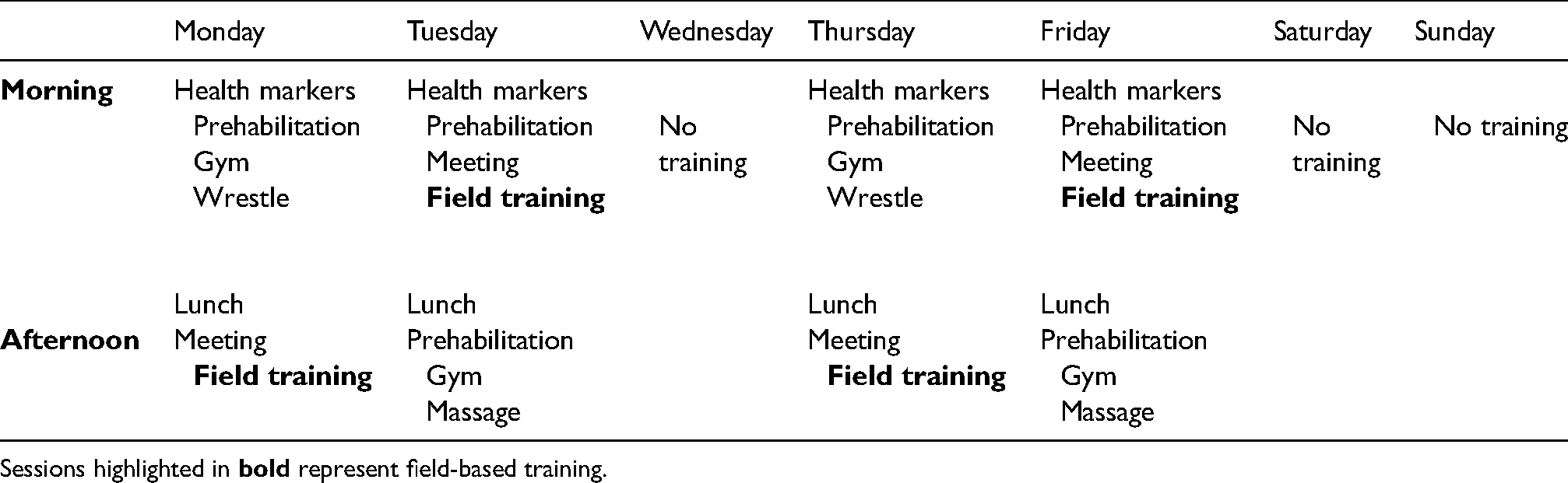
Sessions highlighted in
Measurement of training load
Players’ movements were recorded using 10 Hz GPS devices (Catapult, Optimeye S5, Catapult Innovations, Melbourne, Australia) that were fitted between each player's scapulae within an appropriately sized vest. HR was collected for all field sessions using a coded HR monitor (Polar Electro Oy, Kempele, Finland), which was fitted to the chest of the player. Both movement and HR data were downloaded using Catapult OpenField 1.21.0 (Catapult innovations, Melbourne, Australia). Players were each allocated their own GPS unit and HR monitor which was worn for each field session to prevent interunit error.21,22 Each session was recorded live so that data could be split into individual drills, as determined by the defined training types, using the start and end time and with any unwanted sections discarded. The data were then analysed to calculate for each specific drill: total time (min), total distance (m), intensity (m/min), distance (m) covered at high-speed running (>15 km/h), distance (m) covered at a high metabolic distance (>20 W/kg), mean (HRmean; b/min) and peak HR (HRpeak; b/min) and time (s) ≥80% estimated HRmax. These measures were selected by the researchers and coaching staff to represent reliable training metrics that enabled an understanding of the load imposed on players from field-based training and have also been used in previous studies of rugby league players.1,13,23
Training types
All field-based training performed by the participants was delivered by professional coaches and strength and conditioning staff, and categorised using the following definitions.
Speed
Short duration drills that build in intensity designed to improve running technique, maximal speed, acceleration, deceleration, and footwork.
Conditioning
Running-focused drills are designed to improve players’ aerobic and anaerobic capacity, which can be both rugby league-specific and non-specific.
Rugby skill training
A combination of position-specific and team-focused drills that focus on improving physical competency in both core skills, such as catching and passing and decision making, as well as working on specific aspects of rugby league, such as defensive technique and attacking positioning performed in a controlled manner.
Game-based training
A combination of the following.
Game situation
Activities designed to replicate match demands of rugby league and to work on skills in an ecologically dynamic environment. With a specific focus on achieving the desired game-related outcome, for example, 13 versus 13 goal-line defence with a focus on last play defence.
Game-con split
Sections of training that transition between the conditioning and game situation activities without a break, however, the focus has shifted to completing rugby league-specific skills in the chaotic (i.e. random) match-like environment now under fatigue.
Game-drill split
Sections that combine the rugby drill and game situation aspects of training with no break, with the focus upon working on a skill both in a controlled then chaotic (i.e. random) environment, for example, edge defence versus edge attack, with one play to score.
Statistical analysis
All statistical analyses were performed using Statistical Package for Social Sciences (SPSS, version 25; SPSS Inc., Chicago, IL, USA). Data are presented as mean ± standard deviation (SD). Before analysis, the distribution of the data was verified using the Shapiro–Wilk test. Separate repeated-measures analyses of variance were then used to compare the demands of training types by week and day within the preseason period to detect any change. The source of any significance was examined with a Bonferroni post hoc test. An alpha (α) level of <0.05 was used as the criterion for significance.
Results
Training load over the preseason
The 8-week training period (training sessions n = 31) comprised 641 individual training sessions with a total training time (mean ± SD) of 1450 ± 70 min, a total distance of 116,690 ± 5078 m, and high-speed running of 3762 ± 275 m. The internal and external loads by week and training type and day are shown in Tables 2 to 4.
Total weekly demands of field-based training in the preseason.
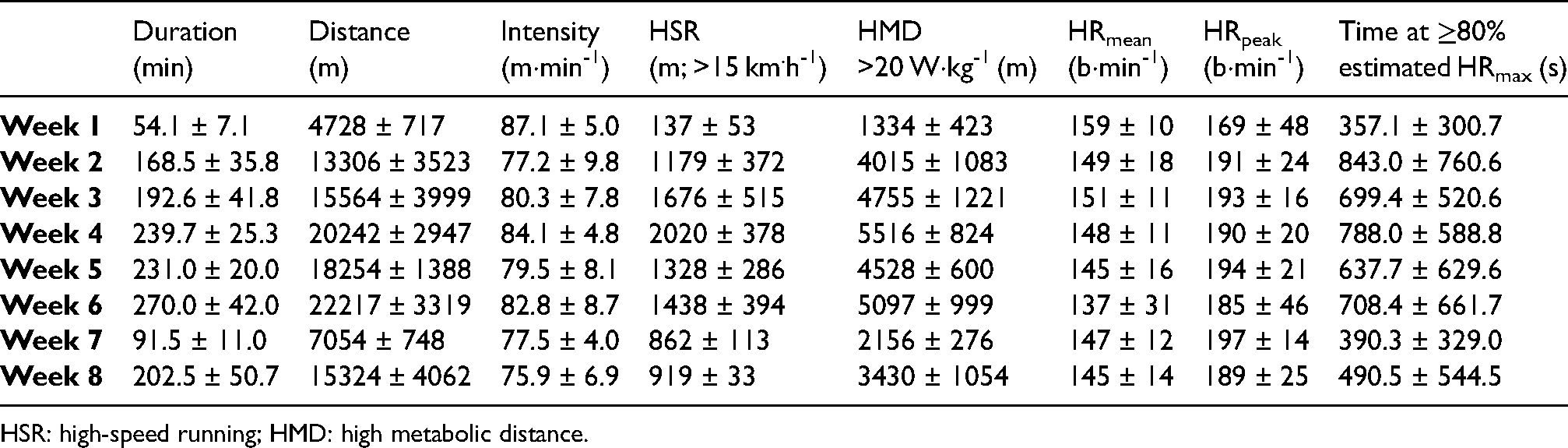
HSR: high-speed running; HMD: high metabolic distance.
The average daily demands of field-based training within the preseason.

HSR: high speed running; HMD: high metabolic distance.
Internal and external training load during the 8-week preseason
Total training time, total distance, high-speed running, and high metabolic distance increased from week 1 to 4, where high-speed running and high metabolic distance peaked (Table 2). The week 4 peak in high-speed running and high metabolic distance was greater than week 1 (both P = 0.0001), week 2 (both P = 0.0001), week 3 (high metabolic distance only, P = 0.020), week 7 (both P = 0.0001), and week 8 (high-speed running, P = 0.0001; high metabolic distance, P = 0.042). This was followed by decreases in week 5, then increased in week 6 where total training time and total distance peaked (Table 2). The total distance recorded in week 6 was greater than all weeks (P = 0.0001). During week 6, the biggest contributor to total distance was game-based training (9512 ± 1996 m), this was also the greatest amount of game-based training distance covered compared to any other week (P = 0.02). Conditioning provided the greatest contribution to distance covered at high-speed (517 ± 357 m; Figure 1). Figure 1 shows the weekly training types as a percentage of weekly total distance, high-speed running, and high metabolic distance. Rugby skill training contributed the most to total distance throughout the preseason, with rugby skill training greatest contributions were in weeks 2 and 7 (Figure 1). Conditioning was the most consistent contributor to weekly high metabolic distance with the biggest percentages in week 3 and week 7 for both high-speed running and high metabolic distance (Figure 1).
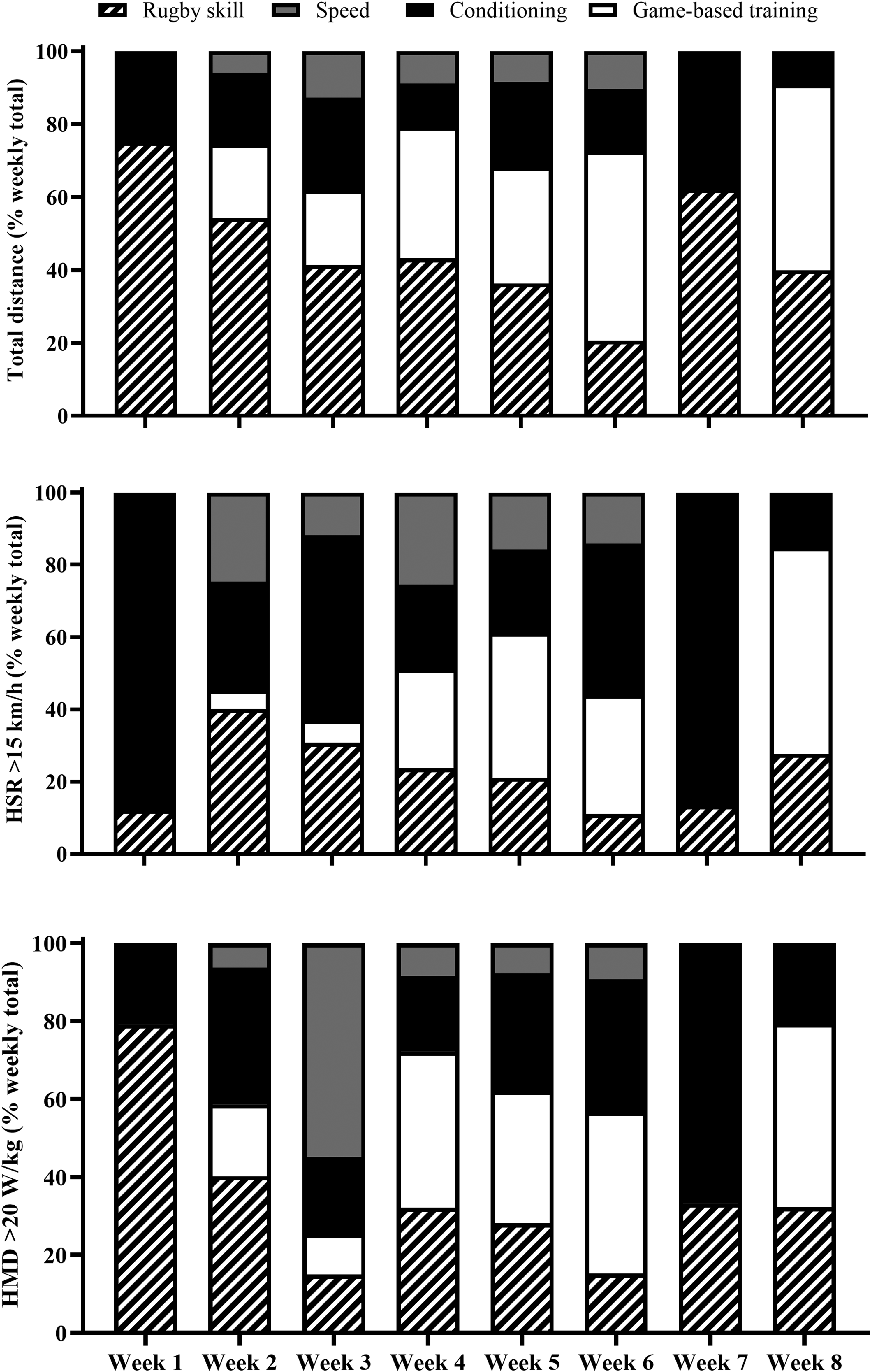
The types of training as a percentage of weekly total distance, high-speed running, and high metabolic distance, across the 8-week preseason.
The internal demands for training during the preseason are presented in Tables 2 and 3. HRmean was the lowest in week 6 (137 ± 31 b/min), yet there was no difference to HRmean of any other week (P > 0.05). The total time spent above the estimated 80% HRpeak was similar between weeks 2 and 8, with the highest values recorded in week 2. Table 3 shows the greatest contributor to total time spent ≥80% estimated HRpeak was game-based training (1412.9 ± 1197.0 s) which equates to 9% of total training time.
Total demands of the types of training over the preseason.
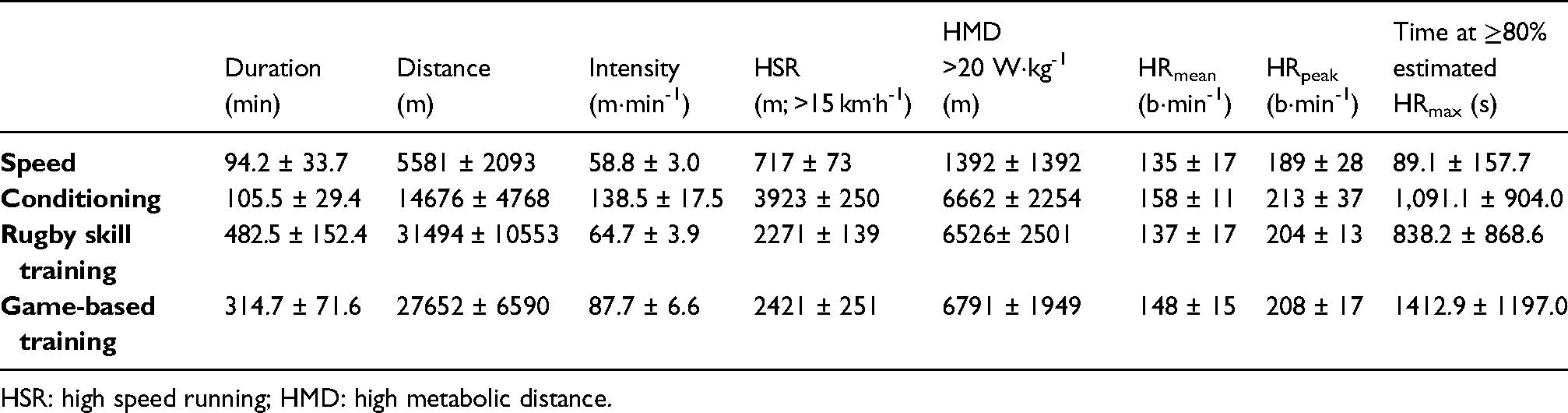
HSR: high speed running; HMD: high metabolic distance.
Internal and external demands of the training days
The average distances covered on individual training days are presented in Table 4. Friday sessions had the highest total distances and high metabolic distances, with the lowest recorded on Mondays. Figure 2 shows that game-based training was the biggest contributor to Friday sessions’ total distance and high metabolic distance. For both total distance (P = 0.0001) and high metabolic distance (P = 0.0001) values recorded on Friday were greater than those recorded on Monday, Tuesday and Thursday. Tuesday sessions had the second-highest total distance (4839 ± 485 m) which was higher than the distances covered on Monday (P = 0.0001) but lower than the distances covered on and Friday (P = 0.0001). Tuesday sessions produced the most high-speed running (453 ± 109 m), with conditioning contributing the greatest percentage to high-speed running and high metabolic distance. Speed drills only contributed to session load on Mondays and Thursdays with rugby skill training being the most constant contributor to daily total distance percentage throughout the week.
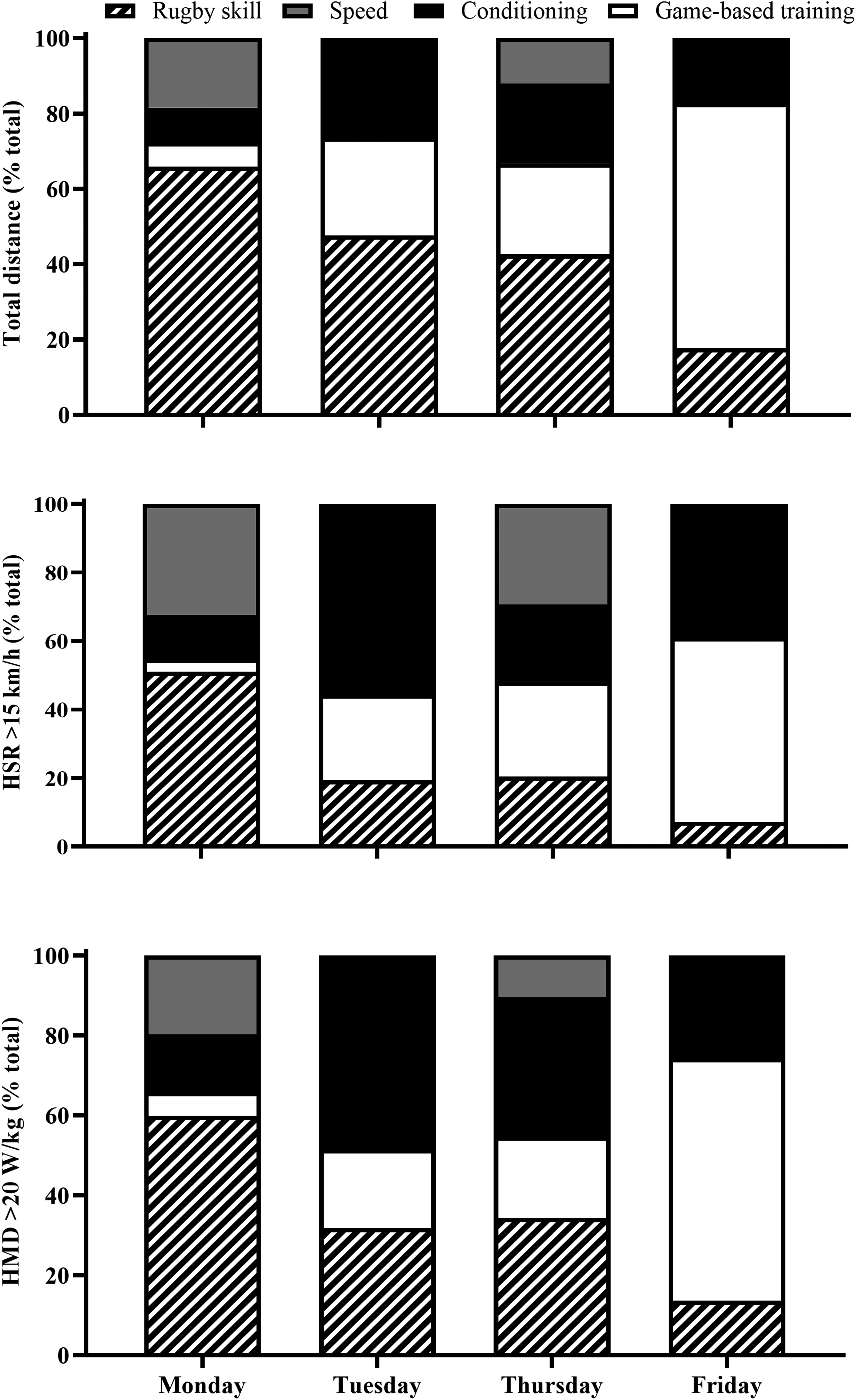
The types of training as a percentage of daily average total distance, average high-speed running, and average high metabolic distance, across the 8-week preseason.
Discussion
Given the lack of data describing how professional team sport athletes’ training is structured, this study offers unique insight describing a combination of internal and external load for the types of field-based training used by a professional rugby league team across an 8-week preseason. These findings illustrate daily undulations in training load and intensity within the preseason training week and the importance of using numerous internal- and external-load parameters to adequately understand training.
This work demonstrates that the early phase of preseason (weeks 1–3) and penultimate week of preseason (week 7) focused on the development of general rugby league fitness using rugby skill training and conditioning drills, while weeks 4 to 6 and week 8 (final week) focused on match-play-specific training with game-based training. While training practices of professional rugby league players have been reported before,1,13,20 the present study goes further to describe the loading and how the types of drills are structured within the training of professional rugby league players. For example, conditioning drills accounted for the greatest contribution to high-speed running that was observed in week 4 and on Tuesdays within the training week. Conditioning drills are more structured in their formation because coaches will typically prescribe running speeds that have players cover specified distances and times to elicit desired physiological adaptation, for example, Dobbin et al. 24 The total distance was highest during week 6 and along with high metabolic distance reached the highest weekly values on Fridays, largely attributed to game-based training. This reaffirms previous observations of more ‘high-intensity’ activity from movements involving accelerating and decelerating during game-based training compared to more high-speed running during conditioning. 1 Moreover, when these two metrics are used to stratify total distance, high-speed running and high metabolic distance equate to 7% and 27% of total distance, respectively. This 20% difference between metrics, although lower than previous findings, 25 likely reflects the multidirectional demands of this club's predominant training type (i.e. game-based training), where players will produce a greater number of accelerations and decelerations, with limited space for players to attain the high-speed threshold (>15 km/h1 1,19). Further research is needed to understand the dose–response relationship of these training approaches, and how the specific metric of training such as conditioning drills and game-based training might contribute to the physiological and performance adaptations during the preseason period.
The intensity of game-based training (87.7 ± 6.6 m/min) in the present study is similar to those recorded previously in rugby league (85 ± 8 m/min 1 ) but lower than that reported in rugby union (94–121 m/min 26 ). The movement demands of game-based training will be influenced by the coaches’ manipulations of factors such as player number, playing area size, and coach encouragement. 27 The addition of collisions to intermittent running activities also slows the movement speeds. 28 The present study also recorded higher intensity for conditioning (138.5 ± 17.5 m/min; cf. 82 ± 12 m/min), rugby skill training (64.7 ± 3.9 m/min; cf. 57 ± 2 m/min), and speed drills (58.8 ± 3.0 m/min; cf. 55 ± 8 m/min) compared to values previously reported in professional rugby league players. 1 Additionally, the higher training loads recorded during game-based training corroborates work in Australian rules football (Australian Football League) that reported ‘Games’ training during a preseason resulted in the highest loads when compared to other aspects of training.9,29
While there are limited studies to corroborate this training approach, it is believed that completing a large volume of both general and specific training is essential to develop the physiological attributes and the skill mastery required to succeed in team sports. 9 The coaches’ aim to improve players' skill is shown by the consistent use of rugby skill training throughout the entire preseason, whereas conditioning drills and game-based training were used periodically. Indeed, for the team described here, fluctuating conditioning drills and game-based training as sources of high-intensity training, was an effective way for the coaches of this team to optimise field-based training time during preseason. Game-based training combines a wide variety of physical attributes and sport-specific skills that have all been identified as important for success in team sports such as rugby league. 30 Furthermore, the risk of injury is potentially decreased in rugby league players who are exposed to more prolonged high-speed running and the adaptations that accompany this training.6,31 More work is needed to establish the associations between these training approaches (i.e. dose) and their contribution to improvements (i.e. response) in the physical qualities specific to rugby league, such as intermittent running capacity.
It is important to understand how training intensity was apportioned because, although well-reported in endurance sports (e.g. Esteve-Lanao et al. 32 and Stöggl and Sperlich 33 ), little is known about the training intensity distribution of team sports during specific training phases. For the first time, this study reports on the HR intensity distribution of the main conditioning period of an elite rugby league team, indicating the percentage of total time recorded ≥80% estimated HRmax (i.e. high intensity) was 6.7 ± 5.3%. While seemingly low, these data are consistent with other team sports that have indicated low proportions of time (∼4–18%) spent in higher HR zones during training.34–36 These data might reflect the intermittent nature and types of training described and are highly likely to be a direct function of the aims and objectives of the coaches during particular training periods (i.e. what type of training the coach wants affects the training intensity). For example, the use of game-based training and skill will involve periods of feedback to players from the coach within these sessions that are likely to lower the overall intensity of the session. Sport-specific fitness qualities (e.g. aerobic fitness and high-intensity intermittent running capacity) and their associations with HR derived training intensities are equivocal and have tended to be reported in sub-elite team sport athletes.36–38 Therefore, future studies should explore how HR-based measures of internal load are associated with adaptations in elite rugby players’ physical qualities and performance.
While the data here offer some novel insights there are several limitations that must be acknowledged. The study is a case study from a single club, meaning the results described are specific to these team players and to the planning adopted by the coaching staff. We also wish to point out that in defining the training characteristics of a ‘championship winning’ team, our intention is not to infer cause and effect. Instead, given the unique opportunity to study a team that subsequently went on to win the domestic competition, our intention was simply to describe this team's training characteristics such that coaches could make a comparison. While the field-based periodisation and training used by the staff of this team would have contributed to the in-season performance, many factors such as, but not limited to, the playing roster, injuries, refereeing decisions, and how the in-season schedule was managed would also have been influential. The case study also represents training of a single season that does not necessarily reflects players’ training and development from previous years. Although not recorded within this study, players completed gym and wrestle-based sessions that mean an underestimation of total training load. The high volume of rugby skill training and game-based training reported in the present study could also contribute additional cognitive and technical loading but was not measured. Future studies might look to assess these additional loads associated with such training approaches and their contribution to the overall load.
Conclusion
The data provided here are the first to use measures of internal and external load to quantify the preseason on-field training periodisation of a professional European Super League team that went on to win the domestic in-season league by a record margin. The data shows that rugby skill training was the biggest contributor to the total distance covered, conditioning was the greatest contributor to high-speed running and game-based training provided the greatest high metabolic distance. There were no specific ‘phases’ rather preseason comprised a progressive increase in external load up to a peak in load during week 6 followed by a taper in the last two weeks. There was also a weekly cycle with Monday primarily comprising rugby skill training and speed drills, Tuesday largely rugby skill training alongside conditioning and game-based training, Thursday was a mix of training types with Friday comprising mostly of game-based training that also elicited the week's highest total distance, high-speed running, and high metabolic distance values.
Practical applications
The current findings are the first in rugby league and extend our knowledge of how a professional rugby league team structures field-based training during the preseason. During the rugby league preseason, coaches should combine game-based training alongside conditioning, skills, and speed to prepare players. Different field-based training formats can be integrated into the micro and macrocycle structures, recognising the importance of specificity (i.e. use of game-based training and rugby skill) to achieve the desired training outcome. Progressions in volume and intensity both within the micro- and macrocycle periods might be accompanied by a tapering in the latter weeks to prepare for the competition phase. These data might enable other coaches and practitioners to better understand the periodisation of training contact team sport athletes that aid in developing appropriate on-field training strategies.
Footnotes
Declaration of conflicting interests
The authors declared no potential conflicts of interest with respect to the research, authorship and/or publication of this article.
Funding
The authors received no financial support for the research, authorship and/or publication of this article.
