




Abstract
Purpose
This study aims to determine the effect of the distribution of practice on learning the forehand shot in tennis.
Method
Twenty-four beginner tennis players participated in the study (13 males and 11 female; 8.63 ± 0.92 years old). The players were separated after groups -massed practice (N = 12) and distributed practice (N = 12). Each group practiced the forehand shot for 12 sessions, 4 series per session and 10 trials/series (6 weeks). The accuracy and efficacy were measured through one post-test and one retest, carried out 2 weeks after the last learning session.
Results
Significant improvements in accuracy between the pre-test and post-test (p=.004) and between pre-test and re-test (p=.006) were found in the massed practice group. Significant improvements in accuracy between the pre-test and post-test (p=.002) and between pre-test and re-test (p=.001) were found in the distributed practice group. No significant differences were found between groups but there was a favourable trend toward better learning in both, with improved accuracy and efficacy.
Conclusion
The motor learning through the distribution of practice among children has been noted, with a significant improvement in the skill acquisition of the forehand shot in the two groups. The results are useful because they clear up the doubts about how to plan the teaching of this stroke in tennis, confirming the suitability of carrying out learning programs based on massed and distributed practice.
Introduction
The acquisition of motor skills during the early stages of learning is one of the main concerns of teachers and coaches.1,2 Verifying the statements of these authors, others such as Fullagar, et al., 3 reviewed current perceptions of practitioners, researchers and coaches in sport, concluding that “skill acquisition” is, among others, one of the areas of research that can produce direct benefits on practical coaching.
In the early motor stage, marked improvements in proficiency can be observed, whereas later stages are usually associated with smaller motor performance adjustments and the ability to adapt the newly acquired motor skills to novel environments. 4 To achieve this, a number of approaches and theories have been suggested in the field of motor control and learning, in an attempt to identify the best practices in the teaching process. 5 Besides the teaching methods, models and processes, there are is a variety of conditions of practice that may influence the learning process, such as material conditions, initial information, type of feedback, complexity and nature of the motor task, student motivation, time of motor practice and pauses or rests.6,7 This variety of factors has currently led to the use of learning models for tennis strokes, based on the application of induced variability. Recent studies in this sport have concluded that varying the practice conditions could be a determining action to adapt the learning loads to the characteristics of the tennis players and achieve better performance in strokes such as the backhand or the serve.8–10
We think that an alternative way to those proposed so far to vary the practice can also be the manipulation of work and rest times during the learning processes of tennis strokes. Massed and distributed practices are two ways to distribute practice that can be used by teachers to promote the acquisition of motor skills.2,11 Massed practice is generally defined as practice that occurs without rest between trials.12,13 This may also refer to a practice schedule in which the amount of rest between trials is short relative to the trial length. 2 Distributed practice is carried out with a rest or additional skill learning, 2 or refers to a practice schedule in which the amount of rest between practice trials is long relative to the trial length. 14
The distribution of practice-massed or distributed must be carefully planned in order to provide the best conditions for increasing the possibility of acquiring motor skills and improving the motor performance. 15 Studies on this research topic are inconclusive as to which of the two schedules practices is the best.2,15,16 A comparison between massed and distributed practice reveals that, the nature of motor task –continuous or discrete–, the age and experience, and the complexity may influence the results. 17
Although far from sports, the differences between mass and distributed practice in practitioners in continuous or discrete skill and different ages have also been studied. Garcia et al., 15 examined the effects of distributed and massed practice on the learning and retention of a discrete computerized skill. In a pursuit rotor skill –continuous- and in a discrete task of reaction time to a visual stimulus –discrete-, the distributed practice group was superior to the massed practice group. However, the learners in the massed practice group were better at retention.
Previous studies report benefits of distributed practice in learning with children in laboratory contexts and especially for long-term retention,11,18 investigated which of the two practice schedules provided better performance in a laboratory-developed coincident timing-task. They measured the ability of the learners in temporal adjustment to different sequences of visual stimuli. No significant differences were found between massed and distributed practice in children. On the other hand, differences were found in older participants, for whom the best results were found for distributed practice.
About the nature of motor task –continuous or discrete– and its complexity, is essential your consideration to develop motor learning processes of the forehand shot in tennis, as it is a discrete and complex motor skill. Although no research has been conducted on mass and distributed practice in this sport, it has been investigated in other sports with similar motor skills. Ahmadvand, Kiani and Shojae, 19 conducted research in volleyball. They evaluated accuracy and precision at over-head set –simple skill- and jumping serve –complex skill-. They found progress in acquisition, retention and transfer, both in simple and complex motor skills and differences to the kind of skill, which were higher in the mass practice group.
Few studies have been conducted in sports on real environments and conditions. According to research carried out, it seems clear that sport skill may be a key factor to explain the effects of massed and distributed practice. On the other hand, the results suggest that this unsolved research problem, is addressed in each sport particularly as it seems difficult to generalize the results to all motor skills due to differences in the real conditions of practice. In learning tennis, it has not yet conducted any study to discover what kind of distribution practice is more effective. Learners in training stages have few hours of work during the week and often the sessions are widely spaced in time. The research question focuses on the need for educators to have a scientific basis on which to organize the time and rests of practice.
For this reason, the aim of this study was to analyse the effects of massed and distributed practice on the learning of the forehand shot in tennis. As the previous studies were not carried out in real sports contexts and the results regarding the influence of the nature of the motor ability –discrete and complex-, although scarce, point towards a superior effect of the massed practice, we hypothesized that massed practice will be more appropriate to obtain motor learning in players with few sessions to week.
Methods
Participants
Twenty-four children (8.63
Afterwards, the parents of the children signed the Free and Clarified Consent Form in accordance with the Helsinki Declaration. The players were asked to maintain normal daily food and water intake during the study period. Outside of the sessions scheduled in the research, neither player played tennis.
Sample size and power
The calculations to establish the sample size were carried out with the GPower® v. 3.1.9.7. software. The level of significance was established at α = 0.05 and the effect size (ES) = 1.5. According to the standard deviation SD = 1.2%, established for the percentage of efficacy obtained in the pre-test by both groups and an estimated error of 0.90%, the representative sample size for a confidence interval of 95% was of 20 participants (10 per group). Finally, 24 participants completed the learning program.
Procedures and measures
In order to perform the forehand shot it was necessary to feed the ball for each participant. Consequently, three feeders were tested before the study began. The test had three series of 10 trials with a rest of 1 minute between series. The feeders were positioned on the “T” of the court and were asked to feed the ball using forehand shot in a square of the opposite side of the court and 0.70 cm × 0.70 cm dimensions (Figure 1).
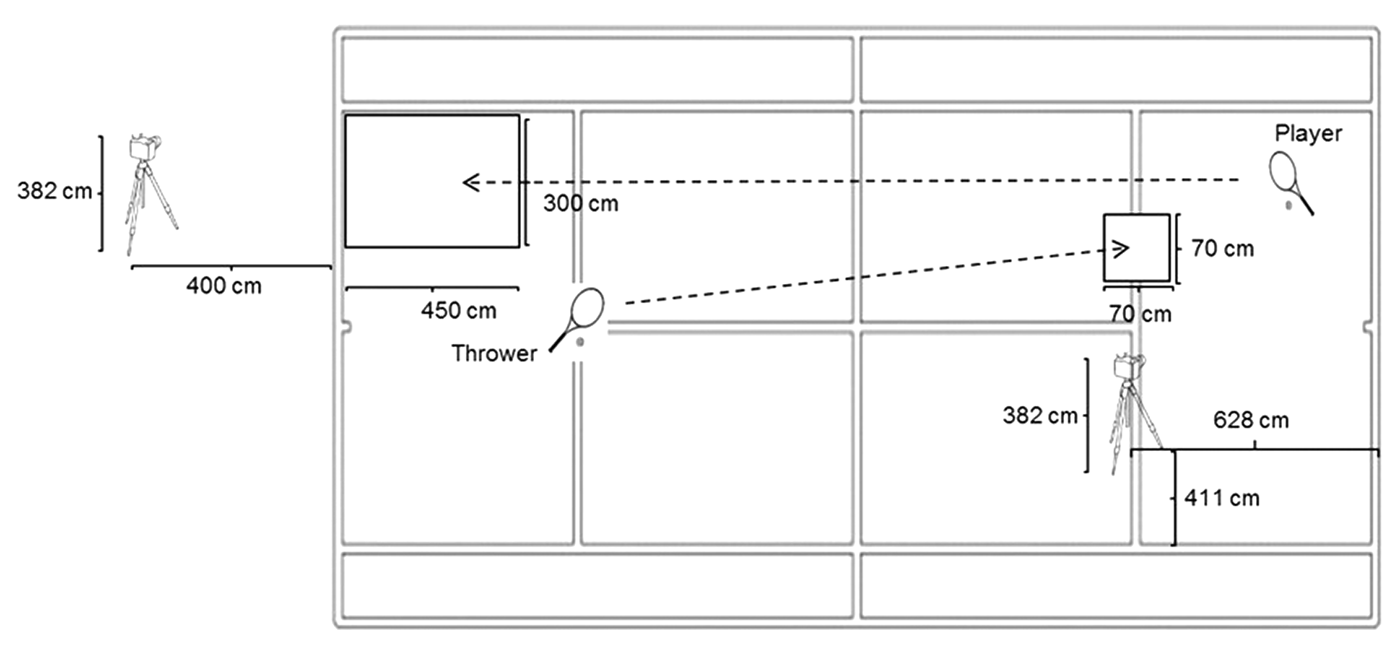
Experimental set-up for test procedures.
The performance on the acquisition stage was analyzed through one pre-test and one post-test, 12 weeks later. One retest were carried out 2 weeks after the learning program. Before each test, a 10 minutes warm-up protocol was carried out.
The test required a forehand shot in the direction inside an area measuring 3 × 4.5 m 23 (Figure 1). A dimensions adjustment of the court based on the ITF’s Play and Style, Tennis 10 s was made for the children.
Three series of 15 trials with a recovery time between trials of 5 seconds and between series of 20 seconds were carried out in the three tests.
Subsequently, the schedules of practice (massed or distributed) was applied for participants (Table 1).
Practice schedules per experimental group.

The bounces of the ball were registered using a video camera (HD Sony® HDR-XR155E 3.1 Mega Pixels, 25 Hz), deinterlacing at 50 Hz and digitalized regarding the centre of target with Kinovea® 8.24. The digitalization error was 0.5 centimetres. Matlab R2015b® routine was applied for the calculation of real-space Cartesian coordinates of the ball bounces. 10
The performance of the forehand shot was tested using radial error (Formulae 1) and percentage of efficacy (Formulae 2). The radial error for each trial was obtained from the computation of the square root of the sum of real distances less virtual distance as follows.24,25 The efficacy of the forehand shot was also tested using the percentage of efficacy.
26


Statistical procedures
In order to ensure consistency of throwers, ANOVA test on the radial error between-subject factor was applied. The effect of the learning program (massed and distributed schedules) on the radial error and percentage of efficacy was analysed using repeated measures ANOVA. The assumption of normality was examined using Shapiro-Wilk test.
The following scale was used to classify the effect size of the test (Partial Eta Squared -η2p-): small, 0.14–0.36; moderate, 0.37–0.50; large, 0.51–1. 27 Levene’s test was used to check the homogeneity of variances and Mauchly correction was used to check the sphericity assumption. A significance level of p < 0.05 was accepted for all statistical comparisons.
Calculations were performed with SPSS Statistics for Windows, Version 22.0 (IBM Corp., Armonk, NY, USA).
Results
No differences in the accuracy -radial error- were found between throwers (mean ± standard deviation = 35.9 ± 20.5 cm, F = 1.112, p = 0.335) (Table 2). An efficacy of 92% was also found among the throws, suggesting sufficient reliability to follow in the study.
Accuracy (cm) of feeder’s test.
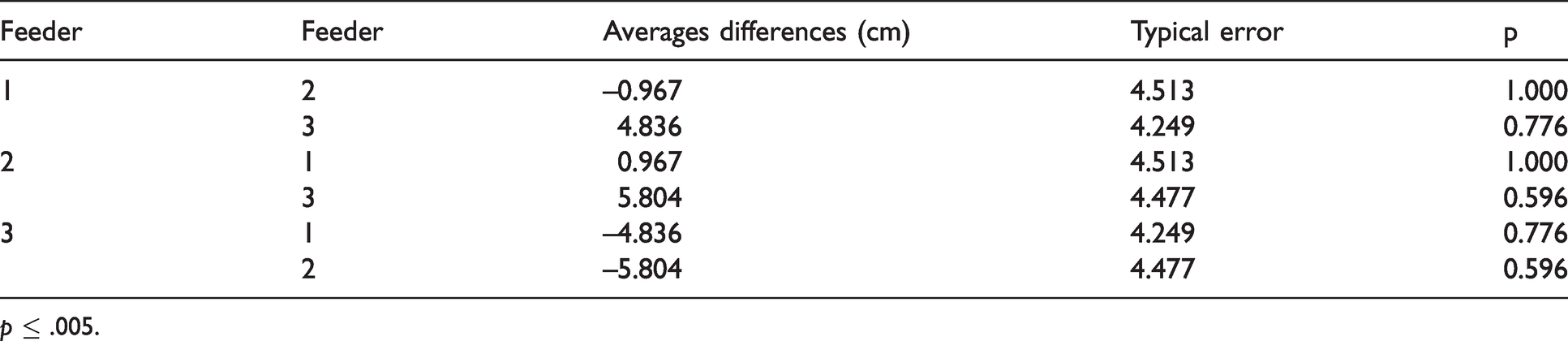
p ≤ .005.
The results revealed that both groups show a tendency (R2) to improve the scores in the post-test than the pre-test for the accuracy and efficacy (Figures 2 and 3). Also, it was verified that distributed group had better trend data (R2) towards improved accuracy than the mass group (Figures 2 and 3).
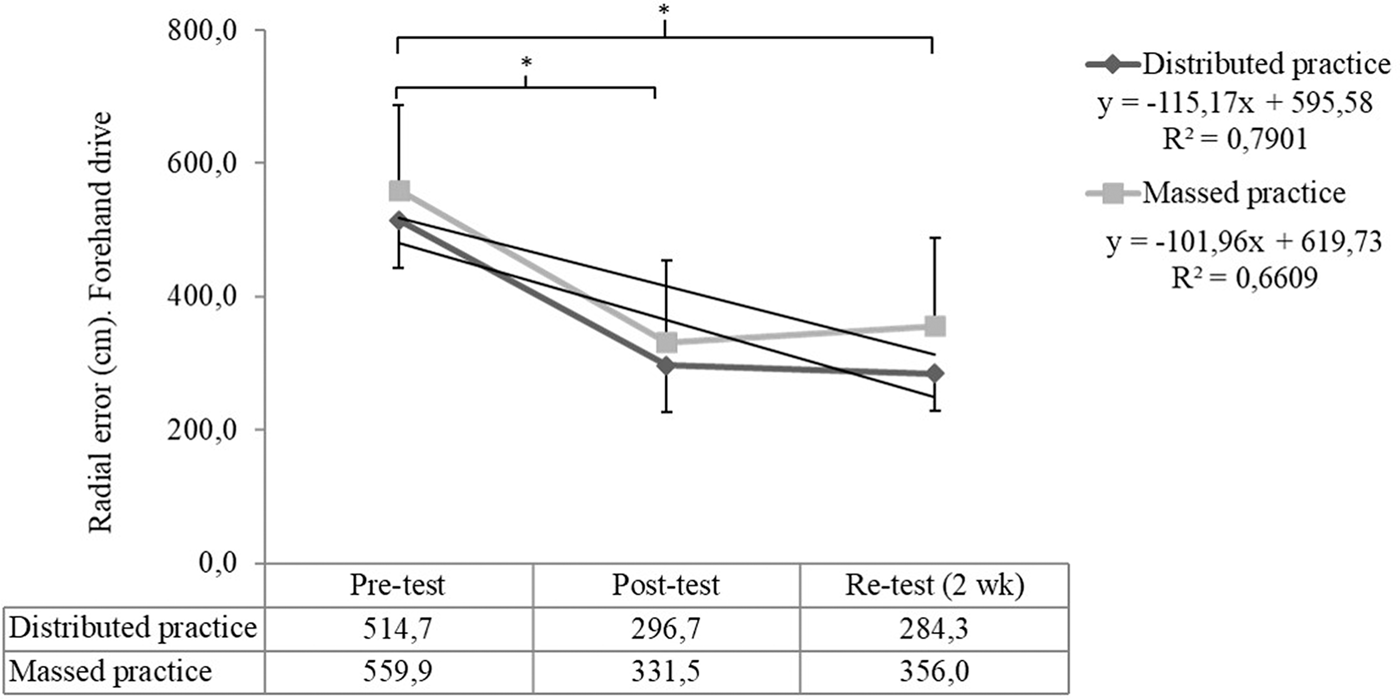
Radial error (cm) –accuracy- on forehand shot recorded in the three tests. Bars show standard deviations.
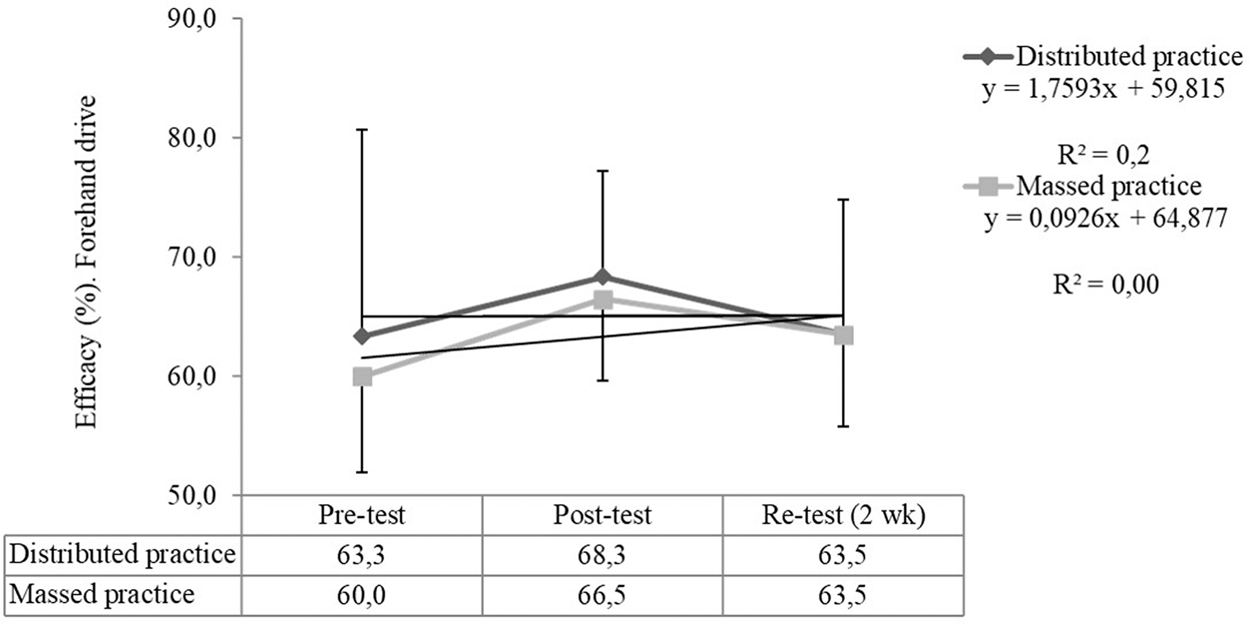
Efficacy (%) on forehand shot recorded in the three tests. Bars show standard deviations.
Inter-group analysis
No significant differences were found between groups and test in the accuracy. Pre-test (F(2,22)= 0.66, p = 0.424); post-test (F(2,22)= 0.42, p = 0.524); re-test (F(2,22)= 2.04, p = 0.167). No significant differences were found between groups and test in the efficacy. Pre-test (F(2,22)= 0.24, p = 0.632); post-test (F(2,22)= 0.15, p = 0.699); re-test (F(2,22)= 0.00, p = 1.000).
Intra-group analysis
In the massed practice group, significant improvement in the accuracy were found between test (F(2,22)= 14.03, p = 0.01;
In the distributed practice group, significant improvement in the accuracy were found between test (F(2,22)= 19.04, p = 0.01;
Discussion
The aim of this study was to verify the effects of massed and distributed practice in the acquisition of a tennis skill in children. The accuracy and efficacy of the forehand shot in tennis before and after an acquisition programme was measured. The main results found no statistical differences between the groups in massed and distributed practice. The same results was found in previous studies. 18
Leite et el., 18 investigated the effects of the distribution of practice (distributed vs. massed) on the learning of a coincident timing task in young and older adults. These types of skills have a high spatio-temporal synchronization component, as does the forehand shot in tennis. As in our study, not having found differences for learning between massed and distributed practice could be explained by the age and/or inexperience of the learners. The cognitive and motor abilities in children are not consolidated, 18 therefore, we think that there is a wide margin for improvement in children so that, both massed and distributed practice, produce the increases in performance in the forehand shot that we have found in our study. The lack of significant differences between the two groups may be due to the length of rest intervals used during practice in discrete motor tasks, which affected the amount of learning received, which in our case was two days per week. 18 This result agrees with the anterior conclusions of Aghdasi, and Jourkesh, 28 in his research on the effect of massed and distributed practice in different stages of discrete motor task learning. These authors concluded that the learner's stage while learning discrete motor task, is not considered as an effective and significant factor in the way of distributing the practice and rest duration.
Considering these contributions from previous studies, the results found in our study corroborate that, to generate learning in discrete motor skills, such as the forehand shot in tennis, we can apply both massed and distributed practice, this being not a key factor in the initial stages of learning. On the other hand, the distribution of practice over several days instead of one day seems to correspond to a greater retention of tasks, whether discrete or continuous. 29 Moreover, the nature of the task and the concentration of practice for one session or over several sessions can affect both the learning and retention of motor tasks. 15 With these statements, we can see that perhaps the pace of work, rest periods between sets, and the time between sessions (2 days a week) could lead to failure to find significant differences between groups, just as it happens in our study.
In this sense, the absence of differences between the post-test and re-test could be related both to the time elapsed between both tests, as other authors have proposed.6,7
Generally, the effects of massed and distributed practice are different in the continuous or discrete task.14,15,17 Nevertheless, some studies found that children of 6, 8 and 10 years old who were analysed for accuracy and speed learned in the same way in a continuous or discrete task. 30 Furthermore, acquisition and retention were facilitated by massed practice in a discrete task, as a massed practice programme is more appropriate in the early stages of learning. 31 Thus, offering repeated trials in the initial phase of learning will allow problem-solving strategies to be explored, errors corrected and new patterns of movement explored, and determination of how to achieve the goal successfully. 17 The results of our study are not in line with earlier comments that massed practice had significant value in relation to accuracy with novice children. In fact, distributed practice can also increase forehand accuracy by learners.
Our results will provide a basis for further studies applied to different groups. Thus, we will try to obtain more results about the learning process in different tennis strokes, as in our study we only analysed the forehand shot as a discrete task. Future research will try to check whether the conclusions in our study in relation to the distribution of practice in learning of tennis strokes can be confirmed with different levels of expertise or practice times.
Conclusions
The main conclusion of this study is that the use of distribution of practice in the learning of the forehand shot in tennis by children at an initial level presents favourable trends towards such learning, but there is not significant differences between massed and distributed practice. The efficacy reached in learning the forehand shot by the children after the conclusion of the learning programme tends to improve slightly with both schedules of practice, maintaining the same trend during the retention period but without significant results.
The training in timing task conditions with children seems to have favourable effects on the accuracy in the massed and distributed practice groups, with significant improvements between pre-test and post-test, and between pre-test and ret-test. Moreover, not significant differences were found between post-test and re-test, which indicates that further research is needed on this result for the learning of a timing task by children at an initial level. Such studies about the massed and distributed effects will increase the amount of information available for coaches to identify the best strategies for teaching new motor skills to children during acquisition stages.
Supplemental Material
sj-pdf-1-spo-10.1177_17479541211028503 - Supplemental material for Massed and distributed practice on learning the forehand shot in tennis
Supplemental material, sj-pdf-1-spo-10.1177_17479541211028503 for Massed and distributed practice on learning the forehand shot in tennis by Juan Pedro Fuentes, Silvia Pulido, Noemí Morales and Ruperto Menayo in International Journal of Sports Science & Coaching
Footnotes
Acknowledgements
The authors thank to participants who committed themselves to this study and the Cabezarrubia Tennis Club who loan the tennis courts and material, which served to guarantee equality in the situation of measured practice.
Declaration of Conflicting Interests
The author(s) declared no potential conflicts of interest with respect to the research, authorship, and/or publication of this article.
Funding
The author(s) received no financial support for the research, authorship, and/or publication of this article.

References
Supplementary Material
Please find the following supplemental material available below.
For Open Access articles published under a Creative Commons License, all supplemental material carries the same license as the article it is associated with.
For non-Open Access articles published, all supplemental material carries a non-exclusive license, and permission requests for re-use of supplemental material or any part of supplemental material shall be sent directly to the copyright owner as specified in the copyright notice associated with the article.
