




Abstract
Research demonstrates the benefits of a more contemporary, ecological-dynamics led approach in sport coaching; however, traditional methods of practice design persist. Few studies have explored the intentions of performance tennis coaches as they design practice. This study explored performance tennis coach philosophies and approaches to practice design. Interviews took place with ten high performance coaches who worked within a national tennis performance network. A thematic analysis revealed that coach approaches to practice design were informed by 1) their experiential knowledge and 2) their beliefs regarding player development. Coaches emerged as learners, who developed their knowledge through unmediated, informal learning opportunities, for example reflective practice and ‘on the job' experience. Six coaches had played tennis professionally, valuing this as a learning experience that informed their own practice. Three common beliefs regarding player development emerged between participants: repeatable players, performing under pressure, and individualised practice. These beliefs formed practice design principles, which translated into a uniform implementation of drills (serial, blocked, repeated patterns of play) and the intuitive inclusion of representative practice designs and constraints manipulation. The findings from this study suggest that, although performance tennis coaches are aware of contemporary approaches to practice design, a traditional, information-processing approach to skill development dominates their design of practice tasks. This study documents approaches to practice design in elite tennis and contributes to a growing body of pedagogical research in performance sport.
Keywords
Introduction
Traditional methods of skill development persist in sport. 1 A traditional approach to practice design refers to one based on a reproductive style of teaching; where athlete learning is perceived to take place via structured practice that includes demonstration of ‘optimal' technique, extensive verbal feedback, and tasks that often isolate the learner from their performance environment.2–4 The theory of ‘deliberate practice' is one traditional approach to practice design, originating from research into the development of expertise by Ericsson et al. 5 This approach has since been widely generalised to sport and athlete skill development, 6 supporting the concept that athlete expertise develops over time spent in deliberate practice. 7 , 8 However, misrepresentations of Ericsson's original research9–11 have resulted in an overemphasis of practice volume over quality or type, resulting in athlete expertise being quantified or predicted according to practice volume. 12 This approach to practice and expertise has been criticised for its' linear representation of learning, particularly as research suggests that learning is an intrinsically nonlinear process.13,14 Thus, alternative, more contemporary approaches have emerged that emphasise nonlinear approaches to practice design.
One such contemporary approach is informed by ecological dynamics theory. An ecologically-led approach conceptualises learning as a nonlinear process that should be accommodated through nonlinear teaching and practice design.15,16 In an ecologically-led, nonlinear approach, learning takes place as a performer interacts with their environment and is exposed to a variety of dynamic performance contexts.2,17 Performer expertise is characterised by the emergence of adaptive, flexible movement behaviours within dynamic sport contexts. 14 When applied to sport, a nonlinear, ecological dynamics approach provides a framework by which to understand how athlete behaviour emerges under a variety of environmental, performer and task constraints. 18 The benefits of an ecologically-led approach to athlete skill development have been demonstrated in cricket, 19 athletics, 20 and diving. 21 However, research into how coaches approach practice design demonstrates that traditional pedagogies supported by information processing theories remain across many sporting domains.4,22–24
Previous research suggests that traditional pedagogies persist in tennis,25,26 where coach intuition and experiences inform coaching practice. Although the application of experiential knowledge can benefit practice design and coach decision-making,27,28 a custodial approach may sustain traditional methodologies. In addition, educational coaching resources from British and American Tennis Associations encourage traditional, information processing approaches to coaching, by suggesting that player skill development occurs through repetition and adjustment according to coach feedback.29,30 Social, cultural and historical constraints that exist within sport 23 , 31 have been shown to create barriers for coaches who want to implement more contemporary approaches to practice design, 1 , 4 thus, traditional practice in tennis may continue due to an engrained traditional practice design culture.
There are limited investigations into performance coach approaches to practice design within tennis; however, some understanding can be gained by interpreting previously documented practice tasks. For example, commonly prescribed practice tasks within Australian national junior academies have been documented by Krause et al. 32 , 33 Within these tasks, players completed coach-prescribed, blocked patterns of play, which aimed to develop either groundstroke or serve technique by completing a high number of shot repetitions. Research by Buszard et al. 34 – also in Australian junior performance tennis – again observed that tennis coaches often prescribed serving practice in high volume blocked practice designs that resulted in low between-skill variability. Examples of ecologically-led approaches to practice design also exist, for example in the manipulation of task35,36 and equipment 37 constraints to facilitate skill development. These studies clearly demonstrate the benefits of an ecological approach; however, the majority of ecologically led tennis research considers very young or beginner, rather than performance, tennis players. These more contemporary practice designs also reflect interventions implemented by scientists in tennis environments, meaning they may not represent typical coaching approaches. There is no research that documents tennis coach intentions or approaches as they design practice, therefore it is unclear whether examples of ecologically led research reflect a wider implementation of contemporary approaches by coaches.
There is a need to investigate and understand the coaching philosophies of high-performance coaches working within performance tennis, in order to establish coach rationale for practice structure and task design. This study therefore aims to explore how performance tennis coaches design practice, and to understand why coaches design practice in this way.
Method
To address the aims of the study, the researchers adopted a combined approach of ontological relativism and epistemological constructionism. This informed a post-positivist research model. 38 The lead author (EA) conceptualised the study, conducted all interviews and performed all analyses. The author has 10 years' experience in elite tennis - using this and their existing relationships with coaches to build and sustain participant rapport. Ethical approval for this study was obtained from Sheffield Hallam University Research Ethics Sub-Committee prior to recruitment and data collection.
Participants
A purposive, criterion-based sample of ten high-performance coaches were recruited into this study.
To be eligible, participants had to be employed by a National Governing Body (NGB) or work within a Performance Academy – defined as an academy that trains junior elite and/or professional tennis players. All participants were coaching junior or senior players supported through their nation's performance pathway at the time of interview. All participants met at least two of the following criteria regarding coaching expertise:39–42 achieved the highest level of coaching qualification within their country, had a minimum of ten years coaching experience, were employed by a national governing body, had coached at a minimum of one senior event (for example, Grand Slam tournament, Davis or Billie Jean King Cup). Additional information regarding participant characteristics is presented in Table 1.
Coach characteristics.

Note: Age and experience displayed as mean ± SD (range).
Coaches were invited to take part in this study via email, or through face-to-face conversation. After initial contact, coaches received information regarding the project, example topics of conversation, and were able to ask questions to clarify the interview or data analysis process prior to an interview being organised. Participants consented to take part in the study prior to the interview starting. Consent was provided by participants on the understanding that their views and information would be anonymised as much as possible, therefore coaches have been coded numerically (C1–C10) throughout the study.
Data collection
Interviews conducted in this study were semi-structured and used open-ended questions to guide conversation; this gave participants greater freedom in their responses but ensured the collection of relevant information across the sample. The framework used for each coach interview started with general warm-up questions concerning their background, coaching journey and experiences, followed by questions that aimed to investigate 1) how the participant designed and prescribed practice and 2) the participant’s coaching philosophy. Example questions included: ‘What is your coaching philosophy?', ‘What sorts of tasks might you ask athletes to perform in training?', and ‘Why might you prescribe these types of task?'. When necessary, the interviewer asked probing questions to encourage participants to elaborate on or clarify their answers. A team of researchers discussed and approved the interview framework before any interviews took place. The lead author also reflected on the question framework after each interview, to assess question suitability. Based on reflection, additional interview questions concerning coach experiences were included after the third interview. Hereafter, the authors made no further changes to the interview questions.
The lead author conducted all interviews, which took place between May 2018 and March 2020. Interviews were completed either face-to-face in a setting of the participant’s choosing or remotely; locations included a café (2), courtside (1) and over the phone (7). Interviews lasted between 25 and 67 minutes (mean length 42 minutes).
Interviews were recorded using a digital voice recorder. The author completed verbatim transcriptions of recorded conversations as soon as possible post-interview, with small grammatical changes made to enhance the flow of the text. Interview transcriptions were member checked by participants, to ensure that their views were represented fairly and accurately, to clarify meaning where necessary, and to enhance data trustworthiness. 38 No changes to transcripts were made during member checking.
Data analysis
An inductive thematic analysis38,43 was conducted in Microsoft Excel 2010 by the first author. Firstly, this included data immersion through re-reading transcripts and re-listening to interview recordings, alongside highlighting any quotes or passages of interest, regardless of content or context. Secondly, any highlighted text was exported to Excel, where each extract was systematically coded by assigning it a key word or description that captured the ‘essence' of the text. At this point, the second author (JS) acted as a ‘critical friend' (a co-investigator who stimulates critical dialogue to challenge interpretations made and provides a sounding board for exploration of alternative explanations of emerging data 38 , 44 ) to discuss a sample of generated codes. This process ensured that codes and collated extracts followed a coherent pattern. Subsequently, all codes were grouped according to themes observed within those data. The first and second author (EA and JAS) then discussed the observed themes to reduce the likelihood of investigator bias and enhance data credibility. Themes were refined and reworked, to produce final dimensions, higher-order, and lower-order themes.
Rigour and trustworthiness
The authors adopted a relativist position, endeavouring to demonstrate good practice in qualitative research and maintain trustworthiness by viewing universal criteria as a socially constructed list of characteristics. 44 First, purposive sampling was adopted to ensure that the most appropriate coaches were recruited to fully address the research question. From a relativist perspective, the authors accept that subjectivity can influence data interpretation. To encourage reflexivity on the first authors' preconceptions and how they might impact the construction of knowledge, a critical friend was engaged. 38 , 44 It is important to acknowledge that the personal biography of the research team was a motivation for undertaking the current study and that any prior knowledge would influence emergent findings. This acceptance promotes the notion that the researcher does not enter the research process with an ‘empty head', but rather with knowledge of the area that increases, rather than compromises, the theoretical sensitivity for interpreting findings. 45 The authors have attempted to illustrate sincerity by being transparent about their biases and motivations, challenging whether they are well suited to explore the topic of interest, and, how these factors may have played a role in the methods. 46
Results and discussion
To contextualise the results of this study, coach attributes are described first. Following an overview of the cohort, two interrelated emergent themes are presented. These themes are coach experiences and coach beliefs. To enhance the flow of the text, results and discussion are integrated.
Coach attributes
Coaches were recruited into the study based on their experience, expertise, and their position within their nation's tennis performance system. The current coaching roles of the cohort included a mixture of national junior (7) and national senior coaches (3) with a range of ages, experiences, and education. The authors acknowledge that the cohort recruited to take part in this study comprises a range of ages and experiences, which may influence coach approaches to practice design and subsequent interpretation. Coach characteristics are summarised in Table 1.
Coach experiences
Although all coaches had engaged in formal education (for example, undergraduate degrees and advanced coaching awards (Level 5)), no one discussed this as having a continued influence on their own development as a coach. Instead, coaches suggested that they learnt through experience, a finding that corresponds to previous research in high performance coaching. 47 Here, coaches identified two main informal learning opportunities: being a professional tennis player and being a tennis coach.
Learning as a player
Coaches recognised that their experiences as player and/or as a coach informed their coaching approach and delivery. There were six ex-professional players in this cohort, who stated that playing professionally was beneficial to their coaching.
‘I've always said that as a coach, if you've been a good player, course it helps. Because you can play. That's not to say that if you haven't played well you can't be a good coach.'- C2
‘These players have had this massive transition themselves that I could relate to and I think that meant that I was in a position to make sure they were comfortable, happy and whatever it may be … ' - C6
‘Having been a player myself, I think I'm always looking at things from a player's point of view.' - C10
‘I would take ideas from other coaches and I had some things I really loved from some people and things that I maybe didn't enjoy and try and avoid that' - C6
‘the most impactful coach that I had, had an unbelievable way of setting an environment which was fun but hard work, which again is something I really believe in.' - C4
‘A lot of [how I coach] is how I like to be taught! I quite like to just get on and go and do it … I know some people do sessions where there's lots of self-reflection, lots of passing information around … whereas I probably just prefer to get out there and learn by actually doing it and feeling it.' - C10
Learning as a coach
The findings from this study support research in other sports, demonstrating that, aside from initial formal qualification, tennis coaches value and participate in mainly unmediated learning opportunities.
47
For example, coaches identified that they developed because of their work, stating that their ‘on the job' experience informed their coaching approach. Here, coaches referred to opportunities for learning by coaching different players and through trial and error.
‘I learnt a lot the way he approached his tennis and it's shaped the way I coach.'- C3
‘As the years have ticked by I've definitely felt like you can do a lot of volume with not a lot of meaning. And sometimes less can be more. I've made that mistake with [player 1] a little bit. If I could change things with [them] I would.' - C3
Coaches commented on the social and cultural norms of tennis, identifying features of global and national tennis socio-cultural environments that they felt influenced coach practice.
‘It's like our national mind-set, everyone's going ‘I need another drill, I need another practice'. Drill before skill means too many generic training sessions. I think a move towards more group coaching, rather than group training would be a welcome philosophy change.' - C7
‘I think there are national characteristics. So certainly the Spanish, they're doing it [drill based training], the Americans, they're doing it. The Belgians have a more technical approach, but I mean … you're never going anywhere where you think ‘That's a different way of training''. - C9
Coach beliefs
Coaches stated that what they believed influenced their approach to coaching and their identity as a coach.
‘Your philosophy makes you think ‘what do I stand for, how do I operate?' When you've got [a philosophy], you've got a clear identity.' - C2
‘A good philosophy is having belief in what works, and the evidence to support it' - C6
Repeatable players
Coaches believed players needed to be ‘repeatable', and defined this as players needing to be able to repeat shots or patterns of play in large volumes. Coaches believed that if players could not ‘repeat', they would not be able to compete in elite tennis.
‘There's no point in having if you like, the icing on the cake … if they haven't got the core drills, the base drills to repeat shots ‘ - C2
‘You have to feel repeatable and be repeatable to play at a high level, because when you get on a big stage or in tight moments in a match, if you're not [repeatable] then you're gonna get tight and miss.' - C6
‘To achieve the sort of technical competence and rally tolerance that you need, it's just repetition … not being able to repeat that skill time after time after time basically means that you cannot play at [an elite] level.' - C9
Tasks prescribed by interviewed coaches, as stated during interviews.
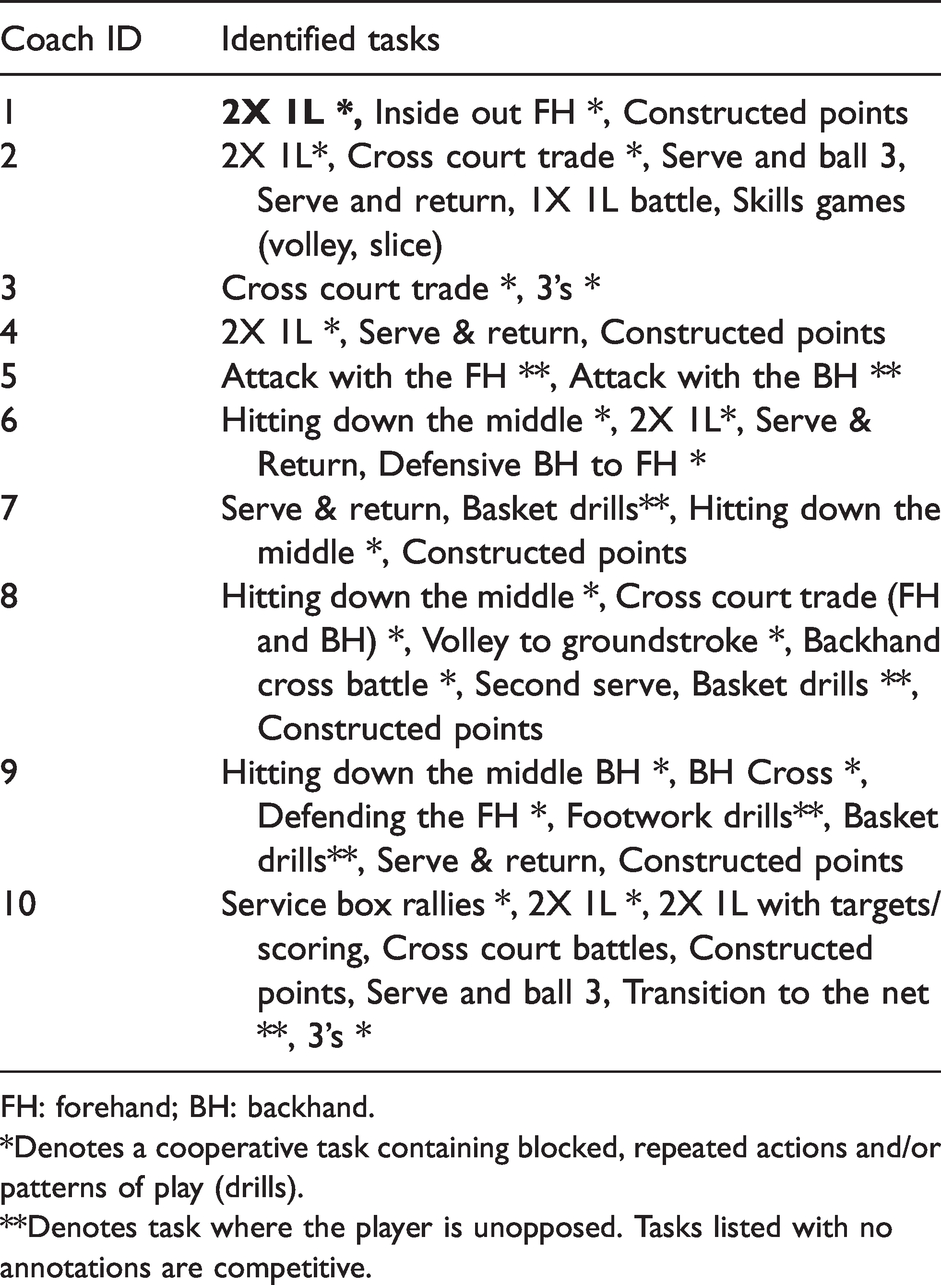
FH: forehand; BH: backhand.
*Denotes a cooperative task containing blocked, repeated actions and/or patterns of play (drills).
**Denotes task where the player is unopposed. Tasks listed with no annotations are competitive.
Although all coaches mentioned volume and repetition based tasks, what coaches intended to develop in players through those tasks varied widely. Figure 1 displays the range of coach intentions when including drill based tasks in practice.
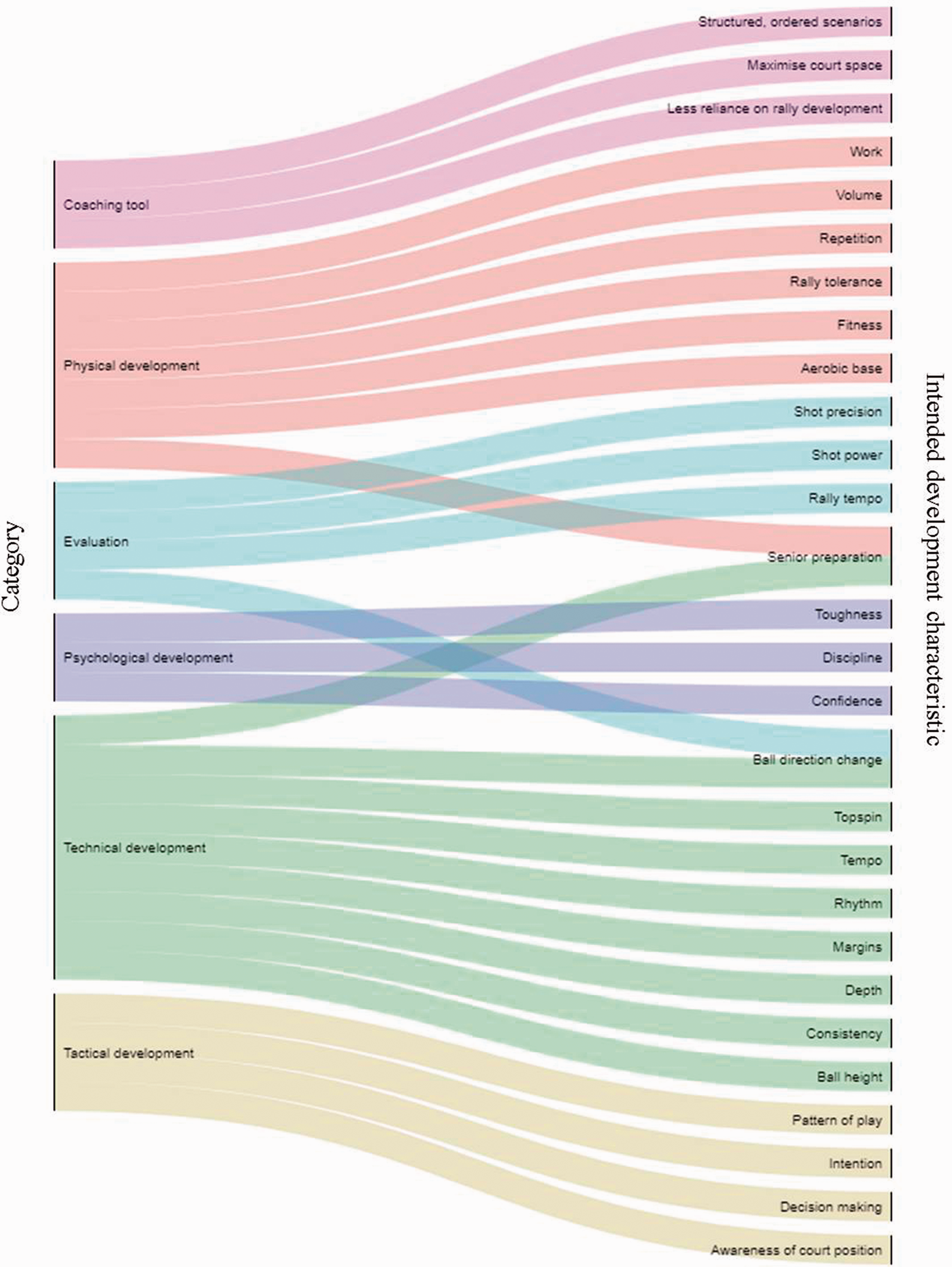
Thematic summary displaying coach rationale for including volume and repetition focused tasks (drills) within practice.
As displayed in Figure 1, coaches intended to develop a range of player attributes through drill-based tasks. Although a wide variety of intentions were highlighted, technical and physical skill were identified as the key attributes that coaches intended for players to develop through drilling.
Coaches rationalised drill-based practice tasks by stating that they felt repetition was necessary to embed and retain technical competence in players.
‘Apart from drilling, I don't know a different way of embedding those skills because it's a very technical game which requires a high degree of technical competence … your ten thousand hours has to be put in on these skills in tennis, in my opinion.' - C9
‘I think the main challenge in developing skills is to develop and maintain … if you don't maintain the strokes you've developed then they go down in quality and/or consistency.' - C1
Coaches also intended to develop player physical development through drilling. Coaches justified this approach to practice design by suggesting that players needed to be fit and physically robust in order to be ‘repeatable'.
‘Drilling offers two main purposes: repetitions to groove their consistency of technical shots, tactical situations, footwork patterns; and pushing their comfort zone to perform at a higher level of physical demands.' - C1
‘If it's just teaching it's dangerous because you're gonna be what I call ‘half-cooked'. You know, because you're not gonna have the volume in you … there's got to be work in the legs, there's got to be a lot of balls hit.' - C2
Accordingly, several coaches identified that excessive drill-based practice resulted in player behaviour that was detrimental to player creativity and the perception of information from their environment.
‘It's two cross one line, hit in the space, hit in the space. It's like block training where no decision-making happens based on their game style - or in relation with the ball received or the opponent … so the drill doesn’t prepare for match play.' - C1
‘I think repetition is key when you're younger and 100% they need to be disciplined, they need to be drilled, but you can stifle a player from a young age. You can inhibit them in the sense of, the more you tell them not to miss, the more they get tentative, the more they don't express themselves, the more they get ineffective. It is a dangerous game to play with young kids I feel, you know to be like ‘volume volume, in, in, put the ball in, don't miss'. - C3
‘Let's learn how to play, how to read the game, understand where the ball goes. Too much drilling destroys that' - C8
Performance under pressure
Coaches believed that to perform in matches, players needed to be able to cope with pressure. Coaches contextualised match play as being combative and recognised that each player is trying to beat the other.
‘It's kind of like I'm preparing a boxer to go for a fight.'- C5
‘On the match court it's gladiatorial. ‘ - C4
‘Normally, the very last words you say to your player before they go on court is ‘find a way to win'. Find a way … for this next hour and a half, you come off and you win the last point. And we can't lose sight of that, even in practice.' - C3
‘[Pressure is] anything that interferes with someone's ability to be totally focused on the process.' - C3
‘[Coaches should] create a little bit of an uncomfortable environment on the practice court. So there is a consequence to missing, in the same way there is a consequence when you miss on a match court.'- C4
‘Rather than just saying ‘right let's see how many you miss', it would be like ‘if you miss, you go back down to zero'. This is what I mean by adding a bit of pressure, adding a bit of consequence' - C3
‘I'm a massive fan of a sudden death. When I give [players] the option of the next point wins, or win by 2 [points] the amount of players that choose win by 2 … I know it's more realistic in terms of a deuce or whatever, but the difference [in performance] when I say ‘OK, now next point wins' is a real great test.'- C6
‘They suddenly go on the match court and the ball coming at them is twice the pace … You genuinely have to put them in a situation where they feel confident that what they're doing on a practice court simulates very closely to what they're getting in a match.' - C4
‘The goal of practice is to perform – to be best prepared for competition. I’m a strong believer in adapting practice to game-like scenarios. What’s the point of practice to be good at practice?' - C3
‘Feeds are very very important. Every ball has to be in the right place, the right shot, so I have to imitate point play. My shot has to have spin, my shot has to have height, sometimes low, sometimes high. ‘ - C5
‘Then what I would do is patterns of play but then turn it into a live point. So let's say it's like, you've gone one forehand cross, you've played one forehand line, point becomes live. So you're always getting a good balance of repetition but you're points scoring' - C2
‘We try and do serving games where you're trying to play against yourself or where players play against themselves like, make a first serve, if you miss the first serve, hit your second serve and you have to spin your racquet - if it's up you've won the point, so it's a 50% chance you win.' - C6
Although coaches recognised the importance of match play and designing representative practice, there remained some separation between technical development and representative practice design (for example, coaches aimed to isolate specific shot development by feeding balls to players). From a practical perspective, it was suggested that coach-fed tasks occurred during sessions where players practised with the coach on a one-to-one basis, in order to focus on individualised development of a specific shot or skill.
Individualising practice
Coaches believed that practice design should be different for each individual and contextualised according to that player's circumstances and preferences.
‘Yeah you design [practice] around the player. The age, the ability, the will, the type of physique, the ranking, the tournament … '- C5
‘I think if you work with a player it's got to be very individualised to what that person thrives on.'- C2
‘You might tackle the same thing in different ways and you're trying to achieve an end goal but how you go about it is quite different. The more I've been coaching, the more I realise that the answers to most of these things are ‘it really does depend' and everything should be so specific to the individual in everything.' - C4
‘I went into an academy where I was essentially doing the same training as a player who was a different game style to me, a different build, different strengths, different weaknesses. And we'd basically do the same thing and neither of us got better, we both got worse.' - C6
‘We'd show them the final skill in terms of maybe it'd be a demo, or we've got a video of them doing it well or someone else doing it well then, [we would develop that skill] by changing the feeds. So making it really closed so hand feeds, block feeds or whatever it might be, and then slowly building it up so feeding from further back or then maybe they'll have to run onto the ball as opposed to being static. And then I suppose you'd look to maybe contrast it so if it's a backhand, could they hit a forehand then to the backhand and do it that way. And then start building it so it's cooperative rather than basket feeds. Then trading in neutral, then open it up a little bit, then add the decision making so almost layer it in one by one.' - C6
‘When I'm teaching a new technical skill, I expose the player to a more demanding task or game situation in order to see how the player adapts their technique to remain effective or efficient. Then I'd increase the difficulty progressively where the player can make the adjustments alone or require only easy tips to improve … .There are four variables I'd modify in any specific order. These are: challenge to
Organismic asymmetry might also occur through coach conceptualisations of problem solving. For example, the second approach that coaches used to individualise practice was to adjust their coaching style to facilitate player reflection. In adjusting their delivery, coaches intended to encourage players to find their own solutions to on-court problems.
‘Just to make them talk but in the way they want I would just ask clarification questions so like ‘can you tell me more', ‘what do you mean exactly'. You always let the person talk first and then define [the problem'] - C1.
‘If something isn't going right, not jumping in straight away and telling them what they did wrong, it's actually, ‘right if you hit that same ball again what would you do differently?'. You know, to get them to understand and to find the solution to the problem, with input, rather than it being a dictatorial session of ‘this is what you're gonna do, this is what you've done right, this is what you've done wrong'.' - C4
Thirdly, coaches described manipulating common practice task constraints according to game style, in order to individualise practice for players within group sessions.
‘Even if you want to do a two cross one line drill, which is like the most simple of drills - we would do it differently for different people. So, for someone that's more of a counterpuncher or will hang in the point longer, we'd do it for say a minute. Someone that's more attacking we'd do it for 30 seconds. And the targets we'd put down would be different and the type of ball to change line we'd maybe reframe it- for example by saying this one is more of a heavy ball, or this one we want to try and step in. And so you can make a really simple drill that everyone does, you can still individualise it.'- C6
Conclusion
This study aimed to explore how performance tennis coaches design practice and to understand why coaches design practice in that way. The results of this study are the first to document the philosophy and practices of elite tennis coaches, and contribute to a growing body of research concerning pedagogical approaches to coaching in performance sport.
Although there were variations in how coaches delivered practice, three common principles for practice design emerged between participants - repeatable players, performing under pressure, and individualised practice. These principles translated into common approaches to practice design, demonstrated by a uniform implementation of volume and repetition based tasks and the tacit inclusion of representative practice. Although coaches were aware of contemporary approaches to practice design, an information-processing approach dominated their understanding of skill development and subsequent approaches to coaching.
This study found that these coaches were learners themselves, who developed their knowledge through experience. Formative coach experiences, such as being an ex-athlete or coaching different players, influenced what coaches understand to be important for player development and their development philosophy. Through their experiences, coaches may interact with consistent social and cultural constraints that create a tennis ‘form of life'. Coach beliefs and, in turn, practice design may therefore reflect the social, cultural and historical constraints that exist within tennis both internationally and nationally.
The results of this study deliver an overview of the philosophies and pedagogical approaches of performance tennis coaches as they design practice for players. These findings provide a platform for dialogue between tennis practitioners and coaches regarding traditional and contemporary approaches to practice design, which may help to optimise learning experiences for performance tennis players.
Ethnographic note
The lead author (EA) has previous experience as a practitioner working with recruited coaches and long existing (5-10 year) relationships with all coaches except one. In two instances the lead author had worked with coaches whilst they were still playing tennis, and in all cases except one, had worked with coaches in camp settings and/or one-to-one with an athlete. The lead author also worked within a performance tennis network for 5 years, which provided additional insight into the institution, culture and values of the group from the perspective of an accepted and interactive group member. This provides the data here with additional credibility, through prolonged engagement and persistent observation. 38 However, preconceptions and knowledge from previous immersion in the group may have also made the author susceptible to bias. To mitigate this as much as possible, prior to the interviews and throughout the analysis the lead author reflected on what bias might be present and referred to this throughout the analysis process. A critical friend also facilitated evaluation and reflection of data interpretation, before final themes were established.
Footnotes
Declaration of Conflicting Interests
The author(s) declared no potential conflicts of interest with respect to the research, authorship, and/or publication of this article.
Funding
The author(s) received no financial support for the research, authorship, and/or publication of this article.
