




Abstract
Athlete health and sport performance research for athletes with disabilities has increased substantially over the years as the level of competition and intensity in Paralympic sport has grown. However, relative to able-bodied sport, there remains some key areas of parasport research which are distinctly lacking. Athlete recovery, as a counterbalance to training stress and an important factor in preventing adverse health consequences such as illness and injury, is one of these understudied areas for elite para-athletes. Thus, the purpose of this descriptive qualitative study was to understand factors impacting recovery among Paralympic athletes, based on practitioner perspectives, with the aim of providing insightful guidance for applied practice. Semi-structured interviews were conducted with 15 North American sport practitioners who worked with elite para-athletes. Through thematic analysis, five main themes about optimizing athlete recovery in various populations of para-athletes were developed: a) prioritize the simple concepts, b) get to know the whole athlete, c) experience matters, d) musculoskeletal factors, and e) non-training load. Collectively, these results highlight how humanistic approaches to care, augmented by individual athlete expertise, extensive education, and a consideration of fundamental lifestyle factors is exceedingly important for para-athlete recovery. This study further describes that the approach to recovery among para-athletes, a diverse population, is uniquely complex from that of able-bodied sport and warrants scholarly attention.
Introduction
Paralympic sport has evolved exponentially, with over 4000 athletes competing in the 2016 Rio Paralympic Games 1 compared to the first Stoke Mandeville Games, as part of the 1948 London Olympics, which saw 16 athletes compete. 2 With substantial growth, increases in training intensities, more competitive performances, and development of more innovative technologies have transpired. 3 Despite advancements in the Paralympic movement, there remain unexplored topics regarding athlete health. In the context of able-bodied sport, athlete health is most often described as the management of illness and injury. 4 Health status of the athlete has also been identified as a key determinant of sport performance 5 where derivation from optimal health status negatively influences overall team 6 and individual competitions success. 7 This requires attention in Paralympic sport since epidemiological studies on sport-related injuries and illness indicate that higher rates of illness have been reported in Paralympic athletes and higher incidences of injury were reported during the London 2012 and Sochi 2014 Paralympic Games when compared to their related Olympic Games. 8 Moreover, sport-related injuries are a concern among para-athletes as the combination of temporary injury alongside physical impairment may present functional limitations making activities of daily living more difficult and yielding greater quality of life consequences.3,9,10 Thus, the consequences of illness or injury do pose added challenges, highlighting the importance of athlete health monitoring and risk prevention in Paralympic athletes. 11 Furthermore, Paralympic athletes in some instances have perceived reduced or absent recovery as an important risk factor for sports injuries, especially when training includes exceedingly rapid increases in volume, poor-quality sessions, and too much sport-specific training. 3 Collectively, the aforementioned points highlight a need for research specifically regarding recovery as an important topic of athlete health among this population.
The perception that more recovery is important to the overall success and health of para-athletes fits with the established training principle of rest and recovery. 5 To elucidate, it is well known that a balance between athletic training and recovery is necessary to achieve desired performance outcomes, while considering non-training stressors as well.5,12 Moreover, an imbalance between training and recovery can result in maladaptation to training and adverse health consequences such as illness or injury. 13 These concepts have been well explored in able-bodied literature as per a recent consensus statement on recovery and performance in sport 13 but are not, to our knowledge, explored in para-athletes where the approach to recovery may differ. 14 Studying recovery in Paralympic sport is particularly intriguing because of distinctive non-training stressors evident in some athletes. An athlete who uses a wheelchair, for instance, may experience unique challenges to recovery due to the combined demands of sport and daily wheelchair pushing. 15 In addition, factors such as pressure ulcers or muscle spasticity may complicate recovery and overall health status16–18 leading to a reduced overall recovery capacity. 3 Despite these previous findings, the concept of recovery in Paralympic athletes remains largely unexplored, lending certain relevance to the present study which seeks to investigate this topic. Hence, the purpose of this qualitative study was to explore the concept of recovery in Paralympic athletes, specifically factors impacting recovery, from the perspectives of experienced parasport practitioners (i.e., coaches, exercise physiologists, health and wellness providers) since these individuals are often tasked in directing the recovery process and ensuring optimal athlete health. We perceive these individuals to be credible contributors on this topic given their professional training and experience. The main research question guiding this inquiry was: What considerations exist for athlete recovery in Paralympic sport? We hope knowledge generated from this study can provide guidance to help optimize recovery in applied practice, especially for those practitioners who are new to working in Paralympic sport.
Methods
To achieve the aim of this study and better understand factors impacting athlete recovery in Paralympic sport and particularly, how practitioners perceive this process, a qualitative descriptive study was conducted. Qualitative description strives to provide a rich description of a given phenomenon while remaining close to words and insights collected from participants.19,20 With the aim of producing data that parasport practitioners could apply in practice, a descriptive qualitative design proved appropriate.
Qualitative description is not guided by any specific theoretical or philosophical foundations rather, it draws upon the tenets of naturalistic inquiry. 19 However, the present study was underpinned by ontological relativism and epistemological constructivism, thus assuming that reality varies across people and knowledge is socially constructed and subjective. 20 Considering the research team and majority of participants were able-bodied individuals lacking lived experience with disability, the philosophical assumption that knowledge is socially constructed was especially appropriate for this inquiry. Moreover, the present study offers subjective perspectives from practitioners and are not representative of all practitioner/athlete dyads in Paralympic sport.
Participants
Following institutional ethics approval, participants were recruited using criterion-based, maximum variation and snowball sampling strategies. 21 These combined purposive sampling strategies ensured recruitment of participants with sufficient experience and expertise from diverse professional backgrounds to provide insightful information for the inquiry purpose.19,22 Inclusion criteria required that participants were educated in kinesiology (i.e., physical education, recreation, human kinetics), sport performance and/or coaching, or hold a professional designation in a healthcare profession and have a minimum of one-year experience working with athletes with disabilities involved in elite level competition or in sports with a Paralympic identity. Eligibility for the study also required that practitioners be individuals who assess athlete recovery and monitor fitness and fatigue to determine the athlete’s readiness to train. Similarly, practitioners facilitating recovery through the application of a specific treatment or prescription of a recovery method were eligible.
Recruitment letters were sent by email to national sport institutions and governing bodies in sport across Canada, as well as to professional associations for physical therapy, massage therapy and athletic therapy. Snowball sampling occurred by word of mouth as participants shared the recruitment letter with colleagues. A total of 15 parasport practitioners (Table 1) from across North America were recruited. Practitioners were organized into five cohorts with three individuals per cohort: a) sport-specific coaches; b) strength and conditioning coaches; c) exercise physiologists; d) healthcare practitioners (sport medicine physicians and a physical therapist); and e) wellness practitioners (mental performance trainer, a sport dietician, and a massage therapist). Participants included eight females and seven males, with one female participant identifying as having a disability. Practitioners had experience across a diverse range of sports including wheelchair basketball, wheelchair rugby, triathlon, athletics, swimming, cycling, tennis, judo, alpine skiing and snowboarding, Nordic skiing and biathlon, goal ball, sledge hockey and sitting volleyball.
Participant demographics.
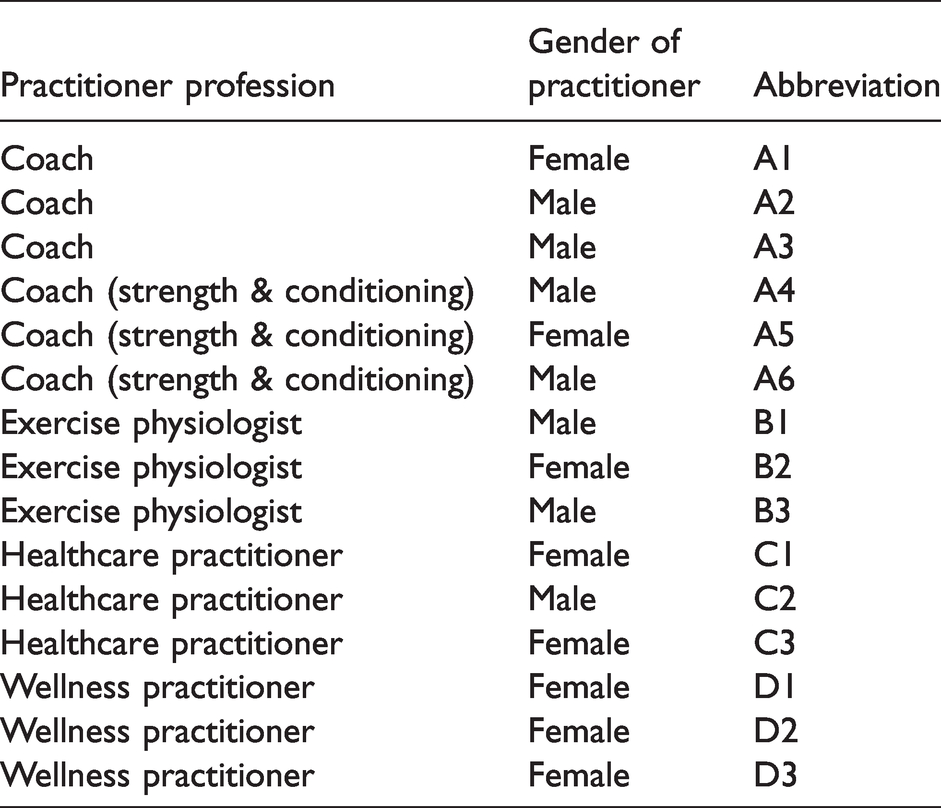
The diversity of professional backgrounds in our sample aimed to encapsulate the entire paradigm of integrated support structures in parasport (coaches, sport scientists, and allied health professionals). While findings may not be specifically generalizable to one profession (i.e., coaching), we value the individual perspectives that each practitioner offers and the contribution each makes to the complex, multi-faceted process that is athlete recovery. We believe the variety of perspectives collected enriched this research and may be transferable across professions. Given that integrated support practitioners are tasked with assessing athlete health and prescribing training and recovery accordingly, we felt that understanding factors that practitioners consider in an effort to best serve their athletes would provide a rich determination of recovery in parasport. However, while this study offers a perspective of athlete recovery in parasport, the lived experience of recovery heard from the perspectives of Paralympic athletes themselves should be pursued.
Procedure
Data were generated using individual semi-structured interviews. All interviews were conducted by the first author, who had some volunteer experience in parasport but no pre-existing relationships with any of the interview participants. A total of 15 interviews were completed with four conducted in-person and 11 completed either by Skype or telephone. Whilst there are weaknesses to the latter interview mediums, these options were essential to accommodate participants who did not reside locally. Online interviews present risk of technological challenges and do not always capture the subtleties of body language and telephone interviews lack visual cues that confirm the interviewer is actively listening. 23 Despite these weaknesses, we are confident that our various interview mediums were able to produce rich, detailed data. An interview guide was used in every interview and included introductory, main and concluding questions. Introductory questions asked participants to describe their career experience while examples of main questions included, “What does athlete recovery mean to you?”, “How do you assess an athlete’s recovery status?” and “Have you observed any impairment related symptoms that may affect (either positively or negatively) an athlete’s ability to adequately recover from training?”. Concluding questions asked, “Is there any advice you would want to share with your fellow clinicians, coaches, trainers, or sport scientists about approaches to recovery in athletes with physical impairments?” and “Is there anything else that I have not asked you that you feel might be important for me to know?” Interviews ranged in length from 40 min to 70 min, with a total of 863.45 min of interview recorded and mean interview duration of 57.35 min. Each interview was audio-recorded with participant consent and transcribed verbatim.
Data were analysed using inductive thematic analysis guided by the six phases of data analysis recommended by Braun and Clarke. 24 The first author became deeply immersed in the data through transcription, then by actively reading and re-reading the interviews.24,25 Data were coded initially using a semantic approach to identify explicit meanings, but a second round of coding, examining underlying ideas enabled development of more latent codes. 25 Data were coded entirely by the first author. Themes were developed by assembling codes together to identify patterns and broader meaning across the data. 25 Finally, it is also necessary to acknowledge writing as an important and ongoing part of analysis. For example, the first author incorporated writing through reflective note taking which helped guide the data generation and analysis processes. Further, the iterative process of writing provided physical organization of quotes for thematic areas and assisted in developing initial and subsequent iterations of themes, facilitating a robust results section.
Trustworthiness
Techniques to enhance quality and trustworthiness were used throughout the research process. Credibility, confirmability and transferability were sought through purposeful sampling, reflective note taking, inclusion of direct quotations and conducting detailed interviews to generate rich insights. 20 Developing rapport at the beginning of interviews helped enhance communication 20 and maintaining the same interviewer allowed for more consistent interview execution. Further, practicing reflexivity throughout the research process is critical to demonstrate trustworthiness.20,26 The research team engaged in extensive conversation about how our personal positioning, background, and assumptions may impact the research. Our research process was guided by existing literature and while we recognize that unconscious biases do exist, we do not feel this impacted the research process or outcomes. Lacking lived experience with disability or significant presence in this community, we acknowledge our limitations to empathize with the disability experience. Thus, in the future, we feel trustworthiness in this research area would be further enhanced by seeking scholastic contribution from within the disability community, either on the research team or as a critical friend.
Results
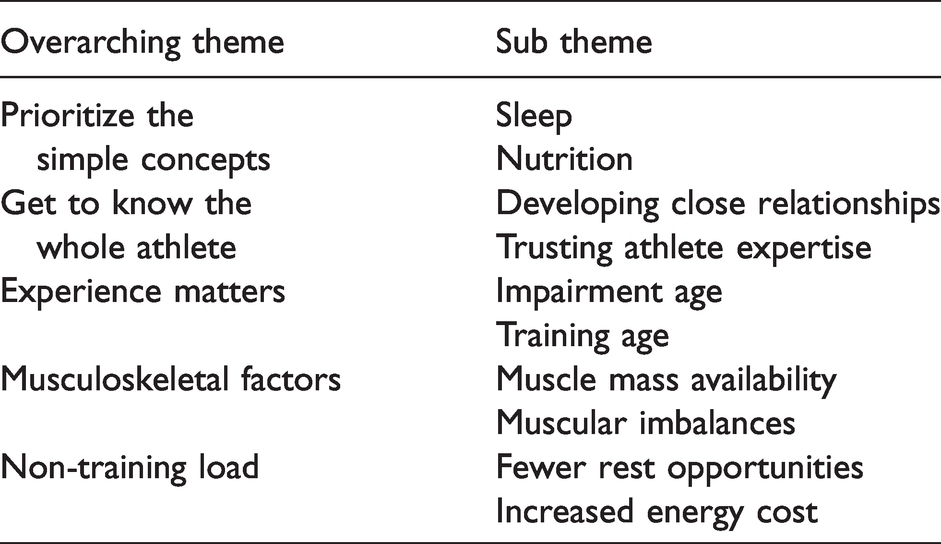
Practitioners discussed various factors that impact the recovery process, specifically when working with para-athletes. While these factors are likely to align with what practitioners working in able-bodied sport would consider, the practitioners discussed subtle, and sometimes complex, ways in which working with para-athletes differs. Through analysis, 10 sub-themes and five main themes were developed: a) prioritize the simple concepts, b) get to know the whole athlete, c) experience matters, d) musculoskeletal factors, and e) non-training load (Table 2); each theme is described below.
Themes.
Prioritize the simple concepts
The first theme highlights the importance of prioritizing lifestyle factors such as sleep and nutrition to optimize recovery. Many practitioners emphasized that adequate rest and proper nutrition are the key components required for an athlete to truly recover and gain desired adaptations from their training. As one participant stresses: So, although it’s not sexy, I would say that probably 90-95% of recovery is based on nutrition and sleep. A lot of elite athletes might train 300–600 times a year but they eat 1400–1600 times a year so, when you put those numbers up it’s pretty obvious that how and what and when you eat is important. (B1) I think sleep is the biggest driving point with your recovery as a whole and if you have a visual impairment, a lot of times, you know, there’s a lot of research in this area, maybe not necessarily as much around visual impairment performance but around sleep and visual impairment that is an area that has decent documentation behind it and you know, we know athletes are gonna have a harder time hitting a circadian rhythm because they don’t have that sensation of seeing the sun or seeing the light. (A6) … a number of our visually impaired athletes, particularly those with kind of degrees of visual impairment have issues with sleep and we know that sleep is an important factor in recovery. Also, some athletes have a lot of muscle spasm and pain that can interrupt their sleep. And so, from a sleep perspective that can be a really crucial one, that we – we always have a discussion with the athlete, it’s not always something that I can kind of directly influence. But working towards doing more assessment of sleep capability and how to manage that … and I think that’s unique to Paralympic athletes in certain pockets, of those athletes. (D3)
In addition to challenges with sleep, there may be certain athletes who experience concerns related to nutrition. One participant points out energy intake concerns for athletes with spinal cord injury (SCI): With athletes with quadriplegia and high levels of spinal cord lesion, their gastric motility is smaller … so that can sometimes hinder recovery, if they just don’t have the appetite and the capacity to get a certain amount of food in. (D3) … certain pockets of our athletes come from a rehab setting. So they’ve had an injury; they go to rehab; and that rehab setting is very much – tends to have a focus on ‘don’t put weight on, because then it’s harder for you to transfer or you can’t put your prothesis on’. And so really come from that environment into a sporting environment, you have to create a shift in their mentality around fuelling and sufficient food for training volume as opposed to restricting food to prevent weight gain. (D3)
Get to know the whole athlete
Participants discussed different tools to monitor and assess athlete recovery including the use of objective measures such as AM resting heart rate, heart rate variability, and measures of blood lactate. All participants used some form of subjective questionnaire where athletes self-report on daily fatigue or overall feeling. Many practitioners worked with decentralized parasport teams, making self-report measures a realistic option for consistent monitoring that can be maintained remotely. Undoubtedly, the use of self-report strategies for monitoring is not exclusive to para-athletes and a close relationship facilitating honest communication is crucial in any athlete population. However, the intimacy developed with a para-athlete appears to be unique, and essential. As one participant shared, “I think we’re a lot closer to a para-athlete than we are to an able-bodied athlete, like you really understand things.” (A5)
With para-athletes, knowing the athlete goes beyond understanding their personality and tolerance to training, it also includes a deep understanding of their experience with impairment. As one participant explained: As much as you assess an able-bodied athlete, the para-athlete, I feel like there’s a lot more questions that need to be asked to understand their lifestyle, you know? … Like there’s these little things that are just a little bit more important to actually get to know the athlete, but I always trust how the athlete feels or says it feels because I’ll never have that impairment. (A5) So you can offer suggestions and you can chat and get to know that person but a lot of it is just understanding that yeah, they’ve lived with this impairment for a long time and they know it better than others, or better than I would anyway. So yeah, I guess I spend a lot of time trying to get to know that person in terms of, what is their disability and how do they sort of perceive their fatigue relative to their disability. (B3) I’ve never seen people so in tune with their bodies and how things feel and how they feel last week and the week before. And trying to explain their impairment, especially in Cerebral Palsy. I would say they’re very open about, not necessarily pain and fatigue, but how something felt specifically, like, ‘I felt like I could use everything, I could activate all my muscles’, whatever it is. In that regard, I think that they are very in tune with their bodies, and how they feel day to day and how to take care of themselves so they can train. (A5)
Experience matters
Many participants discussed the diversity of experiences among para-athletes, sharing how athletes with congenital impairment, at times, demonstrate different experiences with their impairment than those who acquired their impairment later in life. As one participant explained: … I would say the first thing is, how long have they had their injury? It’s a huge thing. So, was it something that was acquired or was it something at birth? Those things will really make a big difference in terms of, I guess, how quickly those athletes can start to adapt to training, just because if they’ve only been a year out of their acquired injury, especially spinal cord, that’s kind of where we’re working with because it’s usually acquired, then it takes them a long time to kind of adapt to that lifestyle to begin with and then even their muscles, they might still be just kind of, atrophy is still happening a little bit. (B2) … And then with the younger athletes, I think it’s important to maybe try to help guide them through that process, I think with veteran athletes hopefully they figure out what works well for them, and you know, I can respect that but you know, a younger athlete, maybe we kind of help guide why they might use a certain modality to recover from a certain stress but also what time of year that might be most appropriate. (A6) Let’s say one particular athlete I worked with who has been competing in sport in a wheelchair for multiple decades versus someone who just went through a traumatic experience is now in a chair for less than 2 years of their life; I think there’s a learning curve. (A6)
Musculoskeletal factors
One factor outlined as an important consideration for recovery was muscle mass and muscular imbalances or asymmetries. Muscle mass availability is a specific consideration for recovery among athletes with SCI. For athletes with high-lesion SCI, practitioners should consider providing additional recovery time, if needed. As one participant stated: You know one of the things that I’ve seen is that there are times where like our lower-class players, so those who don’t functionally have as much muscle to be able to use. They need a little more recovery time. And we have to be a little more cognizant of like how much rest we’re giving them within practice, or how much rest and recovery they need between training sessions. Just because they’re recruiting all the muscles they have in their body. All the time, basically, and so their work rate tends to be a little bit higher. (A1) Okay so your, for your high spinal cord lesions, you know, definitely the – approaching the volume training, we do very cautiously, very incrementally, because you don’t have the big musculature in the legs, hips, glutes; to accommodate a three-four hour plus training session, right. (A2) … lower functioning, so in rugby we have classifications of 0.5–4, 0.5 being they really only have biceps function and shoulders, they don’t necessarily have triceps and no core. So, for them you’ll see very low lactate numbers or responses to lactate variation and that again I think just comes down to the ability to not generate because of the lack of muscle mass. (B2)
In addition to available functional muscle mass, another consideration for recovery in different athlete populations is muscle spasticity and tone. One participant described this as a factor requiring diligent recovery focus, “if they don’t keep up with that massage or stretching type rehab, then that spasticity can increase, and it gets pretty tough to stay ahead of with that with their recovery.” (B2) This consideration was further emphasized by a number of practitioners who discussed spasticity and the resulting hypertonicity of muscle tissue. In this context, practitioners highlighted that allowing additional recovery time is key, especially to reduce muscle soreness. As one participant mentioned: The spastic athletes tend to be slower to recover and they tend to be stiffer with more muscle trigger points. Just because they’re tight everywhere. So, when they train and they get, either over trained or even just regularly trained, they’re tight – they’re stiff, they’re sore, and lose range of motion. (C2)
Non-training load
The final theme acknowledges the impact of external load imposed through non-training physical stressors that may lead to increased fatigue. For example, for an athlete using a wheelchair full time, substantial load is applied to the upper body through combined physical stress of everyday use as well as athletic training, leaving little opportunity to recover and thus, presenting added risk of injury and mechanical overtraining. In addition to limited recovery time for the upper body, injuries occurring in other areas of the body, such as pressures sores, may not recovery as quickly or successfully if large amounts of time in their wheelchair is required. One participant explained: The athlete who has, who uses a wheelchair also requires the upper extremity for everyday ambulation, right, they ambulate with their upper extremity, let alone compete in a sport that utilizes a wheelchair. And it is very difficult to rest, specifically say, the upper extremity. They need to lift, transfer and ambulate, it is very difficult to rest and recovery from the pressure sore that result from tremendous amounts of friction, by tremendous amounts of time in the chair during training and competition. (C1) … full rest is I think complex for athletes who have impairment, because their impairment not only affects their ability to compete – their impairment is part of what allows them to compete in parasport, but their impairment is something that affects their – their activities of everyday living, really fundamental activities of everyday living. (C1)
Discussion
The purpose of this study was to understand factors impacting recovery among para-athletes based on practitioner perspectives. Our results reveal five main themes discussing fundamental lifestyle factors, athlete-practitioner relationships, individual history, musculoskeletal considerations and understanding physical load beyond training. Collectively, these findings can be applied in practice to inform more mindful decision-making regarding athlete health and may be particularly useful for practitioners with less experience, education, or training in parasport. We hope that this discussion serves as a starting point for greater recognition of para-athlete recovery as well as a starting point for further prospective research in para-athlete fatigue and recovery status.
We found that many practitioners in the current study valued the practitioner-athlete relationship, aligning with a humanistic approach to athlete care that may be heightened in parasport. In coaching, humanistic philosophy promotes an athlete-centered approach, emphasizing athlete autonomy and empowerment.27,28 A humanistic approach also involves positive interpersonal relationships with athletes where a certain closeness is achieved and increased collaboration with and input from the athlete is embraced.27–29 Existing research has expressed value in these principles for coaches of elite wheelchair sport 30 and confirms that coaches do appear to develop closer relationships with athletes with disabilities than with able-bodied athletes 31 but this is less explored among other non-coaching support practitioners. Considering the perspectives within this study represent those of an elite sample, the context of an athlete’s impairment age and training age is also worth considering. However, our findings suggest to achieve closeness with an athlete, it is essential for practitioners to gain a comprehensive understanding of the athlete as a person and their lived experience with impairment. Moreover, our results illustrate many parasport practitioners recognize how their own lack of lived experience with disability necessitates a greater collaboration among the practitioner-athlete dyad, aligning with athlete insights which emphasize increased collaboration among coach-athlete dyads wherein athlete knowledge is embraced tends to facilitate more positive sport experiences. 32 This demonstrates the significance of valuing and trusting the athlete’s expertise to reveal their embodied experience – a need that has been previously underscored by para-athletes. 33 Consequently, to ensure optimal training prescription and recovery advisement, an athlete-centred approach and collaborative dynamic is essential, particularly among coaches and sport scientists who are heavily involved in these daily processes. Additionally, the need for a collaboration extends to integrated support practitioners as well, especially as research about coaching athletes with disabilities has recommended that coaches should work closely with supporting practitioners like physical therapists to foster comprehensive understandings their athletes. 34 Thus, to optimize athlete health across professional domains, all practitioners should embrace humanistic principles and draw upon athlete expertise to fully comprehend the athlete to the best of their ability, likely more than with able-bodied athlete-practitioner relationships.
When evaluating recovery status and readiness to train, participants acknowledged the use of subjective self-report tools for assessment as invaluable. This speaks to a general awareness and good level of base knowledge on how athlete monitoring tools can inform decision making to the betterment of performance. 35 These forms of athlete monitoring are especially useful in parasport since self-report measures mandate greater reliance on athlete expertise. However, implementing supplementary in-depth reporting may yield more comprehensive insights regarding the impact an athlete’s impairment has or does not have on lifestyle, performance and recovery. Our results would suggest that developing a self-report questionnaire, containing impairment specific questions may prove valuable to better understand the individualized experience of impairment and its effects, leading to improved decision-making about recovery strategies and training programming. Further, diligent monitoring of factors such as the intensity of muscle spasticity, pain, or the quantification of non-training physical stress imposed by daily activity would be helpful to more accurately understand individual recovery and prevent undue fatigue. This approach may not be necessary for all athletes but for some, it may prove beneficial by facilitating a more individualized athlete profile that better informs recovery decisions.
Notably, all practitioners had good awareness that athletes should be viewed as athletes first, shifting focus to athletic achievement as opposed to impairment. Yet, results of this study emphasize that fundamental lifestyle differences do exist for some, and when considering athlete health, these differences must be acknowledged. This idea aligns with a social-relational approach to disability sport which identifies the need to recognize disability as an integral part of the athlete while maintaining focus on the athlete as a person and their sporting goals. 32 Para-athletes and able-bodied athletes share similar yet different experiences, allowing for understandings in able-bodied sport to inform practice in parasport while still demanding that differences between experience be confronted to develop new insight for enriched practice. 10 Further, coaching literature has emphasized that while similarities exist between able-bodied athletes and athletes with disabilities, working with the latter population differs because coaches must thoroughly understand the nature of the impairment, biomechanical adaptations, accessibility/environmental concerns and additional lifestyle elements.30,34,36 In the context of recovery, physical impairment can elicit a dissimilar sport experience whereby more substantial consideration to the above factors may be central to optimizing recovery. This can be achieved by further drawing upon the social-relational model of disability, recognizing the construct of impairment effects as restrictions of activity that arise directly from impairment. 37 One participant illustrated this, expressing how athletes who use their wheelchair full-time were occasionally more vulnerable since “true rest” of the upper body is hard to achieve. In this scenario, a comprehensive conversation about lifestyle planning in combination with strategic training programming could help limit increased cumulative fatigue. Ultimately, as the results expressed, impairment is what allows the athlete to compete in parasport but also impacts life at a fundamental level. This statement is echoed in existing research 30 which advises parasport coaches to focus predominantly on the athlete, not the impairment, while simultaneously appreciating the reality that experiencing impairment does impact an individual’s life. Thus, to enhance parasport recovery we recommend that the in-depth understanding of the athlete as a human being is balanced with significant impairment-specific knowledge. Para-athletes themselves have expressed the need for practitioners to possess this combined knowledge in order to provide optimal support and moreover, have conveyed that coaches may not always have enough impairment specific knowledge to understand how the body is exposed during difficult athletic training. 3 Our study participants reiterated the need for more educational opportunities – this is not a novel finding across coaching literature but the need extends to other professions, such as sport science. Interestingly, of the practitioners recruited and interviewed for the present study, parasport scientists were difficult to come by. Yet, these professionals were recognized, especially by coaches, as highly valued support for athletes. Thus, we specifically recommend that post-secondary institutions should present disability specific considerations in exercise physiology or training methodology courses thereby encouraging more new professionals to enter the parasport field, prepared and inspired.
Practical applications
Overall, our research indicates that parasport practitioners have diverse views from their professional backgrounds yet find common ground in their approach to athlete recovery. It was clear that in the absence of sound evidence for recovery strategies in parasport, these participants gained their acumen in two ways: first, they borrowed from what is known in recovery for able-bodied athletes, in many instances using the same recovery guidelines or measures. This is typical in current parasport practice where theory is often adapted from able-bodied guidelines. 38 Second, they used trial and error to figure out what works best for the individual athletes with whom they worked. The latter approach illuminated that individual sport experience combined with impairment experience are important aspects to how recovery was managed but additionally, demonstrates how the process of optimizing recovery in parasport can be more complex than in able-bodied sport. As applied takeaways from the present study, practitioners should strive for open dialogue that embraces athlete expertise alongside more in-depth monitoring with particular consideration to load incurred through non-training stress.
Limitations
We recognize that focusing our inquiry on practitioner perspectives is a limitation to the study. The need to centre the voices of athletes in parasport research cannot be overlooked and we recommend that future research in this area should explore the lived experience of recovery from the perspective of para-athletes for a more comprehensive understanding of this phenomenon. Another limitation is the lack of representation of practitioners experiencing disability whose knowledge would be especially insightful in this area. We encourage scholars in this area to seek insights from these individuals as vital contributors.
Conclusion
Results of the present study offer valuable knowledge derived from practitioner perspectives regarding recovery for para-athletes. To our understanding, this is the first exploration into this topic. Not only must practitioners strive for comprehensive understanding of the athlete but must be knowledgeable about specific impairments and resulting impairment effects to most adequately support their athletes. Given that our participants advocated for greater general education for coaches, sport scientists, and other professions working in parasport, educational modules focused specifically on recovery should be a long-term goal. Ultimately, we propose a humanistic approach enriched by athlete expertise and further augmented by infusion of disability experiences in education 39 for practitioners to effectively accommodate individual needs. We infer this strategy would improve sport performance via enhanced recovery and result in greater likelihood of career longevity with improved long-term health outcomes for athletes.
Supplemental Material
sj-pdf-1-spo-10.1177_17479541211022706 - Supplemental material for Practitioner perspectives of athlete recovery in paralympic sport
Supplemental material, sj-pdf-1-spo-10.1177_17479541211022706 for Practitioner perspectives of athlete recovery in paralympic sport by Sara W Szabo and Michael D Kennedy in International Journal of Sports Science & Coaching
Footnotes
Acknowledgements
The authors would like to thank all of the practitioners who participated in this study for their insightful contributions.
Declaration of Conflicting Interests
The author(s) declared no potential conflicts of interest with respect to the research, authorship, and/or publication of this article.
Funding
The author(s) received no financial support for the research, authorship, and/or publication of this article.

References
Supplementary Material
Please find the following supplemental material available below.
For Open Access articles published under a Creative Commons License, all supplemental material carries the same license as the article it is associated with.
For non-Open Access articles published, all supplemental material carries a non-exclusive license, and permission requests for re-use of supplemental material or any part of supplemental material shall be sent directly to the copyright owner as specified in the copyright notice associated with the article.
