




Abstract
Tactical Periodisation is a training methodology, originally developed for soccer, that focuses primarily on the systems of play that a team intends to use in competition. It has been popularised by successful European coaches and subsequently has been proposed as a model to follow for other sports such as rugby union and tennis in more recent times. Gaelic football is an amateur sport that has similarities to soccer and rugby union. To date no training periodisation model has been proposed for Gaelic football. The aim of this article was to present a Tactical Periodisation model for Gaelic football, taking the sport’s game structure, physical and technical demands and amateur status into account.
Introduction
Tactical Periodisation is a conceptual framework developed by Professor Vitór Frade from the University of Porto in Portugal, that was initially designed for soccer training, and popularised by high-profile Portuguese soccer coaches such as José Mourinho, Carlos Queiroz, and André Villas-Boas. 1 In recent years, the Tactical Periodisation model has been adopted to other sports such as rugby union 2 and tennis. 3 A recent systemic review of Tactical Periodisation concluded that the training model is an interesting theoretical proposition which is yet to be supported by scientific research. 4 In simple terms, the premise of the original Tactical Periodisation model is that soccer should be trained with respect to its logical structure of four game ‘moments’; (i) offensive organisation, (ii) defensive organisation, (iii) transition from defence to attack, and (iv) transition from attack to defence. 1 One of the key principles is that the tactical, technical, physical and physiological components are never trained in isolation and are always integrated to the training of at least one of the four game moments. While traditional periodisation models are developed to integrate with technical and tactical training, 5 much of the emphasis in these models is placed on the development of physical components with little reference on how to approach the tactical and technical elements of training.
Gaelic football is one of the most popular sports in Ireland yet there is very limited information relating to general periodisation of training in Gaelic football. 6 The game of Gaelic football has been around for centuries 7 and it share similarities with sports such as rugby, Australian rules football and soccer. 8 Players can carry the ball in their hands and can play the ball in any direction with their hands or feet. Players are not permitted to throw the ball, instead if passing the ball by hand they must hold the ball in one hand and strike it with the other hand in a clear underhand action. Whilst in possession of the ball, players must bounce the ball or solo the ball every four steps. A solo requires the player to drop the ball onto their foot and return it into their hands. To score players can hit the ball over the crossbar and between the two uprights for 1 point and below the crossbar and between the two uprights for a goal, worth 3 points.
Gaelic football is played at both an elite and sub-elite level. Gaelic football players play for their clubs at a sub-elite level in each of the 32 counties of Ireland. Inter county competitions represent the elite level of Gaelic football, with teams comprising the best club players in each county. 9 The duration of sub-elite matches are 60 minutes while elite matches are 70 minutes. An in-depth needs analysis of Gaelic football has previously identified the key physical attributes required to play the sport. 10 The game is intermittent in nature with a need for players to have high levels of aerobic and anaerobic fitness. 10 Elite players will typically cover 112–151 m.min−1 during match-play with an average heart rate (HR) of 162 ± 10 bpm and a peak HR of 189 ± 6 bpm.9,11 The data for sub-elite players is slightly lower with players covering on average 95-122 m.min−1 during match-play, 12 with no existing data for sub-elite physiological demands. The contest for possession of the ball requires players to perform repeated sprints and demonstrate high levels of strength. 10 Elite players will typically complete 40 sprints (speed entries above 22 km h−1) during match-play 13 demonstrating the stochastic nature of the game. Gaelic football players have been observed to have a baseline, dead lift (lower body) 1 repetition max (1RM) of between 132.8-162.8 kg and a bench press (upper body) 1RM of between 81.0-112.0 kg. 14
Traditionally, pitch based training sessions would consist of a warm up, some technical drills, conditioning runs, perhaps some small sided games (SSGs) and finally large sided games (LSGs). SSGs are characterised by a reduction in player number and or pitch size compared to regular games and are commonly used in team sports to train the physical, physiological and technical elements of games in tandem. 15 LSGs are more akin to match-play with greater player numbers (typically 8v8 and above) and larger pitch sizes. 15 Current coaching practice and related training sessions are informed by previous experience, coach education programs and informal/formal learnings from other sports. Recent research relating to the match-play demands of Gaelic football13,16 is beginning to inform training practice in elite teams. It would be anticipated that this change will occur at a slower rate in sub-elite teams where teams are unlikely to have access to the same level of professional support staff. 17
In a typical in-season week, it has been reported that elite Gaelic football players will cover up to 21188 m, with a total internal load between 1386-2740 AU.6,18 Elite teams will often have training camps throughout a season where they will train for a number of consecutive days. One elite team was observed to cover 54175 ± 4254 m with an associated internal training load of 5984 ± 554 AU during a 7-day in-season training camp consisting of 10 pitch sessions and 2 gym sessions – an increase of 42-45% from their regular weekly training load. 19 Training load figures reported to date have been based on single team studies and are likely to be heavily influenced by the coach’s philosophies, quality and level of players and the expertise of the medical and conditioning staff.
In recent years, there has been a shift towards a SSG approach to Gaelic football training with coach education programmes and associated research highlighting the benefits of this coaching philosophy.20,21 SSGs can be used to prepare players for the ‘worst-case scenario’ of physical demands in a match, 20 whilst concurrently preparing players for the technical and physiological demands. 22 It must be noted however that SSGs may not be able to prepare players for all the demands of match-play. For example generic SSGs may not prepare players for the tactical demands of match-play and thus have to be designed with tactical scenarios in mind. 23 Furthermore in SSGs in Gaelic football, the average percentage of maximal velocity achieved by players did not surpass 88%, suggesting supplementary speed training is required 22 to prepare players for the high-speed actions of match-play. 24 The Tactical Periodisation developed by Frade model advocates the use of SSGs and LSGs to replicate match-play scenarios in training to comprehensively stimulate and concurrently develop all the elements of match-play performance, without having to separate the tactical from the technical, physical and physiological. 25 Based on the findings by Mangan et al. 22 relating to the effect of pitch size on the technical, physical and physiological performance in Gaelic football SSGs, it is now possible to design (with confidence) SSGs with a tactical emphasis that meet or exceed the match demands for the other three elements of performance.
The game model approach
The design of a Tactical Periodisation model that is suitable for Gaelic football, considering the demands of the game and the amateur status of players, has never been attempted, to the knowledge of this author. Much of the literature relating to Tactical Periodisation centres around the ‘game model’, or simply how the coach wants the game to be played.1,25,26 In Tactical Periodisation, all elements of training should reflect the game model of the coach.
26
In essence, this is the first step in creating a team’s tactical philosophy.
2
The coach should have a clear understanding of the game, and how they want it to be played, leading to the development of a model that they can communicate clearly and concisely to their players. According to Carvalhal,
27
quoted in Tamarit
25
(Chapter 3, PP2), the game model,
“… is the future, what we want to achieve and what I am constantly visualizing, it is what I want, it is where I want to get to even knowing that I will never get there …. It is the idea of play that gives me the coordinates to work, to guide and to achieve the maximum level of play”
If the game model is the overall ideal, how the players react in the specific game moments is the process of how they can achieve this optimal performance. The four game moments widely defined in soccer are (i) offensive organisation, (ii) defensive organisation, (iii) transition from defence to attack, and (iv) transition from attack to defence. 1 It is the coach’s role to re-create these four moments of the game in training to encourage and provoke the players to make the correct decisions when faced with similar scenarios in match-play. While it is important to have a strategy for each of the game moments, it is also important to allow for autonomy and creativity in the mindset of the players, which will facilitate more organic learning and decision making. 25 Once the players know their role in the team, it can be beneficial to change their positions in training to stimulate their thought process with regard to fostering a greater understanding of the collective game plan from a variety of different perspectives. 25
Each of the four game moments in soccer are also transferrable to Gaelic football. However, while both are invasion sports, rule differences mean that the decision-making in each of these four moments are very different. For example, Gaelic football players can score points from greater distances than soccer players can score goals, therefore during defensive organisation, there is a need for a higher press in Gaelic football. During attacking organisation, there are no ‘off side’ violations in Gaelic football, therefore there are no restrictions on the movement of players in the attacking phase of the pitch. Also, in the transitions from ‘defence to attack’ and ‘attack to defence’, players can use a hand pass, kick pass or carry the ball, which means that there are a greater number of options in transitional moments in comparison to soccer or rugby.
In addition, there is also a 5th game moment in Gaelic football that needs to be considered. Similar to the Tactical Periodisation model proposed for rugby union, 2 the contest for possession should also be considered a game moment in its own right. The level of physical contact permitted in Gaelic football is much greater than in soccer. When players are in possession of the ball, opposition players are permitted to make shoulder to shoulder contact, or attempt to slap the ball with their hands, while aerial contests generally involve physical contact between players. The physical contact involved in the contest for possession in Gaelic football combined with the importance of possession, justifies it being considered as a game moment in its own right. In soccer, 8% of team possessions lead to a score; 31 while in Gaelic football, 23% of losing team’s possessions and 33% of winning team’s possessions lead to scores. 32 The significant difference in the ‘possessions:scores %’ between winning and losing teams in Gaelic football highlights the importance of securing primary possession. 32
One of the major possession contests in Gaelic football is the kick-out. A kick-out occurs when the goalkeeper resumes play by kicking the ball off the ground (or from a kicking tee) from the 13 m line after there has been a score or the ball has gone wide of the goal. In an average match, there are 44 kick-outs. 33 While some research 34 considers a kick-out to signal the start of a team’s possession, other research has suggested that kick-outs are not considered as possession until one team is in control of the ball. 32 Kick-outs are the origin of possession for 29–33% of all team possessions in a game. 35 Specifically, kick-outs to the wings result in a scoring opportunity for either team on 31% of occasions, while kick-outs to the centre results in a scoring opportunity 21% of times. 33 Another scenario that leads to a contest of possession in Gaelic football is a throw-up. At the start of each half, the referee throws the ball up between four players on the half-way line to commence play, two from each team. Throw-ups can also be awarded in different areas of the pitch by the referee at any time during a game for a variety of technical fouls and/or dissent. There are no published figures on the number of throw-ups in a game, however their occurrence is much less than kick-outs. The importance of the contest for possession from kick-outs in particular justifies the need to consider this as a separate and distinct game moment.
The traditional Tactical Periodisation model simplifies the game model into principles of play and sub-principles of play for each of the game moments. Principles of play are general strategies that the coach wants the players to perform. 25 An example in Gaelic football of a principle of play may be in the ‘defence to attack transition’, where players are encouraged to attack down the wings. Within the principle of attacking down the wings, there are further sub-principles that are more specific to the game model. For example, one sub-principle in this context might be for the defence to work the ball up one wing with short passing until they get out of the defensive zone, while another might be for the half forwards to make space on the wings by making a series of runs so that there are opportunities for the defenders to either pass the ball or create space to carry the ball (Figure 1). Once each sub-principle is coached and understood by the players, they can be linked together to form the principle of attacking down the wings (Figure 2). According to Vitór Frade, cited in Gomes, 36 by structuring the game model into principles and sub-principles, one can turn the ‘incalculable predictability’ or unpredictability of game events into potential predictability.
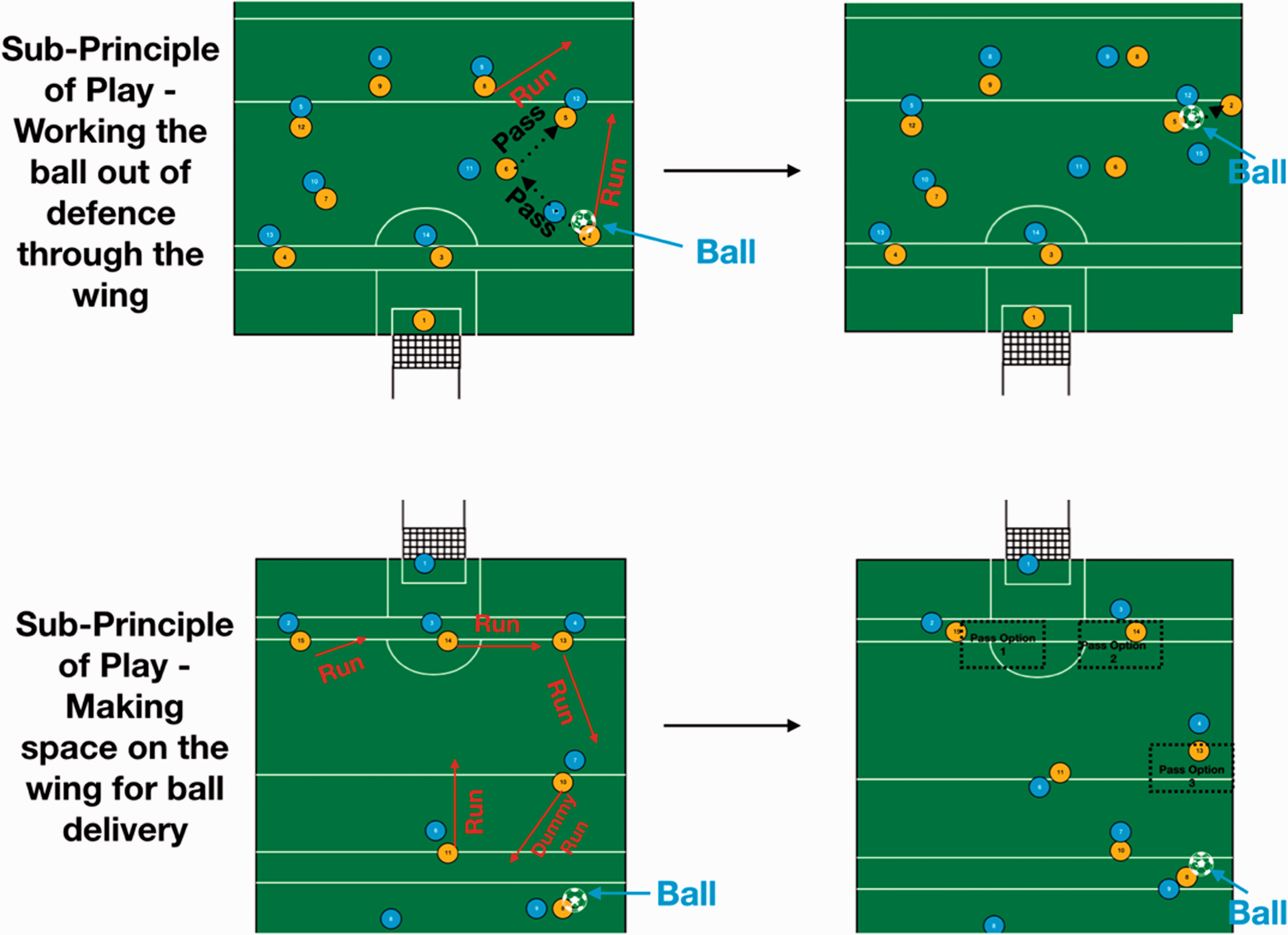
Example of two sub-principles of play scenarios.
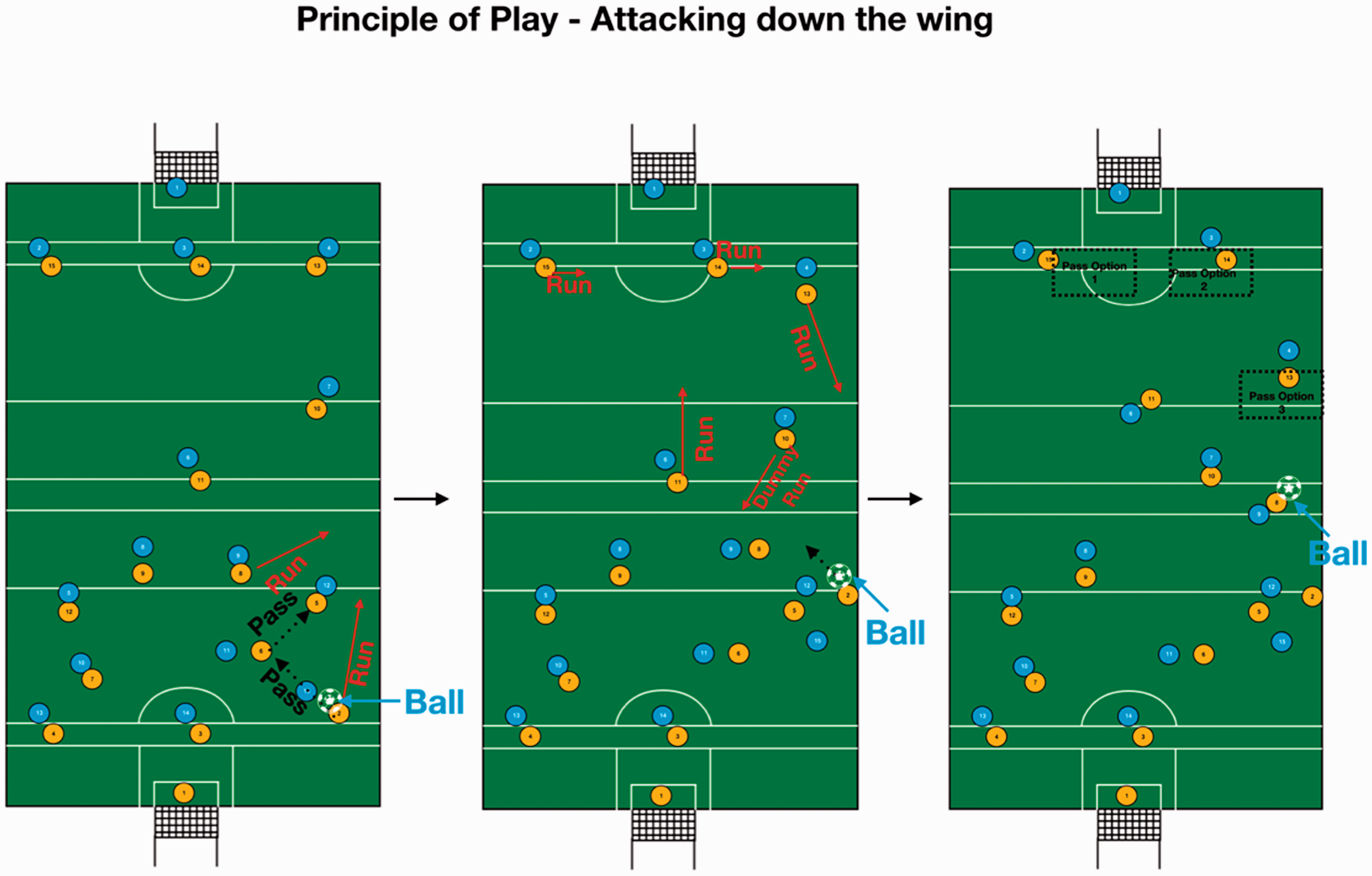
Example of principles of play scenario.
Gaelic football teams should spend a substantial amount of time on each of the 5 game moments discussed above, scaffolded by the training of the principles and sub-principles of play for each moment. Every exercise in training should, therefore, be based on the coaching of (i) the skills required to perform in a specific game moment, or (ii) the creation of match-like scenarios where the players can practice the principles and sub-principles of play in situ. For example, if working on transitioning from defence to attack, in a match most teams will not leave 6 forwards within the opposition 45 m line. Therefore, the exercise should not start with 6 forwards in their traditional positions, instead it should start with 3 forwards inside the opposition 45 m line, with the other 3 forwards starting much deeper in defensive positions where they would have been situated in a representative match context. Training practices should replicate match type scenarios, therefore there is little value in players practicing an action if it is not likely to take place in a match situation. 25
The morphocycle pattern
Tactical Periodisation models are implemented using a weekly pattern known as a ‘morphocycle’. The morphocycle follows the same pattern each week throughout the season and will only be altered if the number of days between matches change. 25 The morphocycle is structured so that there is a ‘horizontal alteration’ throughout the week. Horizontal alteration relates to the manipulation of training to emphasise the development of different physical, physiological and tactical elements at specific stages during the training week. 2 The training emphasis is switched on a daily basis to ensure that training of the physical components is balanced, while also providing sufficient recovery from the physical component stressed in a given session. 2 The typical weekly morphocycle for soccer, as described by Tamarit, 25 is presented in Figure 3. In weeks with a 5-day gap between matches, one day of training is removed to provide for adequate recovery time, and also to ensure that the team can prepare effectively for the next match.
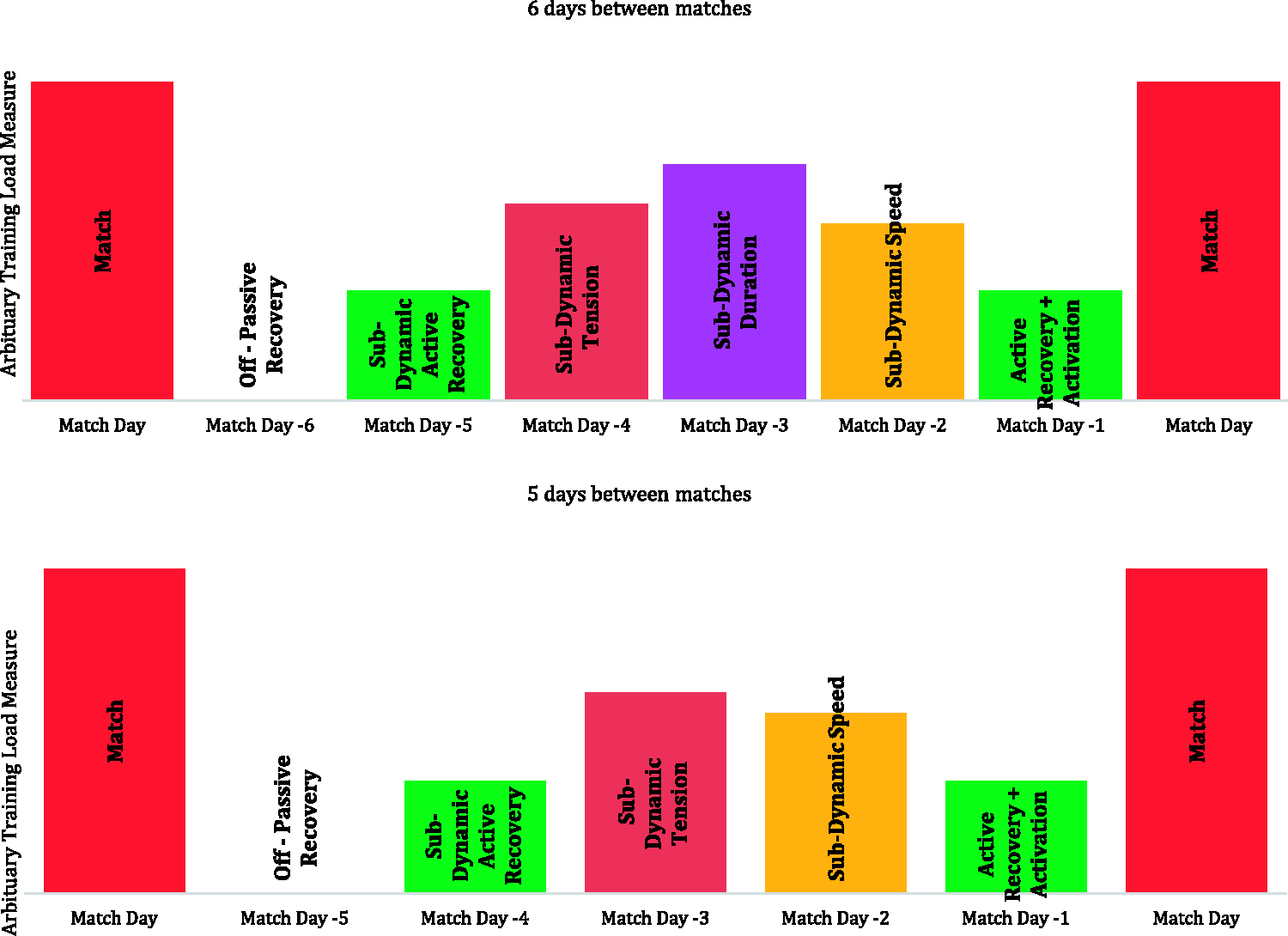
Traditional weekly soccer morphocycle.
This form of periodisation with the volume, intensity and training focus changing throughout the weekly morphocycle has previously been termed as a ‘daily undulated periodisation model’. 5 Such a model is in contrast to a ‘traditional periodisation model’ where the athlete performs the same number of sets and repetitions across the training week while varying the training load. 5 A proposed advantage of a ‘daily undulated periodisation model’ is that because the training focus is changed on a daily basis, there is less likely to be accumulated neural fatigue which would occur from doing the same type of exercises across the training week.5,37 However, it must be noted that undulating training models with a higher volume of training load have been linked to greater peripheral fatigue and increased injury risk, therefore training load should be planned carefully, particularly in periods of competition.5,38 Gaelic football is a sport that requires high levels physical strength, power, and ability to perform repeated high-intensity actions. 39 Therefore during in-season periods, it is not appropriate to block focus on singular physical attributes so training focus should vary from day-day within the morphocycle. Overtraining can occur if the volume or intensity of training is increased too rapidly over a period of months or even weeks without sufficient recovery time. 40 In order to prevent overtraining the Tactical Periodisation model proposed for Gaelic football will include 2 recovery days in the 7 day cycle. Coaches should avoid sudden spikes in volume and intensity by planning training loads carefully in advance.
Although one of the foundations of Tactical Periodisation is that no element of performance should be trained in isolation, it is unlikely that Gaelic football players can acquire the required physical adaptions for performance solely from pitch-based sessions. As mentioned previously, there are greater levels of physical contact in Gaelic football in comparison to the game of soccer. Because of the greater levels of physical contact in Gaelic football, supplementary resistance training is recommended to meet the high levels of muscular strength required. Therefore, similar to rugby, training cannot be completely tactical in nature. 2 Research in professional soccer has demonstrated that one strength session every week during the in-season is more effective at maintaining strength and sprint performance than one session every two weeks. 41 Rønnestad et al. 41 recommend performing the strength maintenance session between 1-2 days after a match and at least 2-3 days before the next match. The authors do not mention whether the strength maintenance session was completed prior to or post the pitch session. In rugby, it is proposed that the strength work is conducted prior to a pitch session. 2 However due to a lack of resources and facilities, particularly at the sub-elite level of Gaelic football, in most situations it would not be feasible to conduct a group strength session prior to a pitch session. In this proposed Tactical Periodisation model for Gaelic football, such a session could be completed on the day following a match (Figure 4 and Table 1).
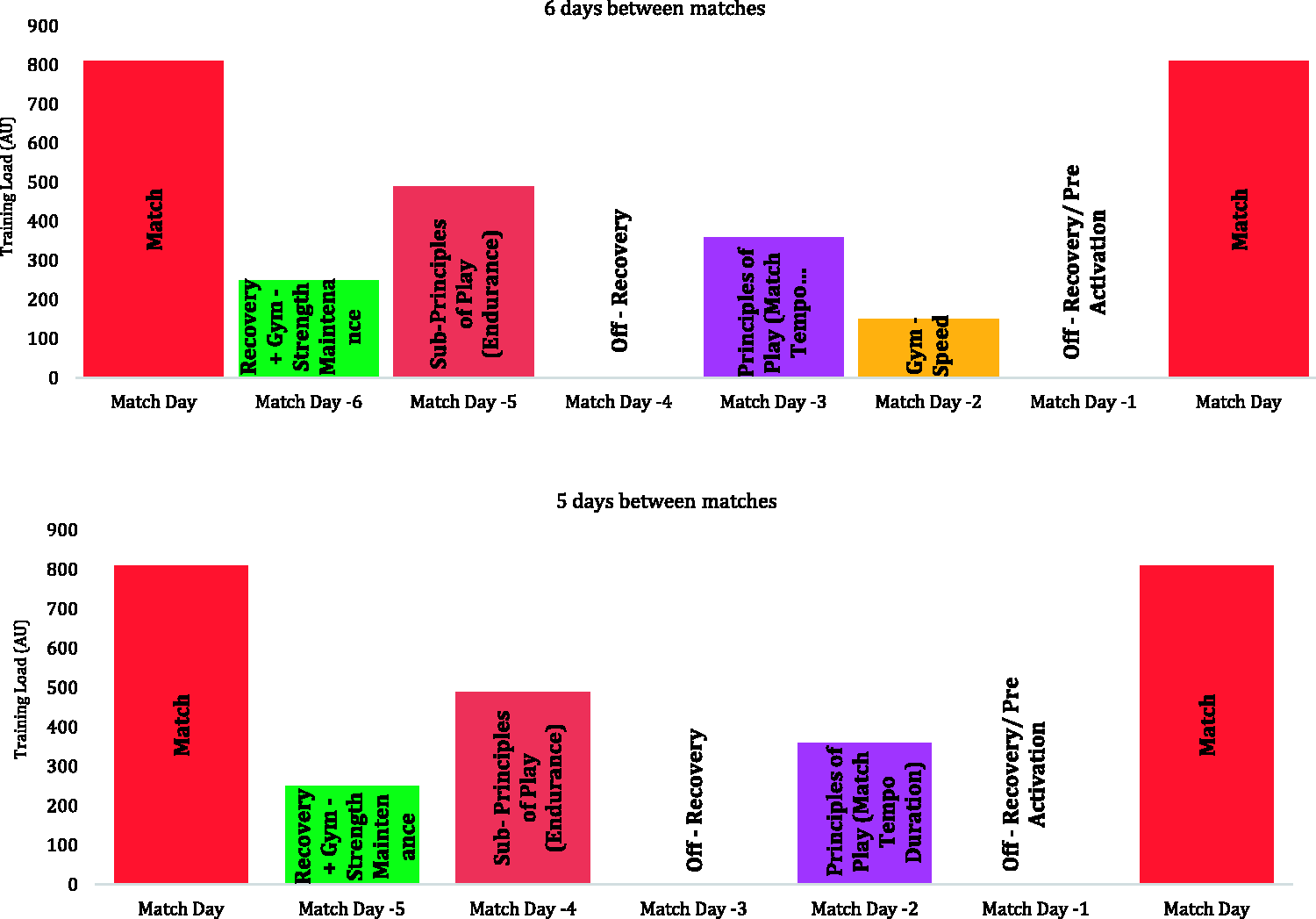
Proposed weekly Gaelic football morphocycle.
Weekly morphocycle with day to day detail.
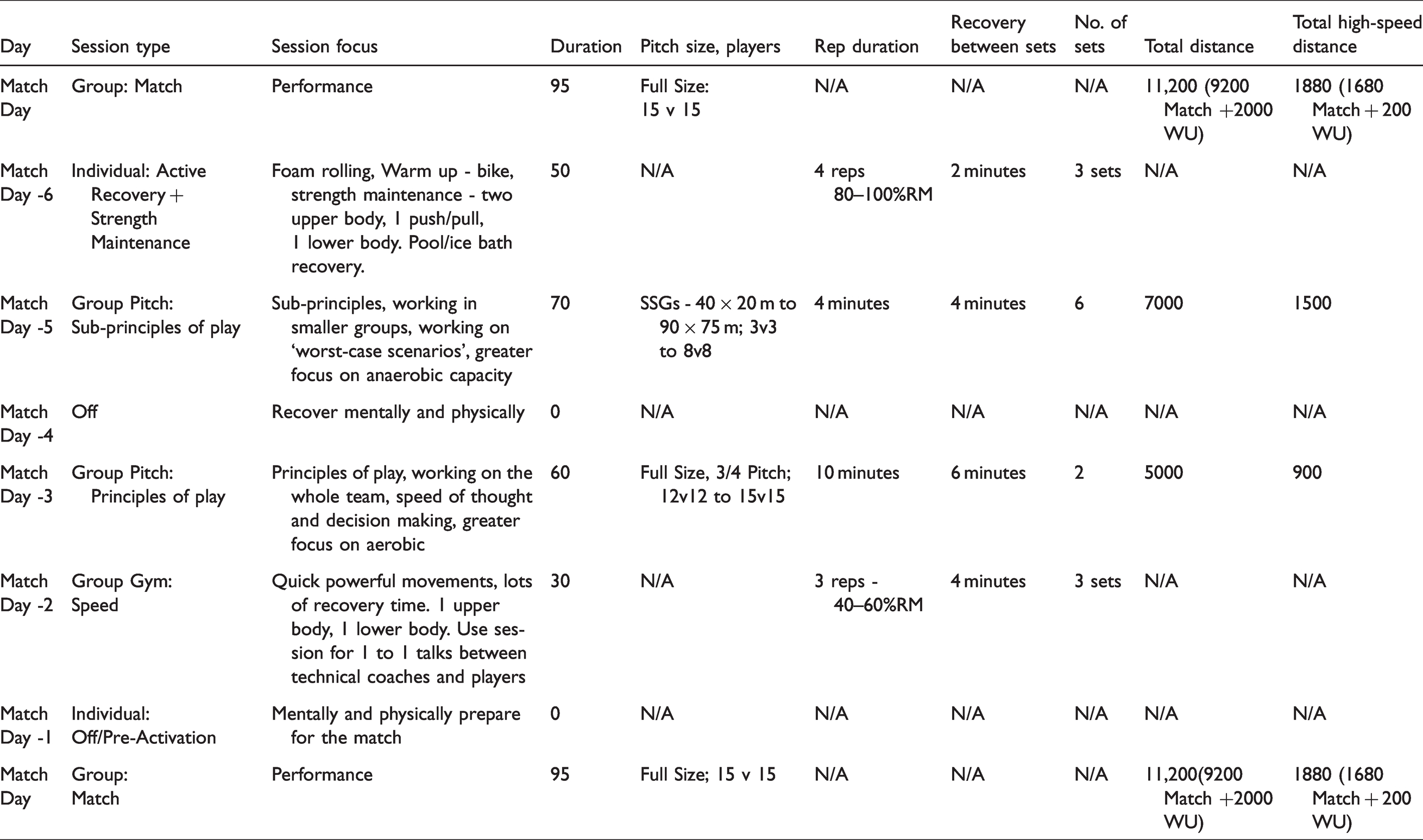
In designing a weekly training cycle for Gaelic football, one of the first considerations that needs to be accounted for is the amateur status of the sport (i.e. less training days in comparison to professional soccer or rugby union). Many players, particularly at the elite level, will have to travel long distances from their work to training and matches. 42 Due to work commitments, it is not feasible or reasonable to expect Gaelic football players to train more than 4 times a week as in many professional sports. The proposed weekly training cycle presented for weeks in which there are 5 and 6 days between games (Figure 4) relates to a typical training week during the National Football League and the All Ireland Championship (Table 1).
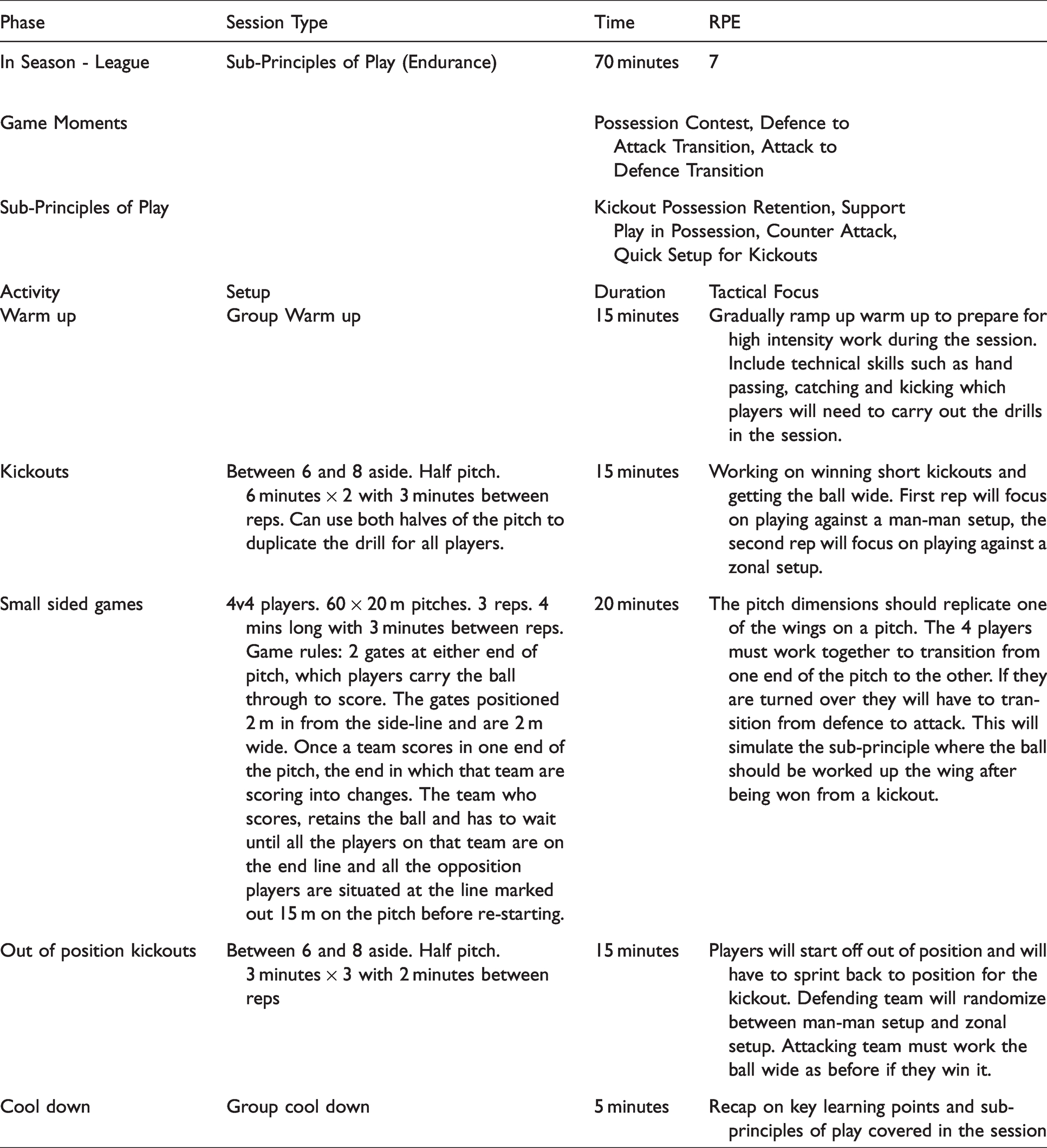
With reference to the Sunday-Sunday match cycle, there are a number of differences to the traditional soccer morphocycle. Match Day -6 is designated as a strength maintenance and active recovery day. The proposed session would not be collective to reduce any unnecessary travelling for players and would consist of a short gym session followed by a pool recovery session. The day would serve to facilitate adequate recovery from the match, while also maintaining strength from pre-season gains. Match Day -5 is designed as a training day called sub-principles of play (Endurance). It is similar in principle to the sub-dynamic tension session defined by Tamarit, 25 rather than the sub-dynamic active recovery session found on Match Day -5 in the soccer model. The proposed session workload would equate to approximately 60% of the load of a match, and while players would not be fully recovered from the previous match, this is the heaviest training day of the week, so is placed furthest away from the next match. 25 Typical training activities on this day would consist of players working in small groups on sub-principles of play while being exposed to challenging anaerobic conditions above match demands. A sample training session for sub-principles of play is presented in Table 2.
Sample tactical periodisation pitch session.
Match Day -4 is a complete rest day to provide the players with the opportunity to recover from the previous session and furthermore to rest mentally. Match Day -3 is similar to the sub-dynamic duration day in the soccer model, 25 however it is also combined with some sub-dynamic speed to incorporate some elements of decision-making at speed. The focus would be on using greater amounts of players on larger pitches for longer durations in comparison to the sub-principles of play (Endurance) session. The aim should be to practice full principles of play in a match-like scenario. Match Day -2 is recommended as a collective gym-based speed session where players will perform a low number of high-speed movements with large recovery times. The football coaches can use this gym session as an opportunity to discuss role-clarity and role-execution matters, both individually and collectively, with in the group. Finally, Match Day -1 is a rest day for players, where they will prepare individually for the match by doing some pre-activation exercises at their homes.
It has been reported that fitness levels 43 and physical match demands 44 in Gaelic football increase systematically across the season. The periodisation of training load will depend on the team’s objectives for the year. In both the sub-elite and elite levels of Gaelic football, the majority of teams will prioritise the Championship competition over the League competition. 45 The Championship competition is situated in the latter half of the season. As a result, teams are more likely to have higher training loads during pre-season and the early stage of the season when the aim is to build fitness levels; with a subsequent reduction in training load during the later championship phase, where the aim is fitness maintenance and match performance. Specifically teams should use the period following the League and prior to the Championship as a further precompetitive development stage. During this stage the focus would no longer be on match preparation and maintenance but rather furthering the development of physical, technical and tactical capabilities. For example, the strength maintenance session normally scheduled for Match Day-1 would change to a strength development session, with the intensity of lifts remaining the same and the number of sets increasing. 5 During this stage, the days normally designated as Match Days could serve as an extra pitch training session to develop a higher level of aerobic capacity which is required to meet the running performance demands of the Championship. 44 However, with any Tactical Periodisation model, it is important to adhere to horizontal alteration throughout the season, and keep the tactical objective of days constant. 25 To account for changes in fitness levels and match demands across the season, the number of activity bouts and session durations can be altered, rather than changing the tactical objective of training days. The format of the Championship at the elite level means that at certain times, teams can go 2-3 weeks without a game. In these periods teams have an opportunity for further physical development once again on a microscale. Likewise it is known that physical match demands are lower when playing against lower ranked teams, 30 which opens the possibility to increasing training load prior to matches versus lower ranked teams.
To conclude, the Tactical Periodisation model proposed here is appropriate for both elite and sub-elite Gaelic football teams. The examples provided above are based on elite team performance. To apply the same model to sub-elite teams, coaches should consider that the distance covered per minute is 15-23% lower in sub-elite match-play, while matches are 10 minutes shorter at the sub-elite level (i.e. 60 vs 70 minutes). 12 Sub-elite Gaelic football players also possess inferior fitness levels and have a higher percentage of adipose tissue than elite players.46,47 To account for the difference in playing levels, coaches should reduce the training load by approximately 15% for sub-elite players, whilst maintaining the same training days. In terms of planning training load, there should be constant discussions between the strength and conditioning coaches and the football coaches for both short term and long term planning of training. 2 While the majority, if not all, of elite inter county teams will have dedicated strength and conditioning coaches and sport scientists, many sub-elite teams will not have access to this expertise and may struggle to plan training loads and supervise physical conditioning sessions. 17 Should teams not have access to GPS for monitoring training load, internal training load can be measured and monitored by multiplying the session duration by session RPE.
Finally, the morphocycle proposed in Table 1 is derived from players who played the majority of minutes in each match. If players do not get game time, or only get limited game time, they should be given supplementary exercises to complete in the form of SSGs and conditioning runs to replicate the match intensity. This should be incorporated preferably on the match day but, if that is not possible, during the subsequent week without impinging on the horizontal alteration
Conclusion
The Tactical Periodisation model has been in existence for over 30 years; however, it has become more popularised in recent years with high profile soccer coaches advocating its methodologies. A proposed Tactical Periodisation model for Gaelic football is presented here, which can be applied by elite and sub-elite teams to prepare more effectively for competitive match-play. The Tactical Periodisation model should be designed with the football coach’s game model at the centre. The football coach must define their game model and how they want their players to play in each of the respective game moments. From this, they can explain to players their principles and sub-principles of play. All training exercises and games, therefore, must relate to the team’s principles and sub-principles of play, placing players in match-like scenarios where they have freedom to make decisions.
Careful attention should be placed on the number of players, size of the playing area, and length of time of each exercise to ensure that the desired physical, physiological and technical outputs are met, while also ensuring that it is appropriate for the tactical approach and philosophy. The morphocyle outlined ensures that the theory of horizontal alteration is observed across the week, over the 2 pitch sessions and the 1-2 gym sessions. While the structure of the morphocycle should remain consistent across the season, the level of team and stage of season will determine the volume and intensity of each session. To successfully implement a Tactical Periodisation model, the strength and conditioning coach/sport scientist and football coaches should be in constant communication with regard to short-term and long-term planning of training.
This is the first structured training model proposed for Gaelic football. The ideas outlined consider the amateur nature of Gaelic football, the physical demands of training and matches, and the differences between Gaelic football and other sports that apply a Tactical Periodisation conceptual model. The morphocyle should provide coaches with a structure that they can utilise to ensure that all elements are trained in a given week while affording adequate recovery time. While impossible to claim that applying a Tactical Periodisation model like the one proposed will lead to success, as it has yet to be trialled in Gaelic football, some teams may apply the model to assess whether it improves their training processes and match performance in their unique setting. Only then can the real value of Tactical Periodisation in Gaelic football be fully understood.
Footnotes
Declaration of Conflicting Interests
The author(s) declared no potential conflicts of interest with respect to the research, authorship, and/or publication of this article.
Funding
The author(s) received no financial support for the research, authorship, and/or publication of this article.
