




Abstract
Offloads are an effective way of breaking through a defensive line in rugby union. Higher tackle heights are considered an effective strategy to defend against offloads. However, in a bid to reduce head injuries, there is a cultural shift within the rules of the game to tackle lower down on the body. This study used match video analysis of ten games from the 2019 Rugby World Cup to investigate whether tackle height influences offload success for the ball carrier. Each legal tackle was categorised based on tackle height (e.g. shoulder), player body position (e.g. upright), tackle type (e.g. shoulder tackle), tackle direction (e.g. front on) and player position (e.g. tight forwards). For each characteristic, the Odds Ratio (OR) and 95% Confidence Interval (CI) were calculated based on offload success outcome. Tackles at the hip (OR = 1.81, 95% CI 1.10 to 2.96, p = 0.018) and upper leg (OR = 1.94, 95% CI 1.30 to 2.90, p = 0.001) had a greater propensity to result in offload success while tackles at shoulder height reduced offload success (OR = 0.09, 95% CI 0.04 to 0.22, p < 0.001). A bent at the waist tackler against an upright ball carrier had a greater propensity to result in offload success (OR = 1.74, 95% CI 1.19 to 2.54, p = 0.004). Tackling lower increased the chances of offload success for the ball carrier. The cultural shift towards lower tackle heights is likely to result in an increased number of offloads and it is up to players, coaches and defensive systems to be able to adapt to this.
Introduction
Rugby union is a high-paced, dynamic and territorial collision sport. 1 These collisions occur in the tackle, ruck and maul situation. A major cause of injuries and concussion in rugby union is tackling. 2 There are on average a total of 220 tackles in a single game of rugby union. 3 It has been found that over 50% of all concussions occur in the tackle. 4 This is believed to be a result of two factors, the dynamic nature of the tackle and the high number of tackles that take place in a game. 5 Illegal high tackles (contact above the lines of the ball carrier’s shoulder) result in a significantly higher risk of concussion. 6 Although both the tackler and ball carrier are at risk of injury, illegal tackles injure the ball carrier more while legal tackles lead to more injuries to the tackler. 6
In a bid to reduce injuries, World Rugby are trialling and implementing rule changes that encourage tackling lower down on the body. 5 Tackling higher results in increased concussion risk to both the tackler and ball carrier. 6 One of the measures utilised by World Rugby was a no tolerance policy on illegal high tackles. The World Rugby High Tackle Framework brought in stricter penalties for any contact above the line of the ball carriers shoulder, particularly when contact with the head or neck is made. 7 Mitigating factors that illustrate that the tackler attempted to tackle lower, through a bent at the waist body position, to avoid the ball carrier’s head are included in the framework. Law changes have the potential to reduce injuries. A trial on a new tackle height law in rugby union was carried out in the Championship cup competition in England. 5 Players could not tackle above the armpit line of the ball carrier. However, the trial had the unintended consequence of increasing tackler concussion rates under the new law. 5 In addition to law changes, improved tackle technique training and player and coach education have the potential to prevent injuries.
Video analysis of matches has been used to identify performance strategies in rugby union. 8 Previous research has been done using match video evidence on the impact of tackle height on tackle dominance. 9 Tackling the upper body may prevent the ball carrier from offloading as the tackler is able to hold onto the ball or disrupt the ball carrier’s arms movements. The offload has become a major part of the modern game and is effective in unlocking defences. One study found that there is a positive association between the number of line-breaks and offloads and the amount of points that are scored against a team. 10 Offloading in the tackle was associated with scoring a try within two phases. 10 Research in rugby league found that performing a front on tackle at the chest region led to a reduction in offload success. 11
Hendricks et al. 12 concluded that front on tackles are effective at the prevention of offloads. The same study also found that fending and leg drive in the tackle increased the chance of offloading for the ball carrier, while tacklers executing a front-on shoulder tackle with leg drive was the most effective way to decrease chances of an offload. 12 Strong fending strategies created opportunities to offload the ball during the tackle. 13 It was further found that an attacker using an evasive manoeuvre such as a fend or sidestep significantly decreased the chances of a defender stopping an offload. 14 Given the implementation of the World Rugby High Tackle Framework, the main aim of this study is to use match video evidence to examine the influence of tackle height and player body position in the tackle on offload success. In order for injury prevention strategies through law changes to be effective, they ideally need to not adversely affect performance.
Methods
Data collection
Ten games from both the pool and knockout stages of the 2019 Rugby World Cup were randomly selected and analysed. The footage was available online and no medical data were reported. Thus ethical approval was not needed similar to previous rugby union video analysis studies.15,16
Tackle and offload definitions
A tackle was defined as an event whereby one or more tacklers attempt to stop a ball carrier regardless of whether or not the ball carrier was taken to the ground. 17 There were two outcomes in the tackle, offload and no offload. An offload is when a ball carrier successfully passes the ball to a teammate while being tackled while a ‘no offload’ was defined as when a player did not successfully pass the ball to a teammate while being tackled. 17
Tackle analysis
For this study, only single tackler tackles were analysed. For tackle height, legal tackles were classified into lower leg, upper leg (area between the shorts line and the knee), hip, torso, arm and shoulder tackles. 17 Player body position for both the tackler and ball carrier was classified as either bent at the waist, upright or falling. 6 Tackle type was categorised as shoulder, smother, jersey, tap or arm tackles. 18 Tackles were classified as front-on, side-on or behind tackles. 9 Tacklers and ball carriers were classified into their positions as tight forwards, loose forwards, inside backs and outside backs. The videos data were broadcast at 25 frames-per-second and Kinovea video software (Version 8) was used to analyse the video frame-by-frame.
Statistical analysis
For each parameter, odds ratio, 95% confidence interval (95% CI) and significance (p) values were calculated. 19 The odds ratio was calculated by comparing the frequency of occurrence of successful offloads with the frequency of occurrence of no offloads. If the odds ratio (OR) is equal to one it means that the condition does not have a greater or lesser propensity to result in offload success. If the OR is greater than one or less than one, it means that there is a greater and lesser propensity to result in offload success respectively. A variable is considered to be statistically significant if the 95% CI did not include 1 and the p value is less than 0.05. 8
Reliability
Two coders analysed the same randomly selected 25 tackle cases in order to determine the inter-rater reliability. The main coders then performed another analysis on the same 25 tackle cases at least one month after the original analysis in order to test for intra-rater reliability. Reliability was assessed by use of Cohen’s kappa. A kappa value of more than 0.8 indicates almost perfect agreement. 20 The overall inter-rater reliability was 0.87 and the intra-rater reliability was 0.92.
Results
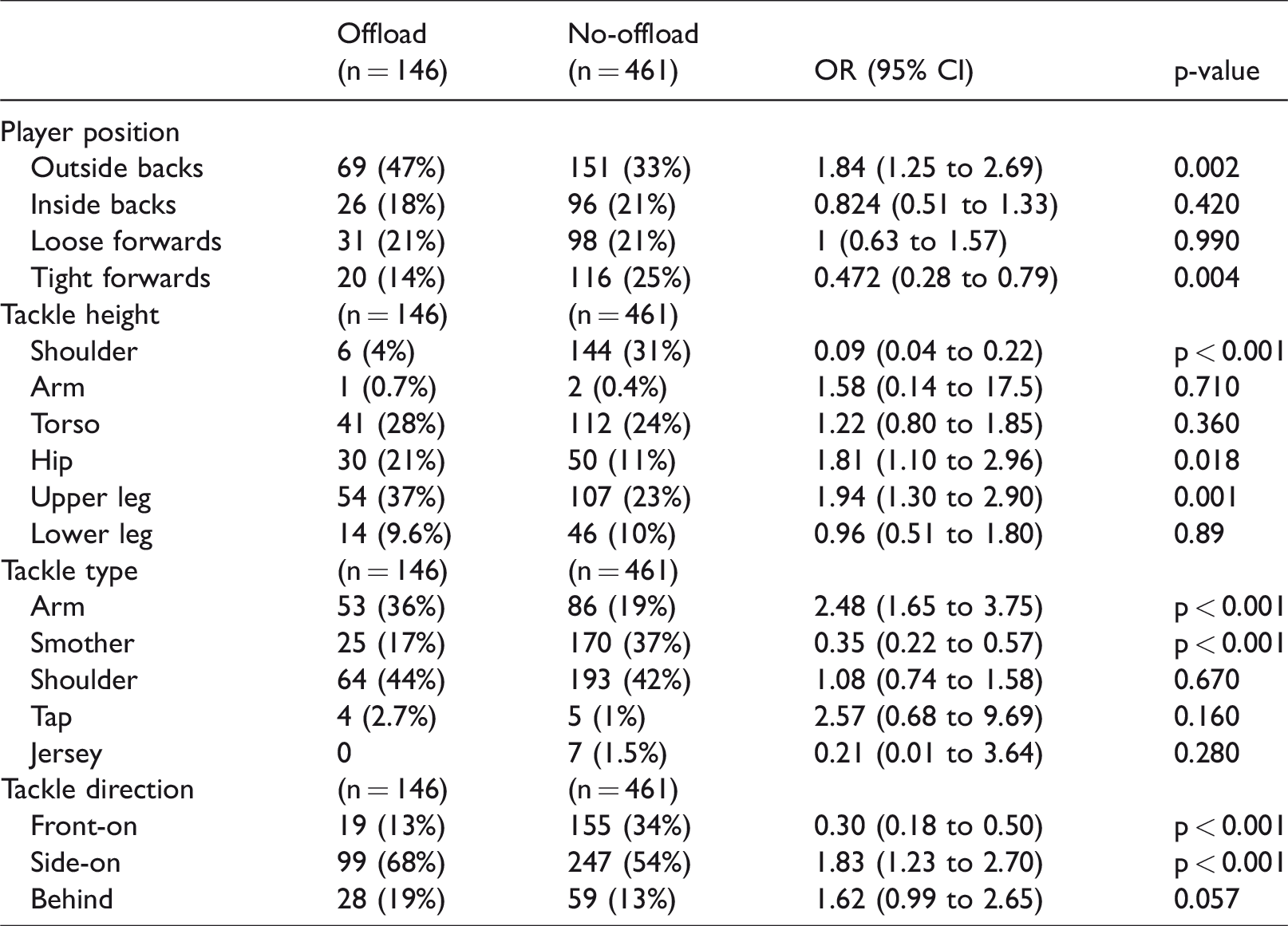
A total of 607 tackle cases were analysed with 146 resulting in offloads. Side on tackles had a higher propensity to result in offload success (OR= 1.83, 95% CI 1.23 to 2.70, p < 0.001) and front on tackles had a lower propensity (OR= 0.30, 95% CI 0.18 to 0.50, p < 0.001), see Table 1. Arm tackles had a greater propensity to result in offloads success (OR= 2.48, 95% CI 1.65 to 3.75, p < 0.001) whereas smother tackles had a lower propensity (OR= 0.35, 95% CI 0.22 to 0.57, p < 0.001).
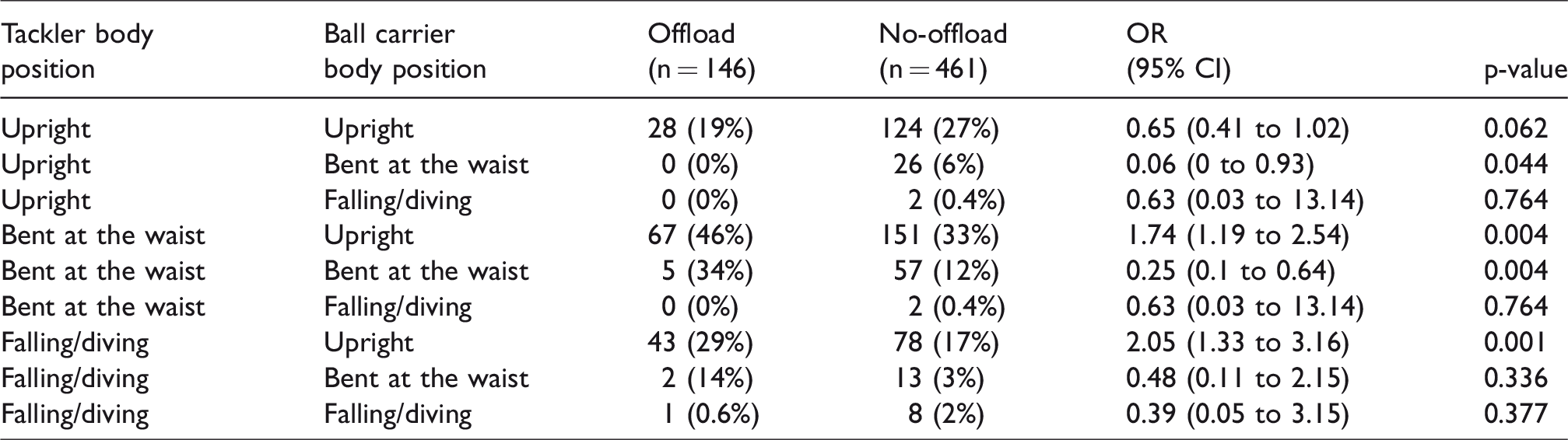
Tackles at the upper legs had the highest offload success for tackle height (OR= 1.94, 95% CI 1.3 to 2.9, p = 0.001), see Table 1. Tackles at shoulder height resulted in lower offload success (OR= 0.09, 95% CI 0.04 to 0.22, p < 0.001). Outside backs were more likely to offload (OR= 1.484, 95% CI 1.25 to 2.69, p = 0.002). than tight forwards (OR= 0.47, 95% CI 0.28 to 0.79, p = 0.004). A tackle scenario with a tackler bent at the waist and ball carrier upright was found to have a higher propensity for offload success (OR= 1.74, 95% CI 1.19 to 2.54, p = 0.004), see Table 2. Conversely, a tackle with an upright tackler and a bent at the waist ball carrier to have a lower propensity for offload success (OR = 0.06, 95% CI 0 to 0.93, p = 0.044).
Discussion
The study made use of video evidence to evaluate whether tackling lower resulted in a higher propensity for offload success. Front on tackles were found to be the most effective method of defending against offloads in terms of tackle direction which agrees with previous findings. 1 Front on tackles give the tackler an opportunity to hold onto the ball as the ball carrier runs into them. Additionally, it is harder to free the arms when held in a front on tackle. 1 One study found that when a player uses footwork to evade a front-on tackle, the defender is left in a relatively weak position and the attacker is able to free their arms to offload the ball. 14
Tackles at the hip and upper leg had a higher propensity for offload success. The ball carrier is able to free their arms in the tackle at these tackle heights. Tackling at shoulder height means that the arms and ball are wrapped up, taking away the ability to offload. This agrees with a study in rugby league which found that tackling at the chest region is the most effective way of defending against offloads. 11 A study investigating the impact of tackle height on overall tackler success 8 found smother tackles at the shoulder to be an ineffective strategy of tackling as it enables the ball carrier to use leg drive and go past the gain line. In addition to this, they are able to fend off the tackler. Despite having a low propensity for overall tackler success, tackles at shoulder level were more effective at preventing offloads in this study. A well-executed offload can lead to a line break leaving a team more vulnerable when compared to a completed tackle in which the ball carrier had overall tackle success. One previous study found that tackling lower increased the chances of a successful tackle, however it gives the ball carrier a better chance to execute an offload. 1
Similarly, when the tackler was bent at the waist and the ball carrier was upright, there was a significantly greater propensity for offload success. The reason for this could be that when the tackler bends at the waist, the upright ball carrier will be able to free their arms. 5 focused on the results of a trialled law in which any tackle below the armpit was deemed illegal. One result of this was that there was a change in tackler and ball carrier behaviour. Tacklers adopted a bent at the waist body position when approaching tackles in order to target lower on the ball carrier’s body. Ball carriers carried the ball in a bent at the waist body position less often. 5 This shows that when the tackle height reduces, there are more situations where a bent at the waist tackler tackles an upright ball carrier. Based on the results of this study, the cultural shift towards lower tackle heights through frameworks and law changes is likely to result in an increased number of offloads and it is up to players, coaches and defensive systems to be able to adapt to this.
There appears to be a trade-off between safety and performance when it comes to tackler body position and tackle height. Tucker et al. 6 previously found that a bent at the waist tackler body position reduced the risk of a head injury assessment and an upright tackler increased this risk. However, in this study, we found that an upright tackler reduced the propensity for offload success but a bent at the waist tackler increased this propensity. Tierney et al. 16 found that smother tackles around the chest/shoulders increased the risk of a head injury assessment for the tackler. However, in this study it was found that this reduced the propensity for offload success. Tierney et al. 16 also found that shoulder tackles at the upper legs increased the risk of a head injury assessment for the tackler. Shoulder tackles at the upper legs should be discouraged as they also increased the propensity for offload success in the current study.
Arm tackles were found to have a high propensity to result in offloads which agrees with previous findings. 13 Wheeler et al. 13 categorised a tackler reaching to the ball carrier with an outstretched arms in an attempt to tackle them as moderate defensive position. Wheeler et al. 13 found that 51% of all offloads occurred with moderate defensive positions which were in essence arm tackles. 13 An arm tackle to the torso is not effective as the ball carrier has a large effective mass at the torso which would allow the ball carrier’s momentum to overcome the impact of the arm. 8 Additionally, arm tackles limit the tackler’s hold on the ball carrier. 1 This makes it easier for an offload to occur as the ball carrier’s arms are free. Stokes et al. 5 found that when the tackle height law was lowered in the English Championship competition, there was a significant increase in arm tackles, a tackle type that favours offload success. Smother tackles resulted in lower offload success. According to the World Rugby coaching manual, the aim of a smother tackle is to target the ball and wrap their arms in a bid to trap the ball and the ball carrier’s arms. 21 By trapping the ball, the ability for the ball carrier to offload is limited.
With regards to position, outside backs had the highest offload success. A study found that playing the ball wide significantly reduced the probability of a team defending against an offload. 14 Typically, it is the outside backs who play out wide meaning they are generally in better positions to offload the ball when compared to other players who play tighter. Tight forwards had the lowest significant propensity for offload success. This could be because a lot of tight forward play in narrow channels therefore preventing them from getting into a good position to offload the ball.
The results from this study can assist coaches in training their players on how to effectively offload and effectively defend against an offload. Drills focusing on evasion strategies such as a sidestep or a fend can be utilised as they will put the attacker in an effective position to offload. Defence drills in which the tackler aims at the ball carrier’s shoulder region and attempts to wrap the ball can be used in training how to defend against offloads.
Limitations
Only one camera angle was available to the reviewers which results in tackles being omitted from analysis when there were occlusions, though this did not occur more than ten times. Only ten international games were selected for the study which was a limitation as there were forty eight games in the tournament. However, the results from the ten games were in line with previous studies with regard to the tackle height and tackle technique. 15 , 16 Thus, results are applicable to the elite game. Potentially, these results are applicable to amateur and youth level rugby however further research in these areas is needed. Further monitoring of other teams should be pursued. The approach utilised in this study can be used by coaches to identify any differences for their own team which can result in customised tackling training regimes to be created based on their own team’s needs.
Conclusion
Tackling higher reduced the chances of offload success for the ball carrier. However, there appears to be a trade-off between safety and performance when it comes to tackler body position and tackle height as previous studies have found that tackling high increases head injury assessment risk. When coaching how to defend against the offload, front-on tackles should be encouraged and arm tackles and tackles to the upper legs discouraged. The cultural shift towards lower tackle heights is likely to result in an increased number of offloads and it is up to players, coaches and defensive systems to be able to adapt to this.
Offload success results based on player position, tackle height, tackle type and tackle direction (includes % occurrence, odd ratios (OR) with 95% confidence intervals (95% CI) and p values).
Offload success results based on tackler and ball carrier body position (includes % occurrence, odd ratios (OR) with 95% confidence intervals (95% CI) and p values).
Footnotes
Declaration of conflicting interests
The author(s) declared no potential conflicts of interest with respect to the research, authorship, and/or publication of this article.
Funding
The author(s) received no financial support for the research, authorship, and/or publication of this article.
