




Abstract
Talent identification and selection in soccer has been shown to be confounded by individual differences in relative age and biological maturation. Limited research has however, investigated whether these effects are reflected in coaches’ evaluations of performance. This study investigated relative and biological age associated differences in coach perceptions of performance in a professional soccer academy across four seasons. The performances of 279 male players were evaluated on a 4-point Likert-scale. Multi-level modelling was used to examine predictive relationships between biological age, chronological age, result and opposition of game, on match grades. Result of the games was a statistically significant predictor of players perceived performance in every age-group; category of opposition was only significant in the under 13 and 14 age-groups. Biological age significantly predicted players perceived performance grades in the under 10, 14 and 15 age-groups, whereby advanced maturity predicted a higher grade. Across all age-groups, a relative age effect was observed, however age half was not a significant predictor of perceived performance grade in any age-group. Coaches evaluations of match performance appear to vary in accordance with maturity, opposition, and result of game. Academy staff should recognise and account for individual differences in biological maturation when retaining and releasing players.
Introduction
The identification and development of young soccer players is a primary objective of professional soccer academies. 1 Professional soccer academies scout and recruit talented players from increasingly young ages. 2 Those identified as talented are invited to join development programmes and/or academies and benefit from greater investment in their development and access to professional coaching and sports science/medicine support.3,4 The literature surrounding talent identification advocates for a holistic approach, considering the athlete’s physical, technical and psychosocial attributes. 5
Two factors known to impact player selection and retention in academy soccer are relative age and biological maturity.6,7 Relative age is the difference in chronological age between the oldest and youngest individuals within an age group determined by date of birth and age group cut off dates. Athletes born close to the sporting cut-off date (September 1st in English soccer) are chronologically almost one year older than their peers born at the end of the sporting year (August 31st). In contrast, biological maturation refers to the process of progression towards the mature state, defined in terms of status, timing and tempo. 8 Children of the same chronological age have been shown to vary by as much as five to six years in skeletal (i.e., biological) age.3,9 Individual variation in maturation is determined by a combination of hereditary (i.e., genes) and, to a lesser extent, environmental factors (e.g., stress).10,11 Thus, it is entirely possible for the oldest athlete within a competitive age group to also be the least mature within his or her cohort, and vice versa. 7 In support of this contention, recent research observed that relatively younger male players were more likely to be advanced in maturation for their age. 12
Relative age and biological maturity are often considered and treated as synonymous. They do, however, exist and operate independent of one another. 4 The relative age effect (RAE), whereby older players are disproportionally represented and retained in youth soccer, can be observed from early childhood and is relatively stable through adolescence.7,13,14 Whereas some studies have reported a reversal of the RAE in adulthood; an equal, if not greater number, of studies have reported no such reversal or, at most, a small attenuation in the effect. 15 In contrast, the selection bias towards players advanced in maturity emerges with the onset of puberty (approximately 11 to 12 years of age) and generally increases with age and level of competition.3,8 Given the independent nature of these phenomenon’s, it is logical to assume that the RAE and maturity selection biases arise from and be governed by different factors and, thus, may require independent solutions.
The physical and athletic advantages (i.e., greater size, lean mass, speed, power and strength) of advanced maturation are well documented in boys’ soccer.6,16,17 Most of this evidence is, however, limited to tests of strength, speed and power using standardised testing batteries. Advanced maturation has also been shown to be contribute towards more successful performance on a range of different skills tests, though to smaller degree. 18 The extent to which these advantages are also observed in relation to in game performance is, as of yet, unclear. Some studies have investigated the influence of biological maturity on match performance but have assessed physical capacity through speed zones 19 and match running performance, 20 rather than performance as a whole. Although standardised performance testing and objective data collected through Global Positioning System (GPS) can aid the practitioner’s understanding on player’s ability and potential, it may not reflect the quality of the individual’s technical or tactical attributes.21–23 Accordingly, Malina recommended that further studies are needed to understand variation in performance associated with maturity, which need to include a broader variety of performance measures than traditional standardised testing. 17
The ‘coach’s eye’ is considered to be an essential part of the talent identification process; skilled, knowledgeable, and experienced coaches and scouts are often employed to recognise potential athletes, with physiological testing results used to support the subjective assessment of talent.1,21 In addition to the player’s inherent attributes (i.e., skill, performance, knowledge, technical & tactical awareness), coaches’ evaluations of talent in soccer have been shown to be influenced by a multitude of factors including intuition, experiences, personal preference and philosophy, and the sporting culture. 23 Coaches’ evaluations of player performance across games also play a central role in the process of deciding whether players are recruited, retained, or released. The physical and athletic advantages associated with advanced relative age and/or biological age may also act to influence coaches’ perceptions of talent.4,24
Primary scientific literature promotes multi-dimensional models of talent identification; however the coaches’ subjective assessment of game performance continues to be used as a core indicator of ability and future potential.25,26 The coach’s observation of match game performances provides a holistic measure of performance, as players are able to show a variety of their talent and skills. Early maturing players are able to display their strength, speed, and power and therefore tend to dominate the game physically,4,27 whereas later maturing individuals are more likely to display their technical and tactical ability (i.e. decision making, awareness) which are all deemed important qualities for success. 28 Coaches can use and integrate the information from a number of different domains shown in a game to judge the player as a whole. 26 The coach’s perceptions of their player’s performances is crucial, therefore a holistic approach to evaluating performance, such as game observations, is required. As previously noted, it is often the coach’s decision as to whether a player is selected or released from a talent programme, thus evaluating if relative age and biological age influence the coach’s perceptions of performance throughout adolescence is imperative.
Research investigating the impact of relative age and biological age upon coaches’ evaluations of performance are limited. Biological maturation has previously been shown to influence coaches’ predictions of long-term potential in under-16 Australian male soccer players. 29 Coaches were asked to rate each player’s long term potential in terms of the level of competition they will attain; results demonstrated that later maturing players were perceived to have a significantly lower long-term potential than their average and early maturing teammates. 29 This study used a cross-sectional rating of potential, in a group of under 16’s. 29 As soccer is a sport that selects for early maturing boys from eleven years of age, it is possible that the sample in this study may not have had the appropriate range of early, on time and late maturing players required to fully understand the associations between maturity and coach perceptions of ability/potential.3,8
In light of the previous discussion, the purpose of the current investigation is to understand the degree to which variance in relative age and biological age influences coaches’ perceptions of game performance in elite youth soccer players who play for an English Premier League Soccer Academy (Southampton Football Club). Assuming that older relative and biological age afford a performance advantage in youth soccer, it was predicted that both of these variables would be positively associated with coach evaluations of match performance. That is, relatively older and more mature players would receive higher match ratings than their younger and/or late maturing peers, respectively. Given that coach evaluations of player performance may be confounded by the game outcome and standard of opposition, these variables were examined in parallel with differences in biological and relative age.
Method
Participants
Participants included male academy players registered and playing for the under-9 to under-16 age groups at Southampton Football Club between July 2014 and June 2018. Players were divided into chronological age groups of 12-month bands, beginning in September and ending in August. Data was collected from all academy games within this time (tournaments excluded). Within this period, 279 participants were included, however many players participated in multiple games over the four seasons and therefore 13199 data points were collected. For a game to be included within the analysis, the player must have played over 40 minutes in the game, thus the final number of data points analysed was 12272 from 279 athletes.
Relative age (age-half)
A player’s birthdate and date of game was used to calculate their decimal age for each game. Within each team (age group) playing every game, players were ordered in terms of their chronological age and split into two halves. The players in the top half (coded as 0) represented the oldest and the players in the bottom half (coded as 1) the youngest. This was carried out to understand where a player was positioned in their team in terms of their chronological age. Birth quarter was also collected, with September, October and November coded as birth quarter 1, December to February as birth quarter 2, March to May as birth quarter 3 and June, July and August coded as birth quarter 4 to understand relative age.
Biological age (%PAH z-score)
Biological maturity status was estimated using percentage of predicted mature adult height attained at the time of observation. 30 Among children of the same chronological age, children who are estimated to be closer to their adult height (higher percentage) are more advanced in maturation compared to those further away from their predicted adult height. To predict adult height, the Khamis-Roche method was used which requires current age, height and weight of the player and mid-parent height (i.e. the biological parents mean height). 30 The median error bound for this Khamis-Roche method between the actual height and that of the predicted adult height is 2.2 cm for males between the ages of 4 to 17.5 years. 30 For the age groups used within this study, 9 to 16 years old, the lowest 50% error was 1.3 cm for the 16 year olds, and the highest 50% error was 2.8 cm for the 14-year olds. 30 Trained academy sports scientists used standardised procedures to measure height and weights of the player (around every 12 weeks). Parents self-reported their heights, which were subsequently adjusted for overestimation. 31
For each game the most recent estimate of biological maturity status was utilised. To be included the nearest measurement of biological maturity status had to be within the six months before the game. If a player missed a measurement and therefore didn’t have a measurement within the six months before the game, their biological maturity status was coded as missing for that game; if a player’s biological maturity status could not be estimated (no biological parent height) their biological maturity status was coded as missing. For every game a z-score was created using percentage of predicted adult height to understand where each player was positioned in their team in terms of their biological maturity.
Match grade, result and opposition
As part of normal procedures in Southampton’s soccer academy, every player has their performance evaluated and graded by their coach. Grades range from one to four, with one representing not at academy standard; two, approaching academy standard; three, meeting academy standard and four, exceeding academy standard; standards are outlined by the academy relative to what is expected at each age group. Consequently, for every game a player has participated in they have a corresponding match grade indicating their performance (to be included in the analysis, the player must have played over 40 minutes in the game). Opposition teams were coded according to the Premier League Academy category status, with the standard of the opposing team rated from 1-4, with 1 being the most elite and 4 the least elite opposition (local grass-root teams). Result of each game was also coded as loss (0), draw (1) and win (2).
Ethics
When players register with Southampton Football Club’s academy, they and their parents/guardians’ consent to routine collection of data. This also includes consent to the potential use of this data for research and publication purposes. All measurements of height and weight were taken on a voluntary basis and participants had the right not to be assessed. The Research Ethics Approval Committee for Health of Bath University (REACH) approved this research study and the right to use the retrospective anonymous data.
Statistical methods
Data was inputted and analysed using IBM SPSS (version 23; SPSS Inc, Chicago, USA). Descriptive statistics were conducted looking at means and standard deviations of chronological age, match grades and percentage of predicted adult height. A series of multi-level models (i.e. hierarchical linear modelling) using maximal likelihood estimation were conducted to examine the predictive associations between biological maturity status, relative age, result and opposition and the performance match grade amongst. Separate analyses were conducted for each age group. In accordance with processes outlined by Field (2005) a stepwise approach was employed whereby potential predictors of match performance were entered in stages and the comparative fit of successive models was evaluated at each stage. 32 Model fit was evaluated using the Akaike Information Criterion (AIC). 33 The AIC was chosen as the index of model fit as it provides a better estimate of comparative fit across models, is more conducive to model parsimony, and less likely to generate an overfitted model. The baseline Model (Model 1) included only the dependent variable (i.e., match grade). A random intercept model accounting for the nesting of repeated measures across individuals was then tested (Model 2). In the next model, the slopes describing the predictive association of maturation, age-half, opposition status, and match outcome upon match performance were entered as fixed factors (Model 3). In the final model (Model 4), the slopes were allowed to vary for age-half, result and opposition status. Biological maturation remained as a fixed factor in the final model as it was entered as a continuous and non-categorical variable.
Results
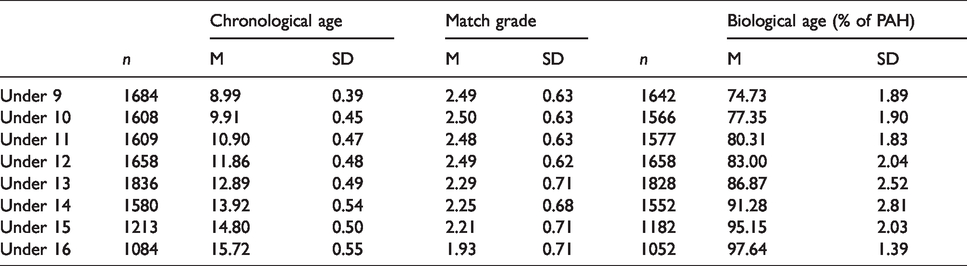
Descriptive statistics for chronological age, match grade, and percentage of predicted adult height are reported in Table 1. The descriptive statistics shows the mean values for chronological age and biological age increases with successive age groups. For percentage of predicted adult height, the standard deviation generally increased with age up to the under 15 age group (with the exception of the under 11 age group). Mean match grades generally decreased with age and standard deviations remained fairly consistent across the age groups. The relative age effect, when expressed by birth quarters, 47.6% of all players were born in birth quarter 1 (September-November); corresponding percentages of players born in the other birth quarters were 22.6% in birth quarter 2, 17.0% in birth quarter 3 and 12.8% in birth quarter 4 (June to August).
Descriptive statistics showing means and standard deviations of chronological age, biological age (%PAH) and match grade and across the age groups.
Across all of the age groups, Model 3 was statistically significant and provided the best degree of model fit. That is, allowing the slopes to vary relative to result, standard of opposition, or age half did not result in any improvements to model fit. As such, Model 3 was treated as the final Model in all age groups. The Estimated Mean coefficients (β), standard error estimates (SE), significance (p) and 95% confidence intervals (CI) associated with the best fitting Model is presented in Table 2. Consideration of the main effects associated with Model 3 demonstrated that advanced maturation was positively associated with higher ratings of match performance in the U10, U14 and U15 age groups. Relative age (age half) was, however, unrelated to coach evaluations of match performance in any of the age groups. Game outcomes were positively associated with ratings of match performance in all of the age groups. That is, coaches awarded higher ratings of match performances when the game outcomes were more positive (i.e., draws and wins, versus losses). Finally, opposition status was associated with superior rating of match performance in only the U13 and U14 age groups, with players in these age groups being awarded higher match ratings when competing against poorer opposition level academies.
Multi-level Model explaining biological maturation (%PAH z-score) and chronological age (age half- oldest or youngest halves) relative to teammates on performance match grade.
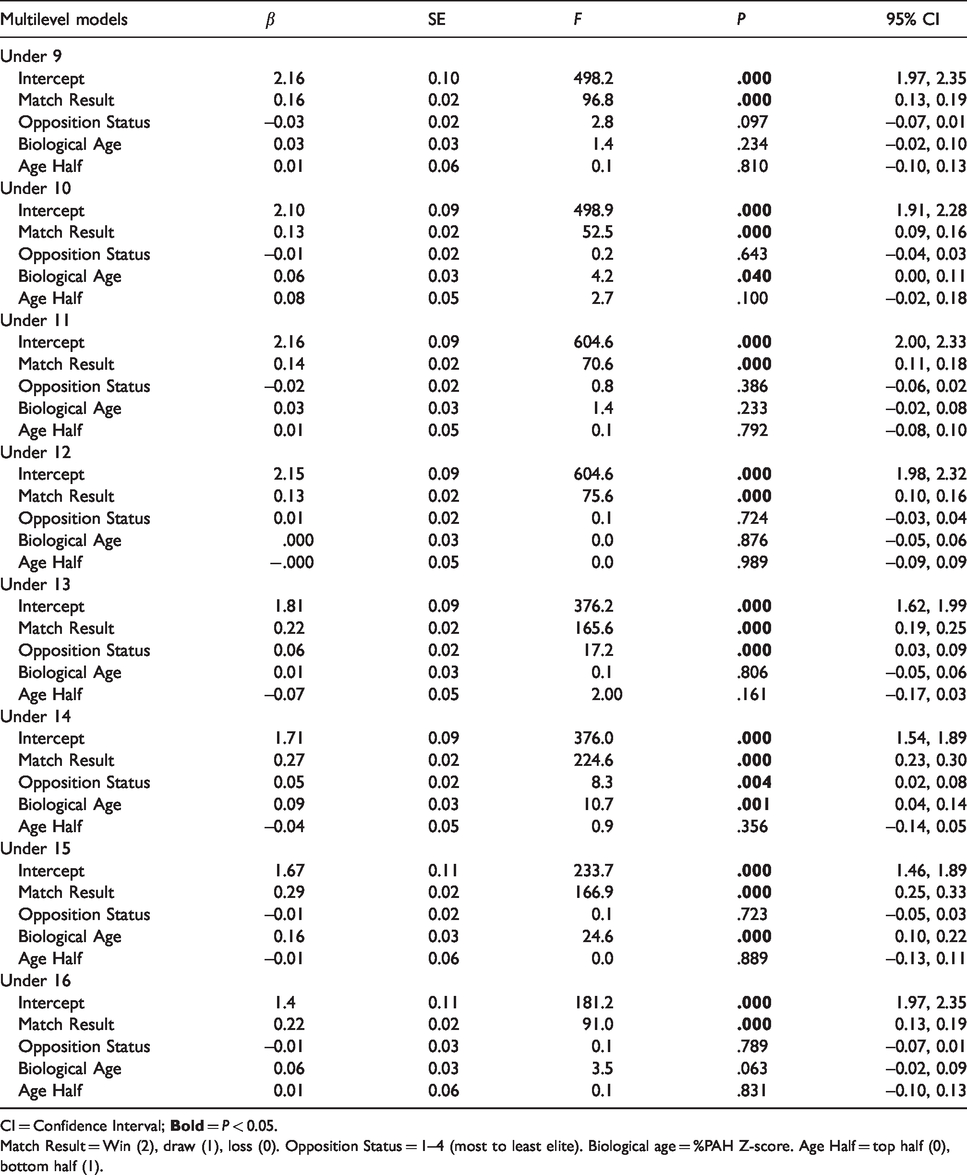
CI = Confidence Interval;
Match Result = Win (2), draw (1), loss (0). Opposition Status = 1–4 (most to least elite). Biological age = %PAH Z-score. Age Half = top half (0), bottom half (1).
Discussion
The purpose of this study was to investigate the degree to which variance in relative age and biological age among players was related to coaches’ evaluations of player match performances in academy soccer. Multilevel modelling, controlling for match outcome, standard of opposition and nesting of data within individuals revealed that advanced biological maturation was associated with more positive coach evaluations of match performance in the U10, U14 and U15 age groups. That is players who matured in advance of their peers were considered to performed better. Advanced maturation was not significantly associated with coaches’ evaluations of performance in the U9, U11 through to U13 and the U16 age groups. Contrary to expectation, relative age was unrelated to coach evaluations of match performance in all of the age groups.
Although there are no existing studies to directly compare the result of the current investigation, the findings from this study are generally consistent with those examining the impact of biological maturation upon player selection and performance in Academy soccer.3,5,34 As previously noted, from the onset of puberty early maturing players have consistently been shown to outperform their later maturing peers on most tests of physical fitness and, to a lesser degree, skill performance.4,16,17 During competition, early maturing players have also shown to reach higher peak speed, cover greater distance at speed, and engage in more singular and repeated instances of high intensity activity.19,20,35–38 A selection bias toward early maturing players is also evident from the onset of puberty, generally increases in magnitude with age and competitive level.3,6,39 Accordingly, it is not surprising that the physical and athletic advantages associated with advanced maturity are also reflected in coach evaluations of game performance in some of age groups.
The failure to observe an association between relative age and coach evaluations of match performance is somewhat surprising, given that a relative age effect in this sample was previously documented. 34 It is well established that relative age plays an important role in the selection and recruitment of academy players.13,14 The degree to which relative age impacts player performance following entry into the academy system is, however, less clear. Research examining the associations between relative age and physical fitness/aptitude in academy players have generally shown little to no association between the constructs of interest. 12 That is, once in an academy setting relative age has limited bearing upon player performance and/or retention. This may be due to a number of factors including limited variance in relative age within the academy population and/or differences in the performance characteristics or attributes of relatively old and young academy players. Extreme differences in chronological age are contained to one year within a single age group, and with results showing a disproportionate number of players to be born in the first half of the competitive year, extreme differences in relative age are limited. Further, aligned with the underdog theory, the limited number of relatively younger born athletes selected into academy systems, need to possess superior physical, technical and psychological attributes in order to remain competitive.4,40,41
Result of the game was found to be statistically significant in all age groups, with coaches awarding higher performance grades to players when the team were more successful. In terms of opposition, when the opposing team were classified as a weaker opponent (a lower category classification), perceived performance grades were higher and statistically significant in the under 13 and under 14 age groups only. It is not surprising coaches perceive greater performances from their players when they are winning or playing seemingly poorer oppositions; either the team performed better thus higher performance grades were warranted or the success of the game biases coaches’ perceptions positively.
It is also important to note the general decrease in performance grades with chronological age as seen in Table 1. This may reflect the increase in competition and expectations with advanced age or poor performances against opposition teams with a more pronounced maturity selection bias than the sampled academy population. 34 Further, decrements in performances grades with age may reflect the adolescent growth spurt. Results showed associations between match grade and maturity in the Under 11 through to Under 13 age groups failed to reach significance; early maturing players in these age groups may have any advantages of advanced maturation mitigated by the challenges experiences with the growth spurt. Research has shown the adolescent growth spurt can present significant challenges in terms of increased risk of injury and adolescent awkwardness factors such as coordination, mobility and skill execution.4,37,42–45 Additionally, in the older age groups, players advanced in maturity have overcome growth-related challenges, have acquired the maturity-associated advantages and as some researchers and coaches suggest, got “their growing out of the way”. 46
The findings of this study have practical implications for those working within youth soccer academies. When identifying, selecting and/or evaluating players; awareness and consideration of differences in biological maturity is important. As shown, maturity is positively associated with coach’s player evaluations, which play an important role in selection, retention and release decisions. Ideally, when selection decisions are made, players should be evaluated in order of maturation; doing so would provide decision makers with the context and awareness of where a player is in their development, but also may draw attention to the individual differences in maturity influencing coaches performance grades. Further, it may be beneficial to understand whether a player is experiencing their growth spurt when making selection decisions based upon performance grades. Future studies should assess the influence of the growth spurt on match grades, as well as the reliability and validity of assessing players via a match grade.
Limitations of this study should be noted. First, the results of this study are specific to one professional academy and may not generalise to other academies or grassroots competition. For example, the degree to which coaches place value upon physical and/or athletic aptitude may vary relative to the level of competition, coaches’ understanding and awareness of growth and maturation, and or the academies underlying philosophy of player development. The measure of performance used in this research is also reliant on a single item evaluating performance that is scored on a continuum from 1 to 4. While this method has ecologically validity (i.e., it is the system currently used to evaluate match performance), information regarding the validity and reliability of this scale as a measure of performance is lacking. Further, the reliability of this scale is limited by the single item and the relatively small number of response items. This limitation is further compounded when you consider that the majority of the performance grades awarded fall within the middle response categories, liming variation on this scale (match grades of 2’s and 3’s). Reliability is generally higher for scales or items that provide and utilise a greater number of response categories. Lower levels of reliability can attenuate effects, making associations or differences look smaller than they are in reality. Future research should seek to validate and determine the reliability of this measure of performance.
According to our findings, a player’s biological maturity status within their team can influence the coaches’ perception of their performance for some age groups. Positive match outcomes are also associated with higher perceived performance ratings. This study provides further support for sport practitioners and coaches to understand maturation continues to affect an individual’s development and not just their selection into a sport. 18
Footnotes
Declaration of conflicting interests
The author(s) declared the following potential conflicts of interest with respect to the research, authorship, and/or publication of this article: Megan Hill is a PhD student part-funded by Southampton Football Club. Sam Scott is an employee of Southampton Football Club.
Funding
The author(s) received no financial support for the research, authorship, and/or publication of this article.
