




Abstract
Place kicks present valuable opportunities to score points in Rugby Union, which are typically performed under varying constraints in competitive performance environments. Previous quantitative studies suggest these interacting constraints can influence fluctuations in place kick success. To further the understanding of how fluctuations in place kicking success emerge, our aim was twofold: i) to explore and identify the key constraints that professional place kickers and experienced place kicking coaches perceive to influence the difficulty of a place kick and ii) to understand the level to which current place kicking practice environments represent these key constraints experienced in performance environments. Six professional place kickers and six experienced place kicking coaches were interviewed. Using a deductive thematic analysis, 11 key constraints were identified: individual constraints of expectation for success and fatigue, task constraints of angle and distance to goalposts, environmental constraints of wind, weather, pitch, and crowd, and situational constraints of previous kicking performance, time remaining and current score margin. Place kicking is typically practised individually or with a small number of place kickers in isolation from team sessions. Where possible, coaches should be encouraged to include place kicking in simulated game scenarios during practice to represent key constraints from performance environments. Our study demonstrates how experiential knowledge can enrich the understanding of sport performance and inform the design of practice environments which simulate relevant constraints of competitive performance to enhance skill adaptation of athletes.
Experiential knowledge can be used in combination with quantitative research to identify the key information that shapes emerging behaviours in competitive performance environments. Whilst quantitative research has identified fluctuations in success percentage of skills in competitive environments,1–3 this type of research is limited for understanding the contributing factors which interact during performance fluctuations. Recognising these limitations, there has been a growing tendency in sport science and coaching research to consider the experiential knowledge of expert sport performers and coaches, which has been gained through years of practice and performance experiences at various levels of competition.4–7 Informed by the theoretical framework of ecological dynamics, rich experiential knowledge of expert coaches and performers can be analysed to help identify key task, environmental, and individual constraints 8 to understand how performance fluctuations can occur. Identifying key constraints using experiential knowledge can also provide the focus for future empirical investigations, support theoretical frameworks, and inform practice design. 5 , 9
One of the main challenges facing coaches is to design practice environments that facilitate the transfer of skills to competitive performance environments. 10 One way to achieve this aim is by using the theoretical framework of Representative Learning Design, 11 which proposes that practice designs should include key information sampled from competitive performance environments. To inform Representative Learning Design, the insights gained from experiential knowledge can be considered in combination with experimental and performance analytical approaches to studying sport performance.
In international Rugby Union, place kicking performance fluctuates under varying task constraints (e.g. distance and angle to goalposts) and under specific situational constraints (e.g. previous kicking performance, current score margin, time remaining).2,3,12 For example, in the 2015 Rugby World Cup, place kicking success was 8% lower in the 10 minutes before half-time, compared with the mean tournament success percentage, and 7% lower following a previous unsuccessful attempt, compared with following a successful attempt. 2 These findings informed suggestions that specific situational constraints, which in Rugby Union can be related to time remaining and current score within the game, 13 may influence individual constraints such as thoughts, emotions, and fatigue. 2 Furthermore, environmental constraints (e.g. wind and weather conditions) can vary within and between games, which may influence perceived affordances for place kickers. 14 Understanding the influence of key constraints, and their interaction in performance environments, can inform explanations for emerging behaviours of place kickers.
Previous studies using quantitative data in isolation can only inform suggestions based on observed performance outcomes.2,3,12 However, this type of analysis is limited for providing any clear explanations for how performance fluctuations can occur. Moreover, there may be key constraints, the effects of which are not easily measurable (if at all) using quantitative analysis methods only. Therefore, tapping into the experiential knowledge of professional place kickers can help identify key task, environmental, and individual constraints that influence perceptions of task difficulty and performance.
In addition to experiential knowledge of performers, coaches are perceptively attuned to relevant constraints within performance environments from their experiences of observing and coaching specific skills within their sport. 5 Given their experiences of working closely with place kickers to improve performance, the experiential knowledge of specialist place kicking coaches is vital to understanding key constraints in competitive environments. Furthermore, designing effective practice environments to improve place kicking performance is critical for Rugby Union coaches, especially given the important contribution of place kicking to the outcome of matches (e.g. 45% of all points scored in 582 international matches between 2002-2011 3 ). Despite the value of place kicking, and the great responsibility of one player within a team to consistently score points with place kicks, there is currently a lack of evidence-based recommendations for how to design place kicking practice environments. Whilst there are previous examples of qualitative studies in Rugby Union, these have typically used isolated case studies with an individual place kicker or coach, to understand pre-performance routines 15 or place kicking technique. 16 To provide recommendations for representative practice environments, there is a need to understand key constraints in performance environments from the perspectives of place kickers and coaches.
Combining the experiential knowledge of place kickers and coaches to understand their perspectives of key constraints can be aligned to concepts from the theoretical framework of ecological dynamics. This rich mix of experiential and empirical knowledge can inform the design of representative practice environments which seek to induce similar perceptions of pressure and emotions as experienced in competitive environments. 17 Therefore, our first aim was to explore and identify the key constraints that professional place kickers and experienced place kicking coaches perceive to influence the difficulty of a place kick. Our second aim was to understand the level to which current place kicking practice environments represent key constraints experienced in competitive performance environments, which can then inform recommendations for designing representative practice environments.
Method
Participants
Six male place kickers and six male place kicking coaches were selected for the study. Participants were selected using criterion-based purposeful sampling to identify individuals that were experienced with the skill of interest: place kicking in Rugby Union. All six place kickers were selected because they satisfied two key criteria: having the role of place kicker within their team and having experience of place kicking in professional Rugby Union. All six place kicking coaches were selected as they were all currently responsible for specialist coaching of Rugby Union place kickers. The coaches satisfied this requirement because they had specific experiences of observing, analysing, and designing practice environments for place kicking, which other coaches (e.g. head coach, forwards coach) within Rugby Union teams may not have.
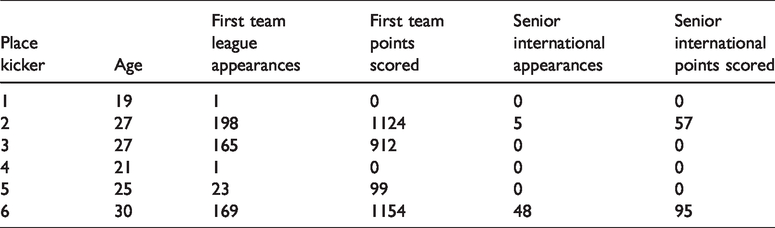
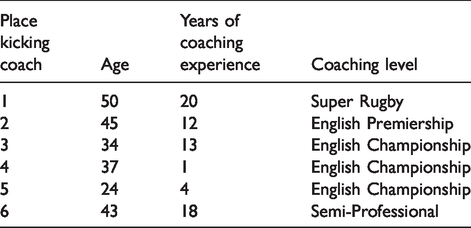
All six place kickers were currently playing in the first team squads of English Premiership teams at the time of interview (mean ± SD age: 24.8 ± 4.1 years; career first team appearances: 93 ± 94; career first team points scored: 548 ± 572; international caps: 9 ± 19; international points scored 25 ± 41; Table 1). The six specialist place kicking coaches (mean ± SD age: 38.8 ± 9.2 years; coaching experience: 11.3 ± 7.5 years; Table 2) were all currently working with Super Rugby, English Premiership, English Championship, or semi-professional teams at the time of interview. Ethical approval was obtained from the local University ethics committee and all participants gave written informed consent.
Participant characteristics of the six place kickers interviewed.
Participant characteristics of the six place kicking coaches interviewed.
Procedure
A novel semi-structured interview guide was developed, based on: (i) a previous case study of a place kicking coach 16 and (ii), a priori knowledge of the topic area predicated on key findings from quantitative analyses of place kicking.2,3,12 Semi-structured interviews were used to elicit relevant experiences and facilitate the interview process. 18 As the study required participants to share their experiences and perspectives on place kicking, it was deemed appropriate to individually interview each participant.
The interview guide was split into five main sections for place kickers: career history, practice, place kicking success percentages, experience of competitive place kicks, and overall contribution of place kicking. The order of the interview guide was chosen to build rapport by discussing the participants’ career (career history) and how participants currently trained for competitive place kicks (practice). Following this introduction to the interview, the questions focused on the first aim of the present study by discussing the place kicker’s kicking success percentages and any factors that could influence their performance (success percentages), and any difficult place kicks in competitive performance environments (experience of competitive place kicks). To conclude, participants were asked to broadly discuss the importance of place kicking (overall contribution of place kicking).
When interviewing coaches, the interview guide was adapted slightly to discuss observing place kicking situations and designing practice environments. Both interview guides (place kicker and coach) are available as supplementary files. Interview guides were pilot tested on a separate sample of three participants who had experience of either competitive place kicking or coaching place kicking. The pilot interviews were reflected on and minor modifications were made to the order of the interview guide to improve the structure of the five sections. Specifically, the section which discussed current practice environments was moved earlier in the interview guide to help build rapport before discussing difficult kicks.
Participants were asked open-ended questions such as: “what is the most difficult place kick you/a place kicker could have within your/their kicking range?” to create discussions around key constraints influencing task difficulty from the perspectives of place kickers and coaches. By using these open-ended questions, this allowed place kickers the opportunity to describe their own previous experiences of attempting difficult kicks and coaches the opportunity to describe their previous experiences of observing players attempt difficult kicks. To further understand the specific experiences of participants, clarification and elaboration questions such as “why is that a difficult place kick?” and “why is practice designed in that way?” were used in the interviews.
Mean ± SD duration time of the interviews was 45 ± 11 minutes, with 10 interviews occurring face-to-face (nine at the participants’ training facilities and one at the university where the lead researcher was based), and two conducted via internet telephony. All interviews were audio recorded using an mp3 storage device and were transcribed verbatim for data analysis.
Data analysis
Transcripts were subjected to line-by-line coding using thematic analysis to address the first aim of the study: to explore and identify the key constraints that professional place kickers and experienced place kicking coaches perceive to influence the difficulty of a place kick. The method of thematic analysis chosen was a deductive, theory driven approach, 19 which was based on the existing theoretical framework of Newell’s 8 model of constraints. Data extracts were categorised into four dimensions (Table 3). These included each of the dimensions (individual, task, environmental) from Newell’s 8 model of constraints, and a fourth dimension of situational constraints, based on quantitative analyses of place kicking.2,3 Lower and higher order themes were categorised into these four dimensions.
Definitions of key constraints.
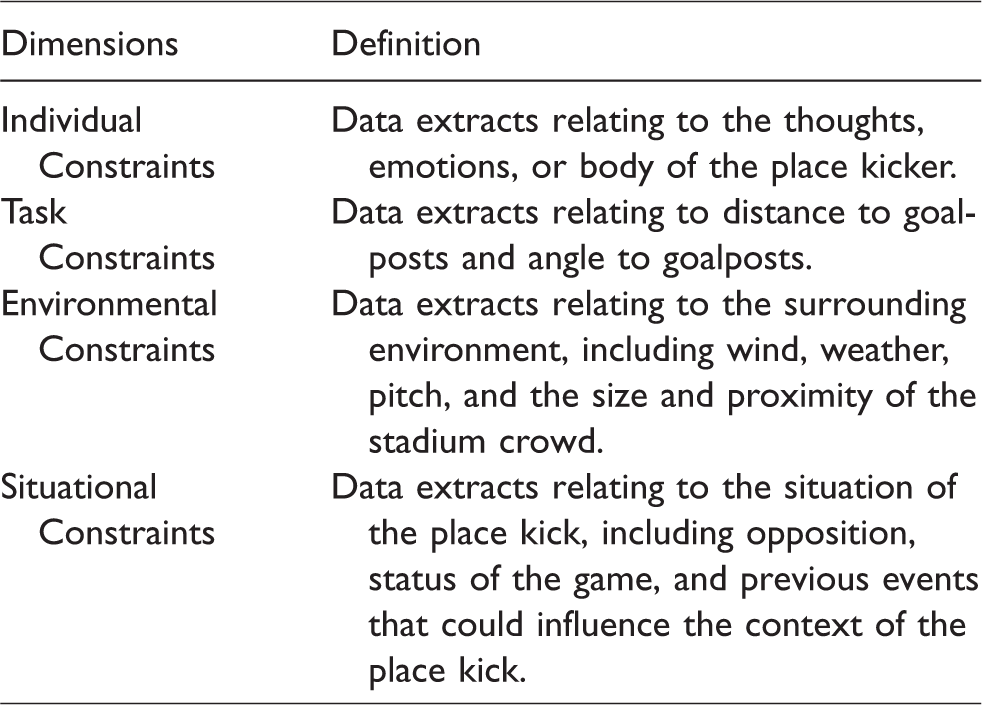
Data extracts relating to practice environments were analysed using a two-stage thematic analysis approach to address the second aim of the present study: to understand the level to which current place kicking practice environments represent key constraints experienced in competitive performance environments, which can then inform recommendations for designing representative practice environments. Following the identification of higher order themes of key constraints in performance environments, these higher order themes and the same four dimensions (Table 3) were used as a framework to categorise data extracts relating to practice environments. Participant experiential knowledge of practice environments was then compared with key constraints identified in competitive performance environments.
Methodological rigour
To enhance the methodological rigour of the study, three strategies were adopted. First, criterion-based purposeful sampling of participants was employed, with specific criteria (current role within team, playing experience; specialist coaching role, coaching experience) used to ensure that participants had appropriate experiences to discuss for the study. 20 Second, the co-authors acted as critical friends to the first author throughout the process of data analysis. This involved the first author presenting his interpretation of the data to the co-authors on a regular basis, as well as providing written summaries of the findings for evaluation. The co-authors provided a “sounding board” to encourage reflection on and exploration of alternative interpretations and explanations of the data. As part of the process of critical dialogue, the first author was required to make a defendable case that the available data supported his interpretations. Finally, a sub-sample of six participants were offered the opportunity for member reflections, 21 by sending copies of transcripts, together with a summary of the results. Following these member reflections, no changes were made to the transcripts or data analysis.
Results and discussion
Key constraints in performance environments
Deductive analysis of the data identified 11 higher order themes (Figure 1), which were categorised into four dimensions of key constraints in competitive performance environments (Table 3). The four dimensions will be discussed as four separate sub-sections, which include key quotations from place kickers and coaches to reflect the higher order themes that were identified.
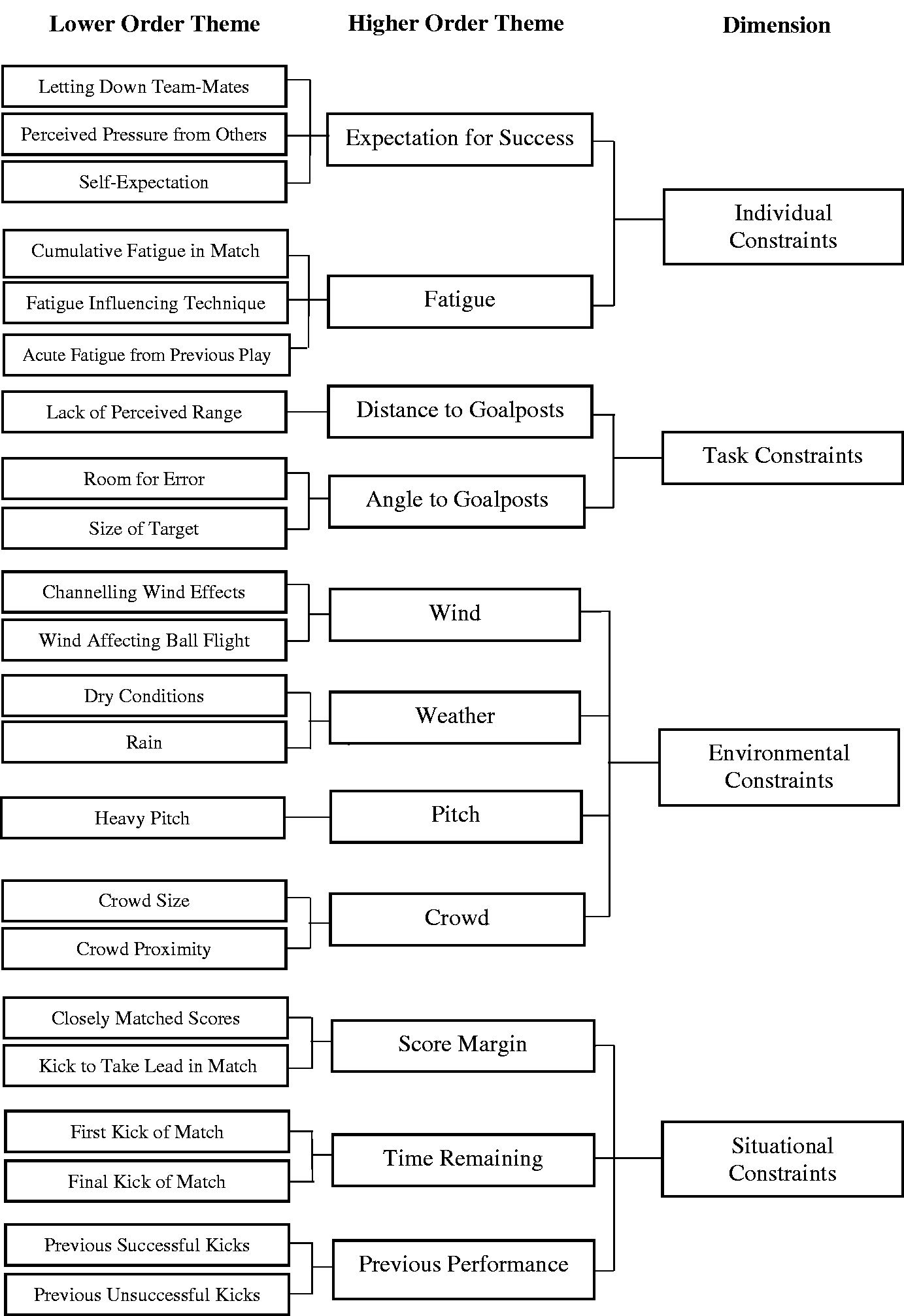
Thematic map of key constraints on place kicking performance, from the perspectives of professional place kickers and experienced coaches.
Individual constraints
All six place kickers referred to perceived feelings of expectation for success, either from themselves or significant others, when discussing the perceived difficulty of a place kick. All place kickers identified a specific area on the pitch for their “most difficult kick”, with five place kickers describing an area between 5 and 15 m inside the touchline, irrespective of distance to goalposts, and the other (Place Kicker 5) describing an area directly in front of the goalposts. These pitch areas were identified as locations where place kickers perceived a feeling of expectation for success from others, particularly team-mates. The combination of expectation for success and likelihood of a successful kick (shaped by task constraints of angle and distance to goalposts), interacted to create pitch areas where place kickers perceived varying difficulty of place kicks. Essentially, place kickers perceived that kicks directly in front of the goalposts have the highest expectation, but the task constraints presented the highest likelihood of success. Touchline kicks are perceived by place kickers to be a “challenge”, as the likelihood of success is lower due to increased angle and distance to goalposts and the expectation for success is perceived to be considerably lower. However, in between central pitch areas and the touchline is an area bordered by the 5 m and 15 m lines, where the majority of place kickers perceived a high expectation for success, even with increased angle to goalposts (because of the associated shorter distance to goalposts). To exemplify, one place kicker reported his experiences of expectation for success: “In terms of some of the hardest kicks, I think are the ones that people think you should get … The ones that are, the angle’s difficult, but it’s not touchline, kind of between the 5 and the 15 [m lines, infield from the touchline] I guess, maybe closer towards the 15 [m line]. One of those you’re expected, as a goal kicker, you’re expected to get” (Place Kicker 3). “No-one’s gonna go at the end of the game “oh we should have got that one from the touchline”, but if you lose by two points and you should have got one from the 15 [m line] then, it’s a little bit more pressure there. I know that kickers do feel worse there, not worse, but they should be getting these, it’s kind of a lose-lose situation” (Coach 5).
These expressions of experiential knowledge reveal how perceived expectation for success and acute performance fatigue provide examples of individual constraints that influence perceptions of task difficulty during competition. The powerful influence of expectation for success on individual performance has been reported in previous qualitative investigations of team sports.22,23 These studies have revealed the effects of individual responsibility within a team, which can increase perceived pressure, when performing an individual skill which contributes to the success of a team. Place kicking is a unique example of an individual player performing a self-paced skill to directly score points in Rugby Union. Given that place kicking can contribute 45% of all points scored in the professional game, 3 these insights suggest expectation for success and fatigue should be recognised by coaches when designing representative practice environments that seek to mimic performance environments.
Task constraints
Consistent with previous research,2,3 place kickers and coaches reported angle and distance to goalposts as key task constraints which influence place kicking performance. In addition to the high expectation for success which was perceived when place kicking 15 m in from the touchline, one place kicker describes why this pitch area is challenging: “I actually find the ones in and around the 15 m channel, 15 m line [infield from the touchline], the hardest … probably 2 or 3 m outside the 15 s. The kind of ones that should be bread and butter, but you can sometimes get caught between not kicking it, it’s easy to undercompensate or overcompensate for either … they’re probably just a bit more difficult because you get caught in two minds. Sometimes you can just jump out of the kick thinking you can just chip it over, when you’re better off getting through it” (Place Kicker 2).
From an ecological dynamics perspective, these insights on uniqueness and functionality of kicking performance underlies how performers are conceived as dynamical systems which adapt to the interacting constraints in a specific environment. The observation that performers switch between different types of kick (“clipping it” vs “getting through it”), which was revealed by experiential knowledge of place kickers and coaches, could be related to metastability, which expresses a region where skilled performers can transition between two different movement patterns. 24 Metastability emerges when a performer is poised between multiple co-existing states and a number of movement options can be utilised, which creates an area of functional instability for the performer. 25 These perceived changes in a place kicker’s movement patterns can be explored in practice environments by seeking to identify metastable regions and adaptive movement patterns.
Environmental constraints
Whilst most place kickers generally stated that performing in front of a large crowd did not influence their thoughts or emotions, the proximity of the crowd can influence place kicks near to the touchline, as one place kicker explains: “Your back is against the crowd, you know, they can heckle you and you’re close to them … it’s just one of those kicks you think “ah I’ve got to go to the touchline now and kick, in front of all those people” … because like I said, they’re [the crowd] right next to you” (Place Kicker 5).
The potential influence of environmental constraints has been highlighted in previous research, 3 with a 10% difference reported between the stadiums with the highest and lowest success percentages for international level place kicking. Place kickers indicate a preference for calm conditions and describe how weather conditions can alter perceptions of task difficulty and affordances for place kicking. However, the reality is that wind and weather conditions can change within and between competitive matches. Therefore, when aiming to practice place kicking in representative conditions, the direct influence of environmental constraints needs to be considered. Place kickers are encouraged to practice in varying wind (e.g. speed and direction) and weather (e.g. dry, wet, humid and cold) conditions.
Situational constraints
The influence of previous performance within the same game was identified as a key situational constraint by place kickers and coaches. One place kicker reports how unsuccessful previous performance can influence perceived expectation for success from the crowd and team-mates: “If you’ve missed a couple, and you’ve not struck them well, that’s when it’s the hardest because obviously, you have the weight of the crowd, you know, your team mates are probably, sort of not doubting you, but sort of ‘umming and arghing’ a little bit over whether you should take the penalty at goal or not, because you know, you’ve missed two” (Place Kicker 2).
Place kickers reported always being aware of the score margin when place kicking, with the most difficult scenario perceived to be when their team are trailing. More specifically, a scenario when the outcome of the place kick can change their team’s standing in the game, as one place kicker reports: “Yeah, it’s probably a kick to take the lead … so that’s a difficult kick when it’s, when the kick directly affects your standing in the game, when you go to being 1 point up if it’s a conversion, or to bring you back into losing bonus point range [losing by 7 points or fewer] or something like that … yeah there’s probably a bit more pressure on that” (Place Kicker 6).
Place kickers reported that situations with little time remaining have increased pressure because of the consequence of little or no further play, therefore, offering few opportunities to rectify a potential unsuccessful kick in play or with another kick. Critically, these situations are shaped by an interaction between time remaining and score margin, with place kickers only citing an increased pressure with little time remaining if the place kick is an opportunity to change their team’s standing in the game. Place Kicker 6 explains the effects of time remaining: “When it gets closer toward the 80 minutes, you know like after that, your chances to make amends for it is getting smaller and smaller”. Coaches are therefore encouraged to use these insights to design practice tasks which simulate performance contexts with little time remaining (i.e. little opportunity to rectify a potential error), containing meaningful consequences for successful or unsuccessful performance to represent game-deciding place kicks as faithfully as possible.
Practice design
Current place kicking practice typically takes place after team sessions, either individually or with a small number of place kickers, due to a perceived lack of time in team sessions. Therefore, place kicking is not seen as a priority during team practice and is typically separate from team sessions, as one coach described:
“I know [place] kicking only takes you about a minute, so in theory you could put that in the rest period between blocks of training, but erm, I think because there’s always a big time limit on training. I think the [place] kicking will be the last thing to put in, or the first thing to be thrown out” (Coach 4).
Following the identification of 11 key constraints in performance environments earlier in the present study, experiential knowledge of practice environments will now be presented and discussed in relation to these key constraints.
Individual constraints
As place kicking practice is typically performed separately from team sessions, this reduces the perceived expectation for success from team-mates. One coach explained the difference between place kicking practice and competitive environments: “I think it’s an assumption that it’s the same thing, that people just assume that kicking after [training] is the same as kicking in a game, and well I’m certainly starting to realise that it’s not, and we could probably do more … there’s no pressure from team-mates or opposition. Erm, the more I think about it, the more I think it’s just so different” (Coach 5).
As place kicking practice is typically organised after team sessions, it is suggested that place kickers are practising under cumulative fatigue from the preceding session. However, the majority of place kicking practice is completed with no representation of acute fatigue, or phases of play, in between each place kick. One place kicking coach describes the differences between place kicking in practice and competitive environments: “Not much kicking training is done under fatigue. Because they just have a block of it so you’re walking around in between … You just practice this technique you don’t actually use in games. This fresh technique where you use your knee, and then you go out to games and you start using your hip more, so it’s a different, erm technique” (Coach 1).
Task constraints
In practice environments, place kickers typically represented key task constraints of angle and distance to goalposts by kicking towards full sized goalposts from various pitch locations. Within a typical place kicking practice session of 12 kicks, place kickers will kick from several different kicking locations, which can either be determined by personal routine or random locations. Randomising the angle and distance to goalposts of practice place kicks is designed to represent a penalty, which can be awarded by the referee for an infringement by the opposition in any pitch location, or a conversion, which varies depending on the position of the ball being grounded for a try. One place kicking coach describes the varying task constraints of place kicking and how these should be represented in practice environments: “Balls could be anywhere, so it’s very difficult to, to know exactly where those, the right sweet spot is to practice, because in Union it could be anywhere … you don’t know where you’re going to score, you don’t know where you’re going to get penalties from, it’s very difficult to be really focused on where you do the practice, and therefore it has to be a bit more sporadic and dotted around” (Coach 4).
Environmental constraints
Whilst kicking towards full sized goalposts in outdoor conditions, place kicking is always practised in varying wind and weather conditions and typically on a pitch that is representative of competitive surfaces. Unlike competitive performance environments, place kickers typically practice without a watching crowd of people due to the logistical difficulties of faithfully representing any effects of a large crowd. One place kicking coach reported using headphones with crowd noise during practice, similar to previous research, 27 which has played crowd noise over a tannoy: “Some of the boys have done, maybe in private sessions, things like headphones in and crowd noise” (Coach 3).
Situational constraints
Place kickers typically adopt a practice strategy of taking multiple attempts from each location in practice, which minimises any effects of previous performance on thoughts or preparation of future kicks. Unlike performance environments, place kickers tend to make corrections to unsuccessful kicks before moving to a different location in practice. Place Kicker 4 describes taking multiple attempts to overcome unsuccessful previous performance: “Probably around two [attempts], but if I miss my first one, like if I miss them or I keep missing from the same spot … I’ll carry on doing that until I get one”.
Taking multiple consecutive attempts from the same location in practice is not representative of the one attempt from each location that place kickers will have in competition. However, there were some examples of place kickers and coaches applying a “one repetition focus” in practice to represent competition pressure and demands. Place Kicker 1 describes this practice strategy: “They’re calling it a “one rep focus” so I’ll kick a ball from a spot … No matter where it goes, pick it up and we’ll walk to a completely different spot and we’ll talk about the last kick”.
A “one repetition focus” approach to practice aligns with the Representative Learning Design framework, 11 as this strategy represents the demands of competitive performance environments, in which a kicker has only one attempt at each kick. This focus also encourages place kickers to practice in a random order using varying task constraints of angle and distance to goalposts, which better represents the pressures of competitive place kicking.
There were only a small number of reported examples of coaches using scenarios of little time remaining with a close score margin to represent game context in practice. However, partly influenced by training loads, coaches and players viewed a limited number of place kicks in each session as a source of pressure. Limiting practice to a small number of kicks, typically 10-12 each day, can increase pressure on the place kicker to perform successfully, similar to the pressure associated with limited time remaining in matches. Coaches can also use scenarios of time remaining and score margin for place kicking in practice environments, as one coach explains: “I would set the score, and say “right, so you’ve got 3 minutes left on the clock until the end of the game”, or just say “until half-time” … and the score is that you’re 3 points down” … or it could be “you’re 8 points down”, so it is scenario based in what we’re gonna face on a Saturday” (Coach 6). “I can’t quite get my head around how we spend so much time around the pitch working incredibly hard to win penalties at scrum time, or win lineout penalties, or march our way up the field to get points, and then spend so little time actually executing that skill that gets you the points. There’s no point getting a penalty because you don’t get anything for it, you have to then kick the ball through the posts [to score points]” (Coach 5).
Recommendations for practice design
Using an ecological dynamics framework, and recommendations from Representative Learning Design, 11 coaches are encouraged to incorporate the key constraints from performance environments identified in this study into practice environments. Focusing on one attempt per kicking location can represent the random and unpredictable task constraints of penalties and conversions. Place kicking coaches are encouraged to break up routines of moving to set pitch locations in sequential orders at walking pace, and to prioritise putting place kickers into areas of uncertainty by using randomised pitch locations which are integrated into game-related activities. 13 , 28 Using varying pitch locations in practice can also promote learning in metastable regions, where place kickers can develop adaptive movement solutions. Coaches could also challenge place kickers following previous unsuccessful performance in practice, by putting the following place kick in difficult pitch areas (e.g. 15 m line).
One way which place kicking coaches could mimic individual constraints of acute fatigue and expectation for success is to incorporate place kicking into game situations in training, such as following a try, or as a penalty option. Traditionally, coaches will design dynamic practice environments which include interactions between attacking and defending players to shape representative affordances to pass, carry the ball, and score a try. 13 However, typical team sessions do not include place kicking due to a perceived lack of time and the focus on scoring tries. Given the importance of place kicking to the outcome of matches, and the experiential knowledge identified in this study, this provides a strong rationale for including place kicking in team practice sessions.
Using the framework of Affective Learning Design, 17 coaches are encouraged to use vignettes which represent expectation for success (i.e. meaningful consequences for a successful or unsuccessful kick) which could induce emotions during practice. Potential methods for representing expectation for success include a team forfeit (e.g. fitness related forfeit) following unsuccessful place kicking performance in practice, and place kicking for points in gameplay situations where the winning team is rewarded. Identifying specific situational constraints in performance environments (e.g. time remaining, score margin, previous performance) can inform the design of specific vignettes in practice. Therefore, coaches are encouraged to design place kicking practice environments with clear purposes and consequences to avoid the dangers of athletes performing below competition intensity in practice, which creates different thoughts, emotions and emerging perception-action couplings. 14
Conclusion
This study has explored and identified the key constraints that professional place kickers and experienced place kicking coaches perceive to influence the difficulty of a place kick. Through experiential knowledge, this study has also increased understanding of how current place kicking practice environments represent these key constraints and makes recommendations for representative practice design. Professional place kickers perceived individual constraints, such as feelings of expectation for success, to influence their perceptions of task difficulty in specific pitch locations (e.g. 15 m in from touchline). Place kickers revealed experiences of unsuccessful previous performance, little time remaining and close score margins, as situational constraints which influence perceptions of task difficulty when preparing to place kick. Place kicking coaches and place kickers reported observations of individual constraints (e.g. fatigue) and task constraints (angle and distance to goalposts) influencing place kicking movement patterns. The novel insights gained from experiential knowledge of professional place kickers and experienced place kicking coaches enrich current understanding of key constraints on place kicking, which have only previously been speculated about using statistical data from performance analyses.2,3,12
The findings of this study clarify the multiple interacting constraints that can influence a place kicker, such as task constraints (e.g. distance and angle to goalposts), environmental constraints (e.g. wind, weather, pitch, and crowd), individual constraints (e.g. expectation for success and fatigue), and situational constraints (e.g. previous performance, score margin, and time remaining). The multiple interacting constraints highlighted in this study should be considered when designing practice environments. Coaches are encouraged to include place kicking in team sessions with relevant scenarios to represent the pressures and demands of place kicking in competitive performance environments.
Supplemental Material
sj-pdf-1-spo-10.1177_1747954120943073 - Supplemental material for Understanding key constraints and practice design in Rugby Union place kicking: Experiential knowledge of professional kickers and experienced coaches
Supplemental material, sj-pdf-1-spo-10.1177_1747954120943073 for Understanding key constraints and practice design in Rugby Union place kicking: Experiential knowledge of professional kickers and experienced coaches by Chris Pocock, Neil E Bezodis, Keith Davids, Ross Wadey and Jamie S North in International Journal of Sports Science & Coaching
Footnotes
Declaration of conflicting interests
The author(s) declared no potential conflicts of interest with respect to the research, authorship, and/or publication of this article.
Funding
The author(s) received no financial support for the research, authorship, and/or publication of this article.

Supplemental material
Supplemental material for this article is available online.
References
Supplementary Material
Please find the following supplemental material available below.
For Open Access articles published under a Creative Commons License, all supplemental material carries the same license as the article it is associated with.
For non-Open Access articles published, all supplemental material carries a non-exclusive license, and permission requests for re-use of supplemental material or any part of supplemental material shall be sent directly to the copyright owner as specified in the copyright notice associated with the article.
