




Abstract
Visual gaze behaviour, and in particular Quiet Eye (QE), have been found to be important in aiming tasks in multiple sports. The aim of this study is to provide insight into the characteristics of gaze behaviour in a moving condition, that is of football players during the run-up and kick of free kicks. Fourteen skilled youth players performed a set of free-kick trials while their eyes were being tracked. Two QE periods have been determined prior to a critical phase of the kick: QE Target and QE Ball. For the scored trials both the QE Target (M = 886 ms SE = 78 ms) and QE Ball (M = 627 ms SE = 52 ms) duration were significantly longer than in the missed trials, QE Target (M = 488 ms SE = 45 ms) and QE Ball (M = 513 ms SE = 80 ms). The analysis of the number of fixations suggests that one fixation on a target is the optimum, and more (2-3x) or no fixations resulted in less accurate shooting. These results provide insight into the characteristics of football shooting that can be incorporated into shooting practice in order to improve performance.
Introduction
In football, outstanding shooting performance is characterized by highly effective (i.e. accurate, consistent, and reliable) and efficient (i.e. with minimal physical and mental effort) movements. 1 It is well accepted that sufficient visual gaze behaviour is required for prospective control of movement and appropriate goal-directed actions.2–6
Visual gaze in sports
Promising research has been done to quantify visual gaze behaviour in relation to sports performance.7–15 The location and duration of fixations have been found to differ between experts and novice players. 16 , 17 Visual gaze behaviour is not only useful to differentiate between players but can also distinguish variations within an individual player’s performance. Across multiple targeting tasks in sports, superior performance is associated with fewer fixations and a longer final fixation on a target. Vickers 18 defined this final fixation prior to the onset of the movement as the quiet eye (QE), which developed into a well-known measure in visual gaze research. Examples in pistol and rifle shooting, 19 , 20,21 darts, 22 golf, 23 billiards, 24 and basketball 25 , 26,27 demonstrate that performance increases when the QE is at the right location (i.e. target) for an optimal amount of time prior to the movement. 28,29
Visual gaze in football
Within closed motor skills in football (i.e. penalty kick, free kick), most research on visual gaze has been focused on the receiver of the ball (i.e. goalkeeper).30,31 Wood and Wilson 32 were the first to reveal the gaze behaviour in a more dynamic condition; that is of the penalty taker. They found that gaze behaviour prior to the run-up is essential for accurate shooting performance. There is a lack of evidence on visual gaze behaviour in other football-specific aiming tasks, such as free kicks. Free kicks represent an important component of performance in football. On average a free kick occurs 30 to 40 times per match, 33 and free kicks are one of the most effective situations from which goals are scored. 34 The test setup in the current study will be as close as possible to the actual performance environment.35–37 It is important to test real actions under match-like constraints and preserve the coupling of perception and action. 16 , 36 , 38 In order to accurately capture the perceptual-motor performances of athletes, the current study measures a free-kick situation that is representative of an actual football match.
Based on the aforementioned findings of i.e. Wood and Wilson, 39 it is expected that performance in other football shooting conditions will also be related to specific visual gaze behaviour. Therefore, in the current study, it is hypothesized that there is a relationship between free-kick shooting accuracy and visual gaze characteristics-in particular, the QE duration.
Method
Participants
Fourteen skilled youth (mean age = 15, sd = 0.6) football players, with +-5 years (sd = 2) of football experience, participated within their usual training time. The ethics committee of the Faculty of Behavioural and Movement Sciences of the Vrije Universiteit Amsterdam had approved the research protocol and all participants (parents) signed a written informed consent40 form before the start of the experiment.
Apparatus
The experiments were conducted on an artificial grass pitch within the Sport Science centre, AFC Ajax, Amsterdam, Netherlands. A standard, official-sized (7.32 m × 2.44 m) football goal was used. Official (FIFA-approved) size 5 balls were used. A standard free-kick practice wall with five removable dummies (total width 3 m) was used in the test. The wall was placed between the ball and the goal at a distance of 9.15 m from the ball, aligned with the centre of the goal.
The eye-tracking device used was the ASL MobileEye, (Inc MobileEye™, ASL Ltd). The MobileEye records video data at 60 Hz using images taken from two cameras. The eye camera captures the right eye of the player, while the scene camera records the environment in front of the player. Both image streams are recorded on the same digital medium by alternating frames. Therefore, the actual functional sampling rate is 30 Hz. The technique is based on combined pupil–corneal reflection and is accurate to about 1° visual angle over a 30° viewing range. 41
Procedures and design
It was intended to test each participant twice within a period of 4 weeks between the test days. From the group of fourteen players eight participated on both testing days.
Test design
To gain insight into the relationship between gaze behaviour and accuracy of shooting, a shooting task with a controllable setup was designed. The target task was chosen to be challenging but also suited to the skill level of the participants. Trainers and scientists concerned with the players were consulted during the design of the test. Each player was challenged to shoot at the predefined target area ten times while his gaze behaviour was being tracked with the MobileEye device. Each time six trials were taken from 18 m and, for motivational purpose, another four trials with the ball placed at 23 m from the goal. The wall was at both situations 9.15 m in front of the ball. The accuracy was tracked by scoring a goal within the target area, upper right or left quarter of the goal. This allowed reviewing of the gaze behaviour with respect to the accuracy of each trial.
Prior to a free kick in football, a goalkeeper usually places a wall consisting of two to five players between the ball and the goal. 42 The wall of dummies covers a large part of the goal. By adding a practice wall of five dummies (height 190 cm, widest part 55 cm) in front of the goal, the target task difficulty is comparable with a match situation. In the current study, there was no goalkeeper included to keep the setup controllable and not influence the players’ gaze behaviour. There were no visible target markings in the goal, again to prevent influencing gaze behaviour. Only verbally the participants were told whether they should aim at the right or left half of the goal according to their preferred side, which was in line with leg dominance. 43 To exclude influence of a preferred side, the shot was taken from a position in line with the centre of the goal.44 Players with right-leg preference took ten trials aiming at the right half of the goal (Figure 1). Players with left-leg preference took ten trials aiming at the left half.
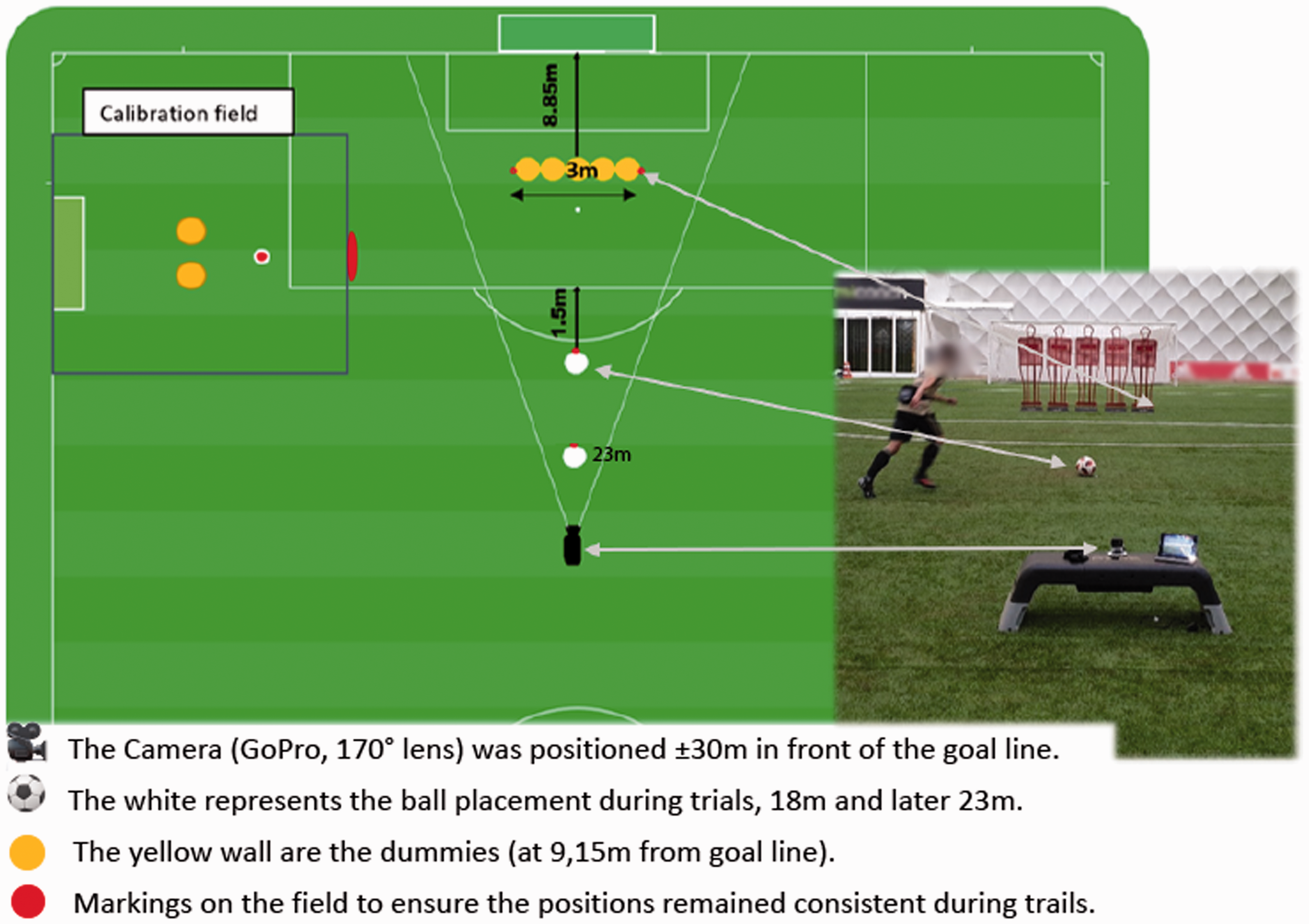
Test setup (not to scale). The ball was placed in the centre of the field at a distance of 18 m from the goal line and 1.5 m from the penalty area. The front of the five-dummy wall was placed at a distance of 9.15 m from the ball and 8.85 m from the goal line. This means that the wall was placed 3.35 m in front of the (5.5 m deep) goal area.
Instructions
The players first received information about the shooting task and the MobileEye device. They were instructed to shoot the ball into the right or left upper half (“corner”) of the goal. No instructions were given on how the ball should be kicked (e.g. curled or through the air), nor were they instructed on where to look. During the test, the other players were not allowed to distract the player by entering his field of sight around the goal. Because accuracy was being measured, the players were encouraged to do their best in every trial. No information was given about the purpose of the measurements except that they were intended to improve the players’ practice.
Calibration
After a player put on the MobileEye, a calibration was done to make sure his gaze was being tracked correctly. A calibration field was set up next to the test field to prevent prior aiming or the gaze being disturbed by the visible calibration markers during trials.
Calibration of the first trial
For the calibration, seven markers were placed in a separate field next to the actual test field. One marker was placed on each corner of the goal, one on each outer dummy, and one 2 m in front of the player. The players were instructed to focus on each marker in a prescribed sequence and for at least 3 seconds. The player was asked to confirm verbally when he was looking at the marker (e.g. researcher: ‘Look at target one’; player: ‘Target one’), and the audio was recorded. Based on the recommendations of the makers of the ASL MobileEye (Operation Manual, MobileEye) and Vickers, 28 seven calibration markers were used within the calibration field. The markers represented the same locations (width) and distance (depth) as those used during the experiment.
Calibration between trials
Prior to each new trial, the participant was asked to do a brief calibration using only markers 1 and 2. This enabled the researcher to check the accuracy of the tracker during the trials and, if necessary, correct the calibration during the video analysis. The calibration was performed off-line, after testing, to limit the test duration.
Data analysis
Parameters
Accuracy
For the analysis of shooting accuracy, the number of goals (accurate shots) within the defined target was divided by the total number of trials per player.
Gaze behavior
After calibration, the player’s gaze direction was mapped on top of the footage of the front camera of the scene, and the foveated region was highlighted with a circle (Supplement 1). The gaze behaviour was manually analysed frame by frame for the duration of the run-up and the kick of the ball. To define a fixation, a threshold of 125 ms was used, which was the same at that used by Van Maarseveen and colleagues 38 and comparable to the 120 ms used by Savelsbergh et al. 42 and the 116 ms used by Vaeyens et al. 17 To gain more insight into the gaze behaviour, four dependent variables—number of fixations on target, fixation duration, fixation location and fixation sequence—were assessed. The onset of each trial was defined as an arbitrary 3 seconds before ball contact (kick) 28 capturing all locomotive phases. The fixation duration per location was determined, and the number of fixations was calculated for each trial and then averaged for each participant. The results were coupled with the corresponding phases of the locomotor behaviour (shooting action).
Locomotion
Individual players differed in the time they needed to perform the shooting task. Therefore, the gaze behaviour of each individual phase was evaluated to identify certain gaze sequences. The shooting task was divided into five phases: 1) target selection/aiming (the phase prior to the first step of the run-up); 2) run-up (starting from the first foot lift followed by an approach to the ball); 3) leg placement (placement of the last step of the non-shooting leg before ball contact); 4) foot contact with the ball; and 5) follow-through (after ball release).
Statistical analysis
The statistical package SPSS (IBM SPSS Statistics 25) was used to analyse the collected data. Descriptive statistics were used to present data: mean and standard deviation (SD) for ratio data, median for ordinal data, minimum (min) and maximum (max) values, and frequency and percentage for nominal data. When performing statistical tests, the data were checked against the assumptions for a parametric test. Normality was checked with normality plots, skewness, kurtosis (between -2 and 2) and the Kolmogorov-Smirnoff (KS) test (with Lilliefors correction). Whenever the assumptions were not met, a non-parametric variant was conducted on the data.
Comparing players based on performance
Accuracy score per player was used to rank the players. To distinguish the better shooters from the less accurate players, the group was split in two with a cut-off point of 50% accurate trials. The better (more accurate) performers (n = 10) were statistically compared to their less accurate (below 50%) teammates (n = 4). Dependent t-tests were performed on accuracy score (%), mean fixation at target (QE-Target), mean fixation at ball (QE-Ball) and mean number of fixations.
Comparing trials based on outcome
To analyse the relationship between accuracy and visual gaze, all trials are distinguished by ‘hit’ or ‘miss’. Comparing QE Target and QE Ball duration were analysed in absolute time (ms), using a repeated measures ANOVA. Fixed effects were outcome (hits, misses), QE location (Target, Ball), and participants (n = 14) were the random effect. Contrast of means was used to determine interaction effects. Effect sizes were calculated using partial in accordance with Cohen’s d, with 0.10 considered a low effect, 30 a moderate effect, and 0.50 a large effect. 0.05 was set as the significance level. The number of fixations is on a ratio scale and was therefore analysed separately.
Results
Accuracy performance
The test design was sensitive to shooting accuracy with a variance between 30% and 80% and allowed the researcher to distinguish the more accurate (good) performers from the less accurate (poor) performers.
Quiet eye characteristics
The mean QE duration on target (total, ‘if scored’ and ’if missed’), the fixation duration on the ball and the number of fixations on the target are displayed per player in Table 1.
Overview of the mean values per player.
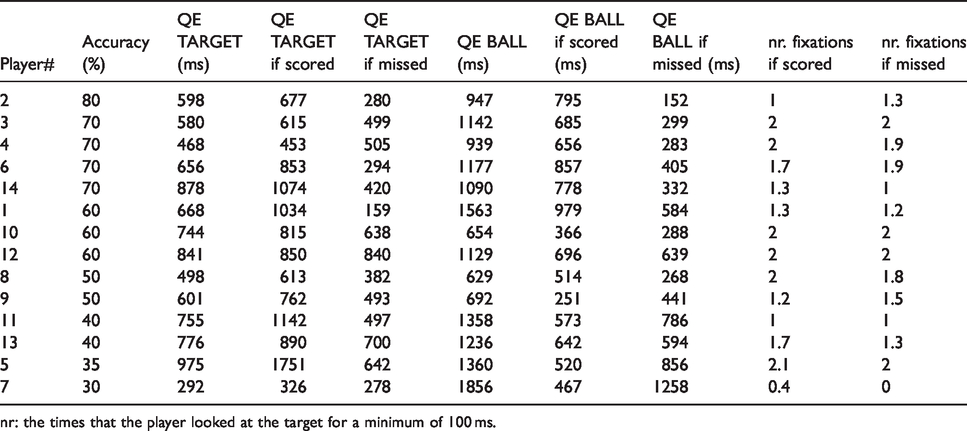
nr: the times that the player looked at the target for a minimum of 100 ms.
Good vs. poor performers
Parametric independent t-tests were performed for the following results:
The accuracy score
There was a significant difference, t(12)=−5.15, p < 0.001, r = 0.83, in the accuracy score between the good performers (n = 10) (M = 65%, SD = 10.5%) and the poor performers (n = 4) (M = 36.3%, SD = 4.8%).
The fixation duration at the target (QE-Target)
The mean QE-Target durations between the good performers (M = 676 ms, SD = 229 ms) and the poor performers (M = 656 ms, SD = 130 ms) were not significantly different, t(12) = .209, p > 0.05, r = 0.06.
The number of fixations
The difference between the mean numbers of fixations of the good performers (M = 1.1, SD = 0.56) and the poor performers (M = 1.57, SD = 0.33) was not significant, t(12) = −2, p = 0.068, r = 0.5.
The fixation duration at ball (QE-Ball)
Comparing the fixation duration at the ball between the good performers (M = 996, SE = 289 ms) and the poor performers (M = 1452, SE = 275 ms) using an independent sample t-test revealed a significant difference t(12) = 2.7, p = .019, r = 0.61.
Scored vs. missed trials
Effect of outcome
Significant differences were found for outcome (hit, miss) and also QE location (target, ball). Outcome of the trials differed, F(1,14) = 26.11, p < 0.001, η2 = 0,69. Effect of the QE location on the outcome is less, but significant, F(1,14) = 7.36, p = 0.019, η2 = 0,38. Therefore, the researcher looked at both QE locations separately.
QE duration at target
Figure 2 illustrates the distribution and difference for all trials (N = 220), those in which the player scored (N = 113) and those in which the player missed (N = 107). It can be clearly seen in Figure 2 that for the scored trials, the player had a longer fixation (M = 886 ms, SD = 325 ms) on the target, prior to ball contact, than in the missed trials (M = 488 ms, SD = 187 ms). A normality check using the Kolmogorov-Smirnov test revealed that the data deviated from a normal distribution (D(220) = .095, p < .001). Because the data did not meet the assumptions for a parametric test, a Wilcoxon test was conducted. The QE-Target duration in the scored trials (Mdn = 850) did significantly differ from that in the missed trials (Mdn = 497;) , Z(df) = −3.040, p = .002 (2-tailed), r = −0.81.
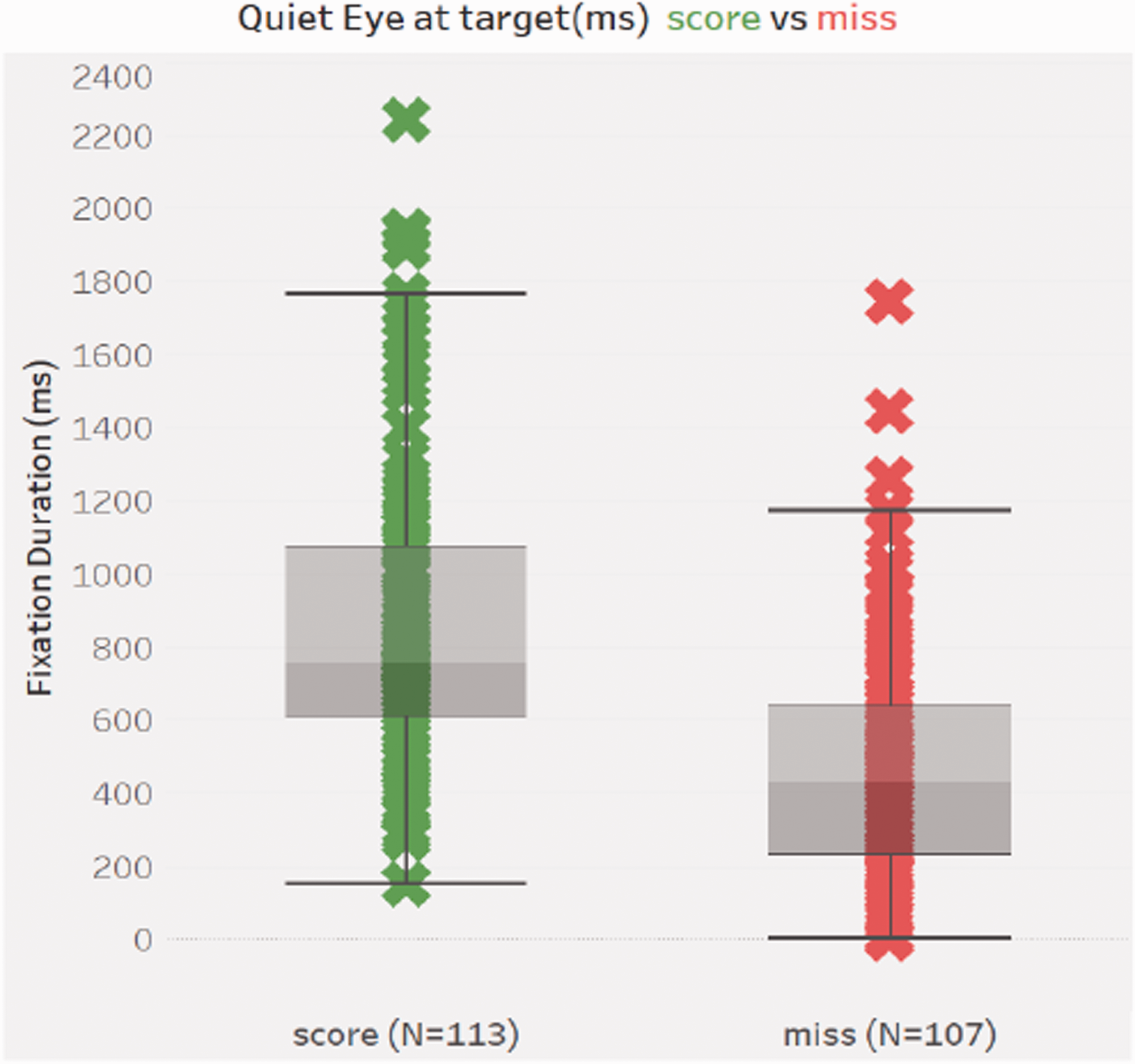
Distribution and difference of the trials (N = 220) that were scored (1) and those that were missed (0).
Fixation duration at ball
The fixation at the ball was also longer in the scored trials (M = 627 SD = 189) compared with the missed trials (M = 513 SD = 288). The QE-Ball duration in the scored trials (Mdn = 656) did significantly differ from that in the missed trials (Mdn = 405), Z = −2.062, p = .039 (2-tailed), r = −0.55.
The number of fixations
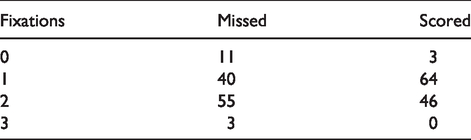
The number of fixations (Table 2) was defined as the number of times that a player fixated his gaze on the target (within 3° of visual angle) for a minimum of 125 ms consecutively in the three seconds prior to ball contact. Some players did not look at the target at all (nrfixations = 0) and some looked 3 times (nrfixations = 3). Players who fixated on the target location once (nrfixation = 1) scored most (N = 64).
Overview of the scored and missed trials per number of fixations at the target.
The difference within players between scored and missed trials
Figure 3 visualises the difference between QE duration in scored and missed trials for each player separately. Their mean QE duration was significantly longer prior to the scored trials (M = 886 ms SE = 78 ms) than prior to the missed trials (M = 488 ms SE = 45 ms), t(13) = 5, 96, p (2-tailed) <.001. With a very large-sized effect, d = 1.6. Except for player 4 (difference = −52 ms), all players showed a longer QE duration for the trials that they scored compared with the missed trials. The mean of all differences was 399 ms (SE = 22 ms).
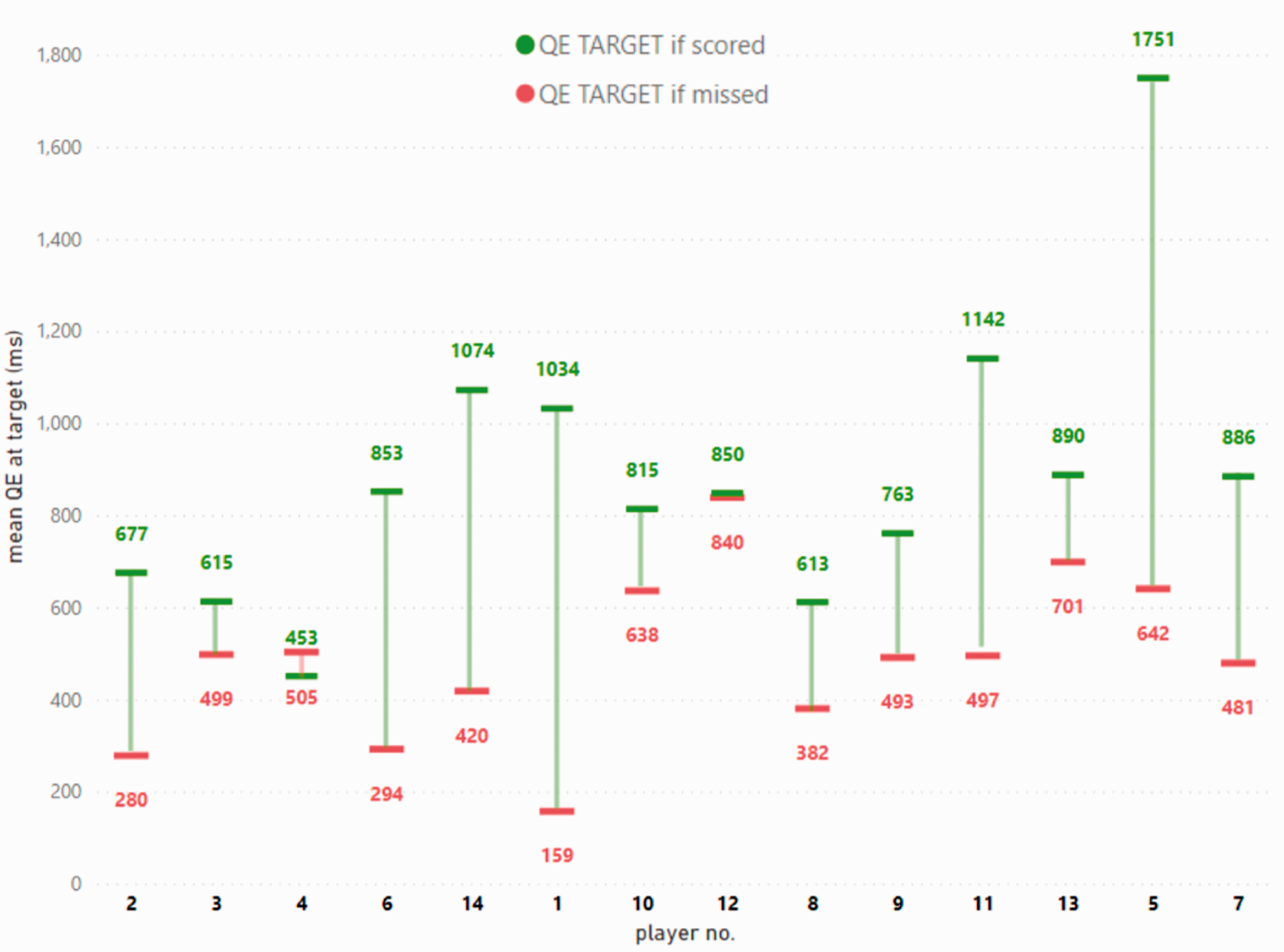
Visualisation of the difference in mean QE (ms) per player (N = 14), divided into missed and scored trials. All trials are included.
Discussion
The aim of the study was to gain insight into visual gaze behaviour by descriptive research on its characteristics during a football shooting task. Therefore, it is important to affirm that the test design is sensitive to differences in shooting performance. With a variance between 30% and 80%, the test was challenging enough to distinguish players on performance without being too difficult. The results showed an almost equal division of scored and missed shots. Using this test, it was possible to compare the corresponding visual gaze characteristics.
The role of quiet eye
Almost all players (n = 13) had a significantly longer QE at the target for their accurate trials. An even stronger significant difference was found when comparing each player’s scored vs. missed trials (Figure 3). This is in line with the hypothesis of the current study and findings in other aiming tasks (e.g. basketball by Oudejans et al. 45 ). The hypothesis was that the better-performing group of players would differ from their lesser-performing teammates by having a longer QE-Target. However, the results did not statistically confirm this hypothesis; even splitting the players at a 50% score threshold did not reveal a significant difference in QE-Target. However, there was a significant difference in QE-Ball, which is accompanied by an early offset of the QE-Target. In these trials the shift of gaze from target to the ball occurred earlier in the run-up which allowed the player to fixate its gaze at the ball. Length of the run-up (number of steps taken) was not tracked; however, based on examination of the recordings, it did not explain the difference in QE-Ball duration. The QE-Ball might be as important as or even more important in the shooting performance. Gonzalez et al. 46 already questioned the studies that considered only one single QE period, while more QE periods can be distinguished. These additional QE periods may be critical for motor performance. Vickers et al. 47 identified five sequential QE periods prior to phases of a three-point shot in basketball. Wood and Wilson 39 suggested that QE-Ball assists the transformation of the aiming phase into a motor output and guides the accurate motion for appropriate foot-to-ball contact. In golf, extended QE-Ball has been found to contribute to more accurate putting. 23 However, the aiming task in football is considered more complex and can be divided into two coherent tasks: aiming at the target (QE-Target) and aiming at the ball (QE-Ball). QE-Target is the most frequently used measure for aiming tasks and can be explained by Land, 48 among others. Land 48 explains the difference in performance based on several interacting systems responsible for visual and motor control. Visual fixation on the distal target location facilitates forwarding information to the motor system. Subsequently the motor system pre-programs motor plans for successful execution of the kick.49 A longer QE-Target was possibly allowing more pre-programming based on the target parameters. Another effect of the QE could be the locking out of irrelevant environmental cues which could act as distractions. 18 This mechanism could also substantiate the importance of the QE-Ball. In football, the ball can be considered as a sub-target at which the foot needs to be placed precisely. During the run-up, it is possible that QE-Ball plays an essential role in gaining crucial information for a steady run-up. Gauthier 50 concluded that the (quiet) position of the eye in the orbit provides proprioceptive information that allows the player to localise a target.
Optimal number of fixations
The number of fixations is commonly studied in interceptive tasks, and better performers 17 have been found to have fewer fixations. However, no publications were found regarding the number of fixations in aiming tasks in ball sports. The results of the current study suggest that one fixation at the target is better than zero, two or more fixations. Therefore, it is concluded that one fixation at the target is optimal for shooting accuracy in free kicks. Trials with no fixations were rare, and in these trials, there probably was likely not enough visual information gathered to perform an accurate shot. In line with the theory of Vickers, 28 a single fixation is required to lock out distractions. More than one fixation is considered ‘distracted’ gaze behaviour and probably cancels out most of the effects of a QE. The second or third fixation at the target is considered a ‘quick look’ and is distinct from the QE. The ‘quick look’ occurred after the first or second step of the run-up and lasted for a shorter period (max. 200 ms) than the observed QE. In some cases, the quick look occurred for less than 100 ms, raising the question of whether it contributed to the aiming task. This observation of a ‘quick look’ is not found in other studies, perhaps because those studies examined shots over shorter distances, such as penalties. In studies on penalties, some analyses describe a higher number of fixations towards goal/goalkeeper when a ‘power’, or higher velocity, penalty is taken. 51 It is possible that players adopt different gaze behaviour according to the power of the shot. In the current study, no measures on ball speed were done and there were no substantial explanations for the ‘quick look’. The second (and third) fixation might be acquired in order to allow adjustments according to the last situation. For example, during a free kick, a ‘gap’ in the wall appears and a last-minute change of the shot can be required in order to score. As a counterargument, for controlled situations like penalties and free kicks, placement might be the first priority and ‘change-independent’ shooting can be more beneficial. This is consistent with goalkeeper-independent shooting. 52 Nevertheless, the implementation of practising on one single gaze for aiming should be done thoughtfully, as it might not be optimal for all shooting situations.
Limitations and future challenges
The onset of the trial was defined as an arbitrary 3000 ms before the moment of ball contact. 28 During data collection, it was observed that players had already looked at the target before this time (e.g. during ball placement or when getting in position for the run-up). It was expected that they would observe the field around them; however, this specific gaze at the goal could have provided them with relevant perceptual information for the subsequent aiming and shooting. In the current study, these were not measured or included in the analysis because they occurred prior to the 3000 ms timeframe. For future research, it would be beneficial to analyse the absolute gaze time at the target prior to the trial. Nagano et al. 53 accomplished this by instructing participants to close their eyes, then setting the onset as the moment they opened their eyes. In this way, a minimum—or possibly, optimum—time at target could be discovered.
For future studies, it would be interesting to implement these findings in an intervention study. It would be interesting to test the effect of implicitly evoking a longer QE duration during free kick practise.
Conclusion
Better performance in football shooting accuracy is characterised by a longer fixation on both, the target and the ball. Players score more when they only fixate their gaze once on an (imaginary) target area in the goal; more or fewer fixations on the target area leads to less accurate shooting.
Supplemental Material
sj-pdf-1-spo-10.1177_1747954120943067 - Supplemental material for Visual gaze behaviour during free-kicks in football
Supplemental material, sj-pdf-1-spo-10.1177_1747954120943067 for Visual gaze behaviour during free-kicks in football by Sten Schaper, Lisanne van der Kaaden, Vosse de Boode and Geert Savelsbergh in International Journal of Sports Science & Coaching
Footnotes
Authors’ contribution
All authors listed have made a substantial, direct and intellectual contribution to the work, and approved it for publication.
Declaration of conflicting interests
The author(s) declared no potential conflicts of interest with respect to the research, authorship, and/or publication of this article.
Funding
The author(s) received no financial support for the research, authorship, and/or publication of this article.

Supplemental Material
Supplemental material for this article is available online.
References
Supplementary Material
Please find the following supplemental material available below.
For Open Access articles published under a Creative Commons License, all supplemental material carries the same license as the article it is associated with.
For non-Open Access articles published, all supplemental material carries a non-exclusive license, and permission requests for re-use of supplemental material or any part of supplemental material shall be sent directly to the copyright owner as specified in the copyright notice associated with the article.
