




Abstract
This study was based on the hypothesis that advances in cognitive science may be helpful for Coach Development Programs. We wondered: How can a learning tool such as a digital workbook that is informed by evidence-based pedagogical principles be helpful for coach development? After designing the learning material, based on the cognitive theory of multimedia learning, the digital workbook was used in a coach development program that aimed to improve coaches' need-supportiveness. Ten coaches at an elite sport school in Norway attended the program over a season, and afterwards they were asked whether the learning material had contributed to their knowledge of need-supportive skills. Thematic analysis of the interviews revealed visualization, awareness, and transfer to one’s practice as the three main themes describing the educational value of the digital workbook. The material showed the coaches how need-support can be acted out in a sport-specific context. Additionally, the learning material resulted in increased engagement and awareness through coaches' reflections, which is an important step towards integrating new material to prior knowledge and create meaningful learning. Finally, the coaches highlighted transfer of the presented learning material to their practice experiences. We conclude that cognitive science may have useful implications for the design of effective learning materials for coach development programs.
Introduction
Research shows that few coach development programs (CDPs) and coach education interventions lead to coach learning.1,2 Furthermore, there is little scientific evidence that CDPs have a long-term impact on coaching practice. 3 CDPs can be defined as systematically applied learning activities that are designed to change coaches' behaviors through education, social interaction, or personal reflection. 4 CDPs aim to improve coach effectiveness in different domains, such as professional knowledge (sport specific), interpersonal knowledge (relation-building skills), or intrapersonal knowledge (capacity to intersect and reflect). 5 However, “effective coaching” is not a self-evident concept. Côté and Gilbert 6 suggest that there are three key elements to effective coaching: (a) coaches’ knowledge/behavior, (b) the outcome of the application of that knowledge/behavior, and (c) the coaching context. 6 Coaches who consistently use theoretical and practical knowledge in training sessions or competitions and adapt it to the athletes and their contexts are effective. However, while there are numerous prescriptions for coach learning, evidence of coach learning is limited. 7
A central issue in the field of sport coaching education is increasing the effectiveness of coaching.4,5 However, before we can expect coaches to change and become more effective by attending a CDP, we need to understand how we can successfully initiate that change. 1 One way to achieve behavioral change is through applying theories of learning. 3 Paramount for successful learning is the underlying pedagogy (i.e. how the learning material contributes to the learning process). 8 Interviews with coaches in different domains reveal that CDPs typically play a marginal role for coach learning compared to learning from experience. 3 Coaches spend much more time on coaching and interacting with athletes than in coach education programs.9,10 This highlights the need of focusing on the design of the CDPs. The aim of the present study was twofold: (a) to design a digital workbook that is informed by evidence-based pedagogical principles and (b) assess the educational value of the digital workbook for coach development.
Theoretical framework
This study is based on the hypothesis that advances in cognitive science are helpful for the design of CDP learning materials. We will address why knowledge about learning is important, before outlining how theory should (can) be taught, and what we chose to include as the content of the designed digital workbook.11,12
Why – The holistic approach to learning
There are different ways to understand learning and thus inform the practice of coach learning. There are three main approaches to learning theory (i.e. behaviorism, cognitivism, and social/constructivism). 13 The holistic approach to learning acknowledges that different theories capture parts of the whole; indeed, not one coaching approach fits all learning situations. 14 We developed a theoretical framework that incorporates different learning theories.
Learning dimensions
A major concern regarding the effectiveness of coach education is the transfer of theoretical knowledge to practical skills, or lack thereof.15,16 On the one hand, we have theoretical knowledge, on the other practical. This mirrors the distinction between theory and practice that seems problematic in skill acquisition.
The horizontal column in Figure 1 shows three learning dimensions, and we added two bridges to connect them. The theoretical dimension is the “knowing-that”, including knowing why to act need-supportive, and what constitutes good coaching. The practical dimension is knowing-how to act, which is difficult to articulate. Some theories explain the transcendence between “knowing that” and “knowing-how” (i.e. Mesterlære (apprenticeship),
17
situated learning,
18
the three-level model of professional learning,
19
and the five-stage model of the mental activities involved in directed skill acquisition
20
). We propose the meaningful learning dimension as the nexus between the theoretical and practical dimension as the coaches relate practical experience and theoretical knowledge and understand how they connect; or not.
21
Meaningful learning is not behavioral change per se, but it is important for behavioral change. This is an important distinction as we will assess whether coaches can apply knowledge about need-supportive skills to their previous experiences – not the actual behavior change.
The learning process and pedagogical principles informing the motivation activation program in sports (MAPS).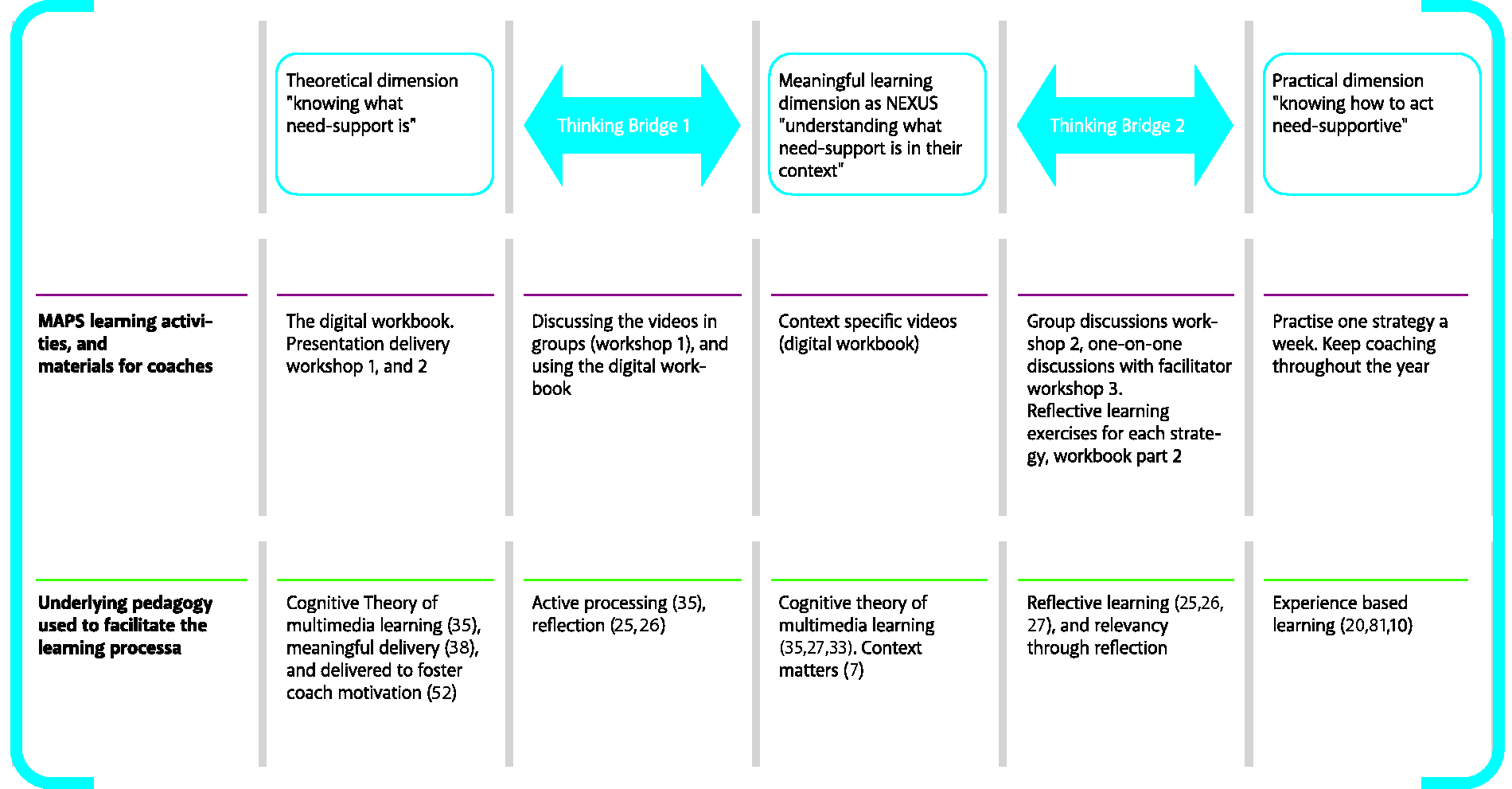
Using theory to improve practice has proven difficult in the field of coach development, and coaches’ engagement with the real world may need to be better monitored, understood, and evaluated to improve coaching expertise.22,23 It has been suggested that the learning process needs both experience and reflection to understand what theoretical constructs mean in practice.24–26 The combination of this is reflected in the two bridges in Figure 1, as coaches' engagement and reflection (internal learning situation) are essential in a meaningful learning process. The bridges illustrate that the thinking process goes back and forth between the meaningful learning dimension and the theoretical and practical dimensions, and they illustrate the notion that learning is not a linear process (see Jones et al. 27 ).
The intervention implementation in relation to learning dimensions
The transfer problem is pervasive in discussions concerning formal and informal learning.28,29 On one side, there is the traditional, formal educational system, which is “highly institutionalized, bureaucratic, curriculum driven, and formally recognized with grades, diplomas, or certificates” (see Merriam et al., 30 p. 29). Informal learning on the other hand is concerned with the individual’s ability to experience and learn through self-motivation. Naturally, there are factors within the social context as well as within the individual (doing, thinking, and feeling) that affect individual learning.31–33 Coaches' experiences (i.e. biographies, cognitive structure) and the specific learning situation (i.e. mediated, unmediated, internal) plays a crucial role in coaches’ learning process.24,25,33 The suggested learning situations of the Motivation Activation Program in Sports (MAPS) are described in the “MAPS learning activities and materials for coaches” in the vertical column of Figure 1 and explanation of “underlying pedagogy used to facilitate the learning process” for the activities and material is presented in the lower vertical column of Figure 1.
How – The cognitive theory of multimedia learning
Given the lack of detailed guidelines from the coach education literature on how to design learning materials for coach learning, we turned to the science of learning and the cognitive theory of multimedia learning,34,35 one of the most thoroughly developed research-based theories on how people learn from words and pictures.35,36 There are several different theories within the cognitive science tradition (i.e. cognitive load theory, cognitive affective theory of learning, cognitive theory of multimedia learning). We prefer the cognitive theory of multimedia learning because it is based on the assumption that people learn from a combination of words and pictures, and uses information-processing to explain how people learn. 35 This theory was a good fit for the planning of an intervention designed to use video, a well-known training tool for coaches in addition to the use of textbooks. Coaching training can be very theoretical and showing coaching expertise in context-specific situations was deemed beneficial and appropriate.
Multimedia learning includes learning from textbooks that contain text and illustrations, computer-based lessons that contain animation and narration, and face-to-face slide presentations that contain graphics and spoken words. 35 How information is presented impacts processing capacity. Information can be conveyed through spoken words, as text and pictures, or as multi-presentation (music, text, spoken words, and pictures and moving pictures).37,38 Multi-presentations are effective educational means.35,38 To understand how the mind works and how to design learning materials for meaningful learning, three main assumptions need consideration. 39
The dual channel assumption
First, human information processing has two channels.35,40,41 This so-called ‘dual channel assumption’ was introduced by Paivio in 1986, called the dual-coding theory, 42 and has been supported by recent researchers.35,41,43 The auditory/verbal channel processes sound through the ears: auditory input or verbal representation. The visual/pictorial channel processes images through the eyes: visual input and pictorial representations. 39 The assumption is that presentation of information through two channels simultaneously leads to better learning than through one single channel.21,41 For example, it has been argued that pictures can be easier recalled than words. 44 Sound and pictures activate more memory processes than spoken words alone and this increases the chances of knowledge retention, as long as no contradictory information is given through the different presentation forms.37,38 Simply put, a multimedia presentation offers better results.
The channels have limitation
Our working memory has limited capacity for processing information.21,35 In contrast, our capacity for holding information in sensory memory and long-term memory seems unlimited. Only a limited amount of processing can take place in the verbal and the visual channel at any one time.43,45 Mayer's research has shown that multimedia presentations lead to better learning, especially when speech and image are combined rather than text and image. 35 This allows for stretching of our information processing capacity (quality). The ability to stretch the span of the channels when exposed to multimedia presentations is of great importance to learning. 41
Active processing is needed for meaningful learning
The third assumption focuses on the selection, organization, and integration of new material.35,46,47 The information needs to get organized and then integrated into already existing knowledge. 21 For example, coaches need to engage in cognitive processes when learning (selecting words and images, organizing words and images, and integrating the information to prior knowledge), before being able to apply what is taught to new situations. Meaningful learning requires the internal state that initiates, maintains, and energizes the coaches' efforts to learn the material. Motivation can improve coach learning as long as there is not a constant overload of extraneous processing or distracted from essential processing. 48 The facilitator delivering the intervention should also be need-supportive to foster high-quality motivation in the coaches (see Figure 1). This active processing requires five cognitive processes: selecting words, selecting images, organizing words, organizing images, and integrating; 39 thus, design is important.
Developing authentic material for the MAPS
There are potential problems in multimedia learning situations relating to the three aforementioned assumptions. Mayer 21 proposes three instructional goals and nine principles for design of multimedia lessons to optimize the information processing system and increase meaningful learning. These principles are derived from empirical research in the field of education, specifically the cognitive theory of multimedia learning.21,35,39 Learning outcomes in multimedia research have typically been achieved by using problem solving transfer tests.35,39 The design of the digital learning tool for MAPS followed the following three steps.
What: Need-supportive coaching skills
There has been a dearth of research on the challenges and complexities of a need-supportive approach to coaching,
49
and there is currently limited evidence informed practice, particularly in examining learning tools employed in coach education. For a CDP to be theory informed, researchers must show how the strategies map onto the theoretical construct.
1
The need-supportive learning skills in our coach development program are derived from self-determination theory (SDT; see literature50–52). More precisely, we extended Mageau and Vallerand’s
11
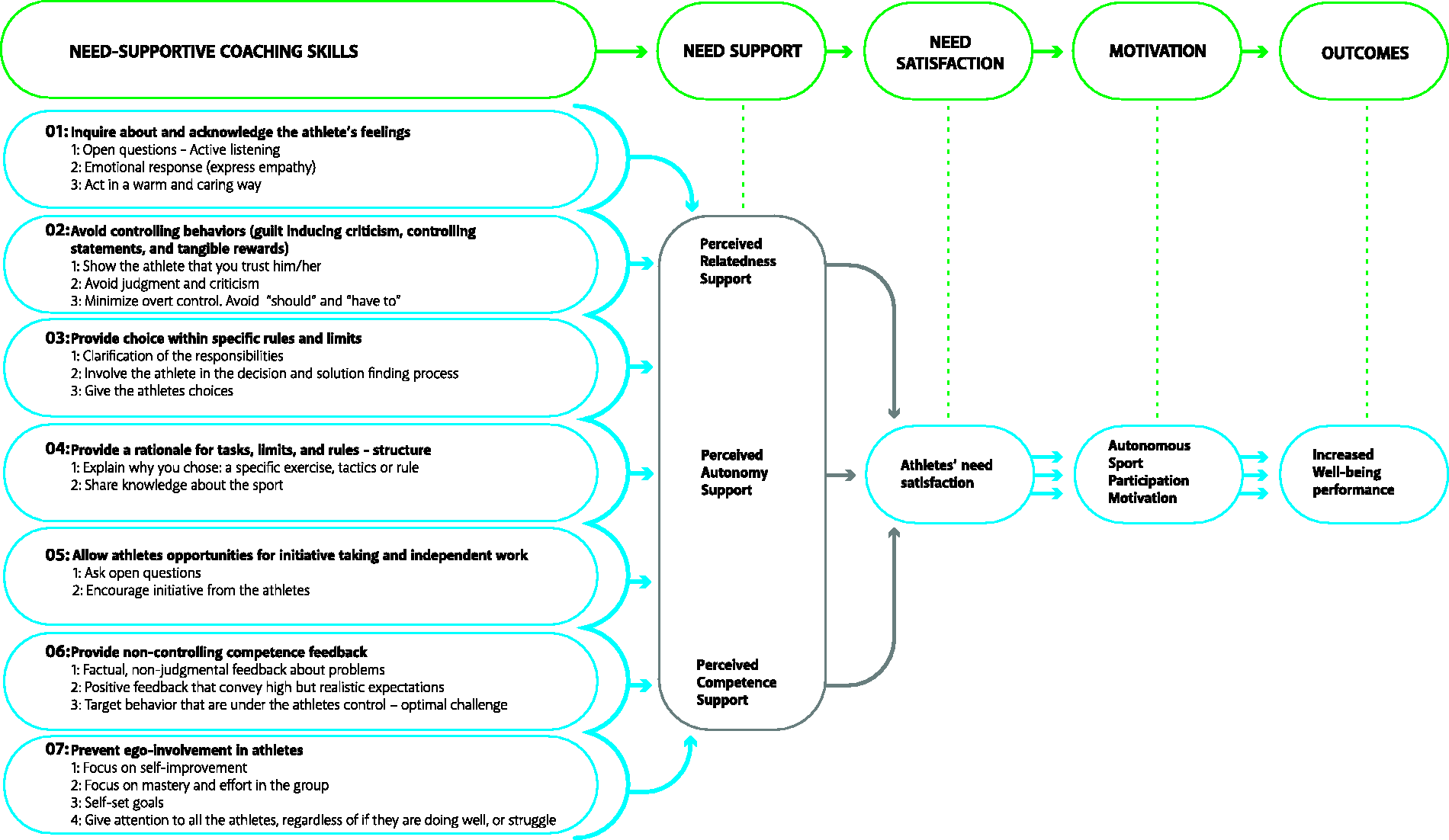
autonomy-supportive strategies. Need support is defined as autonomy support accompanied by structure and interpersonal involvement.12,53 Mageau and Vallerand's model shows that autonomy-support encourages the satisfaction of all three basic psychological needs. Focus on support for competence and relatedness (structure and interpersonal involvement) was secured by adding explicit coaching skills (See Figure 2; see literature11,12,52–57) for each of the original seven autonomy-supportive strategies.
11
Need-supportive coaching towards young athletes is associated with higher quality motivation (associated with adaptive outcomes) and well-being in these athletes.11,12,53
SDT process model of coach need-supportive behaviours influence on sport participation motivation and well-being.
58
Need supportive skills were chosen as previous research found it teachable in domains such as physical education, exercise, and health. 59 To demonstrate the value of evidence-based pedagogical principle, the aim of this study was to examine the learning material employed in this CDP and fill a gap in coach education literature by designing a multimedia learning tool to improve the efficiency of the CDP. Thus, we asked: What is the educational value of a digital workbook (learning tool) that is informed by evidence-based pedagogical principles, for coach learning?
Method
Philosophical assumption
Qualitative research is a complex mix of different traditions, orientations, and techniques, and philosophical assumptions determine its quality and (mis)alignment of approaches and techniques.60,61 Five main approaches (i.e. narrative, phenomenology, grounded theory, ethnography, and case study) have been suggested in qualitative inquiry. 62 Bradbury-Jones et al. 60 suggest adding “generic qualitative” approach to these main approaches. In their recently published review on the state of qualitative research in health and social sciences, they found that almost half of the articles belonged to the generic qualitative, as well as having the highest level of alignment. Through their wheel of alignment, they argue for the possibility of pluralism (i.e. using different methods) as long as stating level of alignment for rigor. 60
Based on the above recommendation, the methodological approach of this study is generic qualitative with an interpretive epistemology. The post positivistic approach of critical realism 63 has emerged as one of the most powerful directions in philosophy of science, offering a good alternative to positivism and constructivism. 64 Critical realism merges classical realistic ontology (there is a real world that exists independently of our perceptions of it) with an interpretive (relativism) epistemology (our understanding of the world is constructed and colored by our subjective perspectives). 65 With an interpretive epistemology comes the subjective nature of the research process, which makes transparency important (i.e. describing the procedures)61,66 in the construction of knowledge.
Participants and their context
The context of this research was an elite sport school, the non-profit private foundation The Norwegian College of Elite Sport (hereafter NTG), which can be referred to as elite youth coaching. NTG is a network of six elite sport schools in Norway, with 990 students participating in 27 different sports. 67 Current and former NTG athletes have achieved considerable success, accumulating in 186 world championship medals and 77 medals in the Olympics. 67
The current investigation took place at one of the sport schools, and all 10 coaches between 25 and 54 years old (Male = 9, Female = 1, M age = 36.4, SD = 9.167, alpine skiing n = 2, cross-country skiing n = 3, biathlon n = 3, snowboard and freeski n = 2) participated. The coaches’ working experiences ranged from no prior full-time (only club based experience), to true veterans with over eight years of experience at NTG (M = 5.4, SD = 4.35). Of the 10, 2 have long careers as national team coaches at the world cup level in addition to their NTG coaching experience. Six of the 10 coaches had a university education in sport sciences (four Masters, two Bachelors), which made them a well-educated group and ideal for the intervention based on SDT. 52 Two of the coaches without university education were certified elite coaches through their respective federations.
Procedures
After obtaining approval from the Norwegian Social Science Data Services, informed consent was obtained in the beginning of August 2016, before conducting the three researcher led workshops (24 August, 5, 11 and 13 October 2016), followed by semi-structured interviews (May 2017). The coaches were informed about the project before the implementation of the intervention (workshops), as well as their participation rights.
Knowing the context
Expert knowledge about the context of youth sports (especially skiing) was very helpful when producing the learning material of MAPS and especially while developing the video scripts. Facilitators’ knowledge on context and coaching was suggested as a success criterion by Trudel et al. 33 as the facilitator meets coaches with different biographies. In addition to extensive experience as a coach and former elite athlete in multiple snow sports, the first author travelled around Norway, visiting ski clubs, presenting and discussing need-supportive strategies as part of the research for the development of the learning materials. The researcher also spent a week in a ski resort with a group of elite skiers and their coaches. The athletes and the coaches were given drafts of the manuscript and asked to act out the different roles and contexts. The researcher (facilitator) explained, instructed, and talked with the “actors” as they acted out the scenarios. As a perceived sense of being controlled depends also on non-verbal factors, the scripts were acted out; tone of voice and non-verbal expressions are essential to clearly distinguish between the two different coaching styles.
Using the digital workbook
All coaches were introduced to the digital workbook as part of a presentation on need-supportive coaching strategies at the first work shop at the elite sport school. Shortly after the first workshop, the coaches received the digital workbooks as a link, sent to their work e-mail addresses. The digital workbook was downloaded onto their tablets, phones, or computers – making it easily accessible. Coaches reported that they read through the workbook and watched the videos before we met for the second workshop (i.e. presentation and group discussions) and third workshop (i.e. one-on-one sessions with the facilitator). Some coaches reported that they used the workbook frequently throughout the season. Having access to the learning material throughout the season gave the coaches an opportunity to use it when time permitted.
The content of the digital workbook
The design of the workbook followed principles of learning in line with the cognitive theory of multimedia learning as outlined above 21 and was divided into three parts. In the first part, benefits of a need-supportive coaching style are outlined and key concepts explained through text with tables, graphics, and pictures in part one of the coaches' workbook. Part two of the workbook contains video fragments that show each of the seven strategies. Between the workshops, coaches were asked to work with one strategy per week, by preparing for hypothetical situations, and then reflecting retrospectively about how it went when they tried to use the strategy (see Figure 1). In part three, personal, contextual, and social influences on coach behaviors are presented.
The video fragments (1.37–3.18 min) show how coaches can act need-supportive. All videos had a similar structure; first a sport-specific scenario is described by a voice-over. The videos show athletes practicing while music is fading out and (human) voice-over starts. Next, we witness a dialogue between a coach and an athlete or a monologue by the coach. The coach behavior in each scenario is shown in a need-supportive way (“good coach”) as well as a controlling way (“bad coach”). The videos end with a reflection by one of the athletes of how it felt to be treated in a need-supportive versus a controlling style.
Interviews
The coaches' assessment of the learning material may offer important insight into the effectiveness (or lack thereof) of the learning material. Typically coach transfer retention tests have been used to assess meaningful learning. 35 As the aim is to understand the nuances of the coaches' experiences with the digital workbook and to explore their understanding of the seven need-supportive coaching skills, 68 we chose interviews to explore coaches' perceptions of the digital workbook, whether it had fostered meaningful learning, and to ask about their ability to use the material to talk about how they coach.68,69 In addition, interviews can help us to understand the meaningfulness of the implementation of programs.68,70
The semi-structured interviews were conducted six months after the end of intervention (May 2017), and the interview guide71,72 focused on five areas of the coaches’ (learning) experiences with MAPS. First, the coaches were asked about their experiences with the intervention and MAPS as a whole (all the workshops). Next, the coaches responded to the extent they used the digital workbook and what they thought about the different parts of it (e.g. text, videos, and scenarios). We went on to explore coaches' perception of learning (whether they changed something in how they coach or think about their coaching), then the coaches were asked about their opinions as to what they would suggest as revisions to the program, and finally, what they found challenging. The first author conducted the interviews. The interview guide was piloted with two coaches (not from NTG), one freeski coach and one alpine coach (this data not included here). During this pilot, the interviewer learned to listen and not interfere but use prompts to encourage the participants to keep talking. Small changes to the interview guide were made regarding how to ask open questions and get detailed answers rich in texture. Learning which prompts can encourage coaches to keep talking was helpful as well. The interviews lasted about an hour and were audio recorded. The interviews were conducted at school offices. Each interview was conducted in one of the offices that were available at the time of the interview. Pseudonyms were used when writing up the report.
Data analysis
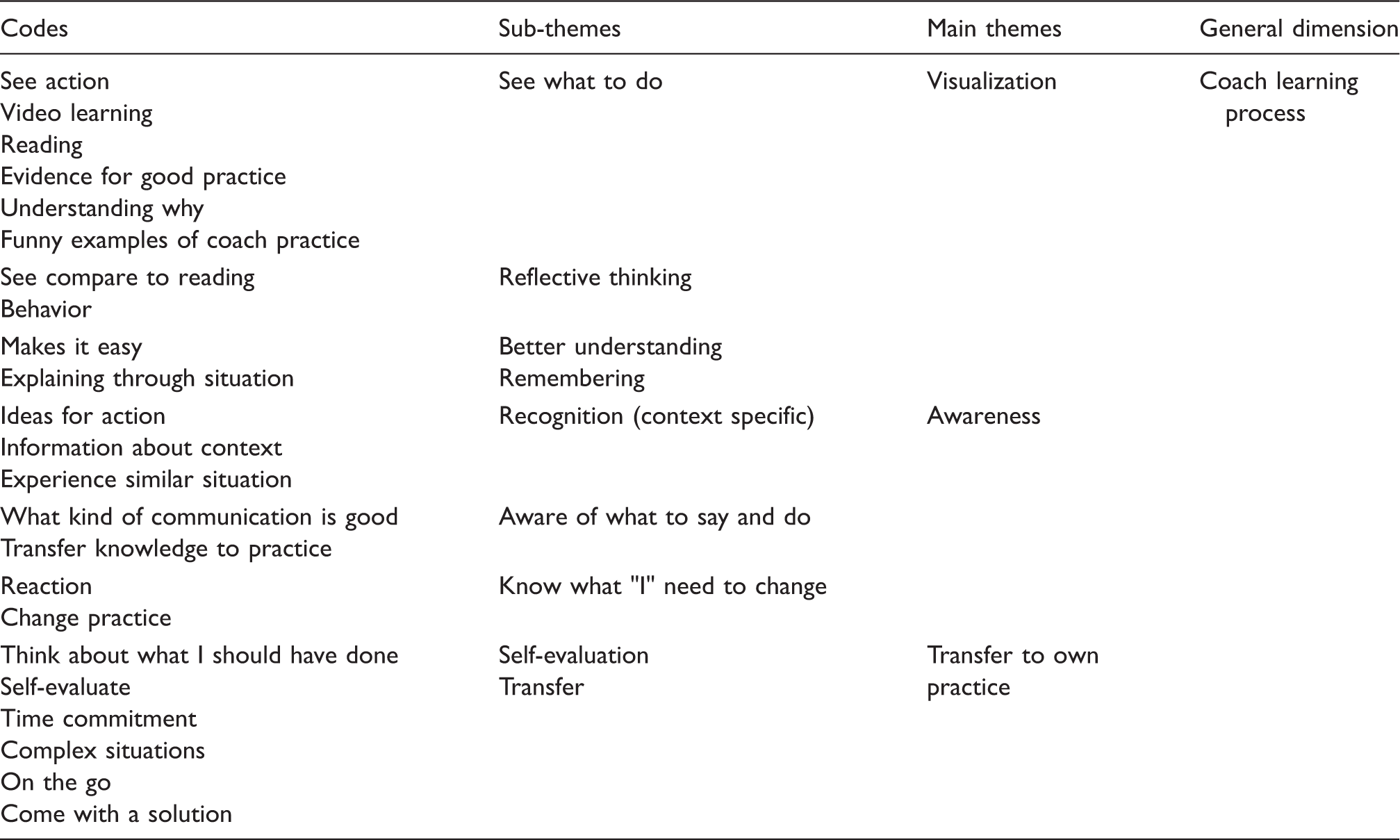
Coaches' assessment of the value of the digital workbook for coach learning.
Rigor
The interviews were conducted in Norwegian by the first author. We carefully translated the quotes in English to make sure the meaning was conveyed with accuracy. The first author is fluent in two languages. The data were aggregated to maintain anonymity, following ethical guidelines.
Member reflections
As the research process evolved, an early draft of the article and tables with quotes were sent via e-mail to all the coaches to ensure accuracy of meaning translation and to enhance trustworthiness. Further, member reflections66,76 helped create high quality, meticulous, and robust research. Member reflections are not done to verify the research but rather to generate additional insight. This logic of justification is in line with the critical realist position since the realist epistemological position acknowledges that we can never know the objective world. 66 The data analysis process did not reveal negative case analysis, as all the codes seem to fit the developed categories.
Critical friend
Inter-rater reliability as traditionally used by Lincoln and Guba 77 is ineffective in ensuring that the findings are reliable, as we cannot know the objective world. 66 The critical friend strategy is an opportunity for dialogue to acknowledging multiple truths, perspectives and results in the research process, and may be a marker of rigor in qualitative research.66,78 The second author acted as a critical friend throughout the process, from data collection, analysis, and writing of the manuscript. Coders met in person on several occasions to discuss codes and meanings. All the text was coded and multiple paragraphs were marked for each code. Feedback from both coders was discussed to reach an agreement of the coding. Emerging findings and final draft were also read and commented on by an experienced scholar within the field of sport.
Results
The coaches' understanding, adaption, and evaluation of ability to transfer the meaning of the need-supportive skills to their own practice as revealed by the interviews are summarized in Table 1. The thematic analysis revealed three main themes and nine sub-themes. The two overreaching themes were coaches' perceptions of the format of the learning material (visualization and awareness) and its contribution to foster meaningful learning (by transfer to own practice).
Visualization
The first aspect of the coach learning process, visualization, had four sub-themes; (a) see what to do, (b) reflective thinking, (c) better understanding, and (d) remembering. Overall, the major advantage of using videos, in contrast to text only, was that it showed the coaches how need support can be acted out in a context-specific way. They experienced the videos as a medium that helped them recognize context-specific situations. The inclusion of athletes in the sport they usually coached also helped as they more easily could relate to the issues dealt with. To see what to do was the main reason given by the coaches as it gives you the “essence of the task” immediately. As Mark (pseudonym) emphasized: What I remember is that it is really easy to see how one should act according to the videos, what the point of the situation is and how this is illustrated by the different scenarios. I thought that was good. I absolutely found this instructional. Those videos are really easy to understand, and they show the situation in a totally different way than what you would be able to understand from reading about it. And I think that is very good. It is a great medium.
Even if you just pay a little bit of attention when watching the videos, you will remember them much better than any text. If the learning material only consisted of text, it would have been much harder to recognize the different situations.
Awareness
The second aspect of the coach learning process, awareness, had three subthemes; (e) recognition, (f) awareness of what to say and do, and (g) awareness of what “I” need to change. This aspect is related to another major advantage of the videos, in contrast with text only, which is that being able to see and compare coaching style heightens the awareness of one’s own practice. In short, they shared that the digital workbook made them much more aware on how they acted as coaches. For example, Adam explained how the videos helped him recognize different contexts, “To see it this way, makes it very visual and it is easy to recognize the different situations. This was clearly aimed at us (situations in the videos), so that is very good. I think it worked well.” The scenarios were tailored to reflect typical situations, problems, and challenges. Using these familiar situations heightened coaches’ awareness of how to be need-supportive (or controlling). In other words, the theoretical concepts became alive.
The recognition of context specific situations increased coaches’ awareness of what to say and do. This example from Josh shows the awareness aspect of the learning material: One becomes more aware in a way over what to say, what to do or how to act. One thinks more about it, one does that, so that is for sure what it [i.e., the digital workbook] has contributed to. I also think it has given me some ideas for how I should act as a coach, and certainly made me more aware [i.e. of how my action affected the athletes].
Transfer to one’s practice
The third aspect of the coach learning process, transfer to practice, had two subthemes: (h) self-evaluation and (i) transfer. Self-evaluation was discussed in all the coach-interviews due to it being a natural part of the learning process. For example, Tim expressed: I remember the strategies when I meet resistance or when I realize I should have handled the situation differently, then you remember, and I think “I should have been smarter, given myself a minute to think before responding” (i.e., giving non-controlling competence feedback). It is really important to think about how one meets the athletes … It can sometimes be a little difficult … one athlete approached me: “Jeff [pseudonym], can we practice shooting inside today [part of biathlon training] because its cold and it is snowing?” I remember thinking that we can still practice outside. But he had a better solution, it will be better to train inside … The athlete showed initiative and had a good rationale, so for me to stick with my original plan required a rationale that they accepted, but sometimes you simply can't find your rationale before your three seconds are up.
Transfer shows the complexity of using the skills in real situations, and how coaches used the newly acquired knowledge about what need support is to their coaching practice. Thus, transfer may require adaptation of knowledge to new situations over an extended period of time. The videos provided them with a toolbox of strategies, but these strategies need to be adapted to each situation, and information about the athlete and the sport plays a role in how the coach responds. Fred addressed this point in the interview: The videos have the potential to make it clearer when you as a coach should or could respond in different ways. In the digital workbook, Strategy 5 emphasized the importance of allowing athletes opportunities for initiative taking and independent work. While I wholeheartedly support this for some athletes, you cannot let one who is always late have this opportunity. It is important that we distinguish between the different situations, and how to respond would depend on the situation and athlete in question. Sometimes we challenge the athletes a little more than the “good coach” in the video in similar situations by coming up with suggestions “can you …?” or “how would it have been if you …?” If an athlete approaches me and says it is not possible to compete three days after a graduation party, I would say that yes, it is possible. I make the structure clear for the athlete based on the information about the situation.
Discussion
The purpose of this study was to investigate the value of a digital workbook that was informed by evidence-based pedagogical principles. The findings revealed that the design of the workbook increased the coaches' perception of need-supportive skills. In the interviews, the coaches expressed that they started an awareness process. They had an opportunity to compare need-supportive and controlling coaching behaviors and shared a few laughs about coach–athlete interactions in the videos. They learned tools for better coaching, also the aim of most CDPs. However, their time spent in CDPs is limited compared to their time spent coaching.3,10 Therefore, they underlined the usefulness of a CDP that takes place where the coaches learn to coach. 10
Designing CDPS
Coaches valued the video more than the text and books. As the findings suggest, the videos with situation-context specific videos help coaches visualize, develop awareness of what to say and do, and transfer the new knowledge to their own practice. Learners’ preferences and motivation influence their engagement and experience with the learning situations, 48 and through the learning materials, coaches could learn to differentiate between need-supportive and controlling coach–athlete interactions. Using illustrations they could relate to enabled them to relate the material to their coaching practice. Awareness is closely related to relevance when the goal is to reach meaningful learning.33,35 The relevance also allows the coaches to better engage in their own learning process, 79 which was clearly expressed in the interviews.
Designing the CDP for this investigation (i.e. MAPS) was time consuming. Specific knowledge of the sports and its context and pedagogical principles were starting points before even adding the content! We used real-life problems for coaches in an attempt to construct learning situations where problems of theoretical and craft knowledge are intertwined in the situation specific videos. 27 This helps translate theoretical constructs/content into real-world actions. The videos made the material relevant for the coaches attending the program, as the actors and situations were all from the elite sport school snow sport contexts. For authentic situation-specific scenarios, the material has to be meaningful. 33 Learning needs to be contextualized and facilitated in an appropriate environment.13,27 The coach-centered learning opportunities come from the design of the digital workbook. When coaches understand what the theory means for their practice, then this is a great starting point for further reflection between meaningful learning and their experiences (practical dimension), and continued development of need-supportive skills, as seen in Figure 1 (Bridge 2). Reflection increases coaches’ understanding of their own practices, 27 which will be important in the next stages of the learning process to improve practice. Each stage in the learning process is important to evaluate in depth to increase our knowledge about what causes coaches to change their behavior. We argue that for better CDP design, different stages of the learning process have to be identified and designed accordingly for coach learning.
The importance of meaningful learning for improved practice
The ultimate goal for CDPs is improved practice (behavioral change). This has proven to be a challenging endeavor due to the problematic nature of transferring theory directly to coaching.7,80 Our solution to this challenge was to propose a model of coach learning process where theory, thinking, and doing are intertwined (see Figure 1), a model we adapted from Jones et al. 27 In our proposed pedagogical model, meaningful learning happens in the intersection (nexus) between theory and practice. The meaningful learning nexus allows coaches to better engage in their own learning, which is an important step toward behavior change. Thus, the information about how to behave need-supportive can lead to improved practice when reaching the meaningful learning dimension.
Theory has the potential to become meaningful to the individual33,35 if integrated to her or his experiences. It is not enough to know what need-supportive coaching is. It is essential that the coaches know what the skills look like in their context specific. The cognitive theory of multimedia learning explained how the coach needs to bring the information of the different learning styles to relevant prior knowledge. 35 Similar arguments have been made in the body of coach learning literature. The coaches’ ability to see the link between the material and their coaching practice is important for deep learning. 33
The meaningful learning stage is proposed to represent coaches adaption of the knowledge dimensions (see Figure 1), and essential because it means that the coaches know what “good coaching” looks like in their practice. When moving towards improving practice, Jones et al. 27 argue for the importance of reflection to improve practice. Knowing what need-supportive skills means in their context is a great starting point for learning how to coach through experience and reflection (see Figure 1). When reflecting without knowing what “good coaching” is, one cannot expect improved practice.6,27 When coaches reach the meaningful learning stage, they will or can reflect on their own practice meaningfully – alone or with other coaches. 27
The knowledge dimensions seen in Figure 1 have been adapted from Trudel et al., 33 Mayer 35 and Jones et al. 27 Adapting the theoretical material to one’s own practice experience is crucial to reach the meaningful stage. 35 Reflection 27 between meaningful learning and experience is essential for improved practice. As coach learning happens inside and outside of educational settings,13,81 the meaningful learning stage lays the foundation for ongoing learning.
Strengths and limitations
This article assessed meaningful learning,35,39 not actual behavioral change. This is a strength, as careful consideration of underlying pedagogical principles is a neglected aspect in current CDPs, and current reviews do not mention this topic at all.1,4 There is a lack of concern for how coaches learn, 7 and thus the careful design of MAPS fills a current gap in research on CDP.
We used coaches, in contrast to testing the intervention on students. 7 This is a clear strength of the investigation. The design also opened interpersonal perspectives in coach education, and the interviews revealed that the education offered by their respective ski federations had not provided an interpersonal perspective. The coaches found MAPS useful as they learned new tools such as the concept of need-support, a concept only one of the 10 was familiar with before. Lefebvre et al. 5 review of CDPs found that only 18 out of 285 programs primarily focused on coaches’ interpersonal knowledge/behavior.
The study also has its limitation due to size and the role of the first author who developed the intervention as well as conducted the workshops and the interviews. It is possible that the coaches felt obliged to say positive things about the program due to her being a familiar figure, which might be considered a limitation. On the other hand, her knowledge in the sport encouraged them to attend and engage fully. Trudel et al. 33 encourage a careful selection of the facilitator, as the facilitators’ biographies influence the ability to guide the learning process and interactions with coaches. This suggests the importance of the facilitators' expert knowledge, as they meet coaches with different biographies. As such, the combination of credibility in sport combined with theoretical knowledge was a success factor in this study.
Concluding remarks
Coach education needs to be better supported by empirical evidence.7,13 We conclude by presenting the contribution of our results to coaching science, and more specifically how to plan for coach learning. The results revealed that coaches perceive the digital workbook, which was informed by the cognitive theory of multimedia learning, to be successful in fostering coach meaningful learning. The distinctive contribution of this article is the outline of the development of educational means for teaching coaches to understand how to be need-supportive that is informed by an underlying pedagogical principle. This may lay the foundation for further development of the effective CDPs. Therefore, advances in cognitive science may have useful implications for how to design effective learning material for CDPs, and we encourage other sports to use this approach to improve their learning material for coaches.
Practical applications of the results
The main practical application of this work is that the cognitive theory of multimedia learning as an underlying pedagogical principle is helpful for the design of learning materials for CDPs, an important part of the complex reality of coach learning. Taking a holistic approach opens possibility for combining different types of learning theories. Video as a medium used as part of learning material helped coaches conceptualize, reflect, recognize, and prepare them for the practice context. Also valued as a medium of choice for these coaches. Meaningful learning has the potential to serve as a nexus between theory and practice. It creates what we call a thinking bridge, and may guide coaches towards improved practice.
Footnotes
Acknowledgements
Thanks to coaches and athletes at the Norwegian College of Elite Sport for their participation in this research project. A big thanks to Professor of Education, Dr. Glenn-Egil Torgersen (Norwegian Defence University College, Akershus Fortress, Oslo) for his advice on the development of coach learning material based on the Cognitive theory of multimedia learning.
Declaration of conflicting interests
The author(s) declared no potential conflicts of interest with respect to the research, authorship, and/or publication of this article.
Funding
The author(s) disclosed receipt of the following financial support for the research, authorship, and/or publication of this article: This research was supported by The Norwegian Olympic and Paralympic Committee and Confederation of Sports (NIF), The Norwegian Ski Federation (NSF) and The Norwegian Research Centre for Children and Youth Sports (FOBU) at The Norwegian School of Sport Sciences.