




Abstract
Several golf swing movements have been correlated with the production of club speed in skilled golfers. However, less skilled golfers, such as senior golfers, may not be capable of many of those movements. One golf swing—Minimalist Golf Swing—reduces the downswing range of motion through which a golfer’s body must move to reach the impact positions seen in skilled golfers. The purpose of this study was to assess whether the MGS could improve senior golfers’ ball flight and consistency, and increase their motivation to play golf. Twenty-two seniors (16 males, 6 females), aged 54–81, participated in an 11-session study comprising pretest, intervention, and posttest sessions. During the test sessions, participants hit 20 shots with each of their own 6-iron and driver clubs. Ball movement immediately after impact was measured using a camera-based ball launch monitor. Participants’ motivation to play golf before and after the intervention was assessed using the Sports Motivation Scale II. A mixed effects model was used for the statistical analysis of this repeated measures study, in which participants served as their own controls. Statistically significant per-session results were an increase in the ball’s speed (6-iron and driver) and trajectory (6-iron), and a change in direction (both clubs) from left to slightly right (for right handed golfers). Consistency of ball flight, total motivation and intrinsic motivation increased slightly post-intervention, while amotivation decreased, none significantly. Therefore, some senior golfers can improve ball flight, consistency, and motivation to play golf after six MGS training sessions.
Keywords
The full swing in golf is considered to be one of the most difficult biomechanical motions to execute. 1 Although individual styles vary considerably, most swings are generally either classic or modern. The modern swing has been increasingly used over the past 60 years, 2 and aims at achieving greater club speed through vertical and horizontal (lateral) acceleration of the body’s hub (located approximately between the shoulders), during the downswing. Club speed, and the movements generating it, moreover, is what most golf swing researchers have typically focused on, while research has ignored the movements that might generate better direction. In addition, there is little research to indicate how less-skilled golfers might achieve the downswing movements which are associated with greater club speed in skilled golfers.
Skilled golfers have been observed to be able to move through a considerable range of vertical, lateral and rotational movement during the downswing to reach the impact positions which are said to translate to greater club speed. Less skilled golfers, however, do not have the strength and speed to move through the same range of motion, which is not surprising as the golf downswing lasts only between 0.27 and 0.34s 3 for all golfers, regardless of skill level.
Vertical acceleration is achieved by an upward movement of the hub during the downswing. It was shown 4 to be significantly higher ( p < .01) in elite golfers (M = 139.5 cm, SD = 4.8 cm) than in novice golfers (M = 118.7 cm, SD = 18.3 cm). The lateral movement that contributes to greater club speed is termed “weight shift”. In a comparison of skilled versus nonskilled golfers, it was seen that the former shifted weight (from the trail foot, i.e. right foot for a right-handed golfer) by 12.3 ± 3.7 cm towards the lead foot (left foot for a right-handed golfer) during the downswing, while the latter showed less, and delayed, weight-shift. 1 Finally, rotational acceleration takes place in a proximal-to-distal sequence, much like a stack of discs that rotate about the same axis, with the larger disc below imparting its energy to the smaller one above it, in keeping with a summation-of-speed principle. 5 During the downswing, professional golfers had a significantly higher ( p < .011) average pelvic rotational acceleration of 2.1 kd/s2 ± 0.4 compared to amateurs’ 1.5 kd/s2 ± 0.4, and a significantly higher ( p < .011) average thorax rotational acceleration of 3.3 kd/s2 ± 0.5 compared to amateurs’ 2.3 kd/s2 ± 0.5. 5
One solution for less skilled golfers to reach some of the impact positions seen in their more skilled counterparts might be to reduce the vertical and lateral range of motion through which they have to move during the short time frame of the downswing, as both involve a movement of the body’s center of mass through some distance. These movements could be replaced by an increased rotary range of motion about a longitudinal axis.
One golf swing—the Minimalist Golf Swing (MGS)—requires a golfer to maintain the lead shoulder higher, and the body’s weight closer to target, than typically seen, from set-up to the top of the backswing. It thus requires less vertical and lateral body-movement during the downswing, to help a golfer get into suitable impact positions within the short time frame of the downswing. At the same time, it is designed to increase rotational range of motion, and thus acceleration, through a pre-swing rotation of the torso, which is positioned to face away from target. The MGS has been shown, in a previous study, to produce greater clubhead speed for a mixed age-group of golfers over a single-session swing change. 6
A population for whom there may be benefits to the use of the MGS, based on its purported advantages, might be senior golfers (aged 50 years and above), because aging is associated with diminished performance due to a reduction in muscle-strength, speed, flexibility and range of motion. 7 Senior golfers, therefore, are unable to move through the large range of motion that elite golfers do, as their motor performance becomes slower and less consistent with age, 7 which loss of speed reduces their ability to hit the golf ball long distances with the full-swing. 8 Moreover, while concentric and isometric strength reduce with age, it is known that eccentric muscle performance is retained to a greater extent, 9 and this is a concept the MGS capitalizes on through its greater range of torso rotation, in the expectation of club speed gains.
The loss of ball-distance and trajectory (which together with direction constitute ball flight) are important factors for performance. 10 An attenuation of performance might cause senior golfers to be less likely to be attracted to, and retained by, golf. This might occur because humans have a need for feelings of competence and autonomy, 11 and are known to engage in tasks “…in which they feel competent and confident and avoid those in which they do not”. 12 If the MGS is able to improve ball flight for senior golfers, it might also increase their motivation to play golf.
The purpose of this study, therefore, was to assess whether the MGS intervention could, for a mixed group of senior golfers, improve actual ball striking (ball speed, trajectory and direction), consistency of ball striking, as well as the motivation to play golf, while using two different golf clubs which have considerably different performance characteristics. It was hypothesized that ball-striking would improve with respect to ball speed and trajectory, while direction would change from starting randomly left or right, to starting either straight or slightly towards the right (for the right-handed golfer). It was also hypothesized that ball-striking consistency (as assessed by the standard deviation of each outcome), would be improved. Finally, it was hypothesized that overall motivation and intrinsic motivation would increase, while amotivation would decrease.
Methods
Participants
Twenty-two male and female golfers over the age of 50 years were recruited for this study. A G*Power 3 post hoc power analysis 13 for this single-group, repeated measures study of 22 participants and three dependent variables, with a significance level of α = .05, and a Cohen’s d effect size of 0.7, resulted in a power of 0.8. Convenience as well as snowball sampling techniques were used, and golfers were recruited from the Dallas-Ft. Worth Metroplex area. All participants signed an informed consent form approved by Texas Woman’s University’s Institutional Review Board, prior to the commencement of the study. Inclusion criterion was age above 50 years. Exclusion was based on a history of musculoskeletal injury or surgery which might prevent them from making a full-swing range of motion repeatedly, for one hour.
Experimental procedure
Participants attended 11 one-hour sessions and hit Callaway Big Bertha brand golf balls off a mat, into a net in an indoor location. Participants used their own 6-iron and driver clubs, and chose one of two tee heights for the driver shots. They were asked to wear whatever apparel, shoes and glove they typically wear while playing golf. Prior to each of the 11 sessions, participants warmed up in their usual fashion—either by hitting some shots or through some stretching exercises, or both. Session 1 was the baseline, pretest session, and was used to measure the ball-striking capabilities of participants’ existing swings. During this session, participants hit 20 balls with each of their 6-iron and driver clubs. This large number of shots was chosen as it was expected to adequately represent a baseline measurement. Sessions 5, 6, 10 and 11 were posttest sessions, intended to study changes at different time points after the commencement of the intervention. During these sessions, too, participants hit 20 balls per club. The remaining six sessions were training sessions for the interventional golf swing (MGS).
The 18-question revised Sports Motivation Scale II (SMS II) was administered before commencement of session 1 and upon completion of session 11, to assess changes in motivation. It has been assessed to be a valid and reliable measurement tool, and all subscales have a Cronbach’s α ≥ .70. SMS II assesses six sub-scales of motivation—intrinsic, integrated, identified, introjected, external and amotivated. Motivation is “intrinsic” when it is self-driven, is “integrated” when a person feels it is the essence of who they are, is “identified” when an activity is self-chosen, is “introjected” because it self-reflects a person’s worth, and is “external” when it involves others’ opinions. The SMS II generates an overall score of motivation, the Relative Autonomy Index (RAI) score, which indicates the autonomy level of a person’s motivation. 11
Instructions for interventional swing technique
Standardized instructions that were given to all participants.
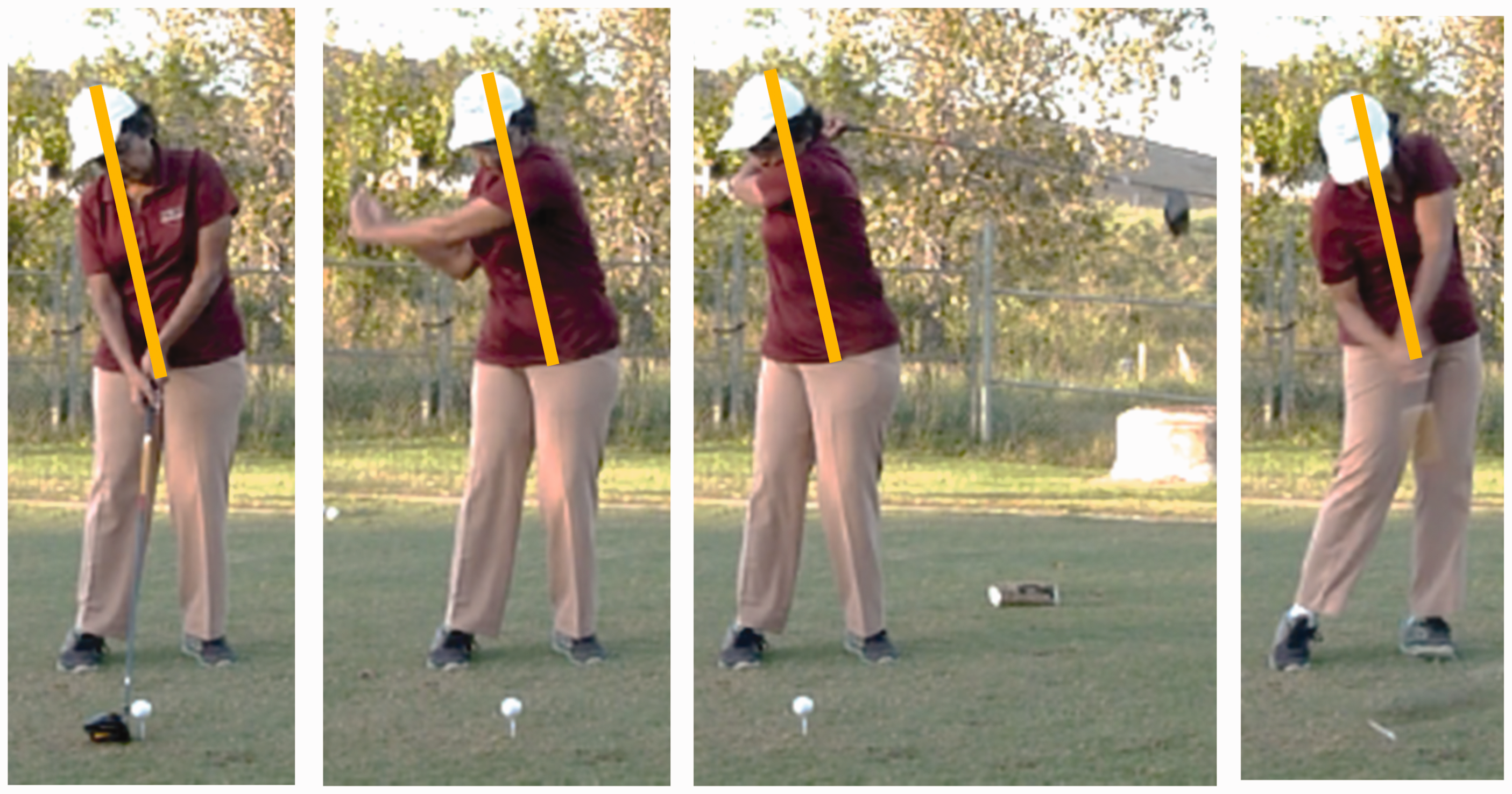
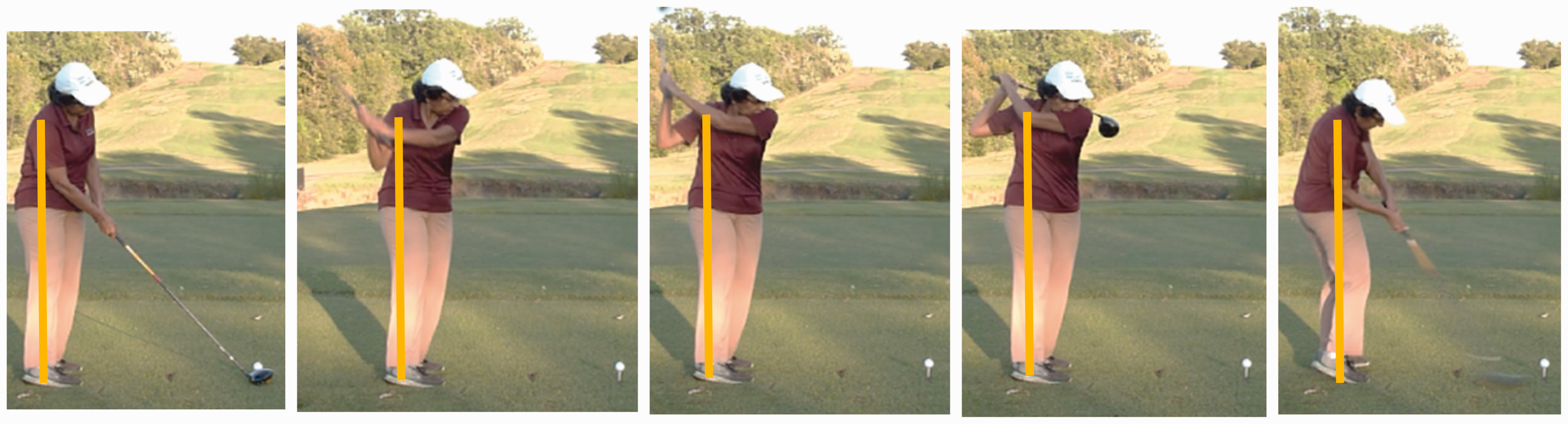
Set-up: Posture as upright as possible, using minimal hip and knee flexion. Rotate the torso to face away from target. Tilt the head towards the trail shoulder. Backswing: While maintaining the trail-side lateral flexion of the set-up, and keeping the lead arm close to the chest, lift it as high as it is able to go (no restriction to arms’ backswing length). Avoid any side-to-side, up-and-down or rotary movements of the torso during the backswing. Downswing: Continue to maintain the head’s trail-side lateral flexion. No other swing thoughts are required (Figures 1 and 2). Face on view. Set-up: Posture as upright as possible. Torso rotated to face away from target. Head tilted towards the trail shoulder. Backswing: While maintaining the trail-side lateral flexion of the set-up, and keeping the lead arm close to the chest, lift it as high as it is able to go (no restriction to arms’ backswing length). Avoid any side-to-side, up-and-down or rotary movements of the torso during the backswing. Downswing: Continue to maintain the head’s trail-side lateral flexion, no other swing thoughts are required. Note. Copyright. Original photographs of and by the first author of this article. Down-the-line view. Set-up: fairly upright posture, with minimal hip and knee flexion. Backswing: try to maintain the trail-side lateral flexion of the set-up. Note. Copyright. Original photographs of and by the first author of this article.
Explanations that were made to all participants.
No golfer gets into precisely the recommended positions, but any change made, to whatever extent possible, will show ball-striking improvement. The “magic move” of the MGS is maintaining the trail side’s (especially the head’s) lateral flexion throughout the backswing.
‐ It makes returning the club to the ball on the ground each time more likely, as the body has not moved up and down or side-to-side during the backswing. ‐ It positions the trail arm in “external rotation”, which makes it more likely that the club will arrive at the ball from the “inside” rather than “over the top”, for better directional control. ‐ It automatically cuts off any over-long backswing. No downswing thought is required, except to maintain the head’s tilted position. The MGS backswing sets up important joints like a row of dominoes—the movement of one piece triggers the sequential movement of the rest.
Data collection
The equipment used for data collection was a Foresight Sports GC2 golf ball launch monitor. It is a high-resolution, camera-based system which uses stereoscopic lenses for spatial recognition and has a data-capture capability of up to 10,000 frames per second. The system has an internal accelerometer which corrects for non-level surfaces. It has a reported accuracy tolerance of ±0.5 mph (0.22 m/s) for ball speed, ±0.2° for vertical launch angle (trajectory), and ±1.0° for azimuth (direction), according to the user-manual of the product. 14 Calibration was performed prior to each session by placing the launch monitor perpendicular to the target line, using a golf-specific alignment stick. The three dependent variables measured using this device were ball speed, trajectory and direction (left or right of target) at the start of the ball’s flight, immediately after impact with the club.
Data analysis
This study had a pretest–posttest repeated measures design, in which participants served as their own controls. The independent variable was the golf swing pre- and post-intervention, and the dependent variables were three important indicators of ball flight—ball speed, trajectory and direction, measured at club-ball impact. In a similar golf study, measurements had been nested within participants and multilevel analysis used. 15 Thus, a mixed effects model, also known as a multilevel model, was used in this study, and the three dependent variables of ball speed, trajectory and direction (level 1) were nested within the individual golfer (level 2). The main predictor (independent) variable in the model was the session number, which served to indicate ball flight changes from the use of existing swings (pretest) and then interventional swings (posttest), over the duration of the study. Other fixed-effect predictors used were the gender of the participant (male, with female as baseline), age, years playing golf and pre-intervention motivation. Skill level was not used as a predictor in this model because most senior participants did not keep a record of their scores while playing golf. The random effect of the model was the individual golfer. The multi-level (mixed effects) model was developed by starting with a basic fixed-effects only version. 16 After testing for significance of the fixed effects, the random effect of individual participants was incorporated into the model.
While ball flight is an important consideration for a golfer, so too is consistency of ball contact. This was assessed from the standard deviation, and was calculated separately for each aspect of ball flight. Finally, pre- and post-intervention motivation—total, intrinsic and amotivation—were compared using a paired samples t-test. A significance level of α = .05 was set for all tests, and SPSS 24.0 was used for all statistical analyses.
Results
Descriptive statistics
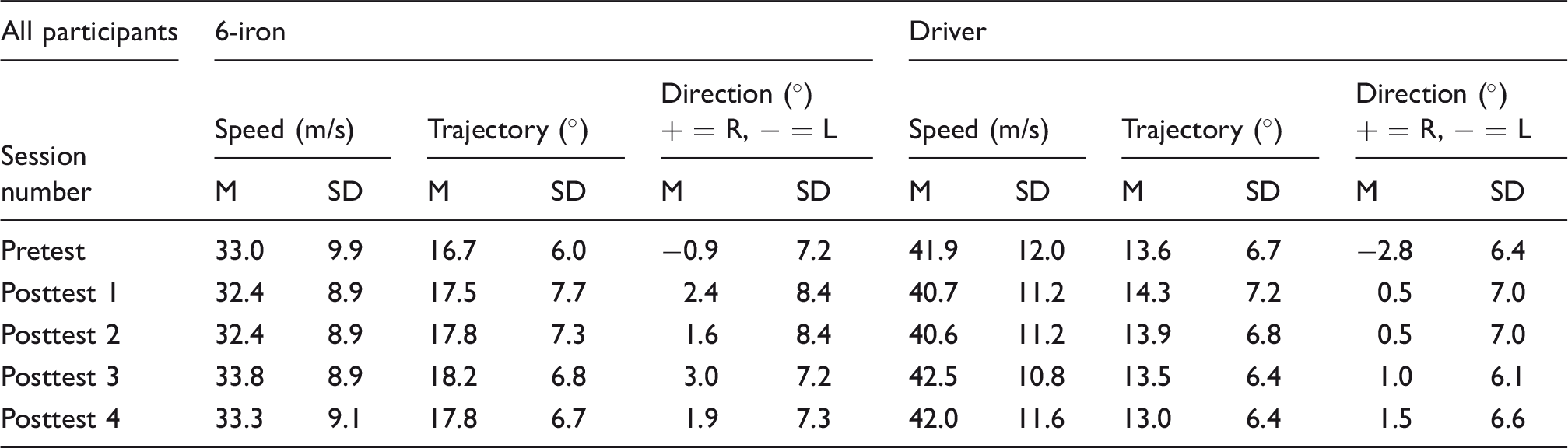
Session-wise mean (M) ball striking and standard deviation (SD); all participants.
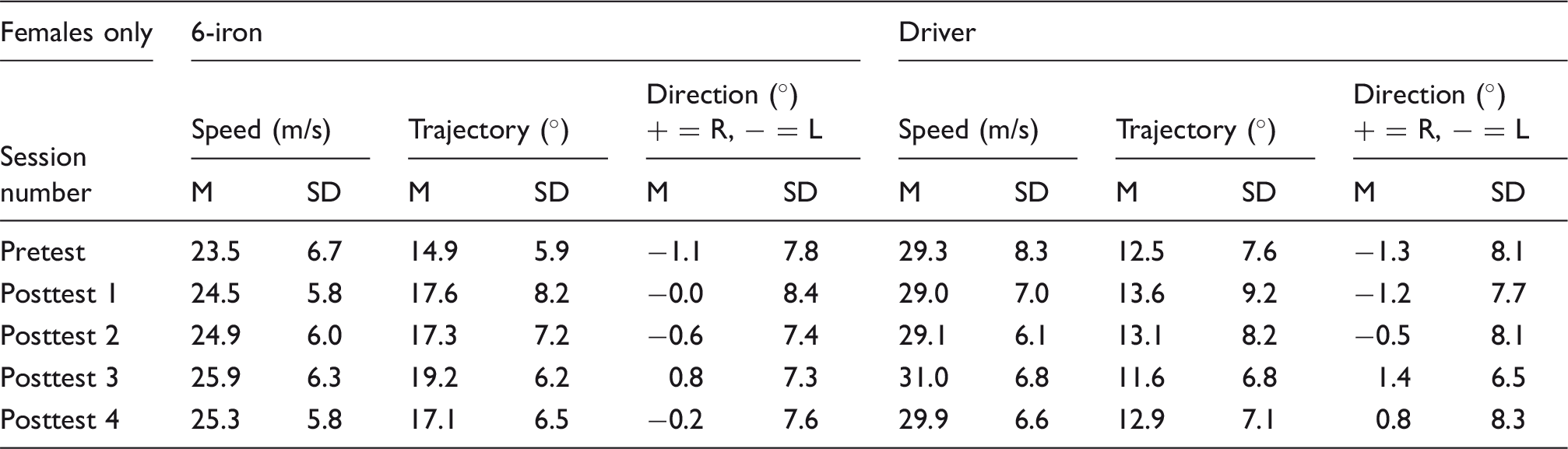
Session-wise mean (M) ball striking and standard deviation (SD), females only.
Session-wise mean (M) ball striking and standard deviation (SD), males only.
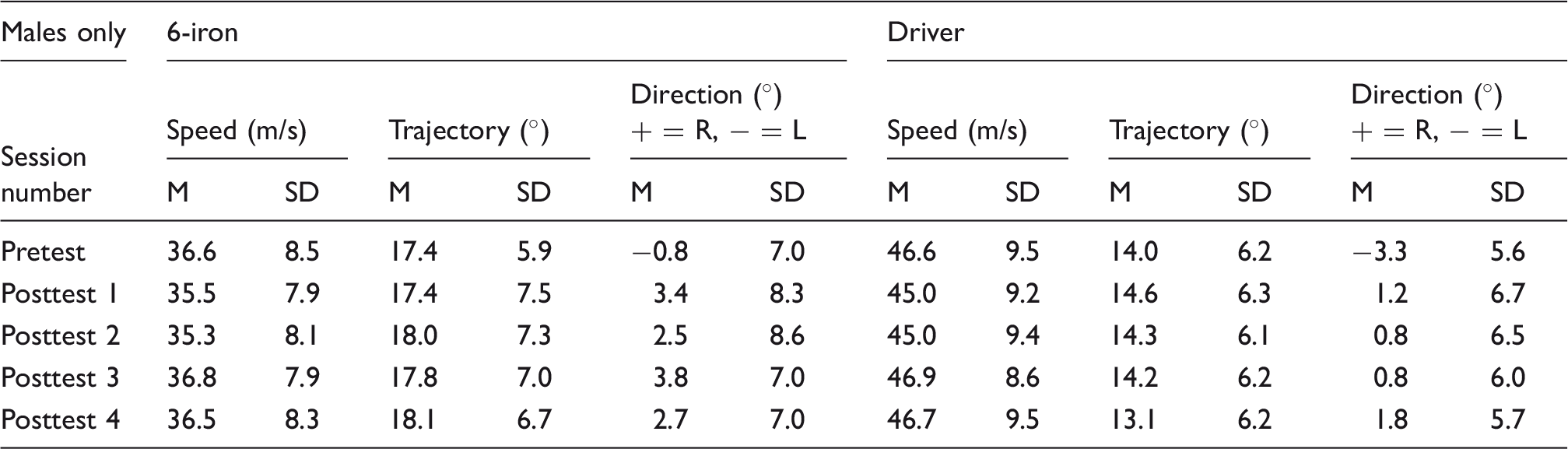
Male golfers’ baseline pretest ball-striking measurements (Table 3, session 1) for 6-iron and driver respectively were: 36.6 m/s (SD = 8.5); 17.4° (SD = 5.9); −0.8° (SD = 7.0); and 46.6 m/s (SD = 9.5); 14.0° (SD = 6.2); −3.3° (SD = 5.6) respectively. A measurement in m/s converts to approximately 2.24 mph.
Mixed effects model statistics
The relationship between session number (the main predictor) and the respective dependent variables showed significant variance in intercepts across participants, with p < .01 in all cases. Thus randomization of the intercepts of the model was justified because the respective dependent variables showed significant (seen from the χ2 test) variance, across participants. In other words, a mixed effects model is a suitable one to use when variability in ball flight already exists between participants prior to the commencement of the study.
The mixed effect analyses showed a significant effect of session on all three measures of 6-iron ball flight: ball speed b = (0.2), t(2128.3) = 3.0, p = .002, ball trajectory b = (0.3), t(2123.6) = 3.1, p = .002, and ball direction b = (0.6), t(2125.5) = 3.1, p < .001. Thus, per measurement session, 6-iron ball speed increased significantly ( p < .01) by an average of 0.2 m/s (0.45 mph); trajectory increased significantly ( p < .01) by an average of 0.3°; and direction moved significantly ( p < .001) right (for right-handed golfers) by an average of 0.6°.
Mixed effects model: significant fixed factors.
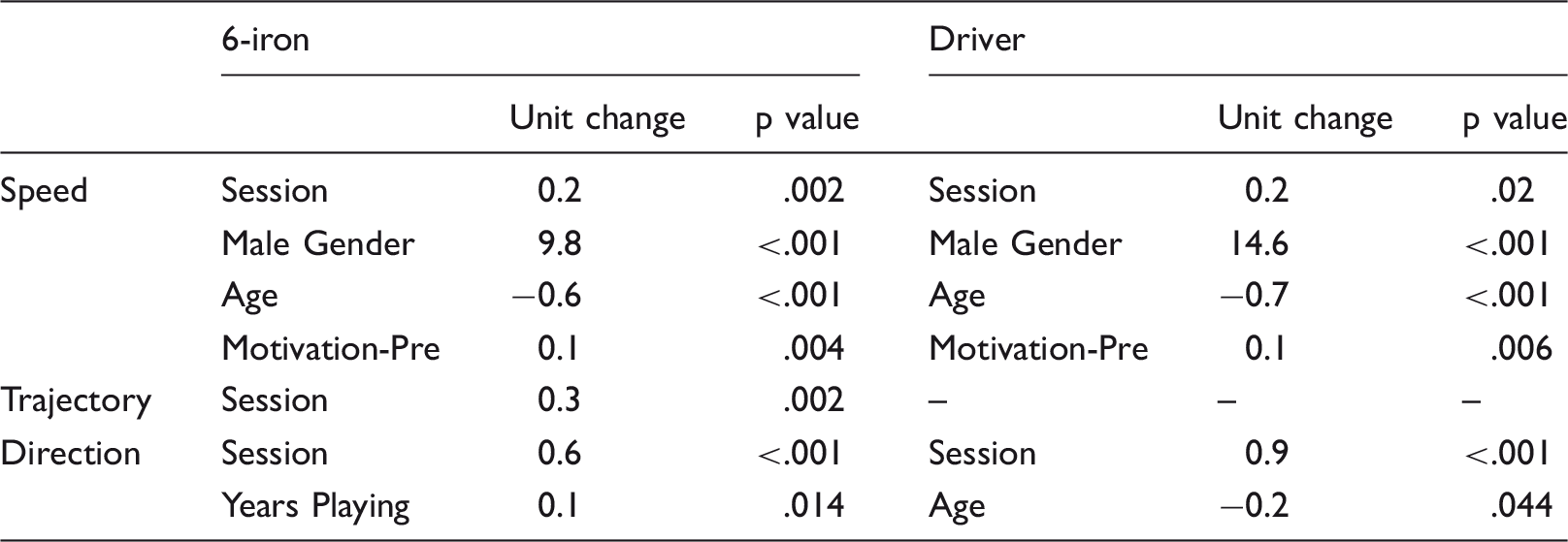
Finally, effect size has not been reported because no consensus exists 17 on an appropriate calculation of it for a mixed effects model. However, the post hoc power analysis of this study did input a Cohen’s d effect size of 0.7, which is considered to be medium-large.
Motivation statistics
There was a mean increase of 3.4 and 2.1 in total motivation and intrinsic motivation, respectively, and a mean decrease of 1.3 in amotivation; none were statistically significant. Of the 21 participants who completed the SMS II questionnaire, 17 had increased (11), or the same (6), intrinsic motivation after the golf swing intervention.
Discussion
This was the first study in golf involving a complete swing change, and was also the first interventional study for senior golfers. The intervention in this study involved a change of most set-up and backswing positions and movements, and even resulted in some participants feeling that their grips had changed. Moreover, most participants reported not having had any golf lessons, initially making so many simultaneous swing changes disconcerting.
The participants in the present study (which included many golfers over age 65, as well as six female golfers) had average pre-intervention baseline (Table 1) 6-iron ball speeds of 33.0 (± 9.9) m/s or 74 mph, and driver ball speeds of 41.9 m/s (± 12.0) or 94 mph. The average driver ball speed would therefore convert to a club speed of approximately 63 mph using a conversion (smash) factor of 1.5, 22 (Joseph, n.d.), which is within the driver speed range found by Little 10 to be between 55 and 75 mph, for most women, senior men, juniors and beginners. His study found that such golfers also had very low trajectory, which together resulted in very small total distance.
Discussion of descriptive statistics
Outcome measures for ball speed, trajectory and direction for all sessions and both clubs are reported in Tables 1 (all participants), 2 (females only) and 3 (males only). However, this descriptive statistics’ discussion section compares results from the pretest and the penultimate posttest sessions, as it was expected that participants’ anxiety during the final session, from “trying too hard”, would negatively affect their performance during that session. It is known that skill acquisition is a gradual process, affected by anxiety and fatigue. 18
Ball speed and trajectory
In the present study, ball speed (Table 1) increased by an average of 0.8 m/s (1.8 mph) for the 6-iron and by 0.6 (1.3 mph) for the driver, when comparing results for all participants from the pretest and the penultimate posttest session. Ball trajectory increased by an average of 1.5° for the 6-iron and decreased by 0.1° for the driver during the same two sessions. For male golfers, average 6-iron ball speed increased by 0.2 m/s and driver speed by 0.3 m/s. Their average 6-iron ball trajectory increased by 0.4° and driver ball trajectory by 0.3°. None of these changes was statistically significant. For female golfers, average 6-iron ball speed increased by 2.4 m/s (significant, p < .01) and driver speed by 1.7 m/s. Their average 6-iron trajectory increased by 4.3° (significant, p < .05) and driver trajectory decreased by 0.9°. Typically, while movement skills are being acquired, a trade-off between accuracy and speed of movement is expected, with one happening at the cost of the other. 19 However, this was not the case in the present study, in which accuracy was judged by trajectory or the vertical launch angle in degrees, which would be excessively decreased in the absence of precision of ball contact.
An increase in ball speed and/or trajectory would be expected to improve ball distance. According to the Trackman golf ball launch monitor manufacturer, 23 a gain of 1 mph (0.45 m/s) of ball speed can increase driver distance by up to 2 yds (1.8 m). In addition, according to an instruction article on the PGA TOUR website, 20 “The general rule of thumb is: the lower your clubhead speed and ball speed, the higher you need to launch the ball.”
Although not quantified through biomechanical analysis or video recordings, the MGS is designed to increase rotational acceleration by moving the pelvis from a closed (facing away from target) to a square and finally an open position, during the downswing. This movement is expected to have a greater “X-Factor Stretch” effect, as there is likely to be greater downswing separation of the hips and shoulders (which is expected to lag behind during the downswing because of the lateral torso- and head-tilt away from target). The greater separation, 5 in turn, is said to increase eccentric muscle contraction, known to be beneficial for seniors.
While greater increases in ball speed might be expected from an 11-session study, with or without an intervention, the authors believe that the large number of changes that senior golfers had to make all at once may have required more than the six training sessions to stabilize, especially as poor shots were not discarded during any of the measurement sessions.
Ball direction
At the commencement of this study (Tables 1 and 2), the average starting (i.e. immediately post-impact) direction was to the left −0.9° for 6-iron and −2.8° for the driver. In addition, average starting directions for females and males, respectively, were −1.1° and −0.8° for the 6-iron, and −1.3° and −3.3° for the driver. This reflects the expectations of the Perfect Golf Swing Review website’s section on ball flight laws, 21 which states that beginner golfers tend to hit the ball starting off to the left of target. Comparing the pretest to the penultimate posttest for all participants, there was a change in direction from an average of −0.9° to 3.0° with the 6-iron, and an average of −2.8° to 1.0° for the driver (both significant, p < .01). While female golfers also showed a change in starting direction from the left, changes were not significant for either club. Male golfers’ starting direction changed significantly from left to slightly right, for both clubs ( p < .01). With the interventional swing method, the starting direction of the ball is expected to be either straight or slightly right of center only, and not randomly left or right, because the pre-swing torso rotation of the MGS positions the body to face away from target. The arms, therefore, would not be expected to easily pull across the torso and to the left while the torso was facing right (for a right-handed golfer).
Consistency
Standard deviation (SD) was used to indicate reduced variability or greater consistency of shot making, with respect to post-impact ball speed, trajectory and direction (Tables 1 to 3). SD for speed decreased for both clubs, for all participants, females only and males only. SD for trajectory also decreased for all three categories with the driver. Finally, directional SD decreased for all three categories for the 6-iron, and for all participants as well as females only for the driver. No statistical significance was seen in any of the changes. Although not quantified in this study, the MGS is expected to show greater consistency because the trail-side lateral tilt of the head and torso during the backswing, combined with no in-swing rotation, allows the club to return to a more precise position every time.
Novice and intermediate players (as seen in a table tennis study) typically show greater inconsistency close to impact during the skill acquisition phase. 18 However, the MGS with its curtailed overall degrees of freedom of joint movements would be expected to subject senior golfers to less inconsistency even during the movement acquisition phase.
Discussion of the mixed effects model
This discussion incorporates all results from the pretest, as well as all four posttest sessions. The 6-iron and driver speeds both increased significantly by a mean of 0.2 m/s (0.45 mph) per measurement-session. Trajectory increased significantly per session by a mean of 0.3° for the 6-iron, and direction changed significantly by a mean of 0.6° and 0.9° from left to right for the 6-iron and driver, respectively, per session. All of the above results were obtained while controlling for the fixed effects of gender, age, motivation pre-intervention, and years playing golf. Many of the other predictor variables (fixed effects) also significantly affected ball speed, trajectory, and direction (Table 3). For instance, 6-iron mean speed increased by 0.2 m/s per measurement session over time, by 0.6 m/s per year decrease in age, by 0.1 m/s per unit of pre-intervention motivation, and by 9.8 m/s for males as compared to females. Driver mean speed increased by 0.2 m/s per measurement session, by 0.7 m/s per year decrease in age, by 0.1 m/s per unit increase in pre-intervention motivation, and by 14.6 m/s for males as compared to females. The results show that a slow but steady improvement took place over the duration of this study. All significant effects of all predictor variables, on the three dependent variables of this study, as seen from the mixed effects model, are listed in Table 4. Non-significant results have not been included in the table.
Motivation
Although there was no statistically significant improvement in total motivation, intrinsic motivation, or amotivation in this study, 17 of the 21 participants who completed the SMS II scale were seen to either increase (11) or maintain (6) intrinsic motivation after the study. This might indicate that they either felt that further practice would continue to improve their ball flight past the improvements already seen, or that the highly precise steps for the set-up and backswing gave them something extremely specific to work towards, to help them to attain desirable results.
Limitations and future studies
One limitation of this study was that there was no comparison group of participants who either only practiced, or who were trained in some other interventional swing method. It was felt to be important to use a repeated measures design with participants acting as their own controls, to show greater homogeneity between pretest and posttests. Moreover, it was not possible to use the same participants for 11 sessions of no/alternate intervention and then for the MGS intervention because of time constraints. Additionally, the authors believed that the number of pretest shots—20 per club—would adequately represent the existing, typical performance of these golfers, most of whom claim to play frequently. Based on this limitation, an attempt was made to control internal validity as strictly as possible. Threats to internal validity such as history, maturation, statistical regression, selection, mortality and testing, were controlled through the use of a very short-term, repeated measures design with completely different movements pre- and post-intervention. Equipment was calibrated prior to the commencement of each session to contain any internal validity threat from instrumentation. A second limitation of this study was that no actual movements were measured or recorded, as it was cost-prohibitive to do so.
Third, in order to limit the number of dependent variables used, side spin and back spin were not measured. Side spin combined with starting direction of the ball together determine the ending position of a golf ball on a fairway. 14 Side spin is especially important for the MGS, in which, after the rightward start (for a right-handed golfer) seen in this study, the ball would be expected to curve back leftwards, towards the center of the fairway, in what is termed a draw pattern.
Future studies could include a measurement of all the important movements, forces, and torques of golfers’ pre- and post-interventional swings, while comparing the MGS with other swing methods or studying the MGS for elite golfers, long-drivers, and juniors. It may also be surmised from the present study that six training sessions may not be adequate for senior golfers, and that, in the future, more training sessions spread out over some months might be more informative. It would also be beneficial to have a matched control group that only practiced their swings without any intervention, over the same duration. A longitudinal study assessing the swing during play as well as during more randomized practice over a longer duration might also be informative.
In conclusion, the MGS, despite involving a complete change of set-up and backswing, can be performed fairly consistently in the relatively short time of six training sessions, by senior golfers who are typically slower to learn new motor skills. Thus, adopting the MGS swing may help to improve some senior golfers’ existing ball-flight and their motivation to play golf.
Footnotes
Acknowledgements
This article was published with support from Texas Woman's University Libraries' Open Access Fund.
The authors sincerely appreciate Foresight Sports for the loan of the GC2 golf ball launch monitor and Gary Bostick for the use of the indoor golf facility at Golf by George, Denton, Texas.
Declaration of Conflicting Interests
The author(s) declared no potential conflicts of interest with respect to the research, authorship, and/or publication of this article.
Funding
The author(s) received no financial support for the research, authorship, and/or publication of this article.