Three potential hosts with an amine-conjugated nitro group, derived from reacting 4,5-difluoro-1,2-dinitrobenzene or 1,3-difluoro-4,6-dinitrobenzene with different amines, have been crystallised and their structures solved by X-ray single crystal structure determinations. The first of these gives a complex structure in space group P31 with Z’ = 12 owing to different conformations of the butyl side chains. ‘Doughnut’ like hydrogen-bonded six rings occur in the extended structure with F. . .F separations across the rings of about 13 Å, but there is no overall porosity because the doughnuts are staggered with respect to the c-direction of the trigonal unit cell. The other two potential hosts did not form porous networks.
2,4-Difluoronitrobenzene 1 reacts with amines to give compounds 2 and 3 (Figure 1).1–4 Amines react initially in the ortho position of compound 1 followed by the para position. 2,4-Difluoronitrobenzene 1 reacted twice with aniline to give compound 2.1 This was a low-yielding reaction because aniline is a weak nucleophile. Compound 3 forms by an initial reaction with butylamine. The linker diamine 1,4-diaminobutane can then couple two units together by reacting in the para position to give compound 3.1 The structures of compounds 2 and 3 were unambiguously established by X-ray single crystal structure determinations. These crystallise with an open channel framework (Figure 2). Figure 3 shows the pores in the framework. This paper reports further investigations into this class of materials.
2,4-Difluoronitrobenzene 1 and two organic molecular building blocks: 2,4-bis(phenylamino) nitrobenzene (C18H14N3O2) 2 and N1, N1′-(butane-1,4-diyl)bis(N3-butyl-4-nitrobenzene-1,3-diamine) (C24H36N6O4) 3.
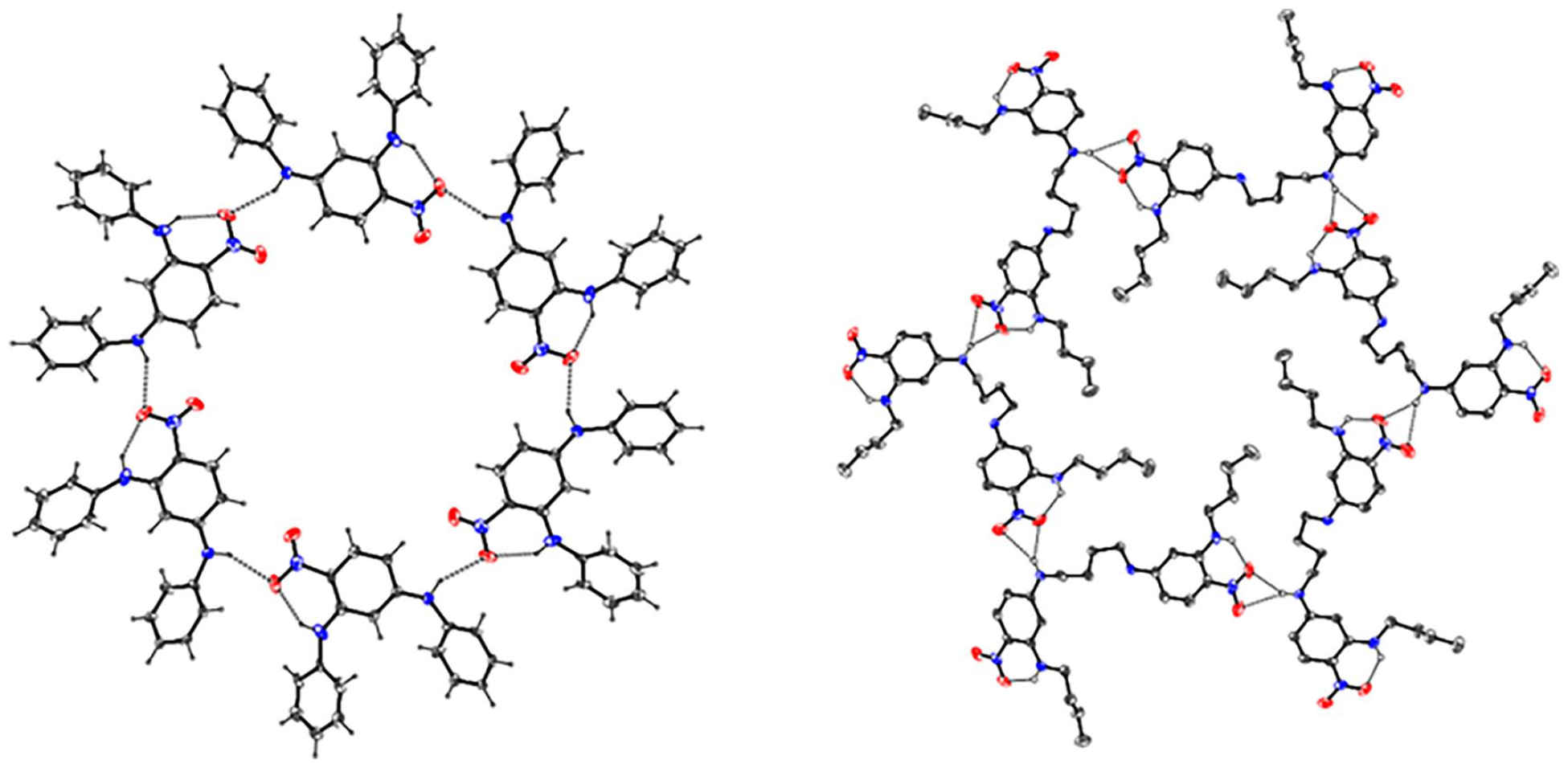
Two examples of hydrogen-bonded hexamers. Left: compound 2; Right: compound 3.
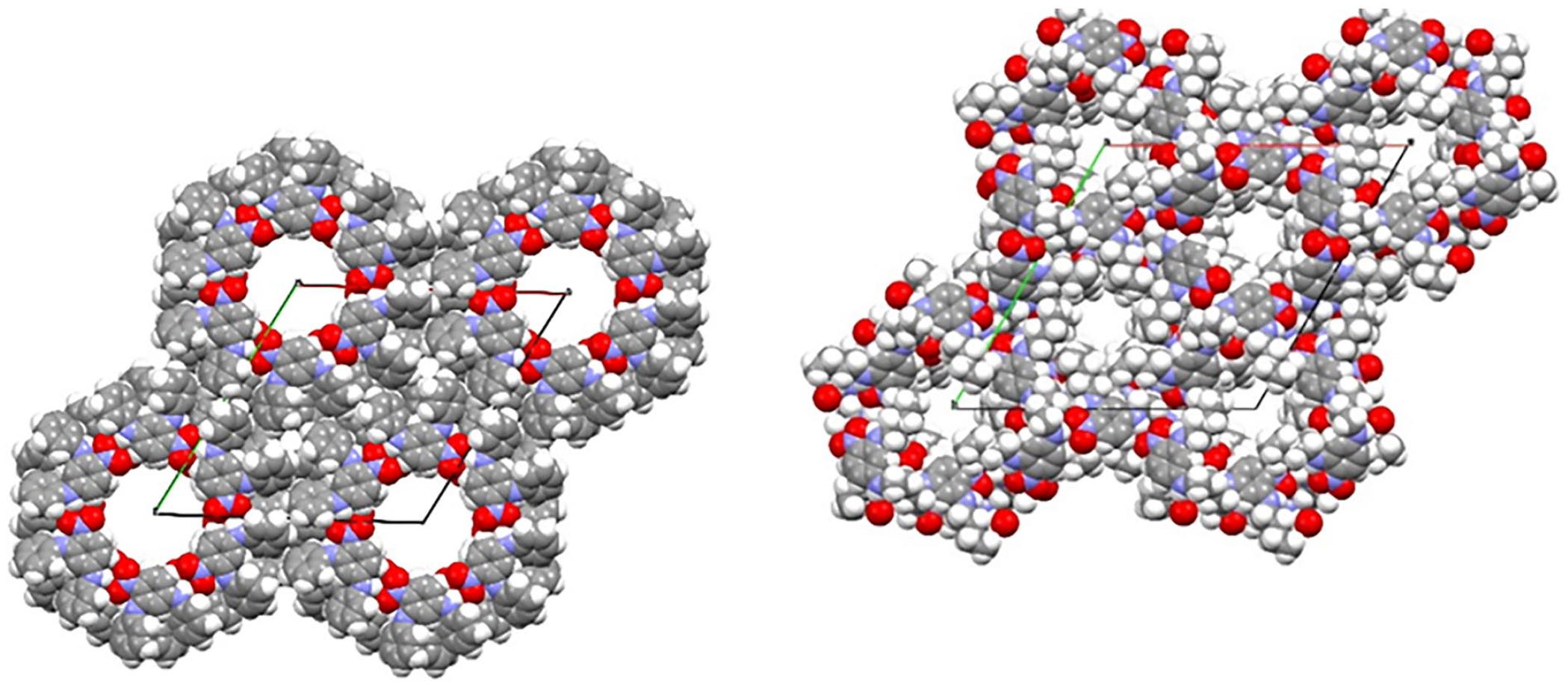
Left: hydrogen-bonded channels formed from compound 2; right: hydrogen-bonded channels formed from compound 3.
Figure 2 shows that compound 2 forms cyclic hexamers. These form from double acceptor N–H. . .O hydrogen bonds which involve one oxygen atom of each nitro group and two amino groups. There is one intramolecular and one intermolecular hydrogen bond. The other oxygen atom of each nitro group forms a close contact with the C–H bond opposite.5–9 This supramolecular association gives rings which pack, forming a channel running through the crystal of about 10 Å in diameter (Figure 3).
Figure 2 also shows that compound 3 forms cyclic hexamers that are linked by bifurcated N–H. . .(O, O) hydrogen bonds arising from the NH group of the linker diamine. An O atom of the nitro group also accepts an intramolecular N–H. . .O hydrogen bond from its ortho amino group. The butyl groups are packed on the inside of the ring, forming a hydrophobic channel or pore of about 10 Å in diameter (Figure 3).
Figure 3 shows space-filling diagrams for compound 2 (left) and 3 (right), emphasising the large one-dimensional pores of the open-framework structures. Compound 2 crystallises in space group with approximately 2660 Å3 of free space per unit cell (~19.7% of the unit-cell volume). Compound 3 (space group P6cc) encapsulates some 762 Å3 of free space per unit cell (~14.5% of the unit-cell volume). These channels are empty apart from disordered solvent molecules. Unlike many clathrate-forming hosts, such as urea, the stability of an open framework does not depend upon the inclusion of guest molecules.
There are, however, a number of known organic zeolites10–24 with potential for novel properties as well as metal–organic frameworks (MOFs)25–29 and materials that form one-dimensional channels.12,19,30–34 These materials, known as nanoporous materials, with molecular-sized pores, are of potential importance in molecular separation, heterogeneous catalysis, gas storage, and carbon dioxide capture.
Organic crystals that form channels have been referred to as ‘organic zeolites’ owing to their structural similarity to inorganic ones35 (Figure 4). Inorganic zeolites have many applications such as hydrogen storage, carbon dioxide capture, heterogeneous catalysis and molecular separation.36–39 The soluble precursors required for organic zeolites may include and extend the range of these applications because of solution processing, the choice of components and their functionality (Figure 3).11 We and others are also interested in the properties of organic zeolites crystallised from conformationally flexible building blocks of which there are many.21 Tris-(o-phenylenedioxy)cyclotriphosphazene 4 forms crystals with empty channels, some 5 Å in diameter, which can clathrate solvent and organic guest molecules.16,17 Dipeptides such as compound 5 crystallise with hydrogen-bonded tubular assemblies forming one-dimensional channels with diameters of 3–5.4 Å. These channels are filled with solvent that can be evacuated by careful heating.12,13 3,3’-4,4’-Tetra(trimethylsilylethynyl)biphenyl 6 crystallises, forming narrow channels in three dimensions that interconnect large internal voids of diameter 11 Å.14 The porosity of the de-solvated crystals was shown by nitrogen and hydrogen absorption. 1,2-Dimethoxy-p-tert-butylcalix[4]dihydroquinone, 7, crystallises in a tubular fashion to form two types of void space filled with water molecules. One void space is a three-dimensional network of channels with diameters of 3.9 and 8.5 Å and the other void space consists of spherical cages of 11.2 Å in diameter connected by narrow channels.15,20 The host retained its structural integrity upon removal of the water molecules. Cyclic host 8 forms cylindrical channels 5–8 Å in diameter stabilised by urea–urea hydrogen bonding and aromatic stacking.18,19 This material was shown to be able to absorb carbon dioxide.
Examples of soluble precursors that form open-framework solids.
Results and discussion
Compounds 9 and 10 were made by previously described methods40 (Figure 5). They were crystallised from DCM/light petroleum ether. Some care in the reaction conditions is required to make sure that a nitro group is not displaced instead of a fluorine atom. The butyl group was chosen because it is sufficiently hydrophobic to reduce the polarity of the compound, which makes it easier to isolate. The (S)-chiral amine was one of the cheaper ones available and was of interest for its packing.
The structures of compounds 9 and 10 reported previously.
Compound 11 is a precursor to Marfey’s reagent,41,42 but the dimeric structure 12 was hitherto unknown (Figure 6). We have shown that large, flexible molecules with conjugated nitro groups can give porous frameworks, so structures like this are of interest.1–4
The synthesis of compound 12.
Compound 9 crystallises in the trigonal space group P31 with 12 molecules in the asymmetric unit, one of which is shown in Figure 7.
The molecular structure of the monofluorinated molecule in compound 9 showing 50% displacement ellipsoids. The C2–N3 and C1–N2 bond lengths are 1.446 (5) and 1.479 (5) Å, respectively.
In all the molecules, the nitro group para to the secondary amine is close to coplanar with the benzene ring, whereas the nitro group para to the fluorine atom is close to perpendicular to the ring. As well as minimising steric crowding, this can be explained by resonance of the amine nitrogen atom lone pair with the para nitro group (i.e. a small contribution from a C=N+ quinoid form), and in every case, the C–N bond of the nitro group para to nitrogen is shorter than the other C–N bond para to F, by about 0.02 Å. The asymmetric molecules have different arrangements of their butyl side chains: in eight of them, the C–C–C–C torsion angle indicates an anti (a) conformation, but the other four have a gauche (g) conformation.
In the extended structure of compound 9, the 12 asymmetric molecules self-assemble into two distinct supramolecular six-ring ‘doughnuts’ linked by N–H. . .O hydrogen bonds to generate (48) loops (Figure 8) with the fluorine atoms pointing inwards. The opposite F. . .F separations across the ring are about 13 Å. One of the six rings incorporating the molecules containing atoms F1 to F6 has an aaaaaa conformation for its butyl side chains, while the other (atoms F7 to F12) is agggga (a = anti, g = gauche) on tracking around the ring. This subtle conformational difference appears to be the main reason for the large number of asymmetric molecules in compound 9, which is quite different to the structures of compounds 2 and 3 described above with Z’ = 1, where crystal symmetry generates the six rings. Despite the evident free volume at the centres of the six-ring doughnuts, the unit-cell packing for compound 9 does not feature any identifiable porosity because the doughnuts are staggered (rather than stacked) with respect to the crystallographic c-direction and their butyl chains protrude into the six rings above and below. An analysis with PLATON did not reveal any free space in the crystal of compound 9.
Space-filling representation of a ‘doughnut’ hydrogen-bonded six-ring in compound 9 (atom colours: C grey, H white, N blue, O red, F yellow green).
The structure of compound 10 features just one asymmetric molecule (Figure 9) in the tetragonal space group P43. The dihedral angle between the fluorobenzene ring and phenyl group (major disorder component) is 85.5 (3)°. The nitro groups in compound 10 have the same relative orientations as in compound 9, which again can be explained by resonance, as can the lengths of the C–N bonds. Despite the use of Mo Kα radiation, the absolute structure of compound 10 is well defined, and the stereogenic C7 atom shows its expected S configuration based on the chiral starting material.
The molecular structure of compound 10 showing 50% displacement ellipsoids. The C4–N3 and C5–N2 bond lengths are 1.4400 (11) and 1.4743 (10) Å, respectively. Only the major orientation of the C8–C19 ring is shown.
The packing for compound 10 features infinite C(7) N–H. . .O hydrogen-bonded chains linking the amine NH group to a nitro oxygen atom. The tetragonal crystal symmetry dictates that the chains alternately propagate in the [100] and [010] directions with respect to the crystallographic c-axis. There is no identifiable porosity or channels in the overall structure of compound 10.
There are three half molecules (Figure 10) in the asymmetric unit of compound 12 leading to the unusual situation of Z = 3 (Z’ = 1½) in the triclinic space group . Each molecule is generated by crystallographic inversion symmetry, and the central piperazine ring has a typical chair conformation with the exocyclic N–C bonds in equatorial orientations. In compound 12, the conjugation of both amine N atoms (N1 and N2) with their para nitro groups is possible: the C–N bond lengths of the nitro groups suggest that atom N1 of the piperazine ring is slightly more effective in sharing its electrons. The three molecules differ slightly in the conformations of their butyl side chains (one is gauche and two are anti).
The molecular structure of the C1 molecule of compound 12 showing 50% displacement ellipsoids. The C1–N3 and C5–N4 bond lengths are 1.452 (3) and 1.426 (3) Å, respectively. Symmetry code: (i) 1–x, 2–y, 2–z.
In the crystal of compound 12, the molecules are linked by N–H. . .O hydrogen bonds (each N–H group also forms an intramolecular hydrogen bond). One of these is a bifurcated N6–H2n . . . (O2, O8) link, which draws the acceptor oxygen atoms together to result in a rather short O. . .O separation of 2.795 (3) Å compared to a Van der Waals separation of about 3.04 Å. No porosity is observed.
Conclusion
Compound 9 is unusual in having 12 molecules in the asymmetric unit. Six of these molecules form a porous channel, but the other six pack with the butyl side chains protruding into the potential channel. This prevents porosity because unlike structure 3, there is no channel in the middle. The large number of asymmetric molecules appears to arise because the butyl side chains have different conformations (eight anti and four gauche). In compound 10, no porosity is seen, but it crystallises in an uncommon space group of P43, which leads to ‘cris-cross’ hydrogen-bonded chains propagating along the [100] and [010] directions. In compound 12, the unusual situation of Z = 3 (or Z’ = 1½) arises in space group . The molecules differ in the conformations of their butyl side chains. The structure is closely packed and not porous. Better examples of porous frameworks in this series have a more flexible framework.1–4 Our studies show that flexible building blocks pack differently to leave space, whereas rigid units pack with no channels.
Experimental
Infrared (IR) spectra were recorded on a diamond-attenuated total reflection (ATR) Fourier-transform infrared (FTIR) spectrometer. Ultraviolet (UV) spectra were recorded using a Perkin Elmer Lambda 25 UV-Vis spectrometer with EtOH as the solvent. The term sh means shoulder. 1H and 13C nuclear magnetic resonance (NMR) spectra were recorded at 400 and 100.5 MHz, respectively, using a Bruker 400-MHz spectrometer. Chemical shifts, δ, are given in ppm and measured by comparison with the residual solvent. Coupling constants, J, are given in Hz. High-resolution mass spectra were obtained at the University of Wales, Swansea, using an Atmospheric Solids Analysis Probe (ASAP) (positive mode) instrument: Xevo G2-S ASAP. Melting points were determined on a Cole–Palmer Stuart microscope.
Synthesis
Compound 9 and 10
Compound 12
A solution of 1,3-Difluoro-4,6-dinitrobenzene 11 (300 mg, 1.47 mmol) in acetonitrile (30 mL) was mixed with BuNH2 (107 mg, 1.47 mmol) and Et3N (149 mg, 1.47 mmol). The mixture was heated at 85 °C for 2 h. Piperazine (63 mg, 0.74 mmol) and more Et3N (149 mg, 1.47 mmol) were added, and the mixture was heated at 85 °C for 18 h.40 Upon cooling, the mixture was diluted with water (200 mL) and extracted twice with dichloromethane (100 mL). The combined extracts were dried with MgSO4, filtered, and evaporated. The product was purified by chromatography on silica gel. Elution with DCM followed by DCM/Et2O (90:10) gave the title compound (228 mg, 55%) as yellow crystals, m.p. > 220 °C (from dichloromethane: light petroleum ether). νmax (diamond) (cm–1) 3356w, 2957w, 2930w, 2861w, 1617s, 1570s, 1530s, 1491s, 1418s, 1320s, 1262s, 1320s, 1262s, 1227s, 1011s, 821s, 797s, 752s, 711s, 671s, 620w, 570s and 477s; δH (400 MHz; CDCl3) 1.05 (6H, t, J = 7.0), 1.54 (4H, s, J = 7.0), 1.80 (4H, q, J = 7.0), 3.62 (4H, q, J = 7.0), 3.41 (8H, s), 6.12 (2H, s), 8.47 (2H, s, br) and 9.06 (2H, s); δC (100.1 MHz; CDCl3) 13.6, 20.1, 30.6, 43.0, 50.1, 99.6, 124.9, 129.1, 129.9, 148.3, and 151.5; m/z (Orbitrap ASAP) 561.2418 (M+ + H, 100%) C24H32N8O8H requires 561.2421
Crystal structure determinations
The crystal structures of compound 9 (yellow plate 0.15 × 0.10 × 0.02 mm), compound 10 (orange block 0.20 × 0.16 × 0.05 mm) and compound 12 (yellow block 0.05 × 0.04 × 0.02 mm) were established using intensity data collected on a Rigaku CCD diffractometer. The structures were routinely solved by dual-space methods using SHELXT,43 and the structural models were completed and optimised by refinement against |F|2 with SHELXL-2019.44 For compound 9, the N-bound hydrogen atoms were geometrically placed and refined as riding atoms, whereas for compounds 10 and 12, they were located in difference maps, and their positions were freely refined. For all structures, the C-bound H atoms were placed in idealised locations (C–H = 0.95–0.99 Å depending on hybridisation) and refined as riding atoms. The methyl groups were allowed to rotate, but not to tip, to best fit the electron density. The constraint Uiso(H) = 1.2Ueq(carrier) or 1.5Ueq(methyl carrier) was applied in all cases. The C8–C13 phenyl ring in compound 10 is disordered over two orientations in a 0.705 (16):0.295 (16) ratio. The molecular graphics were rendered with ORTEP345 and Mercury.46 Full details of the structures and refinements are available in the deposited cifs.
Crystal data for compound 9 C10H12FN3O4, Mr = 257.23, trigonal, space group P31 (no. 144), a = 24.4751 (3) Å, c = 20.6899 (2) Å, V = 10,733.4 (3) Å3, Z = 36, Z’ = 12, T = 100 K, Cu Kα radiation, λ = 1.54184 Å, μ = 1.053 mm–1, ρcalc = 1.433 g cm–3, 68,628 reflections measured (4.2 ⩽ 2θ ⩽ 147.1°), 18,512 unique (RInt = 0.040), R(F) = 0.044 [15,737 reflections with I > 2σ(I)], wR(F2) = 0.120 (all data), Δρmin, max (e Å–3) = –0.22, +0.22, Flack absolute structure parameter 0.04 (10), CCDC deposition number 2431356.
Crystal data for compound 10 C14H12FN3O4, Mr = 305.27, tetragonal, space group P43 (no. 78), a = 8.23933 (7) Å, c = 21.3928 (3) Å, V = 1452.28 (3) Å3, Z = 4, Z’ = 1, T = 100 K, Mo Kα radiation, λ = 0.71073 Å, μ = 0.113 mm–1, ρcalc = 1.396 g cm–3, 73,892 reflections measured (4.9 ⩽ 2θ ⩽ 76.4°), 7682 unique (RInt = 0.022), R(F) = 0.033 [7182 reflections with I > 2σ(I)], wR(F2) = 0.088 (all data), Δρmin, max (e Å–3) = –0.19, +0.33, Flack absolute structure parameter –0.07 (8), CCDC deposition number 2431357.
Crystal data for compound 12 C24H32N8O8, Mr = 560.57, triclinic, space group (no. 2), a = 10.3454 (2) Å, b = 14.6458 (2) Å, c = 15.6781 (3) Å, α = 116.703 (2)°, β = 101.427 (2)°, γ = 93.4650 (10)°, V = 2049.55 (7) Å3, Z = 3, Z’ = 1½, T = 100 K, Cu Kα radiation, λ = 1.54184 Å, μ = 0.877 mm–1, ρcalc = 1.363 g cm–3, 72,491 reflections measured (6.5 ⩽ 2θ ⩽ 141.0°), 7698 unique (RInt = 0.057), R(F) = 0.065 [6272 reflections with I > 2σ(I)], wR(F2) = 0.148 (all data), Δρmin, max (e Å–3) = –0.32, +0.76, CCDC deposition number 2431358.
Supplemental Material
sj-docx-1-chl-10.1177_17475198251346820 – Supplemental material for In search of open-framework channels: Reactions of amines with 4,5-difluoro-1,2-dinitrobenzene and 1,3-difluoro-4,6-dinitrobenzene
Supplemental material, sj-docx-1-chl-10.1177_17475198251346820 for In search of open-framework channels: Reactions of amines with 4,5-difluoro-1,2-dinitrobenzene and 1,3-difluoro-4,6-dinitrobenzene by Michael J Plater and William T A Harrison in Journal of Chemical Research
Footnotes
Acknowledgements
The authors thank the UK EPSRC National Mass Spectrometry Service Centre for mass spectrometric data and the UK National Crystallography Service Centre (University of Southampton) for the X-ray data collections. M.J.P. performed all synthesis and obtained the characterisation data, and W.T.A.H. solved the crystallographic data sets. Data sets were obtained free of charge from the National Crystallography Service Centre, University of Southampton.
ORCID iD
Michael J Plater
Ethical considerations
Ethical approval was not required for this project. W.T.A.H. has given approval for this publication.
Author contributions
M.J.P. contributed to investigation, methodology, project administration, resources, supervision, validation, visualisation, writing – original draft, and writing – review and editing.
W.T.A.H. contributed to project administration, resources, software, supervision, validation, visualisation, writing – original draft, and writing – review and editing. W.T.A.H. has agreed to the publication of this manuscript.
Funding
The author(s) received no financial support for the research, authorship, and/or publication of this article.
Declaration of conflicting interests
The author(s) declared no potential conflicts of interest with respect to the research, authorship, and/or publication of this article.
Data availability statement
This paper and the supplementary will be made available in the Aberdeen University Duncan Rice library, .
Supplemental material
Supplemental material for this article is available online.
References
1.
PlaterMJHarrisonWTA. An organic zeolite with 10 Å diameter pores assembles from a soluble and flexible building block by non-covalent interactions. ChemOpen2019; 8: 457–463.
2.
PlaterMJHarrisonWTA. A paddle-wheel motif versus extended network: two polymorphs of 2,4-bis(phenylamino)nitrobenzene. J Chem Res2015; 39: 98–104.
3.
PlaterMJHarrisonWTAde los ToyosLMM, et al. The consistent hexameric paddle-wheel crystallisation motif of a family of 2,4-bis(n-alkylamino)nitrobenzenes: alkyl = pentyl, hexyl, heptyl and octyl. J Chem Res2017; 41: 235–238.
4.
PlaterMJEsslemontAJHarrisonWTA. Porous and close packed supramolecular assemblies from 2,4-difluoronitrobenzene with three different linkers and an n-butylamine cap. Int J Mol Sci2023; 24: 14683.
5.
HorowitzSTrievelRC.Carbon-oxygen hydrogen bonding in biological structure and function. J Biol Chem2012; 287: 41576–41582.
6.
GuYKarTScheinerS.Fundamental properties of the CH···O interaction: is it a true hydrogen bond?J Am Chem Soc1999; 121: 9411–9422.
7.
VibhuteAMPriyakumarUDRaviA, et al. Model molecules to classify CH⋯O hydrogen-bonds. Chem Commun2018; 54: 4629–4632.
8.
DerewendaZSLeeLDerewendaU.The occurrence of C-H. . .O hydrogen bonds in proteins. J Mol Biol1995; 252: 248–262.
9.
ItohYNakashimaYTsukamotoS, et al. N+-C-H···O hydrogen bonds in protein-ligand complexes. Sci Rep2019; 9(1): 767.
10.
DavisME.Ordered porous materials for emerging applications. Nature2002; 417: 813–821.
SoldatovDVMoudrakovskiILGrachevEV, et al. Micropores in crystalline dipeptides as seen from the crystal structure, He pycnometry, and 129Xe NMR spectroscopy. J Am Chem Soc2006; 128: 6737–6744.
13.
ComottiABraccoSDistefanoG, et al. Methane, carbon dioxide and hydrogen storage in nanoporous dipeptide-based materials. Chem Commun2009; 3: 284–286.
14.
MsayibKJBookDBuddPM, et al. Nitrogen and hydrogen adsorption by an organic microporous crystal. Angew Chem Int Ed2009; 48: 3273–3277.
15.
TedescoCImmediataIGregoliL, et al. Interconnected water channels and isolated hydrophobic cavities in a calixarene-based, nanoporous supramolecular architecture. CrystEngComm2005; 7: 449–453.
16.
SozzaniPBraccoSComottiA, et al. Methane and carbon dioxide storage in a porous van der Waals crystal. Angew Chem Int Ed2005; 44: 1816–1820.
17.
ComottiABraccoSComottiA, et al. A single-crystal imprints macroscopic orientation on xenon atoms. Chem Commun2007; 350–352.
18.
ShimizuLSHughesADSmithMD, et al. Self-assembled nanotubes that reversibly bind acetic acid guests. J Am Chem Soc2003; 125: 14972–14973.
19.
DewalMBLufasoMWHughesAD, et al. Absorption properties of a porous organic crystalline apohost formed by a self-assembled bis-urea macrocycle. Chem Mater2006; 18: 4855–4864.
20.
ThallapallyPKMcGrailBPAtwoodJL, et al. Carbon dioxide capture in a self-assembled organic nanochannels. Chem Mater2007; 19: 3355–3357.
21.
PiggeFC.‘Losing control?’ ‘Design’ of crystalline organic and metal–organic networks using conformationally flexible building blocks. CrystEngComm2011; 13: 1733–1748.
22.
BasdoganYKeskinS.Simulation and modelling of MOFs for hydrogen storage. CrystEngComm2015; 17: 261–275.
23.
ZhaQRuiXWeiT, et al. Recent advances in the design strategies for porphyrin-based coordination polymers. CrystEngComm2014; 16: 7371–7384.
24.
RiccoRPfeifferCSumidaK, et al. Emerging applications of metal–organic frameworks. CrystEngComm2016; 18: 6532–6542.
25.
ZouRAbdel-FattahAIXuH, et al. Storage, and separation applications of nanoporous metal–organic frameworks. CrystEngComm2010; 12: 1337–1353.
26.
AllendorfMDStavilaV.Crystal engineering, structure–function relationships, and the future of metal–organic frameworks. CrystEngComm2015; 17: 229–246.
27.
McKeownNB.Nanoporous molecular crystals. J Mater Chem2010; 20: 10588–10597.
28.
TsueHMatsuiKIshibashIK, et al. Azacalix[7]arene heptamethyl ether: preparation, nanochannel crystal structure, and selective adsorption of carbon dioxide. J Org Chem2008; 73: 7748–7755.
29.
AllcockHRSiegelLA.Phosphonitrilic compounds. III.1 molecular inclusion compounds of tris(o-phenylenedioxy)phosphonitrile trimer. J Am Chem Soc1964; 86: 5140–5144.
30.
GorbitzCH.Nanotube formation by hydrophobic dipeptides. Chem-Eur J2001; 7: 5153–5159.
31.
AfonsoRVDuraoJMendesA, et al. Dipeptide crystals as excellent permselective materials: sequential exclusion of argon, nitrogen, and oxygen. Angew Chem Int Ed2010; 49: 3034–3036.
32.
CoudercGHertzschTBehrndN-R, et al. Microporous Mesoporous Mater2006; 88: 170–175.
TsueHIshibashiKTokitaS, et al. Azacalix[6]arene hexamethyl ether: synthesis, structure, and selective uptake of carbon dioxide in the solid state. Chem-Eur J2008; 14: 6125–6134.
35.
HertzschTHulligerJWeberE, et al. Organic zeolites. In: AtwoodJL (ed.) Encyclopaedia of Supramolecular Chemistry. New York: Marcel Dekker, 2004, pp. 996.
36.
LiJ-RKupplerRJZhouH-C.Selective gas adsorption and separation in metal–organic frameworks. Chem Soc Rev2009; 38: 1477–1504.
LeeJFarhaOKRobertsJ, et al. Metal–organic framework materials as catalysts. Chem Soc Rev2009; 38: 1450–1459.
39.
MurrayLJDincaMLongJR.Hydrogen storage in metal–organic frameworks. Chem Soc Rev2009; 38: 1294–1314.
40.
PlaterMJHarrisonWTA. Sequential nucleophilic aromatic substitution reactions of activated halogens. Int J Mol Sci2024; 25(15): 8162.
41.
BhushanRBrucknerH.Marfey’s reagent for chiral amino acid analysis: a review. Amino Acids2004; 27: 231–247.
42.
HaradaK-IShimizuYFujiiK.A chiral anisotropic reagent for determination of the absolute configuration of a primary amino compound. Tetrahedron Lett1998; 39: 6245–6248.
SheldrickGM.Crystal structure refinement with SHELXL. Acta Cryst2015; C71: 3–8.
45.
FarrugiaLJ.WinGX and ORTEP for Windows: an update. J Appl Cryst2012; 45: 849–854.
46.
MacraeCFSovagoICottrellSJ, et al. Mercury 4.0: from visualization to analysis, design and prediction. J Appl Cryst2020; 53: 226–235.
Supplementary Material
Please find the following supplemental material available below.
For Open Access articles published under a Creative Commons License, all supplemental material carries the same license as the article it is associated with.
For non-Open Access articles published, all supplemental material carries a non-exclusive license, and permission requests for re-use of supplemental material or any part of supplemental material shall be sent directly to the copyright owner as specified in the copyright notice associated with the article.