




Abstract
Two oxygenated eremophilane-type sesquiterpenoids, possessing C21 skeleton, a pair epimers, have been isolated from the whole plants of Ligularia macrophylla (Compositae). Their structures were determined by analysis of infrared, ultraviolet, nuclear magnetic resonance, high-resolution electrospray ionization mass spectrometry data, and electronic circular dichroism as well as comparison with literature data. Of the two compounds, the compound
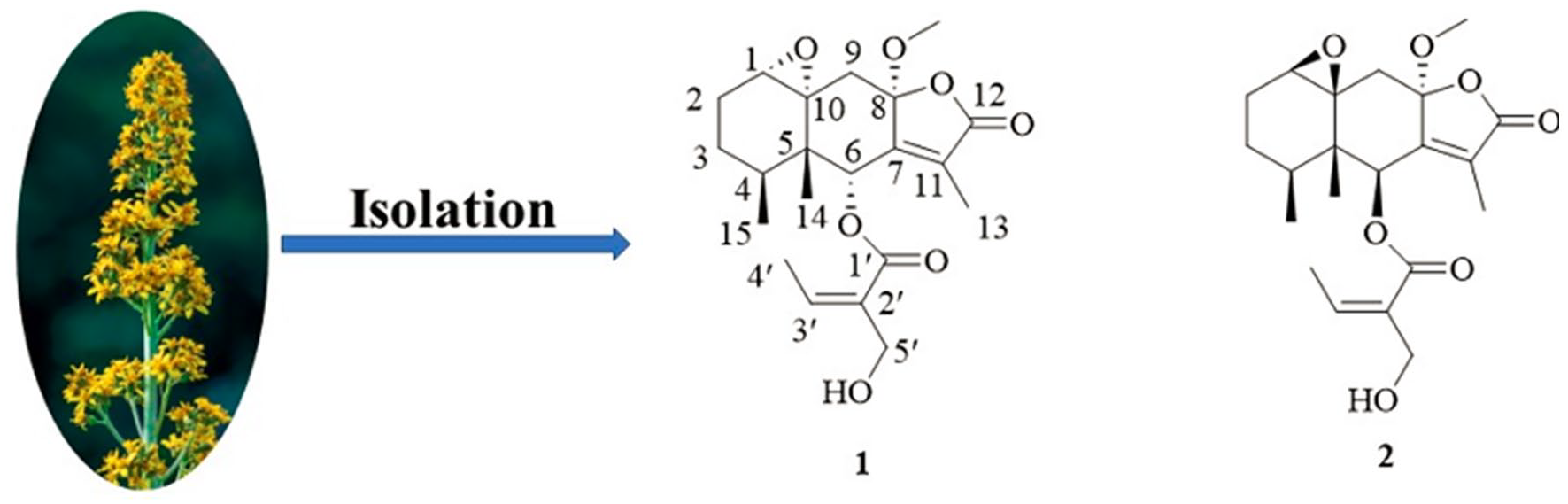
A pair epimers of eremophilane sesquiterpene from Ligularia macrophylla, collected from Xinjiang Province, China
Introduction
Ligularia macrophylla (Ledeb.) DC. belongs to Senecioneae genus (Compositae) ligularia blue-gray group (Sect. Thrynoides); the distribution of this species is extensive throughout the Tianshan Mountains and Altay region of Xinjiang. Altay was the source of type specimens. It grows on the banks of river valleys, grasslands, reed swamps, shady slopes, and forest at an altitude of 700–2900 m.
1
The rhizomes and roots of L. macrophylla are utilized as “Aster”
2
in traditional Chinese medicine
3
in numerous regions of China, which has the effects of warming the lungs, lowering qi, eliminating phlegm, and relieving cough.4–6 It is used by folks to treat diseases such as tuberculosis,
7
pharyngitis, bronchitis, urethritis, hepatitis, and rheumatism. It has been reported that the chemical components in Ligularia macrophylla mainly contain fatty acids,
8
polyolefins,
9
erimofenane sesquiterpenes,10–13 tetrahydrofuran,
14
and benzofurans.
15
Some of which demonstrate in vitro cytotoxic effects on human tumor cell lines MCF-7 (breast cancer) and A549 (lung cancer).
16
In this study, two erimofenane sesquiterpenes epimers (compounds

Structures of compounds
Result and discussion
Compound

1H-1H COSY (blue bold), key HMBC (red arrows) of compounds
The 1H (600 MHz) and 13C NMR (150 MHz) data for compounds

The relative stereochemistry of compound

NOESY (black double arrow) correlations of compounds

The ECD spectra of compounds
Compound
The antibacterial activities of compounds
Antibacterial activity (MIC) of compounds

MIC (μg/mL): minimum inhibitory concentration.
Conclusion
Two oxygenated eremophilane-type sesquiterpenoids have been isolated from the whole plants of L. macrophylla, including a new compound
Experimental section
General experimental procedures
The RUDOLPH AUTOPOL IV polarimeter (Rudolph Research Analytical, Madison, WI, USA) was utilized to measure the optical rotations. A Shimadzu UV-260 spectrophotometer (Shimadzu Corporation, Tokyo., Japan) was employed for the measurement of UV spectra. IR spectra were obtained from a BRUKER TENSOR27 spectrometer (Rudolph Research Analytical, Karlsruhe, Baden-Württemberg, Germany). A BRUKER 500 MHz AVANCE NEO (Rudolph Research Analytical, Madison, WI, USA) was used to acquire the NMR spectra. The ECD spectra were obtained using a JASCO J1500 spectrometer (JASCO Corporation, Hachioji-shi, Tokyo, Japan). HRESIMS data were acquired using a Bruker APEX-II mass spectrometer (Rudolph Research Analytical, Madison, WI, USA). A Shimadzu High-Performance Liquid Chromatograph (Shimadzu LC-2030C series) was used for semi-preparation. Normal phase column chromatography (CC) is conducted by silica gel (300−400 mesh, 200−300 mesh, 100−200 mesh, Qingdao Marine Chemical Company, China) and Sephadex LH-20 gel (20–150 µm, Pharmacia, China). Macroporous resin (DIAION HP20, Mitsubishi Group, Japan), MCI GEL CHP20P (75–150 µm, Mitsubishi Group, Japan), reversed-phase silica gel (LiChroprep RP-18 (25–40 µm), Merck, Germany). The thin-layer chromatography (TLC) was performed using the silica gel plate GF254 (Merck).
Plant material
The L. macrophylla were gathered from Ili city (30°45’00.00’’N, 105°58’00.00’’E), Xinjiang Province in September 2020 and were identified by Professor Sheng Que of Normal School for Nationalities, Qinghai Normal University. The voucher specimen (No: DYTW-20200920) has been submitted to the Institute for the Development of Natural Medicines, Lanzhou Jiaotong University.
Extraction and isolation
The entire plants of L. macrophylla (6.0 kg) were subjected to air-drying and subsequently extracted using industrial-grade methanol (3 × 4 L, 7 days each time) at room temperature (RT) to yield a crude extract weighing 290 g. The extract was pinched and dissolved in warm water, then extracted with petroleum ether, ethyl acetate, and n-butanol to obtain extracts 100, 90, and 20 g, respectively. The ethyl acetate extract (90 g) was separated by macroporous resin column and eluted with methanol/water (30:70, 50:50, 80:20, 90:10, 100:0) afforded fractions F1-F5. The F3 (26.52 g) was separated by normal phase column chromatography and elution with petroleum ether (PE)/ethyl acetate (EtOAc) (100:1 to 1:1) to give 10 fractions A-J. Fraction D was separated by the preparative with gradients (flow rate, 2.0 mL/min, C2H3N/H2O, v/v, 6/4) to afforded compounds
Antibacterial assay
Four bacteria, B. cereus, B. subtilis, E. coli, and S. aureus, which have lyophilized and preserved, were streaked and inoculated on TSA solid medium and subjected to incubation at a temperature of 37°C for a duration of 24 h. Next, the bacteria were suspended in the Mueller−Hinton broth until reaching a turbidity equivalent to a 0.5 McFarland standard (approximately 1.5 × 10⁸ CFU/mL). Stock solutions containing compounds
Compound characterization
Compound 1
Colorless gelatinous,
Compound 2
Colorless gelatinous,
Supplemental Material
sj-pdf-1-chl-10.1177_17475198241255788 – Supplemental material for A pair epimers of eremophilane sesquiterpene from Ligularia macrophylla
Supplemental material, sj-pdf-1-chl-10.1177_17475198241255788 for A pair epimers of eremophilane sesquiterpene from Ligularia macrophylla by Tong Shen, Xiang-Tao Zha, Mei Yu, Guo-Li Li and Yi-Lin He in Journal of Chemical Research
Footnotes
Acknowledgements
The authors thank Lanzhou Jiao Tong University for providing the necessary facilities for carrying out research.
Declaration of conflicting interests
The author(s) declared no potential conflicts of interest with respect to the research, authorship, and/or publication of this article.
Funding
The author(s) disclosed receipt of the following financial support for the research, authorship, and/or publication of this article: The funding for this research was provided by the National Natural Science Foundation of China (NFSC no. 21967015), the Talent Innovation and Entrepreneurship Project of Lanzhou (grant no. 2022-RC-45), and the Research Foundation of Education Bureau of Gansu Province (grant no. 2022CYZC-35).

Supplemental material
Supplemental material for this article is available online.
References
Supplementary Material
Please find the following supplemental material available below.
For Open Access articles published under a Creative Commons License, all supplemental material carries the same license as the article it is associated with.
For non-Open Access articles published, all supplemental material carries a non-exclusive license, and permission requests for re-use of supplemental material or any part of supplemental material shall be sent directly to the copyright owner as specified in the copyright notice associated with the article.
