In this article, a new “turn-off” fluorescent sensor N-n-butyl-4-{2-[(ethylimino)methyl]phenol}-1,8-naphthalimide (HL) for CuII ions is synthesized, which contains a 1,8-naphthalimide moiety as the fluorophore and a Schiff base as the recognition group. As expected, it exhibits high selectivity and sensitivity for detecting CuII ions over other common metal ions in acetonitrile–2-(4-(2-hydroxyethyl)-1-piperazinyl)-ethanesulfonic acid (HEPES) (1:1 v/v, pH = 7.4) solution. In addition, the fluorescence intensity for HL showed a good linearity with the concentration of CuII ions in the range of 0.5–5.0 μM. The 2:1 binding stoichiometry between HL and CuII ions was established on the basis of combined fluorescence titrations, a Job’s plot, single-crystal X-ray analysis and mass spectrometry. The quenching response of HL toward CuII ions is attributed to the reverse photoinduced electron transfer mechanism. The proposed sensor HL is preliminarily applied to quantify CuII ions in water samples from the Yellow River and tap water.
Chemosensor HL has been synthesized as a “turn–off” sensor for the highly selective and sensitive detection of CuII ions. The 2:1 binding stoichiometry between HL and CuII ions was established. The quenching response of HL toward CuII ions is attributed to the reverse-PET mechanism.
Introduction
It is well known that CuII ions are representative transition metal elements, which are widely distributed in biological tissues. In addition, copper is the second most important trace element in the human body.1–4 To sustain normal health, it is highly essential to intake a limited amount of dietary copper. However, excess concentrations of CuII ions can easily burden the organs in the body, resulting in metabolism becoming disordered, which in turn may be associated with many neuronal cytoplasmic neurodegenerative diseases like Wilson’s disease, dyslexia, and Alzheimer’s disease.5–19 The results of toxicity data and scientific studies by the World Health Organization (WHO) and United States Environmental Protection Agency (US EPA) determined the acceptable limits of CuII ions in drinking water to be 31.5 and 20 μM, respectively.11,20 Since excessive CuII ions may pose a threat to life and sanitation, it is important to develop efficient and convenient methods to detect CuII ion concentrations.
Due to high sensitivity, low cost, simplicity, and high efficiency, fluorescence detection has broad applications, and is commonly applied in many fields including chemistry, electronics, materials science, analytical biochemistry, cell biology, medical diagnostics, and environmental control.4–8,21 The 1,8-naphthalimide derivatives are currently commonly used as precursors or fluorescent sensors because of their high photostability and high quantum yields, strong absorption bands in the visible region, and large Stokes shifts,22 which give this method advantages over other traditional metal ion detection and analysis methods.23 As a result of this, derivatives of 1,8-naphthalimide have been successfully utilized in the production of fluorescent whitening agents, liquid crystal displays, fluorescent dyes, laser-active media, electroluminescent materials, photoconductive materials, and fluorescent switches and sensors.24–39Until now, many excellent fluorescent sensors based on naphthalimide and its derivatives for detection of CuII have been reported,40–55 but most were not sensitive enough to determine low concentration levels of CuII and only function in organic solvents, with only a very few examples working in aqueous media.56–59 Many copper compounds that coordinate with naphthalimide and its derivatives have been reported and their structures have been determined, but few have been used to explain the relationship between structure and fluorescence quenching mechanisms.60–70 Due to the lack of crystal structures of copper(II) complexes with sensors, it is difficult to speculate on the fluorescence quenching mechanism. It is still important and challenging to develop 1,8-naphthalimide-based sensors which can detect CuII rapidly in aqueous media and provide specific binding modes.
Herein, we have designed and synthesized a new “turn-off” fluorescent sensor toward CuII ions with 1,8-naphthalimide as the chromophore and a Schiff base as the recognition group, which exhibits a large fluorescence quenching upon binding to CuII. The sensor showed good sensitivity and selectivity for the detection of copper(II) ions over other transition metal ions.
Results and discussion
The route to the synthesis of N-n-butyl-4-{2-[(ethylimino)methyl]phenol}-1,8-naphthalimide (HL) is detailed in three steps as shown in Scheme 1. Its structure was fully characterized by elemental analysis, IR, 1H NMR, 13C NMR and electrospray ionization mass spectra (ESI-MS). The HL was readily soluble in solvents like N,N-dimethylmethanamide (DMF), dimethyl sulfoxide (DMSO), acetonitrile, ethanol, methanol, tetrahydrofuran and acetone, and slightly soluble in dichloromethane and trichloromethane, but insoluble in water.
Synthesis of sensor HL.
It is essential to investigate the optimization of pH on the efficiency of the sensor HL and find the best buffer system. The fluorescence behavior of HL–CuII did not fluctuate significantly in the pH range 5.0–8.0, implying that HL–CuII was virtually pH-independent between pHs 5.0 and 8.0 (Supplemental Figure S1). It has been determined that the optimum pH under experimental conditions is 7.0, which is within the biologically relevant pH range (5.5–7.5),71 indicating that HL could be applied for the determination of CuII ions in a neutral environmental (about pH 7) for subsequent studies.72–74
Selectivity and interference study
The performance ability of an ideal chemosensor is greatly influenced by its selectivity parameter. Therefore, the binding properties of HL with various metal ions (Na+, K+, Ca2+, Mg2+, Al3+, Pb2+, Fe3+, Ni2+, Zn2+, Hg2+, Ag+, Co2+, Cr3+, Mn2+, Cd2+, and Cu2+) were systematically investigated by performing selectivity and interference experiments in acetonitrile–HEPES (1:1 v/v) solution. As shown in Figure 1(a), the free sensor HL showed a strong fluorescence emission at 524 nm when excitation occurred at 430 nm. When various metal ions were added to complete the respective fluorescence titration experiments, only CuII ions caused a significant quenching of the fluorescence intensity of HL (approximately 12.85 times lower). In contrast, the other metal ions investigated under the same conditions had negligible effects on the fluorescence intensity of the sensor. The above results indicated that the sensor HL shows remarkable and exclusive selectivity toward CuII ions.
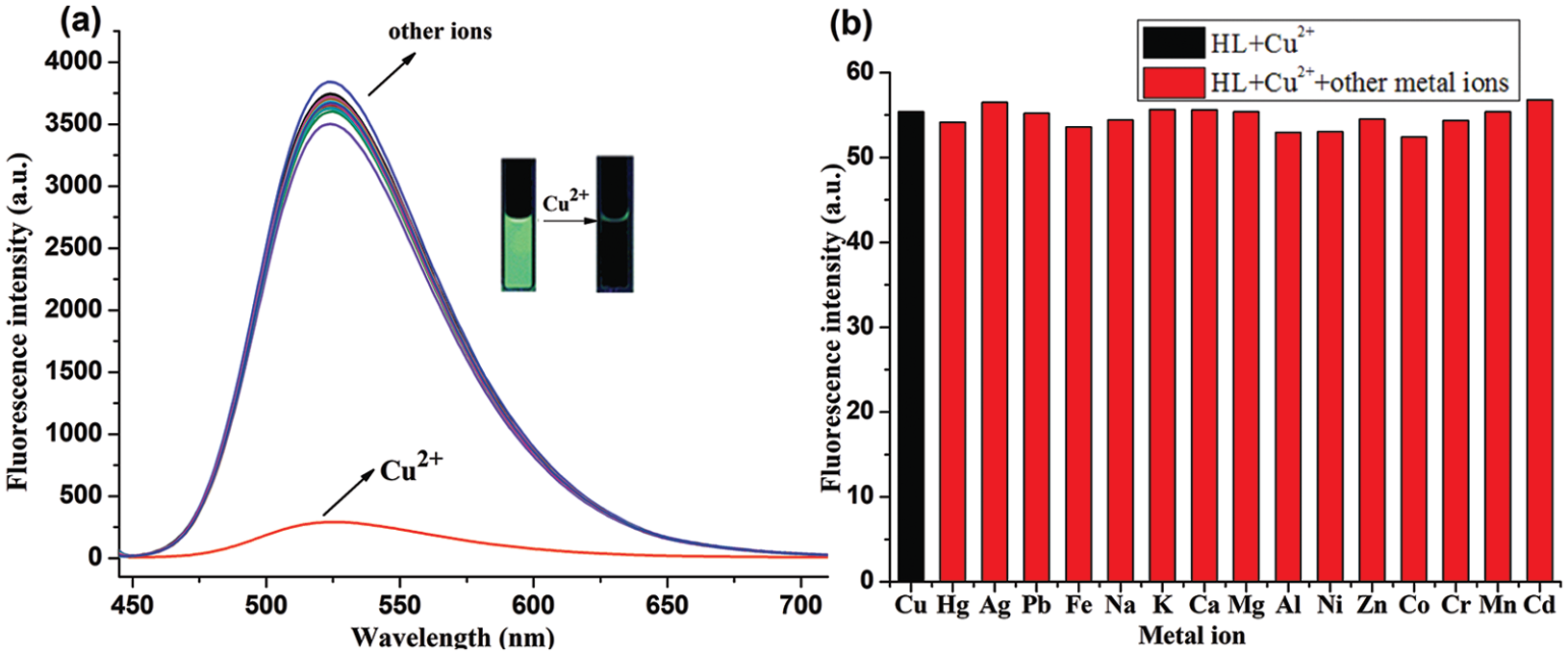
(a) Fluorescence spectra of HL (5 μM) upon the addition of metal salts (50 μM) of Na+, K+, Ca2+, Mg2+, Al3+, Pb2+, Fe3+, Ni2+, Zn2+, Hg2+, Ag+, Co2+, Cr3+, Mn2+, Cd2+, and Cu2+ in acetonitrile–HEPES (1:1 v/v) solution (λex: 430 nm). (b) Interference of other metal ions in a binary mixture solution of HL (5 μM) + Cu2+ (50 μM) + Mn+ (50 μM) (λem: 527 nm, λex: 430 nm), where Mn+= Na+, K+, Ca2+, Mg2+, Al3+, Pb2+, Fe3+, Ni2+, Zn2+, Hg2+, Ag+, Co2+, Cr3+, Mn2+, and Cd2+ in acetonitrile–HEPES (1:1 v/v) solution.
In order to further verify the sensing potency of sensor HL toward CuII ions, its selectivity properties were examined. To begin with, CuII ions (50 µM) were added to an aqueous solution of HL (5 µM) and competitive experiments in the presence of CuII ions mixed with each of the various interfering metal ions (Na+, K+, Ca2+, Mg2+, Al3+, Pb2+, Fe3+, Ni2+, Zn2+, Hg2+, Ag+, Co2+, Cr3+, Mn2+, Cd2+ and Cu2+), also at concentrations of 50 µM, were conducted in acetonitrile–HEPES (1:1 v/v). The fluorescence intensities were recorded and the observed fluorescence changes are shown in Figure 1(b). It can be clearly seen that there is no significant change in the fluorescence emission intensity of the HL–Cu2+solution containing the above-mentioned interfering metal ions compared with the fluorescence intensity of the HL–Cu2+ solution. The above results indicate that HL can be used as a highly selective chemical sensor for CuII ions in an acetonitrile–HEPES (1:1 v/v) environment.
Fluorescence titrations
To further investigate the characteristics of the sensor HL, we performed fluorescence titrations of HL in acetonitrile–HEPES (1:1 v/v) solution containing CuII ions of different concentration gradients. As shown in Figure 2(a), the CuII ion concentration increased with a concentration gradient and the fluorescent intensity of HL decreased correspondingly, which was attributed to the single electron effect.75 In Figure 2(b), the stoichiometric ratio between the HL and the CuII ion is 2:1 by nonlinear curve fitting of the fluorescence titration. The binding constant was determined using the Benesi–Hildebrand equation:76 1/(F − F0) = 1/(Ka(Fmin − F0)[Cu2+]n) + 1/(Fmin − F0). Herein, F is the fluorescence intensity at 524 nm at any given concentration of CuII ions, F0 is the fluorescence intensity at 524 nm in the absence of CuII ions, Fmin is the minimum fluorescence intensity at 524 nm in the presence of CuII ions in solution, and n is the stoichiometric mole ratio, which is 2 in this case. The plot of 1/(F − F0) against 1/[Cu2+]2 (Figure 3(a)) yielded the binding constant value as 4.76 × 10¹¹ M−1. The data are a further confirmation of the preferential binding property of the complex L–Cu2+.
(a) Fluorescence spectra of HL (10 μM) upon addition of Cu2+ (0, 0.5, 1.0, 1.5, 2.0, 2.5, 3.0, 3.5, 4.0, 4.5, 5.0, 5.5, 6.0, 6.5, 7.0, 7.5, 8.0 μM) in acetonitrile–HEPES (1:1 v/v) solution (λex: 430 nm). (b) Fitting of the fluorescence titration curve of HL in acetonitrile–HEPES (1:1 v/v) solution.
(a) Determination of the association constant of HL for Cu2+ in acetonitrile–HEPES (1:1, v/v, HEPES buffer, 10 μM, pH 7.4). (b) Emission intensities of HL (10 μM) as a function of [Cu2+]: em: 524 nm, ex: 430 nm. The detection limit is 3.30 × 10⁻⁸ M.
Figure 3(b) shows good linearity between the emission at 524 nm and the concentrations of CuII ions in the range from 0.5 to 5.0 μM, which indicates that HL can detect quantitatively relevant concentrations of CuII ions.
The value of the detection limit was further calculated based on the following equation:77 DL = 3σ/k. Herein, σ is the standard deviation of the blank solution and k is the slope of the intensity versus sample concentration. DL was calculated to be 3.30 × 10⁻⁸M, which is far lower than the WHO and US EPA regulated limits of 31.5 and 20 μM, respectively. This result validates that sensor HL has the ability to monitor CuII ions at the low concentrations usually encountered whether in environmental or physiological systems.
Mechanism of recognition
Although we have obtained a stoichiometric ratio of approximately 1:2 between the CuII ions and HL by the previous fluorescence titration experiment, the exact coordination ratio needed to be calculated from the Job plot of the fluorescence spectrum. In Figure 4, the Job plot of the fluorescent intensity versus [Cu2+]/[HL + Cu2+] showed that the maximum fluorescence value is 0.33 at 524 nm, which indicated that a 1:2 coordination stoichiometry Cu2+–L complex was formed. The obtained results were consistent with the above fluorescence titration measurements results.
Job’s plot for the determination of the stoichiometry of the [L–Cu2+] system in acetonitrile–HEPES (1:1, v/v, HEPES buffer, 10 μM, pH 7.4).
To further demonstrate the stoichiometry between HL and Cu2+ ions, we used matrix-assisted laser desorption/ionization time-of-flight (MALDI-TOF) mass spectrometry for analysis. Mass peaks at m/z 893.39 (calcd 893.48) corresponding to [Cu(L)2 + H+]+, and 416.21 (calcd 416.35) corresponding to [HL + 1]+ were clearly observed when Cu2+ was added to HL, which provided evidence for the formation of a 1:2 complex (Supplemental Figure S2).
Combining the obtained fluorescence titration, Job’s plot, and MALDI-TOF mass spectrometry, we have proposed a sensing mechanism of the sensor HL for detecting CuII ions (Scheme 2). The moderate fluorescence of sensor HL was probably due to the lack of a lone pair of electrons with suitable energy in O-hydroxy Schiff base group to cause sufficient photoinduced electron transfer (PET) effects in the molecule. CuII is paramagnetic with an unfilled d shell and can strongly quench the emission of a nearby fluorophore via electron transfer. The quenching response of HL toward CuII could be ascribed to a reverse-PET mechanism, that is, electron transfer from the 1,8-naphthalimide moiety to an electron-deficient C=N group occurs by metal ion complexation.78–81
Proposed mechanism for detection of Cu(II) by HL.
Crystal structure of the CuL2 complex
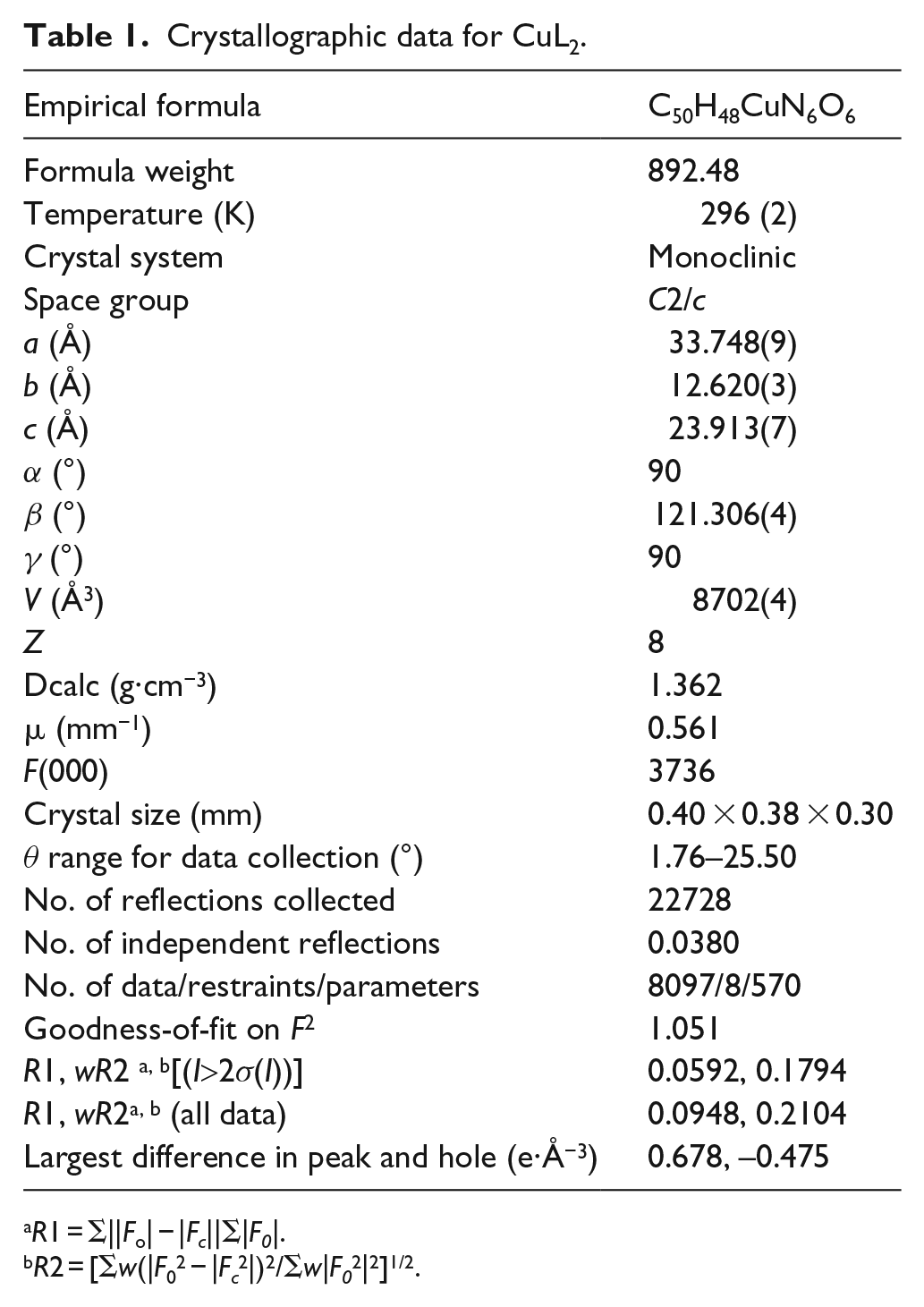
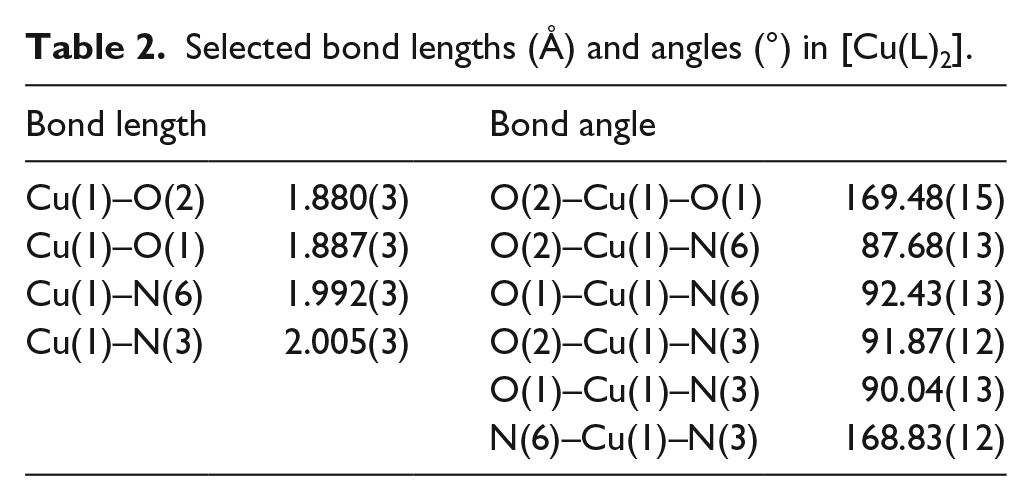
To investigate the binding mode between HL and CuII ions, a single-crystal of the CuL2 complex was grown by adding Cu(NO3)2 to HL in methanol and acetone, and then evaporating the solvents slowly at room temperature. The complex CuL2 crystallized in the monoclinic space group C2/c, and its ORTEP structure (15% probability ellipsoids) along with the atom labels are shown in Figure 5. The crystal data and experimental parameters relevant to the structure determination are listed in Table 1. Selected bond distances and angles are given in Table 2. Structural analysis shows that the central Cu(II) ion is four-coordinated by two phenoxy oxygen atoms and two imine nitrogen atoms, an N2O2 (O1, O2, N3, N6) donor set, provided by the ligands, forming a slight distortion square plane (τ4 = 0.15). The parameter τ4 is defined as [360° − (α + β)]/141° [where β = O(2)–Cu(1)–O(1), α = N(6)–Cu(1)–N(3)] and its value varies from 0 (in regular square planar geometry) to 1 (tetrahedral).63,82–86 The τ4 values for CuL’2 (L’ = 2-[(dehydroabietylamine)methyl]-6-methoxyphenol),83 [Cu(L’’)(NO3)]NO3 (L’’ = paeonol-(2-aminoethylpiperazine)84 and [Cu(L’’’2)]·5H2O (H2L’’’ = 2-(E)-{3-[(E)-5-tert-butyl-2-hydroxy-3-(piperidin-1-ylmethyl) benzylideneamino]propylimino}methyl)-4-tert-butyl-6-(piperidin-1-ylmethyl)phenol85 are 0.16, 0.2, and 0.27, respectively. The CuL2 is less distorted than the above mentioned Cu(II) complexes, which suggests that CuL2 has a slightly deformed ground plane square structure. The crystal structure reveals clearly a 1:2 stoichiometry between the metal and ligand, which is in accordance with the results of the Job’s plot. The crystal structure results further illustrate the exact bonding mode of copper ions and the sensor.
Molecular structure (ORTEP) of [Cu(L)2] in the crystal with displacement ellipsoids at the 15% probability level; hydrogen atoms are omitted for clarity.
Selected bond lengths (Å) and angles (°) in [Cu(L)2].
Bond length
Bond angle
Cu(1)–O(2)
1.880(3)
O(2)–Cu(1)–O(1)
169.48(15)
Cu(1)–O(1)
1.887(3)
O(2)–Cu(1)–N(6)
87.68(13)
Cu(1)–N(6)
1.992(3)
O(1)–Cu(1)–N(6)
92.43(13)
Cu(1)–N(3)
2.005(3)
O(2)–Cu(1)–N(3)
91.87(12)
O(1)–Cu(1)–N(3)
90.04(13)
N(6)–Cu(1)–N(3)
168.83(12)
Application of HL for CuII ion analysis in water samples
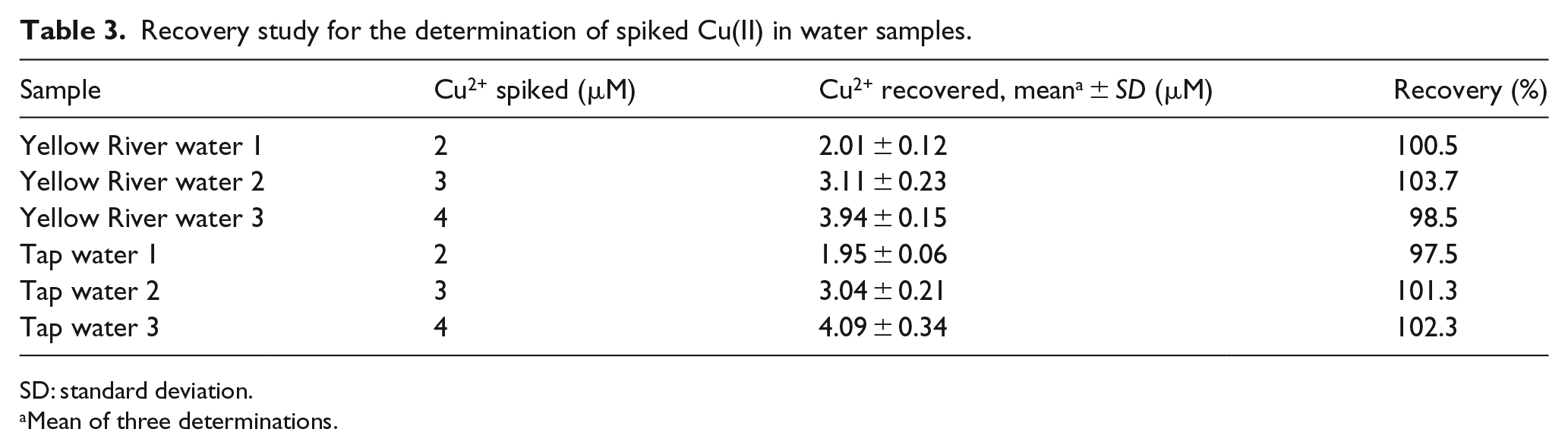
The effectiveness of the designed sensor HL was evaluated by applying the sensor to detect CuII ions in actual water samples. Water samples were sourced from the Yellow River (Lanzhou, China), while tap water samples were obtained from our school, Lanzhou Jiaotong University. The water samples were appropriately filtered to make sure that they were free of CuII ions. All water samples were added to different concentration gradients of CuII ion standard solutions, and then analyzed using sensor HL. The results are shown in Table 3. The recoveries for sensor HL were in the range of 97.5%–103.7%, with the implication that the sensor has the potential for the detection of CuII ions in real samples.
Recovery study for the determination of spiked Cu(II) in water samples.
In summary, a new fluorescent sensor has been synthesized for the highly selective and sensitive detection of CuII ions. The experimental results indicate that HL and CuII ions form a 2:1 complex and the quenching response of HL toward CuII ions was attributed to the reverse-PET mechanism. The limit of detection of HL for the monitoring of CuII ions reached 3.30 × 10⁻⁸ M, making it highly useful for the quantitative analysis of CuII ions. More importantly, the practical utilities of the sensor was successfully demonstrated in its ability to track micromolar concentrations of CuII ion in the two different water samples with excellent recovery rates obtained. This work should provide inspiration for the design of new sensors for the monitoring of metal ions.
Experimental
Materials and Methods
All chemicals were obtained from commercial sources, and except if specified, they are of analytical reagent grade and were used without any further purification. Adjustment of the pH was carried out by addition of dilute hydrochloric acid (HCl) and sodium hydroxide (NaOH). The HEPES buffer (pH = 7.4) was prepared by using double-distilled water. Solutions of Na+, K+, Ca2+, Mg2+, Al3+, Pb2+, Fe3+, Ni2+, Zn2+, Hg2+, Ag+, Co2+, Cr3+, Mn2+, Cd2+, and Cu2+ were prepared from their nitrate salts. Double distilled water was used for the preparation of metal ion (1 mM) nitrate stock solutions.
The C, H, and N content analyses were carried out by using a Carlo Erba 1106 elemental analyzer. An XD-4 digital micro-melting point apparatus was used for determining the melting points of compounds. Thin-layer chromatography (TLC) was carried out on silica gel 60F254 plates (Merck KGaA). The 1H NMR and 13C NMR spectra were recorded on Mercury plus 400 MHz NMR spectrometer (Palo Alto, CA, USA) with tetramethylsilane (TMS) as the internal standard and dimethyl sulfoxide-d6 (DMSO-d6) as the solvent. The infrared (IR) spectra (4000–400 cm−1) were recorded on a Nicolet FT-VERTEX 70 spectrometer as KBr pellets. The UV-Vis spectra were obtained using a Lab-Tech Bluestar Plus spectrophotometer. Fluorescence spectra were measured with a Lengguang Tech. F97 Pro spectrofluorometer. ESI-MS were obtained on a Bruker microTOF-Q system.
Synthesis of N-n-butyl-4-{2-[(ethylimino)methyl]phenol}-1,8-naphthalimide (HL)
The intermediate compounds 2 and 3 were synthesized according to the literature.87–89 Compound 3 (0.5 g, 1.61 mmol) was dissolved in absolute ethanol (30 mL) and treated with a solution of excess salicylaldehyde (0.39 g, 3.22 mmol) in ethanol (10 mL) by dropwise addition over 10 min. The reaction mixture was refluxed for 4 h. After the reflux was complete, the mixture was cooled to room temperature, and the filtered precipitate was washed with ethanol to afford sensor HL. Yield: 72%. m.p. 136–138°C. IR (KBr; v, cm−1): 2958, 1683, 1634. UV-Vis (in DMF, nm): 282, 435. Anal. calcd C, 72.27; H, 6.06; N, 10.11%; found: C, 72.20; H, 6.11; N, 10.08%. MS ([C25H25N3O3+1]+): m/z = 416.21. 1H NMR (400 MHz, DMSO-d6): δ (ppm) 13.36 (s, 1H), 8.67 (d, 1H, J = 8 Hz), 8.56 (s, 1H), 8.43 (d, 1H, J = 8 Hz); 8.26 (d, 1H, J = 8 Hz), 7.91 (s, 1H), 7.68 (t, 1H, J = 16 Hz), 7.38 (d, 1H, J = 8 Hz), 7.31(t, 1H, J = 16 Hz), 6.93 (d, 1H, J = 12 Hz), 6.87 (d, 1H, J = 8 Hz), 6.84 (s, 1H), 3.99−4.03 (m, 2H), 3.94 (d, 2H), 3.76 (d, 2H), 1.55-1.62 (m, 2H), 1.31−1.38(m, 2H), 0.92 (t, 3H, J = 8 Hz). 13C NMR (400 MHz, DMSO-d6): δ (ppm) 167.64, 164.29, 163.48, 161.25, 150.97, 134.61, 132.96, 132.28, 131.16, 129.93, 128.95, 124.84, 122.49, 120.77, 119.32, 119.11, 117.11, 108.68, 104.64, 57.36, 44.11, 39.99, 30.49, 20.53, 14.40 (Supplemental Figures S3–S5).
Preparation of a single crystal of complex Cu(L)2
To a stirred solution of HL (0.20 mmol, 83.1 mg) in methanol (5 mL) and acetone (5 mL), Cu(NO3)3⋅3H2O (0.1 mmol, 24.2 mg) was added in methanol (5 mL). The resulting yellow solution was evaporated at room temperature. Crystals suitable for X-ray diffraction studies were obtained after several days. Yield: 53%. Anal. calcd for C50H48CuN6O6 (%): C, 67.29; H, 5.42; N, 9.42. Found (%): C, 67.33; H, 5.44; N, 9.46. IR (KBr; ν, cm−1): 1151 ν(C–N–C), 1352 ν(C–O), 1618 ν(C=N), 1685 ν(C=O). UV-Vis (DMF, λmax, nm): 271, 343, 435. ESI-MS ([Cu(L)2+H+]+): m/z = 893.39.
X-ray crystallography
The intensity data of single crystals mounted on glass fibers were collected on a Bruker Smart CCD diffractometer with graphite-monochromated MoKα radiation (k = 0.71073 Å) at 296 K. Data reduction and cell refinement were carried out by using the SMART and SAINT programs.89 Data was refined by using SHELXTL software through full-matrix least squares program.90 The CCDC 1810957 contains the supplementary crystallographic data for this article. These data can be obtained free of charge from The Cambridge Crystallographic Data Centre via www.ccdc.cam.ac.uk/data_request/cif.
Supplemental Material
Supplementary_data – Supplemental material for A new 1,8-naphthalimide-based fluorescent “turn-off” sensor for detecting Cu2+ and sensing mechanisms
Supplemental material, Supplementary_data for A new 1,8-naphthalimide-based fluorescent “turn-off” sensor for detecting Cu2+ and sensing mechanisms by Yao Qu, Yancong Wu, Cong Wang, Kun Zhao and Huilu Wu in Journal of Chemical Research
Footnotes
Declaration of conflicting interests
The author(s) declared no potential conflicts of interest with respect to the research, authorship, and/or publication of this article.
Funding
The author(s) disclosed receipt of the following financial support for the research, authorship, and/or publication of this article: This work was supported by the Natural Science Foundation of Gansu Province (grant no. 17JR5RA090), Foundation of A Hundred Youth Talents Training Program of Lanzhou Jiaotong University (grant no. 152022), and the National Natural Science Foundation of China (grant no. 21367017).
ORCID iD
Huilu Wu
Supplemental material
Supplemental material for this article is available online.
References
1.
YouGRParkGJLeeJJ, et al. Dalton Trans2015; 44: 9120.
Please find the following supplemental material available below.
For Open Access articles published under a Creative Commons License, all supplemental material carries the same license as the article it is associated with.
For non-Open Access articles published, all supplemental material carries a non-exclusive license, and permission requests for re-use of supplemental material or any part of supplemental material shall be sent directly to the copyright owner as specified in the copyright notice associated with the article.