




Abstract
A schools test for aldehydes and ketones in water at room temperature using test tubes has been developed in this laboratory using either phenylhydrazine hydrochloride or phenylhydrazine hydrochloride with NaOAc . 3H2O. The role of one equivalent of a strong or weak acid which catalyses the reaction is discussed.
Keywords
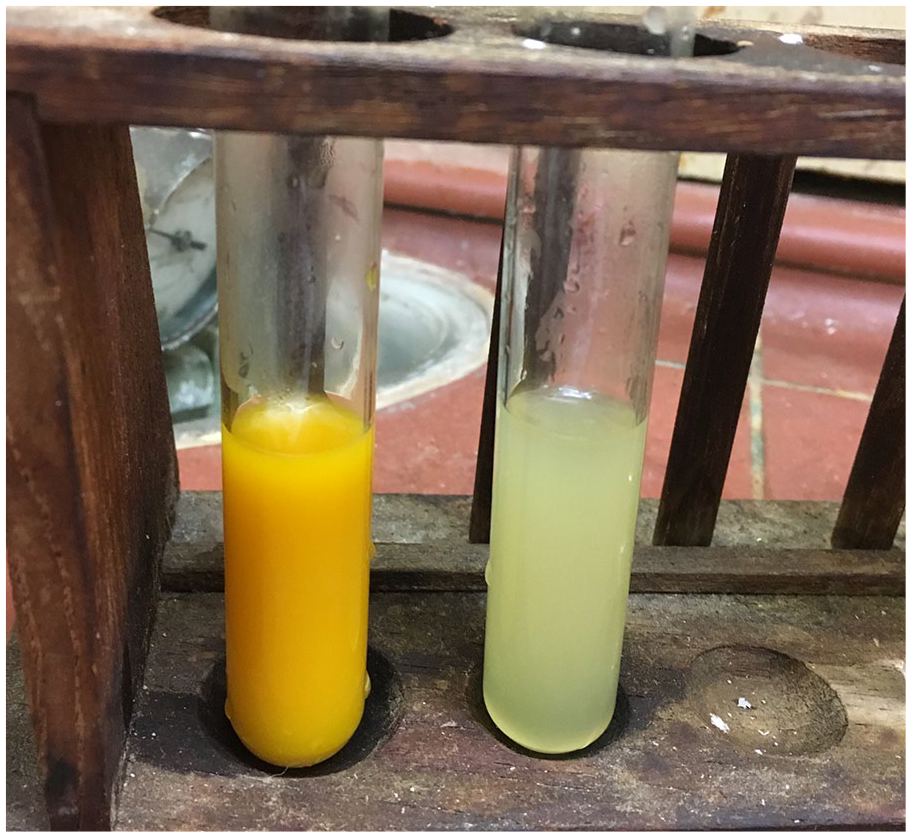
A comparison of the tests for glycolaldehyde using PhNHNH3Cl (left) or PhNHNH3Cl/NaOAc . 3H2O (right) in water at 50 °C for 5 min.
Introduction
The treatment of aldehydes or ketones with 2,4-dinitrophenylhydrazine in either EtOH under reflux, in aqueous 2M hydrochloric acid or in 5% cH2SO4/EtOH or MeOH at room temperature (RT) is known as Brady’s test.1–2 In 1926, Brady reported the melting points of a series of crystalline hydrazones and summarised previous studies in the field.1–5 The hydrazone precipitate has a characteristic melting point for the aldehyde or ketone (Figure 1).6–7 This reagent is special because it formed hydrazones in acidic water or methanol which crystallized, hence its development as a school test. Many publications involve hydrazone synthesis,8–12 and it is part of popular textbook culture.13–18

A classic test for an aldehyde or ketone with 2,4-dinitrophenylhydrazine in ethanol or water with acid catalysis.
However, this reagent is classed as an energetic substance and is sold moistened with water to reduce its shock-sensitive nature.19–20 The dinitrated benzene ring and N–N bond are energetic moieties. A number of instances have occurred, in which bottles of dried reagent have been collected from schools for destruction. For this reason, we have investigated the behaviour of other hydrazines to see if they might be suitable as a test for aldehydes and ketones to be used in place of 2,4-dinitrophenylhydrazine. In these studies, indoles are not observed as these require treatment of the hydrazone formed with concentrated acids.21–22
Discussion
Owing to the energetic structure of 2,4-dinitrophenylhydrazine and its withdrawal from some schools, we aimed to introduce an alternative but related test for aldehydes and ketones using known chemistry. Both phenylhydrazine and phenylhydrazine hydrochloride are commercially available and will give precipitates with aldehydes and ketones. Here, we have carried out a series of tests in test tubes to clarify the results that are obtained and make it suitable as a test in schools. This takes into account the time required for the test reaction to complete satisfactorily with a clear positive result, the quantity of test reagent required, the temperature, the pH and general safety requirements. We have not sought to isolate products and determine their melting points because in schools, Brady’s reagent can be used as a qualitative test for a carbonyl group of an aldehyde or ketone. An analysis of melting points of hydrazones as a means of identifying carbonyl containing compounds has also been criticised. 23 Phenylhydrazine has an m.p. near to RT (18–21 °C) and on a cold day is likely to be frozen in the bottle. Warming is feasible, but it is quite a vigorous reagent, and this would be an additional step so we chose to work with phenylhydrazine hydrochloride. This is available as a stable, white, fluffy solid and was easy to work with. A small amount, about 50 mg, was placed in a test tube in a fume hood (fan off), and the test was done on an open bench. Sample aliquots of 1 mL were also measured from a standard (0.5 g of phenylhydrazine hydrochloride in 10-mL H2O). The tests were done in water using approximate amounts of reagents obtained with a spatula.
Figure 2 shows how phenylhydrazine is available to react from phenylhydrazine hydrochloride with mild acid catalysis. The more vigorous reagent is produced from treating phenylhydrazine hydrochloride with NaOAc . 3H2O 13 because the equilibrium shown increases the concentration of phenylhydrazine. However, for both these schemes in Figure 2, we showed that the small stoichiometric quantity of acid, either hydrochloric acid or acetic acid, is critical to producing an acceptable and rapid positive test result. If phenylhydrazine hydrochloride in water was acidified with 2–3 drops of conc. aqHCl, precipitate formation was inhibited presumably because the hydrazine primary amine is protonated. Also, if phenylhydrazine hydrochloride is neutralised with KOH in water, the test was not satisfactorily fast enough with both aldehydes and ketones. This illustrates that the one equivalent of acid present with the reagent, aqHCl or aqHOAc, catalyses the hydrazone formation. Methanol or ethanol was not satisfactory as solvents to give precipitates under these conditions so only water was used. The precipitates were presumed to be hydrazones and were not characterised any further.

Top: Phenylhydrazine hydrochloride is only weakly dissociated because hydrogen chloride is a strong mineral acid. Bottom: Treatment with NaOAc . 3H2O liberates more phenylhydrazine because acetic acid is a weak acid.
The results are shown in Table 1 and 2. Most of the aldehydes reacted satisfactorily with phenylhydrazine hydrochloride (Table 1, Entries 1–9, Test 1) to give precipitates within 2–3 s. Methanal gave a white precipitate, glyoxal gave an orange/brown precipitate and glycolaldehyde dimer gave an orange/yellow precipitate after heating. Photographs of Entries 1–3 and Entry 9, from vanillin, are shown in the ESI (Supplemental Figure S1–S4). Phenylhydrazine hydrochloride did not react with acetone at RT or on heating (Table 2, Entry 10, Test 1). Other ketones (Table 2 Entries 11–13) gave no precipitate at RT. Ketones are less electrophilic than aldehydes, which slows down the reaction. However, phenylhydrazine hydrochloride/NaOAc . 3H2O reacts satisfactorily with both aldehydes and ketones at RT within a few seconds (Table 1 and 2, Test 2). The base will deprotonate the phenylhydrazine hydrochloride, giving phenylhydrazine and acetic acid which is a much weaker acid (Figure 2). The phenylhydrazine is more available to react compared to phenylhydrazine hydrochloride which will dissociate less in water, and acetic acid can catalyse the reaction. Methanal gave a white precipitate, glyoxal gave a lemon yellow precipitate, glycolaldehyde dimer gave a green/grey haze on heating and vanillin gave a white precipitate (Supplemental Figures S1–S4 in the ESI). 3,5-Dinitrosalicylaldehyde gave a brown precipitate (Entry 8). Glucose, fructose and other reducing sugars can react in boiling water and is the basis of the osazone test for reducing sugars which was developed by Emil Fischer.13,24–30
Test for aldehydes with a minimum quantity of 50 mg of PhNHNH3Cl or PhNHNH3Cl/NaOAc . 3H2O in water (8 mL) at RT for 2–3 s unless otherwise stated.

RT: room temperature.
Photographs of test tubes for Entries 1–3 and 9 are in the ESI (Supplemental Figures S1-S4). All tests were shaken manually in a test tube.
Test for ketones with a minimum quantity of 50 mg of PhNHNH3Cl/NaOAc . 3H2O in water (8 mL) at RT for a few seconds.

RT: room temperature.
All tests were shaken manually in a test tube.
Conclusion
A satisfactory school test for aldehydes and ketones in test tubes has been developed using phenylhydrazine hydrochloride and NaOAc . 3H2O in water at RT, which gives a precipitate in a few seconds with shaking. Phenylhydrazine hydrochloride in water at RT will give a precipitate with aldehydes in 2–3 s but not ketones. The reagent is best weighed out directly into test tubes in approximate quantities in a fume hood, but the test can be done on an open bench. A 50-mg sample of phenylhydrazine hydrochloride with or without NaOAc . 3H2O (50 mg) is a suitable quantity to be weighed out and mixed with five drops of the carbonyl compound in water.
Experimental
Warning
Phenylhydrazine 31 and 2,4-dinitrophenylhydrazine/MeOH/H+ (Brady’s reagent) are toxic compounds and should be handled with care.
By wearing disposable gloves, solid phenylhydrazine hydrochloride, a stable white fluffy solid, was transferred by a spatula from the reagent bottle into test tubes in a fume hood. The fume hood was not switched on. The test tubes can then be used on an open bench. Initially, 50-mg samples of phenylhydrazine hydrochloride were weighed out with a balance, and it was verified that this quantity was satisfactory for the test with aldehydes and ketones. An estimated quantity from a spatula in a fume hood, switched off, was used for simplicity as was the quantity of NaOAc . 3H2O (50 mg or an excess). We assume this is likely to be the scenario in a school for simplicity, speed and safety. We also used 1-mL aliquots of reagent from a standard solution which had been kept sealed for 2 months (0.5 g of phenylhydrazine hydrochloride in 10-mL H2O). Phenylhydrazine hydrochloride or phenylhydrazine hydrochloride and NaOAc . 3H2O were mixed in water (8 mL) in a test tube at RT by shaking or with upwards and downwards movements of a spatula. Five drops of the aldehyde or ketone was added and a precipitate formed within seconds with shaking. The test tube was not stoppered with a bung but was shaken from side to side with the top held in one hand between thumb and forefinger. The test with glycolaldehyde was heated at 50 °C for 5 min in a water bath. See Table 1 and 2 for the details and photographs of the test results for Entries 1–3 and 9 are in the ESI (Supplemental Figure S1–S4).
Supplemental Material
Supplemental_material – Supplemental material for Shaken, not stirred: a schools test for aldehydes and ketones
Supplemental material, Supplemental_material for Shaken, not stirred: a schools test for aldehydes and ketones by M John Plater in Journal of Chemical Research
Footnotes
Declaration of conflicting interests
The author(s) declared no potential conflicts of interest with respect to the research, authorship and/or publication of this article.
Funding
The author received no financial support for the research, authorship and/or publication of this article.

Supplemental material
Supplemental material for this article is available online.
References
Supplementary Material
Please find the following supplemental material available below.
For Open Access articles published under a Creative Commons License, all supplemental material carries the same license as the article it is associated with.
For non-Open Access articles published, all supplemental material carries a non-exclusive license, and permission requests for re-use of supplemental material or any part of supplemental material shall be sent directly to the copyright owner as specified in the copyright notice associated with the article.
