



Abstract
A new norditerpenoid lactone, nakaiilactone A was isolated from the seeds of Podocarpus nakaii together with a known one, nagilactone C and a known bisnorditerpenoid lactone, inumakilactone B. The structure of the new compound was determined by detailed analyses of the spectroscopic data, especially 1D- and 2D-NMR and HR-ESI-MS.
Introduction
The genus Podocarpus (Podocarpaceae) is composed of more than 100 species of evergreen coniferous trees or shrubs, mainly distributed in tropical and subtropical areas and the south temperate zone. 1 The typical chemical constituents of the genus are structurally diverse diterpenoids, especially nor- and bisnor-diterpenoids.2–4 These nor- and bisnor-diterpenoids show a wide range of bioactivities, such as cytotoxic,4–7 anti-inflammatory 8 and antibacterial activities. 9 Podocarpus nakaii, a dicotyledonous shrub plant, is mainly distributed in the middle area of Taiwan. 1 Previously, diterpenoids, 10 phenylpropanoids, 11 steroids11,12 and flavonoids 12 were obtained from the leaves, stems and bark of this plant.
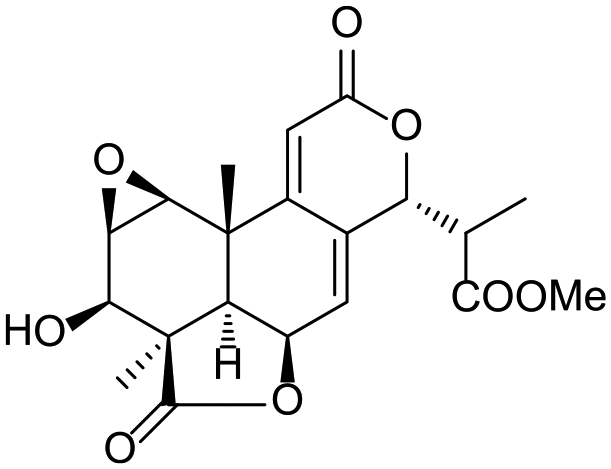
In the present study, a chemical investigation of the CHCl3-soluble part of an EtOH extract of P. nakaii resulted in the isolation of a new norditerpenoid, nakaiilactone A (
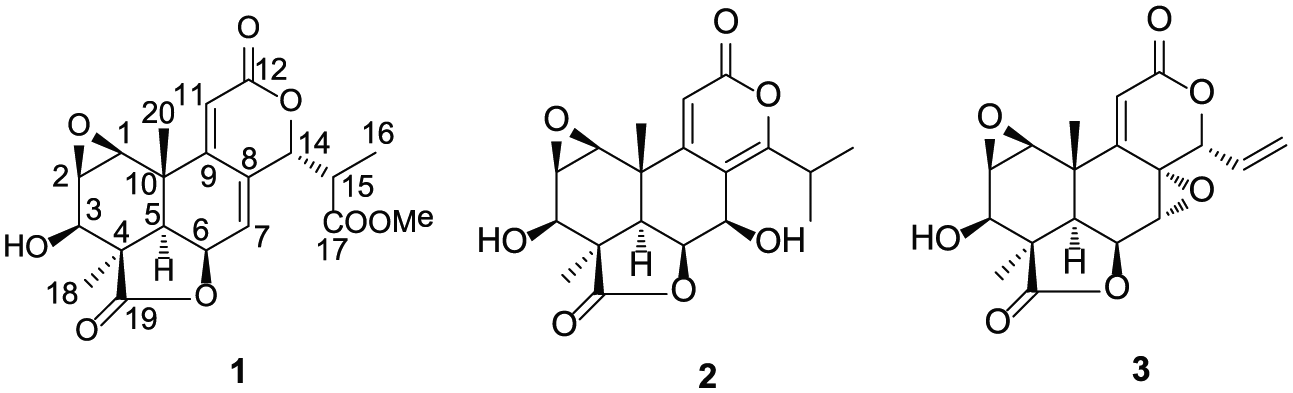
Compounds from P. nakaii.
Results and discussion
Compound
1H NMR (400 MHz) and 13C NMR (100 MHz) data of
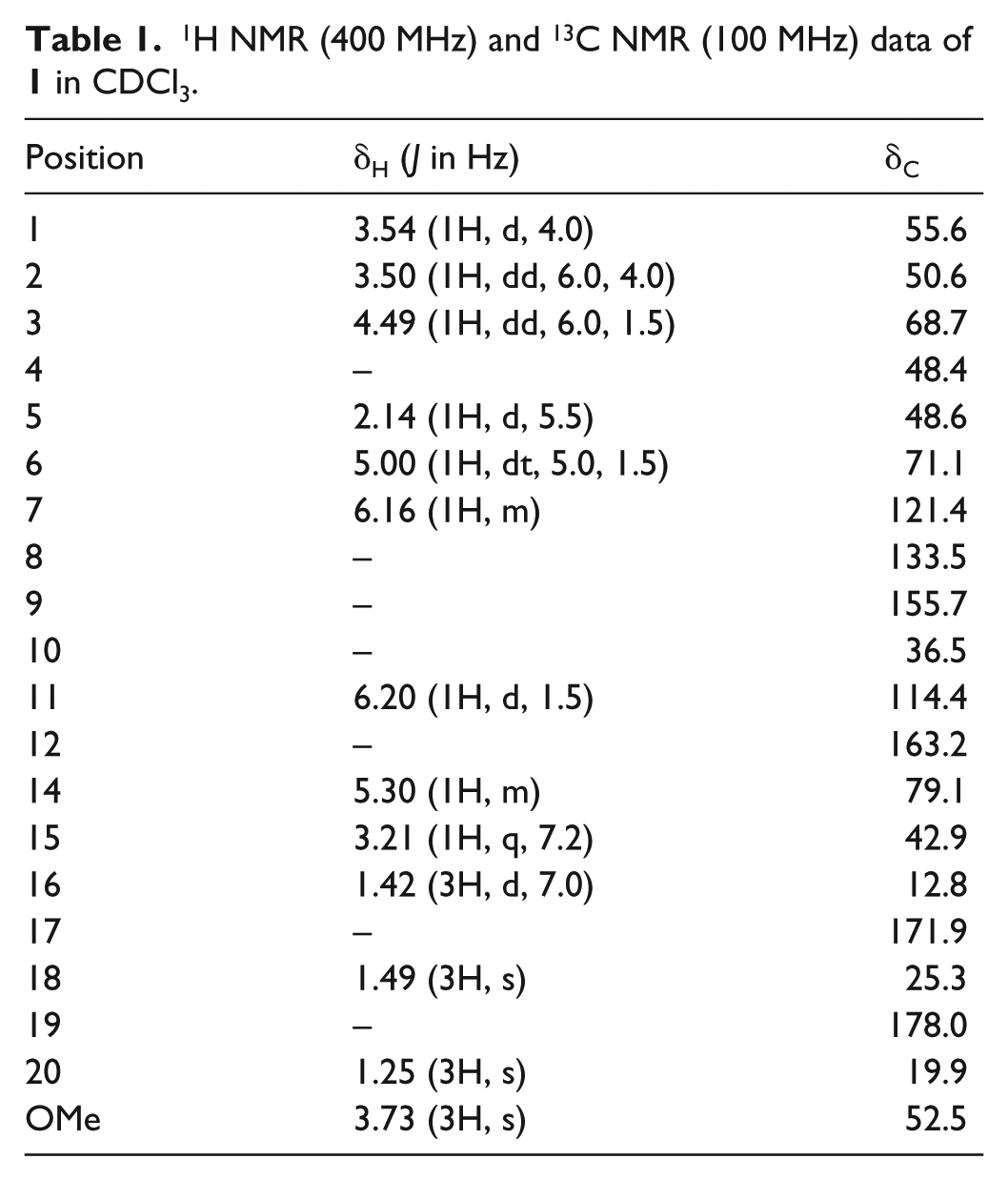
Analysis of the 1H NMR, 13C NMR and HMQC spectra of

Selected 2D NMR correlations of
The known compounds were identified as nagilactone C (
Experimental
All solvents were of analytical grade (Hangzhou Gaojing Fine Chemical Plant). Thin layer chromatography: precoated SiO2 GF254 plates (Qingdao Haiyang Chemical Co., Ltd), visualized by UV light (254 and/or 360 nm) or by spraying with 10% H2SO4 reagent followed by heating at 110°C for 5−10 min. Column chromatography: silica gel (SiO2, 200−300 mesh, Qingdao Haiyang Chemical Co., Ltd) and reversed-phase SiO2 (ODS-A 12 nm S-150, YMC Co.). Optical rotations: Rudolph-AutoPolIV polarimeter. IR spectra: Nicolet-Avatar-370 spectrometer (ν in cm−1). UV spectra: Shimadz-UV-2450 spectrometer (λ in nm). NMR spectra: Bruker AM-400 spectrometer ( 1 H NMR at 400 MHz, 13C NMR at 100 MHz, δ in ppm relative to Me4Si, J in Hz). ESI-MS: Agilent-6210-Lc/TOF mass spectrometer (in m/z).
Plant material was collected in Wuxi County of Jiangshu Province, P.R. China, in October 2017 and identified as P. nakaii by Prof. Yong-Hong Zhang of the Fujian Medical University, P.R. China. A voucher specimen (No. P20171008) was deposited in the Zhejiang University of Technology.
The seeds of P. nakaii (1.5 kg) were pulverized and extracted with 95% EtOH exhaustively at room temperature to give a crude extract (55 g). The ethanol extract was then partitioned between H2O and CHCl3. Removal of CHCl3 under reduced pressure yielded a brown residue (18 g), which was subjected to silica column chromatography eluting with petroleum ether (boiling range: 60°C–90°C) containing increasing amounts of Me2CO to afford two fractions. Fraction 1 (1.3 g) eluting with petroleum ether/Me2CO (8:2) was applied to a reversed-phase silica gel column, elution of which with MeOH-H2O (5:5−6:4) yielded compounds 1 (12 mg) and 3 (45 mg). Fraction 2 (2.8 g), which was eluted with petroleum ether/Me2CO (4:1), was applied to a silica gel column, gradient elution of which with CHCl3-MeOH (20:1−10:1) yielded compound 2 (120 mg).
Nakaiilactone A (
Nagilactone C (
Inumakilactone B (
Footnotes
Declaration of conflicting interests
The author(s) declared no potential conflicts of interest with respect to the research, authorship and/or publication of this article.
Funding
The author(s) disclosed receipt of the following financial support for the research, authorship, and/or publication of this article: Financial support from the National Natural Science Foundation of China (81872777) is gratefully acknowledged.