



Abstract
Background:
While infarcts and white matter hyperintensities (WMHs) are critical determinants of post-stroke cognitive impairment (PSCI), their comprehensive network disconnection mechanisms remain poorly characterized.
Aims:
This study aimed to systematically map the functional and structural network disconnection patterns underlying PSCI, elucidate the relationship between network disconnection and cognitive status—particularly the mediating role of WMH—and identify potential neuromodulation targets based on the disconnection maps.
Methods:
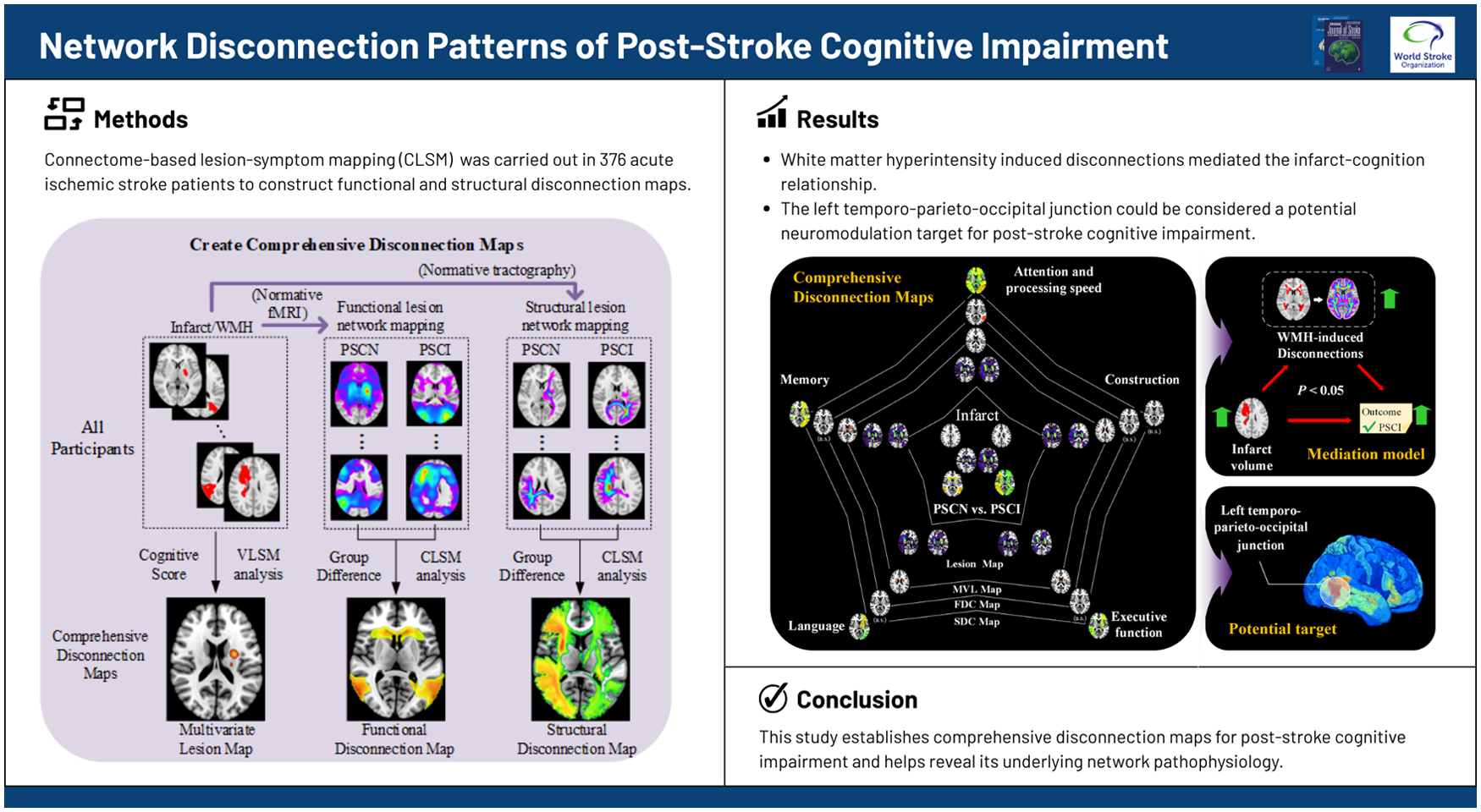
In a cohort of 376 mild-to-moderate first acute ischemic stroke patients without pre-stroke dementia, we employed connectome-based lesion-symptom mapping (CLSM) to construct comprehensive disconnection maps derived from infarct and WMH lesions. The distinctiveness was validated against an independent cohort of 78 cerebral small vessel disease patients. CLSM-derived lesion impact scores were analyzed using regression models to assess their domain-specific cognitive relationships and using mediation modeling to quantify the mediating effects of WMH. Potential neuromodulation targets were subsequently identified based on the disconnection patterns.
Results:
Results revealed that spatially heterogeneous infarcts and WMH converge on functionally/structurally coherent disconnection patterns through distinct pathological mechanisms, with attention and processing speed (APS) deficits emerging as the most sensitive domain. Lesion impact scores were significantly correlated with cognitive deficits and demonstrated greater predictive contribution for 3-month cognitive outcomes than traditional volumetric measures. WMH-induced disconnections significantly mediated the relationship between infarct and PSCI/APS deficits. The left temporo-parieto-occipital junction could be considered a potential neuromodulation target for PSCI.
Conclusion:
This study establishes a network-level pathophysiological framework for PSCI, demonstrating distinct yet synergistic roles of acute and chronic vascular lesions.
Keywords
Get full access to this article
View all access options for this article.