



Abstract
Background:
Nearly half of the patients who received endovascular thrombectomy (EVT) for large vessel occlusion experience poor functional outcomes. Reliable tools for early post-procedural prognostication are needed. We aimed to assess and compare the performance of existing, pragmatic post-EVT prognostic scores in a large national multicenter cohort.
Methods:
We conducted a systematic literature search to identify pragmatic post-thrombectomy prognostic scores predicting 90-day functional outcomes. Models relying on advanced imaging, small derivation samples, or machine learning were excluded. We analyzed data from the IRETAS registry—a prospective, multicenter Italian cohort of stroke patients treated with EVT. Inclusion criteria were pre-stroke modified Rankin Scale (mRS) ⩽ 2 and available 90-day mRS. The primary outcome was good functional outcome (mRS ⩽ 2). Prognostic performance was assessed using c-statistics in the samples where each individual score was measurable. Scores were compared using DeLong tests in the subset of patients for whom all scores were measurable.
Results:
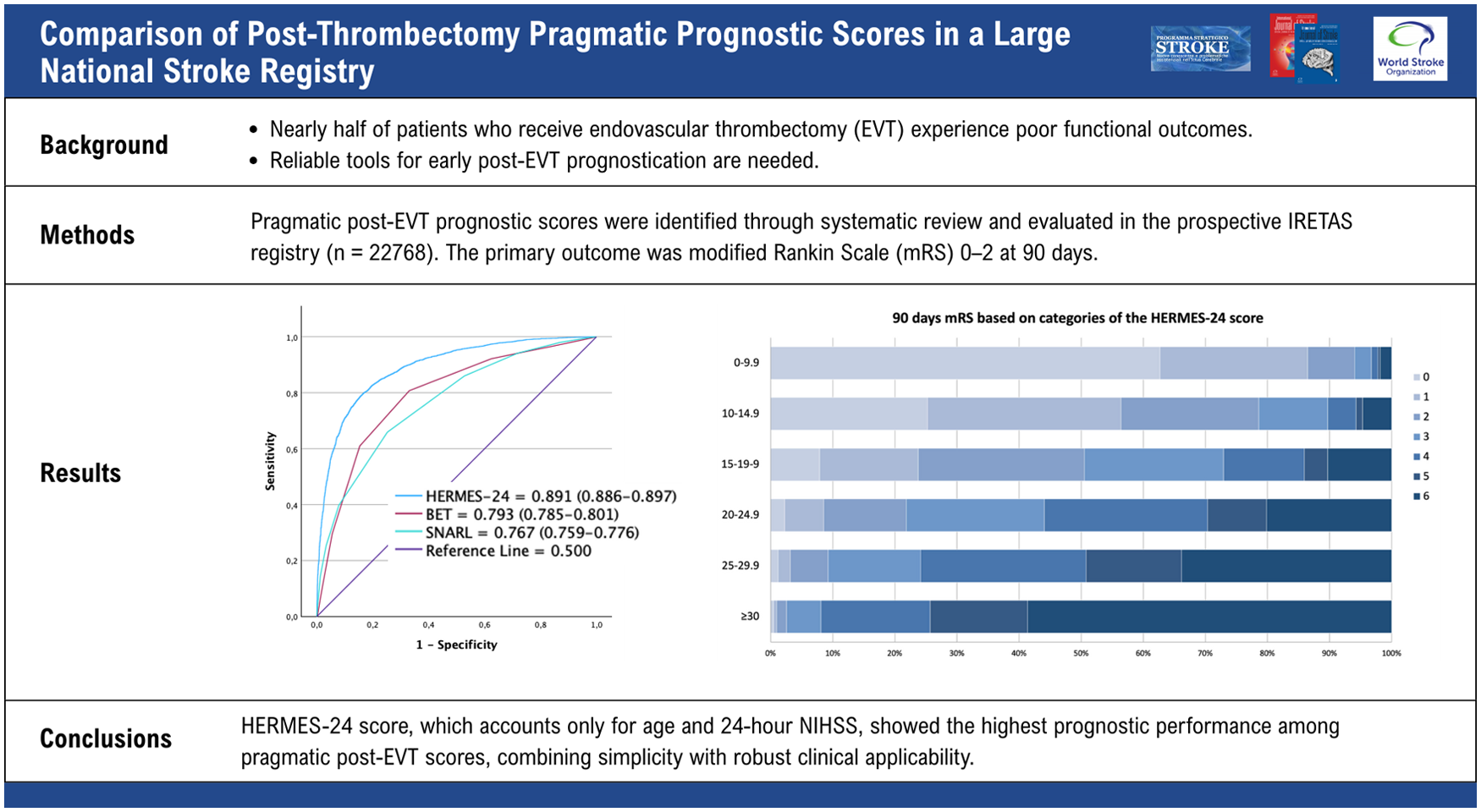
Three scores were identified: HERMES-24, BET, and SNARL. Among 22,768 patients in the registry, 18,408 (89.1%) had a measurable HERMES-24 score, 13,593 (59.7%) had a measurable BET score, and 19,007 (83.5%) had a measurable SNARL score. Median age was 75 years (IQR 65–82), and 11,528 (50.6%) were female. In the subset in which each test was measurable, HERMES-24 showed the best performance for predicting mRS ⩽ 2 (c-statistic = 0.889), followed by BET (c-statistic = 0.794) and SNARL (c-statistic = 0.762) (p < 0.001). In the subset of 12,233 patients for whom all three prognostic scores were calculable, a head-to-head comparison confirmed the superior performance of the HERMES-24 model: HERMES-24 score versus BET score (c-statistic difference = 0.098 [95% CI = 0.092–0.105]; p < 0.001) and HERMES-24 score versus SNARL score (c-statistic difference = 0.124 [95% CI = 0.116–0.132]; p < 0.001).
Conclusions:
In this large, multicenter, national cohort, the post-EVT HERMES-24 score—which accounts only for age and 24-h NIHSS—demonstrated the highest prognostic performance among existing, pragmatic post-EVT scores. Its simplicity and robust performance support its routine adoption in clinical practice.
Keywords
Get full access to this article
View all access options for this article.